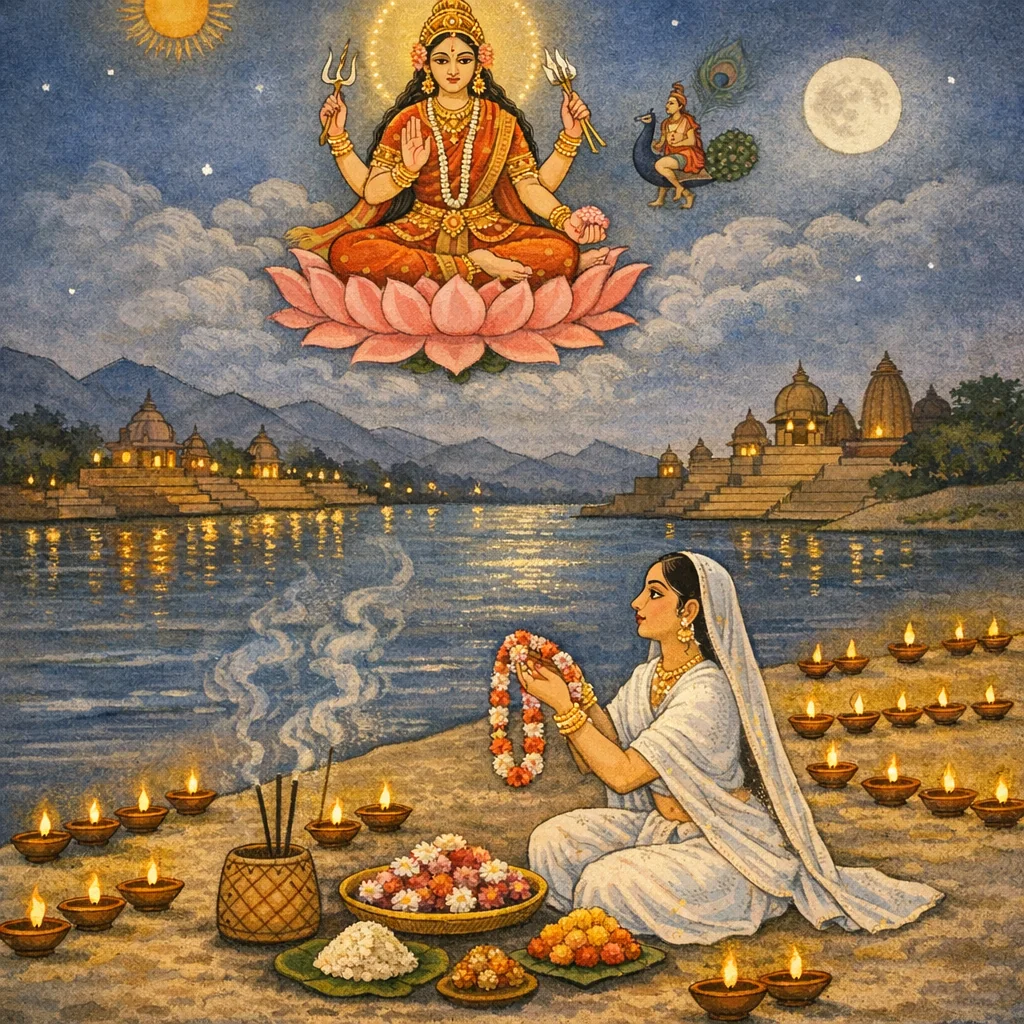
The Exposition of the Ṣaṣṭhī-vrata Observed Through the Twelve Months
Sanātana instructs Nārada on Ṣaṣṭhī vows (the sixth lunar day) as a month-by-month ritual calendar. Beginning with Caitra Śukla Ṣaṣṭhī (Kumāra-vrata) and continuing through the year, it assigns deities and fruits: worship of Ṣaṇmukha/Skanda for fulfillment of aims and virtuous progeny; in Jyeṣṭha, worship of the Sun for a mother’s happiness; in Āṣāḍha, Skanda-vrata for the continuity of lineage; in Śrāvaṇa, worship of Śarajanmā with sixteen offerings. A major section details the Bhādrapada Kṛṣṇa Ṣaṣṭhī Lalitā-vrata for women—morning bath, white dress, a sandbank at a river confluence, bamboo vessel and lump-form, prescribed flowers, counts of 108 and 28, prayers at specific tīrthas, abundant naivedya, lamps and incense, and an all-night vigil with a strict no-sleep rule—followed by gifts, feeding brāhmaṇas and maidens, and honoring married women. Later, Āśvina Śukla Ṣaṣṭhī worship of Kātyāyanī grants husband and children; other months name further Ṣaṣṭhīs (e.g., Candanā, Varuṇā) with worship of the Sun/Viṣṇu/Varuṇa/Paśupati, culminating in the promised attainment of Śiva’s world.
Shlokas
Verse 1
सनातन उवाच । श्रृणु विप्र प्रवक्ष्यामि षष्ठ्याश्चैव व्रतानि ते । यानि सम्यग्विधायात्र लभेत्सर्वान्मनोरथान् ॥ १ ॥
Sanātana said: “Listen, O brāhmaṇa; I shall declare to you the vows of the sixth lunar day (Ṣaṣṭhī). When they are duly performed here, one attains all the aims the heart desires.”
Verse 2
चैत्रमासे शुक्लषष्ठ्यां कुमारव्रतमुत्तमम् । तत्रेष्ट्वा षण्मुखं देवं नानापूजा विधानतः ॥ २ ॥
In the month of Caitra, on the sixth lunar day of the bright fortnight, one should observe the excellent vow called the Kumāra-vrata. On that day, having worshipped the six-faced Lord (Ṣaṇmukha) with diverse offerings according to the prescribed rite, the vow is fulfilled.
Verse 3
पुत्रं सर्वगुणोपेतं प्राप्नुयाच्चिरजीविनम् । वैशाखशुक्लषष्ठ्यां च पूजयित्वा च कार्तिकम् ॥ ३ ॥
By worshipping (the Lord) on the sixth lunar day of the bright fortnight of Vaiśākha, and by duly honoring the month of Kārttika, one obtains a son endowed with every virtue and blessed with long life.
Verse 4
लभते मातृजं सौख्यं नात्र कार्या विचारणा । ज्येष्ठमासे शुक्लषष्ठ्यां विधिनेष्ट्वा दिवाकरम् ॥ ४ ॥
One gains the happiness that comes through one’s mother—of this there is no need for doubt. In the month of Jyeṣṭha, by duly worshipping the Sun, Divākara, on the bright Ṣaṣṭhī, this fruit is attained.
Verse 5
लभते वांछितान्कामांस्तत्प्रसादान्न संशयः । आषाढशुक्लषष्ठ्यां वै स्कंदव्रतमनुत्तमम् ॥ ५ ॥
By his grace one surely attains the desired aims—there is no doubt of it. Indeed, on the sixth lunar day of the bright fortnight of Āṣāḍha, the unsurpassed Skanda-vrata is observed.
Verse 6
उपोष्य पूजयित्वैनं शिवोमाप्रियमात्मजम् । लभतेऽभीप्सितान्कामान्पुत्रपौत्रादिसंततीः ॥ ६ ॥
Having fasted and then worshipped this beloved son of Śiva and Umā, one attains the desired aims—including progeny such as sons, grandsons, and further descendants.
Verse 7
श्रावणे शुक्लषष्ठ्यां तु शरजन्मानमर्चयेत् । उपचारैः षोडशभिर्भक्त्या परमयान्वितः ॥ ७ ॥
On the sixth lunar day (Ṣaṣṭhī) of the bright fortnight in the month of Śrāvaṇa, one should worship Śarajanmā, the One born from the reeds, offering the sixteenfold services with supreme devotion.
Verse 8
लभतेऽभीप्सितानर्थान्षण्मुखस्य प्रसादतः । भाद्रमासे कृष्णषष्ट्यां ललिताव्रतमुच्यते ॥ ८ ॥
By the grace of Ṣaṇmukha, one obtains the desired aims. This observance is called the Lalitā-vrata, to be performed on the dark-fortnight sixth day (Kṛṣṇa-ṣaṣṭhī) in the month of Bhādrapada.
Verse 9
प्रातः स्नात्वा विधानेन नारी शुक्लाम्बरावृता । शुक्लमाल्ययधरा वापि नद्याः संगमवालुकाम् ॥ ९ ॥
After bathing in the morning according to the prescribed rite, a woman—clad in white garments and also wearing a white garland—should go to the sandy bank at the confluence of a river.
Verse 10
गृहीत्वा वंशपात्रे तु धृत्वा पिंडाकृतिं च ताम् । पञ्चधा ललितां तत्र ध्यायेद्वनविलासिनीम् ॥ १० ॥
Taking a bamboo vessel and placing within it that lump-shaped offering, one should meditate there upon the Divine Lady Lalitā, who roams in the forest, graceful in her fivefold form.
Verse 11
पङ्कजं करवीरं च नेपालीं मालतीं तथा । नीलोत्पलं केतकीं च संगृह्य तगरं तथा ॥ ११ ॥
Having gathered the lotus, karavīra (oleander), the fragrant nepālī and mālatī, as well as the blue lotus and ketakī, one should also collect tagara, the sweet-scented jasmine.
Verse 12
एकैकाष्टशतं ग्राह्यमष्टाविंशतिरेव च । अक्षताः कलिका गृह्य ताभिर्देवीं प्रपूजयेत् ॥ १२ ॥
One should take, of each, one hundred and eight, and also twenty-eight; taking akṣata (unbroken rice-grains) and flower-buds, one should duly worship the Goddess with them.
Verse 13
प्रार्थयेदग्रतः स्थित्वा देवीं तां गिरिशप्रियाम् । गंगाद्वारे कुशावर्त्ते विल्वके नीलपर्वते ॥ १३ ॥
Standing before her, one should offer prayers to that Goddess who is beloved of Girīśa (Śiva)—at Gaṅgādvāra, at Kuśāvarta, at Bilvaka, and on Nīlaparvata.
Verse 14
स्नात्वा कनखले देवि हरिं लब्धवती पतिम् । ललिते सुभगं देवि सुखसौभाग्यदायिनि ॥ १४ ॥
O Goddess, having bathed at Kanakhala, she obtained Hari as her husband—O Lalitā, O auspicious Lady, O Goddess who bestows happiness and good fortune.
Verse 15
अनंतं देहि सौभाग्ये मह्यं तुभ्यं नमोऽनमनः । मंत्रेणानेन कुसुमैश्वंपकस्य सुशोभनैः ॥ १५ ॥
O Ananta, the Infinite Lord, grant me unending auspicious fortune. To You I bow again and again. With this mantra, one should worship You with beautifully radiant campaka flowers.
Verse 16
अभ्यर्च्य विधिवत्तस्या नैवेद्यं पुरतो न्यसेत् । त्रपुषैरपि कूष्माण्डैर्नालिकेरैः सुदाडिमैः ॥ १६ ॥
Having worshipped her properly according to the prescribed rite, one should place the naivedya, the food-offering, before the Deity—even if it be cucumbers, ash-gourds, coconuts, and fine pomegranates.
Verse 17
बीजपूरैः सुतुंडीरैः कारवेल्लैः सचिर्भटैः । फलैस्तत्कालसंभूतैः कृत्वा शोभां तदग्रतः ॥ १७ ॥
With citrons (bījapūra), fine pomegranates, bitter gourds, and cucumbers—together with fruits ripened in that very season—he arranged them before the Deity, creating a splendid display.
Verse 18
विरूढधान्यांकुरकैः सुदीपावलिभिस्तथा । सार्द्धै सर्गणकैधूपः सौहालककरंजकैः ॥ १८ ॥
With sprouted grain-shoots, with rows of brightly burning lamps, and with incense prepared together with fragrant substances—such as resin (sauhālaka) and karañja—thus is the rite to be performed.
Verse 19
गुडपुष्पैः कर्णवेष्टैर्मोदकैरुपमोदकैः । बहुप्रकारैर्नैवेद्यैर्यथा विभवसारतः ॥ १९ ॥
With flower-offerings sweetened with jaggery (guḍa), with ear-shaped pastries (karṇaveṣṭa), with modakas and upamodakas, and with many kinds of naivedya, one should worship according to one’s means and resources.
Verse 20
एवमभ्यर्च्य विधिवद्रात्रौ जागरणोत्सवम् । गीतवाद्यनटैर्नृत्यैः प्रोक्षणीयैरनेकधा ॥ २० ॥
Thus, having worshipped in the proper manner, one should celebrate at night the festival of wakeful vigil (jāgaraṇa), accompanied by singing, instrumental music, performers, dances, and various ritual sprinklings for sanctification.
Verse 21
सखीभिः सहिता साध्वी तां रात्रिं प्रसभं नयेत् । न च संमीलयेन्नेत्रे नारीयामचतुष्टयम् ॥ २१ ॥
Accompanied by her female companions, the virtuous woman should pass that night in steadfast vigilance; and through the four watches of the night she should not close her eyes (that is, she should remain awake).
Verse 22
दुर्भगा दुष्कृता वंध्या नेत्रसंमीलनाद्भवेत् । एवं जागरणं कृत्वा सप्तम्यां सरितं नयेत् ॥ २२ ॥
If, during the vigil, one closes the eyes (falls asleep), she is said to become unfortunate, sinful, and barren. Therefore, having kept the night-long vigil in this manner, on the seventh lunar day (saptamī) one should proceed to the river.
Verse 23
गन्धपुष्पैस्तथाभ्यर्च्य गीतवाद्यपुरःसरैः । तच्च दद्याद्द्विजेन्द्राय नैवेद्यादि द्विजोत्तम ॥ २३ ॥
Having duly worshipped with fragrant substances and flowers, with singing and instrumental music going before, one should then present that offering—together with naivedya (food-offerings) and the like—to the chief among the twice-born, O best of Brahmins.
Verse 24
स्नात्वा गृहं समागत्य हुत्वा वैश्वानरं ततः । देवान्पितॄन्मनुष्यांश्च पूजयित्वा सुवासिनीः ॥ २४ ॥
Having bathed and returned home, one should then offer an oblation to Vaiśvānara, the sacred household fire. Thereafter, having worshipped the gods, the pitṛs (ancestors), and people, one should honour the su-vāsinīs—auspicious married women.
Verse 25
कन्यकाश्चैव संभोज्य ब्राह्मणान्दश पंच च । भक्ष्यभोज्यैर्बहुविधैर्दत्वा दानानि भूरिशः ॥ २५ ॥
One should also feed young maidens, and feed fifteen brāhmaṇas; and, with many kinds of foods—both snacks and cooked dishes—one should give abundant gifts in charity.
Verse 26
ललिता मेऽस्तु सुप्रीता इत्युक्त्वा तान्विसर्जयेत् । यः कश्चिदाचरेदेतद्व्रतं सौभाग्यदं परम् ॥ २६ ॥
Saying, “May Goddess Lalitā be greatly pleased with me,” one should then dismiss them. Whoever performs this vow—anyone at all—receives the supreme bestowal of good fortune.
Verse 27
नरो वा यदि वा नारी तस्य पुण्यफलं श्रृणु । यद्व्रतैश्च तपोभिश्च दानैर्वा नियमैरपि ॥ २७ ॥
Whether man or woman, hear the meritorious fruit that comes to such a person: the very same merit gained through vows, austerities, charity, and disciplined observances.
Verse 28
तदेतेनेह लभ्येत किं बहूक्तेन नारद । मृतेरनंतरं प्राप्य शिवलोकं सनातनम् ॥ २८ ॥
By this alone it is attained here—what need is there to say more, O Nārada? Immediately after death one reaches the eternal world of Śiva.
Verse 29
मोदते ललितादेव्या शैवे वै सखिवच्चिरम् । नभस्ये मासि या शुक्ला षष्ठी सा चंदनाह्वया ॥ २९ ॥
That bright sixth lunar day (Śukla-Ṣaṣṭhī) in the month of Nabhasya is called “Candanā.” By observing it, one rejoices long in Śiva’s realm, enjoying the companionship of Goddess Lalitā like a close friend.
Verse 30
तस्यां देवीं समभ्यर्च्य लभते तत्सलोकताम् । रोहिणी पातभौमैस्तु संयुता कपिला भवेत् ॥ ३० ॥
On that day, by duly worshipping the Goddess, one attains residence in her very world. And when Rohiṇī is conjoined with certain terrestrial conditions associated with Mars, then (the cow or offering connected with the rite) becomes “Kapilā”—the tawny, auspicious one.
Verse 31
तस्यां रविं समभ्यर्च्य व्रती नियमतत्परः । लभते वांछितान्कामान्भास्करस्य प्रसादतः ॥ ३१ ॥
On that auspicious occasion, one who keeps the vow and is devoted to discipline, worshipping Ravi (the Sun) with steadfast heart, attains the desired aims by the grace of Bhāskara, the Sun-god.
Verse 32
अन्नदानं जपो होमं पितृदेवर्षितर्पणम् । सर्वमेवाक्षयं ज्ञेयं कृतं देवर्षिसत्तम ॥ ३२ ॥
Food-giving, mantra-recitation (japa), fire-offerings (homa), and the libations (tarpana) to the ancestors, the gods, and the sages—all these, when duly performed, are to be known as imperishable in merit, O best of the devarishis.
Verse 33
कपिलां धेनुमभ्यर्च्य वस्त्रमाल्यानुलेपनैः । प्रदद्याद्वेदविदुषे द्वादशात्मप्रतुष्टये ॥ ३३ ॥
Having worshipped the tawny kapilā milch-cow with garments, garlands, and fragrant unguents, one should gift her to a knower of the Veda, for the satisfaction of the Twelvefold Self—the indwelling Divine in twelve aspects.
Verse 34
अथेषुशुक्लषष्ठ्यां तु पूज्या कात्यायनी द्विज । गंधाद्यैर्मंङ्गलद्रव्यैर्नैवेद्यैर्विविधैस्तथा ॥ ३४ ॥
Then, on Ṣaṣṭhī—the sixth lunar day of the bright fortnight of Āśvina—O twice-born one, Goddess Kātyāyanī should be worshipped with fragrances and other auspicious substances, and with various naivedya, offerings of food.
Verse 35
ततः क्षमाप्य देवेशीं प्रणिपत्य विसर्जयेत् । पूज्यात्र सैकती मूर्तिर्यद्वा द्विजसती मुदा ॥ ३५ ॥
Then, having sought forgiveness from the Goddess—the Supreme Lady—one should bow down and respectfully dismiss her, thus concluding the worship. In this rite an image made of sand is to be worshipped; or else, with joy, a virtuous brāhmaṇa woman may be honored in her stead.
Verse 36
वस्त्रालंकरणैर्भव्यैः कात्यायिन्याः प्रतुष्टये । कन्या वरं प्राप्नुयाच्च वांचितं पुत्रमंगना ॥ ३६ ॥
By offering fine garments and splendid ornaments to delight Goddess Kātyāyinī, a maiden attains a husband, and a married woman attains the son she longs for.
Verse 37
कात्यायिनीप्रसादाद्वै नात्र कार्या विचारणा । कार्तिके शुक्लषष्ठ्यां तु षण्मुखेन महात्मना ॥ ३७ ॥
Truly, by the grace of Kātyāyinī there is no need for doubt or further deliberation here. Indeed, on the bright sixth day (Śukla Ṣaṣṭhī) of Kārttika, the great-souled Ṣaṇmukha accomplished it.
Verse 38
देवसेना महाभागा लब्धा सर्वुसुरार्पिता । अतस्तस्यां सुरश्रेष्ठां देवसेनां च षण्मुखम् ॥ ३८ ॥
Thus was Devasenā—the greatly fortunate one—obtained, offered by all the gods; and therefore, from her was born the most excellent among the devas: Ṣaṇmukha (Skanda).
Verse 39
संपूज्य निखिलैरेव उपचारैर्मनोहरैः । प्राप्नुयादतुलां सिद्धिं मनोभीष्टां द्विजोत्तम ॥ ३९ ॥
Having duly worshipped (the deity) with all delightful ritual offerings, O best of the twice-born, one attains incomparable siddhi—indeed, the fulfillment of the heart’s desire.
Verse 40
अत्रैव वह्निपूजोक्तां तां च सम्पक्समाचरेत् । विविधद्रव्यहोमैश्च वह्निपूजापुरः सरम् ॥ ४० ॥
Right here itself, one should duly perform the procedure prescribed as the worship of Agni; and, with homa oblations of various substances, one should complete the entire sequence of fire-worship from beginning to end.
Verse 41
मार्गशीर्षे शक्लषष्ठ्यां निहतस्तारकासुरः । स्कंदेन सत्कृतिः प्राप्ता ब्रहमाद्यैः परिकल्पिता ॥ ४१ ॥
On the bright sixth day (Śukla-Ṣaṣṭhī) of Mārgaśīrṣa, Skanda slew the asura Tārakāsura; and Skanda received due honor, as ordained by Brahmā and the other gods.
Verse 42
ततोऽस्यां पूजयेत्स्कंदं गंधपुष्पाक्षतैः फलैः । वस्त्रैराभूषणश्चापि नैवेद्यैर्विविधैस्तथा ॥ ४२ ॥
Then, in that observance, one should worship Skanda with fragrances, flowers, akṣata (unbroken grains), and fruits; likewise with garments, ornaments, and various food-offerings (naivedya).
Verse 43
रविवारेण संयुक्ता तथा शतभिषान्विता । यदि चेत्सा समुद्दिष्टा चंपाह्वा मुनिसत्तम ॥ ४३ ॥
O best of sages, if she is described as conjoined with Sunday and also associated with Śatabhiṣā, then she is indicated by the name ‘Campā’.
Verse 44
तस्यां विश्वेश्वरो देवो द्रष्टव्यः पापनाशनः । पूजनीयो वेदनीयः स्मर्तव्यः सौख्यमिच्छता ॥ ४४ ॥
There, the Lord Viśveśvara should be beheld—the Destroyer of sins. He should be worshipped, truly known, and remembered by one who desires well-being and happiness.
Verse 45
स्नानदानादिकं चात्र सर्वमक्षय्यमुच्यते । पौषमासे शुक्लषष्ठ्यां देवो दिनपतिर्द्विज ॥ ४५ ॥
Here, all acts such as ritual bathing, charitable giving, and the like are declared to yield inexhaustible merit. O twice-born, on the bright sixth day (Śukla-Ṣaṣṭhī) of the month of Pauṣa, the deity of that day is the Lord of the Day—the Sun (Sūrya).
Verse 46
विष्णुरूपी जगत्त्राता प्रदुर्भूताः सनातनः ॥ ४६ ॥
The Eternal One manifested—He who, assuming the form of Viṣṇu, is the protector of the world.
Verse 47
स तस्मात्पूजनीयोऽस्यां द्रव्यैर्गंधपुरस्कृतैः । नैवेद्यैर्वस्त्त्रभूषाद्यैः सर्वसौख्यमभीप्सुभिः ॥ ४७ ॥
Therefore, in this observance, he should indeed be worshipped with offerings led by fragrant substances—along with food-offerings (naivedya), garments, ornaments, and the like—by those who desire complete well-being and happiness.
Verse 48
माघमासे सिता षष्ठी वरुणाह्वा स्मृता तु सा । तस्यां वरुणमभ्यर्च्येद्विष्णुरूपं सनातनम् ॥ ४८ ॥
In the month of Māgha, the bright (waxing) sixth lunar day is remembered as ‘Varuṇā’. On that day one should worship Varuṇa—who is the eternal form of Viṣṇu.
Verse 49
रक्तैर्गंधांशुकैः पुष्पैर्नैवेद्यैर्धूपदीपकैः । एवमभ्यर्च्य विधिवद्यद्यच्चाभिलषेन्नरः ॥ ४९ ॥
With red offerings, fragrant garments, flowers, food-offerings (naivedya), incense, and lamps—having thus worshipped in the prescribed manner—whatever a person may desire, that he attains.
Verse 50
तत्तच्च फलतो लब्ध्वा मोदते तत्प्रसादतः । फाल्गुने शुक्लषष्ठ्यां तु देवं पशुपतिं द्विज ॥ ५० ॥
Having obtained each and every result in accordance with that observance, one rejoices through its grace. On the bright sixth day of Phālguna, O twice-born one, (one should worship) the god Paśupati.
Verse 51
मृन्मयं विधिना कृत्त्वा पूजयेदुपचारकैः । संस्नाप्य शतरुद्रेण पृथक्पंचामृतैर्जलैः ॥ ५१ ॥
Having duly fashioned an image (or emblem) of clay according to the prescribed rite, one should worship it with the customary offerings. Then, reciting the Śatarudrīya, one should bathe it separately with the five nectars (pañcāmṛta) and with pure water.
Verse 52
गन्धैरालिप्य सुश्वेतैरक्षतैः श्वेतपुष्पकैः । बिल्वपत्रैश्च धत्तूरकुसुमैश्च फलैस्तथा ॥ ५२ ॥
Having anointed with fragrant substances, one should offer pure white akṣata (unbroken rice grains) and white flowers, along with bilva leaves, datura blossoms, and fruits as well.
Verse 53
सम्पूज्य नानानैवेद्यैर्नीराज्य विधिवत्ततः । क्षमाप्य प्रणिपत्यैनं कैलासाय विसर्जयेत् ॥ ५३ ॥
Having duly worshipped Him with various naivedya (food-offerings) and performed the nīrājya/ārati according to rule, one should seek forgiveness, bow down, and then ritually dismiss Him to return to Kailāsa.
Verse 54
एवं कृत शिवार्चस्तु नरो नार्यथवा मुने । इह भुक्त्वा वरान्भोगानन्ते शिवगतिं लभेत् ॥ ५४ ॥
O sage, whether man or woman, one who thus performs the worship of Śiva enjoys excellent pleasures in this very world, and in the end attains Śiva-gati—the supreme state associated with Śiva.
Verse 55
इति श्रीबृहन्नारदीयपुराणे पूर्वभागे बृहदुपाख्याने चतुर्थपादे द्वादशमासस्थितषष्ठीव्रतनिरूपणं नाम पञ्चदशाधिकशततमोऽध्यायः ॥ ११५ ॥
Thus ends the one-hundred-and-fifteenth chapter—titled “The exposition of the Ṣaṣṭhī-vrata observed through the twelve months”—in the earlier section of the Śrī Bṛhannāradīya Purāṇa, within the Great Narrative, in the Fourth Pada.
Frequently Asked Questions
It is the chapter’s most detailed vrata-kalpa template: it specifies eligibility/role (a woman), ritual setting (river confluence sandbank), material culture (bamboo vessel, sand/clay form, flower taxonomy, lamps, incense, seasonal fruits), numerical prescriptions (108 and 28 items), and a strict jāgaraṇa rule (no sleeping). It also ties household piety to social dharma via feeding and gifting, and culminates in phala-śruti extending to Śiva-loka.
It treats monthly Ṣaṣṭhī observances as a calendrical framework where different devatā-forms are worshipped according to time and rite: Skanda/Ṣaṇmukha dominates, while Lalitā and Kātyāyanī appear for specific aims, and Sun/Varuṇa/Viṣṇu/Paśupati are invoked in designated months. The unity is provided by dharma (proper procedure) and the shared soteriological horizon (merit and Śiva’s realm).
Upavāsa (fasting), pūjā with standard upacāras (fragrance, flowers, akṣata, lamps, incense, naivedya), optional homa/Agni sequence in some contexts, dāna (including cow-gift in an auspicious configuration), and formal conclusion steps (kṣamā-yācñā/forgiveness, namaskāra, visarjana/dismissal).