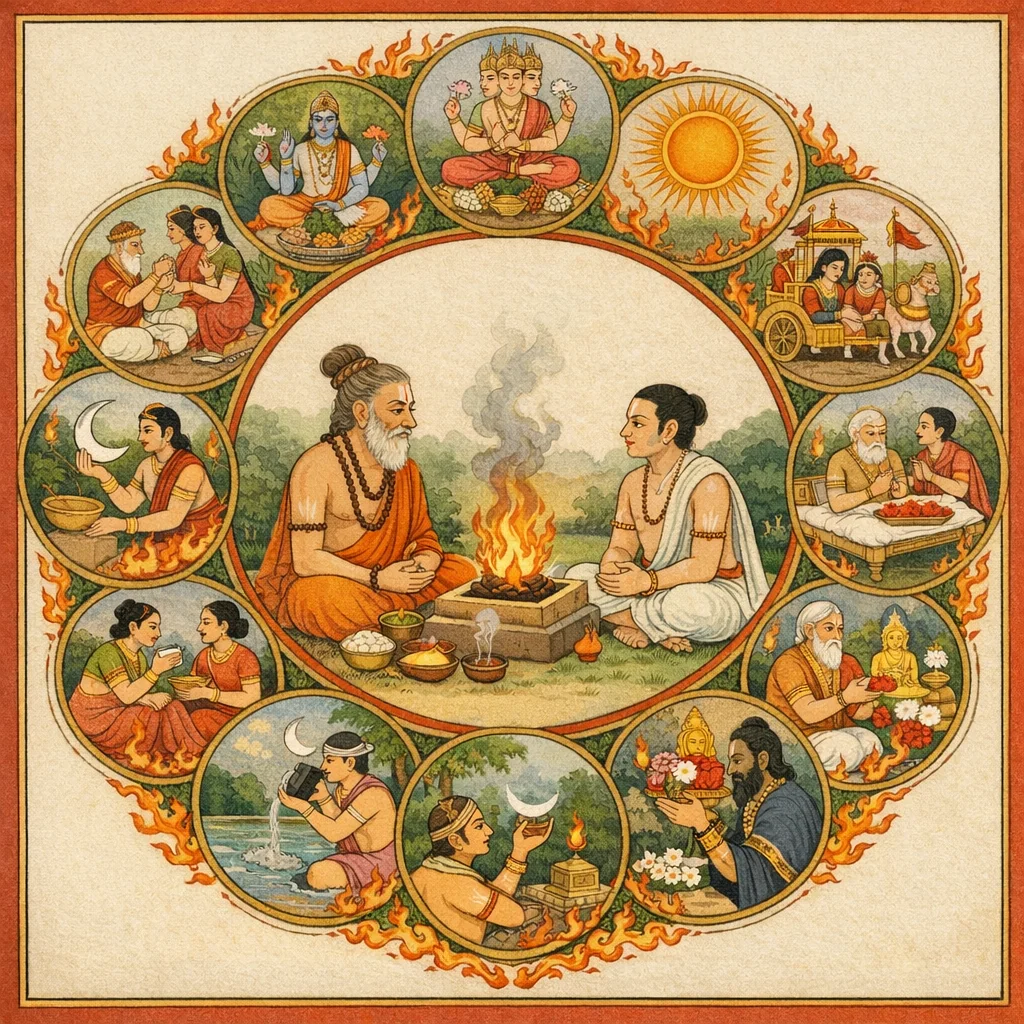
The Second Twelve-Month Vrata: Dvitīyā Observances and Their Fruits
Sanātana instructs a brāhmaṇa on the “second series” of twelve-month vows centered on Dvitīyā, the second lunar day. Beginning with Caitra’s Śukla-dvitīyā, the votary worships Brahmā with Śakti using havis and fragrances, gaining desire-fulfillment and Brahman-attainment. Month by month the rite varies: Brahmā as Viṣṇu with seven grains (Rādha); Sūrya/Bhāskara worship (Jyeṣṭha) leading to the Sun’s world; a Rāma–Subhadrā chariot festival (Āṣāḍha); Viśvakarmā/Prajāpati on “Svapitī/Aśoka-śayana” with a prayer protecting the household (Nabhas); Indra-form worship and a “half-moon offering” (Bhādrapada); emphasis on inexhaustible dāna (Āśvina); and the Yama–Yamunā “Yamā” observance honoring and feeding one’s sister (Ūrja). It also includes Pitṛ-śrāddha on Mārgaśīrṣa Dvitīyā, cow-horn sanctified bathing and crescent-moon arghya (Pauṣa), Sun/Prajāpati worship with red flowers, cows, and a golden image (Māgha), and Śiva worship with fragrant white flowers and full prostration (Phālguna). The procedures extend to Kṛṣṇa-pakṣa Dvitīyās, with Agni—assuming monthly forms—identified as the underlying Dvitīyā deity, and brahmacarya linked to ritual efficacy.
Shlokas
Verse 1
सनातन उवाच । श्रृणु विप्र प्रवक्ष्यामि द्वितीयाया व्रतानि ते । यानि कृत्वा नरो भक्त्या ब्रह्मलोके महीयते ॥ १ ॥
Sanātana said: “Listen, O brāhmaṇa; I shall teach you the vows of the second series. By performing them with devotion (bhakti), a man is honored in the world of Brahmā.”
Verse 2
चैत्रशुक्लद्वितीयायां ब्रह्मणं च सशक्तिकम् । हविष्यान्नेन गन्धाद्यैः स्तोष्य सर्वक्रतूद्भवम् ॥ २ ॥
On the Dvitiya (second lunar day) of the bright fortnight of Caitra, one should worship Brahmā together with His Śakti, praising Him as the source from whom all sacrificial rites arise, and offer haviṣyānna along with fragrances and the like.
Verse 3
फलं लब्ध्वाखिलान्कामानंते ब्रह्मपदं लभेत् । अस्मिन्नेव दिने विप्र बालेंदुमुदितं परे ॥ ३ ॥
Having obtained the fruit—fulfilling all desires—one ultimately attains the state of Brahman. O brāhmaṇa, this occurs on that very day, when the young moon rises in the exalted bright fortnight.
Verse 4
समभ्यर्च्य निशारंभे भुक्तिमुक्तिफलं भवेत् । अथवास्मिन्दिने भक्त्या दस्रावभ्यर्च्य यत्नतः ॥ ४ ॥
If one worships properly at the beginning of the night, the fruit attained is both worldly enjoyment and liberation (mokṣa). Or else, on this very day, worshipping the Dasras (the Aśvin twins) with devotion (bhakti) and diligent effort brings that same result.
Verse 5
सुवर्णरजते नेत्रे प्रदद्याच्च द्विजातये । पूर्णयात्राव्रते ह्यस्मिन्दध्ना वापि घृतेन च ॥ ५ ॥
In this Pūrṇa-yātrā vow, one should give to a twice-born (Brāhmaṇa) a pair of “eyes” fashioned of gold and silver, and also offer curd (dadhi) or ghee (ghṛta) as well.
Verse 6
नेत्रव्रतं द्वादश वत्सरान्वै कृत्या भवेद्भूमिपतिर्द्विजेंद्र । सुरूपरूपोऽरिगणप्रतापी धर्माभिरामो नृपवर्गमुख्यः ॥ ६ ॥
O best of Brahmins, by duly observing the Netravrata for twelve years, one becomes a ruler of the earth—handsome in form, mighty against hosts of enemies, delighting in dharma, and foremost among kings.
Verse 7
राधशुक्लद्वितीयायां ब्रह्मणं विष्णुरूपिणम् । समर्च्य सप्तधान्यान्याढ्यकुंभोपरि विधानतः ॥ ७ ॥
On the second lunar day (Dvitīyā) of the bright fortnight of the month Rādha, one should duly worship Brahmā in the form of Viṣṇu; and, according to rule, arrange the seven kinds of grains upon a filled and auspicious ritual pot (kumbha).
Verse 8
विष्णुलोकमवाप्नोति भुक्त्वा भोगान्मनोरमान् । ज्येष्ठशुक्लद्वितीयायां भास्करं भुवनाधिपम् ॥ ८ ॥
Having enjoyed delightful pleasures, one attains Viṣṇu’s world—this is said with regard to worship of Bhāskara, the Sun, lord of the worlds, on the second lunar day (Dvitīyā) of the bright fortnight in the month of Jyeṣṭha.
Verse 9
चतुवक्त्रस्वरूपं च समभ्यर्च्य विधानतः । भोजयित्वा द्विजान् भक्त्या भास्करं लोकमाप्नुयात् ॥ ९ ॥
Having duly worshipped, according to the prescribed rite, the four-faced form (of Brahmā), and having fed the twice-born with devotion (bhakti), one attains the world of Bhāskara, the Sun.
Verse 10
आषाढस्य सिते पक्षे द्वितीया पुण्यसंयुता । तस्यां रथं समारोप्य रामं सह सुभद्रया ॥ १० ॥
On the auspicious Dvitīyā, the second lunar day of the bright fortnight of Āṣāḍha, one should seat Rāma upon the chariot together with Subhadrā.
Verse 11
द्विजादिभिर्व्रती सार्धं परिक्रम्य पुरादिकम् । जलाशयांतिकं गत्वा कारयेच्च महोत्सवम् ॥ ११ ॥
The votary who observes the vow, together with brāhmaṇas and other devotees, should circumambulate the town and its sacred places; then, going near a reservoir of water, he should have a grand festival performed.
Verse 12
तदन्ते देवभवने निवेश्य च यथाविधि । ब्राह्मणान्भोजयेच्चैव व्रतस्यास्य प्रपूर्तये ॥ १२ ॥
At the conclusion of the observance, having duly installed (the deity/rite) in the temple as prescribed, one should also feed the brāhmaṇas, so that this vow is properly brought to completion.
Verse 13
नभः शुक्लद्वितीयायां विश्वकर्मा प्रजापतिः । स्वपितीति तिथिः पुण्या ह्यशोकशयनाह्वया ॥ १३ ॥
On the bright second lunar day (Śukla-dvitīyā) of the month Nabhas, Prajāpati Viśvakarmā is to be worshipped. This auspicious tithi is called “Svapitī,” and it is also renowned as “Aśoka-śayana.”
Verse 14
सशक्तिक तु शय्यास्थं पूजयित्वा चतुर्मुखम् । इममुच्चारयेन्मंत्रं प्रणम्य जगतां पतिम् ॥ १४ ॥
Then, having worshipped the four-faced Lord (Brahmā) as he rests upon his couch, together with his śakti, one should bow to the Lord of the worlds and recite this mantra.
Verse 15
श्रीवत्सधारिञ्छ्रीकांत श्रीवास श्रीपते प्रभो । गार्हस्थ्यं मा प्रणाशं मे यातु धर्मार्थकामद ॥ १५ ॥
O Lord who bears the Śrīvatsa mark—O beloved and radiant One, O Śrīvāsa, O consort of Śrī (Lakṣmī), O Master—may my householder life not fall into ruin; O giver of dharma, artha, and kāma, may it remain protected.
Verse 16
चंद्रार्द्धदानमत्रोक्तं सर्वसिद्धिविधायकम् । भाद्रशुक्लद्वितीयायां शक्ररूपं जगद्विधिम् ॥ १६ ॥
Here the gift known as the “half-moon offering” is taught, said to bestow all attainments. On Dvitiya, the second lunar day of the bright fortnight of Bhādrapada, one should worship the Lord who orders the world, in the form of Śakra (Indra).
Verse 17
पूजयित्वा विधानेनन सर्वक्रतुफलं लभेत् । आश्विने मासि वै पुण्या द्वितीया शुक्लपक्षगा ॥ १७ ॥
Having performed worship according to the prescribed rite, one obtains the fruit of all sacrifices. Indeed, in the month of Āśvina, the auspicious second lunar day that falls in the bright fortnight is sacred.
Verse 18
दानं प्रदत्तमेतस्यामनंतफलमुच्यते । ऊर्ज्जशुक्लद्वितीयायां यमो यमुनया पुरा ॥ १८ ॥
A gift given on this day is said to yield endless fruit. Formerly, on Dvitiya, the second lunar day of the bright fortnight of Ūrja, Yama was associated with Yamunā.
Verse 19
भोजितः स्वगृहे तेन द्वितीयैषा यमाह्वया । पुष्टिप्रवर्द्धनं चात्र भगिन्या भोजनं गृहे ॥ १९ ॥
Having been fed by him in his own house—this second observance is called Yamā. Here it is said that nourishment and prosperity increase when one feeds one’s sister at home.
Verse 20
वस्त्रालंकारपूर्वं तु तस्मै देयमतः परम् ॥ २० ॥
But first offer him garments and ornaments; thereafter, bestow whatever is to be given.
Verse 21
यस्यां तिथौ यमुनया यमराजदेवः संभोजितो निजकरात्स्वसृसौहृदेन । तस्यां स्वसुः करतलादिह यो भुनक्ति प्राप्नोति रत्नधनधान्यमनुत्तमं सः ॥ २१ ॥
On the tithi when the divine King Yama was once fed by Yamunā with sisterly affection from her own hand—whoever, on that very tithi, eats here from the palm of his sister attains unsurpassed wealth: jewels, riches, and abundant grain.
Verse 22
मार्गशुक्लद्वितीयायां श्राद्धेन पितृपूजनम् । आरोग्यं लभते चापि पुत्रपौत्रसमन्वयः ॥ २२ ॥
On Dvitīyā, the second lunar day of the bright fortnight in Mārgaśīrṣa, by performing Śrāddha as worship of the ancestors, one attains health—and also the blessing of continuity through sons and grandsons.
Verse 23
पौषशुक्लद्वितीयायां गोश्रृंगोदकमार्जनम् । सर्वकामप्रदं नॄणामास्ते बालेंदुदर्शनम् ॥ २३ ॥
On Dvitīyā, the second lunar day of the bright fortnight in Pauṣa, cleansing with water sanctified by a cow’s horn is said to grant the fulfillment of all desires; and beholding the young crescent moon is also enjoined.
Verse 24
योऽर्घ्यदानेन बालेंदुं हविष्याशी जितेंद्रियः । पूजयेत्साज्यसुमनेधर्मकामार्थसिद्धये ॥ २४ ॥
He who has mastered his senses and lives on havis (simple sacrificial food), worships the young moon by offering arghya, and honors it with flowers and ghee—attains success in dharma, kāma, and artha.
Verse 25
माघशुक्लद्वितीयायां भानुरूपं प्रजापतिम् । समभ्यर्च्य यथान्यायं पूजयेद्रक्तपुष्पकैः ॥ २५ ॥
On Dvitīyā, the second lunar day of the bright fortnight in Māgha, one should duly worship Prajāpati in the form of the Sun, and, in proper ritual order, honor Him with red flowers.
Verse 26
रक्तैर्गंवैस्तथा स्वर्णमूर्तिं निर्माय शक्तितः । ततः पूर्णं ताम्रपात्रं गाघृमैर्वापितण्डुलैः ॥ २६ ॥
With red cows given as offerings, one should, according to one’s capacity, fashion a golden image; then one should prepare a copper vessel filled either with ghee or with cooked rice-grains.
Verse 27
समर्प्य देवे भक्त्यैव स मूर्तिं प्रददेद्द्विजे । एवं कृते व्रते विप्र साक्षात्सूर्य इवोदितः ॥ २७ ॥
Having offered it to the Lord with devotion alone, he should then give that image to a brāhmaṇa. When this vow is performed in this way, O brāhmaṇa, he shines forth like the Sun himself, newly risen.
Verse 28
दुरासदो दुराधर्षो जायते भुविमानवः । इह कामान्वराम्भुक्त्वा यात्यंते ब्रह्मणः पदम् ॥ २८ ॥
A human being is born on earth as one difficult to overcome and hard to assail; having enjoyed here the excellent fulfillments of desire, he finally attains the supreme abode of Brahman.
Verse 29
सर्वदेवस्तुतोऽभीक्ष्णं विमानवरमास्थितः । अथ फाल्गुनशुक्लाया द्वितीयायां द्विजोत्तमः ॥ २९ ॥
Ever praised by all the gods, he mounted a most excellent celestial vimāna. Then, O best of the twice-born, on the second lunar day of the bright fortnight of Phālguna…
Verse 30
पुष्पैः शिवं समभ्यर्च्य सुश्वेतैश्च सुगंधिभिः । पुष्पैर्वितानकं कृत्वा पुष्पालंकरणैः शुभैः ॥ ३० ॥
Worship Śiva with flowers—especially those that are pure white and fragrant. Fashion a canopy of flowers, and adorn the place of worship with auspicious floral ornaments.
Verse 31
नैवेद्यैर्विविधैर्धूपैर्दीपर्नीराजनादिभिः । प्रसाद्य प्रणमेच्चैव साष्टांगं पतितो भुवि ॥ ३१ ॥
Having pleased (the Lord) with various food-offerings (naivedya), incense, lamps, ārati and the like, one should then bow—falling upon the earth in full eight-limbed prostration (sāṣṭāṅga).
Verse 32
एवमभ्यर्च्य देवेशं मर्त्यो व्याधिविवर्जितः । धनधान्यसमायुक्तो जीवेद्विर्षशतं ध्रुवम् ॥ ३२ ॥
Thus, having duly worshipped the Lord of the gods, a mortal becomes free from disease; endowed with wealth and grain, he surely lives for a hundred years.
Verse 33
यद्विधानं द्वितीयासु शुक्लपक्षगतासु वा । प्रोक्तं तदेव कृष्णासु कर्त्तव्यं विधिकोविदैः ॥ ३३ ॥
Whatever ritual procedure is prescribed for the second lunar day (Dvitīyā) in the bright fortnight (Śukla-pakṣa), that very same procedure should also be performed on the Dvitīyās of the dark fortnight (Kṛṣṇa-pakṣa) by those who know the rules of rite.
Verse 34
वह्निरेव पृथङ्मास्सु नानारूपवपुर्द्धरः । पूज्यते हि द्वितीयासु ब्रह्मचर्य्यादि पूर्ववत् ॥ ३४ ॥
Agni alone—assuming diverse forms and bodies in each separate month—is indeed to be worshipped on the Dvitīyā (the second lunar day), with brahmacarya and the other observances, just as described earlier.
Verse 35
इति श्रीबृहन्नारदीयपुराणे पूर्वभागे बृहदुपाख्याने चतुर्थपादे द्वादशमासद्वितीयाव्रतनिरूपणं नामैकादशाधिकशततमोऽध्यायः ॥ १११ ॥
Thus ends the one-hundred-and-eleventh chapter of the First Part of the Śrī Bṛhan-Nāradīya Purāṇa, in the Great Narrative, within the Fourth Section (Pāda), entitled “The Description of the Second Twelve-Month Vrata (vow).”
Frequently Asked Questions
The chapter frames Dvitīyā worship as a calibrated vrata: correct timing (tithi), disciplined conduct (e.g., havis, brahmacarya), prescribed offerings, and dāna generate worldly prosperity while orienting the practitioner toward higher states—culminating in Brahman-attainment—thereby expressing the Purāṇic synthesis of pravṛtti and nivṛtti.
It ritualizes the theme of vision—auspicious perception and spiritual insight—through a tangible dāna item, aligning bodily symbolism (eyes) with merit-making; the text links sustained observance to sovereignty, strength, and dharmic rulership, showing how Purāṇic vrata-kalpa ties material signs to ethical and soteriological outcomes.
It sacralizes kinship reciprocity: honoring and feeding one’s sister on the tithi associated with Yama being fed by Yamunā is said to increase nourishment and prosperity, embedding social dharma (family care, gifting, hospitality) into the month-by-month vrata framework.