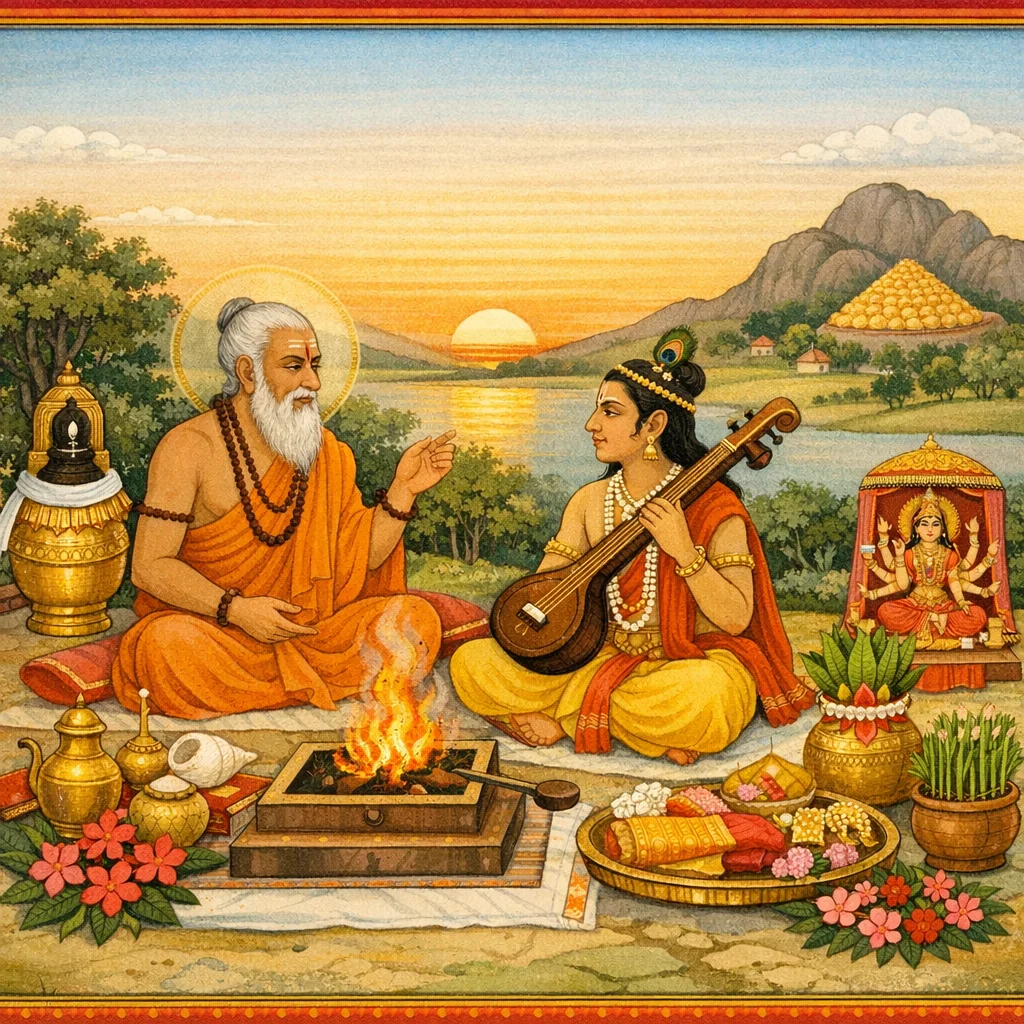
The Exposition of the Pratipadā Vrata for the Twelve Months
Nārada asks for a stepwise explanation of the tithis so vratas may be fixed without doubt. Sanātana begins the tithi-sequence with Pratipadā, declaring that right tithi-order itself bestows siddhi. Pratipadā is grounded in the dawn-creation of Caitra, and its chief rites are to be observed as pūrvaviddhā. Mahāśānti is prescribed to cleanse impurity, inauspiciousness, and Kali-age sin, with detailed worship of Brahmā (pādya/arghya, flowers, incense, garments, ornaments, naivedya), followed by homa, brāhmaṇa-satiation, and orderly worship of the deities. Dāna of cloth and gold with Oṁ and sanctified water is enjoined; completion requires dakṣiṇā, establishing a Sauri-vrata and also a Vidyā-vrata on the same tithi. A Kṛṣṇa-taught tilaka rite is introduced (karavīra flower, seven sprouted grains, fruits, a forgiveness mantra), and Bhādrapada śukla Pratipadā is said to grant Lakṣmī and buddhi, begun on Monday for 3.5 months with Kārtika fasting/worship and a vāyana gift. The chapter further outlines Śiva’s Mauna-vrata (16 offerings, a gold Śiva on a kumbha, cow-gift), Aśoka-vrata, Navarātra (ghaṭa-sthāpana, sprouts, Devī-māhātmya recitation, kumārī-pūjā), Viṣṇu’s Annakūṭa at Govardhana, Dhana-vrata in Mārgaśīrṣa kṛṣṇa-pakṣa, later Sun/Agni/Śiva rites, and Vaiśākha worship of Viṣṇu leading to sāyujya. It concludes by reaffirming brahmacarya and haviṣyānna as general rules for all Pratipadā vratas.
Shlokas
Verse 1
नारद उवाच । पुराणसूत्रमखिलं श्रुतं तव मुखाद्विभो । मरीचये यथा प्रोक्तं ब्रह्मणा परमेष्ठिना ॥ १ ॥
Nārada said: O venerable one, I have heard from your own mouth the entire Purāṇic sūtra, just as Parameṣṭhin Brahmā taught it to Marīci.
Verse 2
अधुना तु महाभाग तिथीनां वै कथानकम् । क्रमतो मह्यमाख्याहि यथा स्याद्वतनिश्चयः ॥ २ ॥
Now then, O greatly fortunate one, please narrate to me—step by step—the account of the tithis, the lunar days, so that a clear determination regarding vratas, sacred vows, may be made.
Verse 3
यस्मिन्मासे तु या पुण्या तिथिर्येन उपासिता । यद्विधानं च पूजादेस्तत्सर्वं वद सांप्रतम् ॥ ३ ॥
In whichever month the meritorious tithi (lunar day) is to be observed, and by what manner it is to be undertaken in worship—together with the proper procedure for pūjā and related rites—tell me all of that now, in full.
Verse 4
सनातन उवाच । श्रृणु नारद वक्ष्यामि तिथीनां ते व्रतं पृथक् । तिथीशानुक्रमादेव सर्वसिद्धिविधायकम् ॥ ४ ॥
Sanātana said: Listen, O Nārada; I shall explain to you, separately, the vows (vratas) associated with the lunar days (tithis). Following the tithis in their proper sequence itself becomes a means that bestows all attainments (siddhis).
Verse 5
चैत्रे मासि जगद्ब्रह्मा ससज प्रथमेऽहनि । शुक्लपक्षे समग्रं वै तदा सूर्योदये सति ॥ ५ ॥
In the month of Caitra, Jagad-Brahmā created the entire world on the very first day—during the bright fortnight (śukla-pakṣa)—at the time of sunrise.
Verse 6
वत्सरादौ वसंतादौ बलिराज्ये तथैव च । पूर्वविद्धैव कर्तव्या प्रतिपत्सर्वदा बुधैः ॥ ६ ॥
At the beginning of the year, at the beginning of spring, and likewise in the Bali-related observance/period, the wise should always perform Pratipat (the first tithi) as “pūrvaviddhā”—determined by its prior occurrence.
Verse 7
तत्र कार्या महाशांतिः सर्वकल्मषनाशिनी । सर्वोत्पातप्रशमनी कलिदुष्कृतहारिणी ॥ ७ ॥
There, the great rite of pacification (Mahāśānti) should be performed—one that destroys all impurity, appeases every ill-omen and calamity, and removes the sinful effects of the Kali age.
Verse 8
आयुः प्रदापुष्टिकरी धनसौभाग्यवर्द्धिनी । मंगल्या च पवित्रा च लोकद्वयमुखावहा ॥ ८ ॥
It grants long life and brings nourishment; it increases wealth and good fortune. It is auspicious and purifying, and it leads one to the welfare of both worlds—this world and the next.
Verse 9
तस्यामादौ तु संपूज्यो ब्रह्मा वह्निवपुर्धरः । पाद्यार्ध्यपुष्पधूपैश्च वस्त्रालंकारभोजनैः ॥ ९ ॥
In that rite, first of all, Brahmā—whose body is of the nature of fire—should be duly worshipped with foot-water (pādya) and arghya, with flowers and incense, and also with garments, ornaments, and food.
Verse 10
होमैर्बल्युपहारैश्च तथा ब्राह्मणतर्पणैः । ततः क्रमेण देवेभ्यः पूजा कार्या पृथक्पृथक् ॥ १० ॥
With fire-offerings (homa), with bali and other presentations, and likewise with tarpaṇa to honour the brāhmaṇas, then thereafter worship should be performed in due order for the deities, each separately.
Verse 11
कृत्वोंकार नमस्कारं कुशोदकतिलाक्षतैः । सवस्त्रं सहिरण्यं च ततो दद्याद्दिजातये ॥ ११ ॥
After making a reverential salutation with the syllable Oṁ, using sanctified water with kuśa grass, sesame, and unbroken rice grains (akṣata), one should then give to a twice-born (brāhmaṇa) cloth together with gold.
Verse 12
दक्षिणां वेदविदुषे व्रतसंपूर्तिहेतवे । एवं पूजाविशेषेण व्रतं स्यात्सौरिसंज्ञकम् ॥ १२ ॥
One should offer dakṣiṇā to a knower of the Veda, for the sake of completing the vow. Thus, by this specific mode of worship, the observance becomes known as the Sauri-vrata.
Verse 13
आरोग्यदं नृणां विप्र तस्मिन्नेव दिने मुने । विद्याव्रतमपि प्रोक्तमस्यामेव तिथौ मुने ॥ १३ ॥
O brāhmaṇa, this observance bestows health upon people on that very day, O sage. And the vow for attaining knowledge (Vidyā-vrata) is also enjoined on this same lunar date, O muni.
Verse 14
तिलकं नाम च प्रोक्तं कृष्णेनाजातशत्रवे । अथ ज्येष्ठे सिते पक्षे पक्षत्यां दिवसोदये ॥ १४ ॥
The rite known as “tilaka” was taught by Kṛṣṇa to Ajātaśatru; and it was (first) set forth in the bright fortnight of Jyeṣṭha, on the eighth lunar day, at sunrise.
Verse 15
देवोद्यानभवं हृद्यं करवीरं समर्चयेत् । रक्ततन्तुरीधानं गंधधूपविलेपनैः ॥ १५ ॥
One should reverently worship with the pleasing karavīra flower, grown in the gardens of the gods, together with kindling bound with red thread, and with fragrant unguents and incense for fumigation.
Verse 16
प्ररूढसप्तधान्यैश्च नारगैर्बीजपूरकैः । अभ्युक्ष्याक्षततोयेन मंत्रेणेत्थं क्षमापयेत् ॥ १६ ॥
With sprouted seven kinds of grains, with pomegranates and citrons, one should sprinkle with water containing unbroken rice-grains (akṣata); and with the mantra in this manner, one should seek forgiveness and appease the offended sacred power.
Verse 17
करवीर वृषावास नमस्ते भानुवल्लभ । दंभोलिमृडदुर्गादिदेवानां सततं प्रिय ॥ १७ ॥
O Karavīra, O Vṛṣāvāsa—salutations to you, beloved of the Sun. You are ever dear to the gods such as Indra, wielder of the thunderbolt, Śiva, Durgā, and others.
Verse 18
आकृष्णेनेति वेदोक्तमंत्रेणेत्थं क्षमापयेत् । एवं भक्त्या समभ्यर्च्य दत्त्वा विप्राय दक्षिणाम् ॥ १८ ॥
Thus one should seek forgiveness by reciting the Veda-prescribed mantra that begins with “ākṛṣṇena.” Then, having duly worshipped with bhakti, one should offer dakṣiṇā to a learned brāhmaṇa.
Verse 19
प्रदक्षिणं ततः कुर्यात्पश्चात्स्वभवनं व्रजेत् । नभः शुक्ले प्रतिपदि लक्ष्मीबुद्धिप्रदायकम् ॥ १९ ॥
Then one should perform pradakṣiṇā, and afterwards return to one’s own home. When observed on pratipad, the first lunar day of the bright fortnight in the month of Nabhas (Bhādrapada), it bestows Lakṣmī and clarity of buddhi.
Verse 20
धर्मार्थकाममोक्षाणां निदानं परमं व्रतम् । सोमवारं समारभ्य सार्धमासत्रयं द्विज ॥ २० ॥
O twice-born one, this supreme vow is the highest source of dharma, artha, kāma, and mokṣa. Begin it on a Monday and observe it for three and a half months.
Verse 21
कार्तिकासितभूतायामुपोष्यं व्रततत्परः । पूर्णायां शिवमभ्यर्च्य सुवण वंशसंयुतम् ॥ २१ ॥
On the new-moon night of Kārtika, one devoted to the vow should fast; and on the full-moon day, having worshipped Śiva, one should offer, as part of the rite, something such as a golden bamboo-staff (or golden bamboo).
Verse 22
वायनं सुमहत्पुण्यं देवताप्रीतिवर्धकम् । दद्याद्विप्राय संकल्प्य धनवृद्ध्यै मुनीश्वर ॥ २२ ॥
The offering called vāyana is exceedingly meritorious and increases the satisfaction of the deities. O lord among sages, one should give it to a brāhmaṇa, having made a solemn saṅkalpa, for the increase of wealth.
Verse 23
भाद्रशुक्लप्रतिपदि व्रतं नाम्ना महत्तमम् । व्रतं मौनाह्वयं केचित्प्राहुरत्र शिवोऽर्च्यते ॥ २३ ॥
On Pratipadā, the first lunar day of the bright fortnight of Bhādrapada, there is a vow renowned as exceedingly great. Some call it the “Mauna” (silence) vow; in this observance, Śiva is worshipped.
Verse 24
नैवेद्यं तु पचेन्मौनी षोडशत्रिगुणानि च । फलानि पिष्टपक्वानि दद्याद्विप्राय षोडश ॥ २४ ॥
Observing silence, one should cook the food-offering (naivedya) in a quantity equal to sixteen multiplied threefold; and one should give a brāhmaṇa sixteen offerings of fruit and sixteen cooked preparations made from flour.
Verse 25
देवाय षोडशान्यानि भुज्यंते षोडशात्मना । सौवर्णं शिवमभ्यर्च्य कुम्भोपरि विधानवित् ॥ २५ ॥
The knower of ritual procedure (vidhāna) should worship Śiva fashioned in gold and placed upon a consecrated pot (kumbha); then, being of the sixteenfold nature, he offers and partakes of the sixteen ritual items for the Deity.
Verse 26
तत्सर्वं धेनुसहितमाचार्य्याय प्रदापयेत् । इदं कृत्वा व्रतं विप्र देव देवस्य शूलिनः ॥ २६ ॥
He should present all of that—together with a cow—to the teacher (ācārya). Having thus performed this vow, O brāhmaṇa, one attains the grace of Śūlin, the God of gods (Śiva).
Verse 27
चतुर्दशाब्दं देहांतं भुक्तभोगः शिवं व्रजेत् । आश्विने सितपक्षत्यां कृत्वाशोकव्रतं नरः ॥ २७ ॥
A person who performs the Aśoka-vrata on the proper lunar day in the bright fortnight of Āśvina enjoys worldly pleasures for fourteen years; and at the end of the body, he attains Śiva (Śiva-loka/Śiva’s state).
Verse 28
अशोको जायते विप्रधनधान्यसमन्वितः । अशोकपूजनं तत्र कार्यं नियमतत्परैः ॥ २८ ॥
There an aśoka tree arises, endowed with Brahmins, wealth, and abundant grain. In that place, those devoted to sacred observances should perform the worship of the aśoka tree.
Verse 29
व्रतांते द्वादशे वर्षे मूर्तिं चाशोकशाखिनः । समर्प्य गुरवे भक्त्या शिवलोके महीयते ॥ २९ ॥
At the conclusion of the vow, in the twelfth year, having devotedly presented to one’s guru a mūrti associated with the aśoka tree, one is honored and glorified in Śiva’s world (Śivaloka).
Verse 30
अस्यामेव प्रतिपदि नवरात्रं समारभेत् । पूर्वाह्णे पूजयेद्देवीं घटस्थापनपूर्वकम् ॥ ३० ॥
On this very first lunar day (pratipad), one should commence the Navarātra observance. In the forenoon, one should worship the Goddess, beginning with the establishment of the ritual pot (ghaṭa-sthāpana).
Verse 31
अंकुरारोपणं कृत्वा यवैर्गोधूममिश्रितैः । ततः प्रतिदिनं कुर्यादेकभुक्तमयाचितम् ॥ ३१ ॥
Having performed the planting of sprouts using barley mixed with wheat, one should thereafter, each day, eat only once—and that food should be unasked-for, received without solicitation.
Verse 32
उपवासं यथाशक्ति पूजापाठजपादिकम् । मार्कंण्डेय पुराणोक्तं चरितत्रितयं द्विज ॥ ३२ ॥
Fast according to your capacity, and perform worship, recitation, japa, and related observances; and, O twice-born one (dvija), undertake the three sacred narratives as taught in the Mārkaṇḍeya Purāṇa.
Verse 33
पठनीयं नवदिनं भुक्तिमुक्ती अभीप्सता । कुमारीपूजनं तत्र प्रशस्तं भोजनादिभिः ॥ ३३ ॥
One who longs for both worldly enjoyment and liberation should recite this for nine days. In that observance, the worship of maidens (kumārī-pūjan) is especially praised, along with offerings such as food and the hospitality that attends it.
Verse 34
इत्थं कृत्वा व्रतं विप्र सर्वसिद्ध्यालयो नरः । जायते भुवि दुर्गायाः प्रसादान्नात्र संशयः ॥ ३४ ॥
O brāhmaṇa, by performing the vow in precisely this manner, a person becomes as it were an abode of all attainments (siddhis). On earth he becomes so by the grace of Goddess Durgā—of this there is no doubt.
Verse 35
अथोर्जसितपक्षत्यां नवरात्रोदितं चरेत् । विशेषादन्नकूटाख्यं विष्णुप्रीतिविवर्धनम् ॥ ३५ ॥
Then, in the bright fortnight of the month of Ūrja (Āśvina), one should observe the prescribed rite of the Nine Nights (Navarātri). In particular, one should perform the offering called Annakūṭa, for it greatly increases the satisfaction of Lord Viṣṇu.
Verse 36
सर्वपाकैः सर्ददोहैः सर्वैः सर्वार्थसिद्धये । कर्तव्यमन्नकूटं तु गोवर्द्धनसमर्चने ॥ ३६ ॥
For the fulfillment of all aims, one should offer the Annakūṭa—the mountain-like offering of food—during the worship of Govardhana, using every kind of cooked dish and all varieties of milk preparations.
Verse 37
सायं गोभिः सह श्रीमद्गोवर्द्धनधराधरम् । समर्च्य दक्षिणीकृत्य भुक्तिमुक्ती समाप्नुयात् ॥ ३७ ॥
In the evening, together with the cows, one should duly worship the glorious Lord—He who lifted Govardhana, the support of the earth—and, having offered the prescribed dakṣiṇā, one attains both worldly prosperity and liberation.
Verse 38
अथ मार्गसिताद्यायां धनव्रतमनुत्तमम् । नक्तं विष्ण्वर्चनं होमैः सौवर्णीं हुतभुक्तनुम् ॥ ३८ ॥
Now, on the dark lunar day in the month of Mārgaśīrṣa, one should undertake the unsurpassed Dhana-vrata: worship Viṣṇu at night, together with homa fire-offerings, presenting gold as an oblation to be received and consumed by the sacred fire.
Verse 39
रक्तवस्त्रयुगाच्छन्नां द्विजाय प्रतिपादयेत् । एवं कृत्वा धनैर्धान्यैः समृद्धो जायते भुवि ॥ ३९ ॥
He should present to a dvija (brāhmaṇa) a pair of red garments as a covering. By doing so, one becomes prosperous on earth, endowed with wealth and grain.
Verse 40
वह्निना दग्धपापस्तु विष्णुलोके महीयते । पौषशुक्लप्रतिपदि भानुमभ्यर्च्य भक्तितः ॥ ४० ॥
One whose sins are burnt away by fire is honored in Viṣṇu’s world. By devotionally worshiping Bhānu, the Sun, on the first lunar day of the bright fortnight of Pauṣa, one attains such merit.
Verse 41
एकभक्तव्रतो मर्त्यो भानुलोकमवाप्नुयात् । माघशुक्लाद्यदिवसे वह्निं साक्षान्महेश्वरम् ॥ ४१ ॥
A mortal who undertakes the Ekabhakta-vrata—taking a single meal in devotion—attains the world of the Sun. On the first day of the bright fortnight of Māgha, one should worship Fire, who is directly Maheśvara (Śiva) himself.
Verse 42
समभ्यर्च्य विधानेन समृद्धो जायते भुवि । अथ फाल्गुनशुक्लादौ देवदेवं दिगंबरम् ॥ ४२ ॥
Having duly worshiped according to the prescribed rite, one becomes prosperous on earth. Then, at the beginning of the bright fortnight of Phālguna, one should worship the God of gods, the sky-clad Lord Digambara.
Verse 43
धूलिधूसरसर्वांगं जलैरुक्षेत्समंततः । कर्मणा लौकिकेनापि संतुष्टो हि महेश्वरः ॥ ४३ ॥
One whose whole body is covered with dust should be sprinkled with water on every side. For Maheśvara (Śiva) is truly pleased even by such ordinary, worldly acts of service.
Verse 44
स्वसायुज्यं प्रदिशति भक्त्या सम्यक्समर्चितः । वैशाखे तु सिताद्यायां विष्णुं विश्वविहारिणम् ॥ ४४ ॥
When Lord Viṣṇu, the Wanderer through all worlds, is properly worshiped with devotion—especially in the bright fortnight beginning in the month of Vaiśākha—He bestows sāyujya, union in His own state.
Verse 45
समभ्यर्च्य विधानेन विप्रान्संभोजयेद्वती । एवं शुचिसिताद्यायां ब्रह्माणं जगतां गुरुम् ॥ ४५ ॥
Having duly worshiped according to the prescribed rite, the devoted woman should feed the brāhmaṇas. Thus, on a pure bright lunar day, she honors Brahmā, the teacher of the worlds.
Verse 46
विष्णुना सहितो ब्रह्मा सर्वलोकेश्वरेश्वरः । स्वसायुज्यं प्रदिशति सर्वसिद्धिमवाप्नुयात् ॥ ४६ ॥
Brahmā—accompanied by Viṣṇu, the supreme Lord over the rulers of all worlds—bestows sāyujya. By attaining it, one gains complete spiritual perfection.
Verse 47
आसु द्वादशमासानां प्रतिपत्सु द्विजोत्तम । व्रतानि तुभ्यं प्रोक्तानि भुक्तिमुक्तिप्रदानि च ॥ ४७ ॥
O best of the twice-born, I have thus described to you the vows to be observed on Pratipad, the first lunar day, in each of the twelve months—vows that bestow both worldly enjoyment and final liberation.
Verse 48
व्रतेष्वेतेषु सर्वेषु ब्रह्मचर्यं विधीयते । भोजने तु हविष्यान्नं सामान्यत उदाहृतम् ॥ ४८ ॥
In all these vows, the practice of brahmacarya (continence and purity) is enjoined; and regarding food, as a general rule, haviṣyānna—simple sacrificial fare—is recommended.
Verse 49
इति श्रीबृहन्ननारदीयपुराणे पूर्वभागे बृहदुपाख्याने चतुर्थपादे द्वादशमासप्रतिपद्व्रतनिरूपणं नाम दशोत्तरशततमोऽध्यायः ॥ ११० ॥
Thus ends, in the revered Bṛhannāradīya Purāṇa—within the Pūrva-bhāga, in the Great Narrative (Bṛhad-upākhyāna), in the Fourth Pada—the one-hundred-and-tenth chapter entitled “The exposition of the Pratipadā vow for the twelve months.”
Frequently Asked Questions
Pratipadā is presented as the starting point of the tithi-sequence, linked to cosmological beginnings (Caitra creation) and to yearly renewal. Observing the tithis in proper order is said to yield siddhi, making Pratipadā a methodological entry into month-wise vrata-kalpa.
Pūrvaviddhā indicates that the observance is determined by the tithi’s prior occurrence (typically when the relevant tithi touches the earlier qualifying period, such as sunrise), emphasizing ritual precision in tithi-nirṇaya for correct vrata performance.
It uses a layered, month-wise and purpose-wise approach: Brahmā is central in Mahāśānti; Śiva is emphasized in Mauna-vrata and Aśoka-vrata; Devī in Navarātra; Viṣṇu in Annakūṭa and Dhana-vrata; Sūrya and Agni in specific months. The unity is maintained through shared ritual grammar—pūjā, homa, dāna, and phala—rather than exclusive sectarian claims.
The chapter prescribes brahmacarya (continence) and recommends haviṣyānna (simple sacrificial fare) as a general food rule, framing these as universal niyamas that stabilize vrata efficacy across diverse month-wise rites.