The Description of the Brahmāṇḍa Purāṇa’s Table of Contents (Anukramaṇī)
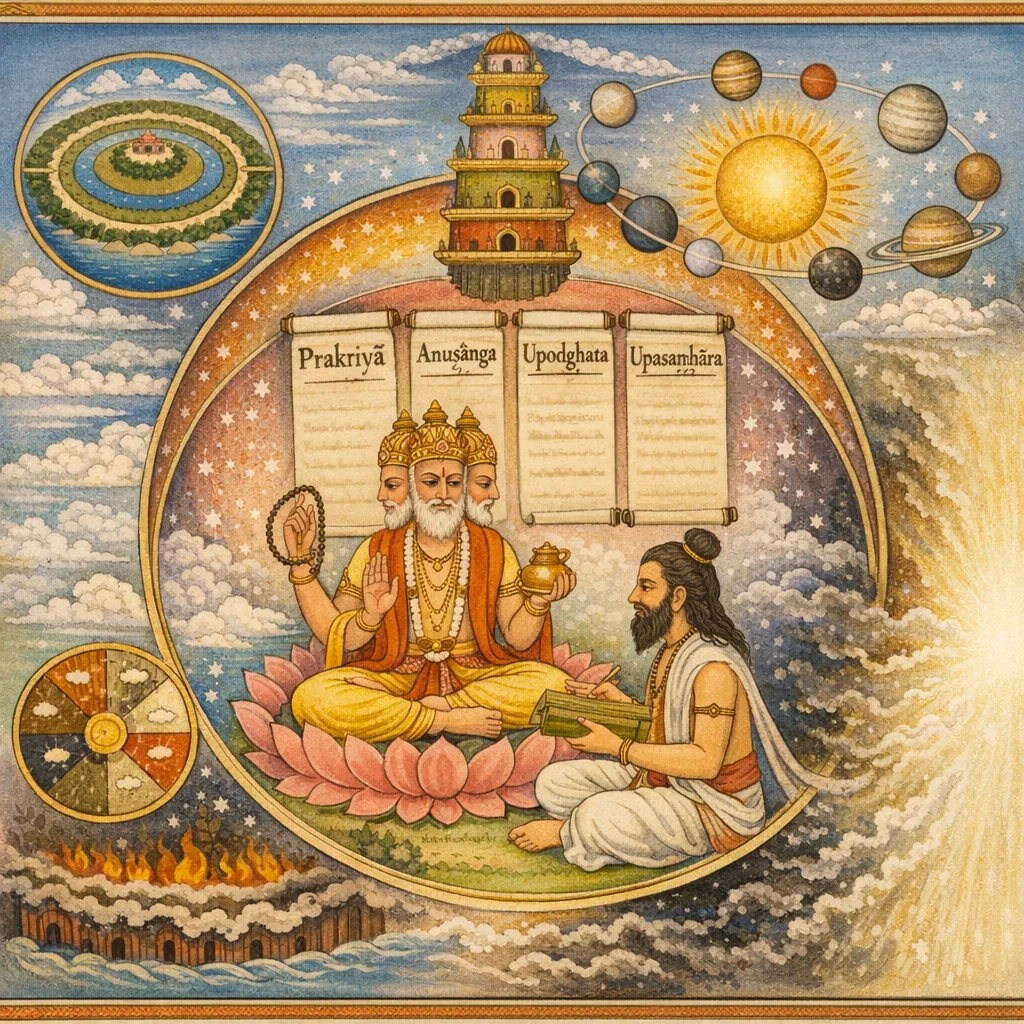
In the Pūrva-bhāga of the Bṛhannāradīya Purāṇa, Brahmā speaks to Marīci and sets forth the scope and internal divisions of the Brahmāṇḍa Purāṇa. He defines four pādas—Prakriyā, Anuṣaṅga, Upodghāta, Upasaṃhāra—arranged as former, middle, and latter sections, and then catalogs the topics: rites and duties; the Naimiṣa narrative; Hiraṇyagarbha and the formation of the world; kalpas and manvantaras; mind-born creation, Rudra’s birth, Mahādeva’s manifestations, and the creation of sages; cosmography (Bhārata, other regions, seven dvīpas, nether and higher worlds), planetary motions and the sun’s formation; yuga principles and end-of-yuga events; Vedic calamities, Manus such as Svāyambhuva, and the milking of Earth; Vaivasvata Manu and royal/ṛṣi lineages (Ikṣvāku, Atri’s line, Yayāti, Yadu, Kārtavīrya, Paraśurāma, the Vṛṣṇis, Sagara), deva–asura conflicts, Kṛṣṇa’s avatāra, hymns and Bali’s lineage; and Bhaviṣya material for the Kali age. It then treats pralayas, measures of time, the fourteen lokas, hells, Manomaya city, dissolution into Prakṛti, a note on the Śaiva Purāṇa, guṇa-based destinies, and Brahman indicated through anvaya–vyatireka. The chapter ends with the Purāṇa’s transmission lineage, the fruits of hearing/reciting/writing, and ethical rules for proper giving and teaching.
Shlokas
Verse 1
ब्रह्मोवाच । श्रृणु वत्स प्रवक्ष्यामि ब्रह्मांडाख्यं पुरातनम् । यच्च द्वादशसाहस्रमादिकल्पकथायुतम् ॥ १ ॥
Brahmā said: Listen, dear child; I shall proclaim the ancient Purāṇa called the Brahmāṇḍa, consisting of twelve thousand verses and adorned with accounts of the primordial kalpa, the first cosmic aeon.
Verse 2
प्रक्रियाख्योऽनुषंगाख्य उपोद्घातस्तृतीयकः । चतुर्थ उपसंहारः पादाश्चत्वार एव हि ॥ २ ॥
The first section is called Prakriyā (methodical exposition), the second Anuṣaṅga (connected continuation), the third Upodghāta (introductory preface), and the fourth Upasaṃhāra (concluding summary); indeed, there are exactly four pādas (quarters/sections).
Verse 3
पूर्वपादद्वयं पूर्वो भागोऽत्र समुदाहृतः । तृतीयो मध्यमो भागश्चतुर्थस्तूत्तरो मतः ॥ ३ ॥
Here, the first two quarters (pādas) are declared to constitute the former section; the third is the middle section; and the fourth is regarded as the latter section.
Verse 4
आदौ कृत्यसमुद्देशो नैमिषाख्यानकं ततः । हिरण्यगर्भोत्पत्तिश्च लोककल्पनमेव च ॥ ४ ॥
First comes a concise listing of the prescribed rites and duties; next follows the account of Naimiṣa; then the birth of Hiraṇyagarbha is described, and also the fashioning of the worlds.
Verse 5
एष वै प्रथमः पादो द्वितीयं श्रृणु मानद । कल्पमन्वन्तराख्यानं लोकज्ञानं ततः परम् ॥ ५ ॥
“This indeed is the first section; now hear the second, O noble one. Therein are the accounts of the kalpas and the manvantaras, and thereafter the higher knowledge concerning the worlds.”
Verse 6
मानसीसृष्टिकथनं रुद्रप्रसववर्णनम् । महादेवविभूतिश्च ऋषिसर्गस्ततः परम् ॥ ६ ॥
It recounts the tale of mind-born creation, describes the birth of Rudra, speaks of Mahādeva’s sacred manifestations (vibhūti), and thereafter the creation of the ṛṣis.
Verse 7
अग्नीनां विजयश्चाथ कालसद्भाववर्णनम् । प्रियव्रतान्वयोद्देशः पृथिव्यायामविस्तरः ॥ ७ ॥
Then are told the triumph of the Fires (Agni), the true nature and reality of Time (Kāla), an outline of Priyavrata’s lineage, and an expansive account of the earth’s measures and breadth.
Verse 8
वर्णनं भारतस्यास्य ततोऽन्येषां निरूपणम् । जम्ब्वादिसप्तद्वीपाख्या ततोऽधोलोकवर्णनम् ॥ ८ ॥
There is a description of this Bhārata; then an account of the other regions; then the seven dvīpas beginning with Jambūdvīpa; and thereafter a description of the lower worlds.
Verse 9
उर्द्ध्वलोकानुकथनं ग्रहचारस्ततः परम् । आदित्यव्यूहकथनं देवग्रहानुकीर्तनम् ॥ ९ ॥
Then comes the account of the higher worlds, followed by the description of the planets’ courses; thereafter, the exposition of the Sun’s cosmic formations (Āditya-vyūha) and the enumeration of the divine planets.
Verse 10
नीलकंठाह्वयाख्यानं महादेवस्य वैभवम् । अमावास्यानुकथनं युगतत्त्वनिरूपणम् ॥ १० ॥
It contains the account called “Nīlakaṇṭha,” the glory of Mahādeva, the narration concerning Amāvāsyā (the new-moon day), and an exposition of the true principles of the yugas (world-ages).
Verse 11
यज्ञप्रवर्तनं चाथ युगयोरंत्ययोः कृतिः । युगप्रजालक्षणं च ऋषिप्रवरवर्णनम् ॥ ११ ॥
It also proclaims the establishment of the sacrificial rites (yajña), the events that arise in the closing phases of the yugas, the marks of the peoples of each age, and the description of the foremost lineages of sages (ṛṣi-pravaras).
Verse 12
वेदानां व्यसनाख्यानं स्वायम्भुवनिरूपणम् । शेषमन्वंतराख्यानं पृथिवीदोहनं ततः ॥ १२ ॥
It recounts the calamities that befell the Vedas, explains the age of Svāyambhuva Manu, then narrates the remaining Manvantara accounts, and thereafter describes the milking of the Earth.
Verse 13
चाक्षुषेऽद्यतने सर्गे द्वितीयोऽङ्घ्रिः पुरोदले । अथोपोद्घातपादे तु सप्तर्षिपरिकीर्तनम् ॥ १३ ॥
In the present creation (sarga) of the Cākṣuṣa Manvantara, the second section is set forth in the opening portion; and then, in the introductory pāda (upodghāta-pāda), the Seven Sages (Saptarṣis) are recounted.
Verse 14
प्रजापत्यन्वयस्तस्माद्देवादीनां समुद्भवः । ततो जयाभिलाषश्च मरुदुत्पत्तिकीर्तनम् ॥ १४ ॥
From that account are described the Prajāpati lineage and the origin of the gods and other beings; thereafter it speaks of the longing for victory, and it recounts the birth of the Maruts.
Verse 15
काश्यपेयानुकथनं ऋषिवंशनिरूपणम् । पितृकल्पानुकथनं श्राद्धकल्पस्ततः परम् ॥ १५ ॥
Then comes the narration concerning the descendants of Kaśyapa, an account of the lineages of the sages (ṛṣis), the exposition of the rites for the Pitṛs (ancestral manes), and thereafter the procedures for Śrāddha.
Verse 16
वैवस्वतसमुत्पत्तिः सृष्टिस्तस्य ततः परम् । मनुपुत्रान्वयश्चांतो गान्धर्वस्य निरूपणम् ॥ १६ ॥
Here are set forth: the origin of Vaivasvata Manu; then the account of his creation thereafter; the lineage of Manu’s sons up to its conclusion; and an exposition of the Gandharva tradition.
Verse 17
इक्ष्वाकुवंशकथनं वंशोऽत्रेः सुमहात्मनः । अमावसोरन्वयश्च रजेश्चरितमद्भुतम् ॥ १७ ॥
Here are recounted the lineage of Ikṣvāku, the illustrious dynasty of the great-souled sage Atri, the genealogy of Amāvāsu, and the wondrous deeds of King Rajeś.
Verse 18
ययातिचरितं चाथ यदुवंशनिरूपणम् । कार्तवीर्यस्य चरितं जामदग्न्यं ततः परम् ॥ १८ ॥
Then comes the account of Yayāti, followed by the description of the Yadu dynasty; thereafter, the life of Kārtavīrya is told, and next the narrative concerning Jāmadagnya (Paraśurāma).
Verse 19
वृष्णिवंशानुकथनं सगरस्याथ संभवः । भार्गवस्यानुचरितं पितृकार्यवधाश्रयम् ॥ १९ ॥
It contains the narration of the Vr̥ṣṇi lineage, then the birth of Sagara, and the subsequent account of Bhārgava—centered on the slaying undertaken as part of fulfilling a father’s duty.
Verse 20
सगरस्याथ चरितं भार्गवस्य कथा पुनः । देवासुराहवकथा कृष्णाविर्भाववर्णनम् ॥ २० ॥
Then follows the account of Sagara, again the narrative of the Bhārgava, the story of the battles between gods and demons, and a description of Kṛṣṇa’s manifestation (incarnation).
Verse 21
इंद्रस्य तु स्तवः पुण्यः शुक्रेण परिकीर्तितः । विष्णुमाहात्म्यकथनं बलिवंशनिरूपणम् ॥ २१ ॥
Then Śukra recounts the meritorious sacred hymn in praise of Indra; and he also narrates the greatness of Viṣṇu, together with an account of Bali’s lineage.
Verse 22
भविष्यराजचरितं संप्राप्तेऽथ कलौ युगे । समुपोद्धातपादोऽयं तृतीयो मध्यमे दले ॥ २२ ॥
Now, when the Kali Yuga arrives, this section is the account of King Bhaviṣya. It is the third division—an introductory portion—placed in the middle segment.
Verse 23
चतुर्थमुपसंहारं वक्ष्ये खण्डे तथोत्तरे । वैवस्वतांतराख्यानं विस्तरेण यथातथाम् ॥ २३ ॥
Next, in the later khaṇḍa, I shall speak the fourth concluding synopsis; and I shall also narrate, in fitting detail, the account of the Vaivasvata Manvantara.
Verse 24
पूर्वमेव समुद्दिष्टं संक्षेपादिह कथ्यते । भविष्याणां मनूनां च चरितं हि ततः परम् ॥ २४ ॥
What was already indicated earlier is now stated here in brief; and thereafter, indeed, the accounts of the future Manus will be narrated.
Verse 25
कल्पप्रलयनिर्देशः कालमानं ततः परम् । लोकाश्चतुर्द्दश ततः कथिताः प्राप्तलक्षणैः ॥ २५ ॥
Thereafter comes the exposition of the kalpas and the dissolutions (pralayas); next, the full measure of time is explained. Then the fourteen worlds (lokas) are described, complete with their defining characteristics.
Verse 26
वर्णनं नरकाणां च विकर्माचरणैस्ततः । मनोमयपुराख्यानं लयः प्राकृतिकस्ततः ॥ २६ ॥
Then follows the description of the hells and the doing of forbidden deeds (vikarma); thereafter the account of the city called Manomaya; and thereafter the dissolution (laya) that pertains to Prakṛti, primordial Nature.
Verse 27
शैवस्याथ पुरस्यापि वर्णनं च ततः परम् । त्रिविधा गुणसंबंधाज्जंतूनां कीर्तिता गतिः ॥ २७ ॥
Thereafter the account of the Śaiva Purāṇa is also given; and then is described the threefold destination of beings, arising from their association with the three guṇas.
Verse 28
अनिर्देश्याप्रतर्क्यस्य ब्रह्मणः परमात्मनः । अन्वयव्यतिरेकाभ्यां वर्णनं हि ततः परम् ॥ २८ ॥
Of the Supreme Self—Brahman, the Paramātman—who is indescribable and beyond the reach of reasoning, it is then taught that the highest way to speak of Him is by anvaya and vyatireka, concomitance and exclusion.
Verse 29
इत्येष उपसंहारपादो वृत्तः सहोत्तरः । चतुष्पादं पुराणं ते ब्रह्माण्डं समुदाहृतकम् ॥ २९ ॥
Thus the concluding pāda has been related, together with its subsequent portion. In this way, the Purāṇa called Brahmāṇḍa has been declared to you as consisting of four pādas.
Verse 30
अष्टादशमनौपम्यं सारात्सारतरं द्विज । ब्रह्मांडं यच्चतुर्लक्षं पुराणं येन पठ्यते ॥ ३० ॥
O twice-born one, among the eighteen Purāṇas the Brahmāṇḍa Purāṇa is incomparable—more excellent than the very essence; it is recited as consisting of four lakhs (400,000) of ślokas.
Verse 31
तदेतदस्य गदितमत्राष्टादशधा पृथक् । पाराशर्येण मुनिना सर्वेषामपि मानद ॥ ३१ ॥
Thus, here this teaching has been set forth distinctly in eighteen divisions by the sage Pārāśarya (Vyāsa) for the welfare of all, O bestower of honor.
Verse 32
वस्तुतस्तूपदेष्ट्राथ मुनीनां भावितात्मनाम् । मत्तः श्रुत्वा पुराणानि लोकेभ्यः प्रचकाशिरे ॥ ३२ ॥
In truth, I became the instructor of sages whose selves were spiritually refined; and after hearing the Purāṇas from me, they made them widely known among the worlds.
Verse 33
मुनयो धर्मशीलास्ते दीनानुग्रहकारिणः । मयाचेदं पुराणं तु वसिष्टाय पुरोदितम् ॥ ३३ ॥
Those sages are steadfast in dharma and compassionate to the afflicted. Indeed, this Purāṇa was formerly narrated by me to Vasiṣṭha.
Verse 34
तेन शक्तिसुतायोक्तं जातूकर्ण्याय तेन च । व्यासो लब्ध्वा ततश्चैतत्प्रभंजनमुखोद्गतम् ॥ ३४ ॥
By him it was taught to Śakti’s son; and by that one again to Jātūkarṇya. Thereafter Vyāsa obtained this teaching—this very Purāṇic lore that had issued from the mouth of Prabhañjana.
Verse 35
प्रमाणीकृत्य लोकेऽस्मिन्प्रावर्तयदनुत्तमम् । य इदं कीर्तयेद्वत्स श्रृणोति च समाहितः ॥ ३५ ॥
Having established it as authoritative in this world, he set this unsurpassed teaching in motion. O dear one, whoever recites this, or listens to it with a collected mind, receives its sacred fruit.
Verse 36
स विधूयेह पापानि याति लोकमनामयम् । लिखित्वैतत्पुराणं तु स्वर्णसिंहासनस्थितम् ॥ ३६ ॥
Shaking off his sins here itself, he goes to a world free from affliction. And having written down this Purāṇa, he attains the state of being seated upon a golden throne.
Verse 37
वस्त्रेणाच्छादितं यस्तु ब्राह्मणाय प्रयच्छति । स यादि ब्रह्मणो लोकं नात्र कार्या विचारणा ॥ ३७ ॥
Whoever gives to a brāhmaṇa something covered with a garment goes to the world of Brahmā; of this there is no need for further deliberation.
Verse 38
मरीचेऽष्टादशैतानि मया प्रोक्तानि यानि ते । पुराणानि तु संक्षेपाच्छ्रोतव्यानि च विस्तरात् ॥ ३८ ॥
O Marīci, these eighteen Purāṇas that I have declared to you should indeed be heard both in brief summary and also in full detail.
Verse 39
अष्टादश पुराणानि यः श्रृणोति नरोत्तमः । कथयेद्वा विधानेन नेह भूयः स जायते ॥ ३९ ॥
That best of men who listens to the eighteen Purāṇas—or who expounds them properly according to the prescribed method—does not take birth again here in this world.
Verse 40
सूत्रमेतत्पुराणानां यन्मयोक्तं तवाधुना । तन्नित्यं शीलनीयं हि पुराणफलमिच्छता ॥ ४० ॥
This is the guiding sūtra of the Purāṇas that I have just spoken to you. Indeed, one who desires the fruit of the Purāṇas should practice it constantly.
Verse 41
न दांभिकाय पापाय देवगुर्वनुसूयवे । देयं कदापि साधूनां द्वेषिणे न शठाय च ॥ ४१ ॥
One should never bestow sacred charity or instruction upon a hypocrite, a sinner, or one hostile to the devas and to one’s guru; nor should it ever be given to a hater of the sādhus, or to a deceitful person.
Verse 42
शांताय शमचित्ताय शुश्रूषाभिरताय च । निर्मत्सराय शुचये देयं सद्वैष्णवाय च ॥ ४२ ॥
One should give to the peaceful, to one whose mind is disciplined, to one devoted to service, to one free from envy, to one who is pure—and above all, to a true Vaiṣṇava.
Verse 43
इति श्रीबृहन्नारदीयपुराणे पूर्वभागे बृहदुपाख्याने चतुर्थपादे ब्रह्माण्डपुराणानुक्रमणीनिरूपणं नाम नवोत्तरशततमोऽध्यायः ॥ १०९ ॥
Thus, in the sacred Bṛhannāradīya Purāṇa, in the Pūrva-bhāga (Former Part), within the Great Narrative (Bṛhad-upākhyāna), in the Fourth Section (Caturtha-pāda), ends the one-hundred-and-ninth chapter entitled “The Description of the Brahmāṇḍa Purāṇa’s Table of Contents (Anukramaṇī).”
Frequently Asked Questions
It functions as a canonical navigation scheme: Prakriyā and Anuṣaṅga establish foundational creation-and-time doctrines, Upodghāta frames the narrative-historical materials (Manus, dynasties, yugas), and Upasaṃhāra consolidates eschatology, pralayas, and philosophical closure.
Anvaya–vyatireka (concomitance and exclusion) is a classical interpretive method used to indicate Brahman by identifying what consistently accompanies the Real and what is negated as non-essential; its presence signals that Purāṇic cosmology culminates in discriminative metaphysics, not mere mythology.
By cataloguing an entire Purāṇa’s modules—ritual duties, cosmology, yuga theory, lineages, sectarian narratives, and liberation-oriented doctrine—it models encyclopedic indexing (anukramaṇikā), a hallmark feature of the Naradīya’s broader project of summarizing and systematizing Purāṇic knowledge.