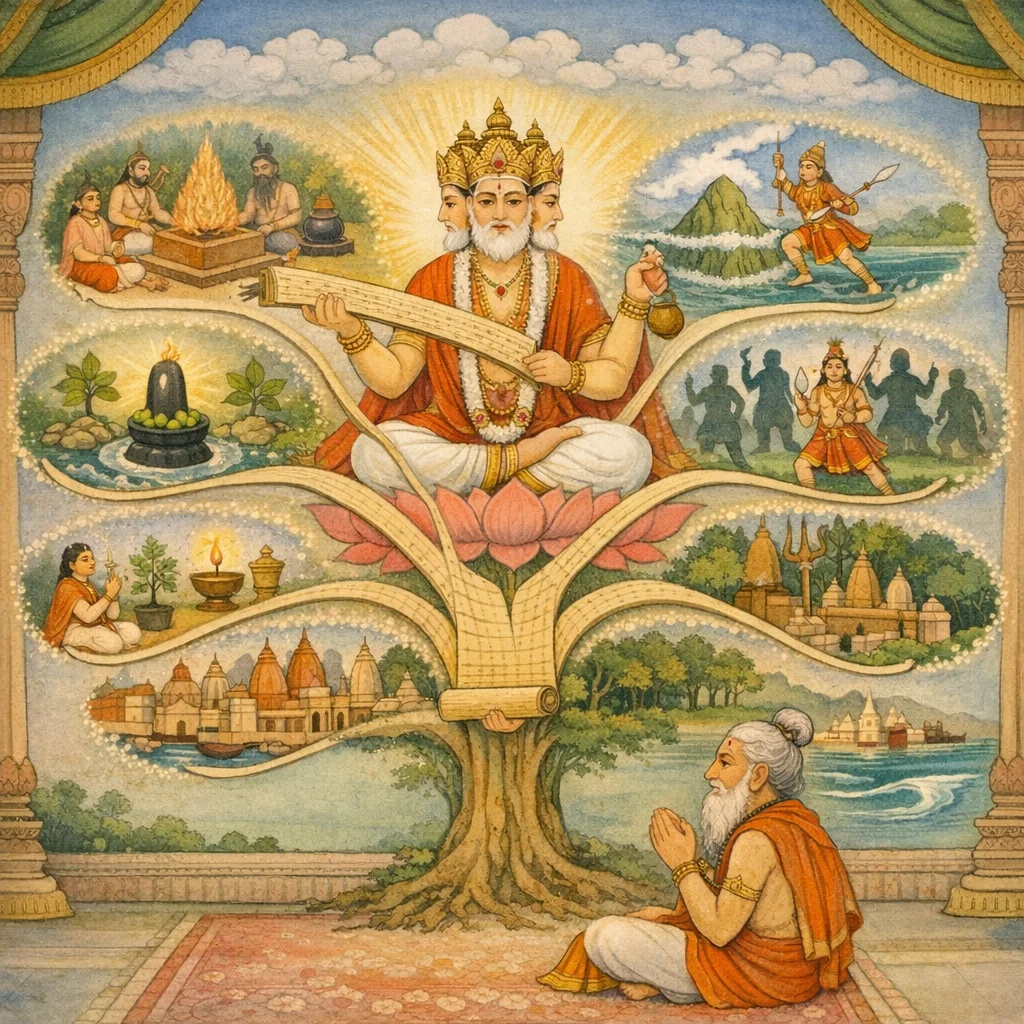
The Description of the Skanda Purāṇa’s Anukramaṇī (Index/Summary)
Brahmā instructs Marīci by presenting the anukramaṇī of the Skanda Purāṇa—its vast scope, the essence distilled by Vyāsa, and its division into seven khaṇḍas. The Māheśvara-khaṇḍa is sketched through Śiva-centered cycles (Dakṣa-yajña, liṅga worship, samudra-manthana, Skanda’s birth, Tāraka’s defeat) and cosmography. The Vaiṣṇava-khaṇḍa covers avatāra narratives, Bhakti practice, and detailed vrata-kalpa (Kārtika, Māgha, Ekādaśī, festival procedures), along with the māhātmyas of Mathurā and Ayodhyā. The Brahma-khaṇḍa treats Setu/Dharmāraṇya, varṇāśrama-dharma, charity, Cāturmāsya, mantra-yoga, and Śaiva observances such as Śivarātri and Pradoṣa. The Kāśī-khaṇḍa surveys Vārāṇasī’s sacred topography and conduct codes; the Avanti-khaṇḍa lists Ujjayinī/Mahākāla forest tīrthas and expiations; the Nāgara-khaṇḍa adds Harīścandra, Viśvāmitra, Triśaṅku and regional tīrthas; and the Prābhāsika-khaṇḍa culminates in the pilgrimage networks of Prabhāsa and Dvārakā-Gomatī. The chapter ends by praising the merit of copying and gifting this Śiva-glorifying summary.
Shlokas
Verse 1
ब्रह्मोवाच । श्रृणु वत्स प्रवक्ष्यामि पुराणं स्कन्दसंज्ञकम् । यस्मिन्प्रतिपदं साक्षान्महादेवो व्यवस्थितः ॥ १ ॥
Brahmā said: “Listen, dear child; I shall proclaim the Purāṇa known as the Skanda Purāṇa—wherein, at every step, Mahādeva (Śiva) himself is directly established as the presiding presence.”
Verse 2
पुराणे शतकोटो तु यच्छैवं वर्णितं मया । लक्षं तस्यार्थं जातस्य सारो व्यासेन कीर्तितः ॥ २ ॥
That which I have described as a Purāṇa of a hundred koṭis (verses)—its meaning, distilled into a hundred thousand (verses), is proclaimed by Vyāsa as the very essence.
Verse 3
स्कन्दाह्वयस्तत्र खण्डाः सप्तैव परिकल्पिताः । एकाशीतिसहस्रं तु स्कान्दं सर्वोघकृतंनम् ॥ ३ ॥
There, the Purāṇa known as the Skanda has been arranged into seven khaṇḍas (sections). The Skānda, consisting of eighty-one thousand verses, is revered as a work that dispels every mass of obstacles—sins and afflictions.
Verse 4
यः श्रृणोति पठेद्वापि स तु साक्षाच्छिवः स्थितः । यत्र माहेश्वरा धर्माः षण्मुखेन प्रकाशिताः ॥ ४ ॥
Whoever listens to it, or even recites it, truly abides as Śiva himself—because here the Maheśvara-dharmas, the Lord’s sacred teachings, have been revealed by Ṣaṇmukha, the Six-Faced One.
Verse 5
कल्पे तत्पुरुषे वृत्ताः सर्वसिद्धिविधायकाः । तस्य माहेश्वरश्चाथ खंडः पापप्रणाशनः ॥ ५ ॥
In the Kalpa called Tatpuruṣa are recounted narratives that bestow every attainment; and within it there is also the Māheśvara section (khaṇḍa), which destroys sins.
Verse 6
किंचिन्न्यूनार्कसाहस्रो बहुपुण्यो बृहत्कथः । सुचरित्रशतैर्युक्तः स्कन्दमाहात्म्यसूचकः ॥ ६ ॥
The great narrative (Bṛhatkathā) is slightly less than a thousand verses long, highly meritorious, furnished with hundreds of noble episodes, and it points to the greatness of Skanda.
Verse 7
यत्र केदारमाहात्म्ये पुराणोपक्रमः पुरा । दक्षयज्ञकथा पश्चाच्छिवलिंगार्चने फलम् ॥ ७ ॥
There, in the Kedāra-māhātmya, the Purāṇa begins as in ancient times; thereafter comes the account of Dakṣa’s sacrifice, and then the merit gained from worship of the Śiva-liṅga.
Verse 8
समुद्रमथनाख्यानं देवेंद्रचरितं ततः । पार्वत्याः समुपाख्यानं विवाहस्तदनंतरम् ॥ ८ ॥
Then comes the account of the Churning of the Ocean and the exploits of Indra; thereafter follows the subsidiary narrative of Pārvatī, and next her marriage.
Verse 9
कुमारोत्पत्तिकथनं ततस्तारकसंगरः । ततः पाशुपताख्यानं चंडाख्यानसमन्वितम् ॥ ९ ॥
It narrates the origin of Kumāra (Skanda); then comes the battle with Tāraka; thereafter the account of the Pāśupata (Śaiva) tradition, together with the episode of Caṇḍa.
Verse 10
द्यूतप्रवर्तनाख्यानं नारदेन समागमः । ततः कुमारमाहात्म्ये पंचतीर्थकथानकम् ॥ १० ॥
It tells of the origin and spread of gambling; then of the meeting with the sage Nārada; and thereafter, within the glorification of Sanatkumāra, the narrative of the five sacred tīrthas.
Verse 11
धर्मवर्मनृपाख्यानं नदीसागरकीर्तनम् । इंद्रद्युम्नकथा पस्चान्नाडीजंघकथान्वितम् ॥ ११ ॥
It contains the account of King Dharmavarman and the praise-filled narration of the rivers and the ocean; thereafter comes the story of Indradyumna, together with the episode of Nāḍījaṅgha.
Verse 12
प्रादुर्भावस्ततो मह्याः कथा दमनकस्य च । महीसागरसंयोगः कुमारेशकथा ततः ॥ १२ ॥
Then comes the account of the Earth’s manifestation, along with the story of Damanaka; thereafter the episode of the union of Earth and Ocean, and then the narrative of Kumāreśa.
Verse 13
ततस्तारकयुद्धं च नानाख्यानसमन्वितम् । वधश्च तारकस्याथ पंचलिंगनिवेशनम् ॥ १३ ॥
Then follows the battle with Tāraka, accompanied by many subsidiary narratives; thereafter come the slaying of Tāraka and the establishment of the five liṅgas.
Verse 14
द्वीपाख्यानं ततः पुण्यमूर्द्धलोकव्यवस्थितिः । ब्रह्मांडस्थितिमानं च वर्करेशकथानकम् ॥ १४ ॥
Then come the sacred account of the continents (dvīpas), the ordered arrangement of the higher worlds, the measure and structure of the Brahmāṇḍa (the cosmic egg, the universe), and the narrative concerning Varkareśa.
Verse 15
महाकालसमुद्भूतिः कथा चास्य महाद्भुता । वासुदेवस्य माहात्म्यं कोटितीर्थं ततः परम् ॥ १५ ॥
Then comes the account of Mahākāla’s arising, a most wondrous sacred narrative; thereafter is proclaimed the greatness of Vāsudeva, and then the supreme holy ford known as Koṭitīrtha.
Verse 16
नानातीर्थसमाख्यानं गुप्तक्षेत्रे प्रकीर्तितम् । पांडवानां कथा पुण्या महाविद्याप्रसाधनम् ॥ १६ ॥
The accounts of many tīrthas are proclaimed with reference to the sacred region called Guptakṣetra. The holy narrative of the Pāṇḍavas bestows merit and is a means to attain—and successfully cultivate—the great sacred knowledge, mahāvidyā.
Verse 17
तीर्थयात्रासमाप्तिश्च कौमारमिदमद्भुतम् । अरुणाचलमाहात्म्यं सनकब्रह्मसंकथा ॥ १७ ॥
There is also the conclusion of the pilgrimage narrative; this wondrous teaching of the Kumāra; the greatness of Arunācala; and the sacred dialogue of Sanaka and Brahmā.
Verse 18
गौरीतपः समाख्यानं तत्तत्तीर्थनिरूपणम् । माहिषासुरमाख्यानं वधश्चास्य महाद्भुतः ॥ १८ ॥
It contains the narration of Gaurī’s tapas, the delineation of the various tīrthas, the account of the asura Mahiṣāsura, and also his exceedingly wondrous slaying.
Verse 19
द्रोणाचले शिवास्थानं नित्यदापरिकीर्तितम् । इत्येष कथितः स्कांदे खंडो माहेश्वरोऽद्भुतः ॥ १९ ॥
On Droṇācala, the abode of Śiva is proclaimed as eternally renowned. Thus, within the Skanda Purāṇa, the wondrous Māheśvara-khaṇḍa has been described.
Verse 20
द्वितीयो वैष्णवः खंडस्तस्याख्यानानि मे शुणु । प्रथमं भूमिवाराहसमाख्यानं प्रकीर्तितम् ॥ २० ॥
The second section is the Vaiṣṇava-khaṇḍa; hear from me its sacred narratives. First is proclaimed the renowned account of Varāha, the Boar Incarnation who lifted up the Earth.
Verse 21
यत्र वेंकटकुध्रस्य माहात्म्यं पापनाशनम् । कमलायाः कथा पुण्या श्रीनिवासस्थितिस्ततः ॥ २१ ॥
Therein is found the sin-destroying greatness of Mount Veṅkaṭa, the holy narrative of Kamalā (Lakṣmī), and thereafter the description of Śrīnivāsa’s abode.
Verse 22
कुला लाख्यानकं चात्र सुवर्णमुखरी कथा । नानाख्यानसमायुक्ता भारद्वाजकथाद्भुता ॥ २२ ॥
Here too are found the account called “Kula-lākhyānaka,” the tale of “Suvarṇamukharī,” and the marvelous story of Bhāradvāja, enriched with many narratives.
Verse 23
मतंगांजनसंवादः कीर्तितः पापनाशनः । पुरुषोत्तममाहात्म्यं कीर्तितं चोत्कले ततः ॥ २३ ॥
The sin-destroying dialogue between Mataṅga and Aṃjana has been recounted; and thereafter, in Otkala (Odisha) as well, the greatness of Puruṣottama has been described.
Verse 24
मार्कंडेयसमाख्यानमंबरीषस्य भूपतेः । इंद्रद्युम्नस्य चाख्यानं विद्यापतिकथा शुभा ॥ २४ ॥
(Here are described) the sacred narrative of Mārkaṇḍeya, the account of King Ambarīṣa, the story of Indradyumna as well, and the auspicious tale of Vidyāpati.
Verse 25
जैमिनेः समुपाख्यानं नारदस्यापि वाडव । नीलकंठसमाख्यानं नरसिंहोपवर्णनम् ॥ २५ ॥
O Vāḍava, this section contains the subsidiary tale of Jaimini, the account of Nārada, the narrative of Nīlakaṇṭha, and a description of Narasiṃha.
Verse 26
अश्वमेधकथा राज्ञो ब्रह्मलोकगतिस्तथा । रथयाव्राविधिः पश्चाज्जन्मस्थानविधिस्तथा ॥ २६ ॥
Also described are the king’s Aśvamedha sacrifice and his attainment of the Brahma-world; then the procedure of the Rathayāvrā rite; and likewise the rules concerning the sacred birthplace (janma-sthāna).
Verse 27
दक्षिणामूर्त्युपाख्यानं गुंडिवाख्यानकं ततः । रथरक्षाविधानं च शयनोत्सवकीर्तनम् ॥ २७ ॥
Then the text recounts the sacred narrative of Dakṣiṇāmūrti, the episode known as Guṇḍivā, the prescribed procedure for protecting the chariot, and the description of the Śayana festival.
Verse 28
श्वेतोपाख्यानमत्रोक्तं पृथुत्सवनिरूपणम् । दोलोत्सवो भगवतो व्रतं सांवत्सराभिधम् ॥ २८ ॥
Here are also told the narrative of Śveta and the description of Pṛthu’s festival; likewise, the Lord’s Dolotsava (swing-festival) is taught, along with the vow known as the sāṃvatsara, the annual observance.
Verse 29
पूजा चाकामिका विष्णोरुद्दालकनियोगतः । योगसाधनमत्रोक्तं नानायोगनिरूपणम् ॥ २९ ॥
Here, too, the desireless worship of Viṣṇu is taught according to the injunctions of Uddālaka; and the means of Yoga are described, with an exposition of many kinds of Yoga.
Verse 30
दशावतारकथनं स्रानादिपरिकीर्तनम् । ततो बदरिकायाश्च माहात्म्यं पापनाशनम् ॥ ३० ॥
Then it recounts the tale of the Ten Avatāras of Śrī Viṣṇu and proclaims the merits of sacred bathing and related rites; thereafter it describes the sin-destroying greatness (māhātmya) of Badarikā (Badrinātha).
Verse 31
अग्न्यादितीर्थमाहात्म्यं वैनतेयशिलाभवम् । कारणं भगवद्वासे तीर्थं कापालमोचनम् ॥ ३१ ॥
It tells the greatness of the tīrtha beginning with Agnyādi, born from the rock associated with Vainateya (Garuḍa); this is the cause of the Bhagavān’s abiding presence there, and it is the tīrtha called “Kāpāla-mocana,” granting release from the skull-bond of sin.
Verse 32
पंचधाराभिधं तीर्थं मेरुसंस्थापनं तथा । ततः कार्तिकमाहात्म्ये माहात्म्यं मदनालसम् ॥ ३२ ॥
Next are described the tīrtha named Pañcadhārā and the establishment of Mount Meru; thereafter, in the Kārtika-māhātmya, the glory called Madanālasa is set forth.
Verse 33
धूम्रकेशसमाख्यानं दिनकृत्यानि कार्तिके । पंचभीष्मव्रताख्यानं कीर्तितं भुक्तिमुक्तिदम् ॥ ३३ ॥
Proclaimed are the account of Dhūmrakeśa, the daily observances to be performed in the month of Kārtika, and the narrative of the Pañca-Bhīṣma vow—bestowing both worldly enjoyment and liberation.
Verse 34
ततो मार्गस्य माहात्म्ये विधानं स्नानजं तथा । पुंड्रादिकीर्तनं चात्र मालाधारणपुण्यकम् ॥ ३४ ॥
Then, in describing the greatness of this sacred path, the prescribed observances are set forth, as well as the merit born of ritual bathing; here too are explained marks such as the puṇḍra (Vaiṣṇava tilaka), along with the spiritual merit of wearing a devotional mālā.
Verse 35
पंचामृतस्नानपुण्यं घंटानादादिजं फलम् । नानापुष्पार्चनफलं तुलसीदलजं फलम् ॥ ३५ ॥
The merit gained by bathing (the Deity) with pañcāmṛta, the reward born of the ringing of bells and the like, the fruit of worship with many kinds of flowers, and the fruit that arises from offering tulasī leaves—all these are obtained.
Verse 36
नैवेद्यस्य च माहात्म्यं हरिवासरकीर्तनम् । अखंडैकादशीपुण्यं तथा जागरणस्य च ॥ ३६ ॥
And (it tells) the greatness of offering food (naivedya), the glorification of Hari’s sacred day, the merit of observing the unbroken Ekādaśī vow, and also the merit of keeping vigil (jāgaraṇa).
Verse 37
यस्योत्सवविधानं च नाममाहात्म्यकीर्तनम् । ध्यानादिपुण्यकथनं माहात्म्यं मथुराभवम् ॥ ३७ ॥
It contains the prescribed procedures for festivals, the proclamation of the greatness of the sacred Names, and accounts of the merits of meditation and related practices—this is the Māhātmya that arose in Mathurā.
Verse 38
मथुरातीर्थमाहात्म्यं पृथगुक्तं ततः परम् । वनानां द्वादशानां च माहात्म्यं कीर्तितं ततः ॥ ३८ ॥
Thereafter, the greatness of the sacred tīrtha of Mathurā is described separately; and following that, the greatness of the twelve forests is also proclaimed.
Verse 39
श्रीमद्भागवतस्यात्र माहात्म्यं कीर्तितं परम् । वज्रशांडिल्यसंवाद अंतर्लीलाप्रकाशकम् ॥ ३९ ॥
Here, the supreme greatness of the Śrīmad Bhāgavata has been proclaimed—through the dialogue of Vajra and Śāṇḍilya, which illumines the Lord’s inner (confidential) divine līlā.
Verse 40
ततो माघस्य माहात्म्यं स्नानदानजपोद्भवम् । नानाख्यानसमायुक्तं दशाध्यायैर्निरूपितम् ॥ ४० ॥
Thereafter, the greatness of the month of Māgha—born of the merits of sacred bathing, charity, and japa—is set forth, together with many illustrative narratives, in ten chapters.
Verse 41
ततो वैष्णवमाहात्म्ये शय्यादानादिजं फलम् । जलदा नादिविधयः कामाख्यानमतः परम् ॥ ४१ ॥
Then, in the Vaiṣṇava Māhātmya, the fruits arising from gifts such as the donation of a bed are described; next come the rites of water-giving and related procedures, and thereafter the account known as the Kāma-ākhyāna.
Verse 42
श्रुतदेवस्य चरितं व्याधोपाख्यानमद्भुतम् । तथाक्षयतृतीयादेर्विशेषात्पुण्यकीर्तनम् ॥ ४२ ॥
The life-story of Śrutadeva and the wondrous tale of the hunter are likewise recounted as holy narratives that proclaim merit—especially the distinct merit connected with Akṣaya-tṛtīyā and related observances.
Verse 43
ततस्त्वयोध्यामाहात्म्ये चक्रब्रह्माह्वतीर्थके । सुरापापविमोक्षाख्ये तथाधारसहस्रकम् ॥ ४३ ॥
Then, in the Ayodhyā-māhātmya, there is an account of the sacred ford called Cakra-brahmāhvā, another known as “Liberation from the sin of liquor,” and likewise the section/tīrtha called Ādhāra-sahasraka, the “thousand foundations.”
Verse 44
स्वर्गद्वारं चंद्रहरिधर्महर्युपवर्णनम् । स्वर्णवृष्टेरुपाख्यानं तिलोदासरयूयुतिः ॥ ४४ ॥
It contains the account of “Svargadvāra,” the description of Candrahari and Dharmahari, the narrative of the shower of gold, and the episode connected with Tilodā together with the river Sarayū.
Verse 45
सीताकुंडं गुप्तहरिसरंयुघर्घरान्वयः । गोप्रतारं च दुग्धोदं गुरुकुंडादिपञ्चकम् ॥ ४५ ॥
Sītā-kuṇḍa; the sacred lake called Gupta-Hari-saras; the holy stream/lineage known as Yugharghara; Gopratāra and Dugdoda—together with the five tīrthas beginning with Guru-kuṇḍa—these are the pilgrimage-places to be held in remembrance.
Verse 46
सोमार्का दीनि तीर्थानि त्रयोदश ततः परम् । गयाकूपस्य माहात्म्यं सर्वाघविनिवर्तकम् ॥ ४६ ॥
Next come the thirteen sacred tīrthas beginning with Somārka; thereafter is proclaimed the greatness of the Gayā-well (Gayākūpa), which turns back all sin.
Verse 47
मांडव्याश्रमपूर्वाणि तीर्थानि तदनन्तरम् । अजितादि मानसादितीर्थानि गदितानि च ॥ ४७ ॥
Thereafter the tīrthas beginning with Māṇḍavya-āśrama were described; and then, too, tīrthas such as Ajita and those beginning with Mānasa were recounted.
Verse 48
इत्येष वैष्णवः खंडो द्वितीयः परिकीर्तितः । अतः परं ब्रह्मखंडं मरीचे श्रृणु पुण्यदम् ॥ ४८ ॥
Thus the second section, the Vaiṣṇava-khaṇḍa, has been duly proclaimed. Now, O Marīci, listen to the Brahma-khaṇḍa that follows, bestowing merit.
Verse 49
यत्र वै सेतुमाहात्म्ये फलं स्नाने क्षणोद्भवम् । गालवस्य तपश्चर्या राक्षसाख्यानकं ततः ॥ ४९ ॥
Therein is told the greatness of Setu, where the fruit of sacred bathing arises in an instant; then comes the account of Gālava’s austerities, and thereafter a narrative concerning a rākṣasa (demon).
Verse 50
चक्रतीर्थादिमाहात्म्यं देवीपत्तनसंयुते । वेतालतीर्थमहिमा पापनाशादिकीर्तनम् ॥ ५० ॥
It proclaims the greatness of Chakra-tīrtha and other sacred fords connected with Devīpattana, and it recounts the glory of Vetāla-tīrtha—how it destroys sins and bestows the related spiritual fruits.
Verse 51
मंगलादिकमाहात्म्यं ब्रह्मकुंडादिवर्णनम् । हनुमत्कुंडमहिमागस्त्यतीर्थभवं फलम् ॥ ५१ ॥
It explains the sacred greatness beginning with Maṅgalā and the rest, describes Brahma-kuṇḍa and other holy ponds, proclaims the glory of Hanumat-kuṇḍa, and states the spiritual fruits arising from the Agastya pilgrimage-site (tīrtha).
Verse 52
रामतीर्थादिकथनं लक्ष्मीतीर्थनिरूपणम् । शंखादितीर्थमहिमा तथा साध्यामृतादिजः ॥ ५२ ॥
It recounts Rāma-tīrtha and other sacred fords, sets forth Lakṣmī-tīrtha, proclaims the greatness of Śaṅkha and other tīrthas, and likewise relates the account beginning with Sādhya-amṛta and the rest.
Verse 53
धनुष्कोट्यादिमाहात्म्यं क्षीरकुंडादिजं तथा । गायत्र्यादिकतीर्थानां माहात्म्यं चात्र कीर्तितम् ॥ ५३ ॥
Here the sacred glory of places beginning with Dhanuṣkoṭi, likewise that of sites beginning with Kṣīrakuṇḍa, and also the greatness of pilgrimage-places beginning with (the Tīrtha of) Gāyatrī, has been described.
Verse 54
रामनाथस्य महिमा तत्त्वज्ञानोपदेशनम् । यात्राविधानकथनं सेतै मुक्तिप्रदं नृणाम् ॥ ५४ ॥
It describes the glory of Rāmanātha, the instruction in true knowledge (tattva-jñāna), and the rules of pilgrimage—how the sacred Setu grants liberation (mokṣa) to human beings.
Verse 55
धर्मारण्यस्य माहात्म्यं ततः परमुदीरितम् । स्थाणुः स्कन्दाय भगवान्यत्र तत्त्वमुपादिशत् ॥ ५५ ॥
Thereafter is proclaimed the supreme glory of Dharmāraṇya—the holy place where Bhagavān Sthāṇu (Śiva) instructed Skanda in the highest truth.
Verse 56
धर्मारण्यसुसंभूतिस्तत्पुण्यपरिकीर्त्तनम् । कर्म्मसिद्धेः समाख्यानं ऋषिवंशनिरूपणम् ॥ ५६ ॥
It also tells of the auspicious origin connected with Dharmāraṇya, proclaims the merit of that sacred place, narrates the attainment of success in rites (karma-siddhi), and sets forth the lineages of the sages (ṛṣi).
Verse 57
अप्सरस्तीर्थमुख्यानां माहात्म्यं यत्र कीर्तितम् । वर्णानामाश्रमाणां च धर्मतत्त्वनिरूपणम् ॥ ५७ ॥
Therein is praised the greatness of the foremost tīrthas, beginning with Apsarastīrtha; and there too is set forth the true principle of Dharma as it pertains to the varṇas and the āśramas.
Verse 58
दिवः स्थानविभागश्च बकुलार्ककथा शुभा । छत्रानन्दा तथा शांता श्रीमाता च मतंगिनी ॥ ५८ ॥
Also described are the divisions of the celestial realms; the auspicious account of Bakula and Arka; and the narratives of Chatrānandā, Śāntā, Śrīmātā, and Mataṅginī.
Verse 59
पुण्यदा च समाख्याता यत्र देव्यः समास्थिताः । इन्द्रेश्वरादिमाहात्म्यं द्वारकादिनिरूपणम् ॥ ५९ ॥
It is also called Puṇyadā, where the Devīs abide. There is described the sacred greatness of Indreśvara and other holy sites, along with an account of Dvārakā and the related tīrthas.
Verse 60
लोहासुरसमाख्यानं गंगाकूपनिरूपणम् । श्रीरामचरितं चैव सत्यमंदिरवर्णनम् ॥ ६० ॥
It contains the tale of the asura Loha, an account of the Ganga-well, the sacred life-story of Śrī Rāma, and also a description of the Temple of Truth (Satya-mandira).
Verse 61
जीर्णोद्धा रस्य कथनमासनप्रतिपादनम् । जातिभेदप्रकथनं स्मृतिधर्मनिरूपणम् ॥ ६१ ॥
It describes the restoration of what has fallen into disrepair, lays down rules for seats and postures (āsana), explains distinctions of social classes, and expounds dharma as taught in the Smṛtis.
Verse 62
ततस्तु वैष्णवा धर्मा नानाख्यानैरुदीरिताः । चातुर्मास्ये ततः पुण्ये सर्वधर्मनिरूपणम् ॥ ६२ ॥
Thereafter, Vaiṣṇava dharma is proclaimed through many narratives; and then, in the meritorious Cāturmāsya observance, all dharmas are expounded in an orderly way.
Verse 63
दानप्रशंसा तत्पश्चाद्व्रतस्य महिमा ततः । तपश्चैव पूजायाः सच्छिद्रकथनं ततः ॥ ६३ ॥
Thereafter comes the praise of charity (dāna); then the greatness of religious vows (vrata); then austerity (tapas); and thereafter an account of worship (pūjā), together with an explanation of the faults and lapses that can occur in it.
Verse 64
तद्वृत्तीनां भिदाख्यानं शालग्रामनिरूपणम् । भारकस्य वधोपायो वृक्षाचामहिमा तथा ॥ ६४ ॥
It also contains an account of the distinctions among those narratives, a description of the Śālagrāma—the sacred Viṣṇu-stone, the method for the slaying of Bhāraka, and likewise the greatness of the rite of ācamana, the purifying sipping of water.
Verse 65
विष्णोः शापश्च वृक्षत्वं पार्वत्यनुतपस्ततः । हरस्य तांडवं नृत्यं रामनामनिरूपणम् ॥ ६५ ॥
Also described are: Viṣṇu’s curse and the consequent becoming a tree; thereafter Pārvatī’s austerity; Hara’s Tāṇḍava dance; and an exposition of the holy Name of Rāma.
Verse 66
हरस्य लिंगपतनं कथा बैजवनस्य च । पार्वतीजन्मचरितं तारकस्य वधोऽद्भुतः ॥ ६६ ॥
It narrates the account of Hara’s falling liṅga, the story of Baijavana, the life-story of Pārvatī’s birth, and the wondrous slaying of Tāraka.
Verse 67
प्रणवैश्वर्यकथनं तारकाचरितं पुनः । दक्षयज्ञसमाप्तिश्च द्वादशाक्षरभूषणम् ॥ ६७ ॥
It also recounts the glory and supremacy of Praṇava (Oṁ), again narrates the episode of Tāraka, describes the completion of Dakṣa’s sacrifice, and extols the Twelve-Syllabled Mantra as an ornament of devotion.
Verse 68
ज्ञानयोगसमाख्यानं महिमा द्वादशाक्षरेः । श्रवणादिकपुण्यं च कीर्तितं शर्मदं नृणाम् ॥ ६८ ॥
The exposition of the Yoga of Knowledge, the greatness of the twelve-syllabled mantra, and the merit arising from practices beginning with hearing have been described—bestowing peace and well-being upon human beings.
Verse 69
ततो ब्राह्मोत्तरे भागे शिवस्य महिमाद्भुतः । पंचाक्षरस्य महिमा गोकर्णमहिमा ततः ॥ ६९ ॥
Then, in the later portion of the Brāhma section, the wondrous glory of Śiva is described—along with the greatness of the five-syllabled mantra; and after that, the sacred greatness of Gokarṇa.
Verse 70
शिवरात्रैश्च महिमा प्रदोषव्रतकीर्तनम् । सोमवारव्रतं चापि सीमंतिन्याः कथानकम् ॥ ७० ॥
Also described are the greatness of the Śivarātri observances, the recitation of the Pradoṣa vow, the Monday vow as well, and the story of the woman named Sīmaṃtinī.
Verse 71
भद्रायुत्पत्तिकथनं सदाचारनिरूपणम् । शिववर्मसमुद्देशो भद्रायूद्वाहवर्णनम् ॥ ७१ ॥
It recounts Bhadrāyu’s origin, sets forth the standards of good conduct (sadācāra), mentions Śivavarman, and describes Bhadrāyu’s marriage.
Verse 72
भद्रायुमहिमा चापि भस्ममाहात्म्यकीर्तनम् । शबराख्यानकं चैव उमामाहेश्वरं व्रतम् ॥ ७२ ॥
Also described are the glory of Bhadrāyu, the narration of the greatness of bhasma (sacred ash), the account known as the Śabara episode, and the vow called the Umā–Māheśvara Vrata.
Verse 73
रुद्राक्षस्य च माहात्म्यं रुद्राध्यायस्य पुण्यकम् । श्रवणादिकपुण्यं च ब्रह्मखंडोऽयमीरितः ॥ ७३ ॥
Here this Brahma-khaṇḍa is set forth: the greatness of the Rudrākṣa, the meritorious power of the Rudrādhyāya, and the spiritual merit gained through hearing and related practices.
Verse 74
अतः परं चतुर्थँ तु काशीखंडमनुत्तमम् । विंध्यनारदयोर्यत्र संवादः परिकीर्तितः ॥ ७४ ॥
Next comes the fourth section, the unsurpassed Kāśī-khaṇḍa, in which the dialogue between Vindhya and Nārada is recounted.
Verse 75
सत्यलोकप्रभावश्चागस्त्यावासे सुरागमः । पतिव्रताचरित्रं च तीर्थयात्रा प्रशंसनम् ॥ ७५ ॥
Also described are the greatness of Satyaloka, the coming of the gods to Agastya’s hermitage, the exemplary conduct of the devoted wife (pativratā), and the praise of pilgrimage to the sacred bathing-places (tīrthayātrā).
Verse 76
ततश्च सप्तपुर्याख्या संयमिन्या निरूपणम् । बुधस्य च तथेंद्राग्न्योर्लोकाप्तिः शिवशर्मणः ॥ ७६ ॥
Then comes the account of the famed ‘seven sacred cities’ (saptapurī), along with a description of Saṃyaminī; and also the narrative of Budha, and how Śivaśarman attained the worlds of Indra and Agni.
Verse 77
अग्नेः समुद्भवश्चैव क्रव्याद्वरुणसंभवः । गंधवत्यलकापुर्योरीश्वर्याश्च समुद्भवः ॥ ७७ ॥
One form is born from Agni (fire) alone; the flesh-eating fire (kravyāda) is born of Varuṇa. From Gandhavatī and from the city of Alakā also arises aiśvarya—sovereignty and splendor.
Verse 78
चंद्रार्कबुधलोकानां कुजेज्यार्कभुवां क्रमात् । मम विष्णोर्ध्रुवस्यापि तपोलोकस्य वर्णनम् ॥ ७८ ॥
In due order, I have described the realms of the Moon, the Sun, and Budha (Mercury), as well as those of Kuja (Mars), Bṛhaspati (Jupiter), and Śukra (Venus); and I have also spoken of my own realm, of Viṣṇu’s, of Dhruva’s, and of Tapoloka.
Verse 79
ध्रुवलोककथा पुण्या सत्यलोकनिरीक्षणम् । स्कंदागस्त्यसमालापो मणिकर्णीसमुद्भवः ॥ ७९ ॥
The sacred account of Dhruva’s world; the vision of Satyaloka; the dialogue between Skanda and Agastya; and the origin (manifestation) of Maṇikarṇī—these are the topics described.
Verse 80
प्रभावश्चापि गंगाया गंगानामसहस्रकम् । वाराणसीप्रशंसा च भैरवाविर्भवस्ततः ॥ ८० ॥
Also described are the glory of the Gaṅgā, the “Thousand Names of Gaṅgā,” the praise of Vārāṇasī, and then the manifestation of Bhairava.
Verse 81
दंडपाणिज्ञानवाप्योरुद्भवः समनंतरम् । ततः कलावत्याख्यानं सदाचारनिरूपणम् ॥ ८१ ॥
Immediately thereafter comes the account of the origin of Daṇḍapāṇi and the Jñāna-vāpī (the “well of knowledge”). Then follows the narrative of Kalāvatī, along with an exposition on proper conduct (sadācāra).
Verse 82
ब्रह्मचारिसमाख्यानं ततः स्त्रीलक्षणानि च । कृत्याकृत्यविनिर्देशो ह्यविमुक्तेशवर्णनम् ॥ ८२ ॥
Then come the account of the brahmacārin (the celibate student), the characteristics of women, the clear instruction on what should and should not be done, and the description of Avimukteśa (the Lord of Avimukta).
Verse 83
गृहस्थयोगिनो धर्माः कालज्ञानं ततः परम् । दिवोदासकथा पुण्या काशिकावर्णनं ततः ॥ ८३ ॥
Next are described the duties of the householder-yogin; thereafter, the higher teaching of the knowledge of time. Then comes the meritorious narrative of Divodāsa, and after that, the description of Kāśikā (Vārāṇasī).
Verse 84
मायागणपतेश्चाथ भुवि प्रादुर्भवस्ततः । विष्णुमायाप्रपंचोऽथ दिवोदासविमोक्षणम् ॥ ८४ ॥
Then the text describes the manifestation on earth of Māyā-Gaṇapati; thereafter, the expansive play of Viṣṇu’s māyā; and then the account of Divodāsa’s deliverance.
Verse 85
ततः पंचनदोत्पर्त्तिर्बिंदुमाधवसंभवः । ततो वैष्णवतीर्थाख्या शूलिनः काशिकागमः ॥ ८५ ॥
Then is told the origin of Pañcanada and the manifestation of Bindumādhava; thereafter comes the section called the Vaiṣṇava Tīrtha, and also Śūlin’s (Śiva’s) coming to Kāśī.
Verse 86
जैगीषव्येन संवादो ज्येष्ठेशाख्या महेशितुः । क्षेत्राख्यानं कंदुकेशः व्याघ्रेश्वरसमुद्भवः ॥ ८६ ॥
There is an account of a dialogue with Jaigīṣavya; of Lord Maheśa known as Jyeṣṭheśa; and a sacred-site narrative of Kaṃḍukeśa, arising in connection with Vyāghreśvara.
Verse 87
शैलेशरत्नेश्वरयोः कृत्तिवासस्य चोद्भवः । देवतानामधिष्टानं दुर्गासुरपराक्रमः ॥ ८७ ॥
The origin of Śaileśa and Ratneśvara is told, and also that of Kṛttivāsa; the sacred seat (adhiṣṭhāna) of the gods; and the heroic exploits in Durgā’s battle with the Asura.
Verse 88
दुर्गाया विजयश्चाथ ॐकारेशस्य वर्णनम् । पुनरोंकार माहात्म्य त्रिलोचोनसमुद्भवः ॥ ८८ ॥
Then comes the account of Durgā’s victory and the description of Oṁkāreśa; again, the greatness of the sacred syllable Oṁ, and the manifestation of the Three-Eyed Lord (Trilocana, Śiva).
Verse 89
केदाराख्या च धर्मेश कथा विष्णुभुजोद्भवा । वीरेश्वरसमाख्यानं गंगामाहात्म्यकीर्तनम् ॥ ८९ ॥
There are also the sections on Kedāra; the account of Dharmeśa, born from Viṣṇu’s arm; the narrative of Vīreśvara; and the proclamation of the Gaṅgā’s greatness (māhātmya).
Verse 90
विश्वकर्मेशमहिमा दक्षयज्ञोद्भवस्तथा । सतीशस्यामृतेशादेर्भुजस्तंभः पराशरे ॥ ९० ॥
O Parāśara, it also recounts the greatness of the Lord of Viśvakarmā, the episode born of Dakṣa’s sacrifice, and the stiffening and paralysis of the arm of Satī’s Lord, of Amṛteśa, and of others.
Verse 91
क्षेत्रतीर्थकदंबश्च मुक्तिमडपसंकथा । विश्वेशविभवश्चाथ ततो यात्रापरिक्रमः ॥ ९१ ॥
Then come: a cluster of sacred kṣetras and tīrthas; the account of the Pavilion of Liberation; the glory of Viśveśa, Lord of the Universe; and thereafter the prescribed pilgrimage circuit (yātrā-parikrama).
Verse 92
अतः परं त्ववंत्याख्यं श्रृणु खंड च पंचमम् । महाकालवनाख्यानं ब्रह्मशीर्षच्छिदा ततः ॥ ९२ ॥
Now, further, listen to the fifth section called “Avanti”. Thereafter comes the account of the Mahākāla forest, and then the narrative of the cutting off of Brahmā’s head.
Verse 93
प्रायश्चित्तविधिश्चाग्नेरुत्पत्तिश्च सुरागमः । देवदीक्षा शिवस्तोत्रं नानापातकनाशनम् ॥ ९३ ॥
It also teaches the procedures of expiation (prāyaścitta), the origin of the sacred fire, and the divine tradition (Āgama); rites of consecration (dīkṣā) for worship, hymns to Śiva, and methods that destroy various sins.
Verse 94
कपोलमोचनाख्यानं महाकालवनस्थितिः । तीर्थं कनखलेशस्य सर्वपापप्रणाशनम् ॥ ९४ ॥
The account of Kapolamocana, situated in the Mahākāla forest—this sacred tīrtha of Kanakhaleśa destroys all sins.
Verse 95
कुंडमप्सरसंज्ञं च सरो रुद्रस्य पुण्यदम् । कुडवेशं च विद्याध्रं मर्कटेश्वरतीर्थकम् ॥ ९५ ॥
Also there is a pond called “Apsaras,” and Rudra’s sacred lake that bestows merit; likewise the holy places Kuḍaveśa and Vidyādhra, and the pilgrimage tīrtha of Markaṭeśvara.
Verse 96
स्वर्गद्वारचतुःसिंधुतीर्थं शंकरवापिका । शंकराक गन्धवतीतीर्थं पापप्रणाशनम् ॥ ९६ ॥
There are the sacred ford called Svargadvāra, the holy place named Catuḥsiṃdhu, the sacred pool Śaṅkaravāpikā, and the tīrtha known as Śaṅkarāka-Gandhavatī—all of these are destroyers of sin.
Verse 97
दशाश्वमेधिकानंशतीर्थे च हरिसिद्धिदम् । पिशाचकादियात्रा च हनुमत्कवचेश्वरौ ॥ ९७ ॥
It also speaks of the Daśāśvamedhikā sacred place, the Śatīrtha, and the site that grants siddhi—success in bhakti to Hari; also the pilgrimage observance concerning Piśācas and the like, and the accounts of Hanumat, the Kavaca (protective hymn), and Īśvara.
Verse 98
महाकालेशयात्रा च वल्मीकेश्वरतीर्थकम् । शुक्रे च पञ्चमे चाख्ये कुशस्थल्याः प्रदक्षिणाः ॥ ९८ ॥
Also to be undertaken are the pilgrimage to Mahākāleśa, the sacred ford of Valmīkeśvara, and the pradakṣiṇā—devotional circumambulations—of Kuśasthalī, to be performed on Friday and again on the fifth lunar day so named.
Verse 99
अक्रूरसंज्ञकन्त्वेकपादं चंद्रार्कवैभवम् । करभेशाख्यतीर्थं च लटुकेशादितीर्थकम् ॥ ९९ ॥
Also mentioned are the sacred place known as Akrūra; the holy site called Ekapāda; the shrine famed for the splendour of the Moon and the Sun; the tīrtha known as Karabheśa; and the tīrtha-sites beginning with Laṭukeśa.
Verse 100
मार्कंडेशं यज्ञवापी सोमेशं नरकांतकम् । केदारेश्वररामेशसौभाग्येशनरार्ककम् ॥ १०० ॥
Mārkaṇḍeśa; Yajñavāpī; Someśa; Narakāntaka; Kedāreśvara; Rāmeśa; Saubhāgyeśa; and Narārkaka—these are the sacred names to be held in remembrance.
Verse 101
केशवार्कं शक्तिभेदं स्वर्णसारमुखानि च । ॐकारेशादितीर्थानि अंधकश्रुतिकीर्तनम् ॥ १०१ ॥
It further enumerates: the sacred account of Keśavārka; the exposition on the distinctions of divine powers (śakti-bheda); the sections beginning with “Svarṇasāra”; the holy tīrthas starting with Oṁkāreśa; and the narration of the tradition known as Andhaka-śruti.
Verse 102
कालारण्ये लिंगसंख्या स्वर्णश्रृंगाभिधानकम् । कुशस्थल्या अवंत्याश्चोज्जयिन्या अभिधानकम् ॥ १०२ ॥
In Kālāraṇya, the tīrtha called Liṅgasaṃkhyā is also known by the name Svarṇaśṛṅga. And Kuśasthalī is the well-known name of Avantī—also called Ujjayinī.
Verse 103
पद्मावतीवै कुमुद्वत्यमरावतिनामकम् । विशालाप्रतिकल्पाभिधानं च ज्वरशांतिकम् ॥ १०३ ॥
Padmāvatī, Kumudvatī, and the one called Amarāvatī; likewise Viśālā and Pratikalpa—these named (places/manifestations) are described as pacifying fever.
Verse 104
शिवानामादिकफलं नागोद्गीता शिवस्तुतिः । हिरण्याक्षवधाख्यानं तीर्थं सुंदरकुंडकम् ॥ १०४ ॥
The opening fruits of reciting Śiva’s names, the Nāga’s hymn, the praise of Śiva, the narrative of the slaying of Hiraṇyākṣa, and the sacred ford called the beautiful Sundara-kuṇḍa—these are the topics here.
Verse 105
नीलगंगापुष्कराख्यं विंध्यवासनतीर्थकम् । पुरुषोत्तमाभिधानं तु तत्तीर्थं चाघनाशनम् ॥ १०५ ॥
There is a sacred ford called Nīlagangā–Puṣkara, the holy place known as Vindhyavāsana; and that tīrtha is also famed as “Puruṣottama,” the destroyer of sin.
Verse 106
गोमती वामनं कुंडो विष्णोर्नामसहस्रकम् । वीरेश्वरसरः कालभैरवस्य च तीर्थकम् ॥ १०६ ॥
Also mentioned are the Gomati River, the holy place of Vāmana, the sacred tank (Kuṇḍa), the Viṣṇu-nāma-sahasra—the Thousand Names of Viṣṇu—the lake of Vīreśvara, and the pilgrimage tīrtha of Kālabhairava.
Verse 107
महिमा नागपंचम्या नृसिंहस्य जयंतिका । कुटुम्बेश्वरयात्रा च देवसाधककीर्तनम् ॥ १०७ ॥
It also tells of the greatness of Nāga-pañcamī, the Jayantī festival of Nṛsiṃha, the pilgrimage to Kuṭumbeśvara, and the kīrtana—glorification of the Deva-sādhakas.
Verse 108
कर्कराजाख्यतीर्थं च विघ्नेशादिसुरोहनम् । रुंद्रकुंडप्रभृतिषु बहुतीर्थनिरूपणम् ॥ १०८ ॥
It describes the sacred ford known as Karkarāja-tīrtha, and the holy ascent (or hill-shrine) associated with Vighneśa and the other gods; and it sets forth many pilgrimage places, beginning with Rudra-kuṇḍa and others.
Verse 109
यात्राष्टतीर्थजा पुण्या रेवामाहात्म्यमुच्यते । धर्मपुत्रस्य वैराग्यो मार्कंडेयेन संगमः ॥ १०९ ॥
The merit born of pilgrimage to the eight sacred tīrthas is proclaimed as the māhātmya—the holy greatness—of the Revā (Narmadā). It also relates Dharmaputra (Yudhiṣṭhira)’s dispassion and his meeting with Mārkaṇḍeya.
Verse 110
प्राग्रीयानुभवाख्यानममृतापरिकीर्त्तनम् । कल्पे कल्पे पृथङ् नाम नर्मदायाः प्रकीर्तितम् ॥ ११० ॥
This is an ancient narration of lived experience, a nectar-like proclamation. In every kalpa, the Narmadā is praised under distinct names.
Verse 111
स्तवमार्षं नामेदं च कालरात्रिकथा ततः । महादेवस्तुतिः पश्चात्पृथक्कल्पकथाद्भुता ॥ १११ ॥
Here follows the seers’ hymn called Ārṣa-stava; then comes the account of Kālarātri. After that is a hymn praising Mahādeva, and thereafter a wondrous narration of the kalpas, each told separately.
Verse 112
विशल्याख्यानकं पश्चाज्जालेश्वरकथा तथा । गोरीव्रत समाख्यानं त्रिपुरज्वालनं ततः ॥ ११२ ॥
Thereafter comes the narrative of Viśalyā, and also the account of Jāleśvara; then the exposition of the Gaurī-vrata, and after that the burning of Tripura.
Verse 113
देहपातविधानं च कावेरीसंगमस्ततः । दारुतीर्थं ब्रह्मावर्तं यत्रेश्वरकथानकम् ॥ ११३ ॥
And (there is described) the proper rite for casting off the body; then the confluence of the Kāverī; also Dāru-tīrtha and Brahmāvarta—where the sacred account concerning Īśvara is narrated.
Verse 114
अग्नितीर्थं रवितीर्थं मेघनादादिदारुकम् । देवतीर्थं नर्मदेशं कपिलाख्यं करंजकम् ॥ ११४ ॥
“These are Agni-tīrtha, Ravi-tīrtha, the place called Dāruka beginning with the landmark Meghanāda, Devatīrtha, the region of the Narmadā, the sacred spot known as Kapilā, and Karañjaka.”
Verse 115
कुंडलेशं पिप्पलादं विमलेशं च शूलभित् । शचीहरणमाख्या नमभ्रकस्य वधस्ततः ॥ ११५ ॥
(It then narrates) Kuṇḍaleśa, Pippalāda, and Vimaleśa; also Śūlabhit; the account of Śacī’s abduction; and thereafter the slaying of Namabhraka.
Verse 116
शूलभेदोद्भवो यत्र दानधर्माः पृथग्विधाः । आख्यानं दीर्घतपस ऋष्यश्रृंगकथा ततः ॥ ११६ ॥
Therein is described the origin of Śūlabheda and the various kinds of dharmas of charitable giving; then follows the narrative of the long austerities (Dīrgha-tapas), and thereafter the story of the sage Ṛṣyaśṛṅga.
Verse 117
चित्रसेनकथापुण्या काशिराज्यस्य लक्षणम् । ततो देवशिलाख्यानं शबरीतीर्थकान्वितम् ॥ ११७ ॥
Then comes the meritorious tale of Citrasena, the description of the kingdom of Kāśī; thereafter, the account known as Devaśilā, together with the sacred pilgrimage-places connected with the Śabarīs.
Verse 118
व्याधाख्यानं ततः पुण्यं पुष्करिण्यर्कतीर्थकम् । आप्रेत्येश्वरतीर्थं च शक्रतीर्थं करोटिकम् ॥ ११८ ॥
Then (comes) the meritorious account of the hunter, the sacred pond and the Arka-tīrtha; also the Āpretyeśvara-tīrtha, the Śakra-tīrtha, and (the holy place called) Karoṭika.
Verse 119
कुमारेशमगस्त्येशमानंदेशं च मातृजम् । लोकेशं धनदेशं च मंगलेशं च कामजम् ॥ ११९ ॥
([One should remember]) Kumāreśa, Agastyeśa, and Ānandeśa—born of the Mother—also Lokeśa and Dhanadeśa, and likewise Maṅgaleśa, born of Kāma (desire).
Verse 120
नागेशं चापि गोपारं गौतमं शंखचूडकम् । नारदेशं नंदिकेशं वरुणेश्वरतीर्थकम् ॥ १२० ॥
He also enumerated Nāgeśa, Gopāra, Gautama, and Śaṅkhacūḍaka; likewise Nāradeśa, Nandikeśa, and Varuṇeśvara—together with the holy tīrtha, the sacred ford of Varuṇeśvara.
Verse 121
दधिस्कंदादितीर्थानि हनूमतेश्वरं ततः । रामेश्वरादि तीर्थानि सोमेशं पिंगलेश्वरम् ॥ १२१ ॥
Then he describes the sacred tīrthas beginning with Dadhiskaṃda, and thereafter the shrine of Hanūmateśvara; and the pilgrimage-sites beginning with Rāmeśvara, as well as the shrines of Someśa and Piṅgaleśvara.
Verse 122
ऋणमोक्षं कपिलेशं पूतिकेशं जलेशयम् । चंडार्कं यमतीर्थं च काल्होडीशं वनादिके ॥ १२२ ॥
In the forest and similar regions are the sacred sites/deities known as Ṛṇamokṣa, Kapileśa, Pūtakeśa, Jaleśaya, Caṇḍārka, Yama-tīrtha, and Kālhoḍīśa.
Verse 123
नारायणं च कोटीशं व्यासतीर्थं प्रभासकम् । नागेशसंकर्षणकं प्रश्रयेश्वरतीर्थकम् ॥ १२३ ॥
And (he should remember/recite) Nārāyaṇa, Koṭīśa, Vyāsa-tīrtha, Prabhāsaka, Nāgeśa, Saṃkarṣaṇaka, and Praśrayeśvara-tīrtha.
Verse 124
ऐरंडीसंगमं पुण्यं सुवर्णशिलतीर्थकम् । करंजं कामहं तीर्थं भांडीरो रोहिणीभवम् ॥ १२४ ॥
The sacred confluence called Airandī is greatly meritorious; so too is the Suvarṇaśilā tīrtha. Likewise are Karañja, the shrine known as Kāmaha, and Bhāṇḍīra, which is associated with Rohiṇī.
Verse 125
चक्रतीर्थं दौतपापं स्कंदमांगिरसाह्वयम् । कोटितीर्थमयोन्यख्यमंगाराख्यं त्रिलोचनम् ॥ १२५ ॥
(There are) Cakratīrtha; Dautapāpa, the tīrtha that washes away sin; Skanda, also called Āṅgirasa; Koṭitīrtha; the place known as Ayonyā; one named Aṅgāra; and Trilocana.
Verse 126
इंद्रेशं कंबुकेशं च सोमेशं कोहनं शकम् । नार्मदं चार्कमाग्नेयं भार्गवेश्वरमुत्तमम् ॥ १२६ ॥
Indreśa, Kambukeśa, and Someśa; Kohana and Śaka; Nārmanda; and also Ārka and Āgneya—together with the most excellent Bhārgaveśvara—are to be remembered and recited.
Verse 127
ब्राह्मं दैवं च मार्गेशमादिवाराहकेश्वरम् । रामेशमथ सिद्धेशमाहल्यं कंकटेश्वरम् ॥ १२७ ॥
(He mentions) Brāhma and Daiva; Mārgeśa; Ādi-Vārāhakeśvara; Rāmeśa; then Siddheśa; Āhalyā; and Kaṅkaṭeśvara.
Verse 128
शाक्रं सौम्यं च नादेशं तोयेशं रुक्मिणीभवम् । योजनेशं वराहेशं द्वादशीशिवतीर्थकम् ॥ १२८ ॥
(One should remember and recite) Śākra, Saumya, Nādeśa, Toyeśa, Rukmiṇī-bhava, Yojaneśa, Varāheśa, and the sacred Śiva-tīrtha connected with Dvādaśī.
Verse 129
सिद्धेशं मंगलेशं च लिंगवाराहतीर्थकम् । कुण्डेशं श्वेतवाराहं गर्भावेशं रवीश्वरम् ॥ १२९ ॥
(One should also remember and visit) Siddheśa and Maṅgaleśa; the sacred Liṅga–Vārāha tīrtha; Kuṇḍeśa; Śveta–Vārāha; Garbhāveśa; and Ravīśvara.
Verse 130
शुक्लादीनि च तीर्थानि हुंकारस्वामितीर्थकम् । संगमेशं नहुषेशं मोक्षणं पञ्चगोपकम् । नागशावं च सिद्धेशं मार्कण्डांक्रूरतीर्थके ॥ १३० ॥
And there are sacred fords beginning with Śuklā; also the holy place called Huṃkārasvāmi-tīrtha; the shrines of Saṃgameśa and Nahuṣeśa; Mokṣaṇa; Pañcagopaka; Nāgaśāva; and Siddheśa—all these are found at the tīrtha associated with Mārkaṇḍa and Krūra.
Verse 131
कामोदशूलारोपाख्ये मांडव्यं गोपकेश्वरम् । कपिलेशं पिंगलेशं भूतेशं गांगगौतमे ॥ १३१ ॥
At the sacred places known as Kāmoda and Śūlāropa, one should worship Māṇḍavya and Gopakeśvara; and likewise at Kapileśa, Piṅgaleśa, Bhūteśa, and at Gāṅga-Gautama as well.
Verse 132
आस्वमेधं भृगुकच्छं केदारेशं च पापनुत् । कलकलेशं जालेशं शालग्रामं वराहकम् ॥ १३२ ॥
One should visit or remember Aśvamedha, Bhṛgukaccha, Kedāreśa—the remover of sins—along with Kalakaleśa, Jāleśa, Śālagrāma, and Varāhaka.
Verse 133
चंद्रप्रभासमादित्यं श्रीपत्याख्यं च हंसकम् । मूल्यस्थानं च शूलेशमुग्राख्यं चित्रदैवकम् ॥ १३३ ॥
Also there are Caṃdraprabhāsa, Samāditya, Śrīpati, and Haṃsaka; likewise Mūlyasthāna, Śūleśa, Ugrākhya, and Citradaivaka.
Verse 134
शिखीशं कोटितीर्थं च दशकन्यं सुवणकम् । ऋणमोक्षं भारभूति पुंखां मुडिं च डिंडिमम् ॥ १३४ ॥
“The text further enumerates: Śikhīśa, Koṭitīrtha, Daśakanyā, Suvarṇaka, Ṛṇamokṣa, Bhārabhūti, Puṃkhā, Muḍi, and Ḍiṇḍima.”
Verse 135
आमलेशं कपालेशं शृंगैरंडीभवं ततः । कोटितीर्थं लोटणेषं फलस्तुतिरतः परम् ॥ १३५ ॥
Then (he recounts) Āmaleśa, Kapāleśa, and Śṛṅgairaṇḍībhava; thereafter Koṭitīrtha and Loṭaṇeśa—supremely devoted to praising the spiritual fruits (phala) of these sacred tīrthas.
Verse 136
दृमिजंगलमाहात्म्ये रोहिताश्वकथा ततः । धुन्धुमारसमाख्यानं वधोपायस्ततोऽस्य वै ॥ १३६ ॥
In the Māhātmya of Dṛmijaṅgala, next comes the story of Rohitāśva; thereafter follows the account of Dhundhumāra, and then indeed the method by which he was slain.
Verse 137
वधौ धुंधोस्ततः पश्चात्ततश्चित्रवहोद्भवः । महिमास्य ततश्चडीशप्रभावो रतीश्वरः ॥ १३७ ॥
Thereafter comes the account of the slaying of Dhuṃdha; then the narration of Citra-vaha’s origin; then its greatness; and then the power and majesty of Ḍīśa—along with the episode concerning Ratīśvara.
Verse 138
केदारेशो लक्षतीर्थं ततो विष्णुपदीभवम् । मुखारं च्यवनांधास्यं ब्रह्मणश्च सरस्ततः ॥ १३८ ॥
Then come Kedāreśa and Lakṣa-tīrtha; thereafter the place known as Viṣṇupadī-bhava; also Mukhāra, Cyavana’s sacred spot, Andhāsya, and then the lake of Brahmā.
Verse 139
चक्राख्यं ललिताख्यानं तीर्थं च बहुगोमयम् । रुद्रावर्तं च मर्कंडं तीर्थं पापप्रणाशनम् ॥ १३९ ॥
He also mentions the sacred ford called Cakrākhya, the holy account known as Lalitākhyāna, and the tīrtha named Bahugomaya; likewise Rudrāvarta and Markaṇḍa—tīrthas renowned for the destruction of sins.
Verse 140
श्रवणेशं शुद्धपटं देवांधुप्रेततीर्थकम् । जिह्वोदतीर्थंसंभूतिः शिवोद्भंदं फलस्तुतिः ॥ १४० ॥
This section tells of Śravaṇeśa, Śuddhapaṭa, the holy ford called Devāndhu-Preta-tīrtha, the origin of Jihvodā-tīrtha, the account of Śivodbhaṇḍa, and a eulogy of the fruits of merit (from pilgrimage/recitation).
Verse 141
एष खंडो ह्यवंत्याख्यः श्रृण्वतां पापनाशनः । अतः परं नागराख्यः खंडः षष्ठोऽभिधीयते ॥ १४१ ॥
This division is indeed called the Avantya-khaṇḍa; for those who listen to it, it destroys sins. Thereafter, the sixth division, known as the Nāgara-khaṇḍa, is described.
Verse 142
लिंगोत्पत्तिसमाख्यानं हरिश्चन्द्रकथा शुभा । विश्वामित्रस्य माहात्म्यं त्रिशंकुस्वर्गतिस्तथा ॥ १४२ ॥
It contains the account of the manifestation of the Liṅga, the auspicious tale of Hariścandra, the greatness of Viśvāmitra, and likewise the narrative of Triśaṅku’s ascent to heaven.
Verse 143
हाटकेश्वरमाहात्म्ये वृत्रासुरवधस्तथा । नागबिलं शंखतीर्थमचलेश्वरवर्णनम् ॥ १४३ ॥
It also includes: the sacred greatness of Hāṭakeśvara; the slaying of the asura Vṛtrāsura; Nāga-bila, the serpent-cavern; the holy ford called Śaṅkha-tīrtha; and the description of Acaleśvara.
Verse 144
चमत्कारपुराख्यानं चमत्कारकरं परम् । गयशीर्षं बालशाख्यं वालमंडं मृगाह्वयम् ॥ १४४ ॥
The narrative called “Camatkāra-pura” is supreme, bringing forth wondrous marvels. (It also mentions) Gayāśīrṣa, the place known as Bāla, Vālamaṇḍa, and the site called Mṛga.
Verse 145
विष्णुपादं च गोकर्णं युगरूपं समाश्रयः । सिद्धेश्वरं नागसरः सप्तार्षेयं ह्यगस्त्यकम् ॥ १४५ ॥
Taking refuge in Viṣṇupāda and Gokarṇa, in Yugarūpa, at Siddheśvara, at Nāgasaras, at Saptārṣeya, and also at Agastyaka—one attains purity through these sacred tīrthas.
Verse 146
भ्रूणगर्तं नलेशं च भैष्मं वैडुरमर्ककम् । शारमिष्ठं सोमनाथं च दौर्गमातर्जकेश्वरम् ॥ १४६ ॥
He then mentions in sequence the sacred places/shrines known as Bhrūṇagarta, Naleśa, Bhaiṣma, Vaiḍura-Markaka, Śāramiṣṭha, Somanātha, and Daurga-Mātarjakeśvara.
Verse 147
जामदग्न्यवधाख्यानं नैःक्षत्रियकथानकम् । रामह्रदं नागपुरं ष़ड्लिंगं चैव यज्ञभूः ॥ १४७ ॥
Included are the account of the slaying by Jāmadagnya (Paraśurāma), the narrative of Naiḥkṣatriya (the eradication of the Kṣatriyas), Rāma-hrada (Rāma’s lake), Nāgapura, the sacred “six liṅgas,” and also Yajñabhū, the sacrificial ground.
Verse 148
मुण्डीरादित्रिकार्कं च सतीपरिणयाह्वयम् । रुद्रशीर्षं च यागेशं वालखिल्यं च गारुडम् ॥ १४८ ॥
“Also included are the sections known as Muṇḍīra and the rest, Trikārka, the one called ‘Satī’s Marriage,’ Rudraśīrṣa, Yāgeśa, Vālakhilya, and Gāruḍa.”
Verse 149
लक्ष्मीशापः सप्तविंशसोमप्रासादमेव च । अंबाबद्धं पांडुकाख्यमाग्नेयं ब्रह्मकुंडकम् ॥ १४९ ॥
“(He describes) the episode called ‘Lakṣmī’s curse,’ and also the shrine known as the ‘Twenty-seventh Soma-temple’; (the places named) Ambābaddha, the tīrtha called Pāṇḍuka, the Āgneya tīrtha, and the sacred pool called Brahma-kuṇḍa.”
Verse 150
गोमुखं लोहयष्ट्याख्यमजापालेश्वरी तथा । शानैश्चरं राजवापी रामेशो लक्ष्मणेश्वरः ॥ १५० ॥
“(These are) Gomukha; the place known as Lohayaṣṭi; likewise Ajāpāleśvarī; Śanaiścara; Rājavāpī; Rāmeśa; and Lakṣmaṇeśvara.”
Verse 151
कुशेशाख्यं लवेशाख्यं लिंगं सर्वोत्तमोत्तमम् । अष्टषष्टिसमाख्यानं दमयंत्यास्त्रिजातकम् ॥ १५१ ॥
“‘Kuśeśākhya’ and ‘Laveśākhya’; the Liṅga (Śiva) that is the best of the best; the account known as ‘Sixty‑Eight’; and the threefold birth‑story of Damayantī—(these are the topics enumerated here).”
Verse 152
ततो वै रेवती चात्र भक्तिकातीर्थसंभवः । क्षेमंकरी च केदारं शुक्लतीर्थमुखारकम् ॥ १५२ ॥
“Thereafter, here are mentioned Revatī and Bhaktikā—arising as sacred bathing‑places (tīrthas); also Kṣemaṅkarī, and Kedāra, renowned as the foremost among the Śukla‑tīrthas.”
Verse 153
सत्यसंधेश्वराख्यानं तथा कर्णोत्पलाकथा । अटेश्वरं याज्ञवल्क्य गौर्यं गाणेशमेव च ॥ १५३ ॥
“(Here are described) the sacred account of Satyasaṃdheśvara, and also the story of Karṇotpalā; (likewise) Ateśvara, (the account connected with) Yājñavalkya, (the account of) Gaurya, and also (that of) Gāṇeśa.”
Verse 154
ततो वास्तुपदाऽख्यानमजागृहकथानकम् । सौभाग्यांधुश्च शुलेशं धर्मराजकथानकम् ॥ १५४ ॥
“Thereafter comes the account called ‘Vāstupada,’ the narrative of the ‘Goat’s House,’ as well as ‘Saubhāgyāndhu’; (then) the account of Śūleśa and the narrative concerning Dharmarāja.”
Verse 155
मिष्टान्नेदश्वराख्यानं गाणापत्यत्रयं ततः । जाबालिचरितं चैव मकरेशकथा ततः ॥ १५५ ॥
Then follows the account of Miṣṭānneśvara; next come the three narratives connected with Gaṇapati; thereafter the life-story of Jābāli, and then the tale of Makareśa.
Verse 156
कालेश्वर्यंधकाख्यानं कुंडमाप्यरसं तथा । पुष्यादित्यं रौहिताश्वं नागरोत्पत्तिकीर्त्तनम् ॥ १५६ ॥
It also contains the account of Kāleśvarya and Andhaka, and of the sacred pool called Kuṇḍamāpya, as well as Arasa; it includes Puṣyāditya, Rauhitāśva, and the narration of the origin of the Nāgara.
Verse 157
भार्गवं चरितं चैव वैश्वामैत्रं ततः परम् । सारस्वतं पैप्पलादं कंसारीशं च पैंडकम् ॥ १५७ ॥
There are also the narrative of Bhārgava; thereafter the Vaiśvāmaitra; the Sārasvata and the Paippalāda; and likewise the Kaṃsārīśa and the Paiṇḍaka sections.
Verse 158
ब्रह्मणो यज्ञचरितं सावित्र्याख्यानसंयुतम् । रैवतं भार्तयज्ञाख्यं मुख्यतीर्थनिरीक्षणम् ॥ १५८ ॥
It recounts Brahmā’s sacrificial narrative together with the episode of Sāvitrī; it also relates the Raivata account—known as the Bhārta-yajña—and surveys the foremost sacred tīrthas, the supreme pilgrimage places.
Verse 159
कौरवं हाटकेशाख्यं प्रभासं क्षेत्रकत्रयम् । पौष्करं नैमिषं धार्ममरण्य त्रितयं स्मृतम् ॥ १५९ ॥
Kaurava, Hāṭakeśa, and Prabhāsa are remembered as a triad of sacred kṣetras, pilgrimage-fields; likewise Puṣkara, Naimiṣa, and Dhārma-araṇya are remembered as a triad of holy araṇyas, sacred forests.
Verse 160
वाराणसी द्वारकाख्यावन्त्याख्येति पुरीत्रयम् । बृन्दावनं खांडवाख्यमद्वैकाख्यं वनत्रयम् ॥ १६० ॥
The triad of sacred cities is: Vārāṇasī, the city called Dvārakā, and the city known as Avantī. The triad of sacred forests is: Vṛndāvana, the forest called Khāṇḍava, and that known as Advaika.
Verse 161
कल्पः शालस्तथा नन्दिग्रामत्रयमनुत्तमम् । असिशुक्लपितृसंज्ञं तीर्थत्रयमुदाहृतम् ॥ १६१ ॥
Kalpa, Śāla, and the unsurpassed triad known as Nandigrāma—these are declared to be three sacred fords (tīrthas) called Asi, Śukla, and Pitṛ.
Verse 162
श्र्यर्बुदौ रैवतश्चैव पर्वतत्रयमुत्तमम् । नदीनां त्रितयं गंगा नर्मदा च सरस्वती ॥ १६२ ॥
Śrī Arbuda and Raivata are indeed the finest among the three sacred mountains; and among rivers, the triad is Gaṅgā, Narmadā, and Sarasvatī.
Verse 163
सार्द्धकोटित्रयफलमेकैकं चैषु कीर्त्तितम् । कूषिका शंखतीर्थं चामरकं बालमण्डनम् ॥ १६३ ॥
Each of these has been declared to bestow merit equal to three and a half crores of sacred results. These are: Kūṣikā, Śaṅkha-tīrtha, Cāmaraka, and Bāla-maṇḍana.
Verse 164
हाटकेशक्षेत्रफलप्रदं प्रोक्तं चतुष्टयम् । सांबादित्यं श्राद्धकल्पं यौधिष्ठिरमथांधकम् ॥ १६४ ॥
A set of four has been declared to bestow the fruits of the Hāṭakeśa sacred field: the Sāmbāditya, the Śrāddha-kalpa, the Yaudhiṣṭhira, and then the Āndhaka section.
Verse 165
जलशायि चतुर्मासमशून्यशयनव्रतम् । मंकणेशं शिवरात्रिस्तुलापुरुषदानकम् ॥ १६५ ॥
(He enumerated) the vow of sleeping upon water (jalaśāyī), the four-month observance (cāturmāsya), the vow of not leaving the bed empty (aśūnya-śayana), the worship of Maṅkaṇeśa, the Śivarātri observance, and the gift called tulāpuruṣa-dāna—having a person weighed and donating gifts equal to that weight.
Verse 166
पृथ्वीदानं वानकेशं कपालमोचनेश्वरम् । पापपिंडं मासलैंगं युगमानादिकीर्तनम् ॥ १६६ ॥
‘Pṛthvīdāna’, ‘Vānakeśa’, ‘Kapālamocaneśvara’, ‘Pāpapiṇḍa’, ‘Māsalaiṅga’, and the narrative beginning with ‘Yugamāna’—these are to be recited as part of the enumeration.
Verse 167
निंवेशशाकंभर्याख्या रुद्रैकादशकीर्तनम् । दानमाहात्म्यकथनं द्वादशादित्यकीर्तनम् ॥ १६७ ॥
It contains the account of Nimveśa and of Śākambharī, the praise of the Eleven Rudras, the narration of the greatness of charitable giving (dāna), and the praise of the Twelve Ādityas.
Verse 168
इत्येषनागरः खंडः प्रभासाख्योऽधुनोच्यते । सोमेशो यत्र विश्वेशोऽर्कस्थलं पुण्यदं महत् ॥ १६८ ॥
Thus ends this Nāgara section; now the one called Prabhāsa is described—where are (the holy sites of) Someśa and Viśveśa, and Arkasthala, a great place that bestows merit.
Verse 169
सिद्धेश्वरादिकाख्यानं पृथगत्र प्रकीर्तितम् । अग्नितीर्थं कपद्दर्शिं केदारेशं गतिप्रदम् ॥ १६९ ॥
Here, the accounts beginning with Siddheśvara are narrated separately—including Agni-tīrtha, Kapaddarśin, and Kedāreśa, the giver of the supreme goal.
Verse 170
भीमभैरवचण्डीशभास्करेन्दुकुजेश्वराः । बुधेज्यभृगुसौरागुशिरवीशा हरविग्रहाः ॥ १७० ॥
Hara (Śiva) manifests as Bhīma, Bhairava, Caṇḍīśa, Bhāskara (the Sun), Indu (the Moon), Kuja (Mars), Budha (Mercury), Ijya (Jupiter), Bhṛgu (Venus), Saura (Saturn), and also as Rāhu, Śira, and Vīśa—these are the sacred forms (vigrahas) of Hara.
Verse 171
सिद्धेश्वराद्याः पंचान्ये रुद्रास्तत्र व्यवस्तत्र व्यवस्थिताः । वरारोहा ह्यजा पाला मंगला ललितेश्वरी ॥ १७१ ॥
There, five other Rudras, beginning with Siddheśvara, are likewise stationed in their appointed places. Also present are Varārohā, Ajā, Pālā, Maṅgalā, and Laliteśvarī.
Verse 172
लक्ष्मीशो वाडवेशश्चोर्वीशः कामेस्वरस्तथा । गौरीशवरुणेशाख्यं दुर्वासेशं गणेश्वरम् ॥ १७२ ॥
He is Lakṣmī’s Lord; the Lord of the submarine fire (Vāḍava); the Lord of the earth; likewise Kāmeśvara; the Lord of Gaurī; the one famed as Varuṇeśa; the Lord of Durvāsā; and Gaṇeśvara, the Lord of the Gaṇas.
Verse 173
कुमारेशं चंडकल्पं शकुलीश्वरसंज्ञकम् । ततः प्रोक्तोऽथ कोटीशबालब्रह्यादिसत्कथा ॥ १७३ ॥
Then the text speaks of Kumāreśa, of Caṇḍakalpa, and of the one known as Śakulīśvara; thereafter it narrates the sacred account concerning Koṭīśa, Bāla, Brahmā, and others.
Verse 174
नरकेशसंवर्त्तेशनिधीश्वरकथा ततः । बलभद्रेश्वरस्याथ गंगाया गणपस्य च ॥ १७४ ॥
Thereafter come the sacred accounts concerning Narakeśa, Saṃvartteśa, and Nidhīśvara; and then the account of Balabhadreśvara, as well as of the Gaṅgā and of Gaṇapa (Gaṇeśa).
Verse 175
जांबवत्याख्यसरितः पांडुकूपस्य सत्कथा । शतमेधलक्षमेधकोटिमेधकथा तथा ॥ १७५ ॥
Also recounted are the holy tale of the river named Jāmbavatī, the sacred legend of Pāṇḍu’s Well, and likewise the narratives of the Hundred-Aśvamedha, the Lakh-Aśvamedha, and the Crore-Aśvamedha sacrifices.
Verse 176
दुर्वासार्कघटस्थानहिरण्यासंगमोत्कथा । नगरार्कस्य कृष्णस्य संकर्षणसमुद्रयोः ॥ १७६ ॥
This section narrates the renowned accounts of Durvāsā; of Arka; of the sacred place called Ghaṭa; of Hiraṇya; of the holy confluence (Āsaṅgama); and also of Nagarārka, of Kṛṣṇa, and of Saṃkarṣaṇa and the ocean.
Verse 177
कुमार्याः क्षेत्रपास्य ब्रह्येशस्य कथा पृथक् । पिंगलासंगमेशस्य शंकरार्कघटेशयोः ॥ १७७ ॥
Separately are told the accounts of Kumārī, of Kṣetrapāla, and of Brahmyeśa; and also the narratives of Piṅgalā-Saṅgameśa, as well as of Śaṅkara, Arka, and Ghaṭeśa.
Verse 178
ऋषितीर्थस्य नंदार्कत्रितकूपस्य कीर्तनम् । ससोपानस्य पर्णार्कन्यंकुमत्योः कथाद्भुता ॥ १७८ ॥
It contains the account of Ṛṣi-tīrtha and the glorification of the three wells of Nandārka; and also the wondrous narrative concerning Sa-sopāna, and (the accounts of) Parṇārka and Nyaṅkumatī.
Verse 179
वाराहस्वामिवृत्तांतं छायालिंगाख्यगुल्फयोः । कथा कनकनंदायाः कुतीगंगेशयोस्तथा ॥ १७९ ॥
The account of Varāhasvāmin; of the sacred places known as Chāyāliṅga and Gulpha; the story of Kanakanandā; and likewise of Kutī and Gaṅgeśa—all these are to be related.
Verse 180
चमसोद्बेदविदुरत्रिलोकेशकथा ततः । मंकणेशत्रैपुरेशषंडतीर्थकथास्तथा ॥ १८० ॥
Then follow the sacred accounts of Camasodbheda and Vidura, and the narrative of Trilokeśa; likewise, the stories of Maṃkaṇeśa, Traipureśa, and the holy pilgrimage-site called Ṣaṇḍatīrtha.
Verse 181
सूर्यप्राची त्रीक्षणयोरुमानातकथा तथा । भूद्धारशूलस्थलयोश्च्यवनार्केशयोस्तथा ॥ १८१ ॥
Also described are Sūryaprācī; the sacred account of Umā and the Three-eyed Lord; and likewise the holy traditions of Bhūddhāra and Śūlasthala, as well as those of Cyavana and Arkeśa.
Verse 182
अजापालेशबालार्ककुबेरस्थलजा कथा । ऋषितोया कथा पुण्या संगालेश्वरकीर्तनम् ॥ १८२ ॥
The sacred narratives connected with Ajāpāleśa, Bālārka, and Kuberasthala are told; the holy account of Ṛṣitoyā is given; and the meritorious glorification (kīrtana) of Saṅgāleśvara is sung.
Verse 183
नारदादित्यकथनं नारायणनिरूपणम् । तप्तकुंडस्य माहात्म्यं मूलचंडीशवर्णनम् ॥ १८३ ॥
This section contains: the account of Nārada and Āditya (the Sun), an exposition on Nārāyaṇa, the greatness of the sacred Taptakuṇḍa, and a description of Mūla-Caṇḍīśa.
Verse 184
चतुर्वक्त्रगणाध्यक्षकलंबेश्वरयोः कथा । गोपालस्वामिव कुलस्वामिनोर्मरुतां कथा ॥ १८४ ॥
The narrative is given of Caturvaktra, leader of the Gaṇas, and of Kalambeśvara; and the narrative of Gopālasvāmin and Kulasvāmin, together with the account of the Maruts.
Verse 185
क्षेमार्कोन्नतविघ्नेशजलस्वामिकथा ततः । कालमेघस्य रुक्मिण्या दुर्वासेश्वरभद्रयोः ॥ १८५ ॥
Then follow the sacred accounts of Kṣemārka, Unnata, Vighneśa, and Jalasvāmin; and thereafter the narratives concerning Kālamegha, Rukmiṇī, Durvāsēśvara, and Bhadra.
Verse 186
शंखावर्तमोक्षतीर्थगोष्पदाच्युतसद्मनाम् । जालेश्वरस्य हुंकारेश्वरचंडीशयोः कथा ॥ १८६ ॥
Also there is the account concerning Śaṅkhāvarta, Mokṣa-tīrtha, Goṣpada, and Acyuta-sadman; and the narrative of Jāleśvara, along with Huṃkāreśvara and Caṇḍīśa.
Verse 187
आशापुरस्थविघ्नेशकलाकुंडकथाद्भुता । कपिलेशस्य च कथा जरद्गवशिवस्य च ॥ १८७ ॥
There is the wondrous account of Kalākuṇḍa and Vighneśa at Āśāpura; and also the narrative of Kapileśa, and of Jaradgava-Śiva.
Verse 188
नलकर्कोटेश्वरयोर्हाटकेश्वरजा कथा । नारदेशयंत्रभूषादुर्गकूटगणेशजा ॥ १८८ ॥
The narrative concerning Nala and Karkoṭeśvara, and the account connected with Hāṭakeśvara; as well as (the accounts of) Nāradeśa, the sacred yantra-ornament, and Gaṇeśa of Durgakūṭa—these are included here.
Verse 189
सुपर्णैलाख्यभैरव्योर्भल्लतीर्थभवा कथा । कीर्तनं कर्दमालस्य गुप्तसोमेश्वस्य च ॥ १८९ ॥
Also there is the account connected with the Bhairavīs named Suparṇā and Elā, the narrative arising at Bhallatīrtha, and the devotional mention of Kardamāla and of the secret (shrine of) Someśvara as well.
Verse 190
बहुस्वर्णेशश्रृंगेशकोटीश्वरकथा ततः । मार्कंडेश्वरकोटीशदामोदरगृहोत्कथा ॥ १९० ॥
Thereafter is told the account of Bahu-Svarṇeśa, Śṛṅgeśa, and Koṭīśvara; and then the renowned narrative of Mārkaṇḍeśvara, Koṭīśa, and the sacred abode of Dāmodara.
Verse 191
स्वर्णरेखा ब्रह्मकुंडं कुंतीभीमेश्वरौ तथा । मृगीकुंडं च सर्वस्वं क्षेत्रे वस्त्रापथे स्मृतम् ॥ १९१ ॥
In the sacred region called Vastrāpatha are remembered Svarṇarekhā, Brahma-kuṇḍa, the shrines of Kuṁtī and Bhīmeśvara, and also Mṛgī-kuṇḍa—indeed, all these are regarded as the principal holy features of that kṣetra.
Verse 192
दुर्गाभिल्लेशगंगेशरैवतानां कथाद्भुता । ततोऽर्बुदेश्वर कथा अचलेश्वरकीर्तनम् ॥ १९२ ॥
Then comes the wondrous account of Durgābhilleśa, Gaṅgeśa, and Raivata; thereafter, the narrative of Arbudeśvara, and the glorification of Acaleśvara.
Verse 193
नागतीर्थस्य च कथा वसिष्टाश्रमवर्णनम् । भद्रकर्णस्य माहात्म्यं त्रिनेत्रस्य ततः परम् ॥ १९३ ॥
Then come the account of Nāga-tīrtha, the description of Vasiṣṭha’s hermitage, the greatness of Bhadrakarṇa, and thereafter the account of Trinetra as well.
Verse 194
केदारस्य च माहात्म्यं तीर्थांगमनकीर्तनम् । कोटीश्वररूपतीर्थहृषीकेशकथारस्ततः ॥ १९४ ॥
Then come the glory of Kedāra, the narration of pilgrimages to sacred fords, and thereafter the accounts concerning the tīrthas of Koṭīśvara and Rūpa-tīrtha, along with the sacred narrative of Hṛṣīkeśa.
Verse 195
सिद्धेशशुक्रेश्वरयोर्मणिकर्णीशकीर्तनम् । पंगुतीर्थयमतीर्थवाराहतीर्थवर्णनम् ॥ १९५ ॥
This section offers the glorification of Siddheśa and Śukreśvara, the praise of Maṇikarṇīśa, and the description of the sacred tīrthas known as Paṅgu-tīrtha, Yama-tīrtha, and Vārāha-tīrtha.
Verse 196
चंद्रप्रभासर्पिडोदश्रीमाताशुक्लतीर्थजम् । कात्यायन्याश्च माहात्म्यं ततः पिंडारकस्य च ॥ १९६ ॥
Then are described the sacred places—Candraprabhā, Sarpiḍoda, Śrīmātā, and Śukla-tīrtha—together with the māhātmya, the holy glory, of Goddess Kātyāyanī; and thereafter, that of Piṇḍāraka as well.
Verse 197
ततः कनखलस्याथ चक्रमानुषतीर्थयोः । कपिलाग्नितीर्थकथा तथा रक्तानुबंधजा ॥ १९७ ॥
Then follows the account of Kanakhala, and of the holy tīrthas called Cakrama and Manuṣa; likewise the narration of Kapilāgni-tīrtha, and also the account arising from the episode connected with blood (raktānubandha).
Verse 198
गणेशपार्थेश्वरयोर्यांत्रायामुज्ज्वलस्य च । चंडीस्थाननागोद्भवशिवकुंडमहेशजा ॥ १९८ ॥
This section also speaks of the sacred shrine of Gaṇeśa and of Pārtheśvara, of the Yāṃtrā (sacred diagram and rite), and of Ujjvala; as well as the Caṇḍī shrine, Nāgodbhava, Śiva-kuṇḍa, and Maheśajā.
Verse 199
कामेश्वरस्य मार्कंडेयोत्पत्तेश्च कथा ततः । उद्दालकेशसिद्धेशगततीथकथा पृथक् ॥ १९९ ॥
Then comes the account of Kāmeśvara and the story of Mārkaṇḍeya’s birth; and separately, the narration of the sacred pilgrimage tīrthas connected with Uddālaka, Īśa, and Siddheśa.
Verse 200
श्रीदेवरवातोत्पत्तिश्च व्यासगौतमतीर्थयोः । कुलसंतारमाहात्म्यं रामकोट्याह्वतीर्थयोः ॥ २०० ॥
It also recounts the origin of the sacred Devaravāta, the holy tīrthas known as Vyāsa-tīrtha and Gautama-tīrtha, and the greatness of Kulasaṃtāra, as well as of the tīrthas called Rāma-koṭi.
Frequently Asked Questions
The anukramaṇī frames the Skanda as ‘step-by-step’ establishing Mahādeva, emphasizing Maheśvara-dharma, liṅga-worship, Śivarātri/Pradoṣa observances, and pañcākṣarī theology, while still integrating Vaiṣṇava and tīrtha-mahātmya materials under a Śaiva interpretive canopy.
It uses enumerative sequencing (khaṇḍa-by-khaṇḍa topic lists), clustering myths, rituals, mantras, and geographies into navigable modules—effectively a Purāṇic table of contents designed for retrieval, curriculum planning, and pilgrimage/vrata practice.