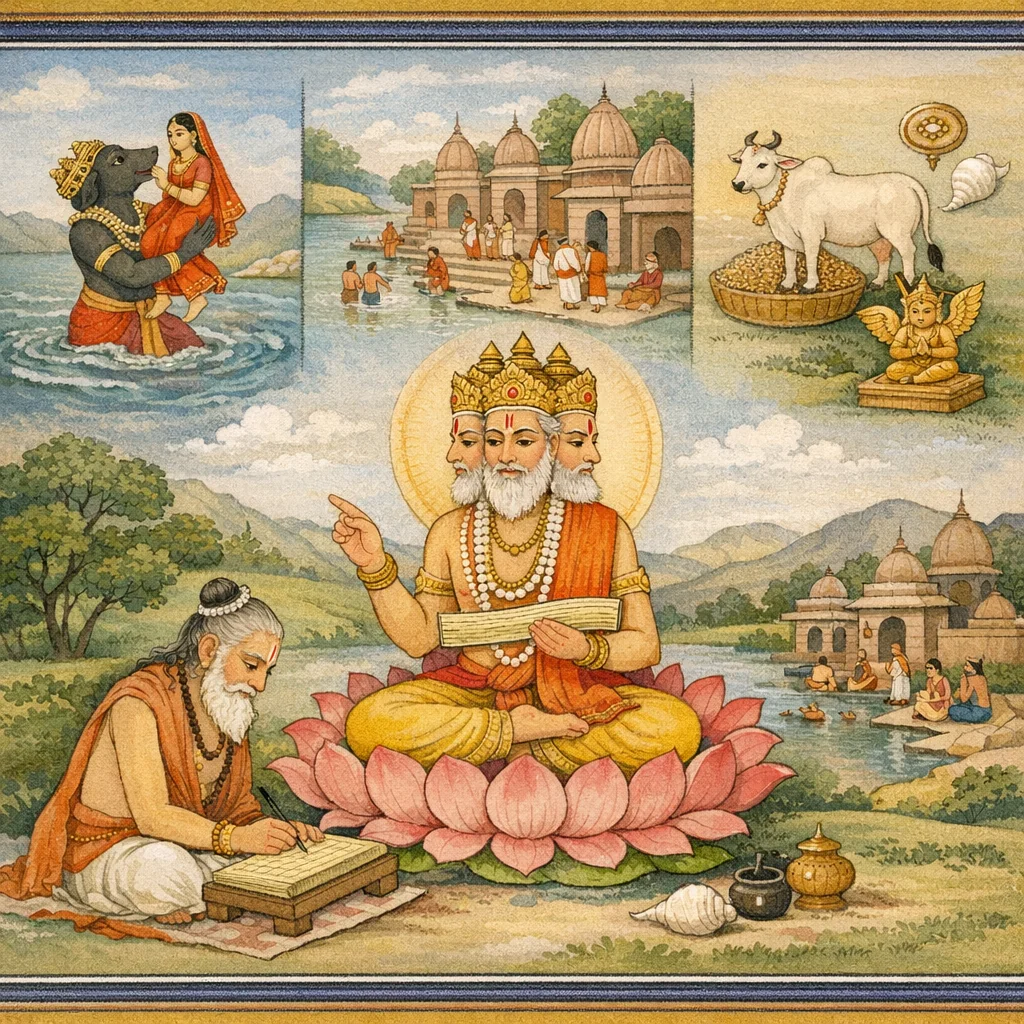
The Description of the Anukramaṇikā (Chapter-wise Summary) of the Varāha Purāṇa
Brahmā gives an index-summary (Anukramaṇikā) of the Varāha Purāṇa (24,000 verses, in two divisions). He highlights the opening Bhūmī–Varāha dialogue and honors Vyāsa as Nārāyaṇa incarnate. The outline surveys narrative cycles (Rambhā, Durjaya, Śveta, and a sage’s son episode connected with Yama), deity-focused sections (Gaurī’s manifestation, Vināyaka, Nāgas, Gaṇas, Kubera/Dhanada, Ādityas), and ritual-didactic teachings: śrāddha-vidhi, parvan observances, go-dāna, vratas, tīrtha-yātrā, and prāyaścitta for thirty-two offenses. Special emphasis is placed on Mathurā and the sin-destroying Gokarṇa; the Uttara division is framed as a Pulastya–Kuru dialogue detailing tīrtha-māhātmya (including Puṣkara) and festival observances. The chapter ends with the fruits of hearing/reciting/writing—growth of Viṣṇu-bhakti and the promise of Vaiṣṇava attainment—along with prescribed gifts (a golden Garuḍa, tila-dhenu) and a Caitra-month donation to a brāhmaṇa.
Shlokas
Verse 1
ब्रह्मोवाच । श्रृणु वत्स प्रवक्ष्यामि वाराहं वै पुराणकम् । भागद्वययुतं शश्वद्विष्णुमाहात्म्यसूचकम् ॥ १ ॥
Brahmā said: Listen, dear child; I shall describe the Varāha Purāṇa—consisting of two parts and ever indicating the greatness of Viṣṇu.
Verse 2
मानवस्य तु कल्पस्य प्रसंगं मत्कृतं पुरा । निबबंध पुराणेऽस्मिंश्चतुर्विंशसहस्रके ॥ २ ॥
Long ago, the account of the Mānavā-kalpa (Manu’s kalpa), composed by me, was incorporated into this Purāṇa of twenty‑four thousand verses.
Verse 3
व्यासो हि विदुषां श्रेष्ठः साक्षान्नारायणो भुवि । तत्रादौ शुभसंवादः स्मृतोभूमिवराहयोः ॥ ३ ॥
Indeed, Vyāsa is the foremost among the learned—Nārāyaṇa Himself manifest upon the earth. There, at the very beginning, the auspicious dialogue between Bhūmī (the Earth) and Varāha is remembered.
Verse 4
अथादिकृतवृत्तांते रंभस्य चरितं ततः । दुर्जयस्य च तत्पश्चाच्छ्राद्धकल्प उदीरितः ॥ ४ ॥
Then, at the conclusion of the account of Ādikṛt, the narrative of Rambhā is given; thereafter, the story of Durjaya is told, and following that, the ritual procedure for Śrāddha is expounded.
Verse 5
महातपस आख्यानं गौर्युत्पत्तिस्ततः परा । विनायकस्य नागानां सेनान्यादित्ययोरपि ॥ ५ ॥
Then comes the account of the great ascetic Mahātapas, followed by the exalted narration of Gaurī’s manifestation; and also the accounts of Vināyaka, of the Nāgas, and of the commanders and the Ādityas as well.
Verse 6
गणानां च तथा देव्या धनदस्य वृषस्य च । आख्यानं सत्यतपसो व्रताख्यानसमन्वितम् ॥ ६ ॥
Also included is the narrative concerning the Gaṇas, the Goddess, Dhanada (Kubera), and Vṛṣa, together with the account of Satyatapasa—complete with the related accounts of sacred vows (vratas).
Verse 7
अगस्त्यगीता तत्पश्चाद्रुद्रगीता प्रकीर्तिता । महिषासुरविध्वंसमाहात्म्यं च त्रिशक्तिजम् ॥ ७ ॥
After that, the Agastya-gītā is described, and then the Rudra-gītā is proclaimed; and also the sacred greatness of the destruction of the demon Mahiṣāsura, born of the threefold divine Power (Triśakti).
Verse 8
पर्वाध्यायस्ततः श्वेतोपाख्यानं गोप्रदानिकम् । इत्यादि कृतवृत्तांतं प्रथमे दर्शितं मया ॥ ८ ॥
Then comes the chapter on the sacred occasions (parvans); thereafter, the tale of Śveta, together with the rite of gifting cows. Such and other completed accounts have I set forth in the First section.
Verse 9
भगवद्धर्मके पश्चाद्वततीर्थकथानकम् । द्वात्रिंशदपराधानां प्रायश्चित्तं शरीरगम् ॥ ९ ॥
After the section on the Dharma of the Blessed Lord (Bhagavān), there comes the account of vows (vratas) and sacred pilgrimage places (tīrthas), and the bodily expiations (prāyaścittas) for the thirty-two offenses.
Verse 10
तीर्थानां चापि सर्वेषां माहात्म्यं पृथगीरितम् । मथुराया विशेषेण श्राद्धादीनां विधिस्ततः ॥ १० ॥
The greatness of all the sacred pilgrimage places (tīrthas) has likewise been described separately; thereafter, with special emphasis on Mathurā, the proper procedures for rites beginning with śrāddha are set forth.
Verse 11
वर्णनं यमलोकस्य ऋषिपुत्रप्रसंगतः । विपाकः कर्मणां चैव विष्णुव्रतनिरूपणम् ॥ ११ ॥
It contains a description of Yama’s realm (Yamaloka) in connection with the episode of a sage’s son, an account of the fruition of actions (karma), and an exposition of vows devoted to Viṣṇu.
Verse 12
गोकर्णस्य च माहात्म्यं कीर्तितं पापनाशनम् । इत्येवं पूर्वभागोऽयं पुराणस्य निरूपितः ॥ १२ ॥
Thus has the sin-destroying greatness of Gokarṇa been proclaimed; in this manner, the Pūrva-bhāga—the former section of this Purāṇa—has been set forth.
Verse 13
उत्तरे प्रविभागे तु पुलस्त्यकुरुराजयोः । संवादे सर्वतीर्थानां माहात्म्यं विस्तरात्पृथक् ॥ १३ ॥
In the later (Uttara) division, in the dialogue between Sage Pulastya and King Kuru, the greatness of all tīrthas—sacred pilgrimage places—is described, each separately and in full detail.
Verse 14
अशेषधर्माश्चाख्याताः पौष्करं पुण्यपर्व च । इत्येवं तव वाराहं प्रोक्तं पापविनाशनम् ॥ १४ ॥
Thus, all dharmas have been declared without remainder, along with the sacred Puṣkara tīrtha and the holy days of pious observance. In this way the Varāha Purāṇa has been expounded to you, the destroyer of sins.
Verse 15
पठतां श्रृण्वतां चैव भगवद्भक्तिवर्धनम् । कांचनं गरुड कृत्वा तिलधेनुसमन्वितम् ॥ १५ ॥
For those who recite it and those who listen to it, it increases devotion (bhakti) to the Lord; one should fashion a golden Garuḍa and, together with it, offer a tila-dhenu—a “sesame-cow”—as a sacred gift.
Verse 16
लिखित्वैतच्च यो दद्याच्चैत्र्यां विप्राय भक्तितः । स लभेद्वैष्णवं धाम देवर्षिगणवंदितः ॥ १६ ॥
Whoever writes out this text and, in the month of Caitra, devoutly gives it to a brāhmaṇa, attains the Vaiṣṇava dhāma—the abode of Viṣṇu—honored by hosts of divine seers.
Verse 17
यो वानुक्रमणीमेंतां श्रृणोत्यपि पठत्यपि । सोऽपि भक्तिं लभेद्विष्णौ संसारोच्छेदकारिणीम् ॥ १७ ॥
Whoever hears this Anukramaṇī (index-summary), or even recites it, attains devotion to Viṣṇu as well—devotion that cuts off saṁsāra, the round of worldly existence.
Verse 18
इति श्रीबृहन्नारदीय पुराणे पूर्वभागे बृहदुपाख्याने चतुर्थपादे वाराहपुराणानुक्रमणीवर्णनं नाम त्र्युत्तरशततमोऽध्यायः ॥ १०३ ॥
Thus ends the one-hundred-and-third chapter of the First Part of the Śrī Bṛhannāradīya Purāṇa, in the Great Narrative, in the Fourth Section, entitled “The Description of the Anukramaṇikā (chapter-wise summary) of the Vārāha Purāṇa.”
Frequently Asked Questions
Śrāddha is a core gṛhya-dharma interface where lineage duty, ritual correctness, and post-mortem welfare converge; anukramaṇikā emphasis signals that the Varāha Purāṇa treats śrāddha not as ancillary, but as a major soteriological and social obligation integrated with tīrtha, dāna, and prāyaścitta.
The list establishes a pilgrimage theology: geography becomes a vehicle of bhakti and purification. Mathurā is foregrounded for Vaiṣṇava rite-procedure, Gokarṇa for sin-destroying potency, and Puṣkara as a paradigmatic tīrtha—together mapping tīrtha-yātrā as applied mokṣa-dharma.