The Exposition of the Table of Contents of the Brahmavaivarta Purāṇa
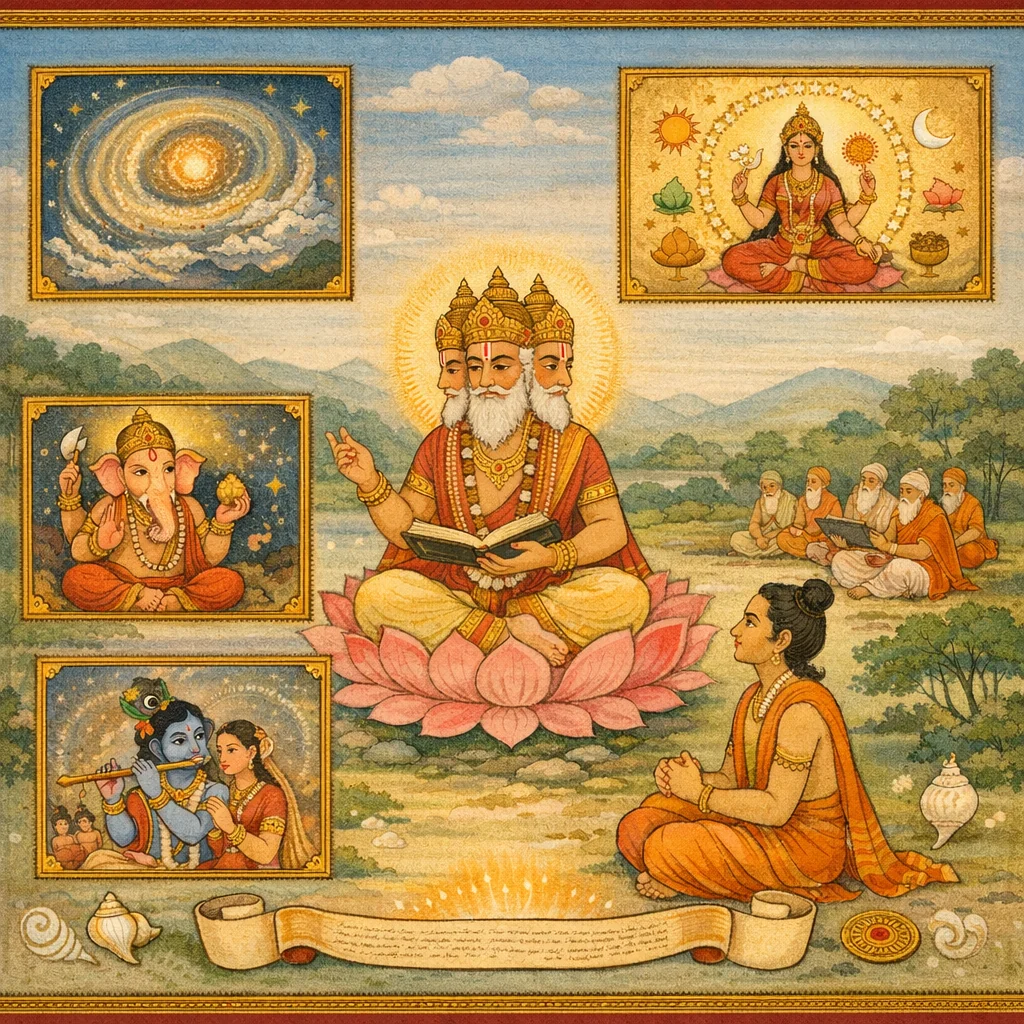
Brahmā speaks to his “child” (the immediate listener within the Naradīya frame) and introduces the tenth Purāṇa in this anukramaṇikā sequence, the Brahmavaivarta, as a guide to Vedic meaning and the Vedic path. The chapter lists its identifiers: linked with the Rathantara-kalpa, condensed within the Śata-koṭi Purāṇa tradition, and arranged by Vyāsa into four khaṇḍas totaling 18,000 verses—Brahmā-khaṇḍa, Prakṛti-khaṇḍa, Vighneśa-khaṇḍa, and Kṛṣṇa-khaṇḍa—set in a Sūta–sage dialogue. It then outlines the inner narrative: creation; a dispute between Nārada and Brahmā; reaching Śiva’s world and gaining Śiva-derived knowledge; Sāvarṇi’s sacred journey; and a turn to Prakṛti’s aṃśas/kalās and ritual materials. The Vighneśa section treats inquiry into Gaṇeśa’s birth, vows, and conflicts (including with Jamadagnya). The Kṛṣṇa section summarizes Kṛṣṇa’s birth, Gokula līlās, the Rāsa with the gopīs and Rādhā, Mathurā events, saṃskāras, study under Sāṃdīpani, slaying of enemies, and return to Dvārakā. The chapter ends with phalaśruti: reading, hearing, writing, donating, and even listening to the anukramaṇikā grants liberation by Kṛṣṇa’s grace.
Shlokas
Verse 1
श्रीब्रह्मोवाच । श्रृणु वत्स प्रवक्ष्यामि पुराणं दशमं तव । ब्रह्मवैवर्तकं नाम वेदमार्गानुदर्शकम् ॥ १ ॥
Śrī Brahmā said: “Listen, dear child; I shall tell you of the tenth Purāṇa—called the Brahma-vaivartaka—which points out and elucidates the path of the Veda.”
Verse 2
सावर्णिर्यत्र भगवान्साक्षाद्देवर्षये स्थितः । नारदाय पुराणार्थं प्राह सर्वमलौकिकम् ॥ २ ॥
There, Sāvarṇi—the Blessed Lord himself—stood directly before the divine sage and revealed to Nārada the purāṇic meaning in its entirety, wondrous and beyond the ordinary.
Verse 3
धर्मार्थकाममोक्षाणां सारः प्रीतिर्हरौ हरे । तयोरभेदसिद्ध्यर्थं ब्रह्मवैवर्तमुत्तमम् ॥ ३ ॥
The essence of dharma, artha, kāma, and mokṣa is loving devotion to Hari (Viṣṇu). And to establish the non-difference of these two—the four aims of life and devotion to Hari—the excellent Brahma-vaivarta (Purāṇa) is taught.
Verse 4
रथंतरस्य कल्पस्य वृत्तांतं यन्मयोदितम् । शतकोटिपुराणे तत्संक्षिप्य प्राह वेदवित् ॥ ४ ॥
The account of the Rathantara Kalpa that I have described—this the knower of the Veda (veda-vit) related in concise form within the Śata-koṭi Purāṇa.
Verse 5
व्यासश्चतुर्द्धा संव्यस्य ब्रह्मवैवर्तसंज्ञिते । अष्टादशसहस्रं तत्पुराणं परिकीर्तितम् ॥ ५ ॥
Having arranged it into four parts, Vyāsa proclaimed the Purāṇa known as the Brahmavaivarta; it is declared to comprise eighteen thousand verses.
Verse 6
ब्रह्मप्रकृतिविघ्नेशकृष्णखंडसमन्वितम् । तत्र सूतर्षिसंवादे पुराणोपक्रमस्ततः ॥ ६ ॥
It is furnished with the sections on Brahmā, Prakṛti, Vighneśa (Gaṇeśa), and the Kṛṣṇa-khaṇḍa; and there, within the dialogue between Sūta and the sages, the Purāṇa begins accordingly.
Verse 7
सृष्टिप्रकरणं त्वाद्यं ततो नारदवेधसोः । विवादः सुमहान्यत्र द्वयोरासीत्पराभवः ॥ ७ ॥
First comes the section on creation; thereafter, in this work, there is a very great dispute between Nārada and Vedhas (Brahmā), in which one of the two meets with defeat.
Verse 8
शिवलोकगतिः पश्चाज्ज्ञानलाभः शिवात्मने । शिववाक्येन तत्पश्चान्मरीचेर्नारदस्य तु ॥ ८ ॥
Thereafter comes the attainment of Śiva’s world, and then the gaining of knowledge for one whose inner self is devoted to Śiva. After that, by Śiva’s instruction, the account continues regarding Nārada, descended from Marīci.
Verse 9
गमनं चैव सावर्णेर्ज्ञानार्थँ सिद्धसेविते । आश्रमे सुमहापुण्ये त्रैलोक्याश्चर्यकारिणी ॥ ९ ॥
And it describes the journey of Sāvarṇi, undertaken for the sake of spiritual knowledge, to an āśrama frequented by perfected beings (Siddhas)—an exceedingly sacred hermitage, wondrous throughout the three worlds.
Verse 10
एतद्धि ब्रह्मखंडं हि श्रुतं पापविनाशनम् । ततः सावर्णिसंवादो नारदस्य समीरितः ॥ १० ॥
Indeed, this Brahma-khaṇḍa has been heard, and it is a destroyer of sins. Thereafter, the dialogue with Sāvarṇi, as spoken by Nārada, is set forth.
Verse 11
कृष्णमाहात्म्यसंयुक्तो नानाख्यानकथोत्तरम् । प्रकृतेरंशभूतानां कलानां चापि वर्णितम् ॥ ११ ॥
It is endowed with the glorification of Kṛṣṇa, and it concludes with many narratives and episodes; and it also describes the various portions (aṃśas) of Prakṛti and her divisions (kalās).
Verse 12
माहात्म्यं पूजनाद्यं च विस्तरेण यथास्थितम् । एतत्प्रकृतिखंडं हि श्रुतं भूतिविधायकम् ॥ १२ ॥
The greatness and the rites beginning with worship have been set forth in full, exactly as they stand. Indeed, this ‘Prakṛti-khaṇḍa’ has been heard as a section that bestows prosperity and well-being.
Verse 13
गणेशजन्मसंप्रश्नः सपुण्यकमहाव्रतम् । पार्वत्याः कार्तिकेयेन सह विघ्नेशसंभवम् ॥ १३ ॥
It contains an inquiry into the birth of Gaṇeśa, along with a highly meritorious great vow; and it narrates the manifestation of Vighneśa for Pārvatī, together with Kārtikeya.
Verse 14
चरितं कार्तवीर्यस्य जामदग्र्यस्य चाद्भुतम् । विवादः सुमहानासीज्जामदग्र्यगणेशयोः ॥ १४ ॥
Wondrous indeed was the story of Kārtavīrya and of the descendant of Jamadagni; a very great conflict arose between the Jāmadagnya and Gaṇeśa.
Verse 15
एतद्विघ्नेशखंडं हि सर्वविघ्नविनाशनम् । श्रीकृष्णजन्मसंप्रश्नो जन्माख्यानं ततोऽद्भुतम् ॥ १५ ॥
This section on Vighneśa indeed destroys all obstacles. Then comes the inquiry into the birth of Śrī Kṛṣṇa, followed by the wondrous narration of His divine advent.
Verse 16
गोकुले गमनं गश्चात्पूतनादिवदाद्भूताः । बाल्यकौमारजा लीला विविधास्तत्र वर्णिताः ॥ १६ ॥
There the journey to Gokula is described, and thereafter the wondrous events beginning with Pūtanā and others. The many diverse divine līlās of childhood and boyhood are also narrated.
Verse 17
रासक्रीडा च गोपीभिः शारदी समुदाहृता । रहस्ये राधया क्रीडा वर्णिता बहुविस्तरा ॥ १७ ॥
The autumnal Rāsa dance with the Gopīs is also proclaimed; and in the confidential, esoteric account, the sportive līlā with Rādhā is described in great detail.
Verse 18
सहाक्रूरेण तत्पश्चान्मथुरागमनं हरेः । कंसादीनां वधे वृत्ते कृष्णस्य द्विजसंस्कृतिः ॥ १८ ॥
Thereafter, accompanied by Akrūra, Hari went to Mathurā. When Kaṃsa and his allies had been slain, Kṛṣṇa then underwent the saṃskāras of a dvija, including upanayana and related rites.
Verse 19
काश्यसांदीपनेः पश्चाद्विद्योपादानमद्भुतम् । यवनस्य वधः पश्चाद्द्वारकागमनं हरेः ॥ १९ ॥
After the episode of Kāśya Sāṃdīpani comes the wondrous account of receiving sacred knowledge. Thereafter is the slaying of the Yavana, and then Hari’s return to Dvārakā.
Verse 20
नरकादिवधस्तत्र कृष्णेन विहितोऽद्भुतः । कृष्णखंडमिदं विप्र नृणां संसारखंडनम् ॥ २० ॥
There, Kṛṣṇa wondrously slew Naraka and the others. O Brahmin, this is the Kṛṣṇa-khaṇḍa, meant to sever for mankind the bonds of saṃsāra.
Verse 21
पठितं च श्रुतं ध्यातं पूजितं चाभिवंदितम् । इत्येतद्ब्रह्मवैवर्तपुराणं चात्यलौकिकम् ॥ २१ ॥
Thus the Brahmavaivarta Purāṇa is to be read, heard, meditated upon, worshipped, and reverently saluted; indeed, it is a supremely transcendent Purāṇa.
Verse 22
व्यासोक्तं चादि संभूतं पठञ्छृण्वन्विमुच्यते । विज्ञानाज्ञानशमनाद्धोरात्संसारसागरात् ॥ २२ ॥
By reciting and hearing this teaching—spoken by Vyāsa and arising from the very beginning—one is liberated; for it pacifies both knowledge and ignorance and delivers one from the dreadful ocean of saṃsāra.
Verse 23
लिखित्वेदं च यो दद्यान्माध्यां धेनुसमन्वितम् । ब्रह्मलोकमवाप्नोति स मुक्तोऽज्ञानबंधनात् ॥ २३ ॥
Whoever has this text written out and then donates it, together with a milch-cow, attains Brahmaloka; he is freed from the bondage of ignorance.
Verse 24
यश्चानुक्रमणीं चापि पठेद्वा श्रृणुयादपि । सोऽपि कृष्णप्रसादेन लभते वांछितं फलम् ॥ २४ ॥
Whoever recites this Anukramaṇikā (index/summary), or even merely hears it, also—by Kṛṣṇa’s grace—attains the desired fruit.
Verse 25
इति श्रीबृहन्नारदीयपुराणे पूर्वभागे बृहदुपाख्याने ब्रह्मवैवर्तपुराणानुक्रमणीनिरूपणं नामैकोत्तरशततमोऽध्यायाः ॥ १०१ ॥
Thus, in the Śrī Bṛhannāradīya Purāṇa, in the Pūrva-bhāga (First Part), within the Great Narrative (Bṛhad-upākhyāna), ends the one-hundred-and-first chapter, entitled “The Exposition of the Anukramaṇī (Table of Contents) of the Brahmavaivarta Purāṇa.”
Frequently Asked Questions
Because it prioritizes catalog metadata—kalpa affiliation, verse-count, internal division, and episode sequence—along with a phalaśruti, functioning as an index/abstract for the Brahmavaivarta rather than unfolding its full stories.
Brahmā-khaṇḍa, Prakṛti-khaṇḍa, Vighneśa (Gaṇeśa)-khaṇḍa, and Kṛṣṇa-khaṇḍa.
It asserts that reciting, hearing, or even listening to the anukramaṇikā grants the desired result by Kṛṣṇa’s grace, and that engagement with the Brahmavaivarta teaching can liberate one from saṃsāra by pacifying both knowledge and ignorance.