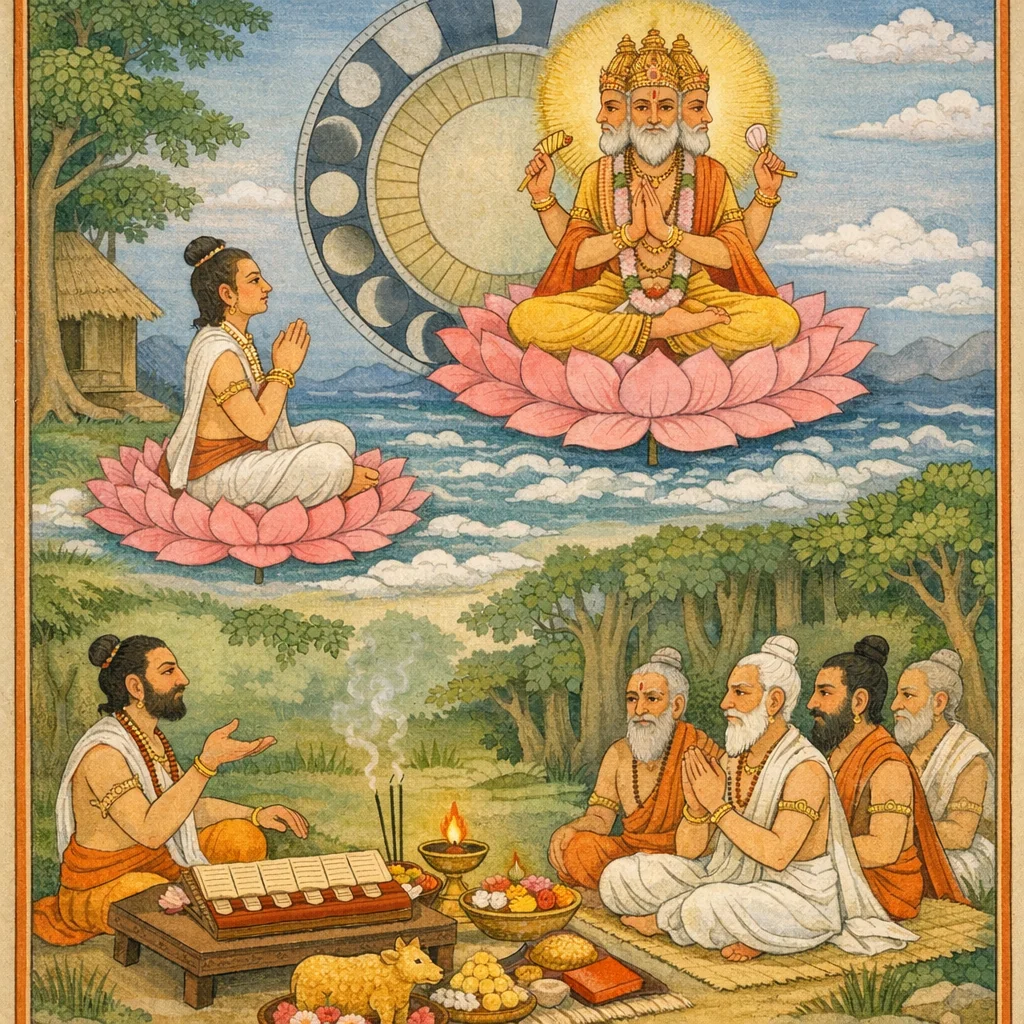
The Exposition of the Contents (Anukramaṇī) of the Bhaviṣya Purāṇa
Brahmā explains the Bhaviṣya Purāṇa as a giver of attainments, tracing its teaching from Brahmā to Svāyambhuva Manu, who asked about dharma as the means to all puruṣārthas. Vyāsa later compiles this dharma-compendium and divides it into five parts, including Adhora-kalpa narratives and an opening Brāhma Parvan. Set within the Sūta–Śaunaka dialogue stream, it is said to bear the Purāṇic marks (beginning with creation), the essence of the śāstras, and notes on manuscript writing on books and palm-leaves. It describes saṃskāras and lists ritual kalpas tied to fortnights and tithis; remaining kalpas fall under the Vaiṣṇava parvan, while Śaiva and Saura traditions arrange them differently. A fifth part, Pratisarga, ends with a summary. The chapter also teaches a graded “equality” of deities in relation to the guṇas, and prescribes copying and gifting the Purāṇa on Puṣya with guḍa-dhenu and other dānas, worship of the reciter and the book, fasting, and listening/recitation—promising destruction of sin, worldly enjoyment, and liberation.
Shlokas
Verse 1
श्रीब्रह्मोवाच । अथ ते संप्रवक्ष्यामि पुराणं सर्वसिद्धिदम् । भविष्यं भवतः सर्वलोकाभीष्टप्रदायकम् ॥ १ ॥
Śrī Brahmā said: Now I shall fully expound to you this Purāṇa, the giver of every attainment (siddhi); it shall be for your future benefit, granting the cherished desires of all worlds.
Verse 2
यत्राहं सर्वदेवानामादिकर्ता समुद्गतः । सृष्ट्यर्थं तत्र संजातो मनुः स्वार्थभुवः पुरा ॥ २ ॥
From that source where I arose as the primordial maker of all the devas, for the purpose of creation there was formerly born Manu, Svārthabhuva.
Verse 3
स मां प्रणम्य पप्रच्छ धर्मं सर्वाथसाधकम् । अहं तस्मै तदा प्रीतः प्रावोचं धर्मसंहिताम् ॥ ३ ॥
Having bowed to me, he asked about Dharma—the means that accomplishes every aim of life. Pleased with him then, I expounded to him the Dharma-saṃhitā, the compendium of Dharma.
Verse 4
पुराणानां यदा व्यासो व्यासं चक्रे महामतिः । तदा तां संहितां सर्वां पंचधा व्यभजन्मुनिः ॥ ४ ॥
When the great-minded Vyāsa undertook the compilation and arrangement of the Purāṇas, that sage then divided the entire compendium into five parts.
Verse 5
अधोरकल्पवृत्तांतं नानाश्चर्यकथान्वितम् । तत्रादिमं स्मृतं पर्वं ब्राह्मं यत्रास्त्युपक्रमः ॥ ५ ॥
It contains the account of the Adhora-kalpa, accompanied by many wondrous narratives. Therein, the first section is remembered as the Brāhma Parvan, where the opening commencement is found.
Verse 6
सूतशौनकसंवादे पुराणप्रश्नसंक्रमः । आदित्यचरितप्रायः सर्वाख्यानसमन्वितः ॥ ६ ॥
In the dialogue between Sūta and Śaunaka, the discussion proceeds through questions about the Purāṇa; it is largely concerned with the exploits of Āditya (the Sun) and is furnished with all kinds of narratives.
Verse 7
सृष्ट्यादिलक्षणोपेतः शास्त्रसर्वस्वरूपकः । पुस्तलेखकलेखानां लक्षणं च ततः परम् ॥ ७ ॥
It is furnished with the defining marks beginning with creation, and it embodies the very essence of all śāstras; and thereafter are stated the characteristics of writing in books and writing on palm-leaves (manuscript forms).
Verse 8
संस्काराणां च सर्वेषां लक्षणं चात्र कीर्तितम् । पक्षस्यादितिथीनां च कल्पाः सप्त च कीर्तिताः ॥ ८ ॥
Here, the defining characteristics of all the saṃskāras (sacramental rites) have been described; and the seven ritual procedures (kalpas) concerning the fortnight (pakṣa) and the lunar dates beginning from the first tithi have also been set forth.
Verse 9
अष्टम्याद्याः शेषकल्पा वैष्णवे पर्वणि स्मृताः । शैवे च कायतो भिन्नाः सौरे चांत्यकथान्वयः ॥ ९ ॥
The remaining Kalpas—beginning with (those named) Aṣṭamī and so forth—are remembered within the Vaiṣṇava parvan (section). In the Śaiva tradition they are differentiated in their arrangement, while in the Saura tradition they follow the sequence of the concluding narrative.
Verse 10
प्रतिसर्गाह्वयं पश्चान्नानाख्यानसमन्वितम् । पुराणस्योपसंहारसहितं पर्व पंचमम् ॥ १० ॥
Thereafter comes the fifth section, called “Pratisarga” (secondary creation), enriched with many narratives and including the concluding summary of the Purāṇa.
Verse 11
एषु पंचसु पूर्वस्मिन् ब्रह्मणो महिमाधिकाः । धर्मे कामे च मोक्षे तु विष्णोश्चापि शिवस्य च ॥ ११ ॥
Among these five, in the first, the greatness of Brahmā is predominant; in matters of dharma and kāma, and in mokṣa as well, the greatness of Viṣṇu—and also of Śiva—is declared.
Verse 12
द्वितीयं च तृतीये च सौरे वर्गचतुष्टये । प्रतिसर्गाह्वयं त्वंत्यं प्रोक्तं सर्वकथान्वितम् ॥ १२ ॥
And in the second and the third sections, within the Saurā division arranged in four groups, the final part—called “Pratisarga” (secondary creation)—has been taught, complete with all the narratives.
Verse 13
सभविष्यं विनिर्द्दिष्टं पर्व व्यासेन धीमता । चतुर्द्दशसहस्रं तु पुराणं परिकीर्तितम् ॥ १३ ॥
The Bhaviṣya Purāṇa, together with its supplements, was delineated as a parvan by the wise Vyāsa; and that Purāṇa is proclaimed to consist of fourteen thousand verses.
Verse 14
भविष्यं सर्वदेवानां साम्यं यत्र प्रकीर्तितम् । गुणानां तारतम्येन समं ब्रह्मेति हि श्रुतिः ॥ १४ ॥
In that teaching it is proclaimed that, in the future, all the gods will be spoken of as equal; yet the Śruti declares that Brahman is “equal” only in the sense of a gradation among the guṇas (qualities).
Verse 15
तं लिखित्वा तु यो दद्यात्पौष्यां विद्वान्विमत्सरः । गुडधेनुयुतं हेमवस्त्रमाल्यविभूषणैः ॥ १५ ॥
The learned one, free from envy, who has it copied and then gives it in charity on the Puṣya nakṣatra day—together with a guḍa-dhenu (a jaggery-cow) and with gold, garments, garlands, and ornaments—wins great religious merit.
Verse 16
वाचकं पुस्तकं चापि पूजयित्वा विधानतः । गंधाद्यैर्भोज्यभक्ष्यैश्च कृत्वा नीराजनादिकम् ॥ १६ ॥
Having duly worshipped, according to the prescribed procedure, both the reciter and the sacred book, one should perform ārati and the related rites, offering fragrances and other items, along with cooked foods and edible offerings.
Verse 17
यो वै जितेंद्रियो भूत्वा सोपवासः समाहितः । अथ वैकहविष्याशी कीर्तयेच्छृणुयादपि ॥ १७ ॥
Whoever, having conquered the senses, remains composed and observes a fast (upavāsa), and then lives on a single sacrificial offering (haviṣya)—such a person should chant these teachings/Names and also listen to them.
Verse 18
स मुक्तः पातकैर्घोरैः प्रयाति ब्रह्मणः पदम् । योऽप्यनुक्रमणीमेतां भविष्यस्य निरूपिताम् ॥ १८ ॥
Freed from dreadful sins, that person attains the state of Brahman; whoever listens to or studies this Anukramaṇī—the outline of what is to be narrated hereafter—also gains that fruit.
Verse 19
पठेद्वा श्रृणुयाच्चैतां भुक्तिं मुक्तिं च विंदति ॥ १९ ॥
Whoever recites this or listens to it attains both worldly enjoyment (bhukti) and liberation (mukti).
Verse 20
इति श्रीबृहन्नारदीयपुराणे पूर्वभागे बृहदुपाख्याने चतुर्थपादे भविष्यपुराणानुक्रमणी निरूपणं नाम शततमोऽध्यायः ॥ १०० ॥
Thus ends the hundredth chapter, entitled “The Exposition of the Contents (Anukramaṇī) of the Bhaviṣya Purāṇa,” in the Pūrva-bhāga of the venerable Bṛhannāradīya Purāṇa, within the Great Narrative (Bṛhad-upākhyāna), in the Fourth Section (Caturtha-pāda).
Frequently Asked Questions
Pratisarga (secondary creation) functions as the culminating structural unit: it gathers narratives into a concluding cosmological frame and provides the closing summary (saṅkṣepa), marking completion of the Purāṇa’s instructional arc.
It prescribes lekhana (copying) and dāna on Puṣya-nakṣatra with guḍa-dhenu and other gifts, plus worship of the reciter and book; this is framed as śāstra-dāna that yields great puṇya, destroys sins, and supports both bhukti (worldly welfare) and mukti (liberation).