Adhyaya 93: The Goddess’s Boons to Suratha and the Merchant (Conclusion of the Devi Mahatmyam)
देवीवाक्यं (Devīvākyaṃ)
Conclusion
In the conclusion of the Devi Mahatmyam, the Goddess appears and speaks her Devīvākya to King Suratha and the merchant. She grants boons: Suratha regains his kingdom and is foretold a future birth as Manu (Sāvarṇi), while the merchant receives wisdom, detachment, and the dharmic path leading toward liberation. The Goddess also promises abiding protection and response to those who praise and remember her with sincere devotion. The chapter closes in gratitude, solace, and wholehearted refuge in the Divine Mother.
Divine Beings
Celestial Realms
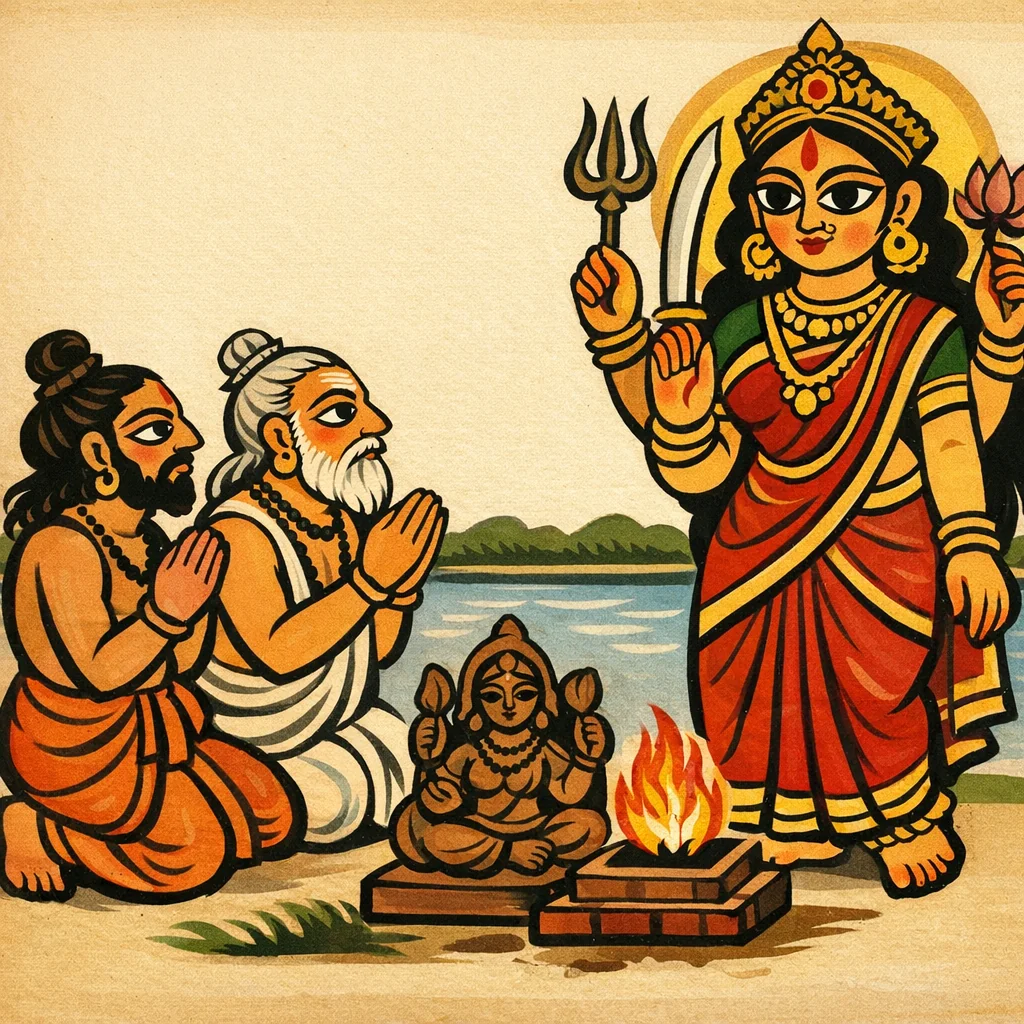
Key Content Points
Focus Keywords
Shlokas in Adhyaya 93
Verse 1
इति श्रीमार्कण्डेयपुराणे सावर्णिके मन्वन्तरे देवीमाहात्म्ये देवीवाक्यं नाम द्विनवतितमोऽध्यायः त्रिनवतितमोऽध्यायः- ९३ । ऋषिरुवाच एतत्ते कथितं भूूप देवीमाहात्म्यमुत्तमम् । एवंप्रभावा सा देवी ययेदं धार्यते जगत् ॥
Thus, in the Śrī Mārkaṇḍeya Purāṇa, in the Sāvarṇika Manvantara, in the Devī Māhātmya (the section called ‘Devī-vākya’)—the ninety-second chapter. Chapter ninety-three begins: The Ṛṣi said: “O king, this supreme Devī Māhātmya has been told to you. Such is the power of that Goddess by whom this world is upheld.”
Verse 2
विद्या तथैव क्रियते भगवद्विष्णुमायया । तथा त्वमेेष वैश्यश्च तथैवान्ये विवेकिनः । मोह्यन्ते मोहिताश्चैव मोहमेेष्यन्ति चापरे ॥
Knowledge too is brought about by the māyā of the Blessed Lord Viṣṇu. So it is with you, and with this vaiśya, and likewise with other discerning people: they are deluded, and having been deluded, others too will fall into delusion.
Verse 3
तामुपैहि महाराज शरणं परमेश्वरीम् । आराधिता सैव नृणां भोगस्वर्गापवर्गदा ॥
O great king, take refuge in the Supreme Goddess. When she is worshiped, she alone grants human beings enjoyment in this world, heaven, and liberation (mokṣa).
Verse 4
मार्कण्डेय उवाच इति तस्य वचः श्रुत्वा सुरथः स नराधिपः । प्रणिपत्य महाभागं तमृषिं शंसितव्रतम् ॥
Mārkaṇḍeya said: Having heard those words, Suratha, the lord of men, bowed down to that most fortunate sage, renowned for his vows.
Verse 5
निर्विण्णोऽतिममत्वेन राज्यापहरणेन च । जगाम सद्यस्तपसे स च वैश्यो महामुने ॥
Disgusted with worldly life because of excessive attachment and because his kingdom had been taken away, he at once went to perform austerity (tapas)—along with that merchant too, O great sage.
Verse 6
संदर्शनार्थमम्बायाः नदीपुलिनसंस्थितः । स च वैश्यस्तपस्तेपे देवीसूक्तं परं जपन् ॥
To obtain the vision (darśana) of Mother Devī, stationed on a riverbank, that merchant performed austerity, repeating the supreme hymn to the Goddess.
Verse 7
तौ तस्मिन् पुलिने देव्याः कृत्वा मूर्ति महीमयीम् । अर्हणां चक्रतुस् तस्याः पुष्पधूपाग्नितर्पणैः ॥
There, on that riverbank, the two made an image of the Goddess out of earth, and they performed her worship with flowers, incense, fire, and libations/oblations (āhuti).
Verse 8
निराहारौ यतात्मानौ तन्मनस्कौ समाहितौ । ददतुस् तौ बलिं चैव निजगात्रासृगुक्षितम् ॥
Fasting, self-controlled, wholly intent upon Her and concentrated, the two also offered a bali—sprinkled with the blood from their own bodies.
Verse 9
एवं समाराधयतोस् त्रिभिर्वर्षैर्यतात्मनोः । परितुष्टा जगद्धात्री प्रत्यक्षं प्राह चण्डिका ॥
Thus, as the two self-restrained devotees worshiped for three years, the Supporter of the world, Caṇḍikā, pleased, spoke to them in visible form.
Verse 10
श्रीदेव्युवाच यत्प्रार्थ्यते त्वया भूप त्वया च कुलनन्दन । मत्तस्तत्प्राप्यतां सर्वं परितुष्टा ददामि तत् ॥
The Blessed Goddess said: O king, and you, delight of your lineage—whatever is sought by you from me, let all of that be obtained. Being pleased, I grant it.
Verse 11
मार्कण्डेय उवाच ततो वव्रे नृपो राज्यं अविभ्रंश्यन्यजन्मनि । अत्रैव च निजं राज्यं हतशत्रुबलं बलात् ॥
Mārkaṇḍeya said: Then the king chose as a boon an unshaken kingdom in another birth, and also here itself his own kingdom—its enemies’ forces destroyed by might.
Verse 12
सोऽपि वैश्यस्ततो ज्ञानं वव्रे निर्विण्णमानसः । ममेति अहमिति प्राज्ञः सङ्गविच्युतिकारकम् ॥
Then that merchant too, his mind disillusioned, chose knowledge—wise as he was—which causes the falling away of attachment rooted in ‘mine’ and ‘I’.
Verse 13
श्रीदेव्युवाच स्वल्पैरहोभिर्नृपते स्वं राज्यं प्राप्स्यते भवान् । हत्वा रिपूनस्कलितं तव तत्र भविष्यति ॥
The Blessed Goddess said: “O king, in a few days you will regain your own kingdom. Having slain your enemies, your rule there will be unshaken.”
Verse 14
मृतश्च भूयः सम्प्राप्य जन्म देवाद्विवस्वतः । सावर्णिको नाम मनुर्भवान् भुवि भविष्यति ॥
“And after dying, obtaining birth again from the god Vivasvat (the Sun), you will become on earth the Manu named Sāvarṇi.”
Verse 15
वैश्यवर्य त्वया यश्च वरोऽस्मत्तोऽभिवाञ्छितः । तं प्रयच्छामि संसिद्ध्यै तव ज्ञानं भविष्यति ॥
“O best of merchants, the boon you have desired from me—I grant it. For your full attainment, true knowledge will arise in you.”
Verse 16
मार्कण्डेय उवाच इति दत्त्वा तयोर्देवी यथाभिलषितं वरम् । बभूवान्तर्हिता सद्यो भक्त्या ताभ्यामभिष्टुता ॥
Mārkaṇḍeya said: “Thus, having granted to both of them the boon they desired, the Goddess immediately vanished, having been hymned by them with devotion.”
Verse 17
एवं देव्याः वरं लब्ध्वा सुरथः क्षत्रियर्षभः । सूर्याज्जन्म समासाद्य सावर्णिर्भविता मनुः ॥
Thus, having obtained the boon from the Goddess, Suratha—bull among kṣatriyas—later attaining birth from the Sun, became the Manu named Sāvarṇi.
Frequently Asked Questions
It examines why discerning persons still fall under delusion (māyā) and presents śaraṇāgati to the Supreme Goddess as the practical and theological resolution, showing how devotion can culminate either in restored dharmic kingship or in detachment-based liberating knowledge.
It explicitly links Suratha’s boon to Manvantara chronology by prophesying his rebirth as Sāvarṇi Manu (in the Sāvarṇika manvantara tradition), thereby integrating the Devīmāhātmya’s shaktic episode into the Purāṇic succession of Manus.
As the Devīmāhātmya’s closing adhyāya, it culminates the text’s shaktic theology with a direct theophany of Caṇḍikā and the doctrinal claim that the Goddess is the giver of bhoga (worldly enjoyment), svarga (heavenly fruition), and apavarga (liberation), validating both royal and renunciant aims through her grace.