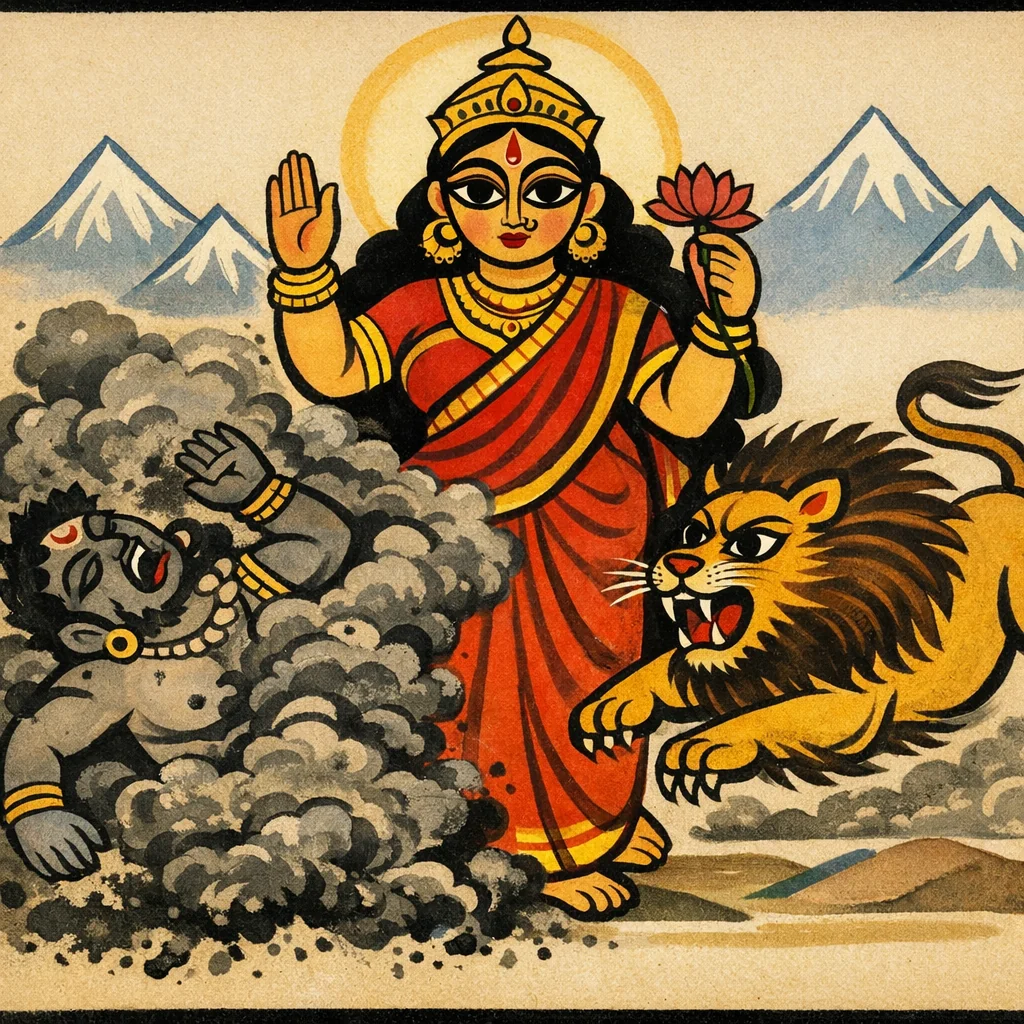
Adhyaya 86: Dhumralocana’s Mission and His Ashing by the Goddess; Shumbha Sends Chanda and Munda
धूम्रलोचनवधः (Dhūmralocana-vadhaḥ)
Devi's Grace
In Adhyaya 86, the Goddess abides upon the mountain as Shumbha dispatches his envoy Dhumralocana to seize and bring Her by force. He approaches with pride and threats, but the Goddess calmly refuses. By the sacred utterance “Hūṃ,” or by Her divine breath, Dhumralocana is instantly burned to ashes. Enraged, Shumbha then sends Chanda and Munda with a great army to capture the Goddess.
Divine Beings
Celestial Realms
Key Content Points
Focus Keywords
Shlokas in Adhyaya 86
Verse 1
इति श्रीमार्कण्डेयपुराणेऽथ सावर्णिके मन्वन्तरे देविमाहात्म्ये पञ्चाशोत्तमोध्यायः । षडशीतितमोऽध्यायः- ८६ । ऋषिरुवाच इत्याकर्ण्य वचो देव्याः स दूतोऽमर्षपूरितः । समाचष्ट समागम्य दैत्यराजाय विस्तरात् ॥
(Transition.) The Ṛṣi said: “Having heard the Goddess’s words, that messenger, filled with indignation, went and reported them in detail to the king of the daityas.”
Verse 2
तस्य दूतस्य तद्वाक्यमाकर्ण्यासुरराट् ततः । सक्रोधः प्राह दैत्यानामधिपं धूम्रलोचनम् ॥
Hearing the messenger’s words, the asura-king then, enraged, spoke to Dhūmralocana, a chief among the daityas.
Verse 3
हे धूम्रलोचनाशु त्वं स्वसैन्यपरिवारितः । तामानय बलाद् दुष्टां केशाकर्षणविह्वलाम् ॥
“O Dhūmralocana, quickly—surrounded by your own army—bring that wicked woman by force, distressed from being dragged by the hair.”
Verse 4
तत्परित्राणदः कश्चिद्यदि वोत्तिष्ठतेऽपरः । स हन्तव्योऽमरो वापि यक्षो गन्धर्व एव वा ॥
If anyone else rises up to protect her, he should be slain—whether he be a god, a Yakṣa, or a Gandharva.
Verse 5
ऋषिरुवाच तेनाज्ञप्तस्ततः शीघ्रं स दैत्यो धूम्रलोचनः । वृतः पष्ट्या सहस्राणामसुराणां द्रुतं ययौ ॥
The Ṛṣi said: Commanded by him, the Dānava Dhūmralocana quickly set out, swiftly going forth surrounded by thousands of companies of Asuras.
Verse 7
स दृष्ट्वा तां ततो देवीं तुहिनाचलसंस्थिताम् । जगादोच्चैः प्रयाहिति मूलं शुम्भनिशुम्भयोः ॥ न चेत्प्रीत्याद्य भवती मद्भर्तारमुपैष्यति । ततो बलान्नयाम्येष केशाकर्षणविह्वलाम् ॥
Seeing the Goddess stationed on the Himālaya, he shouted aloud: “Go to the presence of Śumbha and Niśumbha. If you do not willingly go today to my lord, then I shall take you by force, dragging you, distressed by the pulling of your hair.”
Verse 8
श्रीदेव्युवाच दैत्येश्वरेण प्रहितो बलवान् बलसंवृतः । बलान्नयासि मामेवं ततः किं ते करोम्यहम् ॥
The Blessed Goddess said: “Sent by the lord of Daityas, you are strong and surrounded by strength. If you will take me thus by force—then what shall I do to you?”
Verse 9
ऋषिरुवाच इत्युक्तः सोऽभ्यधावत्तामसुरो धूम्रलोचनः । हुंकारेणैव तं भस्म सा चकाराम्बिका ततः ॥
The Ṛṣi said: Thus addressed, that Asura Dhūmralocana rushed at her; then Ambikā, with a mere huṃkāra, reduced him to ashes.
Verse 10
अथ क्रुद्धं महासैन्यमसुराणां तथाम्बिका । ववर्ष सायकैस्तीक्ष्णैस्तथा शक्तिपरश्वधैः ॥
Then Ambikā rained down sharp arrows upon the enraged great army of the Asuras, and she also struck them with spears and battle-axes.
Verse 11
ततो धुतसटः कोपात्कृत्वा नादं सुभैरवम् । पपातासुरसेनायां सिंहः देव्याः स्ववाहनः ॥
Then, shaking his mane in fury and uttering a most dreadful roar, the lion—Devī’s own mount—leapt upon the army of the Asuras.
Verse 12
कांश्चित् करप्रहारेण दैत्यानास्येन चापरान् । आक्रम्य चाधरेणान्यान् स जग्हान महासुरान् ॥
Some Daityas he struck down with blows of his paws; others with his mouth; and still others he killed by trampling and by biting with his lower jaw.
Verse 13
केषाञ्चित् पाटयामास नखैः कोष्ठानि केशरी । तथा तलप्रिहारेण शिरांसि कृतवान् पृथक् ॥
The lion tore open the chests of some with his claws; and with blows of his paws he severed the heads of others.
Verse 14
विच्छिन्नबाहुशिरसः सृतास्तेन तथापरे । पपौ च रुधिरं कोष्ठादन्येषां धुतकेसरः ॥
Others, with arms and heads severed, fled away from him; and the mane-shaking lion drank the blood from the chests of still others.
Verse 15
क्षणेन तद्बलं सर्वं क्षयं नीतं महात्मना । तेन केसरिणा देव्याः वाहनेंनातिकोपिना ॥
In a single instant, that entire army was destroyed by the great-souled lion—the Goddess’s mount—ablaze with fierce wrath.
Verse 16
श्रुत्वा तमसुरं देव्याः निहतं धूम्रलोचनम् । बलं च क्षयितं कृत्स्नं देवीकेसरिणा ततः ॥
Hearing that the asura Dhūmralocana had been slain by the Goddess, and that the entire army had been destroyed by the Goddess’s lion, then—
Verse 17
चुकोप दैत्याधिपतिः शुम्भः प्रस्फुरिताधरः । आज्ञापयामास च तौ चण्डमुण्डौ महासुरौ ॥
Śumbha, lord of the daityas, enraged—his lips quivering—then commanded the two great asuras, Caṇḍa and Muṇḍa.
Verse 18
हे चण्ड हे मुण्ड बलैर्बहुभिः परिवारितौ । तत्र गच्छत गत्वा च सा समानीयतां लघु ॥
“O Caṇḍa! O Muṇḍa! Go there, surrounded by many troops; and having gone, bring her here quickly.”
Verse 19
केशेष्वाकृष्य बद्ध्वा वा यदि वः संशयो युधि । तदाशेषायुधैः सर्वैरसुरैर्विनिहन्यताम् ॥
“Drag her by the hair and bind her—if you have any doubt in battle; then let all the asuras slay her with every weapon.”
Verse 20
तस्यां हतायां दुष्टायां सिंहें च विनिपातिते । शीघ्रमागम्यतां बद्ध्वा गृहीत्वा तामथाम्बिकाम् ॥
“When that wicked woman is slain and the lion is felled, return quickly—having bound and seized that Ambikā.”
Frequently Asked Questions
The chapter foregrounds the contrast between coercive power (asuric abduction and intimidation) and divine sovereignty (the Devī’s effortless, non-instrumental destruction of evil), presenting shakti as a principle that subordinates brute force and fear-based rule.
It marks a decisive escalation: Śumbha’s attempt at forcible capture fails immediately with Dhūmralocana’s death, the asura army is routed by the Devī’s lion, and Śumbha responds by sending higher-ranking agents (Caṇḍa and Muṇḍa), intensifying the campaign.
It establishes a hallmark Devī Māhātmya motif—victory through the Devī’s intrinsic power (huṃkāra as a shaktic act) and the martial agency of her vāhana—while narratively preparing the Caṇḍa–Muṇḍa episode central to later manifestations and epithets of the Goddess.