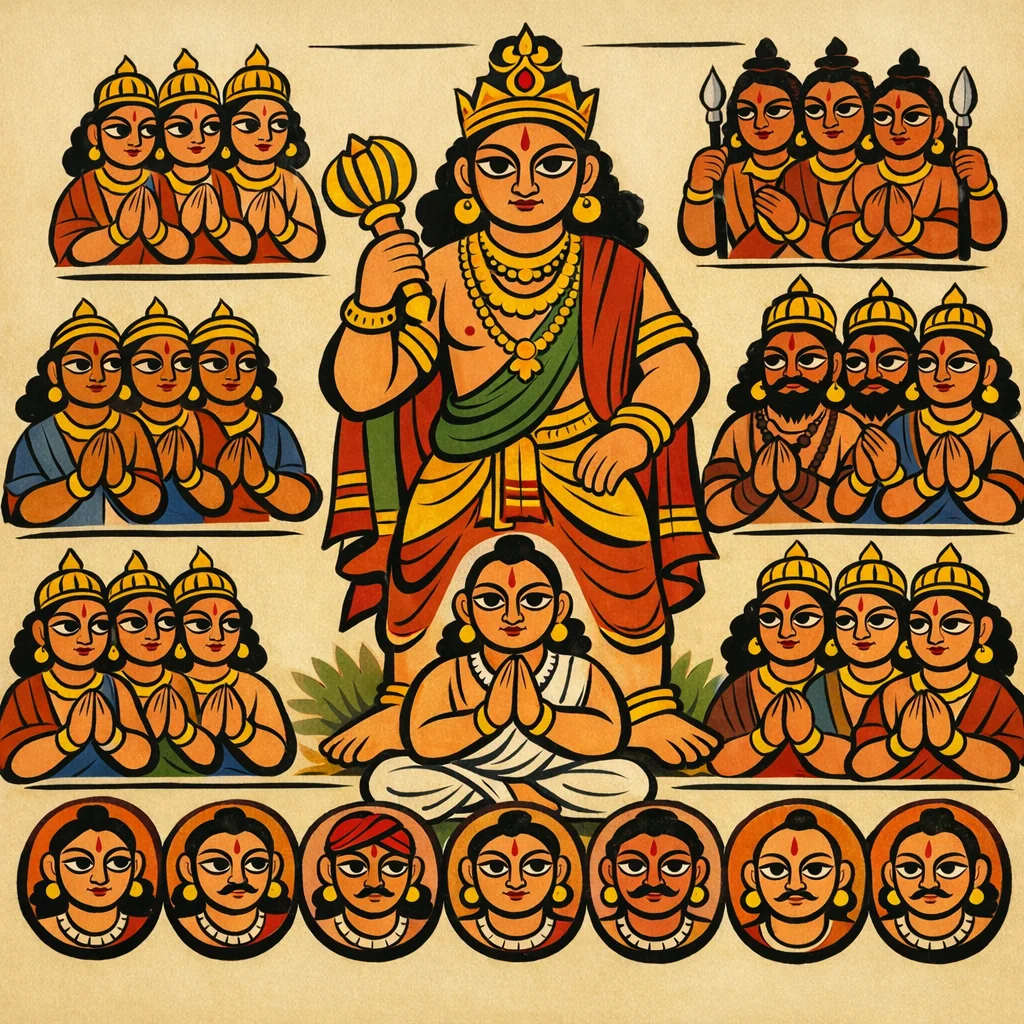
Adhyaya 79: The Vaivasvata Manvantara: Classes of Devas, the Seven Sages, and Manu’s Nine Sons
वैवस्वतोत्पत्तिवर्णनम् (Vaivasvatotpatti-varṇanam)
Chanda and Munda
This adhyaya describes the Vaivasvata Manvantara, setting forth the classes of Devas, their divine groups, and the Indra of this age as the sacred order of heaven. It also names the Seven Sages (Saptarishis) who uphold Dharma in this era. Then it speaks of Manu Vaivasvata and his nine sons, from whom lineages and royal dynasties proceed, ensuring the continuance of humankind in accordance with the cosmic law.
Divine Beings
Celestial Realms
Key Content Points
Focus Keywords
Shlokas in Adhyaya 79
Verse 1
इति श्रीमार्कण्डेयपुराणे सावर्णिके मन्वन्तरे वैवस्वतोत्पत्तिर्नामाष्टसप्ततितमोऽध्यायः ऊनाशीतितमोऽध्यायः- 79 मार्कण्डेय उवाच आदित्या वसवो रुद्राः साध्या विश्वे मरुद्गणाः । भृगवोऽङ्गिरसश्चाष्टौ यत्र देवगणाः स्मृताः ॥
Mārkaṇḍeya said: In that (Manvantara), the gods are remembered as the Ādityas, Vasus, Rudras, Sādhyas, Viśvedevas, and the Marut hosts; and there are eight (groups of) Bhṛgus and Aṅgirasas.
Verse 2
आदित्या वसवो रुद्रा विज्ञेयाः कश्यपात्मजाः । साध्याश्च मरुतो विश्वे धर्मपुत्रगणास्त्रयः ॥
The Ādityas, the Vasus, and the Rudras are to be known as sons of Kaśyapa. The Sādhyas, the Maruts, and the Viśvedevas are three groups among the sons of Dharma.
Verse 3
भृगोस्तु भृगवो देवाः पुत्रा ह्यङ्गिरसः सुताः । एष सर्गश्च मारीचो विज्ञेयः साम्प्रताधिपः ॥
Among the gods, the Bhṛgus are indeed sons of Bhṛgu, and the Aṅgirasas are sons of Aṅgiras. This creation (sarga) is to be understood as the Mārīca line, the one presiding at present.
Verse 4
ऊर्जस्वी नाम चैवेन्द्रो महात्मा यज्ञभागभुक् । अतीतानागताः ये च वर्तन्ते साम्प्रतञ्च ये ॥
And Indra is named Ūrjasvī—great-souled, a partaker of the sacrificial share. Those Indras who are past, those yet to come, and those who exist in the present as well—
Verse 5
सर्वे ते त्रिदशेन्द्रास्तु विज्ञेयास्तुल्यलक्षणाः । सहस्राक्षाः कुलिशिनः सर्व एव पुरन्दराः ॥
All those Indras of the gods are to be known as having similar characteristics: thousand-eyed, wielders of the thunderbolt (vajra), all indeed “destroyers of fortresses” (Purandara).
Verse 6
मघवन्तो वृषाः सर्वे शृङ्गिणो गजगामिनः । ते शतक्रतवः सर्वे भूताभिभवतेजसः ॥
All of them are Maghavans—bull-like, horned, moving with the gait of elephants. All of them are Śatakratus, possessing splendor that overcomes beings.
Verse 7
धर्माद्यैः कारणैः शुद्धैराधिपत्यगुणान्विताः । भूतभव्यभवन्नाथाः शृणु चैतत् त्रयं द्विज ॥
Endowed with sovereignty and its qualities, and purified by causes beginning with dharma—lords of the past, the future, and the present—hear this triad, O twice-born.
Verse 8
भूर्लोकोऽयं स्मृता भूमिरन्तरिक्षं दिवः स्मृतम् । दिव्याख्याश्च तथा स्वर्गस्त्रैलोक्यमिति गद्यते ॥
This Bhūr-loka is known as the earth; the mid-region (antarikṣa) is called the heaven/sky; and likewise Svarga, termed ‘divya’, is spoken of as the three worlds (trailokya).
Verse 9
अत्रिश्चैव वसिष्ठश्च काश्यपश्च महानृषिः । गौतमश्च भरद्वाजौ विश्वामित्रोऽथ कौशिकः ॥
Atri, Vasiṣṭha, and Kāśyapa the great seer; Gautama and Bharadvāja; and Viśvāmitra—also called Kauśika.
Verse 10
तथैव पुत्रो भगवाञृचीकस्य महात्मनः । जमदग्निस्तु सप्तैते मुनयोऽत्र नथान्तरे ॥
Likewise, Jamadagni—the blessed son of the great-souled Ṛcīka—(completes the set): these are the seven sages here, in this interval (of the Manvantara).
Verse 11
इक्ष्वाकुर्नाभगश्चैव धृष्टः शर्यातिरेव च । नरिष्यन्तश्च विख्यातो नाभागारिष्ट एव च ॥
Ikṣvāku and Nābhaga; Dhṛṣṭa and Śaryāti; the famed Nariṣyanta; and also Nābhāga-Āriṣṭa.
Verse 12
करूषश्च पृषध्रश्च वसुमान् लोकविश्रुतः । मनोर् वैवस्वतस्यैते नव पुत्राः प्रकीर्तिताः ॥
Karūṣa and Pṛṣadhra, and Vasumān renowned in the world—these are proclaimed as the nine sons of Vaivasvata Manu.
Verse 13
वैवस्वतमिदं ब्रह्मन् कथितान्ते मयाऽन्तरम् । अस्मिन् श्रुते नरः सद्यः पठिते चैव सत्तम । मुच्यते पातकैः सर्वैः पुण्यञ्च महदश्नते ॥
Thus, O brāhmaṇa, I have related to you this account of Vaivasvata (the Manvantara). When a man hears it—or when it is recited—O best of the good, he is immediately freed from all sins and attains great merit.
Frequently Asked Questions
Rather than a debated dilemma, the chapter advances a doctrinal catalog: cosmic administration is cyclical and typological—especially in its portrayal of successive Indras as ‘tulyalakṣaṇa’ (sharing defining marks)—thereby reinforcing the Purāṇic logic of recurring governance across time.
It anchors the Vaivasvata Manvantara by naming its operative deva-classes, specifying the period’s Indra (Ūrjasvī), listing the Saptaṛṣis, and recording Vaivasvata Manu’s nine sons—standard identifiers used to map each manvantara in Purāṇic chronology.
The chapter catalogues (1) deva lineages (Ādityas/Vasus/Rudras linked to Kaśyapa; Sādhyas/Maruts/Viśvedevas linked to Dharma’s progeny), (2) the Saptaṛṣi succession, and (3) Vaivasvata Manu’s nine sons (including Ikṣvāku), supplying genealogical indices that support later royal and ritual histories derived from manvantara frameworks.