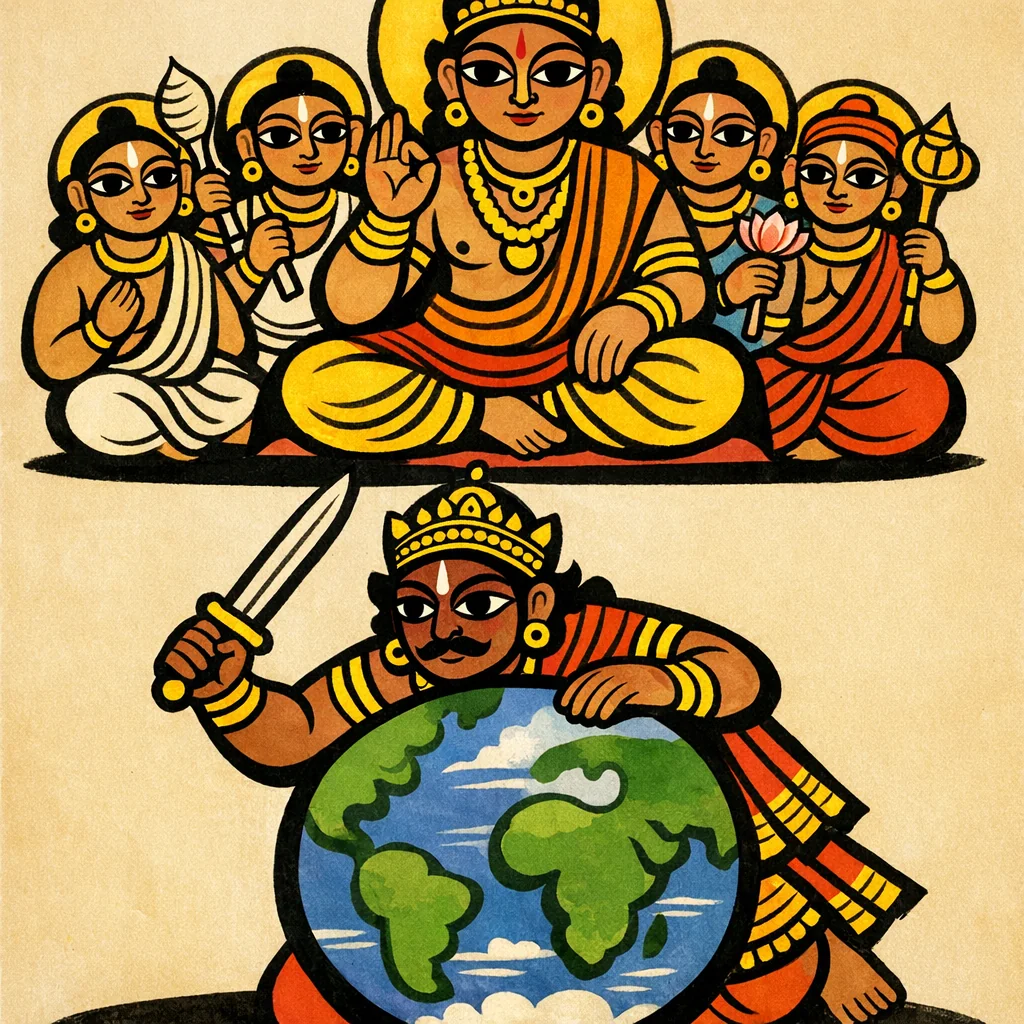
Adhyaya 73: The Uttama Manvantara: Classes of Devas, Indra Sushanti, and the Royal Lineage
औत्तममन्वन्तरवर्णनम् (Auttama-manvantara-varṇanam)
Birth of the Goddess
This chapter describes the Uttama Manvantara, setting forth the classes of Devas and their celestial assemblies in sacred order. It declares Indra Sushanti as the ruler of heaven for that age. It also recounts the royal lineage—the succession of kings who uphold Dharma to preserve the world’s harmony—revealing the cyclical course of time and the protecting power of divine law.
Divine Beings
Celestial Realms
Key Content Points
Focus Keywords
Shlokas in Adhyaya 73
Verse 1
इति श्रीमार्कण्डेयपुराणे औत्तममन्वन्तरे द्विसप्ततितमोऽध्यायः । त्रिसप्ततितमोऽध्यायः- ७३ । मार्कण्डेय उवाच । मन्वन्तरे तृतीयेऽस्मिन् औत्तमस्य प्रजापतेः । देवानिन्द्रमृषीन् भूपान् निबोध गदतो मम ॥
Thus ends Chapter 72 in the Śrī Mārkaṇḍeya Purāṇa, in the Auttama Manvantara. Chapter 73 begins. Mārkaṇḍeya said: In this third Manvantara of Prajāpati Auttama, understand from me as I speak—of the devas, Indra, the ṛṣis, and the kings.
Verse 2
स्वधामानस्तथा देवा यथानामानुकारिणः । सत्याख्यश्च द्वितीयोऽन्यस्त्रिदशानां तथा गणः ॥
One group of gods was called Svadhāmans, in accordance with their names and natures. A second group among the thirty (gods) was called Satyākhyas.
Verse 3
तृतीये तु गणॆ देवाः शिवाख्या मुनिसत्तम । शिवाः स्वरूपतस्ते तु श्रुताः पापप्रणाशनाः ॥
In the third group, O best of sages, the gods were called Śivākhyas. They are auspicious in their very nature, and are heard of as destroyers of sin.
Verse 4
प्रतर्दनाख्यश्च गणो देवानां मुनिसत्तम । चतुर्थस्तत्र कथित औत्तमस्यान्तरे मनोः ॥
And a group of gods called Pratardanas is mentioned, O best of sages, as the fourth (group) in that Auttama interval of Manu.
Verse 5
वशवर्तिनः पञ्चमेऽपि देवास्तत्र गणॆ द्विज । यथाख्यातस्वरूपास्तु सर्व एव महामुने ॥
In the fifth group too, O twice-born, the gods were Vaśavartins. All of them, O great sage, are indeed of the nature corresponding to how they are described (by name and report).
Verse 6
एते देवगणाः पञ्च स्मृता यज्ञभुजस्तथा । मन्वन्तरे मनुश्रेष्ठे सर्वे द्वादशका गणाः ॥
These five groups of gods are remembered, and likewise the partakers of the sacrifice; in the manvantara of that excellent Manu, all these groups are arranged as twelve sets (classes).
Verse 7
तेषामिन्द्रो महाभागस्त्रैलोक्ये स गुरुर्भवेत् । शतं क्रतूनामाहृत्य सुशान्तिर्नाम नामतः ॥
Among them, the fortunate Indra becomes the preceptor in the three worlds; having performed a hundred sacrifices, he is known by the name ‘Suśānti’.
Verse 8
यस्योपसर्गनाशाय नामाक्षरविभूषिता । अद्यापि मानवैर्गाथा गीयते तु महीतले ॥
Adorned with the syllables of his name, a gāthā (praise-verse) that destroys calamities is sung even today by human beings upon the earth.
Verse 9
शुशान्तिर्देवराट् कान्तः शुशान्तिं स प्रयच्छति । सहितः शिवसत्याद्यैस्तथैव वशवर्तिभिः ॥
Suśānti, the beloved sovereign of the gods, indeed grants ‘suśānti’ (good peace), together with (the groups beginning with) Śiva and Satya, and likewise with those under the Vasus’ domain.
Verse 10
अजः परशुचिर्दिव्यो महाबलपराक्रमः । पुत्रस्तस्य मनोरासन् विख्यातास्त्रिदशोपमाः ॥
Aja—pure as an axe, divine, of great strength and valor—was the son of that Manu; and his sons were renowned, comparable to the Thirty (gods).
Verse 11
तत्सूतिसम्भवैर्भूमिः पालिताभून्नरेश्वरैः । यावन्मन्वन्तर तस्य मनोरुत्तमतेजसः ॥
By kings born from his progeny, the earth was protected, for as long as the manvantara of that Manu of excellent splendor endured.
Verse 12
चतुर्युगानां संख्याता साधिका ह्येकसप्ततिः । कृतत्रेतादिसंज्ञानां यान्युक्तानि युगे मया ॥
The number of caturyugas is stated as a little more than seventy-one—those yugas bearing the names Kṛta, Tretā, and so on, which I have described as yugas.
Verse 13
स्वतेजसा हि तपसो वरिष्ठस्य महात्मनः । तनयाश्चान्तरे तस्मिन् सप्त सप्तर्षयोऽभवन् ॥
Indeed, by his own splendor—of that great soul, most excellent in austerity—there were, in that interval, seven sons who became the seven Saptarishis.
Verse 14
तृतीयमेतत्कथितं तव मन्वन्तरं मया । तामसस्य चतुर्थन्तु मनोरन्तरमुच्यते ॥
This third manvantara has been told to you by me; but the fourth interval of Manu is said to be that of Tāmasa.
Verse 15
वियोनिजन्मनो यस्य यशसा द्योतितं जगत् । जन्म तस्य मनोर् ब्रह्मन् ! श्रूयतां गदतो मम ॥
O Brahman, hear from me as I speak: the birth of that Manu—whose origin was non-womb-born and by whose fame the world was illumined.
Verse 16
अतीन्द्रियमशेषाणां मनूनाञ्चरितं तथा । तथा जन्मापि विज्ञेयं प्रभावश्च महात्मनाम् ॥
The exploits of all the Manus are beyond the reach of the senses. Likewise, one should understand the births and the extraordinary power (influence) of great-souled beings.
Frequently Asked Questions
The chapter’s inquiry is structural and cosmological rather than casuistic: it explains how dharmic order is maintained in a given Manvantara through clearly named divine classes (devagaṇas), a stabilizing Indra, and a parallel human kingship that protects the earth—linking ritual economy (yajña) to cosmic governance.
It completes the Auttama (third) Manvantara profile by listing its devagaṇas, naming its Indra (Śuśānti), indicating the Manu’s progeny (Aja) and the kingship that sustains the world, and then explicitly announces the shift to the next cycle: the Tāmasa (fourth) Manvantara and its Manu’s distinctive birth and potency.
The text emphasizes administrative taxonomy (five devagaṇas), the Manvantara’s Indra (Śuśānti) with a remembered protective name, the Manu’s lineage through Aja and earth-protecting kings, and a yuga-based duration marker; these provide a complete closure of Auttama’s order so the narration can pivot cleanly to the Tāmasa Manvantara’s origin-story and extraordinary Manu-birth.