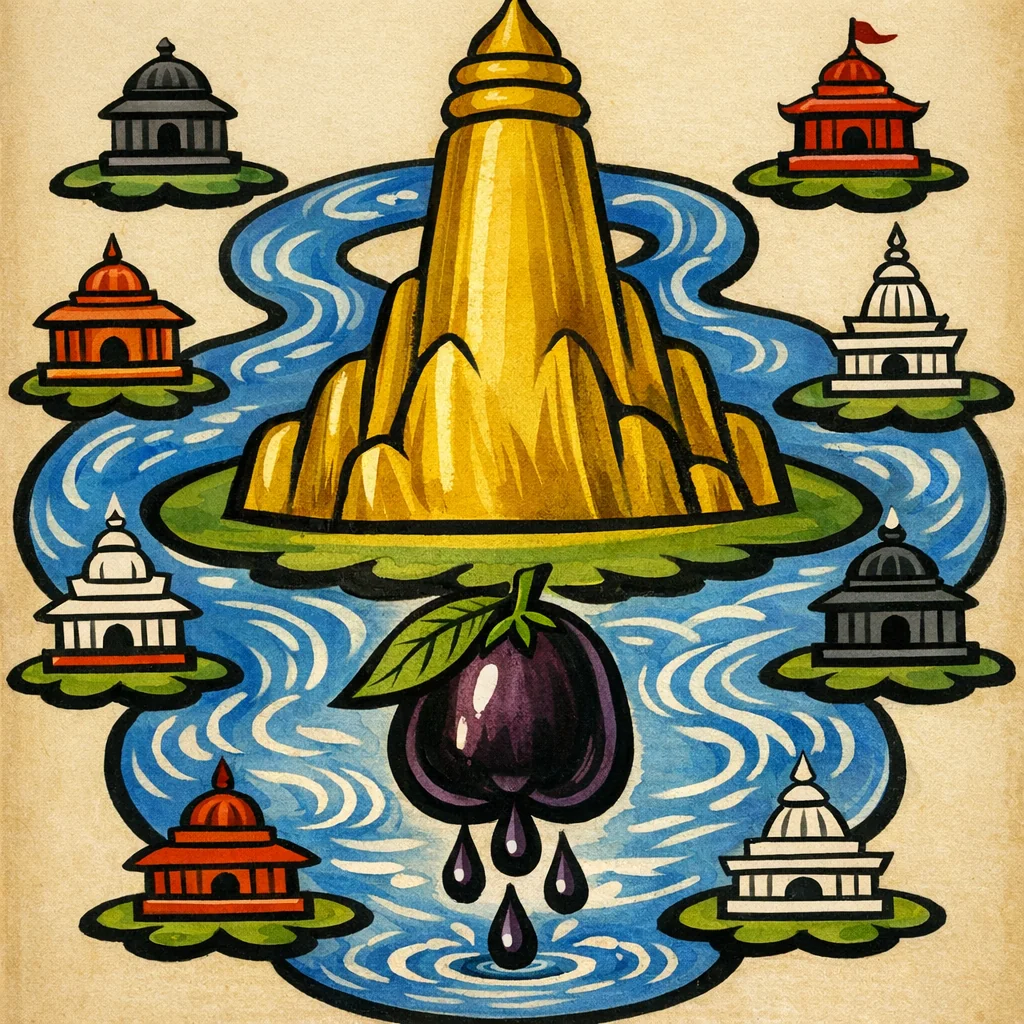
Adhyaya 54: Cosmography of Jambudvipa: Continents, Oceans, Varshas, and Mount Meru
द्वीपसमुद्रवर्णनम् (Dvīpa-Samudra-Varṇanam) / जम्बूद्वीपमेरुवर्णनम् (Jambūdvīpa-Meru-Varṇanam)
Surya the Sustainer
This chapter sets forth the sacred cosmography of Jambudvipa: the continents and encircling oceans, the division into varshas (regions) and their lands, and Mount Meru as the holy central axis of the world, upholding the order of the cosmos in accordance with dharma.
Divine Beings
Celestial Realms
Key Content Points
Focus Keywords
Shlokas in Adhyaya 54
Verse 1
कrauष्टुकिरुवाच । कति द्वीपाः समुद्राः वा पर्वताः वा कति द्विज । कियन्ति चैव वर्षाणि तेषां नद्यश्च का मुने ॥
Krauṣṭuki said: “How many continents are there, how many oceans, and how many mountains, O twice-born? And how many regions (varṣas) are there, and what are their rivers, O sage?”
Verse 2
महाभूतप्रमाणं च लोकालोकं तथैव च । पर्यासं परिमाणं च गतिं चन्द्रार्कयोः अपि ॥
Also tell me the measures of the great elements, and the Lokāloka (the boundary between the world and darkness); the circuit and dimensions of the cosmos, and even the courses of the Moon and the Sun.
Verse 3
एतत् प्रब्रूहि मे सर्वं विस्तरेण महामुने ॥
Explain all this to me in detail, O great sage.
Verse 4
मार्कण्डेय उवाच । शतार्धकोटिविस्तारा पृथिवी कृत्स्रशो द्विज । तस्या हि स्थानमखिलं कथयामि शृणुष्व तत् ॥
Mārkaṇḍeya said: “The earth’s full extent is measured as ‘a hundred and a half koṭis’ in breadth, O twice-born. I shall describe completely its entire placement and structure—listen to that.”
Verse 5
ये ते द्वीपा मया प्रोक्ता जम्बूद्वीपादयो द्विज । पुष्करान्ता महाभाग शृण्वेषां विस्तरं पुनः ॥
Those continents I previously mentioned—beginning with Jambūdvīpa and ending with Puṣkara—O twice-born, O fortunate one, now listen again to their detailed description.
Verse 6
द्वीपात् तु द्विगुणो द्वीपो जम्बुः प्लक्षोऽथ शाल्मलः । कुशः क्रौञ्चस्तथा शाकः पुष्करद्वीप एव च ॥
Each continent (dvīpa) is twice the size of the one before it: Jambu, Plakṣa, then Śālmala, Kuśa, Krauñca, Śāka, and Puṣkara-dvīpa.
Verse 7
लवणेक्षु-सुरा-सर्पिर्दधि-दुग्ध-जलाब्धिभिः । द्विगुणैर्द्विगुणैर्वृद्ध्या सर्वतः परिवेष्टिताः ॥
They are encircled on all sides by oceans of salt, sugarcane-juice, liquor, clarified butter (ghee), curds, milk, and sweet water—each successive ocean increasing twofold over the previous.
Verse 8
जम्बुद्वीपस्य संस्थानं प्रवक्ष्येऽहं निबोध मे । लक्षमेकं योजनानां वृत्तौ विस्तारदैर्घ्यतः ॥
I shall describe the configuration of Jambu-dvīpa; listen to me. Its extent in circumference is one lakh yojanas, and so too in breadth and in length.
Verse 9
हिमवान् हेमकूटश्च ऋषभो मेरुरेव च । नीलः श्वेतस्तथा शृङ्गी सप्तास्मिन् वर्षपर्वताः ॥
Himavān, Hemakūṭa, Ṛṣabha, and also Meru; Nīla, Śveta, and Śṛṅgī—these are the seven varṣa-mountains in this (Jambu-dvīpa).
Verse 10
द्वौ लक्षयोजनायामौ मध्ये तत्र महाचलौ । तयोर्दक्षिणतो यौ तु यौ तथोत्तरतो गिरी ॥
In the middle there are two great mountains, each two lakh yojanas in length. And the mountains that lie to their south, as well as those to their north—
Verse 11
दशभिर्दशभिर्न्यूनैः सहस्रैस्तैः परस्परम् । द्विसाहस्त्रोच्छ्रयाः सर्वे तावद्विस्तारिणश्च ते ॥
They are separated from one another by ten thousand yojanas, each being less than the preceding by ten (that is, by successive tens). All of them are two thousand yojanas in height, and equal in measure in breadth.
Verse 12
समुद्रान्तः प्रविष्टाश्च षडस्मिन् वर्षपर्वताः । दक्षिणोत्तरतो निम्ना मध्ये तुङ्गायता क्षितिः ॥
Six of these varṣa-mountains extend into the ocean. The land is low toward the south and the north, and in the middle it rises high and stretches elevated.
Verse 13
वेद्यर्धे दक्षिणे त्रीणि त्रीणि वर्षाणि चोत्तरे । इलावृतं तयोर्मध्ये चन्द्रार्धाकारवत् स्थितम् ॥
In the southern half of the cosmic altar-ground are three regions, and in the northern half three regions. Between them lies Ilāvṛta, situated in the form of a half-moon.
Verse 14
ततः पूर्वेण भद्राश्वं केतुमालञ्च पश्चिमे । इलावृतस्य मध्ये तु मेरुः कनकपर्वतः ॥
To its east lies Bhadrāśva, and to its west Ketumāla. In the middle of Ilāvṛta is Meru, the golden mountain.
Verse 15
चतुरशीतिसाहस्रस्तस्योच्छ्रायो महागिरेः । प्रविष्टः षोडशाधस्ताद्विस्तीर्णः षोडशैव तु ॥
The height of that great mountain is eighty-four thousand yojanas. It extends sixteen thousand yojanas below the earth, and its breadth is likewise sixteen thousand.
Verse 16
शरावसंस्थितत्वाच्च द्वात्रिंशन्मूर्ध्नि विस्तृतः । शुक्लः पीतो ’सितो रक्तः प्राच्यादिषु यथाक्रमम् ॥
Because it is shaped like a shallow bowl (śarāva), it spreads out at its summit to a width of thirty-two (units). In the eastern and the other directions respectively, its colors are white, yellow, dark/black, and red.
Verse 17
विप्रो वैश्यस्तथा शूद्रः क्षत्रियश्च स्ववर्णतः । तस्योपरि तथैवाष्टौ पुर्यो दिक्षु यथाक्रमम् ॥
In the quarters are the Brāhmaṇa, Vaiśya, Śūdra, and Kṣatriya, according to their respective varṇas. Above that arrangement likewise are eight cities in the directions, in their proper order.
Verse 18
इन्द्रादिलोकपालानां तन्मध्ये ब्रह्मणः सभा । योजनानां सहस्राणि चतुर्दश समुच्छ्रिता ॥
Among the world-guardians beginning with Indra, in their midst is Brahmā’s assembly hall. It rises to a height of fourteen thousand yojanas.
Verse 19
अयुतोच्छ्रायास्तस्याधस्तथा विष्कम्भवर्वताः । प्राच्यादिषु क्रमेणैव मन्दरो गन्धमादनः ॥
Beneath it are mountains serving as supports, with a height of ten thousand (yojanas). In the eastern and the other directions respectively are Mandara and Gandhamādana (and the others in order).
Verse 20
विपुलश्च सुपार्श्वश्च केतुपादपशोभिताः । कदम्बो मन्दरे केतुर् जम्बुवा गन्धमादने ॥
Vipula and Supārśva are adorned with the Ketu tree. On Mandara is the Kadamba tree; on Gandhamādana is the Jambu tree.
Verse 21
विपुले च तथाश्वत्थः सुपार्श्वे च वटो महान् । एकादशशतायामा योजनानामिमे नगाः ॥
On Vipula likewise stands the Aśvattha (sacred fig), and on Supārśva a great Vaṭa (banyan). These mountains extend to a length of eleven hundred yojanas.
Verse 22
जठरो देवकूटश्च पूर्वस्यां दिशि पर्वतौ । आनीलनिषधौ प्राप्तौ परस्परनिरन्तरौ ॥
Jaṭhara and Devakūṭa are the two mountains in the eastern direction. There one also reaches Ānīla and Niṣadha, lying contiguous to one another without a gap.
Verse 23
निषधः पारियात्रश्च मेरोः पार्श्वे तु पश्चिमे । यथा पूर्वौ तथाचैतावानीलनिषधायतौ ॥
Niṣadha and Pāriyātra are on the western flank of Meru. Just like the two in the east, these two also have the same extent as Ānīla and Niṣadha.
Verse 24
कैलासो हिमवांश्चैव दक्षिणेन महाचलौ । पूर्वपश्चायतावेतावर्णवान्तरव्यवस्थितौ ॥
Kailāsa and Himavān are the two great mountains to the south. These two extend from east to west and are situated between the varṇa-regions, marking an intervening division.
Verse 25
शृङ्गवान् जारुधिश्चैव तथैवोत्तरपर्वतौ । यतैव दक्षिणे तद्वदर्णप्वान्तरव्यवस्थितौ ॥
Śṛṅgavān and Jārudhi are likewise the two northern mountains. Just as in the south, so too are these situated between the varṇa-regions as intervening boundaries.
Verse 26
मर्यादापर्वताः ह्येते कथ्यन्तेऽष्टौ द्विजोत्तम । हिमवद्धेमकूटादिपर्वतानां परस्परम् ॥
O best of the twice-born, these are declared to be the eight boundary-mountains, beginning with Himavat and Hemakūṭa, set in mutual relation to one another.
Verse 27
नवयोजनसाहस्रं प्रागुदग्दक्षिणोत्तरम् । मेरोरिलावृते तद्वदन्तरे वै चतुर्दिशम् ॥
Nine thousand yojanas extend to the east, north, south, and west; likewise within Ilāvṛta around Meru, in the intermediate spaces in all four directions.
Verse 28
फलानि यानि वै जम्ब्वाः गन्धमादनपर्वते । गजदेहप्रमाणानि पतन्ति गिरिमूर्धनि ॥
The fruits of the Jambū tree on Mount Gandhamādana—each as large as an elephant’s body—fall upon the mountain’s summit.
Verse 29
तेषां स्त्रावात् प्रभवति ख्याता जम्बूनदीति वै । यत्र जाम्बूनदं नाम कनकं सम्प्रजायते ॥
From the flowing juice of those fruits arises the famed river called Jambūnadī; there the gold known as Jāmbūnada is produced.
Verse 30
सा परिक्रम्य वै मेरुं जम्बूमूलं पुनर्नदी । विशति द्विजशार्दूल पीयमाना जनैश्च तैः ॥
That river, having circled Mount Meru, returns again to the root of the Jambū tree and enters it, O tiger among the twice-born—being drunk by the beings who dwell there.
Verse 31
भद्राश्वेऽश्वशिरा विष्णुर्भारते कूर्मसंस्थितिः । वराहः केतुमाले च मत्स्यरूपस्तथोत्तरे ॥
In Bhadrāśva, Viṣṇu is manifested as Aśvaśiras; in Bhārata he abides as the Tortoise; in Ketumāla as the Boar; and in the northern region as the Fish-form.
Verse 32
तेषु नक्षत्रविन्यासाद्विषयाः समवस्थिताः । चतुष्वपि द्विजश्रेष्ठ ग्रहाभिभवपाठकाः ॥
In those regions, by the arrangement of the lunar mansions (nakṣatras), the domains are set in order; in all four, O best of the twice-born, there are reciters and knowers who interpret the overpowering influences of the planets.
Frequently Asked Questions
The chapter’s inquiry is epistemic and cosmological: how the inhabited world is logically ordered—by measurable extents, concentric dvīpas and oceans, axial mountains, and sacred rivers—so that geography becomes a map of ritual and theological intelligibility rather than mere physical description.
While not naming a specific Manu or lineage here, the chapter supplies the cosmographic framework (dvīpas, varṣas, Meru-centered world-structure) that Manvantara histories presuppose; it functions as a structural ‘world-map’ on which dynastic, ritual, and temporal accounts of successive ages are situated.
This Adhyaya is outside the Devi Mahatmyam (Adhyayas 81–93) and does not develop Śākta theology directly; its contribution is contextual, providing the Purāṇic cosmography and sacred geography that later frames devotional narratives, pilgrimage imaginaries, and theological localization.