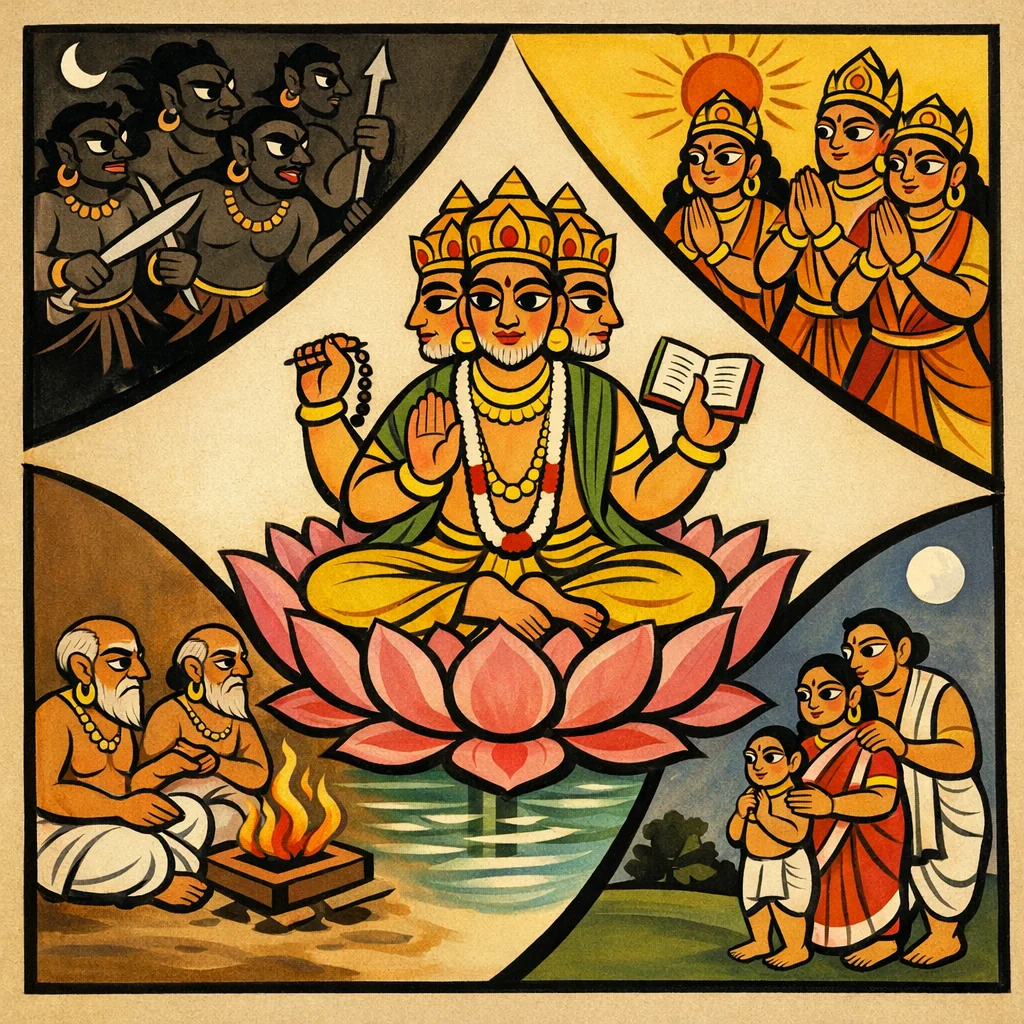
Adhyaya 48: The Emanation of Beings from Brahma: Night, Day, Twilight, and the Orders of Creation
प्राकृतवैक्रतसर्गवर्णन (Prākṛta-Vaikṛta-Sarga-Varṇana)
The Netherworlds
This adhyaya recounts how beings emanate from Brahmā, in harmony with the sacred cycle of night, day, and twilight (sandhyā). It sets forth the ordered stages of creation—from the primordial, natural prākṛta sarga to the derivative, transforming vaikṛta sarga—showing how the various classes of creatures arise according to cosmic law.
Divine Beings
Celestial Realms
Key Content Points
Focus Keywords
Shlokas in Adhyaya 48
Verse 1
इति श्रीमार्कण्डेयपुराणे प्राकृतवैकृतसर्गो नाम सप्तचत्वारिंशोऽध्यायः । अष्टचत्वारिंशोऽध्यायः— क्रौष्टुकिरुवाच— समासात् कथिता सृष्टिः सम्यग् भगवता मम । देवादीनां भवं ब्रह्मन् विस्तरात्तु ब्रवीहि मे ॥
Thus, in the Śrī Mārkaṇḍeya Purāṇa, the forty-seventh chapter called ‘Prākṛta and Vaikṛta Creation’ concludes. Chapter forty-eight begins. Krauṣṭuki said: ‘Creation has been correctly explained to me in brief by the Blessed One. O Brahmin, tell me in detail the origin of the gods and others.’
Verse 2
मार्कण्डेय उवाच कुशलाकुशलैर्ब्रह्मन् भाविता पूर्वकर्मभिः । ख्याता तथा ह्यनिर्मुक्ताः प्रलये ह्युपसंहृताः ॥
Mārkaṇḍeya said: O Brāhmaṇa, beings are shaped by prior actions—by what is wholesome and unwholesome. Thus they become known as such; they are not freed from that conditioning, and at the time of dissolution they are indeed reabsorbed.
Verse 3
देवाद्याः स्थावरान्ताश्च प्रजा ब्रह्मंश्चतुर्विधाः । ब्रह्मणः कुर्वतः सृष्टिं जज्ञिरे मानसास्तदा ॥
O Brāhmaṇa, the creatures—beginning with the gods and ending with the immovables—were fourfold. When Brahmā was performing creation, they then arose as mind-born beings.
Verse 4
ततो देवासुरान् पितॄन् मानुषांश्च चतुष्टयम् । सिसृक्षुरम्भांस्येतानि स्वमात्मानमयूयुजत् ॥
Thereupon, wishing to create the four groups—gods, asuras, pitṛs, and humans—he (Prajāpati) applied his own self in that act.
Verse 5
युक्तात्मनस्तमोमात्रा उद्रिक्ता भूत्त् प्रजापतेः । सिसृक्षोर्जघनात् पूर्वमसुरा जज्ञिरे ततः ॥
As Prajāpati—his self engaged in creation—had tamas predominant, the asuras were born first, from his posterior part.
Verse 6
उत्ससर्ज ततस्तां तु तमोमात्रात्मिकां तनुम् । सापविद्धा तनुस्तेन सद्यो रात्रिरजायत ॥
Then he cast off that body which consisted chiefly of tamas. When that body was discarded by him, Night came into being at once.
Verse 7
अन्यां तनुमुपादाय सिसृक्षुः प्रीतिमाप सः । सत्त्वोद्रेकास्ततो देवा मुखतस्तस्य जज्ञिरे ॥
Taking up another body, he—desiring to create—became pleased. Then, with sattva predominant, the gods were born from his mouth.
Verse 8
उत्ससर्ज च भूतेशस्तनुं तामप्यसौ विभुः । सा चापविद्धा दिवसṃ सत्त्वप्रायमजायत ॥
That mighty Lord of beings cast off that body as well. When it was discarded, Day came into being—predominantly of sattva.
Verse 9
सत्त्वमात्रात्मिकामेव ततोऽन्यां जगृहे तनुम् । पितृवन्मन्यमानस्य पितरस्तस्य जज्ञिरे ॥
Then he took up another body made solely of sattva. As he conceived (himself) in a pitṛ-like mode, the Pitṛs were born from him.
Verse 10
सृष्ट्वा पितॄन् उत्ससर्ज तनुं तामपि स प्रभुः । सा चोत्सृष्टाभवत् सन्ध्या दिवानक्तान्तरस्थिताः ॥
Having created the Pitṛs, that Lord cast off that body as well; when it was released, it became Twilight, situated between day and night.
Verse 11
रजोमात्रात्मिकामन्यां तनुं भेजेऽथ स प्रभुः । ततो मनुष्याः सम्भूता रजोमात्रासमुद्भवाः ॥
Then that Lord assumed another body made of rajas; from that, human beings arose, born from the measure of rajas.
Verse 12
सृष्ट्वा मनुष्याञ् स विभुरुत्ससर्ज तनुं ततः । ज्योत्स्ना समभवत् सा च नक्तान्तेऽहर्मुखे च या ॥
Having created human beings, that all-pervading Lord then cast off a body. From it arose moonlight (jyotsnā), which appears at the end of night and at the opening of day.
Verse 13
इत्येतास्तनवस्तस्य देवदेवस्य धीमतः । ख्याता रात्र्यहनी चैव सन्ध्या ज्योत्स्ना च वै द्विज ॥
Thus are these bodies of that wise Lord of the gods declared: night-and-day, twilight (sandhyā), and moonlight (jyotsnā), O twice-born.
Verse 14
ज्योत्स्ना सन्ध्या तथैवाह—सत्त्वमात्रात्मकं त्रयम् । तमोमात्रात्मिका रात्रिः सा वै तस्मात् त्रियामिका ॥
Moonlight and twilight, and likewise (day) are said to be constituted predominantly of sattva—three in all. Night is constituted predominantly of tamas; therefore it is called ‘triyāmā’ (the three watches).
Verse 15
तस्माद् देवा दिवा रात्रावसुरास्तु बलान्विताः । ज्योत्स्नागमे च मनुजाः सन्ध्यायां पितरस्तथा ॥
Therefore the gods are strong by day, and the asuras are strong at night. At the coming of moonlight humans are (strong), and at twilight the Pitṛs likewise (are strong).
Verse 16
भवन्ति बलिनोऽधृष्या विपक्षाणां न संशयः । तद्विपर्यमासाद्य प्रयान्ति च विपर्ययम् ॥
They become strong and unassailable to their opponents—of this there is no doubt. But when the contrary (time/condition) arrives, they too undergo reversal.
Verse 17
ज्योत्स्नो रात्र्यहनी सन्ध्या चत्वार्येतानि वै प्रभोः । ब्रह्मणस्तु शरीराणि त्रिगुणोपश्रितानि तु ॥
Moonlight, night and day, and twilight—these four indeed are the Lord’s bodies; they are bodies of Brahmā, resting upon the three guṇas.
Verse 18
चत्वार्येतान्यथोत्पाद्य तनुमन्यां प्रजापतिः । रजस्तमोमयीं रात्रौ जगृहे क्षुत्तृडन्वितः ॥
After producing these four, Prajāpati assumed another body at night—made of rajas and tamas—endowed with hunger and thirst.
Verse 19
तदन्धकारे क्षुत्क्षामानसृजद् भगवानजः । विरूपान् श्मश्रुलानत्तुमारब्धास्ते च तां तनुम् ॥
In that darkness, the Blessed Unborn (Aja) created beings wasted by hunger—misshapen and bearded; and they set about to devour that body.
Verse 20
रक्षाम इति तेभ्योऽन्ये य ऊचुस्ते तु राक्षसाः । खादाम इति ये चोचुस्ते यक्षा यक्षणात् द्विज ॥
Those among them who said, ‘Let us protect (it),’ became Rākṣasas. Those who said, ‘Let us eat (it),’ became Yakṣas—so called from their act of eating, O twice-born.
Verse 21
तान् दृष्ट्वा ह्यप्रियेनास्य केशाः शीर्यन्त वेधसः । समारोहणहीनाश्च शिरसो ब्रह्मणस्तु ते ॥
Seeing them, displeasure arose in the Creator (Vedhas), and his hair fell out. Thus those heads of Brahmā became without hair (bald).
Verse 22
सर्पणात्तेऽभवन् सर्पा हीनत्वादहयः स्मृताः । सर्पान् दृष्ट्वा ततः क्रोधात् क्रोधात्मानो विनिर्ममे ॥
From their creeping motion they came to be called “serpents”; and because of their lowliness they are remembered as “ahayaḥ”. Seeing the serpents, then, in anger he created beings whose very nature is wrath.
Verse 23
वर्णेन कपिलेनोग्रास्ते भूताः पिशिताशनाः । ध्यायतो गां ततस्तस्य गन्धर्वा जज्ञिरे सुताः ॥
Those fierce beings, tawny in color, became flesh-eaters. Then, as he contemplated the cow, the Gandharvas were born as his sons.
Verse 24
जज्ञिरे पिबतो वाचं गन्धर्वास्तेन ते स्मृताः । अष्टास्वेतासु सृष्टासु देवयोनिषु स प्रभुः ॥
They were born as he “drank in” speech; therefore they are remembered as Gandharvas. When these eight divine wombs (orders) were created, he (the Lord) [proceeded accordingly].
Verse 25
ततः स्वदेहतोऽन्यानि वयांसि पशवोऽसृजत् । मुखतोऽजाः ससर्जाथ वक्षसश्चावयोऽसृजत् ॥
Then from his own body he created other birds and animals. From his mouth he created goats, and from his chest he created sheep.
Verse 26
गावश्चैवोदराद् ब्रह्मा पार्श्वाभ्याञ्च विनिर्ममे । पद्भ्याञ्चाश्वान् स मातङ्गान् रासबान् शशकान् मृगान् ॥
And Brahmā fashioned cows from his belly, and from his sides as well. From his feet he produced horses, elephants, asses, hares, and deer.
Verse 27
उष्ट्रानश्वतरांश्चैव नानारूपाश्च जातयः । ओषध्यः फलमूलिन्यो रोमभ्यस्तस्य जज्ञिरे ॥
Camels and mules, and many other kinds of diverse forms, were also created. Medicinal plants—bearing fruits and roots—were born from his hairs.
Verse 28
एवं पश्वोषधीः सृष्ट्वा ह्ययजच्चाध्वरे विभुः । तस्मादादौ तु कल्पस्य त्रेतायुगमुखे तदा ॥
Thus, having created animals and medicinal plants, the Lord performed sacrifice according to the rite. Therefore, at the beginning of the kalpa—at the very opening of the Tretā-yuga—this sacrificial order commenced.
Verse 29
गौरजः पुरुषो मेषो अश्वाश्वतरगर्दभाः । एतान् ग्राम्यान् पशूनाहुरारण्यांश्च निबोध मे ॥
The cow, the goat, the human, the ram, the horse, the mule, and the donkey—these are declared to be domestic animals. And now understand from me those that are wild.
Verse 30
श्वापदं द्विखुरं हस्ती वानराः पक्षिपञ्चमाः । औदकाः पशवः षष्ठाः सप्तमास्तु सरीसृपाः ॥
Predatory beasts, cloven-hoofed animals, elephants, monkeys—birds as the fifth group; aquatic creatures as the sixth group of animals; and the seventh are the reptiles/creeping beings.
Verse 31
गायत्रीञ्च ऋचञ्चैव त्रिवृत् सोमं रथन्तरम् । अग्निष्टोमञ्च यज्ञानां निर्ममे प्रथमांमुखात् ॥
From the foremost mouth he created the Gāyatrī and the Ṛk hymns, the Trivṛt, the Soma, the Rathantara, and, among sacrifices, the Agniṣṭoma.
Verse 32
यजूṃषि त्रैष्टुभं छन्दः स्तोमं पञ्चदशं तथा । बृहत्साम तथोकथञ्च दक्षिणादसृजन्मुखात् ॥
From his southern face he brought forth the Yajus formulas, the Triṣṭubh metre, the fifteenfold stoma, and the Bṛhat sāman (chant), together with the sacrificial fee (dakṣiṇā).
Verse 33
सामानि जगतीच्छन्दः स्तोमं पञ्चदशं तथा । वैरूपमतिरात्रञ्च निर्ममे पश्चिमान्मुखात् ॥
From his western face he fashioned the Sāman chants, the Jagatī metre, the fifteenfold stoma, and also the Vairūpa (stoma/chant-form) and the Atirātra (overnight Soma rite).
Verse 34
एकविंशमथर्वाणमाप्तोर्यामाणमेव च । अनुष्टुभं सवैराजमुत्तरादसृजन्मुखात् ॥
From his northern face he brought forth the Atharvan (Atharvaveda), the Ekaviṃśa (twenty-onefold stoma), the Āptoryāma rite, the Anuṣṭubh metre, and the Vairāja (stoma/chant-form).
Verse 35
विद्युतोऽशनिमेघाश्च रोहितेन्द्रधनूंषि च । वयांसि च ससर्जादौ कल्पस्य भगवान् विभुः ॥
At the beginning of the aeon (kalpa), the Blessed, all-pervading Lord created lightning, thunder and clouds, the reddish glow and rainbows, and also birds.
Verse 36
उच्चावचानि भूतानि गात्रेभ्यस्तस्य जज्ञिरे । सृष्ट्वा चतुष्टयं पूर्वं देवासुरपितॄन् प्रजाः ॥
From his limbs were born beings of higher and lower kinds. Having first created the fourfold set—gods, asuras, pitṛs, and progeny—he proceeded further.
Verse 37
ततोऽसृजत स भूतानि स्थावराणि चराणि च । यक्षान् पिशाचान् गन्धर्वांस्तथैवाप्सरसांगणान् ॥
Then he created beings both immobile and mobile—yakṣas, piśācas, gandharvas, and likewise the hosts of apsarases.
Verse 38
नरकिन्नररक्षांसि वयः पशुमृगोरगान् । अव्ययं च व्ययं चैव यदिदं स्थाणुजङ्गमम् ॥
Humans, kinnaras, rākṣasas, birds, cattle, wild beasts, and serpents—indeed, whatever exists as immobile and mobile—(he created), both the imperishable and the perishable.
Verse 39
तेषां ये यानि कर्माणि प्राक् सृष्टेः प्रतिपेदिरे । तान्येव प्रतिपद्यन्ते सृज्यमानाः पुनः पुनः ॥
Whatever actions those beings had adopted before the (previous) creation, those very tendencies they take up again, being created repeatedly, time after time.
Verse 40
हिंस्त्राहिंस्त्रे मृदुक्रूरे धर्माधर्मावृतानृते । तद्भाविताः प्रपद्यन्ते तस्मात्तत्तस्य रोचते ॥
Toward violence and non-violence, gentleness and cruelty, dharma and adharma, truth and falsehood—beings proceed as they have been conditioned by those states; therefore, that very tendency becomes pleasing to each one.
Verse 41
इन्द्रियार्तेषु भूतेषु शरीरेषु च स प्रभुः । नानात्वं विनियोगञ्च धातैव व्यदधात् स्वयम् ॥
In the objects of the senses, in the elements, and in bodies, that Lord—indeed the Ordainer (Dhātṛ)—himself established diversity and the specific allocation of functions.
Verse 42
नाम रूपञ्च भूतानां कृत्यानाञ्च प्रपञ्चनम् । वेदशब्देभ्य एवाऽऽदौ देवादीनाञ्चकार सः ॥
At the very beginning, he (Brahmā) fashioned—by means of the sounds of the Veda—the detailed manifestation of names and forms for beings, and also established the ordering of rites and acts, beginning with the gods and so forth.
Verse 43
ऋषीणां नामधेयानि याश्च देवेषु सृष्टयः । शर्वर्यन्ते प्रसूतानामन्येषाञ्च ददाति सः ॥
He assigns the appellations of the seers (ṛṣis) and the various creations among the gods; and likewise he bestows (names/places) upon those born in the ‘Śarvarī’ line and upon others as well.
Verse 44
यथार्तावृतुलिङ्गानि नानारूपाणि पर्यये । दृश्यन्ते तानि तान्येव तथा भावाः युगादिषु ॥
Just as the distinctive marks of the seasons appear in succession in many forms—the very same patterns again and again—so too do conditions and states recur at the beginnings of the yugas.
Verse 45
एवंविधाः सृष्टयस्तु ब्रह्मणोऽव्यक्तजन्मनः । शर्वर्यन्ते प्रबुद्धस्य कल्पे कल्पे भवन्ति वै ॥
Such kinds of creations indeed occur for Brahmā, whose origin is from the unmanifest (avyakta); when he awakens, they arise in every kalpa—kalpa after kalpa.
Frequently Asked Questions
The chapter addresses how ontological diversity arises without arbitrariness: beings manifest from Brahmā’s guṇa-conditioned bodies, and their moral-psychological dispositions recur according to previously cultivated karma (e.g., violence/non-violence, dharma/adharma, truth/untruth).
Rather than specifying a particular Manu’s lineage, this Adhyāya supplies the cosmological groundwork presupposed by Manvantara histories: the initial categories of beings, their guṇa-based origins, and the ritual-Vedic structures that persist across kalpas and underpin later genealogies and dharma narratives.
It does not directly contribute to the Devī Māhātmya (which occurs later in the text). Its relevance is structural: it establishes a Brahmā-centered cosmogonic and karmic framework within which later theological sections—including Śākta materials—situate moral causality, cosmic cycles, and the ordering power of sacred speech.