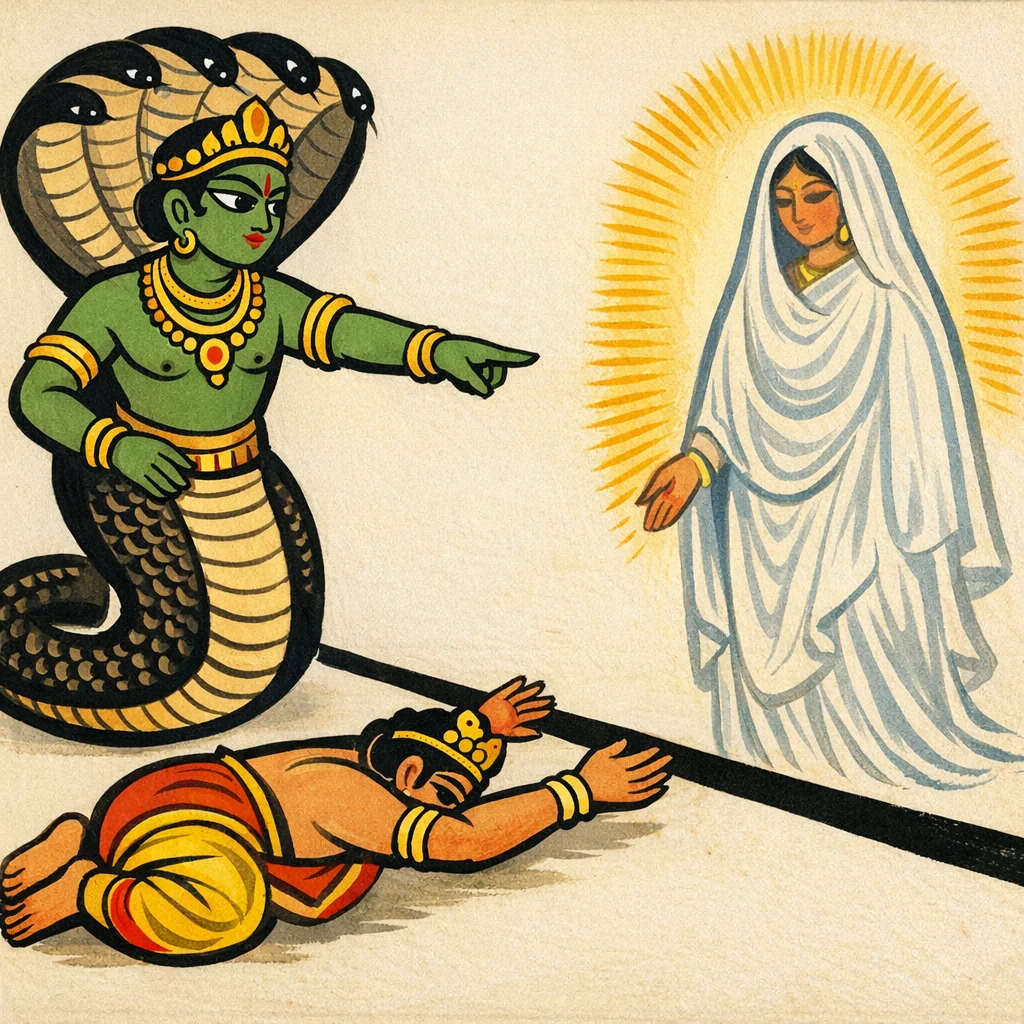
Adhyaya 24: Kuvalayashva’s Refusal of Gifts and the Vision of Madalasa’s Maya
कुवलयाश्वोपाख्याने मदालसामायादर्शनम् (Kuvalayāśvopākhyāne Madālasā-māyā-darśanam)
The Fowler's Discourse
In this adhyaya, King Kuvalayashva refuses gifts and praise, remaining steadfast in dharma and unbound by worldly gain. He then beholds Queen Madalasa’s display of maya, a vision that exposes the impermanence and delusion of worldly appearances, stirring discernment, detachment, and inner peace.
Celestial Realms
Key Content Points
Focus Keywords
Shlokas in Adhyaya 24
Verse 1
इति श्रीमार्कण्डेयपुराणे मदालसोपाख्याने कुवलयाश्वपातालगमनं नाम त्रयोविंशोऽध्यायः । चतुर्विंशोऽध्यायः । जड उवाच कृताहारं महात्मानामधिपं पवनाशिनाम् । उपासाञ्चक्रिरे पुत्रौ भूपालतनयस्तथा ॥
Thus, in the Śrī Mārkaṇḍeya Purāṇa, in the Madālasa episode, ends the twenty-third chapter called ‘Kuvalayāśva’s going to Pātāla.’ Chapter Twenty-Four. Jaḍa said: When the great-souled lord of the ‘wind-eaters’ (serpents) had finished his meal, the two sons, and likewise the king’s sons, attended upon him with service.
Verse 2
कथाभिरनुरूपाभिः स महात्मा भुजङ्गमः । प्रीतिं सञ्जनयामास पुत्रसख्युरुवाच च ॥
With fitting conversations, that great-souled serpent aroused affection; and he spoke to the son’s friend (Kuvalayāśva).
Verse 3
तव भद्र ! सुखं ब्रूहि गेहमभ्यागतस्य यत् । कर्तव्यमुत्सृजाशङ्कां पितरीव सुतो मयि ॥
O noble one, tell me what will please you—what should be done for one who has come to my house. Cast off doubt; be to me like a son to a father.
Verse 4
रजतं वा सुवर्णं वा वस्त्रं वाहनमासनम् । यद्वाभिमतमत्यर्थं दुर्लभं तद्वृणुष्व माम् ॥
Silver or gold, garments, a vehicle, a seat—whatever is exceedingly desired and hard to obtain, choose that from me.
Verse 5
कुवलयाश्व उवाच तव प्रसादाद्भगवन् ! सुवर्णादि गृहे मम । पितुरस्ति ममाद्यापि न किञ्चित् कार्यमीदृशम् ॥
Kuvalayāśva said: By your favor, O Lord, there is gold and the like in my house from my father even now; I have no need of anything of that sort.
Verse 6
ताते वर्षसहस्राणि शासतीमां वसुन्धराम् । तथैव त्वयि पातालं न मे याञ्चोन्मुखं मनः ॥
My father ruled this earth for thousands of years; likewise, even with you in Pātāla, my mind is not inclined toward begging (for boons).
Verse 7
ते स्वर्ग्याश्च सुपुण्याश्च येषां पितरि जीवति । तृणकोटिसमं वित्तं तारुण्याद्वित्तकोटिषु ॥
Blessed for heaven and rich in merit are those whose father is still alive. For them, even heaps of wealth count as nothing—like crores of blades of grass—when set beside the treasure of youthful strength.
Verse 8
मित्राणि तुल्यशिष्टानि तद्वद्देहमनामयम् । जनिता ध्रियते वित्तं यौवनं किं नु नास्ति मे ॥
I have friends of equal refinement, and likewise a healthy body. My father lives; I possess wealth; I have youth—what indeed is lacking for me?
Verse 9
असत्यार्थे नृणां याञ्चाप्रवणं जायते मनः । सत्यशेषे कथं याञ्चां मम जिह्वा करिष्यति ॥
When the aim is untrue, a person’s mind turns away from begging. If only truth remains for me, how could my tongue ever utter a request?
Verse 10
यैर् न चिन्त्यं धनं किञ्चिन् मम गेहेऽस्ति नास्ति वा । पितृबाहुतरुच्छायां संश्रिताः सुखिनो हि ते ॥
They need not worry at all whether there is wealth in my house or not; sheltered in the shade of the tree of a father’s arms, they are truly happy.
Verse 11
ये तु बाल्यात् प्रभृत्येव विना पित्रा कुटुम्बिनः । ते सुखास्वादविभ्रंशान् मन्ये धात्रैव वञ्चिताः ॥
But those householders who, from childhood onward, live without a father—I consider them deprived by the Creator himself, for they miss the very savor of happiness.
Verse 12
तद्वयं त्वत्प्रसादेन धनरत्नादिसञ्चयान् । पितृमुक्तान् प्रयच्छामः कामतो नित्यमर्थिनाम् ॥
Therefore, by your favor, we shall grant—according to desire and always to those who ask—stores of wealth, jewels, and the like, released for giving with our father’s consent.
Verse 13
तत् सर्वमिह संप्राप्तं यदङ्घ्रियुगलं तव । मच्चूडामणिना स्पृष्टं यच्चाङ्गस्पर्शमाप्तवान् ॥
All that has been obtained here—because the jewel upon my head touched your pair of feet, and because I attained the touch of your body.
Verse 14
जड उवाच इत्येवं प्रसृतं वाक्यमुक्तः पन्नगसत्तमः । प्राह राजसुतं प्रीत्या पुत्रयोरुपकारिणम् ॥
Jāḍa said: When these words had thus been spoken, the best of serpents, pleased, addressed the prince—the benefactor of his two sons.
Verse 15
नाग उवाच यदि रत्नसुवर्णादि मत्तोऽवाप्तुं न ते मनः । यदन्यन्मनसः प्रीत्यै तद्ब्रूहि त्वं ददाम्यहम् ॥
The Nāga said: If your mind does not wish to obtain jewels, gold, and such from me, then tell me what else would please your heart—I shall give it.
Verse 16
कुवलयाश्व उवाच भगवन्स्त्वत्प्रसादेन प्रार्थितस्य गृहे मम । सर्वमस्ति विशेषेण संप्राप्तं तव दर्शनात् ॥
Kuvalayāśva said: O revered one, by your grace, in my home everything sought is present—indeed, all has been especially attained simply by seeing you.
Verse 17
कृतकृत्योऽस्मि चैतेन सफलं जीवितञ्च मे । यदङ्गसंस्लेषमितस्तव देवस्य मानुषः ॥
By this I have accomplished what ought to be accomplished, and my life too has become fruitful—since I, a mere human, have obtained bodily contact with you, O divine one.
Verse 18
ममोत्तमाङ्गे त्वत्पादरजसा यदिहास्पदम् । कृतं तेनैव न प्राप्तं किं मया पन्नगेश्वर ॥
Since here the dust of your feet has found a place upon my head, what indeed remains unachieved by that alone? What, O lord of serpents, has not been attained by me?
Verse 19
यदि त्ववश्यं दातव्यो वरो मम यथेप्सितः । तत्पुण्यकर्मसंस्कारो हृदयान्मा व्यपैतु मे ॥
If a boon desired by me must indeed be granted, then may the ennobling impression (saṃskāra) of that meritorious deed not depart from my heart.
Verse 20
सुवर्णमणिरत्नादि वाहनं गृहमासनम् । स्त्रियोऽन्नपानं पुत्राश्च चारुमाल्यानुलेपनम् ॥
Gold, gems, and jewels; conveyances; a house and seat; women; food and drink; sons; and lovely garlands and unguents—
Verse 21
एते च विविधाः कामा गीतवाद्यादिकञ्च यत् । सर्वमेतन्मम मतं फलं पुण्यवनस्पतेः ॥
And these varied pleasures, and also music, instruments, and the like—all this, in my view, is the fruit of the ‘tree of merit’.
Verse 22
तस्मान्नरेण तन्मूलः कार्यो यत्नः कृतात्मना । कर्तव्यः पुण्यसक्तानां न किञ्चिद्भुवि दुर्लभम् ॥
Therefore, a self-controlled man should strive toward that root (merit). For those devoted to merit, nothing on earth is difficult to obtain.
Verse 23
अश्वतर उवाच एवम् भविष्यति प्राज्ञ ! तव धर्माश्रिता मतिः । सत्यञ्चैतत् फलं सर्वं धर्मस्योक्तं यथा त्वया ॥
Aśvatara said: “So it shall be, O wise one—your mind is grounded in dharma. And true indeed is all this fruit of dharma, as you have spoken.”
Verse 24
तथाप्यवश्यं मद्गेहमागतॆन त्वयाधुना । ग्राह्यं यन्मानुषे लोके दुष्प्राप्तं भवतो मतम् ॥
Even so, since you have now come to my house, you must accept something—what you deem difficult to obtain in the human world.
Verse 25
जड उवाच तस्यैतद्वचनं श्रुत्वा स तदा नृपनन्दनः । मुकावलोकनं चक्रे पन्नगेश्वरपुत्रयोः ॥
Jaḍa said: Hearing these words, the prince then cast a silent glance toward the two sons of the lord of serpents.
Verse 26
ततस्तौ प्रणिपत्योभौ राजपुत्रस्य यन्मतम् । तत्पितुः सकलं वीरौ कथयामासतुः स्फुटम् ॥
Then those two heroes, having bowed down, clearly related in full to their father what the prince intended.
Verse 27
पुत्रापूचतुः ततोऽस्य पत्नी दयिता श्रुत्वेमं विनिपातितम् । अत्यजद्दयितान् प्राणान् विप्रलब्धा दुरात्मना ॥
Then the sons asked about it. His beloved wife, hearing that he had been struck down, relinquished her cherished life-breath, having been deceived by a wicked one.
Verse 28
केनापि कृतवैरेण दानवेन कुबुद्धिना । गन्धर्वराजस्य सुता नाम्ना ख्याता मदालसा ॥
By an ill-minded Dānava who had fabricated enmity, the daughter of the king of the Gandharvas—renowned by the name Madālasā—was made the object and instrument of the plot.
Verse 29
कृतज्ञोऽयं ततस्तात ! प्रतिज्ञां कृतवानिमाम् । नान्या भार्या भवित्रीति वर्जयित्वा मदालसाम् ॥
Then, dear father, this ungrateful man made this vow: ‘No other woman shall become my wife,’ thereby rejecting Madālasā.
Verse 30
द्रष्टुं तां चारुसर्वाङ्गीमयं वीर ! ऋतध्वजः । तात ! वाञ्छति यद्येतत् क्रियते तत् कृतं भवेत् ॥
O hero, Ṛtadhvaja wishes to see her, she of lovely limbs. Dear father—if this is desired, then let it be done; it would count as accomplished.
Verse 31
अश्वतर उवाच भूतैर्वियोगिनो योगस्तादृशैरेव तादृशः । कथमेतद्विना स्वप्नं मायां वा शम्बरॊदिताम् ॥
Aśvatara said: ‘For one separated from beings, a “union” can only be with that of the same kind, brought forth by similar means. How can this be, unless it is a dream—or a māyā set forth by Śambara?’
Verse 32
जड उवाच प्रणिपत्य भुजङ्गेशं पुत्रः शत्रुजितस्ततः । प्रत्युवाच महात्मानं प्रेमलज्जासमन्वितः ॥
Jaḍa said: Then Śatrujit’s son, having bowed to the lord of the Nāgas, replied to the great-souled one, filled with affection and modest shame.
Verse 33
मायामयीमप्यधुना मम तात ! मदालसाम् । यदि दर्शयते मन्ये परं कृतमनुग्रहम् ॥
Dear father, even if Madālasā is made of māyā—if you show her to me now, I consider it the highest favor done to me.
Verse 34
अश्वतर उवाच तस्मात् पश्येह वत्स ! त्वं मायाञ्चेद् द्रष्टुमिच्छसि । अनुग्राह्यो भवान् गेहं बालोऽप्यभ्यागतो गुरुः ॥
Aśvatara said: “Therefore, dear child, see here—if you wish to behold māyā. You are worthy of favor; in a house, even a child who arrives as a guest is to be treated as a guru.”
Verse 35
जड उवाच आनयामास नागेन्द्रो गृहगुप्तां मदालसाम् । तेषां सम्मोहनार्थाय ज्जल्प च ततः स्फुटम् ॥
Jaḍa said: The lord of the Nāgas brought Madālasā, who had been kept hidden within the house; and then, for the purpose of deluding them, he spoke clearly.
Verse 36
दर्शयामास च तदा राजपुत्राय तां शुभाम् । सेयं न वेति ते भार्या राजपुत्र ! मदालसा ॥
Then he showed that auspicious woman to the prince and said: “Is she, or is she not, your wife, O prince—Madālasā?”
Verse 37
जड उवाच स दृष्ट्वा तां तदा तन्वीं तत्क्षणात् विगतत्रपः । प्रियेत्य् तामभिमुखं ययौ वाचमुदीरयन् । निवारयामास च तं नागः सोऽश्वतरस्त्वरन् ॥
Jaḍa said: Seeing that slender woman, he instantly became shameless; crying “Beloved!”, he went toward her with raised voice. But the Nāga and the swift Aśvatara hurriedly restrained him.
Verse 38
अश्वतर उवाच मायैयं पुत्र ! मा स्प्राक्षीः प्रागेव कथितं तव । अन्तर्धानमुपैत्याशु माया संस्पर्शनादिभिः ॥
Aśvatara said: “Child, this is māyā—do not touch it. I told you earlier: illusion quickly disappears when one tries to make contact with it and the like.”
Verse 39
ततः पपात मेदिन्यां स तु मूर्च्छापरिप्लुतः । हा प्रियेत्य् वदन् सोऽथ चिन्तयामास भामिनीम् ॥
Then he fell to the ground, overcome by faintness. Crying “Ah, beloved!”, he began to brood over that woman, aflame with passion.
Verse 40
अहो स्नेहोऽस्य नृपतेर्ममोपऱ्यचलं मनः । येनायं पातनोऽरीणां विना शस्त्रेण पातितः ॥
Ah—such is this king’s affection for me: his steadfast mind is fixed upon me; thus he, called a “downfaller of enemies,” has been brought down without any weapon.
Verse 41
मायेति दर्शिता तेन मिथ्या मायेति यत्स्फुटम् । वाय्वम्बुतेजसां भूमेराकाशस्य च चेष्टया ॥
Through him it was shown clearly that it is “māyā”, indeed false māyā—by the operations of wind, water, fire, earth, and space.
Verse 42
जड उवाच ततः कुवलयाश्वं तं समाश्वास्य भुजङ्गमः । कथयामास तत् सर्वं मृतसञ्जीवनादिकम् ॥
Jaḍa said: Then the serpent-being, having consoled Kuvalayāśva, recounted to him everything—beginning with the reviving of the dead and the matters connected with it.
Verse 43
ततः प्रहृष्टः प्रतिलभ्य कान्तां प्रणम्य नागं निजगाम सोऽथ । सुशोभमानः स्वपुरं तमश्वम् आरुह्य संचितितमभ्युपतेम् ॥
Then, delighted at having regained his beloved, he bowed to the Nāga and returned. Radiant, he mounted that horse and went to his own city, intent upon what he had resolved.
Frequently Asked Questions
The chapter examines what is truly worth requesting (or refusing) when offered boons: material prosperity versus the inner continuity of dharmic disposition (puṇya-saṃskāra). It also tests the stability of renunciation by exposing how attachment can reassert itself through māyā.
This Adhyāya does not develop Manvantara chronology. Instead, it advances the Madālasā-upākhyāna by deepening its ethical instruction—linking merit to character formation and illustrating māyā as a narrative device for moral testing.
It is outside the Devī Māhātmya (Adhyāyas 81–93) and contains no direct Śākta stuti or goddess-episode. Its closest thematic overlap is the broader Purāṇic use of māyā as an explanatory category for delusion and attachment, here enacted through the illusory Madālasā.