Adhyaya 16: The Son’s Counsel on Renunciation and the Anasuya–Mandavya Episode: The Suspension of Sunrise and the Power of Pativrata
पितापुत्रसंवादः — अनसूयामाहात्म्योपाख्यानम् (Pitāputrasaṃvādaḥ — Anasūyāmāhātmyopākhyānam)
Surya's Dynasty
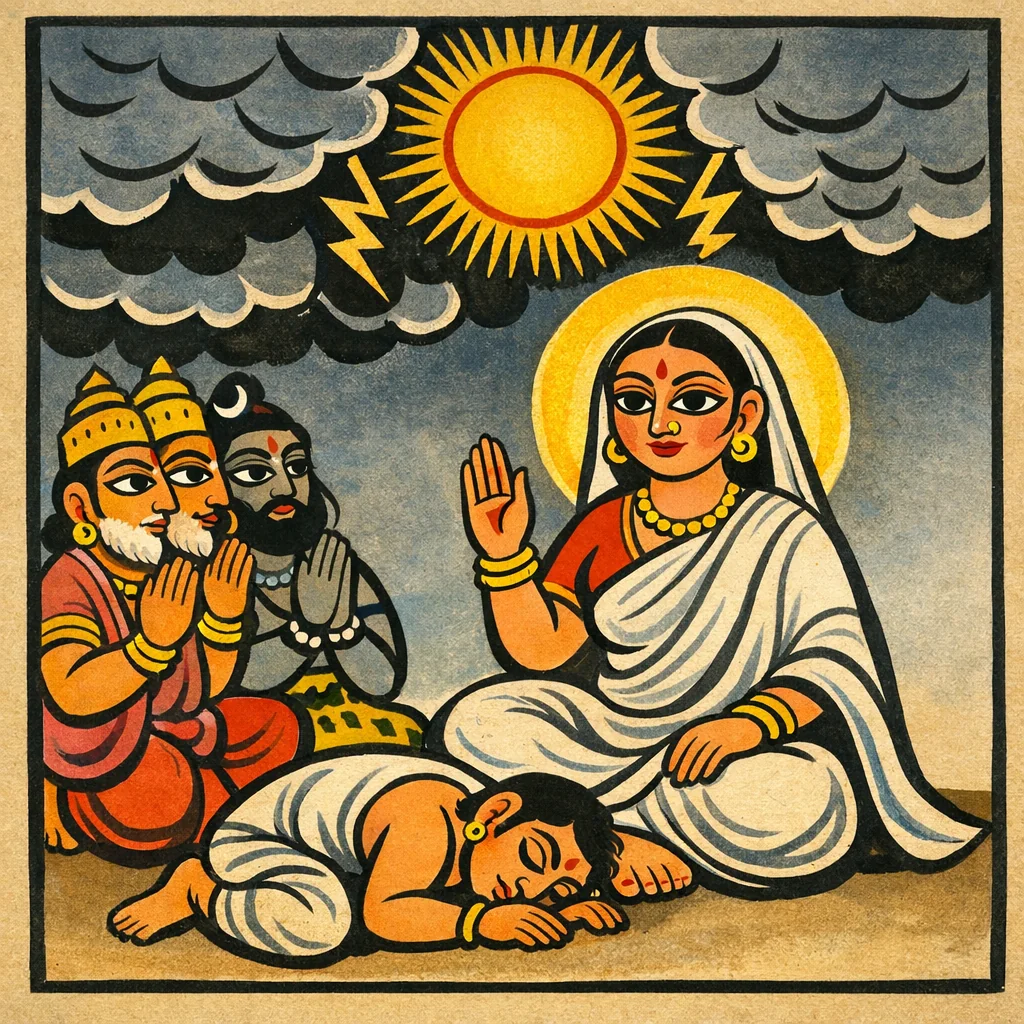
This adhyaya presents a father–son dialogue on renunciation and the release of worldly bonds. The son urges the abandonment of desire, anger, and ego, directing the mind toward the stillness of the Atman and the aim of liberation. It then recounts the Anasuya–Mandavya episode, extolling the might of a pativrata: through truth and the purity of her wifely vow, Anasuya is said to suspend sunrise itself to protect her husband, revealing dharma’s power to transcend even the order of nature.
Divine Beings
Celestial Realms
Key Content Points
Focus Keywords
Shlokas in Adhyaya 16
Verse 1
इति श्रीमार्कण्डेयपुराणे पितापुत्रसंवादो नाम पञ्चदशोऽध्यायः । षोडशोऽध्यायः पितावाच कथितं मे त्वया वत्स संसारस्य व्यवस्थितम् । स्वरूपमतीहेयस्य घटीयन्त्रवदव्ययम् ॥
Thus, in the revered Mārkaṇḍeya Purāṇa, ends the fifteenth chapter called “The Dialogue of Father and Son.” Chapter Sixteen: The father said: “Dear child, you have explained to me the ordered functioning of saṃsāra—its form, hard to pass beyond, unceasing, like the mechanism of a water-clock.”
Verse 2
तदेवमेतदखिलं मयावगतमीदृशम् । किं मया वद कर्तव्यमेवस्मिन् व्यवस्थिते ॥
So now I have understood all of this as it is. Tell me—what should I do, given that things are thus ordered?
Verse 3
पुत्र उवाच यदि मद्वचनं तात श्रद्धधास्यविशङ्कितः । तत् परित्यज्य गार्हस्थ्यं वानप्रस्थपरो भव ॥
The son said: “Father, if you will trust my words without doubt, then abandon the householder’s life and become devoted to the forest-dweller’s (vānaprastha) way.”
Verse 4
तम् अनुष्ठाय विधिवद् विहायाग्निपरिग्रहम् । आत्मन्यात्मानमाधाय निर्द्वन्द्वो निष्परिग्रहः ॥
“Having undertaken that discipline properly, and abandoning the maintenance of sacrificial fires, place the self within the Self; become free from opposites and free from possessions.”
Verse 5
एकान्तराशी वश्यात्मा भव भिक्षुरतन्द्रितः । तत्र योगापरो भूत्वा बाह्यस्पर्शविवर्जितः ॥
“Take food in solitude, be self-controlled; become a diligent mendicant. There, intent on yoga, remain one who avoids outward contacts (sense-touch and worldly engagements).”
Verse 6
ततः प्राप्स्यति तं योगं दुःशसंयोगभेषजम् । मुक्तिहेतुमनौपम्यमनाक्ख्येयमसङ्गिनम् । यत्संयोगान्न ते योगो भूयो भूतैर्भविष्यति ॥
“Then you will attain that yoga—the medicine for the hard-to-bear conjunction (with suffering). It is the cause of liberation: incomparable, inexpressible, and unattached. By its attainment, you will not again have any ‘yoga’ (connection) with embodied beings (i.e., you will not be reborn).”
Verse 7
पितावाच वत्स योगं ममाचक्ष्व मुक्तिहेतुमतः परम् । येन भूतैः पुनर्भूतो नेदृगः खमवाप्नुयाम् ॥
The father said: “Dear son, teach me that yoga, the supreme cause of liberation, by which—having become again among beings—I would not meet such a fate of sorrow in the sky of existence.”
Verse 8
यत्रासक्तिपरस्यात्मा मम संसारबन्धनैः । नैति योगमयोगोऽपि तं योगमधुना वद ॥
Tell me now of that yoga by which my self, intent on non-attachment, does not fall into bondage by the ties of saṃsāra—where even “non-yoga” does not become another “yoga,” a binding connection.
Verse 9
संसारादित्यतापार्तिविप्लुष्यद्देहमांससम् । ब्रह्मज्ञानाम्बुशीतॆन सिञ्च मां वाक्यवारिणा ॥
My body and mind are scorched, as though dripping away and wasting, by the tormenting heat of the sun of saṃsāra. Sprinkle me with the cool water of Brahman-knowledge—by the rain of your words.
Verse 10
अविद्याकृष्णसर्पेण दष्टं तद्विषपीडितम् । स्ववाक्यामृतपानेन मां जीवय पुनर्मृतम् ॥
Bitten by the black serpent of ignorance and oppressed by its poison, revive me—who am as good as dead—by making me drink the nectar of your words.
Verse 11
पुत्रदारगृहक्षेत्रममत्वनिगडार्दितम् । मां मोचयेष्टसद्भावविज्ञानोद्घाटनैस्त्वरन् ॥
I am afflicted by the fetters of “mine-ness” toward son, wife, house, and land. Quickly free me by opening to me the knowledge of true reality and the desired highest good.
Verse 12
पुत्र उवाच शृणु तात यथा योगो दत्तात्रेयेण धीमता । अलर्काय पुरा प्रोक्तः सम्यक् पृष्टेन विस्तरात् ॥
The son said: “Listen, father, to how the wise Dattātreya formerly taught yoga to Alarka—when he was properly questioned—at length.”
Verse 13
पितोवाच दत्तात्रेयः सुतः कस्य कथं वा योगमुक्तवान् । कश्चालर्को महाभागो यो यौगं परिपृष्टवान् ॥
The father said: “Dattātreya—whose son was he, and how did he attain liberation (mokṣa) through yoga? And who is that fortunate Alarka who inquired about yoga?”
Verse 14
पुत्र उवाच कौशिको ब्राह्मणः कश्चित् प्रतिष्ठानेऽभवत् पुरे । सोऽन्यजन्मकृतैः पापैः कुष्ठरोगातुरोऽभवत् ॥
The son said: “In the city of Pratiṣṭhāna there was a brāhmaṇa named Kauśika. Because of sins committed in a former birth, he became afflicted with leprosy.”
Verse 15
तं तथा व्याधितं भार्या पतिं देवमिवार्च्चयत् । पादाभ्यङ्गाङ्गसंवाह-स्त्रानाच्छादनभोजनैः ॥
Though he was so diseased, his wife honored her husband as if he were a god—by massaging his feet, rubbing his limbs, bathing him, clothing him, and feeding him.
Verse 16
श्लेष्म-मूत्र-पुरीषासृक्-प्रवाहक्षालनॆन च । रहश्चैवोपचारॆण प्रियसम्भाषणॆन च ॥
And by washing away the discharges of phlegm, urine, feces, and blood; by tending to him in private; and by speaking to him with affectionate words.
Verse 17
स तया पूज्यमानोऽपि सदातीव विनीतया । अतीव तीव्रकोपत्वान्निर्भर्त्सयति निष्ठुरः ॥
Though he was honored by her—ever so humble—yet, because of his exceedingly fierce anger, the cruel man continually rebuked her.
Verse 18
तथापि प्रणता भार्या तममन्यत दैवतम् । तं तथाप्यतिबीभत्सं सर्वश्रेष्ठममन्यत ॥
Even so, the devoted wife regarded him as her deity; and though he was most repulsive, she still considered him the best of all.
Verse 19
अचङ्क्रमणशोलोऽपि स कदाचिद् द्विजोत्तमः । प्राह भार्यां नयस्वेति त्वं मां तस्या निवेशनम् ॥
Though he was unable to walk, that excellent brāhmaṇa once said to his wife: “Take me—lead me—to her dwelling.”
Verse 20
या सा वेश्या मया दृष्टा राजमार्गे गृहोषिता । तां मां प्रापय धर्मज्ञे ! सैव मे हृदि वर्तते ॥
“That courtesan whom I saw, dwelling in a house on the royal road—take me to her, O you who know dharma! She alone abides in my heart.”
Verse 21
दृष्टा सूर्योदये बाला रात्रिश्चेयमुपागता । दर्शनानन्तरं सा मे हृदयान्नापसर्पति ॥
“I saw that young woman at sunrise, and now this night has come; since seeing her, she does not depart from my heart.”
Verse 22
यदि सा चारुसर्वाङ्गी पीनश्रोणिपयोधरा । नोपगूहति तन्वङ्गी तन्मां द्रक्ष्यसि वै मृतम् ॥
“If that slender-limbed woman—beautiful in every part, with full hips and breasts—does not embrace me, then you will surely see me dead.”
Verse 23
वामः कामो मनुष्याणां बहुभिः प्रार्थ्यते च सा । ममाशक्तिश्च गमने सङ्कुलं प्रतिभाति मे ॥
“Desire is fickle among human beings, and that woman is sought by many. As for me, I lack the strength to go; the journey appears difficult and confused, full of obstacles, to me.”
Verse 24
तत् तदा वचनं श्रुत्वा भर्तुः कामातुरस्य सा । तत्पत्नी सत्कुलोत्पन्ना महाभागा पतिव्रता ॥
Hearing those words of her husband, who was afflicted by desire, his wife—born in a good family, fortunate, and devoted to her husband—prepared to comply.
Verse 25
गागं परिकरं बद्ध्वा शुल्कमादाय चाधिकम् । स्कन्धे भर्तारमादाय जगाम मृदुगामिनी ॥
Having tied up the needed belongings and taking the fee (and more), she lifted her husband onto her shoulder and went forth—she of gentle gait.
Verse 26
निशि मेघास्तृते व्योम्नि चलद्विद्युत्प्रदर्शिते । राजमार्गे प्रियं भर्तुश्चिकीर्षन्ती द्विजाङ्गना ॥
At night, with the sky covered by clouds and lit by moving flashes of lightning, the brahmin woman walked on the royal road, wishing to do what was dear to her husband.
Verse 27
पथि शूले तथा प्रोतं चौरं यौरशङ्कया । माण्डव्यमतिदुःखार्तमन्धकारेऽथ स द्विजः ॥
On the road, in the darkness, that brahmin (Kauśika) came upon Māṇḍavya, pierced upon a stake—punished on suspicion as a thief—tormented by extreme pain.
Verse 28
पत्नीस्कन्धे समारूढश्चालयामास कौशिकः । पादावमर्षणात् क्रुद्धो माण्डव्यस्तमुवाच ह ॥
Mounted upon his wife’s shoulder, Kauśika jostled him. Angered by the trampling/striking of his feet, Māṇḍavya spoke to him.
Verse 29
येनाहमेवमत्यर्थं दुःखितश्चालितः पदाः । दशां कष्टामनुप्राप्तः स पापात्मा नराधमः ॥
“He by whom I—so exceedingly afflicted—have been struck/moved by feet while in this wretched condition: that one is a sinful soul, the lowest of men!”
Verse 30
सूर्योदयेऽवशः प्राणैर्विमोक्ष्यति न संशयः । भास्करालोकनादेव स विनाशमवाप्स्यति ॥
“At sunrise he will helplessly give up his life—without doubt. By merely seeing the sun’s light, he will meet destruction.”
Verse 31
तस्य भार्याततः श्रुत्वा तं शापमतिदारुणम् । प्रोवाच व्यथिता सूर्यो नैवोदयमुपैष्यति ॥
Then his wife, hearing that exceedingly dreadful curse, distressed, declared: “The sun will not rise at all.”
Verse 32
ततः सूर्योदयाभावादभवत् सन्तता निशा । बहून्यहः प्रमाणानि ततो देवा भयं ययुः ॥
Then, because sunrise did not occur, night became continuous. For many days’ measure, the gods then fell into fear.
Verse 33
निःस्वाध्यायवषट्कार-स्वधास्वाहाविवर्जितम् । कथं नु खल्विदं सर्वं न गच्छेत् संक्षयं जगत् ॥
If this whole world were devoid of svādhyāya (Vedic study) and of the ritual calls—vaṣaṭ, svadhā, and svāhā—how indeed would it not go to ruin?
Verse 34
अहोरात्रव्यवस्थाया विना मासर्तुसंक्षयः । तत्संक्षयान्न त्वयने ज्ञायेते दक्षिणोत्तरे ॥
Without the orderly arrangement of day and night, months and seasons would collapse; and when those collapse, the two ayanas—southern and northern—cannot be known.
Verse 35
विना चायनविज्ञानात् कालः संवत्सरः कुतः । संवत्सरं विना नान्यत् कालज्ञानं प्रवर्तते ॥
And without knowledge of the ayanas, how could there be the time-unit called the year? Without the year, no other knowledge of time can properly proceed.
Verse 36
पतिव्रताया वचसा नोद्गच्छति दिवाकरः । सूर्योदयṃ विना नैव स्नानदानादिकाः क्रियाः ॥
By the word (command) of a faithful wife (pativratā), the Sun does not rise; and without sunrise, acts such as bathing, gifting, and the like cannot be performed.
Verse 37
नाग्नेर्विहरणञ्चैव क्रात्वभावश्च लक्ष्यते । नैवाप्ययनमस्माकं विना होमेन जायते ॥
Even the ‘movement’ (activity) of fire and the very condition of sacrifice (yajña) are observed to depend on rites; likewise, our ayana (course/seasonal progression) does not arise without homa.
Verse 38
वयमाप्यायिता मर्त्यैर्यज्ञभागैर्यथोचितैः । वृष्ट्या ताननुगृह्णीमो मर्त्यान् शस्यादिसिद्धये ॥
We are nourished by humans through the proper shares of sacrifice; and by rain we show favor to those humans, so that crops and the like may prosper.
Verse 39
निष्पादितास्वोषधीषु मर्त्या यज्ञैर्यजन्ति नः । तेषां वयं प्रयच्छामः कामान् यज्ञादिपूजिताः ॥
When herbs and produce have been brought forth, mortals worship us with sacrifices; and when we are honored by sacrifice and the like, we grant them their desired aims.
Verse 40
अधो हि वर्षाम वयं मर्त्याश्चोर्ध्वप्रवर्षिणः । तोयवर्षेण हि वयं हविर्वर्षेण मानवाः ॥
We rain downward, while mortals “rain upward”. We do so by raining water; humans do so by raining oblations (havis).
Verse 41
ये नास्माकं प्रयच्छन्ति नित्यनैमित्तकीः क्रियाः । क्रतुभागं दुरात्मानः स्वयञ्चाश्नन्ति लोलुपाः ॥
Those who do not present to us the obligatory daily and occasional rites—those wicked, greedy people—consume the sacrificial share for themselves.
Verse 42
विनाशाय वयं तेषां तोयसूर्याग्निमारुतान् । क्षितिञ्च सन्दूषयामः पापानामपकारिणाम् ॥
For their destruction, we corrupt their water, sun, fire, and wind—and also the earth—of those sinful people who do harm.
Verse 43
दुष्टतोयादिभोगेन तेषां दुष्कृतकर्मिणाम् । उपसर्गाः प्रवर्तन्ते मरणाय सुदारुणाः ॥
By consuming impure water and the like, those who commit evil deeds are afflicted by dreadful calamities that move toward death.
Verse 44
ये त्वस्मान् प्रीणयित्वा तु भुञ्जते शेषमात्मना । तेषां पुण्यान् वयं लोकान् विदधाम महात्मनाम् ॥
But those who first gratify us and then partake of what remains for themselves—we grant to those great-souled ones the meritorious worlds.
Verse 45
तन्नास्ति सर्वमेवैतद्विनैषां व्युष्टिसंस्थितम् । कथं नु दिनसर्गः स्यादन्योऽन्यमवदन्सुराः ॥
All this cannot stand without their establishment of dawn; how, then, can the occurrence of day be?—thus the gods spoke to one another.
Verse 46
तेषामेव समेतानां यज्ञव्युच्छित्तिशङ्किनाम् । देवानां वचनं श्रुत्वा प्राह देवः प्रजापतिः ॥
When those gods had assembled, fearing the cessation of sacrifice, and their words were heard, the god Prajāpati spoke.
Verse 47
तेजः परं तेजसैव तपसा च तपस्तथा । प्रशाम्यतेऽमरास्तस्माच्छृणुध्वं वचनं मम ॥
O immortals, superior tejas is pacified only by tejas itself, and tapas by tapas; therefore listen to my words.
Verse 48
पतिव्रतायाः माहात्म्यान्नोद्गच्छति दिवाकरः । तस्य चानुदयाद्धानिर्मर्त्यानां भवतां तथा ॥
Because of the greatness of a devoted wife who keeps the vow to her husband (pativratā), the Sun does not rise; and from his not rising, harm likewise comes upon mortals (and upon you as well).
Verse 49
तस्मात् पतिव्रतामत्रेरनुभूयां तपस्विनीम् । प्रसादयत वै पत्नीं भानोरुदयकाम्यया ॥
Therefore, seeking the Sun’s sunrise, go and propitiate the ascetic, devoted wife of Atri—Anasūyā.
Verse 50
पुत्र उवाच तैः सा प्रसादिता गत्वा प्रोह्येष्टं व्रियतामिति । अयाचन्त दिनं देवाः भवत्विति यथा पुरा ॥
The son said: Pleased by them, she went and said, “Let the intended rite be completed.” Then the gods begged, “Let day come to be, as it was before.”
Verse 51
अनसूयोवाच पतिव्रतायाः माहात्म्यं न हीयेत कथंत्विति । सम्मान्य तस्मात् तां साध्वीमहमः स्त्रक्ष्याम्यहं सुराः ॥
Anasūyā said: “How could the greatness of a pativratā ever diminish?” Therefore, O gods, honoring that virtuous woman, I shall bring forth the day.
Verse 52
यथा पुनरहोरात्र-संस्थानमुपजायते । यथा च तस्याः स्वपतिर् न साध्व्या नाशमेṣ्यति ॥
This is to be ensured: that the order of day and night may arise again, and that her own husband may not come to destruction because of that virtuous woman.
Verse 53
पुत्र उवाच एवमुक्त्वा सुरां तस्याः गत्वा सा मन्दिरं शुभा । उवाच कुशलं पृष्टा धर्मं भर्तुस्तथात्मनः ॥
The son said: Having spoken thus, that auspicious lady went to her (Anasūyā’s) dwelling. When asked about her welfare, she spoke of the righteousness (dharma) of her husband and of herself.
Verse 54
अनसूयोवाच कच्चिन्नन्दसि कल्याणि स्वभर्तुर्मुखदर्शनात् । कच्चिच्चाखिलदेवेभ्यो मन्यसेऽभ्यधिकं पतिम् ॥
Anasūyā said: O auspicious one, are you joyful upon seeing your husband’s face? And do you regard your husband as superior even to all the gods?
Verse 55
भर्तृशुश्रूषणादेव मया प्राप्तं महत्फलम् । सर्वकामफलावाप्त्या प्रत्यूहाः परिवर्तिताः ॥
Through service to my husband alone I have obtained a great reward; by attaining the fruits of all desires, obstacles were turned back (removed).
Verse 56
पञ्चर्णानि मनुष्येण साध्वि ! देयानि सर्वदा । तथात्मवर्णधर्मेण कर्तव्यो धनसंचयः ॥
O virtuous lady, the five debts are always to be discharged by a person; and wealth should be accumulated in a manner consistent with one’s own varṇa-duty.
Verse 57
प्राप्तश्चार्थस्ततः पात्रे विनियोज्यो विधानतः । सत्यार्जव-तपो-दानैर्दयायुक्तो भवेत् सदा ॥
Whatever wealth is obtained should then be allotted, according to rule, to worthy recipients. One should always be endowed with truthfulness, straightforwardness, austerity, charity, and compassion.
Verse 58
क्रियाश्च शास्त्रनिर्दिष्टा रागद्वेषविवर्जिताः । कर्तव्या अन्वहं श्रद्धा-पुरस्कारेण शक्तितः ॥
The acts enjoined by the scriptures should be performed each day, free from attachment and aversion, with faith placed foremost and in accordance with one’s capacity.
Verse 59
स्वजातिविहितानेव लोकानाप्नोति मानवः । क्लेशेन महता साध्वि ! प्राजापत्यादिकान् क्रमात् ॥
A person attains only those worlds that are ordained for one’s own station (jāti/varna); O virtuous lady, with great effort one reaches, in due order, the Prajāpatya and other realms.
Verse 60
स्त्रियस्त्वेवं समस्तस्य नरैर्दुःखार्जितस्य वै । पुण्यस्यार्धापहारिण्यः पतिशुश्रूषयैव हि ॥
Thus, women indeed take half the merit that men acquire with hardship—through service to the husband alone.
Verse 61
नास्ति स्त्रीणां पृथग्यज्ञो न श्राद्धं नाप्युपोषितम् । भर्तृशुश्रूषयैवैतान् लोकानीष्टान् व्रजन्ति हि ॥
For women there is no separate sacrifice, nor śrāddha, nor even fasting (as an independent rite); by service to the husband alone they indeed go to the desired worlds.
Verse 62
तस्मात् साध्वि ! महाभागे ! पतिशुश्रूषणं प्रति । त्वया मतिः सदा कार्या यतो भर्ता परा गतिः ॥
Therefore, O virtuous and fortunate lady, you must always keep your mind directed toward serving your husband—because the husband is the highest refuge and goal for you.
Verse 63
यद्देवेभ्यो यच्च पित्रागतेभ्यः कुर्याद्भर्ताभ्यर्च्चनं सत्क्रियातः । तस्याप्यर्धं केवलानन्यचित्ता नारी भुङ्क्ते भर्तृशुश्रूषयैव ॥
Whatever worship and proper rites a husband performs for the gods and for the ancestral guests (pitṛs), a woman who is single-minded and undistracted receives half of that merit solely by serving her husband.
Verse 64
पुत्र उवाच तस्यास्तद्वचनं श्रुत्वा प्रतिपूज्य तथादरात् । प्रत्युवाचात्रिपत्नीं तामनसूयामिदं वचः ॥
The son said: Having heard her words, and having respectfully honored her, he replied to that Anasūyā—wife of Atri—with these words.
Verse 65
धन्यास्म्यनुगृहीतास्मि देवैश्चाप्यवलोकिता । यन्मे प्रकृतिकल्याणि ! श्रद्धां वर्धयसे पुनः ॥
I am fortunate; I am blessed, and even regarded by the gods—since you, O naturally auspicious one, increase my faith once again.
Verse 66
जानाम्येतन्न नारीणां काचित् पतिसमा गतिः । तत्प्रीतिश्चोपकाराय इह लोके परत्र च ॥
I know this: for women there is no course (refuge/goal) equal to the husband; and pleasing him is beneficial—both in this world and in the next.
Verse 67
पतिप्रसादादिह च प्रेत्य चैव यशस्विनि । नारी सुखमवाप्नोति नार्या भर्ता हि देवता ॥
By the husband’s favor—here and after death, O renowned one—a woman attains happiness; for the husband is indeed the deity of the wife.
Verse 68
सा त्वं ब्रूहि महाभागे ! प्राप्तायाः मम मन्दिरम् । आर्यायाः यन्मया कार्यं तथाऽऽर्येणापि वा शुभे ॥
Therefore, O noble lady, since you have come to my house, tell me: what should I do for an honored guest, and what should the noble one—yourself, O auspicious lady—also do?
Verse 69
अनसूयोवाच एते देवाः सहेन्द्रेण मामुपागम्य दुःखिताः । त्वद्वाख्यापास्तसत्कर्मदिननक्तनिरूपणाः ॥
Anasūyā said: These gods, together with Indra, came to me in distress—the proper rites having been cast aside, and the order of day and night thrown into disorder, as has been declared to you.
Verse 70
याचन्तेऽहर्निशासंस्थां यथावदविखण्डिताम् । अहं तदर्थमायाता शृणु चैतद्वचो मम ॥
They seek a proper and unbroken arrangement of day and night. For that purpose I have come; listen to these words of mine.
Verse 71
दिनाभावात् समस्तानामभावो यागकर्मणाम् । तदभावात् सुराः पुष्टिं नोपयान्ति तपस्विनि ॥
From the absence of day, all sacrificial rites cease; and from their cessation the gods do not obtain nourishment and strength, O ascetic lady.
Verse 72
अह्नश्चैव समुच्छेदादुच्छेदः सर्वकर्मणाम् । तदुच्छेदादनावृष्ट्या जगदुच्छेदमेष्यति ॥
Indeed, when the day is cut off, all actions are cut off; and from that cessation, through lack of rain, the world will proceed toward destruction.
Verse 73
तत् त्वमिच्छसि चेदेतत् जगदुद्धर्तुमापदः । प्रसीद साध्वि ! लोकानां पूर्ववद्धर्ततां रविः ॥
If you desire this—namely, to rescue the world from calamity—be gracious, O virtuous lady! Let the Sun sustain the worlds as before.
Verse 74
ब्राह्मण्युवाच माण्डव्येन महाभागे ! शप्तो भर्ता ममेश्वरः । सूर्योदये विनाशं त्वं प्राप्ससीत्यतिमन्युनाः ॥
The Brāhmaṇī said: “O noble lady! My lord and husband has been cursed by Māṇḍavya in great anger: ‘At sunrise you will meet destruction.’”
Verse 75
अनसूयोवाच यदि वा रोचते भद्रे ! ततस्त्वद्वचनादहम् । करोमि पूर्ववद्देहं भर्तारञ्च नवं तव ॥
Anasūyā said: “If this pleases you, O good lady, then at your word I shall restore your body as before—and grant a new husband for you.”
Verse 76
मया हि सर्वथा स्त्रीणां माहात्म्यं वरवर्णिनि । पतिव्रतानामाराध्यमिति संमानयामि ते ॥
For I, O fair-complexioned one, honor in every way the greatness of women—holding that the devotion of pativratā women is something to be revered and worshipped.
Verse 77
पुत्र उवाच तथेत्युक्ते तया सूर्यमाजुहाव तपस्विनी । अनसूयार्घ्यमुद्यम्य दशरात्रे तदा निशि ॥
The son said: When she said “So be it,” the ascetic woman invoked the Sun; and then, at night during the ten-night period, Anasūyā raised and offered the arghya.
Verse 78
ततो विवस्वान् भगवान् फुल्लपद्मारुणाकृतिः । शैलराजानमुदयमारुरोहो रुमण्डलः ॥
Then the blessed Vivasvān (the Sun), ruddy in form like a fully blossomed lotus, rose at dawn above the king of mountains, his orb vast.
Verse 79
समनन्तरमेवास्या भर्ता प्राणैर्व्ययुज्यत । पपत च महीपृष्ठे पतन्तं जगृहे च सा ॥
Immediately thereafter, her husband was severed from his life-breaths; he fell upon the earth’s surface, and she caught him as he was falling.
Verse 80
अनसूयोवाच न विषादस्त्वया भद्रे ! कर्तव्यः पश्य मे बलम् । पतिशुश्रूषयावाप्तं तपसः किं चिरेण ते ॥
Anasūyā said: “O good lady, do not despair—behold my power. What need have you of long austerities, when such power is obtained through devoted service to one’s husband?”
Verse 81
यथा भर्तृसमं नान्यमपश्यं पुरुषं क्वचित् । रूपतः शीलतो बुद्ध्या वाङ्माधुर्य्यादिभूषणैः ॥
(She says:) “I have never seen any man anywhere equal to my husband—whether in beauty, character, intelligence, or in ornaments such as sweetness of speech and the like.”
Verse 82
तेन सत्येन विप्रो 'यं व्याधिमुक्तः पुनर्युवा । प्राप्नोतु जीवितं भार्यासहायः शरदां शतम् ॥
By that truth, may this brāhmaṇa be freed from disease and become youthful again; and, together with his wife as companion, may he attain a life of a hundred autumns (a full, long life).
Verse 83
यथा भर्तृसमं नान्यमहं पश्यामि दैवतम् । तेन सत्येन विप्रोऽयं पुनर्जीवत्वनामयः ॥
“As I see no deity equal to my husband, by that truth may this brāhmaṇa live again, free from disease.”
Verse 84
कर्मणा मनसा वाचा भर्तुराराधनं प्रति । यथा ममोद्यमो नित्यं तथायं जीवतां द्विजः ॥
“With deed, mind, and speech, my effort is always directed to the worship and service of my husband; may this brāhmaṇa likewise live.”
Verse 85
पुत्र उवाच ततो विप्रः समुत्तस्थौ व्याधिमुक्तः पुनर्युवा । स्वभाभिर्भासयन् वेश्म वृन्दारक इवाजरः ॥
The son said: “Then the brāhmaṇa rose up—freed from disease, youthful again—illumining the house with his own radiance, like a celestial being, ageless.”
Verse 86
ततोऽपतत् पुष्पवृष्टिर्देववाद्यादिनिस्वनः । लेभिरे च मुदं देवा अनसूयामथाब्रुवन् ॥
“Then a rain of flowers fell, accompanied by the sound of divine instruments. The gods were filled with joy and spoke to Anasūyā.”
Verse 87
देवा ऊचुः वरं वृणीष्व कल्याणि देवकार्यं महत् कृतम् । त्वया यस्मात् ततो देवा वरदास्ते तपस्विनि ॥
The gods said: “Choose a boon, O auspicious one. Since you have accomplished a great work for the gods, the gods are boon-givers to you, O ascetic woman.”
Verse 88
अनसूयोवाच यदि देवाः प्रसन्ना मे पितामहपुरोगमाः । वरदा वरयोग्या च यद्यहं भवतां मता ॥
Anasūyā said: “If the gods—led by the Grandfather (Brahmā)—are pleased with me, and if you deem me worthy to receive a boon, you who are givers of boons…”
Verse 89
तद्यान्तु मम पुत्रत्वं ब्रह्म-विष्णु-महेश्वराः । योगञ्च प्राप्नुयां भर्तृसहिता क्लेशमुक्तये ॥
“Then let Brahmā, Viṣṇu, and Maheśvara become my sons; and may I, together with my husband, attain yoga for freedom from affliction.”
Verse 90
एवमस्त्विति तां देवा ब्रह्म-विष्णु-शिवादयः । प्रोक्त्वा जग्मुर्यथान्यायमनुमान्य तपस्विनीम् ॥
The gods—Brahmā, Viṣṇu, Śiva, and the others—said, “So be it.” Having spoken thus and having honored the ascetic woman, they departed in due order.
Frequently Asked Questions
The chapter asks how one should act after understanding saṃsāra’s instability—specifically, which discipline (yoga) functions as the direct cause of mokṣa. The son answers by prescribing renunciatory withdrawal (non-attachment, non-possession, inner absorption) and then reinforces the ethical dimension through an exemplum where vow-power and truth-speech have cosmic consequences.
This Adhyaya is not structured as a Manvantara catalogue; instead it advances the Purana’s analytical didactic mode by embedding a moral-cosmological case study (sunrise suspended, yajña interrupted, time-reckoning destabilized). Its contribution is thematic: it explains how dharma and tapas uphold cosmic time-order rather than detailing a specific Manu or Manvantara genealogy.
Adhyaya 16 is outside the Devi Mahatmyam (Adhyayas 81–93) and does not present Śākta stutis or battles. Its closest parallel is conceptual: it highlights extraordinary śakti manifested as pativratā-tapas (Anasūyā’s vow-power) that restores cosmic order, but it is not framed as Devī theology.