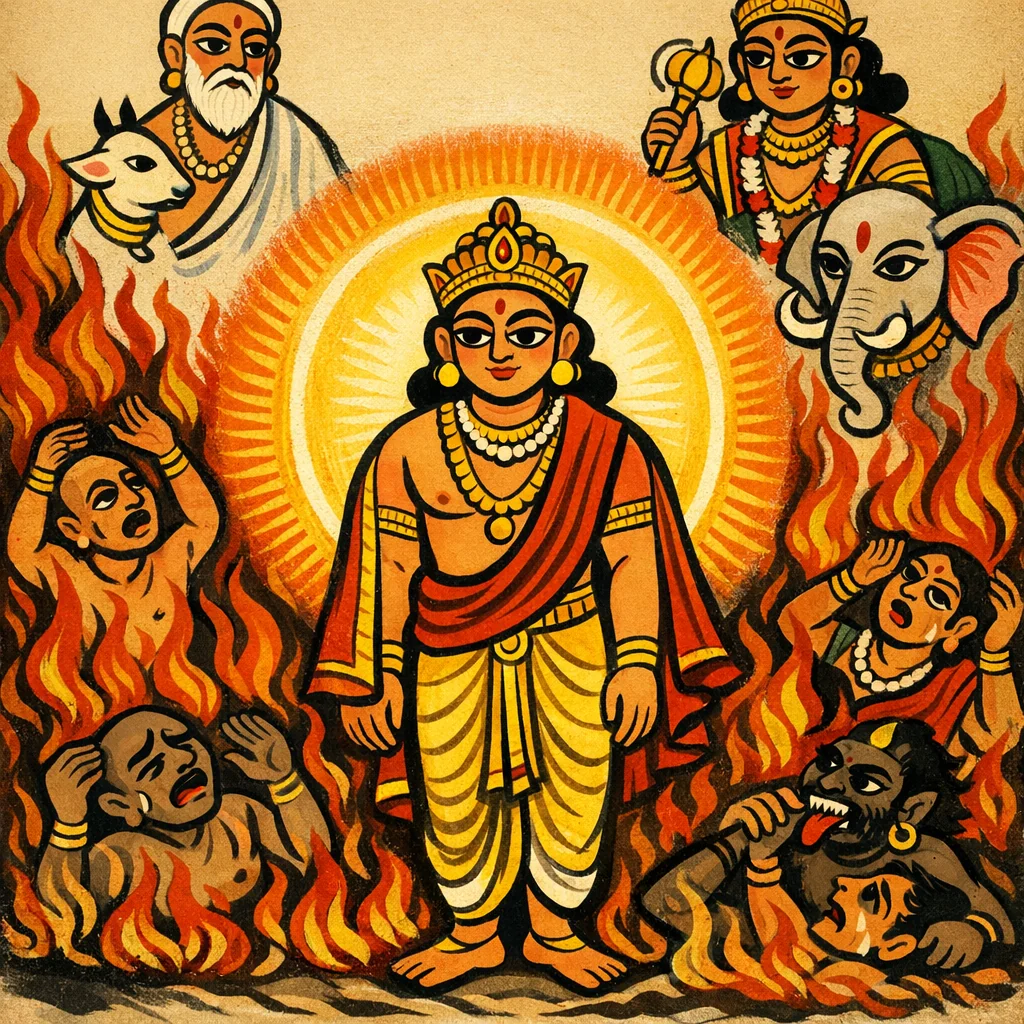
Adhyaya 15: Karmic Retribution: Rebirths After Naraka and the King’s Compassion in Hell
यमकिङ्करसंवादः (Yamakiṅkara-saṃvādaḥ)
Future Manvantaras
This adhyaya presents a dialogue between the Yamakiṅkaras, Yama’s attendants, and souls undergoing punishment in Naraka. Having endured karmic retribution, beings are shown to take rebirth again according to the balance of their virtues and sins. A king, witnessing the torments of hell, is stirred to compassion and sober awe at the strict law of karma, and the chapter upholds dharma, repentance, and righteous deeds as the means to shape a nobler future birth.
Divine Beings
Celestial Realms
Key Content Points
Focus Keywords
Shlokas in Adhyaya 15
Verse 1
इति श्रीमार्कण्डेयपुराणे जडोपाख्याने यमकिङ्करसंबादो नाम चतुर्दशोऽध्यायः । पञ्चदशोऽध्यायः यमकिङ्कर उवाच । पतितात् प्रतिगृह्यार्थं खरयोनिṃ व्रजेद् द्विजः । नरकात् प्रतिमुक्तस्तु कृमिः पतितयाजकः ॥
Thus ends the fourteenth chapter, “The Dialogue of the Messengers of Yama,” in the Jaḍopākhyāna of the Śrī Mārkaṇḍeya Purāṇa. Chapter fifteen begins. The messenger of Yama said: A brāhmaṇa who accepts wealth from a fallen man (patita) enters the womb of a donkey; but one who officiates sacrifices (yajña) for a fallen man, when released from hell, becomes a worm.
Verse 2
उपाध्यायव्यलीकन्तु कृत्वा श्वा भवति द्विजः । तज्जायां मनसावाञ्छन् तद्द्रव्यञ्चाप्यसंशयम् ॥
A brāhmaṇa who practices deceit or treachery against his teacher becomes a dog. One who in his mind covets the teacher’s wife—and also his wealth—falls likewise, without doubt.
Verse 3
गर्दभो जायते जन्तुः पित्रोश्चाप्यवमानकः । मातापितरावाक्रुश्य शारिका सम्प्रजायते ॥
A being that dishonors the forefathers becomes a donkey. And one who reviles his mother and father is born as a myna bird (śārikā).
Verse 4
भ्रातुः पत्न्यवमन्ता च कपोतत्वं प्रपद्यते । तामेव पीडयित्वा तु कच्छपत्वं प्रपद्यते ॥
One who dishonors his brother’s wife attains the state of a pigeon; and one who further harms or oppresses that very woman attains the state of a tortoise.
Verse 5
भर्तृपिण्डमुपाश्नन् यस्तदिष्टं न निषेवते । सोऽपि मोहसमापन्नो जायते वानरो मृतः ॥
Whoever eats the piṇḍa (funerary/ritual offering) meant for the husband and does not partake of what is properly intended (for oneself or for the rite), that deluded person, upon death, is born as a monkey.
Verse 6
न्यासापहर्ता नरकाद्विमुक्तो जायते कृमिः । असूयकश्च नरकान्मुक्तो भवति राक्षसः ॥
One who steals a deposit entrusted to him, after being released from hell, is born as a worm. And one who is envious, after release from hell, becomes a rākṣasa.
Verse 7
विश्वासहन्ता च नरो मीनयोनौ प्रजायते । धान्यं यवांस्तिलान् माषान् कुलत्थान् सर्षपांश्चणान् ॥
A man who destroys trust is born in the womb of a fish. And one who steals grain—barley, sesame, black-gram, horse-gram, mustard, and chickpeas—incurs consequences that are continued in the next verse.
Verse 8
कलायान् कलमान् मुद्गान् गोधूमानतसीस्तथा । शस्यान्यन्यानि वा हृत्वा मोहाज्जन्तुरचेतनः ॥
Stealing peas, rice (paddy), green-gram, wheat, flax, or other crops—through delusion—one becomes a senseless creature (with the specific animal form stated in the next verse).
Verse 9
सञ्जायते महावक्त्रो मूषिको बभ्रुसन्निभः । परदाराभिमर्षात्तु वृको घोरोऽभिजायते ॥
He is born as a large-mouthed mouse, brown in appearance. But by violating another man’s wife, one is reborn as a dreadful wolf.
Verse 10
श्वा शृगालो वको गृध्रो व्याडः कङ्कस्तथा क्रमात् । भ्रातृभार्यां च दुर्बुद्धिर्यो धर्षयति पापकृत् ॥
In due order he becomes a dog, a jackal, a heron, a vulture, a serpent, and a kanka-bird. The evil-doer of wicked mind who violates his brother’s wife falls into such births.
Verse 11
पुंस्कोकिलत्वमाप्नोति स चापि नरकाच्च्युतः । सखिभार्यां गुरोर्भार्यां राजभार्यां च पापकृत् ॥
That sinner—fallen back from hell—attains the state of a male cuckoo: one who violates the wife of a friend, the wife of a teacher, or the wife of a king.
Verse 12
प्रधर्षयित्वा कामात्मा शूकरो जायते नरः । यज्ञ-दान-विवाहानां विघ्रकर्त्ता भवेत् कृमिः ॥
Driven by lust, having violated (a woman), a man is born as a boar. One who obstructs sacrifices, gifts, and marriages becomes a worm.
Verse 13
पुनर्दात् च कन्यायाः कृमिरेवोपजायते । देवता-पितृ-विप्राणामदत्वा योऽन्नमश्नुते ॥
And one who ‘gives a maiden again’ (i.e., violates the proper rule of kanyā-dāna) is indeed born as a worm. Whoever eats food without first giving to the deities, the ancestors, and the Brahmins (incurs blame—the statement continues beyond the provided line).
Verse 14
प्रमुक्तो नरकात् सोऽपि वायसः सम्प्रजायते । ज्येष्ठं पितृसमं वापि भ्रातरं योऽवमन्यते ॥
He too, when released from hell, is born as a crow—namely, the one who shows contempt for his elder brother, who is to be regarded as equal to one’s father.
Verse 15
नरकात् सोऽपि विभ्रष्टः क्रौञ्चयोनौ प्रजायते । शूद्रश्च ब्राह्मणारिं गत्वा कृमियोनौ प्रजायते ॥
Fallen back from hell, he too is born in the womb of a krauñca-bird. And a Śūdra who goes to a Brāhmaṇa woman is born in the womb of a worm.
Verse 16
तस्यामपत्यमुत्पाद्य काष्ठान्तः कीटको भवेत् । शूकरः कृमिको मद्गुश्चण्डालश्च प्रजायते ॥
Having produced offspring in her, he becomes an insect within wood. He is born as a boar, a worm, a madgu (a kind of aquatic creature/bird as used in such lists), and also as a Caṇḍāla.
Verse 17
अकृतज्ञोऽधमः पुंसां विमुक्तो नरकान्नरः । कृतघ्रः कृमिकः कीटः पतङ्गो वृश्चिकस्तथा ॥
The ungrateful—lowest among men—when released from hell, is born as a worm, an insect, a moth/winged insect, and also as a scorpion.
Verse 18
मत्स्यस्तु वायसः कूर्मः पुक्कसो जायते ततः । अशस्त्रं पुरुषं हत्वा नरः सञ्जायते खरः ॥
Thereafter he is born as a fish, a crow, a tortoise, and a pukkasa. Having killed an unarmed man, a person is born as a donkey.
Verse 19
कृमिः स्त्रीवधकर्त्ता च बालहन्ता च जायते । भोजनं चोरयित्वा तु मक्षिका जायते नरः ॥
The slayer of a woman and the slayer of a child are born as worms. And a man who has stolen food is born as a fly.
Verse 20
तत्राप्यस्ति विशेषो वै भोजनस्य शृणुष्व तत् । हत्वान्नन्तु स मार्जारो जायते नरकाच्च्युतः ॥
Even in that matter there is indeed a distinction regarding food—listen to it. Having stolen cooked rice/food, he becomes a cat, fallen from hell.
Verse 21
तिलपिण्याकसम्मिश्रमन्नं हृत्वा तु मूषिकः । घृतं हृत्वा च नकुलः काको मद्गुरजामिषम् ॥
Having stolen food mixed with sesame-cake, he becomes a mouse/rat. Having stolen ghee, he becomes a mongoose. Having stolen the flesh of madgu, he becomes a crow.
Verse 22
मत्स्यमांसापहृत् काकः श्येनो मार्गामिषापहृत् । वीची काकस्त्वपहृते लवणे दधनि कृमिः ॥
One who steals fish-meat becomes a crow; one who steals game-meat becomes a hawk. One who steals salt becomes a vīcīkāka (a kind of crow); and one who steals curd becomes a worm.
Verse 23
चोरयित्वा पयश्चापि बलाका सम्प्रजायते । यस्तु चोरयते तैलं तैलपायी स जायते ॥
Having stolen milk, one is born as a heron (balākā). And one who steals oil is born as a ‘tailapāyī’—an oil-drinker.
Verse 24
मधु हृत्वा नरो दंशः पूपं हृत्वा पिपीलिकः । चोरयित्वा तु निष्पावान् जायते गृहगोलकः ॥
He who steals honey is reborn as a gadfly, a biting insect; he who steals cakes is reborn as an ant. But he who steals niṣpāva (a kind of pulse/bean) is born as a gṛhagolaka, a house-dwelling creature, a domestic vermin.
Verse 25
आसवं चोरयित्वा तु तित्तिरित्वमवाप्नुयात् । अयो हृत्वा तु पापात्मा वायसः सम्प्रजायते ॥
Having stolen āsava (fermented liquor), one attains rebirth as a partridge. But having stolen iron, the sinful person is born as a crow.
Verse 26
हृते कांस्ये च हारीतः कपोतो रूप्यभाजने । हृत्वा तु काञ्चनं भाण्डं कृमियोनौ प्रजायते ॥
If bronze is stolen, one is born as hārīta, a green parrot-like bird; if a silver vessel is stolen, one is born as a pigeon. Having stolen a golden utensil, one is born in the womb, in the species of worms.
Verse 27
पत्रोर्णं चोरयित्वा तु क्रकरत्वञ्च गच्छति । कोषकारश्च कौषेयॆ हृते वस्त्रेऽभिजायते ॥
Having stolen patrorṇa (a cloth of leaf-fibre, plant-based), one becomes a krakara (a certain bird). And if a silk garment is stolen, one is born as a koṣakāra, a silkworm.
Verse 28
दुकूले शार्ङ्गकः पापो हृते चैवांशुके शुकः । तथैवाजाविकं हृत्वा वस्त्रं क्षौमं च जायते ॥
If fine cloth (dukūla) is stolen, the sinner is born as a śārṅgaka (a kind of bird). If a light garment (aṃśuka) is stolen, one is born as a parrot. Likewise, having stolen woollen cloth (ājāvika), one is born in a condition connected with kṣauma (linen).
Verse 29
कार्पासिके हृते क्रौञ्चो वल्कहर्ता बकस्तथा । मयूरो वर्णकान् हृत्वा शाकपत्रं च जायते ॥
If cotton cloth is stolen, one is born as a krauñca (a crane/heron-like bird). A thief of bark-garments (valka) becomes a baka (heron). Having stolen dyes or pigments, one becomes a peacock; and one who steals leafy vegetables becomes (a creature called) śākapatra.
Verse 30
जीवज्जीवकतां याति रक्तवस्त्रापहृन्नरः । छुच्छुन्दरीः शुभान् गन्धान् वासो हृत्वा शशो भवेत् ॥
A man who steals red garments becomes a jīvajjīvaka (a kind of bird). One who steals fine scents or perfumes and clothing becomes a chucchundarī (shrew/field-mouse); having stolen a garment, one becomes a hare.
Verse 31
षण्डः फलापहरणात् काष्ठस्य घुणकीटकः । पुष्पापहृद् दरिद्रश्च पङ्गुर्यानापहृन्नरः ॥
By stealing fruit one becomes a ṣaṇḍha (a eunuch or impotent person). By stealing wood one becomes a ghuṇakīṭa (a wood-boring insect). A thief of flowers becomes poor; and a man who steals a vehicle becomes lame.
Verse 32
शाकहर्ता च हारीतस्तोयहर्ता च चातकः । भूर्हर्ता नरकान् गत्वा रौरवादीन् सुदारुणान् ॥
A thief of vegetables becomes a hārīta (a green bird); a thief of water becomes a cātaka (the rain-bird). But a thief of land, after going to terrible hells such as Raurava and others, suffers severely.
Verse 33
तृण-गुल्म-लता-वल्ली-त्वक्सारतरुतां क्रमात् । प्राप्य क्षीणाल्पपापस्तु नरो भवति वै ततः ॥
After attaining, in sequence, the states of grass, shrubs, creepers, vines, bark-fibre plants, and trees, the one whose minor sins have been exhausted then indeed becomes a human again.
Verse 34
कृमिः कीटः पतङ्गोऽथ पक्षी तोयचरो मृगः । गोत्वं प्राप्य च चण्डालपुक्कसादि जुगुप्सितम् ॥
He becomes a worm, an insect, then a moth; then a bird, an aquatic creature, and a beast. After attaining birth as a cow, he is born among the despised groups such as caṇḍālas and pukkasas.
Verse 35
पङ्ग्वन्धो वधिरः कुष्ठी यक्ष्मणा च प्रपीडितः । मुखरोगाक्षिरोगैश्च गुदरोगैश्च बाध्यते ॥
He becomes lame, blind, and deaf; afflicted with leprosy and tormented by consumption. He is also troubled by diseases of the mouth, diseases of the eyes, and diseases of the anus.
Verse 36
अपस्मारी च भवति शूद्रत्वं च स गच्छति । एष एव क्रमो दृष्टो गोसुवर्णापहारिणाम् ॥
He becomes epileptic (afflicted with apasmāra) and he falls into śūdra-status. This very sequence is observed for those who steal cows and gold.
Verse 37
विद्यापहारीणश्चोग्रा निष्क्रयभ्रंशिनो गुरोः । जायामन्यस्य पुरुषः पारख्यां प्रतिपादयन् ॥
Those who steal knowledge, those who cause the loss of a guru’s fee/compensation (guru-dakṣiṇā), and a man who delivers another man’s wife into the possession of others—these are fierce sins.
Verse 38
प्राप्नोति षण्डतां मूढो यातनाभ्यः परिच्युतः । यः करोति नरो होममसमिद्धे विभावसौ ॥
The deluded man who performs a homa when the fire (Vibhāvasu) is not properly kindled attains impotence (ṣaṇḍhatā), after falling away from the punishments/torments that are due.
Verse 39
सोऽजीर्णव्याधिदुःखार्तो मन्दाग्निः संप्रजायते । परनिन्दा कृतघ्रत्वं परमार्मावघट्टनम् ॥
He becomes afflicted with indigestion, disease, and pain, and his digestive fire (agni) grows weak. There also arise slander of others, ingratitude, and wounding others at their most sensitive points.
Verse 40
नैष्ठुर्यं निर्घृणत्वञ्च परदारोपसेवनम् । परस्वहरणाशौचं देवतानाञ्च कुत्सनम् ॥
Harshness, mercilessness, consorting with another’s wife, stealing another’s property, impurity, and reviling the deities—these are condemned.
Verse 41
निकृत्या कञ्चनं नृणां कार्पण्यं च नृणां वधः । यानि च प्रतिषिद्धानि तत्प्रवृत्तिश्च सन्तता ॥
Cheating people out of their gold, miserliness, killing human beings, and whatever acts are forbidden—together with continual engagement in them—are to be recognized as grave faults.
Verse 42
उपलक्ष्याणि जानीयान्मुक्तानां नरकादनु । दया भूतेषु संवादः परलोकप्रतिक्रिया ॥
One should know the distinguishing signs of those released from hell: compassion toward beings, harmonious speech and conduct, and proper regard for the other world (acting with awareness of consequences beyond this life).
Verse 43
सत्यं भूतहितार्थोक्तिर्वेदप्रामाण्यदर्शनम् । गुरु देवर्षि सिद्धर्षिपूजनं साधुसङ्गमः ॥
Truthfulness; speech spoken for the welfare of beings; recognition of the Veda as authoritative; worship and honoring of the guru, the divine sages (devarṣis) and the perfected sages (siddharṣis); and association with the virtuous.
Verse 44
सत्क्रियाभ्यासनं मैत्रीमिति बुध्यते पण्डितः । अन्यानि चैव सद्धर्मङ्क्रियाभूतानि यानि च ॥
A learned man is known by the practice of good conduct and by friendliness, and also by whatever other deeds are constituted as good dharma.
Verse 45
स्वर्गच्युतानां लिङ्गानि पुरुषाणामपापिनाम् । एतदुद्देशतो राजन् भवतः कथितं मया ॥
O King, the signs of men who have fallen from heaven though not sinful—this much I have stated to you in brief.
Verse 46
स्वकर्मफलभोक्तॄणां पुण्यानां पापिनां तथा । तदेह्यन्यत्र गच्छामो दृष्टं सर्वं त्वयाधुना । त्वया दृष्टो हि नरकस्तदेह्यन्यत्र गम्यताम् ॥
Both the meritorious and the sinful enjoy the fruits of their own deeds. Come—let us go elsewhere; you have now seen everything. Indeed you have seen Naraka; come, let us proceed to another place.
Verse 47
पुत्र उवाच ततस्तमग्रतः कृत्वा स राजा गन्तुमुद्यतः । ततश्च सर्वैरुत्कृष्टं यातनास्थायिभिर्नृभिः ॥
The son said: Then, placing him in front, that king set out; and then a loud cry was raised by all those men who were undergoing torment.
Verse 48
प्रसादं कुरु भूपेति तिष्ठ तावन्मुहूर्तकम् । त्वदङ्गसङ्गी पवनो मनो ह्लादयते हि नः ॥
“Show us favor, O King—stay for just a moment. The wind that touches your body gladdens our minds.”
Verse 49
परितापञ्च गात्रेभ्यः पीडाबाधाश्च कृत्स्नशः । अपहन्ति नरव्याघ्र यदां कुरु महीपते ॥
O tiger among men, O lord of the earth, when you remain here, the burning pain and all afflictive torments depart from our limbs.
Verse 50
एतच्छ्रुत्वा वचस्तेषां तं याम्यपुरुषं नृपः । पप्रच्छ कथमेतेषामाह्लादो मयि तिष्ठति ॥
Hearing their words, the king asked that servant of Yama: “How does this gladness arise for them when I remain here?”
Verse 51
किं मया कर्म तत्पुण्यं मर्त्यलोके महत्कृतम् । आह्लाददायिनी व्युष्टिर्येनेयं तदुदीरय ॥
“What great meritorious deed did I perform in the mortal world, by which this joy-giving effect has arisen? Tell me that.”
Verse 52
यमपुरुष उवाच पितृदेवातिथिप्रैष्य-शिष्टेनान्नेन ते तनुः । पुष्टिमभ्यागता यस्मात्तद्गतं च मनो यतः ॥
The Yamapuruṣa said: “Because your body was nourished by food first offered, in due manner, to the ancestors, the gods, guests, servants/dependents, and the worthy—therefore the mind, too, became oriented to that merit.”
Verse 53
ततस्त्वद्गात्रसंसर्गो पवनो ह्लाददायकः । पापकर्मकृतो राजन् यातना न प्रबाधते ॥
Therefore, O King, the wind that comes into contact with your body becomes joy-giving; and the torments do not oppress even the doers of sinful deeds so long as they receive that influence.
Verse 54
अश्वमेधादयो यज्ञास्त्वयेष्टा विधिवद्यतः । ततस्त्वद्दर्शनाद्यामी यन्त्रशस्त्राग्निवायसाः ॥
“You have duly performed the Aśvamedha and other sacrifices according to rule. Therefore, at the very sight of you, the instruments of the Yama-realms—its weapons, fire, and tormenting winds—are checked.”
Verse 55
पीडनच्छेददाहादिमहादुःखस्य हेतवः । मृदुत्वमागता राजन् तेजसापहता स्तव ॥
“The causes of great suffering—crushing, cutting, burning, and the like—have become mild, O King, driven back by your radiance (tejas).”
Verse 56
राजोवाच न स्वर्गे ब्रह्मलोके वा तत्सुखं प्राप्यते नरैः । यदार्तजन्तुनिर्वाणदानोत्थमिति मे मतिः ॥
The King said: “That happiness is not attained by men even in heaven or in Brahmaloka—the happiness that arises from granting relief and deliverance to afflicted beings; such is my conviction.”
Verse 57
यदि मत्सन्निधावेतान् यातना न प्रबाधते । ततो भद्रमुखात्राहं स्थास्ये स्थाणुरिवाचलः ॥
“If, by my presence, torment does not afflict these beings, then—O fair-faced one—I shall remain here, unmoving like a pillar.”
Verse 58
यमपुरुष उवाच एहि राजन् प्रगच्छामो निजपुण्यसमर्जितान् । भुङ्क्ष्व भोगानपास्येह यातनाः पापकर्मणाम् ॥
Yama’s man said: “Come, O King, let us go onward to the enjoyments you have earned by your own merit. Here, behold the torments of those who have done sinful deeds.”
Verse 59
राजोवाच तस्मान्न तावद्यास्यामि यावदेतॆ सुदुःखिताः । मत्सन्निधानात् सुखिनो भवन्ति नरकौकसः ॥
The King said: “Therefore I will not depart, so long as these exceedingly miserable dwellers in hell become happy by my presence.”
Verse 60
धिक् तस्य जीवनं पुंसः शरणार्थिनमातुरम् । यो नार्तमनुगृह्णाति वैरिपक्षमपि ध्रुवम् ॥
“Shame on the life of that man who does not help an afflicted person seeking refuge—even if he belongs to the enemy’s side, indeed.”
Verse 61
यज्ञदानतपांसीह परत्र च न भूतये । भवन्ति तस्य यस्यार्तपरित्राणे न मानसम् ॥
“For that person whose mind is not set on protecting the afflicted, sacrifices, gifts, and austerities—here and hereafter—do not lead to welfare.”
Verse 62
नरस्य यस्य कठिनं मनो बालातुरादिषु । वृद्धेषु च न तं मन्ये मानुषं राक्षसो हि सः ॥
“That person whose heart is hard toward children, the sick, and the like—and toward the aged—I do not consider him human; he is truly a rākṣasa.”
Verse 63
एतेषां सन्निकर्षात् तु यद्यग्निपरितापजम् । तथोग्रगन्धजं वापि दुःखं नरकसम्भवम् ॥
“But by proximity to these (beings), if there arises pain born of the scorching of fire—or likewise pain born of a terrible stench—(that too is) a suffering originating in hell.”
Verse 64
क्षुत्पिपासाभवं दुःखं यच्च मूर्च्छाप्रदं महत् । एतेषां त्राणदानन्तु मन्ये स्वर्गसुखात् परम् ॥
The suffering born of hunger and thirst, and that great torment which causes fainting—by granting rescue to beings afflicted by these, I deem it superior even to the pleasures of heaven.
Verse 65
प्राप्स्यन्त्यर्ता यदि सुखं बहवो दुःखिते मयि । किं नु प्राप्तं मया न स्यात् तस्मात् त्वं व्रज माचिरम् ॥
If many afflicted beings will obtain happiness while I remain in suffering, then what, in truth, would not be attained by me? Therefore, you may go—do not delay.
Verse 66
यमपुरुष उवाच एष धर्मश्च शक्रश्च त्वां नेतुं समुपागतौ । अवश्यं अस्माद् गन्तव्यं तस्मात् पार्थिव गम्यताम् ॥
A servant of Yama said: ‘Here are Dharma and Śakra (Indra) who have come to lead you. From here you must surely depart; therefore, O king, let it be so—go.’
Verse 67
धर्म उवाच नयामि त्वामहं स्वर्गं त्वया सम्यगुपासितः । विमानमेतदारुह्य मा विलम्बस्व गम्यताम् ॥
Dharma said: ‘I shall lead you to heaven, for I have been rightly honored by you. Ascend this celestial car (vimāna); do not delay—let us depart.’
Verse 68
राजोवाच नरके मानवाः धर्म पीड्यन्तेऽत्र सहस्रशः । त्राहीति चार्ताः क्रन्दन्ति मामतो न व्रजाम्यहम् ॥
The king said: ‘In hell, O Dharma, humans are tormented here by the thousands. The distressed cry out, “Save us!” Therefore I will not go away from here.’
Verse 69
इन्द्र उवाच कर्मणा नरकप्राप्तिरेतेषां पापकर्मिणाम् । स्वर्गस्त्वयापि गन्तव्यो नृप पुण्येन कर्मणा ॥
Indra said: “By their own deeds those evil-doers have attained hell. And you too, O king, should go to heaven—by your meritorious acts.”
Verse 70
राजोवाच यदि जानासि धर्म त्वं त्वं वा शक्र शचीपते । मम यावत् प्रमाणन्तु शुभं तद् वक्तुमर्हथः ॥
The king said: “If you know, O Dharma—or you, O Śakra, lord of Śacī—then please tell me the measure of my auspicious merit.”
Verse 71
धर्म उवाच अब्बिन्दवो यथाम्भोधौ यथा वा दिवि तारकाः । यथा वा वर्षता धारा गङ्गायां सिकता यथा ॥
Dharma said: “As the drops of water in the ocean; as the stars in the sky; as the streams of rain as it pours; as the grains of sand in the Gaṅgā—(so is it)….”
Verse 72
असंख्येया महाराज यथा बिन्द्वादयो ह्यपाम् । तथा तवापि पुण्यस्य संख्या नैवोपपद्यते ॥
O great king, just as water-drops and the like are countless, so too the number of your merits cannot at all be established or computed.
Verse 73
अनुकम्पामिमामद्य नारकेष्विह कुर्वतः । तदेव शतसाहस्रं संख्यामुपगतं तव ॥
By performing this compassion today here among those in hell, that very merit of yours has reached the count of a hundred thousand (that is, it has increased a hundred-thousandfold).
Verse 74
तद्गच्छ त्वं नृपश्रेष्ठ तद्भाक्तुममरालयम् । एतेऽपि पापं नरके क्षपयन्तु स्वकर्मजम् ॥
Therefore go, O best of kings, to enjoy that celestial abode of the immortals. Let these others, in hell, exhaust the sin born of their own deeds.
Verse 75
राजोवाच कथं स्पृहां करिष्यन्ति मत्सम्पर्केषु मानवाः । यदि सत्सन्निधावेṣामुत्कर्षो नोपजायते ॥
The king said: “How will people develop any longing for the good through contact with me, if, even in the presence of the virtuous, their uplift does not arise?”
Verse 76
तस्माद्यत् सुकृतं किञ्चिन्ममास्ति त्रिदशाधिप । तेन मुच्यन्तु नरकात् पापिनो यातनां गताः ॥
“Therefore, O lord of the Thirty (Indra), by whatever small good deed I possess, let the sinners who have fallen into torment be released from hell.”
Verse 77
इन्द्र उवाच एवमूर्ध्वतरं स्थानं त्वयावाप्तं महीपते । एतांश्च नरकात् पश्य विमुक्तान् पापकॄणः ॥
Indra said: “Thus, O lord of the earth, you have attained a higher station. And behold these sinners—freed from hell.”
Verse 78
पुत्र उवाच ततोऽपतत् पुष्पवृष्टिस्तस्योपरि महीपतेः । विमानञ्चाधिरोप्यैनं स्वर्लोकमनयद्धरिः ॥
The son said: “Then a rain of flowers fell upon that king. And Hari, placing him upon a celestial chariot, led him to Svarga.”
Verse 79
अहञ्चान्ये च ये तत्र यातनाभ्यः परिच्युताः । स्वकर्मफलनिर्दिष्टं ततो जात्यन्तरं गताः ॥
And I, and others who there escaped those torments, then went to another birth, as determined by the fruit of our own actions (karma).
Verse 80
एवमेतॆ समाख्याता नरका द्विजसत्तम । येन येन च पापेन यां यां योनिमुपैति वै ॥
Thus, O best of the twice-born, these hells have been described—and indeed which sin leads one to which womb, that is, to which form of rebirth.
Verse 81
तत् तत् सर्वं समाख्यातं यथा दृष्टं मया पुरा । पुरानुभवजं ज्ञानमवाप्यावितथं तव । अतः परं महाभाग किमन्यत् कथयामि ते ॥
All of that has been explained, just as I saw it before. Having obtained knowledge born of prior experience—truthful for you—what else, O fortunate one, shall I tell you beyond this?
Frequently Asked Questions
It analyzes proportional karmic causality: how particular violations—ritual deceit, betrayal, sexual misconduct, theft (itemized by commodity), and disrespect to elders—produce determinate naraka experiences and corresponding rebirth-forms, while compassion and dharmic intention can counteract suffering.
This Adhyāya is not structured as a Manvantara transition; instead it functions as an ethical-eschatological module within the broader Purāṇic frame, supplying a detailed karma–yoni taxonomy and a paradigmatic episode of merit-transfer through compassion.
It does not belong to the Devī Māhātmya (Adhyāyas 81–93) and contains no śākta stuti or Devī-centered battle narrative; its focus is dharmaśāstric ethics, naraka cosmology, and the salvific potency of puṇya expressed through compassion.