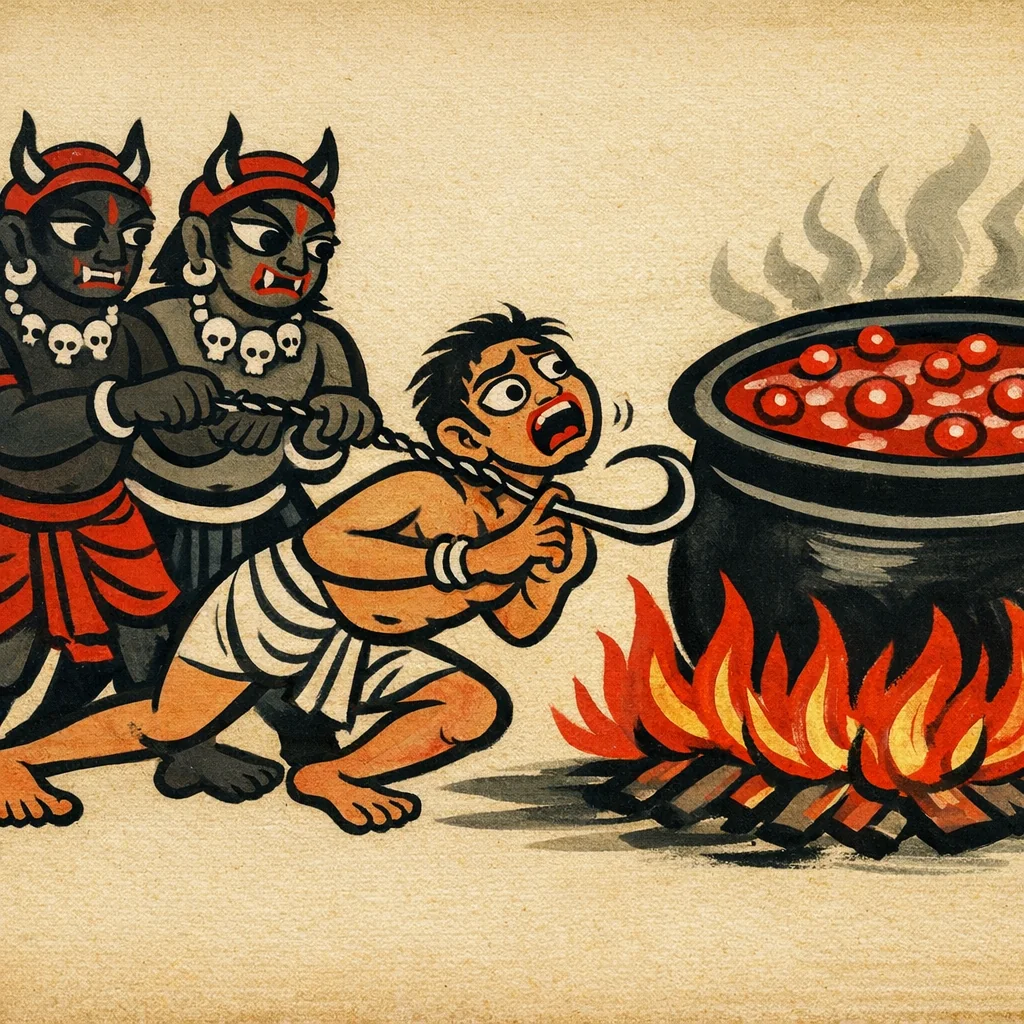
Adhyaya 12: The Son Describes the Narakas: Mahāraurava, Tamas, Nikṛntana, Apratiṣṭha, Asipatravana, and Taptakumbha
नरकवर्णनम् (Narakavarṇanam)
Auttami and Tamasa
In this adhyaya, the son warns against sinful conduct by describing the hells (narakas). He recounts Mahāraurava, Tamas, Nikṛntana, Apratiṣṭha, Asipatravana, and Taptakumbha as realms of fierce torment where souls reap the fruits of karma according to their deeds. The account evokes dread and moral awakening, urging adherence to dharma and righteous living.
Divine Beings
Celestial Realms
Key Content Points
Focus Keywords
Shlokas in Adhyaya 12
Verse 1
इति श्रीमार्कण्डेयपुराणे पितृपुत्रसंवादो नाम एकादशोऽध्यायः । द्वादशोऽध्यायः । पितोवाच— साधु वत्स! त्वयाख्यातं संसारगहनं परम् । ज्ञानप्रदानसम्भूतं समाश्रित्य महाफलम् ॥
Thus ends the eleventh chapter of the Śrī Mārkaṇḍeya Purāṇa, called ‘The Dialogue of Father and Son.’ Now begins the twelfth chapter. The father said: “Well said, dear son. You have described the profound thicket of saṃsāra; relying on the great fruit that arises from the bestowal of knowledge…”
Verse 2
तत्र ते नरकाः सर्वे यथा वै रौरवस्तथा । वर्णितास्तान् समाचक्ष्व विस्तरेण महामते ॥
There, you have described all those hells—such as Raurava and the rest. Now recount them in detail, O great-minded one.
Verse 3
पुत्र उवाच— रौरवस्ते समाख्यातः प्रथमं नरको मया । महाराैरवसंज्ञं तु शृणुष्व नरकं पितः ॥
The son said: “Raurava—the first hell—has been described by me to you. Now hear of the hell called Mahāraurava, O father.”
Verse 4
योजनानां सहस्राणि सप्त पञ्च समन्ततः । तत्र ताम्रमयी भूमिरधस्तस्य हुताशनः ॥
On every side, for an extent of seven thousand and five thousand yojanas, there lies a ground made of copper; and beneath it is fire.
Verse 5
तत्तापतप्ता सर्वाशा प्रोद्यदिन्दुसमप्रभा । विभात्यतिमहारौद्रा दर्शनस्पर्शनादिषु ॥
Scorched by that heat in every direction, it shines with a radiance like the rising moon, yet it is exceedingly terrible in sight, touch, and the like.
Verse 6
तस्यां बद्धः कराभ्यां च पद्भ्यां चैव यमानुगैः । मुच्यते पापकृन्मध्ये लुठमानः स गच्छति ॥
There, bound hand and foot by Yama’s attendants, the evildoer is released in the midst of that place and goes on, writhing and rolling.
Verse 7
काकैर्वकैर्वृकोलूकैर्वृश्चिकैर्मशकैस्तथा । भक्ष्यमाणस्तथा गृध्रैर्द्रुतं मार्गे विकृष्यते ॥
Devoured by crows, herons, wolves and owls, by scorpions and mosquitoes, and also by vultures, he is swiftly dragged along the path.
Verse 8
दह्यमानः पितर्मातर् भ्रातस्तातेति चाकुलः । वदत्यसकृदुद्विग्नो न शान्तिमधिगच्छति ॥
Burning and distraught, he repeatedly cries out, ‘Father! Mother! Brother! Son!’—agitated again and again, he finds no peace.
Verse 9
एवं तस्मान्नरैर्मोक्षो ह्यतिक्रान्तैरवाप्यते । वर्षायुतायुतैः पापं यैः कृतं दुष्टबुद्धिभिः ॥
Thus, only after passing beyond that torment do such men obtain release; those of wicked understanding who committed sin must endure it for tens of millions of years.
Verse 10
तथान्यस्तु तमो नाम सोऽतिशीतः स्वभावतः । महारौरववद्दीर्घस्तथा स तमसा वृतः ॥
And another (hell) is called Tamas; by nature it is exceedingly cold. Like Mahāraurava it is vast and extended, and it is enveloped in darkness.
Verse 11
शीतार्तास्तत्र धावन्तो नरास्तमसि दारुणे । परस्परं समासाद्य परिरभ्याश्रयन्ति च ॥
Afflicted by cold, men run about there in that dreadful darkness; reaching one another, they embrace and cling for shelter and warmth.
Verse 12
दन्तास्तेषाञ्च भज्यन्ते शीतार्तिपरिकम्पिताः । क्षुत्तृष्णाप्रबलास्तत्र तथैवान्येऽप्युपद्रवाः ॥
Their teeth shatter as they tremble from the agony of cold; there hunger and thirst are intense, and other afflictions as well.
Verse 13
हिमखण्डवहो वायुर्भिनत्त्यस्थीनि दारुणः । मज्जासृग्गलितं तस्मादश्नुवन्ति क्षुधान्विताः ॥
A dreadful wind carrying chunks of ice splits their bones; and, driven by hunger, they eat what oozes out—marrow and blood.
Verse 14
लेलिह्यमाना भ्राम्यन्ते परस्परसमागमे । एवं तत्रापि सुमहान् क्लेशस्तमसि मानवैः ॥
Writhing in agony, they reel about; when they collide with one another, they stagger and fall. Thus, there too, in that darkness, men undergo exceedingly great torment.
Verse 15
प्राप्यते ब्राह्मणश्रेष्ठ यावद्दुष्कृतसंक्षयः । निकृन्तन इति ख्यातस्ततो ’न्यो नरकोत्तमः ॥
O best of brāhmaṇas, one reaches that place until one’s evil deeds are exhausted. It is known as Nikṛntana; after that there is another foremost hell.
Verse 16
तस्मिन् कुलालचक्राणि भ्राम्यन्त्यविरतं पितः । तेष्वारोप्य निकृत्यन्ते कालसूत्रेण मानवाः ॥
In that (hell), O father, potter’s wheels spin unceasingly. Men are mounted upon them and are cut to pieces by the Kālasūtra.
Verse 17
यमानुगाङ्गुलिस्थेन आपादतलमस्तकम् । न चैषां जीवितभ्रंशो जायते द्विजसत्तम ॥
Though the finger/hand of Yama’s attendants is applied from the soles of the feet up to the head, yet their life does not depart, O best of twice-born.
Verse 18
छिन्नानि तेषां शतशः खण्डान्यैक्यं व्रजन्ति च । एवं वर्षसहस्राणि छिद्यन्ते पापकर्मिणः ॥
Their severed pieces, by the hundreds, come together again; thus for thousands of years the evil-doers are cut apart again and again.
Verse 19
तावद् यावदशेषं वै तत्पापं हि क्षयं गतम् । अप्रतिष्ठञ्च नरकं शृणुष्व गदतो मम ॥
So long (does it last) until that sin, indeed, has completely gone to destruction. And now hear from me, as I speak, about the hell called Apratiṣṭha.
Verse 20
अत्रस्थैर्नारकैर्दुःखमसह्यमनुभूयते । तान्येव यत्र चक्राणि घटीयन्त्राणि चान्यतः ॥
By the beings situated here in hell, unbearable pain is experienced—where there are those same wheels, and elsewhere also water-wheel mechanisms (ghaṭī-yantras).
Verse 21
दुःखस्य हेतुभूतानि पापकर्मकृतां नृणाम् । चक्रेष्वारोपिताः केचिद् भ्राम्यन्ते तत्र मानवाः ॥
For men who have committed sinful acts, there are causes that become the basis of suffering. Some men, mounted upon wheels, whirl about there.
Verse 22
यावद्वर्षसहस्राणि न तेषां स्थितिरन्तरा । घटीयन्त्रेषु चैवाऽन्यो बद्धस्तोये यथा घटी ॥
For thousands of years there is no pause in their condition. Another is bound in the water-wheel mechanism, like a pot (ghaṭī) in water.
Verse 23
भ्राम्यन्ते मानवाः रक्तमुदिगरन्तः पुनः पुनः । अस्त्रैर्मुखविनिष्क्रान्तैः नेत्रैरश्रुविलम्बिभिः ॥
Men whirl about, vomiting blood again and again—while weapons emerge from their mouths, and their eyes hang down streaming with tears.
Verse 24
दुःखानि ते प्राप्नुवन्ति यान्यसह्यानि जन्तुभिः । असिपत्रवनं नाम नरकं शृणु चापरम् ॥
They undergo sufferings—unbearable to living beings. Hear also of another hell called Asipatravana (“the forest of sword-leaves”).
Verse 25
योजनानां सहस्रं यो ज्वलदग्न्यास्तृतावनिः । तप्ताः सूर्यकरैश्चण्डैर्यत्रातीव सुदारुणैः ॥
There is a region a thousand yojanas across, whose ground is spread over with blazing fire; there the beings are scorched by the sun’s fierce, exceedingly cruel rays.
Verse 26
प्रपतन्ति सदा तत्र प्राणिनो नरकौकसः । तन्मध्ये च वनं रम्यं स्निग्धपत्रं विभाव्यते ॥
The beings who dwell in hell continually fall there; and in the midst of it a charming forest is seen, with glossy, lush-looking leaves.
Verse 27
पत्राणि तत्र खङ्गानां फलानि द्विजसत्तमम् । श्वानश्च तत्र सबलाः स्वनन्त्ययुतशोभिताः ॥
There the leaves are swords and the fruits (too), O best of twice-born. And there are powerful dogs, adorned with (countless) howls and cries.
Verse 28
महावक्त्रा महादंष्ट्रा व्याघ्रा इव भयानकाः । ततस्तद्वनमालोक्य शिशिरच्छायमग्रतः ॥
With huge mouths and great fangs—terrifying like tigers. Then, seeing that forest’s cool shade before them,
Verse 29
प्रयान्ति प्राणिनस्तत्र तीव्रतृट्परिपीडिताः । हा मातर्हा तात ! इति क्रन्दन्तोऽतीव दुःखिताः ॥
The beings go there, afflicted by intense thirst, crying, ‘Alas, mother! Alas, father!’—overwhelmed with grief.
Verse 30
दह्यमानाङ्घ्रयुगला धरणीस्थेन वह्निना । तेषां गतानां तत्रासिपत्रपाती समीरणः ॥
Their pairs of feet burn from the fire in the ground. When they have gone there, a wind arises that makes the sword-leaves fall.
Verse 31
प्रवाति तेन पात्यन्ते तेषां खड्गान्यथोपरि । ततः पतन्ति ते भूमौ ज्वलत्पावकसञ्चये ॥
It blows, and by it swords fall down upon them from above; then they fall to the ground into a mass of blazing fire.
Verse 32
लेलिह्यमाने चान्यत्र व्याप्ताशेषमहीतले । सारमेयास्ततः शीघ्रं शातयन्ति शरीरतः ॥
While the blazing fire licks all around, spreading over the entire surface of the ground, the dogs quickly tear at their bodies.
Verse 33
तेषामङ्गानि रुदतामनेकान्यतिभीषणाः । असिपत्रवनं तात ! मयैतत्कीर्तितं तव ॥
As they weep, their limbs are (torn into) many parts—most dreadful. Thus, dear one, I have described to you this Asipatravana (hell).
Verse 34
अतः परं भीमतरेण तप्तकुम्भं निबोध मे । समन्ततस्तप्तकुम्भा वह्निज्वालासमावृताः ॥
Now learn from me of the even more dreadful hell called Taptakumbha. On every side stand heated cauldrons, enveloped by tongues of fire.
Verse 35
ज्वलदग्निचयोद्वृत्ततैलायश्चूर्णपूरिताः । तेषु दुष्कृतकर्माणो याम्यैः क्षिप्ता ह्यधोमुखाः ॥
Those cauldrons are filled with blazing heaps of fire, overflowing boiling oil, and iron-powder. Into them the doers of evil deeds are hurled headlong by Yama’s servants.
Verse 36
क्वाथ्यन्ते विस्फुटद्गात्र-गलन्मज्जजलाविलाः । स्फुरत्कपालनेत्रास्थिच्छिद्यमाना विभीषणैः ॥
They are boiled—limbs bursting, the liquid made turbid by marrow that drips and flows—while terrifying beings hack them amid flashing skulls, eyes, and bones.
Verse 37
गृध्रैरुत्पाट्य मुच्यन्ते पुनस्तेष्वेव वेगितैः । पुनः सिमसिमायन्ते तैलेनैक्यं व्रजन्ति च ॥
Pulled out by vultures, they are released—only to be swiftly thrown again into those same cauldrons. Again they sizzle, and again they become one with the oil.
Verse 38
द्रवीभूतैः शिरोगात्र-स्नायु-मांस-त्वगस्थिभिः । ततो याम्यैर्नरैराशु दर्व्या घट्टनघट्टिताः ॥
With heads and bodies, sinews, flesh, skin, and bones liquefied, then Yama’s men quickly churn and scrape them with a ladle.
Verse 39
कृतावर्ते महातैले मथ्यन्ते पापकर्मिणः । एष ते विस्तरेणोक्तस्तप्तकुम्भो मया पितः ॥
In that great oil, made to whirl in eddies, the sinners are churned. Thus have I, your father, described to you in detail the (hell) Taptakumbha.
Frequently Asked Questions
The chapter examines karmic proportionality: how specific forms of pāpa mature into correspondingly structured punishments, endured for immense but finite periods until demerit is exhausted. The ethical emphasis is deterrence through a concrete, sensory mapping of consequence.
It does not develop Manvantara chronology directly. Instead, it functions as an eschatological and moral excursus within the dialogue framework, reinforcing karma-doctrine that underlies Purāṇic historiography across Manvantaras.
This Adhyāya is outside the Devi Māhātmya section (Adhyāyas 81–93) and contains no direct Śākta stuti, goddess-epithet theology, or battle narrative. Its contribution is indirect: it supplies a karmic-ethical backdrop commonly presupposed by later devotional and theological portions of the Purāṇa.