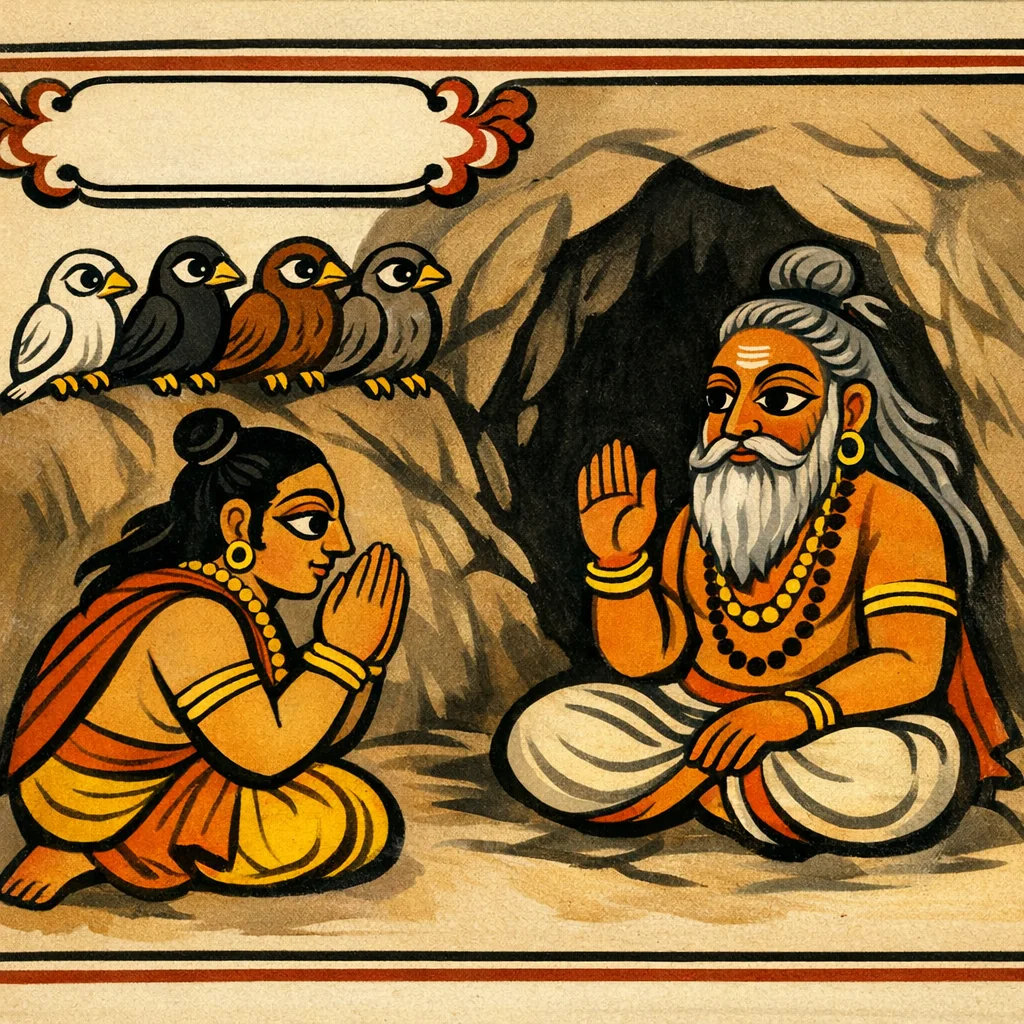
Adhyaya 1: Jaimini’s Questions on the Mahabharata and the Origin of the Wise Birds
पक्ष्युपाख्यानप्रारम्भ (Pakṣyupākhyāna-prārambha)
Jaimini's Questions
Jaimini, Vyasa’s disciple, raises profound questions about the Mahabharata: why dharma seems to suffer, why adharma appears to prevail, and how Sri Krishna’s will accords with the law of karma. Vyasa directs him to seek clarity from certain wise birds, learned in the Vedas and of wondrous origin, who can explain the subtle workings of destiny and moral order. Thus begins the Paksyupakhyana, opening a reverent inquiry into hidden causes and divine justice.
Divine Beings
Celestial Realms
Key Content Points
Focus Keywords
Shlokas in Adhyaya 1
Verse 1
तपःस्वाध्यायनिरतं मार्कण्डेयं महामुनिम् । व्यासशिष्यो महातेजा जैमिनिः पर्यपृच्छत ॥
Jaimini—of great spiritual brilliance and a disciple of Vyāsa—questioned the great sage Mārkaṇḍeya, who was devoted to austerity and the study of sacred texts.
Verse 2
भगवान् भारताख्यानं व्यासेनोक्तं महात्मना । पूर्णमस्तमलैः शुभ्रैर्नानाशास्त्रसमुच्चयैः ॥
The venerable Mahābhārata narrative, spoken by the great-souled Vyāsa, is complete—bright and free from blemish—being a compendium that gathers together many branches of sacred learning.
Verse 3
जातिशुद्धिसमायुक्तं साधुशब्दोपशोभितम् । पूर्वपक्षोक्तिसिद्धान्तपरिनिष्ठासमन्वितम् ॥
“Endowed with purity of lineage and tradition, adorned with proper and refined diction, and furnished with the exposition of the prima facie position (pūrvapakṣa), the established conclusion (siddhānta), and a firm final ascertainment.”
Verse 4
त्रिदशानां यथा विष्णुर्द्विपदां ब्राह्मणो यथा । भूषणानाञ्च सर्वेषां यथा चूडामणिर्वरः ॥
Just as Viṣṇu is foremost among the gods, just as the Brāhmaṇa is foremost among two-footed beings, and just as the crest-jewel is best among all ornaments—so too the one praised here is the most excellent.
Verse 5
यथायुधानां कुलिशमिन्द्रियाणां यथा मनः । तथेह सर्वशास्त्राणां महाभारतमुत्तमम् ॥
As the thunderbolt (vajra) is foremost among weapons, and as the mind is foremost among the senses, so here the Mahābhārata is supreme among all treatises (śāstras).
Verse 6
अत्रार्थश्चैव धर्मश्च कामो मोक्षश्च वर्ण्यते । परस्परानुबन्धाश्च सानुबन्धाश्च ते पृथक् ॥
Here artha (material well-being), dharma (righteous duty), kāma (legitimate desire), and mokṣa (liberation) are described; and these topics are explained both in their mutual interconnections and also separately, together with their attendant subsidiary matters.
Verse 7
धर्मशास्त्रमिदं श्रेष्ठमर्थशास्त्रमिदं परम् । कामशास्त्रमिदं चाग्र्यं मोक्षशास्त्रं तथोत्तमम् ॥
“This is an excellent treatise on dharma; this is a supreme treatise on artha. This is also a foremost treatise on kāma, and likewise an unsurpassed treatise on mokṣa.”
Verse 8
चतुराश्रमधर्माणामाचारस्थितिसाधनम् । प्रोक्तमेतन्महाभाग वेदव्यासेन धीमता ॥
O greatly fortunate one, this has been taught by the wise Veda-Vyāsa: the means by which proper conduct and the established order of the dharmas of the four āśramas are maintained.
Verse 9
तथा तात कृतं ह्येतद् व्यासेनोदारकर्मणा । यथा व्याप्तं महाशास्त्रं विरोधैर्नाभिभूयते ॥
So, dear one, this has indeed been composed by Vyāsa, whose deeds are noble, in such a way that the vast Great Treatise is all-encompassing and is not overpowered by contradictions.
Verse 10
व्यासवाक्यजलौघेन कुतर्कतरुहारिणा । वेदशैलावतीर्णेन नीरजस्का मही कृता ॥
By the flood of Vyāsa’s words—carrying away the trees of perverse reasoning—descending from the mountain of the Veda, the earth has been made free from dust (i.e., clarified and purified).
Verse 11
कलशब्दमहाहंसं माख्यानपराम्बुजम् । कथाविस्तीर्णसलिलं कार्ष्ण वेदमहाह्रदम् ॥
“(This Purāṇa is) a great swan of melodious sound, with the supreme lotus of sacred narratives; its waters are spread wide as expansive stories—an immense lake of Vedic wisdom, O Kārṣṇa.”
Verse 12
तदिदं भारताख्यानं बह्वर्थं श्रुतिविस्तरम् । तत्त्वतो ज्ञातुकामोऽहं भगवन्स्त्वामुपस्थितः ॥
“This narrative known as the Bhārata is rich in many meanings and expansive like the Vedic revelation. Desiring to understand it in truth (in its real principles), O Blessed One, I have approached you.”
Verse 13
कस्मान्मानुषतां प्राप्तो निर्गुणोऽपि जनार्दनः । वासुदेवो जगत्सूतिस्थितिसंयमकारणम् ॥
Why has Janārdana—though beyond the guṇas—attained a human state? Vāsudeva is the cause of the world’s creation, maintenance, and restraint (withdrawal).
Verse 14
कस्माच्च पाण्डुपुत्राणामेका सा द्रुपदात्मजा । पञ्चानां महीषी कृष्णा ह्यत्र नः संशयो महान् ॥
And why indeed did that one daughter of Drupada—Kṛṣṇā (Draupadī)—become the queen-consort of the five sons of Pāṇḍu? On this point, we have great doubt.
Verse 15
भेषजं ब्रह्महत्याया बलदेवो महाबलः । तीर्थयात्राप्रसङ्गेन कस्माच्चक्रे हलायुधः ॥
Why did mighty Balarāma, the wielder of the plough, undertake a pilgrimage to sacred fords as a remedy for the sin of brahmin-slaying (brahmahatyā)?
Verse 16
कथञ्च द्रौपदेयास्तेऽकृतदाराः महारथाः । पाण्डुनाथा महात्मानो वधमापुरनाथवत् ॥
And how did those sons of Draupadī—great chariot-warriors—though not yet married, the noble-souled sons of Pāṇḍu, come to meet death as if they were without a protector?
Verse 17
एतत्सर्वं विस्तरशो ममाख्यातुमिहार्हसि । भवन्तो मूढबुद्धीनामवबोधकराः सदा ॥
You ought to explain all this to me here in full detail. For you (revered ones) are ever the awakeners—those who bring understanding to people of confused intellect.
Verse 18
इति तस्य वचः श्रुत्वा मार्कण्डेयो महामुनिः । दशाष्टदोषरहितो वक्तुं समुपचक्रमे ॥
Having thus heard his words, the great sage Mārkaṇḍeya—free from the eighteen faults—began to speak.
Verse 19
मार्कण्डेय उवाच क्रियाकालोऽयमस्माकं समप्राप्तो मुनिसत्तम । विस्तरे चापि वक्तव्ये नैष कालः प्रशस्यते ॥
Mārkaṇḍeya said: “O best of sages, the time appointed for our duties has now arrived. And when something is to be explained at length, this is not a commendable time for such extended speech.”
Verse 20
ये तु वक्ष्यन्ति वक्ष्येऽद्य तानहं जैमिने तव । तथा च नष्टसन्देहं त्वां करिष्यन्ति पक्षिणः ॥
“O Jaimini, today I shall relate to you those very matters which the birds will also explain; and those birds will make you free from doubt.”
Verse 21
पिङ्गाक्षश्च विबोधश्च सुपुत्रः सुमुखस्तथा । द्रोणपुत्राः खगश्रेष्ठास्तत्त्वज्ञाः शास्त्रचिन्तकाः ॥
And there were Piṅgākṣa and Vibodha, Suputra and likewise Sumukha—sons of Droṇa—excellent among birds, knowers of truth and contemplators of the śāstras.
Verse 22
वेदशास्त्रार्थविज्ञाने येषामव्याहता मतिः । विन्ध्यकन्दरमध्यस्थास्तानुपास्य च पृच्छ च ॥
Those whose understanding of the meanings of the Vedas and the śāstras is unobstructed—dwelling in the midst of the caves of the Vindhya—are worshipped (served) by people, who also question them.
Verse 23
एवमुक्तस्तदा तेन मार्कण्डेयेन धीमता । प्रत्युवाचार्षिशार्दूलो विस्मयोत्फुल्ललोचनः ॥
Thus addressed at that time by the wise Mārkaṇḍeya, the tiger among sages replied, his eyes widened in amazement.
Verse 24
जैमिनिरुवाच अत्यद्भुतमिदं ब्रह्मन् खगवागिव मानुषी । यत् पक्षिणस् ते विज्ञानमापुरत्यन्तदुर्लभम् ॥
Jaimini said: “O Brahmin, this is exceedingly wondrous—speech like that of birds, yet human in sense—how it is that these birds have attained knowledge that is extremely difficult to obtain.”
Verse 25
तिर्यग्योन्यां यदि भवस्तेषां ज्ञानं कुतोऽभवत् । कथञ्च द्रोणतनयाः प्रोच्यन्ते ते पतत्रिणः ॥
“If they are born in an animal womb, then how did they obtain such knowledge? And how is it that those winged ones are spoken of as the sons of Droṇa?”
Verse 26
कश्च द्रोणः प्रविख्यातो यस्य पुत्रचतुष्टयम् । जातं गुणवतां तेषां धर्मज्ञानं महात्मनाम् ॥
And who is that renowned Droṇa, whose four sons were born—virtuous great-souled ones, possessed of knowledge of dharma?
Verse 27
मार्कण्डेय उवाच शृणुष्वावहितो भूत्वा यद्वृत्तं नन्दने पुरा । शक्रस्याप्यसरसां चैव नारदस्य च सङ्गमे ॥
Mārkaṇḍeya said: Listen attentively as I relate what happened long ago in Nandana—at the meeting of Śakra (Indra), the Apsarases, and Nārada.
Verse 28
नारदो नन्दनेऽपश्यत् पुंश्चलीगणमध्यगम् । शक्रं सुराधिराजानं तन्मुखासक्तलोचनम् ॥
In Nandana (Indra’s pleasure-grove), Nārada beheld Śakra, lord of the gods, seated amid a troop of wanton women, his gaze fixed intently upon their faces.
Verse 29
स तेनर्षिवरिष्ठेन दृष्टमात्रः शचीपतिः । समुत्तस्थौ स्वकं चास्मै ददावासनमादरात् ॥
As soon as that best of sages beheld Śacī’s lord (Indra), he rose at once and respectfully offered him his own seat.
Verse 30
तं दृष्ट्वा बलवृत्रघ्नमुत्थितं त्रिदशाङ्गनाः । प्रणेमुस्ताश्च देवर् 7षि विनयावनताः स्थिताः ॥
Seeing that mighty slayer of Vṛtra rise, the celestial women stood up and bowed down; and, O divine seer, they remained standing in humility, their heads lowered in reverence.
Verse 31
ताभिरभ्यर्चितः सोऽथ उपविष्टे शतक्रतौ । यथार्हं कृतसम्भाषः कथाश्चक्रे मनोरमाः ॥
Honoured by them, he then—when Śatakratu (Indra) had taken his seat—after exchanging fitting courtesies, engaged in delightful conversations (stories).
Verse 32
शक्र उवाच ततः कथान्तरे शक्रस्तमुवाच महामुनिम् । देह्याज्ञां नृत्यतामासां तव याभिमतेति वै ॥
Śakra (Indra) said: Then, in the course of the conversation, Śakra spoke to that great sage: “Grant me your permission—tell me which of these matters is acceptable to you.”
Verse 33
रम्भा वा कर्कशा वाथ उर्वश्यथ तिलोत्तमा । घृताची मेनका वापि यत्र वा भवतो रुचिः ॥
“Choose Rambhā, or Karkaśā; or else Urvaśī, or Tilottamā; or Ghṛtācī, or Menakā—whichever is pleasing to you.”
Verse 34
एतच्छ्रुत्वा द्विजश्रेष्ठो वचो शक्रस्य नारदः । विचिन्त्याप्सरसः प्राह विनयावनताः स्थिताः ॥
Having heard these words of Śakra (Indra), Nārada—the foremost among the twice-born—reflected, and then addressed the Apsarases, who stood there with humility, their heads bowed in deference.
Verse 35
युष्माकमिह सर्वासां रूपौदार्यगुणाधिकम् । आत्मानं मन्यते या तु सा नृत्यतु ममाग्रतः ॥
Among all of you here, whichever one considers herself superior in beauty, generosity (nobility), and virtues—let her dance before me.
Verse 36
गुणरूपविहीनायाः सिद्धिर्नाट्यस्य नास्ति वै । चार्वधिष्ठानवन्नृत्यं नृत्यमन्यद्विडम्बनम् ॥
Indeed, drama (nāṭya) cannot attain success when it is devoid of proper qualities and form. Dance (nṛtya) without a charming foundation is not truly dance; it is merely a parody, an imitative mockery.
Verse 37
तद्वाक्यसमकालं च एकैकास्ता नतास्ततः । अहं गुणाधिका न त्वं न त्वं चान्या अब्रवीदिदम् ॥
At the very moment those words were spoken, the others, one by one, bowed down. Then she spoke this: “I am superior in virtues; you are not—nor are you other than me.”
Verse 38
मार्कण्डेय उवाच तासां संभ्रममालोक्य भगवान् पाकशासनः । पृच्छ्यतां मुनिरित्याह वक्ता यां वो गुणाधिकाम् ॥
Mārkaṇḍeya said: Seeing their agitation, the Blessed Pākaśāsana (Indra) said, “Let the sage be questioned; he will speak to you—he who surpasses you in qualities.”
Verse 39
शक्रच्छन्दानुयाताभिः पृष्टस्ताभिः सनारदः । प्रोवाच यत् तदा वाक्यं जैमिने तन्निबोध मे ॥
Questioned by those accompanied by Śakra and the Vedic metres, he—together with Nārada—then spoke those words. O Jaimini, listen from me to what was said at that time.
Verse 40
तपस्यन्तं नगेंद्रस्थं या वः क्षोभयते बलात् । दुर्वाससं मुनिश्रेष्ठं तां वो मन्ये गुणाधिकाम् ॥
She who forcefully agitates you, while the foremost sage Durvāsas is practicing austerities upon the lord of mountains—I consider her superior to you in virtue and excellence.
Verse 41
मार्कण्डेय उवाच तस्य तद्वचनं श्रुत्वा सर्वा वेपत कन्धराः । अशक्यमेतदस्माकमिति ताश्चक्रिरे कथाः ॥
Mārkaṇḍeya said: Hearing his words, all of them trembled at the neck with fear and began to say, “This is impossible for us.”
Verse 42
तत्राप्सरा वपुर्नाम मुनिक्षोभणगर्विता । प्रत्युवाचाद्य यास्यामि यत्रासौ संस्थितो मुनिः ॥
There, an Apsaras named Vapu, proud of her power to disturb sages, replied: “Today I shall go to the place where that sage is staying.”
Verse 43
अद्य तं देहयन्तारं प्रयुक्तेन्द्रियवाजिनम् । स्मरशस्त्रगलद्रश्मिं करिष्यामि कुसारथिम ॥
“Today I shall make that inflamer—who drives the horses of the senses—whose reins are slipping from the weaponry of Smara (Kāma), into a bad charioteer.”
Verse 44
ब्रह्मा जनार्दनो वापि यदि वा नीललोहितः । तमप्यद्य करिष्यामि कामबाणक्षतान्तरण् ॥
“Whether it be Brahmā, or Janārdana (Viṣṇu), or even Nīlalohita (Rudra/Śiva)—even him today I shall make one who has the wound (mark) of Kāma’s arrow removed (i.e., freed from the injury of desire).”
Verse 45
इत्युक्त्वा प्रजगामाथ प्रालेयाद्रिं वपुस्तदा । मुनेस्तपः प्रभावेण प्रशान्तश्वापदाश्रमम् ॥
Having spoken thus, he then departed at that time for Prāleyādri (the Snow Mountain). By the power of the sage’s austerities, the hermitage had become a place where wild beasts were calmed and at peace.
Verse 46
स पुंस्कोकिलमाधुर्या यत्रास्ते स महामुनिः । क्रोशमात्रं स्थितातस्मादगायत वराप्सराः ॥
There, where that great sage dwelt amid a sweetness like the song of the male cuckoo, the excellent Apsarases—standing at a distance of only a krośa—sang forth.
Verse 47
तद्गीतध्वनिमाकर्ण्य मुनिर्विस्मितमानसः । जगाम तत्र यत्रास्ते सा बाला रुचिरानना ॥
Hearing the sound of that song, the sage—his mind filled with wonder—went to the place where that maiden, of lovely face, was seated.
Verse 48
तां दृष्ट्वा चारुसर्वाङ्गीं मुनिः संस्तभ्य मानसम् । क्षोभणायागतां ज्ञात्वा कोपामर्षसन्वितः ॥
Seeing her—beautiful in every limb—the sage steadied his mind. Knowing that she had come to disturb his austerity, he was filled with anger and indignation.
Verse 49
उवाचेदं ततो वाक्यं महर्षिस्तां महातपाः ।
Then the great sage, the mighty ascetic, spoke these words to her.
Verse 50
यस्माद् दुःखार्जितस्येह तपसो विघ्नकारणात् । आगतासि मदोन्मत्ते मम दुःखाय खेचरि ॥
Because you have come here—being the cause of an obstacle to the austerity I have painfully undertaken—O intoxicated one, O sky-roaming being, you have arrived for my sorrow.
Verse 51
तस्मात् सुपर्णगोत्रे त्वं मत्क्रोधकलुषीकृता । जन्म प्राप्स्यसि दुष्प्रज्ञे यावद्वर्षाणि षोडश ॥
Therefore, tainted by my wrath, you shall obtain birth in the lineage of Suparṇa. O ill-minded one, you shall remain so for sixteen years.
Verse 52
निजरूपं परित्यज्य पक्षिणीरूपधारिणी । चत्वारस्ते च तनया जनिष्यन्तेऽधमाप्सराः ॥
Abandoning her former form and assuming the form of a female bird, four sons will be born to her—she, a fallen apsarā.
Verse 53
अप्राप्य तेषु च प्रीतिं शस्त्रपूता पुनर्दिवि । वासमाप्स्यसि वक्तव्यं नोत्तरं ते कथञ्चन ॥
Though you do not obtain their goodwill, yet, purified by the weapon, you will again attain residence in heaven. Nothing further is to be said to you in any way.
Verse 54
इति वचनमसह्यं कोपसंरक्तदृष्टिश्चलकलबलयां तां मानिनीं श्रावयित्वा । तरलतरतरङ्गां गां परित्यज्य विप्रः प्रथितगुणगणौघां संप्रयाताः खगङ्गाम् ॥
Having spoken those unbearable words to that proud lady—his gaze reddened with anger while she chattered restlessly all the while—the brāhmaṇa left that land, rippling with ever-restless waves, and set out for the famed river Gaṅgā, whose hosts of virtues are widely celebrated.
Frequently Asked Questions
The chapter foregrounds hermeneutic and ethical doubts raised by Jaimini about the Mahābhārata’s narrative logic—especially divine incarnation, contested marital norms, expiation for grave sin, and seemingly undeserved deaths—while asserting the Bhārata’s status as an all-encompassing puruṣārtha-śāstra.
This Adhyāya does not yet enter a Manvantara catalogue; instead it establishes the Purāṇa’s pedagogical architecture (Mārkaṇḍeya → birds) that will later be used to transmit long-range cosmological and genealogical materials, including Manvantara-related discourse.
Adhyāya 1 is prior to the Devī Māhātmya (Adhyāyas 81–93) and contains no direct Śākta stuti or Devī-centered battle narrative; its relevance is structural, setting the multi-layered frame narrative through which later high-authority Śākta sections are delivered.