Adhyaya 292
कुन्तीगर्भगोपनम् तथा मञ्जूषाप्रवाहः (Kuntī’s concealed childbirth and the river-borne casket)
Upa-parva: Kuntī–Karna Janma-ākhyāna (Episode: Kuntī’s concealed childbirth and the river-casket)
Vaiśaṃpāyana describes how Kuntī becomes pregnant and, fearing her relatives’ reaction, hides the pregnancy without public awareness, aided only by a skilled attendant. In time she gives birth while still a maiden, by divine dispensation, to a child of striking radiance. The newborn bears innate, divinely fashioned protective armor and shining earrings, resembling his solar father in form. After consulting the nurse, Kuntī places the infant in a well-lined, securely covered casket and releases it into the Aśvanadī, grieving yet acting to conceal the event. She utters a protective benediction invoking cosmic and directional guardians—Varuṇa in waters, Vāyu in the air, and the solar father—asking that paths be auspicious and obstacles non-hostile. The narrative then traces the casket’s downstream journey through connected rivers—Carmaṇvatī, Yamunā, Gaṅgā—toward the Sūta domain and the city of Campā, while emphasizing that the child continues to bear the divine armor and earrings as a sign of origin and future recognition.
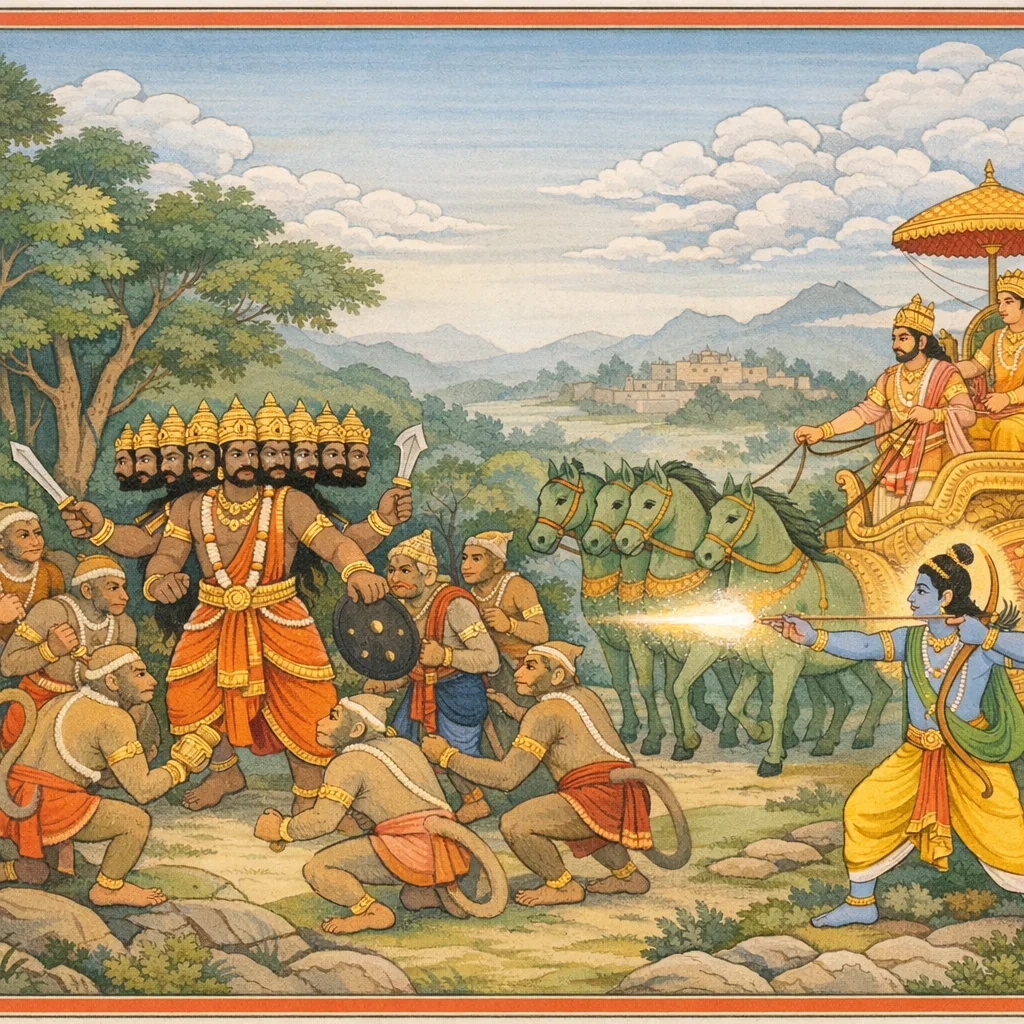
Chapter Arc: मार्कण्डेय युधिष्ठिर से कहते हैं—प्रिय पुत्र इन्द्रजित के वध से व्याकुल रावण स्वयं रणभूमि में उतर आया, घोर राक्षस-सेना से घिरा हुआ, मानो प्रलय का मेघ। → रावण विविध आयुधों की वर्षा करता है; वानर-वीर—मैन्द, नील, नल, अंगद, हनुमान और जाम्बवान—उसके उग्र आक्रमण को रोकने के लिए घेरा डालते हैं। रावण की मायाएँ युद्ध को भ्रम, धूल और आतंक से भर देती हैं; राम और लक्ष्मण संयम रखते हुए रणनीति साधते हैं। → इन्द्र का सारथि मातलि दिव्य रथ लेकर रण में उपस्थित होता है; देव-नाद, सिंहनाद और नगाड़ों के बीच राम-रावण का महासंग्राम चरम पर पहुँचता है। अंततः राम ‘रावणान्तक’ भयंकर, ब्रह्मदण्ड-सदृश तेजस्वी बाण (ब्रह्मास्त्र-प्रभाव) छोड़ते हैं—जो रावण को सर्वथा भस्म कर देता है। → ब्रह्मास्त्र की ज्वाला से रावण के धातु, मांस और रक्त तक दग्ध होकर नष्ट हो जाते हैं; राख भी दृष्टिगोचर नहीं रहती। रण का भार उतरता है और अधर्म-केन्द्र का पतन घोषित हो जाता है। → लंकापुरी और राक्षस-समाज पर इस पतन का तत्काल प्रभाव—शोक, प्रतिशोध या समर्पण—अगले प्रसंग की ओर संकेत करता है।
Shlokas
Verse 1
इस प्रकार श्रीमह्ाभारत वनपर्वके अन्तर्गत रामोपाख्यानपर्वमें इन्द्राजितू-वधविषयक दो सौ नवासीवाँ अध्याय पूरा हुआ ॥/ २८९ ॥। हि >> आय ० () है 7 नवत्यथिकद्वधिशततमो< ध्याय: राम और रावणका युद्ध तथा रावणका वध मार्कण्डेय उवाच ततः क्रुद्धों दशग्रीव: प्रिये पुत्रे निपातिते । निर्ययौ रथमास्थाय हेमरत्नविभूषितम्,मार्कण्डेयजी कहते हैं--युधिष्ठिर! अपने प्रिय पुत्र इन्द्रजितके मारे जानेपर दशमुख रावणका क्रोध बहुत बढ़ गया। वह सुवर्ण तथा रत्नोंसे विभूषित रथपर बैठकर लंकापुरीसे बाहर निकला। हाथोंमें अनेक प्रकारके अस्त्र-शस्त्र धारण करनेवाले भंयकर राक्षस उसे घेरकर चले। वह वानर-यूथपतियोंसे युद्ध करता हुआ श्रीरामचन्द्रजीकी ओर दौड़ा
Mārkaṇḍeya said: Then Daśagrīva (Rāvaṇa), enraged when his beloved son had been struck down, mounted a chariot adorned with gold and jewels and rode out.
Verse 2
स वृतो राक्षसैर्घोरिविविधायुधपाणिशि: । अभिदुद्राव रामं स योधयन् हरियूथपान्,मार्कण्डेयजी कहते हैं--युधिष्ठिर! अपने प्रिय पुत्र इन्द्रजितके मारे जानेपर दशमुख रावणका क्रोध बहुत बढ़ गया। वह सुवर्ण तथा रत्नोंसे विभूषित रथपर बैठकर लंकापुरीसे बाहर निकला। हाथोंमें अनेक प्रकारके अस्त्र-शस्त्र धारण करनेवाले भंयकर राक्षस उसे घेरकर चले। वह वानर-यूथपतियोंसे युद्ध करता हुआ श्रीरामचन्द्रजीकी ओर दौड़ा
Mārkaṇḍeya said: Encompassed by terrifying rākṣasas bearing weapons of many kinds, he rushed straight toward Rāma, fighting as he advanced against the leaders of the monkey-hosts.
Verse 3
तमाद्रवन्तं संक्रुद्धं मैनदनीलनलाड्दा: । हनूमाञ्जाम्बवांश्वैव ससैन्या: पर्यवारयन्,उसे क्रोधपूर्वक आक्रमण करते देख मैन्द, नील, नल, अंगद, हनुमान् और जाम्बवान्ने सेनासहित आगे बढ़कर उसे चारों ओरसे घेर लिया
Mārkaṇḍeya said: Seeing him rushing forward in anger to attack, Mainda, Nīla, Nala, Aṅgada, Hanūmān, and Jāmbavān—together with their forces—advanced and surrounded him on all sides.
Verse 4
ते दशग्रीवसैन्यं तदृक्षवानरपुड्भवा: । द्रुमैर्विध्वंसयांचक्रुर्दशग्रीवस्यथ पश्यत:,उन रीक और वानर-सेनापतियोंने दशाननके देखते-देखते वृक्षोंकी मारसे उसकी सेनाका संहार आरम्भ कर दिया
Mārkaṇḍeya said: Then those foremost among the bears and monkeys began to smash and rout the army of Daśagrīva with uprooted trees—doing so openly, even as Daśagrīva looked on.
Verse 5
ततः स सैन्यमालोक्य वध्यमानमरातिभि: । मायावी चासृजन्मायां रावणो राक्षसाधिप:,अपनी सेनाको शशत्रुओंद्वारा मारी जाती देख मायावी राक्षसराज रावणने माया प्रकट की
Then, seeing his army being cut down by the enemy, the cunning Rāvaṇa—the lord of the Rākṣasas—unleashed an illusion (māyā).
Verse 6
तस्य देहविनिष्क्रान्ता: शतशो5थ सहस््रश: । राक्षसा: प्रत्यदृश्यन्त शरशक्त्यूष्टिपाणय:,उसके शरीरसे सैकड़ों और हजारों राक्षस प्रकट होकर हाथोंमें बाण, शक्ति तथा ऋष्षि आदि आयुध लिये दिखायी देने लगे
Mārkaṇḍeya said: From his body there emerged, by the hundreds and then by the thousands, rākṣasas—visible on every side—each bearing weapons in hand: arrows, spears (śakti), and clubs.
Verse 7
तान् रामो जध्निवात् सर्वान् दिव्येनास्त्रेण राक्षसान् अथ भूयो<5पि मायां स व्यदधाद् राक्षसाधिप:,श्रीरामचन्द्रजीने अपने दिव्य अस्त्रके द्वारा उन सब राक्षसोंको नष्ट कर दिया। तब राक्षसराजने पुनः मायाकी सृष्टि की
Rama slew all those rākṣasas with a divine weapon. Then the lord of the rākṣasas, once again, contrived an illusory display—renewing deception after being overcome by righteous force.
Verse 8
कृत्वा रामस्य रूपाणि लक्ष्मणस्य च भारत । अभिदुद्राव रामं च लक्ष्मणं च दशानन:,भारत! दशाननने श्रीराम और लक्ष्मणके ही बहुत-से रूप धारण करके श्रीराम और लक्ष्मणपर धावा किया
Mārkaṇḍeya said: “O Bhārata, Daśānana (Rāvaṇa), assuming many forms resembling Rāma and also Lakṣmaṇa, rushed to attack both Rāma and Lakṣmaṇa.”
Verse 9
ततस्ते राममार्च्छन्तो लक्ष्मणं च क्षपाचरा: । अभिपेतुस्तदा राम॑ प्रगृहीतशरासना:,तदनन्तर वे राक्षस हाथोंमें धनुष-बाण लिये श्रीराम और लक्ष्मणको पीड़ा देते हुए उनपर टूट पड़े
Mārkaṇḍeya said: Then those night-roaming rākṣasas, pressing hard upon Rāma and Lakṣmaṇa, rushed at them—bows drawn and arrows readied—seeking to torment and overpower them. The scene reveals the sudden surge of adharma in violent assault, met by the steadfast vigilance of the righteous.
Verse 10
तां दृष्टवा राक्षसेन्द्रस्य मायामिक्ष्वाकुनन्दन: । उवाच राम॑ सौमित्रिरसम्भ्रान्तो बृहद् वच:,राक्षषराज रावणकी उस मायाको देखकर इक्ष्वाकुकुलका आनन्द बढ़ानेवाले सुमित्राकुमार लक्ष्मणको तनिक भी घबराहट नहीं हुई। उन्होंने श्रीरामसे यह महत्त्वपूर्ण बात कही--
Seeing the rākṣasa-king’s illusion, Rāma—glory of the Ikṣvāku line—spoke to Saumitri (Lakṣmaṇa) in grave and mighty words, without the least confusion or fear:
Verse 11
जहीमान् राक्षसान् पापानात्मन: प्रतिरूपकान् | जघान रामस्तांश्वान्यानात्मन: प्रतिरूपकान्,“भगवन्! अपने ही समान आकारवाले इन पापी राक्षसोंको मार डालिये।” तब श्रीरामने रावणकी मायासे निर्मित अपने ही समान रूप धारण करनेवाले उन सबको तथा अन्य राक्षसोंको भी मार डाला
Mārkaṇḍeya said: “Slay these sinful rākṣasas who have assumed forms resembling your own.” Thereupon Rāma killed all those who, through Rāvaṇa’s illusion, had taken on his very likeness, and he also slew the other rākṣasas. The episode shows that dharmic power must pierce deception: when evil mimics the righteous to confuse and demoralize, it must be met with clear discernment and decisive action.
Verse 12
ततो हर्यश्वयुक्तेन रथेनादित्यवर्चसा । उपतस्थे रणे रामं॑ मातलि: शक्रसारथि:,इसी समय इन्द्रका सारथि मातलि हरे रंगके घोड़ोंसे जुते हुए सूर्यके समान तेजस्वी रथके साथ उस रणभूमिमें श्रीरामचन्द्रजीके समीप आ पहुँचा
Then Mātali, the charioteer of Śakra (Indra), arrived on the battlefield near Rāma, coming in a sun-radiant chariot yoked with Hari-colored horses. The scene underscores timely divine assistance offered to a righteous warrior in the midst of conflict.
Verse 13
मातलिखस्वाच अयं हर्यश्वयुक् जैत्रो मघोन: स्यन्दनोत्तम: । अनेन शक्र: काकुत्स्थ समरे दैत्यदानवान्
Mātali said: “O scion of Kakutstha, this is the victorious, best of chariots belonging to Maghavan (Indra), yoked with the Hari horses. With this very chariot, Śakra has faced the Daityas and Dānavas in battle.”
Verse 14
शतश: पुरुषव्यात्र रथोदारेण जध्निवान् | तदनेन नरव्याप्र मया यत्तेन संयुगे
Mārkaṇḍeya said: “O tiger among men, he struck down hundreds with his mighty chariot in battle. Thus, O best of men, by my own strenuous effort in that combat, this was accomplished.”
Verse 15
स्यन्दनेन जहि क्षिप्रं रावणं मा चिरं कृथा: । मातलि बोला--पुरुषसिंह श्रीराम! यह हरे रंगके घोड़ोंसे जुता हुआ विजयशाली उत्तम रथ देवराज इन्द्रका है। इस विशाल रथके द्वारा इन्द्रने सैकड़ों दैत्यों और दानवोंका समरांगणमें संहार किया है। नरश्रेष्ठ! मेरे द्वारा संचालित इस रथपर बैठकर आप युद्धमें रावणको शीघ्र मार डालिये, विलम्ब न कीजिये ।। १३-१४ $ ।। इत्युक्तो राघवस्तथ्यं वचो5शड्कत मातले:,मातलिके ऐसा कहनेपर श्रीरामचन्द्रजीने उसकी बातपर इसलिये संदेह किया कि कहीं यह भी राक्षसकी माया ही न हो। तब विभीषणने उनसे कहा--'पुरुषसिंह! यह दुरात्मा रावणकी माया नहीं है
Mārkaṇḍeya said: “Mounting this chariot, strike down Rāvaṇa quickly—do not delay.” The injunction is urgent and ethical in tone: when a righteous battle has become unavoidable and the enemy’s harm is immediate, hesitation that enables further adharma is itself a fault; decisive action, supported by rightful means, is praised.
Verse 16
मायैषा राक्षसस्येति तमुवाच विभीषण: । नेयं माया नरव्याप्र रावणस्य दुरात्मन:,मातलिके ऐसा कहनेपर श्रीरामचन्द्रजीने उसकी बातपर इसलिये संदेह किया कि कहीं यह भी राक्षसकी माया ही न हो। तब विभीषणने उनसे कहा--'पुरुषसिंह! यह दुरात्मा रावणकी माया नहीं है
Vibhīṣaṇa said to him: “This is indeed the rākṣasa’s illusion.” But then he clarified, “O tiger among men, this is not an illusion wrought by the wicked-souled Rāvaṇa.” In the midst of suspicion and danger, Vibhīṣaṇa urges discernment: not every extraordinary event should be dismissed as deceit, and a righteous leader must weigh fear against trustworthy counsel.
Verse 17
तदातिष्ठ रथं शीघ्रमिममैन्द्रं महाद्युते । तत: प्रहृष्ट: काकुस्त्थस्तथेत्युक्त्वा विभीषणम्
“Mount this chariot at once—this Indra-like car, O radiant one.” Thereupon Kakutstha (Rāma), delighted at heart, replied “So be it,” addressing Vibhīṣaṇa. The moment underscores righteous resolve: when counsel aligns with dharma and the protection of the good, the virtuous leader acts promptly and with clarity, without hesitation or pride.
Verse 18
रथेनाभिपपाताथ दशग्रीवं रुषान्वित: । 'महाद्युते! आप शीघ्र इन्द्रके इस रथपर आरूढ़ होइये।” तब श्रीरामचन्द्रजीने प्रसन्नतापूर्वक विभीषणसे कहा--'ठीक है।' यों कहकर उन्होंने रथपर आरूढ़ हो बड़े रोषके साथ दशमुख रावणपर आक्रमण किया ।। हाहाकृतानि भूतानि रावणे समभिद्रुते,रावणपर श्रीरामकी चढ़ाई होते ही समस्त प्राणी हाहाकार कर उठे, देवलोकमें नगारे बज उठे और जोर-जोरसे सिंहनाद होने लगा। दशकन्धर रावण तथा राजकुमार श्रीराममें उस समय महान् युद्ध छिड़ गया
Mārkaṇḍeya said: Then, mounted on his chariot and filled with wrath, Rāma charged straight at Daśagrīva (Rāvaṇa). “O great hero, quickly mount this chariot,” he was urged; and Rāma, pleased, replied to Vibhīṣaṇa, “So be it.” Saying this, he ascended the chariot and, in fierce anger, attacked the ten-faced Rāvaṇa. As soon as Rāma’s assault began, beings everywhere cried out in alarm; in the divine realm war-drums resounded and loud lion-roars arose. Thus a mighty battle broke out between Daśakaṇdhara Rāvaṇa and Prince Rāma—an encounter framed as the clash of unrighteous power with righteous resolve.
Verse 19
सिंहनादा: सपटहा दिवि दिव्यास्तथानदन् । दशकन्धरराजसून्वोस्तथा युद्धम भून्महत्,रावणपर श्रीरामकी चढ़ाई होते ही समस्त प्राणी हाहाकार कर उठे, देवलोकमें नगारे बज उठे और जोर-जोरसे सिंहनाद होने लगा। दशकन्धर रावण तथा राजकुमार श्रीराममें उस समय महान् युद्ध छिड़ गया
Mārkaṇḍeya said: “In the heavens the divine kettledrums resounded, and mighty lion-roars rang out. Then a great battle arose between Daśakandhara (Rāvaṇa) and the royal prince Rāma. At the very onset of Rāma’s advance the worlds were stirred—beings cried out in alarm, and the celestial realm echoed with the signals of war.”
Verse 20
अलब्धोपममन्यत्र तयोरेव तथाभवत् । स रामाय महाघोरं विससर्ज निशाचर:,उस युद्धकी संसारमें अन्यत्र कहीं उपमा नहीं थी। उनका वह संग्राम उन्हींके संग्रामके समान था। निशाचर रावणने श्रीरामपर एक त्रिशूल चलाया, जो उठे हुए इन्द्रके वज्ञ तथा ब्रह्मदण्डके समान अत्यन्त भयंकर था; परंतु श्रीरामने तत्काल अपने तीखे बाणोंद्वारा उस त्रिशूलके टुकड़े-टुकड़े कर दिये
Mārkaṇḍeya said: “Nowhere in this world of warfare could any comparison be found for that encounter; their battle was matchless, comparable only to itself. Then the night-ranger (Rāvaṇa) hurled at Rāma a most dreadful weapon.”
Verse 21
शूलमिन्द्राशनिप्रख्य॑ ब्रह्मदण्डमिवोद्यतम् । तच्छूलं सत्वरं रामश्रिच्छेद निशितै: शरै:,उस युद्धकी संसारमें अन्यत्र कहीं उपमा नहीं थी। उनका वह संग्राम उन्हींके संग्रामके समान था। निशाचर रावणने श्रीरामपर एक त्रिशूल चलाया, जो उठे हुए इन्द्रके वज्ञ तथा ब्रह्मदण्डके समान अत्यन्त भयंकर था; परंतु श्रीरामने तत्काल अपने तीखे बाणोंद्वारा उस त्रिशूलके टुकड़े-टुकड़े कर दिये
Mārkaṇḍeya said: “Rāvaṇa hurled at Śrī Rāma a trident, blazing like Indra’s thunderbolt and raised like the rod of Brahmā—an emblem of terrifying force. Yet Rāma, swift and composed in battle, instantly shattered that weapon into fragments with his keen arrows.”
Verse 22
तद् दृष्टवा दुष्करं कर्म रावणं भयमाविशत् | ततः क्रुद्ध: ससर्जाशु दशग्रीव: शिताउछरान्,उनका वह दुष्कर कर्म देखकर दशानन रावणके मनमें भय समा गया। फिर कुपित होकर उसने तुरंत ही तीखे सायकोंकी वर्षा आरम्भ की
Seeing that formidable and hard-to-accomplish deed, fear entered Rāvaṇa’s heart. Then, enraged, the ten-necked Daśagrīva swiftly unleashed a shower of razor-sharp arrows.
Verse 23
सहस्रायुतशो रामे शस्त्राणि विविधानि च । ततो भुशुण्डी: शूलानि मुसलानि परश्वधान्
Mārkaṇḍeya said: “On Rāma’s side, weapons of many kinds appeared in thousands and tens of thousands. Then there were also bhuśuṇḍīs, spears, clubs, and battle-axes.”
Verse 24
तां मायां विकृतां दृष्टवा दशग्रीवस्य रक्षस:
Mārkaṇḍeya said: Seeing that distorted, deceptive māyā belonging to Daśagrīva (Rāvaṇa), the rākṣasas were struck by its uncanny power—an episode that shows how adharma leans on delusion, and how perception can be bent when discernment is clouded.
Verse 25
भयात् प्रदुद्रुवु: सर्वे वानरा: सर्वतोदिशम् । राक्षत दशाननकी उस विकराल मायाको देखकर सब वानर भयके मारे चारों दिशाओंमें भाग चले ।। २४ $ ।। ततः सुपत्र॑ सुमुखं हेमपुड्खं शरोत्तमम्
Seeing the dreadful illusion conjured by the ten-headed rākṣasa, all the vānaras—overcome by fear—broke ranks and fled in every direction. The episode shows how terror and delusion can shatter collective resolve, and how discernment and steadiness are needed to face deceptive displays of power.
Verse 26
तूणादादाय काकुत्स्थो ब्रह्मास्त्रेण युयोज ह । त॑ बाणवर्य रामेण ब्रह्मास्त्रेणानुमन्त्रितम्
Mārkaṇḍeya said: “Kākutstha (Rāma), taking arrows from his quiver, set them upon the Brahmā-weapon. That foremost arrow, consecrated by Rāma with the Brahmāstra, was thus empowered.”
Verse 27
जह्नषुर्देवगन्धर्वा दृष्टवा शक्रपुरोगमा: । अल्पावशेषमायुश्च ततो$मन्यन्त रक्षस:
Markandeya said: “When the gods and Gandharvas, led by Indra, were seen, the rākṣasas lost heart and withered away; realizing that only a little of their life remained, they concluded that their end was near.”
Verse 28
ब्रह्मास्त्रोदीरणाच्छत्रोर्देवदानवकिन्नरा: । तब श्रीरामचन्द्रजीने सोनेके सुन्दर पंख तथा उत्तम अग्रभागवाले एक श्रेष्ठ बाणको तरकससे निकालकर ससे ब्रह्मास्त्रद्वारा अभिमन्त्रित किया। श्रीरामद्वारा ब्रह्मास्त्रसे अभिमन्त्रित किये हुए उस उत्तम बाणको देखकर इन्द्र आदि देवताओं तथा गन्धर्वोके हर्षकी सीमा न रही। शत्रुके प्रति श्रीरामके मुखसे ब्रह्मास्त्रका प्रयोग होता देख देवता, दानव और किन्नर यह समझ गये कि अब इस राक्षसकी आयु बहुत थोड़ी रह गयी है || २५--२७ * ततः: ससर्ज तं राम: शरमप्रतिमौजसम्
Mārkaṇḍeya said: “When the Brahmāstra was invoked against the enemy, the gods, the Dānavas, and the Kinnaras looked on. Then Śrī Rāmacandra drew from his quiver a superb arrow—golden-feathered and finely tipped—and consecrated it with the Brahmāstra. Seeing that excellent missile, now empowered by Rāma’s Brahmāstra, Indra and the other gods, along with the Gandharvas, were beside themselves with joy. And when they witnessed Rāma directing the Brahmāstra toward the foe, the gods, Dānavas, and Kinnaras understood that the rākṣasa’s life had only a little time left.”
Verse 29
मुक्तमात्रेण रामेण दूराकृष्टेन भारत,युधिष्ठिर! श्रीरामद्वारा धनुषको दूरतक खींचकर छोड़े हुए उस बाणके लगते ही राक्षसराज रावण रथ, घोड़े और सारथिसहित इस प्रकार जलने लगा मानों भयंकर लपटोंवाली आगके लपेटमें आ गया हो
Mārkaṇḍeya said: “O Bhārata, O Yudhiṣṭhira! The moment that arrow—drawn far back and released by Śrī Rāma—struck, the rākṣasa-king Rāvaṇa began to burn along with his chariot, horses, and charioteer, as though he had been caught in the embrace of a fierce, flame-tongued fire.”
Verse 30
स तेन राक्षसश्रेष्ठ: सरथ: साश्चसारथि: । प्रजज्वाल महाज्वालेनाग्निनाभिपरिप्लुत:,युधिष्ठिर! श्रीरामद्वारा धनुषको दूरतक खींचकर छोड़े हुए उस बाणके लगते ही राक्षसराज रावण रथ, घोड़े और सारथिसहित इस प्रकार जलने लगा मानों भयंकर लपटोंवाली आगके लपेटमें आ गया हो
Verse 31
ततः प्रहृष्टास्त्रिदशा: सहगन्धर्वचारणा: । निहतं रावणं दृष्टवा रामेणाक्लिष्टकर्मणा,इस प्रकार अनायास ही महान् कर्म करनेवाले श्रीरामचन्द्रजीके हाथोंसे रावणको मारा गया देख देवता, गन्धर्व तथा चारण बहुत प्रसन्न हुए
Then the gods—together with the Gandharvas and the Cāraṇas—were filled with joy on seeing Rāvaṇa slain by Rāma, whose great deeds are accomplished without strain. The verse underscores the moral order restored when a righteous hero overcomes destructive arrogance, and how the cosmos itself responds with approval when adharma is brought to an end.
Verse 32
तत्यजुस्तं महाभागं पञ्च भूतानि रावणम् | भ्रंशित: सर्वलोकेभ्य: स हि ब्रह्मास्त्रतेजसा,तदनन्तर पाँचों भूतोंने उस महान् भाग्यशाली रावणको त्याग दिया। ब्रह्मास्त्रके तेजसे दग्ध होकर वह सम्पूर्ण लोकोंसे भ्रष्ट हो गया
Mārkaṇḍeya said: Then the five great elements abandoned that illustrious Rāvaṇa. Scorched by the fiery potency of the Brahmāstra, he fell away from all worlds—cast out of every realm. The episode underscores that even extraordinary power and fortune collapse when one stands opposed to cosmic order and incurs the consequence of a supreme, dharma-aligned weapon.
Verse 33
शरीरधातवो हास्य मांसं रुधिरमेव च । नेशु््रह्यास्त्रनिर्दग्धा न च भस्माप्यदृश्यत
Mārkaṇḍeya said: “Even the bodily constituents of this one—his flesh and his very blood—could not be found. Though he had been burned by the weapon’s fire, nothing remained to be grasped, and not even ashes were seen.”
Verse 236
शक्तीश्व विविधाकारा: शतध्नीश्व शितान् क्षुरान् । उस समय श्रीरामचन्द्रजीके ऊपर भाँति-भाँतिके हजारों शस्त्र गिरने लगे तथा भुशुण्डी, शूल, मुसल, फरसे, नाना प्रकारकी शक्तियाँ, शतघ्नी और तीखी धारवाले बाणोंकी वृष्टि होने लगी
Mārkaṇḍeya said: “Then, upon Śrī Rāmacandra there began to fall a relentless shower of weapons—maces of many forms, heavy iron missiles (śatadhnīs), and razor-sharp arrows—so that the sky itself seemed to rain instruments of violence. The scene underscores the extremity of the assault and, by contrast, the steadfastness of the righteous hero who endures it without abandoning dharma.”
Verse 283
रावणान्तकरं घोरें ब्रह्मदण्डमिवोद्यतम् । तदनन्तर श्रीरामचन्द्रजीने उठे हुए ब्रह्मदण्डके समान भयंकर तथा अप्रतिम तेजस्वी उस रावणविनाशक बाणको छोड़ दिया
Mārkaṇḍeya said: Then Śrī Rāmacandra released that Rāvaṇa-destroying arrow—terrible in its might, blazing with incomparable splendor, like the dread Brahma-staff raised aloft—an act that signals the righteous culmination of punishment upon a tyrant who has violated dharma.
Verse 290
उसके शरीरके धातु, मांस तथा रक्त भी ब्रह्मास्त्रसे दग्ध होकर नष्ट हो गये। उसकी राखतक नहीं दिखायी दी ।। इति श्रीमहाभारते वनपर्वणि रामोपाख्यानपर्वणि रावणवधे नवत्यधिकद्धिशततमो< ध्याय:,इस प्रकार श्रीमहाभारत वनपर्वके अन्तर्गत रामोपाख्यानपर्वमें रवणवधविषयक दो यौ नब्बेवाँ अध्याय पूरा हुआ
Markandeya said: Even the bodily constituents—tissue, flesh, and blood—were burned up and utterly destroyed by the Brahmāstra. Not even his ashes could be seen. The episode underscores the terrifying finality of divine weapons when unleashed: once such power is invoked, ordinary measures of resistance, recovery, or even funeral remnants are erased, reminding listeners that righteous restraint and discernment are essential in the use of force.
Frequently Asked Questions
Kuntī faces a conflict between prevailing social norms regarding an unmarried pregnancy and her obligation to protect the child’s life; the chapter records a compromise action—concealment coupled with a life-preserving release and benediction.
The text models how agency operates within constraint: when ideal options are unavailable, actors pursue harm-minimization while entrusting outcomes to protective order (daiva/ṛta) articulated through prayer and ethical intention.
No formal phalaśruti is stated here; the chapter functions as etiological groundwork—explaining identity markers (armor/earrings), river-transit fate, and later recognition—rather than offering a stated recitational merit formula.