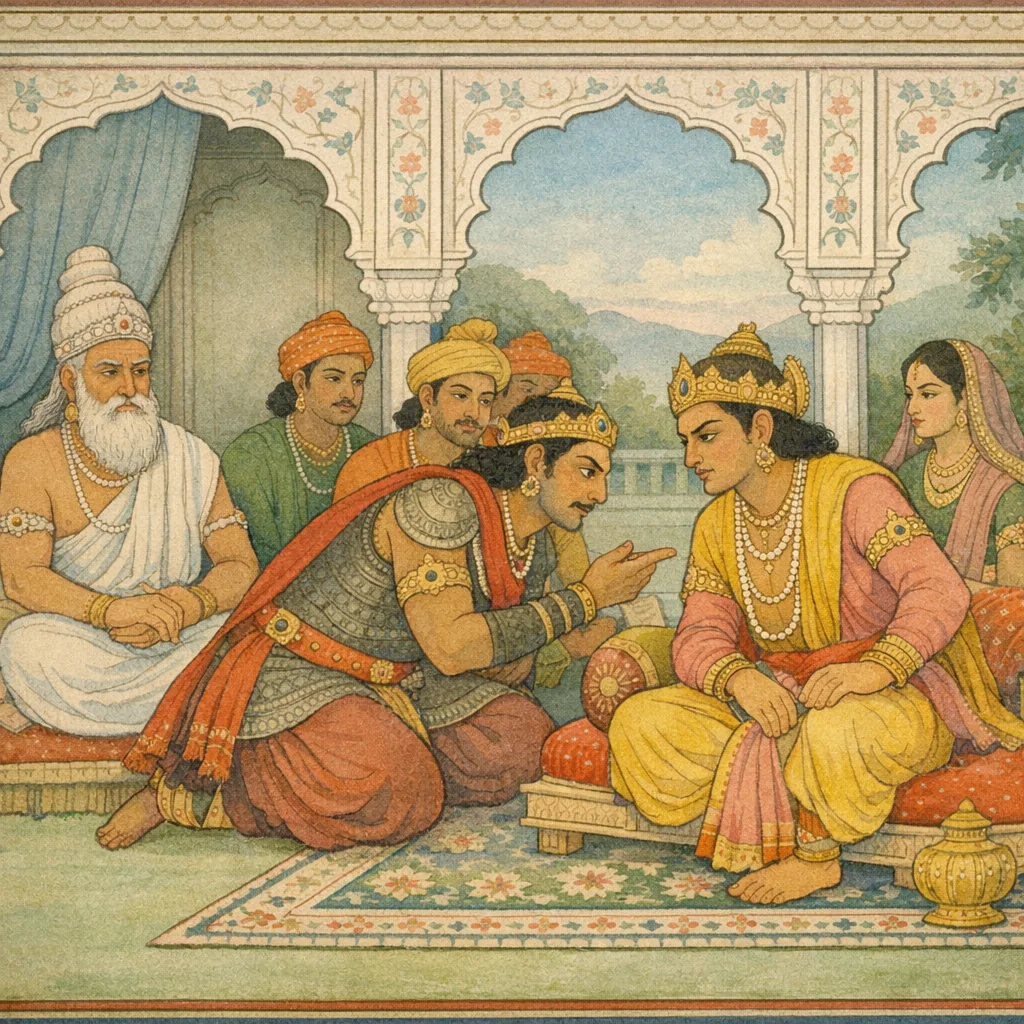
Adhyaya 254
Draupadī’s Identification of the Pāṇḍavas and the Onset of the Chariot Engagement (द्रौपदी-पाण्डव-परिचयः)
Upa-parva: Jayadratha–Draupadī Saṃvāda (within Āraṇyaka/Vana narrative cycle)
Vaiśaṃpāyana reports a sudden, intensified sound in the forest as hostile kṣatriyas react upon seeing Bhīma and Arjuna. Jayadratha, observing the standards atop the chariots, addresses Draupadī (Yājñasenī), who is positioned on a chariot with Bhānumatī, and asks her to identify the five great chariots approaching, presuming them to be her husbands. Draupadī replies in a calibrated, confrontational register: she rebukes Jayadratha’s imprudence, states she feels neither distress nor fear while seeing Dharmarāja with his brothers, and then enumerates the Pāṇḍavas with distinguishing traits and ethical profiles. She highlights Yudhiṣṭhira’s dharma-centered conduct and protective generosity, Bhīma’s formidable strength and relentless completion of enmity, Arjuna’s disciplined virtues and steadfastness, and the twin brothers Nakula and Sahadeva as loyal, skilled, and principled. The speech culminates as a warning that Jayadratha’s force will be shattered like a treasure-laden vessel in turbulent waters. The chapter closes with the five Pārthas initiating a coordinated arrow-barrage that darkens the chariot formation, indicating a controlled but decisive strategic engagement.
Chapter Arc: पाण्डवों के वनगमन के बाद, सुयोधन (दुर्योधन) को मुक्त कराकर हस्तिनापुर लौटाया जाता है—पर लौटते ही सभा-हृदय में एक नई आग धधकती है: भीष्म की कटु निन्दा और पाण्डवों की प्रशंसा। → दुर्योधन के अपमान (गन्धर्व-प्रसंग में पकड़े जाने और पाण्डवों द्वारा छुड़ाए जाने) की चर्चा दरबार में फैलती है। भीष्म, द्रोण, कृप और अन्य वृद्ध-वीर नीति की दृष्टि से पाण्डवों की महत्ता बताते हैं; यह बात कर्ण को असह्य लगती है। कर्ण दुर्योधन के सामने भीष्म पर आरोप रखता है कि वे सदा कौरवों को तुच्छ और पाण्डवों को श्रेष्ठ कहते हैं। → कर्ण का विस्फोट: वह दुर्योधन से कहता है कि भीष्म के वचन और तुम्हारे समक्ष की गई उनकी निन्दा/तुलना वह सह नहीं सकता—और दुर्योधन को उकसाता है कि अपमान का उत्तर पराक्रम से दिया जाए। साथ ही वह दुर्योधन को उसके ‘मोक्ष’ (पाण्डवों द्वारा छुड़ाए जाने) की लज्जाजनक स्मृति दिखाकर, आत्मसम्मान की चोट पर वार करता है। → दुर्योधन कर्ण की वाणी से आश्वस्त होता है; कर्ण उसे अपना अटूट समर्थन देता है—‘धन्य हूँ, अनुगृहीत हूँ’ कहकर मित्र-निष्ठा को दृढ़ करता है और कौरव-पक्ष की प्रतिष्ठा पुनः स्थापित करने का संकल्प जगाता है। → कर्ण का ‘दिग्विजय/प्रताप-प्रदर्शन’ और कौरव-नीति का अगला कदम—क्या यह संकल्प केवल वाणी रहेगा या शीघ्र ही किसी अभियान/उपद्रव में परिणत होगा?
Shlokas
Verse 1
(दाक्षिणात्य अधिक पाठका १६ श्लोक मिलाकर कुल ५३ ६ “लोक हैं) ८५+# ५० (7) पल अभ> त्रिपज्चाशर्दाधिकद्विशततमो< ध्याय: भीष्मका कर्णकी निन्दा करते हुए दुर्योधनको पाण्डवोंसे संधि करनेका परामर्श देना, कर्णके क्षोभपूर्ण वचन और दिग्विजयके लिये प्रस्थान जनमेजय उवाच वसमानेषु पार्थेषु वने तस्मिन् महात्मसु । धार्तराष्ट्रा महेष्वासा: किमकुर्वत सत्तमा:,जनमेजय बोले--मुने! जब महात्मा पाण्डव उस वनमें निवास करते थे, उन दिनों महान् धनुर्धर नरश्रेष्ठ धृतराष्ट्र-पुत्रोंने क्या किया? इस प्रकार श्रीमहाभारत वनपववके अन्तर्गत घोषयात्रापर्वमें कर्णदिग्विजयविषयक दो यौ तिरपनवाँ अध्याय पूरा हुआ ॥/ २५३ ॥/ ऑरड.2 23. () हि ० मु चतुष्पञ्चाशर्दाधिकद्विशततमो< ध्याय: कर्णके द्वारा सारी पृथ्वीपर दिग्विजय और हस्तिनापुरमें उसका सत्कार वैशम्पायन उवाच ततः कर्णो महेष्वासो बलेन महता वृतः । द्रुपदस्य पुरं रम्यं रुरोध भरतर्षभ
Janamejaya said: “O sage, while the high-souled sons of Pṛthā were dwelling in that forest, what did the Dhṛtarāṣṭras—those foremost men and great archers—do then?”
Verse 2
कर्णो वैकर्तनश्वैव शकुनिश्च महाबल: । भीष्मद्रोणकृपाश्चैव तन्मे शंसितुमरहसि,सूर्यपुत्र कर्ण, महाबली शकुनि, भीष्म, द्रोण तथा कृपाचार्य--इन सबने कौन-सा कार्य किया? यह मुझे बतानेकी कृपा करें
Janamejaya said: “Tell me, I ask you—what deeds were done by Karṇa, the son of the Sun (Vaikartana), by the mighty Śakuni, and also by Bhīṣma, Droṇa, and Kṛpa?”
Verse 3
वैशम्पायन उवाच एवं गतेषु पार्थेषु विसृष्टे च सुयोधने । आगते हास्तिनपुरं मोक्षिते पाण्डुनन्दनै:
Vaiśampāyana said: Thus, when the sons of Pṛthā had departed, and when Suyodhana too had been dismissed, and when he had returned to Hāstinapura—having been released by the sons of Pāṇḍu—(the narrative proceeds to what followed thereafter).
Verse 4
उक्त तात यथा पूर्व गच्छतस्ते तपोवनम्
Vaiśampāyana said: “Dear child, just as I told you earlier, proceed on your way to the forest-hermitage (the grove of austerities).”
Verse 5
ततः प्राप्तं त्वया वीर ग्रहणं शत्रुभिर्बलात्
Then, O hero, it came to pass that you were seized by your enemies through sheer force—an episode that underscores how even the valiant may be overpowered when hostile strength converges, and how endurance and right conduct are tested under coercion.
Verse 6
प्रत्यक्ष तव गान्धारे ससैन्यस्य विशाम्पते
Vaiśampāyana said: “O king of men, O Gāndhāra, in your very presence, this has been directly witnessed—together with the army.”
Verse 7
क्रोशतस्तव राजेन्द्र ससैन्यस्थ नूपात्मज
Vaiśampāyana said: “O king, while you were crying out, the prince—standing amid the army—was there, hearing and witnessing it.”
Verse 8
कर्णस्य च महाबाहो सूतपुत्रस्य दुर्मते:,महाबाहो! उस समय खोटी बुद्धिवाले सूतपुत्र कर्णका पराक्रम भी तुमसे छिपा नहीं था। नृपश्रेष्ठ! धर्मवत्सल! मेरा तो ऐसा विश्वास है कि धनुर्वेद, शौर्य और धर्माचरणमें कर्ण पाण्डवोंकी अपेक्षा चौथाई योग्यता भी नहीं रखता है
Vaiśampāyana said: “O mighty-armed one! Even then, Karṇa’s prowess—the sūta’s son, the charioteer’s son, of misguided judgment—was not hidden from you. O best of kings, devoted to dharma! This is my firm conviction: in archery, in valor, and in the practice of righteousness, Karṇa does not possess even a quarter of the worth found among the Pāṇḍavas.”
Verse 9
न चापि पादभाक् कर्ण: पाण्डवानां नृपोत्तम | धनुर्वेदे च शौर्ये च धर्मे वा धर्मवत्सल,महाबाहो! उस समय खोटी बुद्धिवाले सूतपुत्र कर्णका पराक्रम भी तुमसे छिपा नहीं था। नृपश्रेष्ठ! धर्मवत्सल! मेरा तो ऐसा विश्वास है कि धनुर्वेद, शौर्य और धर्माचरणमें कर्ण पाण्डवोंकी अपेक्षा चौथाई योग्यता भी नहीं रखता है
Vaiśampāyana said: “O best of kings, Karṇa is not even worthy of a quarter-share when compared with the Pāṇḍavas—whether in archery, in valor, or in the practice of dharma. O dharma-loving, mighty-armed one, even then the prowess of that misguided sūta’s son was not hidden from you.”
Verse 10
तस्माद हूं क्षमं मन्ये पाण्डवैस्तैर्महात्मभि: । संधिं संधिविदां श्रेष्ठ कुलस्यास्य विवृद्धये,“अतः संधिवेत्ताओंमें श्रेष्ठ नरेश! मैं तो इस कुलके अभ्युदयके लिये उन महात्मा पाण्डवोंके साथ संधि कर लेना ही उचित समझता हूँ
“Therefore, O best of those skilled in alliances, I judge it proper to conclude a treaty with those great-souled Pāṇḍavas, for the prosperity and strengthening of this very lineage.”
Verse 11
एवमुक्तश्न भीष्मेण धार्तराष्ट्रो जनेश्वर: । प्रहस्य सहसा राजन् विप्रतस्थे ससौबल:,राजन! भीष्मके ऐसा कहनेपर राजा दुर्योधन हँस पड़ा और शकुनिके साथ सहसा वहाँसे अन्यत्र चला गया
Vaiśampāyana said: “When Bhīṣma had spoken thus, Dhṛtarāṣṭra’s son—the lord among men—laughed, and, O King, abruptly departed from that place together with Śakuni.”
Verse 12
तं तु प्रस्थितमाज्ञाय कर्णदुःशासनादय: । अनुजममुर्महेष्वासा धार्तराष्ट्र महाबलम्,महाबली दुर्योधनको अन्यत्र गया जान कर्ण और दुःशासन आदि महान धनुर्धरोंने उसका अनुसरण किया
Vaiśaṃpāyana said: Learning that he had set out, Karṇa, Duḥśāsana, and the other great archers followed that mighty Dhārtarāṣṭra (Duryodhana).
Verse 13
तांस्तु सम्प्रस्थितान् दृष्टवा भीष्म: कुरुपितामह: । लज्जया व्रीडितो राजन् जगाम स्वं निवेशनम्,राजन्! उन सबको वहाँसे प्रस्थान करते देख कुरुकुलपितामह भीष्म लज्जित होकर अपने आवास-स्थानको चले गये
Seeing them depart from that place, Bhīṣma—the grandsire of the Kuru line—was overcome with shame. O King, feeling abashed, he withdrew to his own residence.
Verse 14
गते भीष्मे महाराज धार॑राष्ट्रो जनेश्वर: । पुनरागम्य तं देशममन्त्रयत मन्कत्रिभि:,महाराज! भीष्मके चले जानेपर राजा दुर्योधन फिर उसी स्थानपर लौट आया और अपने मन्त्रियोंके साथ गुप्त मन्त्रणा करने लगा--
Vaiśampāyana said: When Bhīṣma had departed, O great king, the lord of men, Dhṛtarāṣṭra’s son (Duryodhana), returned again to that place and began to deliberate in secret with his ministers.
Verse 15
किमस्माकं भवेच्छेय: कि कार्यमवशिष्यते । कथं च सुकृतं तत् स्यान्मन्त्रयामोड्द्य यद्धितम्,“मित्रो! क्या करनेसे हमलोगोंकी भलाई होगी? हमारे लिये कौन-सा कार्य शेष रह गया है? कैसे करनेसे हमारा कार्य शुभ परिणामजनक होगा? क्या करनेमें हमारा हित है? आज इसी विषयपर हमलोगोंको विचार करना है'
Vaiśampāyana said: “What course would bring about our true welfare? What duty still remains for us to accomplish? In what manner would that undertaking be well-executed and yield auspicious results? What, indeed, is beneficial for us? Let us deliberate today on what is truly in our best interest.”
Verse 16
कर्ण उवाच दुर्योधन निबोधेदं यत् त्वां वक्ष्यामि कौरव । भीष्मो<स्मान् निन्दति सदा पाण्डवांश्व प्रशंसति,कर्ण बोला--कुरुकुलरत्न दुर्योधन! मैं तुमसे जो कुछ कह रहा हूँ, उसपर ध्यान दो। भीष्म सदा हमारी निन्दा और पाण्डवोंकी प्रशंसा करते रहते हैं
Karna said: “Duryodhana, O Kaurava, attend to this—what I am about to tell you. Bhishma continually censures us and, at the same time, praises the Pandavas.”
Verse 17
त्वद् द्वेषाच्च महाबाहो ममापि द्वेष्टमर्हति । विगर्हते च मां नित्यं॑ त्वत्समीपे नरेश्वर,महाबाहो! वे तुम्हारे प्रति द्वेष होनेसे मुझसे भी द्वेष रखते हैं। नरेश्वर! तुम्हारे सामने वे सदा मेरी निन्दा ही किया करते हैं
Karna said: “O mighty-armed one, because of their hatred toward you, they also deem it right to hate me. O lord of men, in your very presence they continually disparage me.”
Verse 18
सो<हं भीष्मवचस्तद् वै न मृष्यामीह भारत | त्वत्समक्ष॑ यदुक्तं च भीष्मेणामित्रकर्षण
Karna said: “Therefore I cannot, O Bhārata, endure here those words of Bhīṣma—especially what he spoke in your very presence, O subduer of foes.”
Verse 19
पाण्डवानां यशो राजंस्तव निनन््दां च भारत । अनुजानीहि मां राजन् सभृत्यबलवाहनम्
Karna said: “O King, O Bharata, I cannot bear the glory of the Pāṇḍavas and the reproach that falls upon you. Therefore, O King, grant me leave to depart—together with my attendants, my forces, and my vehicles.”
Verse 20
भारत! तुम्हारे सामने भीष्मने जो कुछ कहा है, उसे मैं सहन नहीं कर सकता। शत्रुदमन! भरतकुलनन्दन! उन्होंने जो पाण्डवोंका यश गाया और तुम्हारी निन््दा की है, यह मेरे लिये असह्य है। अतः तुम मुझे सेवक, सेना तथा सवारियोंके साथ दिग्विजय करनेकी आज्ञा दो ॥। जेष्यामि पृथिवीं राजन् सशैलवनकाननाम् | जिता च पाण्डवैभभूमिश्षतुर्भिबलेशालिभि:
Karna said: “O scion of Bharata! I cannot endure what Bhishma has spoken in your very presence. O tamer of foes, delight of the Bharata line! That he has sung the glory of the Pandavas and spoken ill of you is unbearable to me. Therefore command me—together with attendants, the army, and mounted forces—to set out on a campaign of conquest in all directions. I shall subdue the earth, O king, with its mountains, forests, and groves; and I shall win back the land that has been taken by the Pandavas—those enemies, strong and prosperous.”
Verse 21
तामहं ते विजेष्यामि एक एव न संशय: । सम्पश्यतु सुदुर्बुद्धिर्भीष्म: कुरुकुलाधम:
Karna said: “I will defeat her for you—alone; of this there is no doubt. Let Bhishma, that ill-judging disgrace of the Kuru line, look on and see.”
Verse 22
राजन! मैं पर्वत, वन और काननोंसहित सारी पृथ्वीको जीत लूँगा। जिस भूमिपर चार बलशाली पाण्डवोंने मिलकर विजय पायी है उसे मैं तुम्हारे लिये अकेला ही जीत लूँगा, इसमें संशय नहीं है। खोटी बुद्धिवाला कुरु-कुलाधम भीष्म मेरे इस पराक्रमको अपनी आँखों देखे ।। अनिन्न्दध्य॑ निन्दते यो हि अप्रशंस्यं प्रशंसति । स पश्यतु बल॑ मेडद्य आत्मानं तु विगर्हतु,जो अनिन्दनीयकी निन्दा और अप्रशंसनीयकी प्रशंसा करता है, वह भीष्म आज मेरा बल देख ले और अपने-आपको धिक्कारे
Karna said: “O King, I will conquer the whole earth—its mountains, forests, and wild groves. The very land that the four mighty Pāṇḍavas won together, I will win for you all by myself; of this there is no doubt. Let Bhīṣma—who, with misguided judgment, has brought disgrace upon the Kuru line—see my prowess with his own eyes. For he who censures the blameless and praises the unpraiseworthy—let him behold my strength today and then condemn himself.”
Verse 23
अनुजानीहि मां राजन् ध्रुवो हि विजयस्तव । प्रतिजानामि ते सत्यं राजन्नायुधभालभे,राजन! मुझे आज्ञा दो। तुम्हारी विजय निश्चित है। यह मैं तुमसे प्रतिज्ञापूर्वक सत्य कहता हूँ और शस्त्र छूकर शपथ करता हूँ
Karna said: “Grant me leave, O King; your victory is indeed certain. This I pledge to you as truth, O King, and I swear it upon my weapons.”
Verse 24
तच्छुत्वा तु वचो राजन् कर्णस्य भरतर्षभ । प्रीत्या परमया युक्त: कर्णमाह नराधिप:,भरतश्रेष्ठ राजन! कर्णकी यह बात सुनकर राजा दुर्योधनने बड़ी प्रसन्नताके साथ उससे कहा--
O king, O bull among the Bharatas—having heard Karṇa’s words, the ruler (Duryodhana), filled with the highest delight and affection, addressed Karṇa in return.
Verse 25
धन्यो<स्म्यनुगृहीतो5स्मि यस्य मे त्वं महाबल: । हितेषु वर्तसे नित्यं सफलं जन्म चाद्य मे,“वीर! मैं धन्य हूँ, तुम्हारे अनुग्रहका पात्र हूँ; क्योंकि तुम-जैसे महाबली सुहृद् सदा मेरे हितसाधनमें लगे रहते हैं। आज मेरा जन्म सफल हो गया
Duryodhana said: “Blessed am I; I have been shown favor—because you, a man of great strength, are ever engaged in what is beneficial for me. Today my very birth has become fruitful.”
Verse 26
यदा च मन्यसे वीर सर्वशत्रुनिबर्हणम् । तदा निर्गच्छ भद्रं ते हुनुशाधि च मामिति,“वीरवर! जब तुम्हें विश्वास है कि तुम्हारे द्वारा सब शत्रुओंका संहार हो सकता है तब तुम दिग्विजयके लिये यात्रा करो। तुम्हारा कल्याण हो। मुझे आवश्यक व्यवस्थाके लिये आज्ञा दो
Duryodhana said: “And when you are confident, O hero, that you can crush all enemies, then set out on your campaign of conquest. May good befall you. Command me as well—so that I may make the necessary arrangements.”
Verse 27
एवमुक्तस्तदा कर्णो धार्तराष्ट्रेण धीमता । सर्वमाज्ञापयामास प्रायात्रिकमरिंदम,जनमेजय! बुद्धिमान् दुर्योधनके इस प्रकार कहनेपर कर्णने यात्रासम्बन्धी सारी आवश्यक तैयारीके लिये आज्ञा दे दी
Thus addressed at that time by the wise Dhārtarāṣṭra (Duryodhana), Karṇa—crusher of foes—issued orders for all the preparations required for the impending journey, showing prompt loyalty and readiness to act in support of his ally.
Verse 28
प्रययौ च महेष्वासो नक्षत्रे शुभदैवते । शुभे तिथौ मुहूर्ते च पूज्यमानो द्विजातिभि:,तदनन्तर महान धनुर्धर कर्णने मांगलिक शुभ पदार्थोंसे जलके द्वारा स्नान करके द्विजातियोंकी आशीर्वादमय वाणीसे सम्मानित एवं प्रशंसित हो शुभ नक्षत्र, शुभ तिथि और शुभ मुहूर्तमें यात्रा की। उस समय वह अपने रथकी घर्घराहटसे चराचर भूतोंसहित समस्त त्रिलोकीको प्रतिध्वनित कर रहा था
Then the great archer set out under an auspicious constellation presided over by a beneficent deity—on a favorable lunar day and at a propitious moment—honored and blessed by the twice-born.
Verse 29
मड़लैश्व शुभै: स्नातो वाम्भिश्नापि प्रपूजित: । नादयन् रथघोषेण त्रैलोक्यं सचराचरम्,तदनन्तर महान धनुर्धर कर्णने मांगलिक शुभ पदार्थोंसे जलके द्वारा स्नान करके द्विजातियोंकी आशीर्वादमय वाणीसे सम्मानित एवं प्रशंसित हो शुभ नक्षत्र, शुभ तिथि और शुभ मुहूर्तमें यात्रा की। उस समय वह अपने रथकी घर्घराहटसे चराचर भूतोंसहित समस्त त्रिलोकीको प्रतिध्वनित कर रहा था
Having bathed with auspicious substances and been duly honored with water-rites and the blessing-filled words of the twice-born, Karṇa set out under a favorable constellation, lunar day, and moment. As he departed, the thunder of his chariot resounded, making the entire threefold world—moving and unmoving—echo in response.
Verse 33
भीष्मो<ब्रवीन्महाराज धार्तराष्ट्रमिदं वच: । वैशम्पायनजीने कहा--महाराज! पाण्डवोंद्वारा गन्धर्वोंसे छुटकारा मिल जानेपर जब दुर्योधन विदा होकर हस्तिनापुर पहुँच गया और पाण्डव जाकर पूर्ववत् वनमें ही रहने लगे तब भीष्मजीने धृतराष्ट्रपुत्र दुर्योधनसे यह बात कही--
Vaiśaṃpāyana said: “O great king! After the Pāṇḍavas had been freed from the Gandharvas, and Duryodhana departed and reached Hastināpura while the Pāṇḍavas returned to dwell in the forest as before, Bhīṣma spoke these words to Dhṛtarāṣṭra’s son Duryodhana—”
Verse 46
गमनं मे न रुचितं तव तत्र कृतं च ते । “तात! तुम्हारे तपोवन जाते समय जैसा कि मैंने पहले ही कह दिया था, वही आज भी कह रहा हूँ। मुझे तुम्हारा वहाँ जाना अच्छा नहीं लगा और वहाँ जाकर तुमने जो कुछ किया, वह भी पसंद नहीं आया
Vaiśaṃpāyana said: “I did not approve of your going there; nor did I approve of what you did after you went.”
Verse 66
सूतपुत्रो5पयाद् भीतो गन्धर्वाणां तदा रणात् | 'गान्धारीनन्दन! सेनासहित तुम्हारे सामने ही सूतपुत्र कर्ण गन्धर्वोंसे भयभीत हो युद्धभूमिसे भाग निकला
Vaiśaṃpāyana said: At that time, Karṇa, the charioteer’s son, struck with fear of the Gandharvas, withdrew and fled from the battlefield—this occurring in full view of Dhṛtarāṣṭra’s son and his army.
Verse 252
इस प्रकार श्रीमह्या भारत वनपर्वके अन्तर्गत घोषयात्रापर्वमें दुर्योधनका नगरमें प्रवेशविषयक दो सौ बावनवाँ अध्याय पूरा हुआ
Thus ends the two-hundred-and-fifty-second chapter of the Ghoṣayātrā section within the Vana Parva of the Mahābhārata, describing Duryodhana’s entry into the city.
Verse 253
इति श्रीमहाभारते वनपर्वणि घोषयात्रापर्वणि कर्णदिग्विजये त्रिपज्चाशदधिकद्धिशततमो< ध्याय:
Thus ends the two-hundred-and-fifty-third chapter of the Mahābhārata, within the Vana Parva, in the section on the cattle-expedition (Ghoṣa-yātrā), in the episode describing Karṇa’s conquest in all directions.
Verse 536
मोक्षितश्चासि धर्मज्जै: पाण्डवैर्न च लज्जसे । “वीर! शत्रुओंने तुम्हें वहाँ बलपूर्वक बंदी बना लिया और धर्मज्ञ पाण्डवोंने तुम्हें उस संकटसे छुड़ाया है। क्या अब भी तुम्हें लज्जा नहीं आती?
Vaiśampāyana said: “You have been rescued by the dharma-knowing Pāṇḍavas, and yet you feel no shame. Enemies seized you by force and held you captive, and the Pāṇḍavas delivered you from that peril—does this not awaken modesty in you even now?”
Verse 736
दृष्टस्ते विक्रमश्वैव पाण्डवानां महात्मनाम् | राजेन्द्र! राजकुमार! जब सेनासहित तुम चीखते-चिल्लाते रहे उस समय महात्मा पाण्डवोंने जो पराक्रम कर दिखाया था वह भी तुमने प्रत्यक्ष देखा है
Vaiśampāyana said: “You have yourself witnessed the prowess of the great-souled Pāṇḍavas. O lord of kings, O prince—when you, together with your army, were crying out in alarm, you saw with your own eyes the heroic feat the noble Pāṇḍavas performed.”
Frequently Asked Questions
Whether to respond to provocation with immediate violence or with truthful, deterrent speech first—balancing personal safety, honor, and the duty to prevent avoidable escalation.
Power is ethically legitimate when aligned with dharma: truthful identification, measured warning, and disciplined action are presented as superior to reckless aggression and miscalculated pride.
No explicit phalaśruti appears in the cited passage; the meta-function is narrative—demonstrating how ethical speech and reputational knowledge operate as instruments of conflict management within the epic’s moral causality.