Adhyaya 204
Dharma-vyādha on Parental Worship (Pitṛ-mātṛ-śuśrūṣā as Paramadaivata)
Upa-parva: Mokṣa-dharma / Dharma-vyādha Upākhyāna (Ethical Discourse on Liberation and Householder Duty)
Mārkaṇḍeya reports that after the mokṣa-dharma discourse is completed, a brāhmaṇa praises the Dharma-vyādha’s comprehensive and justice-aligned exposition, noting his apparent mastery of dharma. The Dharma-vyādha then directs the brāhmaṇa to witness his ‘visible dharma’ by entering the inner house to see his parents. The brāhmaṇa observes a well-appointed, sanctum-like household space and finds the parents seated, satisfied, and honored. The Dharma-vyādha prostrates at their feet; the elders bless him, declaring that for him no other deity is needed, and commend his restraint, purity, and unwavering service in mind, act, and speech. They compare his conduct favorably to paradigms of filial reverence (e.g., Jāmadagnya Rāma). After hospitality is extended, the Dharma-vyādha explicitly states that his father and mother are his supreme deities; what is owed to gods he offers to them. He equates them with the Thirty-Three gods, with sacrificial fires, with yajña, and even with the Vedas’ totality, emphasizing constant, non-negligent service: bathing them, washing their feet, providing food, and speaking agreeably. He further outlines a normative hierarchy of five ‘gurus’—father, mother, fire, self (ātman), and teacher—asserting that correct conduct toward these constitutes the eternal dharma of one established in household life.
Chapter Arc: मार्कण्डेय ऋषि राजर्षि से कहते हैं—सुनो, वह आदि-काल का प्रसंग जब समस्त जगत् एकार्णव में लीन था और सृष्टि-क्रम का रहस्य स्वयं देवताओं के सामने प्रश्न बन खड़ा हुआ। → एकार्णव में स्थावर-जंगम नष्ट; उस शून्य-प्रलय के बीच पद्म पर पितामह ब्रह्मा का प्राकट्य और फिर मधु-कैटभ का उन्हें देख विस्मित होना—विस्मय शीघ्र ही संकट में बदलता है, क्योंकि सृष्टि-स्थापन का कार्य बाधित होने लगता है। → मधु-कैटभ के सामने ब्रह्मा की असहायता और केशव-विष्णु से संकट-निवारण की पुकार—‘केशव! यह महान् संकट आ पहुँचा है; अपनी कही बात पूर्ण कीजिये; काल का उल्लंघन कठिन है’—यहीं कथा का शिखर है, जहाँ दैवी वचन, काल-नियम और रक्षक-कर्तव्य एक साथ टकराते हैं। → विष्णु की प्रतिज्ञा-पालन की धुरी पर कथा स्थिर होती है—ब्रह्मा का आगमन ‘मोघ’ नहीं, सृष्टि-क्रम का हेतु है; और मधु-कैटभ-वध के द्वारा मार्ग प्रशस्त होने का संकेत देकर मार्कण्डेय प्रसंग को समेटते हैं। → प्रलय-जल के बीच ‘काल’ और ‘वर’ की शर्तों के साथ यह प्रश्न खुला छोड़ दिया जाता है कि विष्णु किस उपाय से असुरों को वश में करेंगे और सृष्टि-स्थापन कैसे पुनः आरम्भ होगा।
Shlokas
Verse 1
#:73:.8 #::3:..7 () हि 2 7 तर्याधिकद्विशततमो< ध्याय: ब्रह्माजीकी उत्पत्ति और भगवान् विष्णुके द्वारा मधु- कैटभका वध मार्कण्डेय उवाच स एवमुक्तो राजर्षिरुत्तड़केनापराजित: । उत्तड़क॑ कौरवश्रेष्ठ कृताञ्जलिरथाब्रवीत्,मार्कण्डेयजी कहते हैं--कौरवश्रेष्ठ! उत्तड़कके इस प्रकार आग्रह करनेपर अपराजित वीर राजर्षि बृहदश्वने उनसे हाथ जोड़कर कहा--
Mārkaṇḍeya said: Thus addressed by Uttadaka, the unconquered royal sage Bṛhadaśva, O best of the Kurus, joined his palms in reverence and then spoke to Uttadaka. The scene frames an ethical ideal: even a powerful sage responds to earnest inquiry with humility and respectful speech, preparing to transmit sacred instruction.
Verse 2
न तेडभिगमनं ब्रह्मन् मोघमेतद् भविष्यति । पुत्रो ममायं भगवन् कुवलाश्च इति स्मृत:
Mārkaṇḍeya said: “O Brahmin, your coming here will not be in vain. This one is my son, O venerable sir, and he is remembered by the name Kuvalāśa.”
Verse 3
प्रियं च ते सर्वमेतत् करिष्यति न संशय:
Markandeya said: “And he will do all this that is dear to you—of this there is no doubt.”
Verse 4
पुत्र: परिवृत: सर्वे: शूरैः परिघबाहुभि: । विसर्जयस्व मां ब्रह्मन् न्यस्तशस्त्रो5स्मि साम्प्रतम्
“O Brahmin, my son is surrounded on all sides by valiant warriors with mace-like arms. Therefore, release me; at this moment I have laid down my weapons.”
Verse 5
परिघ-जैसी मोटी भुजाओंवाले अपने समस्त शूरवीर पुत्रोंके साथ जाकर यह आपका सारा अभीष्ट कार्य सिद्ध करेगा, इसमें संशय नहीं है। ब्रह्म! आप मुझे छोड़ दीजिये। मैंने अब अस्त्र-शस्त्रोंको त्याग दिया है' |। तथास्त्विति च तेनोक्तो मुनिनामिततेजसा । स तमादिश्य तनयमुत्तड़काय महात्मने
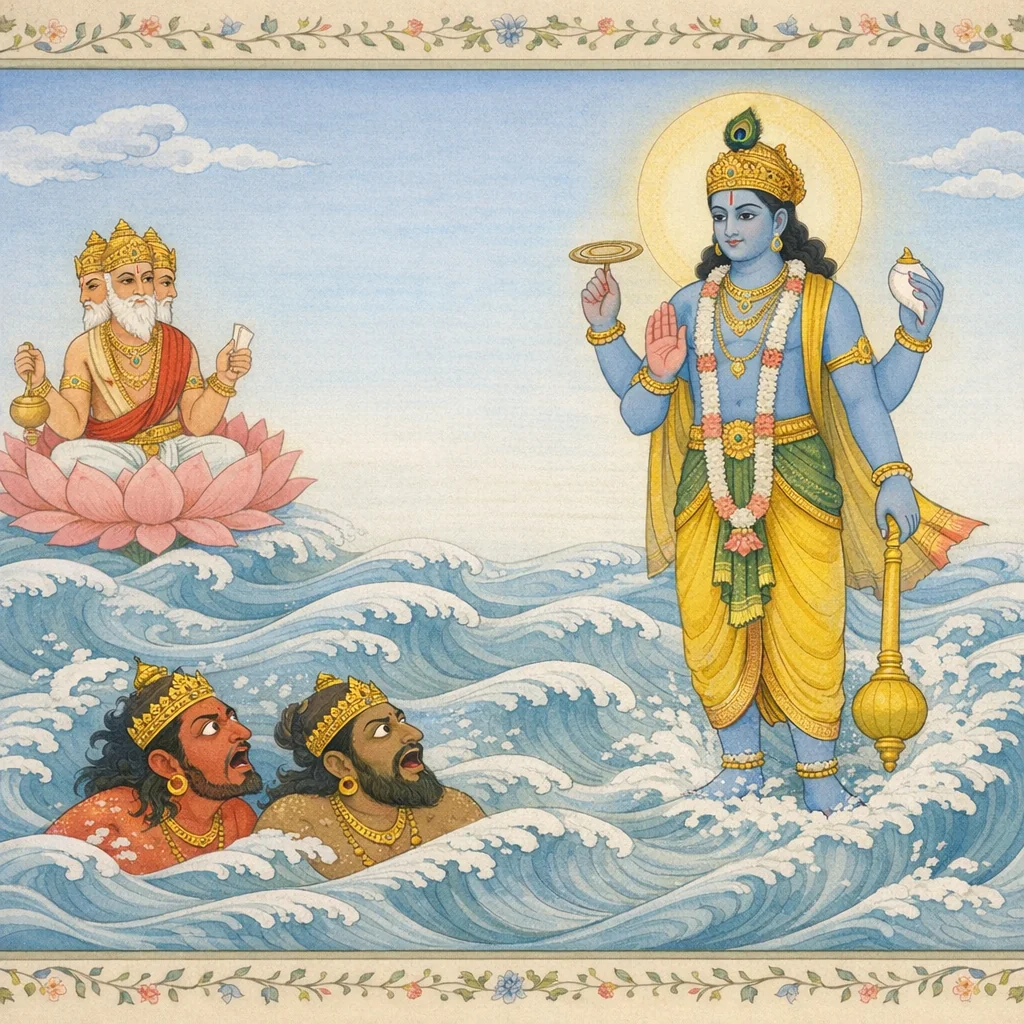
“Going with all your heroic sons, whose arms are thick like maces, he will accomplish the whole of what you desire—of this there is no doubt. O Brahmin, release me; I have now renounced my weapons.” Thus addressed by the sage of immeasurable splendor, he replied, “So be it.” Then, having given his instructions, he entrusted his son to the great-souled Uttadaka—an act of dharmic transfer, where the elder, having laid down arms, authorizes what follows through rightful counsel rather than personal force.
Verse 6
युधिषछ्िर उवाच क एष भगवन् दैत्यो महावीर्यस्तपोधन
Yudhiṣṭhira said: “O venerable one, who is this Daitya of great might, O ascetic rich in austerity?”
Verse 7
एवं महाबलो दैत्यो न श्रुतो मे तपोधन,तपस्याके धनी मुनीश्वर! ऐसा महाबली दैत्य तो मैंने कभी नहीं सुना था, अतः: भगवन्! मैं इसके विषयमें यथार्थ बातें जानना चाहता हूँ। महामते! आप यह सारी कथा विस्तारपूर्वक बताइये
Yudhiṣṭhira said: “O treasure of austerity, I have never heard of such a mighty Daitya before. O lord among sages, so rich in ascetic power—this is astonishing. Therefore, revered one, I wish to know the true facts about him. O great-minded sage, please narrate this entire account in full detail.”
Verse 8
एतदिच्छामि भगवन् याथातथ्येन वेदितुम् । सर्वमेव महाप्राज्ञ विस्तरेण तपोधन,तपस्याके धनी मुनीश्वर! ऐसा महाबली दैत्य तो मैंने कभी नहीं सुना था, अतः: भगवन्! मैं इसके विषयमें यथार्थ बातें जानना चाहता हूँ। महामते! आप यह सारी कथा विस्तारपूर्वक बताइये
Yudhiṣṭhira said: “Revered sir, I wish to know this exactly as it truly is. O greatly wise one, O treasure of austerity—please narrate the entire account to me in full detail.”
Verse 9
मार्कण्डेय उवाच शृणु राजन्निदं सर्व यथावृत्तं नराधिप । कथ्यमानं महाप्राज्ञ विस्तरेण यथातथम्,मार्कण्डेयजी कहते हैं-राजन! तुम बड़े बुद्धिमान हो। यह सारा वृतान्त मैं यथार्थरूपसे विस्तारपूर्वक कह रहा हूँ, ध्यान देकर सुनो
Markandeya said: “O King, lord of men, listen. I shall relate the whole account exactly as it occurred. O greatly wise one, I will tell it in full detail, truthfully and as it really is—so attend carefully.”
Verse 10
एकार्णवे तदा लोके नष्टे स्थावरजड्रमे । प्रणष्टेषु च भूतेषु सर्वेषु भरतर्षभ,भरतश्रेष्ठ] बात उस समयकी है जब सम्पूर्ण चराचर जगत् एकार्णवके जलमें ड्ूबकर नष्ट हो चुका था। समस्त प्राणी कालके गालमें चले गये थे
Mārkaṇḍeya said: “At that time, O bull among the Bharatas, when the whole world had become a single ocean and all that is immovable and movable had perished—when, indeed, all beings had been destroyed—this is what occurred.”
Verse 11
प्रभवं लोककर्तरिं विष्णुं शाश्वतमव्ययम् । यमाहुर्मुनयः सिद्धा: सर्वलोकमहेश्वरम्,उस समय वे भगवान् विष्णु एकार्णवके जलमें अमित तेजस्वी शेषनागके विशाल शरीरकी शय्यापर योगनिद्राका आश्रय लेकर शयन करते थे। उन्हीं भगवान्को सिद्ध, मुनिगण सबकी उत्पत्तिका कारण, लोकस्रष्टा, सर्वव्यापी, सनातन, अविनाशी तथा सर्वलोकमहेश्वर कहते हैं
Markandeya said: “They call Viṣṇu—the source of all, the maker of the worlds—eternal and imperishable. The perfected sages and seers proclaim him the great Lord of all the worlds.”
Verse 12
सुष्वाप भगवान् विष्णुरप्सु योगत एव सः । नागस्य भोगे महति शेषस्यामिततेजस:,उस समय वे भगवान् विष्णु एकार्णवके जलमें अमित तेजस्वी शेषनागके विशाल शरीरकी शय्यापर योगनिद्राका आश्रय लेकर शयन करते थे। उन्हीं भगवान्को सिद्ध, मुनिगण सबकी उत्पत्तिका कारण, लोकस्रष्टा, सर्वव्यापी, सनातन, अविनाशी तथा सर्वलोकमहेश्वर कहते हैं
Mārkaṇḍeya said: “At that time the Blessed Lord Viṣṇu lay asleep upon the waters, resting in yogic slumber. He reclined on the vast coils of the serpent Śeṣa, whose splendor is immeasurable. The perfected sages and seers speak of that very Lord as the source of all beings, the creator of the worlds, all-pervading, eternal, imperishable, and the supreme Lord of all realms.”
Verse 13
लोककर्ता महाभाग भगवानच्युतो हरि: । नागभोगेन महता परिरभ्य महीमिमाम्,साक्षाल्लोकगुसुर्तब्रह्या पद्मे सूर्यसमप्रभ: । महाभाग! अपनी महिमासे कभी च्युत न होनेवाले लोककर्ता भगवान् श्रीहरि नागके विशाल फणके द्वारा धारण की हुई इस पृथ्वीका सहारा लेकर (शेषनागपर) सो रहे थे, उस समय उन दिव्यस्वरूप नारायणकी नाभिसे एक दिव्य कमल प्रकट हुआ, जो सूर्यके समान प्रकाशित हो रहा था। उसीमें सम्पूर्ण लोकोंके गुरु साक्षात् पितामह ब्रह्माजी प्रकट हुए, जो सूर्यके समान तेजस्वी थे
Mārkaṇḍeya said: The blessed Lord Hari—Acyuta, the unfailing maker and sustainer of the worlds—was resting upon Śeṣa, embracing and supporting this earth with the vast coils of the serpent. From the Lord’s navel there arose a divine lotus, radiant like the sun; and upon that lotus appeared the grandsire Brahmā himself, the teacher of all worlds, shining with solar splendor.
Verse 14
स्वपतस्तस्य देवस्य पद्म सूर्यसमप्रभम् । नाभ्यां विनि:सृतं दिव्यं तत्रोत्पन्न: पितामह:
As that deity lay asleep, a divine lotus—radiant like the sun—issued forth from his navel; and there, upon it, the Grandsire (Brahmā) came into being. The narration underscores cosmic order: creation arises not from conflict but from a sacred, luminous source, reminding the listener that the world’s beginnings are rooted in divine law and purposeful emergence.
Verse 15
चतुर्वेदश्नतुर्मूर्तिस्तथैव च चतुर्मुख:
Mārkaṇḍeya said: “He is embodied in the four Vedas, and likewise is four-faced.”
Verse 16
कस्यचित् त्वथ कालस्य दानवीौ वीर्यवत्तमौ
Markandeya said: “Then, after some time had passed, there were two Daitya-born beings, both exceedingly mighty in valor.”
Verse 17
शयानं शयने दिव्ये नागभोगे महाद्युतिम्,वे शेषनागके शरीरकी दिव्य शय्यापर शयन किये हुए थे। उनका तेज महान् है। वे जिस शबय्यापर शयन करते हैं, उसकी लंबाई-चौड़ाई कई योजनोंकी है। भगवानके मस्तकपर किरीट और कण्ठमें कौस्तुभभणिकी शोभा हो रही थी। उन्होंने रेशमी पीताम्बर धारण कर रखा था
Mārkaṇḍeya said: “I beheld that supremely radiant Lord reclining upon a divine couch—the coils of the great serpent (Śeṣa). His splendor was immense; the very bed on which He rested extended for many yojanas. A crown adorned His head, the Kaustubha jewel shone upon His neck, and He wore a silken yellow garment.”
Verse 18
बहुयोजनविस्तीर्णे बहुयोजनमायते । किरीटकौस्तुभधरं पीतकौशेयवाससम्,वे शेषनागके शरीरकी दिव्य शय्यापर शयन किये हुए थे। उनका तेज महान् है। वे जिस शबय्यापर शयन करते हैं, उसकी लंबाई-चौड़ाई कई योजनोंकी है। भगवानके मस्तकपर किरीट और कण्ठमें कौस्तुभभणिकी शोभा हो रही थी। उन्होंने रेशमी पीताम्बर धारण कर रखा था
Markandeya said: “He was lying upon a divine couch, vast in breadth and length—spanning many yojanas. He bore a crown upon his head and the Kaustubha jewel upon his neck, and he was clad in yellow garments of fine silk.”
Verse 19
दीप्यमानं श्रिया राज॑स्तेजसा वपुषा तथा । हलक 2 श्शनम्,राजन! वे अपनी कान्ति और तेजसे उद्दीप्त हो रहे थे। शरीरसे वे सहस्रों सूर्योके समान प्रकाशित होते थे। उनकी झाँकी अद्भुत और अनुपम थी
Mārkaṇḍeya said: “O King, he blazed with auspicious splendor—radiant in majesty, in energy, and in bodily brilliance. His very form shone like a thousand suns. The sight of him was wondrous, unequalled, and beyond compare.”
Verse 20
विस्मय: सुमहानासीन्मधुकैटभयोस्तथा । दृष्टवा पितामहं चापि पद्मे पद्मनिभेक्षणम्,भगवानको देखकर मधु और कैटभ दोनोंको बड़ा आश्वर्य हुआ। तत्पश्चात् उनकी दृष्टि कमलनमें बैठे हुए कमलनयन पितामह ब्रह्माजीपर पड़ी। उन्हें देखकर वे दोनों दैत्य उन अमित तेजस्वी ब्रह्माजीको डराने लगे। उन दोनोंके द्वारा बार-बार डराये जानेपर महायशस्वी ब्रह्माजीनी उस कमलकी नालको हिलाया। इससे भगवान् गोविन्द जाग उठे। जागनेपर उन्होंने उन दोनों महापराक्रमी दानवोंको देखा
Markandeya said: Great astonishment arose in Madhu and Kaiṭabha. Then their gaze fell upon the Grandfather, Brahmā—lotus-eyed—seated upon the lotus. Seeing him, the two demons tried repeatedly to terrify that immeasurably radiant Brahmā. When he was thus threatened again and again, the glorious Brahmā shook the lotus-stalk; by this, Lord Govinda awoke. On waking, he beheld those two mighty, aggressive demons.
Verse 21
वित्रासयेतामथ तौ ब्रह्माणममितौजसम् | वित्रस्यमानो बहुशो ब्रह्मा ताभ्यां महायशा:,भगवानको देखकर मधु और कैटभ दोनोंको बड़ा आश्वर्य हुआ। तत्पश्चात् उनकी दृष्टि कमलनमें बैठे हुए कमलनयन पितामह ब्रह्माजीपर पड़ी। उन्हें देखकर वे दोनों दैत्य उन अमित तेजस्वी ब्रह्माजीको डराने लगे। उन दोनोंके द्वारा बार-बार डराये जानेपर महायशस्वी ब्रह्माजीनी उस कमलकी नालको हिलाया। इससे भगवान् गोविन्द जाग उठे। जागनेपर उन्होंने उन दोनों महापराक्रमी दानवोंको देखा
Mārkaṇḍeya said: Then those two began to terrify Brahmā, the immeasurably radiant one. Repeatedly frightened by them, the greatly renowned Brahmā...
Verse 22
अकम्पयत् पद्मनालं ततो<बुध्यत केशव: । अथापश्यत गोविन्दो दानवौ वीर्यवत्तरी,भगवानको देखकर मधु और कैटभ दोनोंको बड़ा आश्वर्य हुआ। तत्पश्चात् उनकी दृष्टि कमलनमें बैठे हुए कमलनयन पितामह ब्रह्माजीपर पड़ी। उन्हें देखकर वे दोनों दैत्य उन अमित तेजस्वी ब्रह्माजीको डराने लगे। उन दोनोंके द्वारा बार-बार डराये जानेपर महायशस्वी ब्रह्माजीनी उस कमलकी नालको हिलाया। इससे भगवान् गोविन्द जाग उठे। जागनेपर उन्होंने उन दोनों महापराक्रमी दानवोंको देखा
Mārkaṇḍeya said: “Brahmā shook the lotus-stalk; then Keśava awoke. On waking, Govinda beheld the two mighty, valorous Dānavas (Madhu and Kaiṭabha).”
Verse 23
दृष्टवा तावब्रवीद् देव: स्वागतं वां महाबलौ । ददामि वां वर श्रेष्ठ प्रीतिर्हि मम जायते,उन महाबली दानवोंको देखकर भगवान् विष्णुने कहा--“तुम दोनों बड़े बलवान हो। तुम्हारा स्वागत है। मैं तुम दोनोंको उत्तम वर दे रहा हूँ; क्योंकि तुम्हें देखकर मुझे प्रसन्नता होती है”
Seeing those two mighty ones, the Lord spoke: “Welcome to you both, O great warriors. I grant you the finest boon, for on seeing you my heart is filled with pleasure.”
Verse 24
तौ प्रहस्य हृषीकेशं महादर्पों महाबलौ । प्रत्यब्रूतां महाराज सहितौ मधुसूदनम्,महाराज! वे दोनों महाबली दानव बड़े अभिमानी थे। उन्होंने हँसकर इन्द्रियोंके स्वामी भगवान् मधुसूदनसे एक साथ कहा--
Mārkaṇḍeya said: O King, those two mighty demons, swollen with great pride, laughed and together replied to Hṛṣīkeśa—Madhusūdana, the Lord of the senses.
Verse 25
भगवान् विष्णुके द्वारा मधुकैटभका जाँघोंपर वध आवां वरय देव त्वं वरदौ स्व: सुरोत्तम । दातारी स्वो वरं तुभ्यं तद् ब्रवीह्मविचारयन्,'सुरश्रेष्ठ! हम दोनों तुम्हें वर देते हैं। देव! तुम्हीं हमलोगोंसे वर माँगो। हम दोनों तुम्हें तुम्हारी इच्छाके अनुसार वर देंगे। तुम बिना सोचे-विचारे जो चाहो, माँग लो”
Mārkaṇḍeya said: “O blessed Viṣṇu! We two—Madhu and Kaiṭabha—choose to grant you a boon. O god, best of the gods! We are the givers; therefore ask a boon from us. Speak it out without hesitation: whatever you desire, we shall give according to your wish.”
Verse 26
धृतिमान् क्षिप्रकारी च वीर्येणाप्रतिमो भुवि । “ब्रह्मय]! आपका यह आगमन निष्फल नहीं होगा। भगवन्! मेरा यह पुत्र कुवलाश्व भूमण्डलमें अनुपम वीर है। यह धैर्यवान् और फुर्तीला है,श्रीभगवानुवाच प्रतिगृह्ने वरं वीरावीप्सितश्वच॒ वरो मम | युवां हि वीर्यसम्पन्नौ न वामस्ति सम: पुमान् श्रीभगवान् बोले--वीरो! मैं तुमसे अवश्य वर लूँगा। मुझे तुमसे वर प्राप्त करना अभीष्ट है; क्योंकि तुम दोनों बड़े पराक्रमी हो। तुम्हारे-जैसा दूसरा कोई पुरुष नहीं है
Mārkaṇḍeya said: “He is steadfast in resolve and quick in action; in valor he is without equal upon the earth.”
Verse 27
वध्यत्वमुपगच्छेतां मम सत्यपराक्रमौ । एतदिच्छाम्यहं काम॑ प्राप्तुं लोकहिताय वै,सत्यपराक्रमी वीरो! तुम दोनों मेरे हाथसे मारे जाओ। मैं सम्पूर्ण जगत॒के हितके लिये तुमसे यही मनोरथ प्राप्त करना चाहता हूँ
Mārkaṇḍeya said: “You two, steadfast in truth and proven in valor, should submit to being slain by my hand. For the welfare of the world, this is the very boon I seek to obtain from you.”
Verse 28
मधुकैटभावूचतु: अनृतं नोक्तपूर्व नौ स्वैरेष्वपि कुतोडन्यथा । सत्ये धर्मे च निरतौ विद्धयावां पुरुषोत्तम,मधु और कैटभने कहा--पुरुषोत्तम! हमलोगोंने पहले कभी स्वच्छन्द (मर्यादारहित) बर्तावमें भी झूठ नहीं कहा है, फिर और समयमें तो हम झूठ बोल ही कैसे सकते हैं? आप हम दोनोंको सत्य और धर्ममें अनुरक्त मानिये
Madhu and Kaiṭabha said: “We have never spoken falsehood before—not even in moments of unrestrained conduct; how then could we speak otherwise at any other time? Know us, O Puruṣottama, to be devoted to truth and to dharma.”
Verse 29
बले रूपे च शौर्ये च न शमे च समो<स्ति नौ । धर्मे तपसि दाने च शीलसच्त्वदमेषु च,बल, रूप, शौर्य और मनोनिग्रहमें हमारी समता करनेवाला कोई नहीं है। धर्म, तपस्या, दान, शील, सत्त्व तथा इन्द्रियसंयममें भी हमारी कहीं तुलना नहीं है
Mārkaṇḍeya said: “In strength, in beauty, and in valor—and even in self-restraint—there is none equal to us. In righteousness, austerity, generosity, good conduct, inner purity, and the discipline of the senses as well, no one anywhere can be compared with us.”
Verse 30
उपप्लवो महानस्मानुपावर्तत केशव । उक्त प्रतिकुरुष्व त्वं कालो हि दुरतिक्रम:
Mārkaṇḍeya said: “O Keśava, a great calamity is turning back upon us. Do what has been spoken and resolved—act at once; for Time is indeed hard to overstep.”
Verse 31
किंतु केशव! हमलोगोंपर यह महान् संकट आ पहुँचा है। अब आप भी अपनी कही हुई बात पूर्ण कीजिये। कालका उल्लंघन करना बहुत ही कठिन है ।। आवामिच्छावहे देव कृतमेकं त्वया विभो । अनावृते5स्मिन्नाकाशे वधं सुरवरोत्तम,देव! सुरश्रेष्ठ! विभो! हम दोनों आपके द्वारा एक ही सुविधा चाहते हैं। वह यह है कि आप इस खुले आकाशमें ही हमारा वध कीजिये
Markandeya said: “But, O Keśava, a great calamity has now come upon us. Therefore you too must fulfill the word you once gave. To overstep the decree of Time is exceedingly difficult. O God, O Supreme among the gods, O Lord of might—there is one boon we both ask of you: in this open, uncovered sky itself, grant us death.”
Verse 32
पुत्रत्वमधिगच्छाव तव चापि सुलोचन । वर एष वृतो देव तद् विद्धि सुरसत्तम
Mārkaṇḍeya said: “O fair-eyed one, we have attained the state of being your sons. This is the boon that has been chosen, O god—know this, O best among the celestials.”
Verse 33
श्रीभगवानुवाच बाढमेवं करिष्यामि सर्वमेतद् भविष्यति,श्रीभगवान् बोले--बहुत अच्छा, मैं ऐसा ही करूँगा। यह सब कुछ (तुम्हारी इच्छाके अनुसार) होगा
The Blessed Lord said, “So be it. I shall do exactly thus; all this will indeed come to pass.”
Verse 34
स विचिन्त्याथ गोविन्दो नापश्यद् यदनावृतम् । अवकाशं पृथिव्यां वा दिवि वा मधुसूदन:,भगवान् विष्णुने बहुत सोचनेपर जब कहीं खुला आकाश न देखा और स्वर्ग अथवा पृथ्वीपर भी जब उन्हें कोई खुली जगह न दिखायी दी, तब महायशस्वी देवेश्वर मधुसूदनने अपनी दोनों जाँघोंको अनावृत (वस्त्ररहित) देखकर मधु और कैटभके मस्तकोंको उन्हींपर रखकर तीखी धारवाले चक्रसे काट डाला
Mārkaṇḍeya said: Then Govinda reflected and found no uncovered space—neither on the earth nor in heaven—where the deed could be done. Seeing his own thighs as the only “uncovered” place, the Lord Madhusūdana placed the heads of Madhu and Kaiṭabha upon them and severed them with his razor-edged discus.
Verse 35
स्वकावनावृतावूरू दृष्टवा देववरस्तदा । मधुकैटभयो राजन् शिरसी मधुसूदन: । चक्रेण शितधारेण न््यकूृन्तत महायशा:,भगवान् विष्णुने बहुत सोचनेपर जब कहीं खुला आकाश न देखा और स्वर्ग अथवा पृथ्वीपर भी जब उन्हें कोई खुली जगह न दिखायी दी, तब महायशस्वी देवेश्वर मधुसूदनने अपनी दोनों जाँघोंको अनावृत (वस्त्ररहित) देखकर मधु और कैटभके मस्तकोंको उन्हींपर रखकर तीखी धारवाले चक्रसे काट डाला
Mārkaṇḍeya said: “Then, O King, when the illustrious lord among the gods saw his own thighs uncovered, Madhusūdana placed the heads of Madhu and Kaiṭabha upon them and, with his razor-edged discus, severed them—he of great renown.”
Verse 56
क्रियतामिति राजर्षिरजगाम वनमुत्तमम् | तब अमित तेजस्वी उत्तड़क मुनिने “तथास्तु” कहकर राजाको वनमें जानेकी आज्ञा दे दी। तत्पश्चात् राजर्षि बृहदश्वने महात्मा उत्तड़कको अपना वह पुत्र सौंप दिया और धुन्धुका वध करनेकी आज्ञा दे उत्तम तपोवनकी ओर प्रस्थान किया
Mārkaṇḍeya said: “So be it; let it be done.” With these words the royal sage set out for the excellent forest. Then the radiant Uttadaka, saying “So be it,” granted the king permission to depart for the forest. After that, the royal sage Bṛhadaśva entrusted his own son to the great-souled Uttadaka, commanded him to slay Dhundhuka, and himself departed toward the supreme forest-hermitage.
Verse 66
कस्य पुत्रो5थ नप्ता वा एतदिच्छामि वेदितुम् | युधिष्ठिरने पूछा--तपोधन! भगवन्! यह पराक्रमी दैत्य कौन था? किसका पुत्र और नाती था? मैं यह सब जानना चाहता हूँ
Yudhiṣṭhira said: “O ascetic of great austerity, revered sir—who was that mighty demon? Of whom was he the son, and whose grandson? I wish to know this in full.”
Verse 143
साक्षाल्लोकगुसुर्तब्रह्या पद्मे सूर्यसमप्रभ: । महाभाग! अपनी महिमासे कभी च्युत न होनेवाले लोककर्ता भगवान् श्रीहरि नागके विशाल फणके द्वारा धारण की हुई इस पृथ्वीका सहारा लेकर (शेषनागपर) सो रहे थे, उस समय उन दिव्यस्वरूप नारायणकी नाभिसे एक दिव्य कमल प्रकट हुआ, जो सूर्यके समान प्रकाशित हो रहा था। उसीमें सम्पूर्ण लोकोंके गुरु साक्षात् पितामह ब्रह्माजी प्रकट हुए, जो सूर्यके समान तेजस्वी थे
Mārkaṇḍeya said: “O noble one, the Lord Hari—creator of the worlds, never falling from His own majesty—was then lying upon Śeṣa, supported by the earth borne on the serpent’s vast hoods. At that time, from the navel of that divine Nārāyaṇa there appeared a radiant lotus, shining like the sun; and upon it manifested Brahmā, the Grandfather himself, the teacher of all the worlds, blazing with solar splendor.”
Verse 153
स्वप्रभावाद् दुराधर्षो महाबलपराक्रम: । वे चारों वेदोंके विद्वान् हैं। जरायुज आदि चतुर्विध जीव उन्हींके स्वरूप हैं। उनके चार मुख हैं। उनके बल और पराक्रम महान् हैं। वे अपने प्रभावसे दुर्धर्ष हैं
Mārkaṇḍeya said: “By his own innate radiance he is unassailable, possessed of immense strength and heroic might. He is learned in all four Vedas. The four classes of living beings—beginning with the womb-born—are manifestations of his very form. He has four faces; his strength and valor are great. By the power of his own nature, none can overcome him.”
Verse 163
मधुश्न कैटभश्वैव दृष्टवन्तौ हरिं प्रभुम् ब्रह्माजीके प्रकट होनेके कुछ काल बाद मधु और कैटभ नामक दो पराक्रमी दानवोंने सर्वसामर्थ्यवान् भगवान् श्रीहरिको देखा
Markandeya said: “Madhu and Kaitabha—those two mighty demons—beheld Hari, the Supreme Lord. Some time after Brahmā had manifested, these powerful beings encountered the all-capable Lord Śrī Hari.”
Verse 202
इस प्रकार श्रीमह्याभारत वनपर्वके अन्तर्गत मार्कण्डेयसमास्यापर्वमें धुन्धुमारोपाख्यानविषयक दी सौ दोवाँ अध्याय पूरा हुआ
Thus ends the two-hundred-and-second chapter of the Vana Parva of the Śrī Mahābhārata, within the Markandeya-related sub-section, dealing with the episode of Dhundhumāra. This closing colophon signals the completion of a narrative unit and preserves the text’s traditional organization and transmission.
Verse 203
इति श्रीमहा भारते वनपर्वणि मार्कण्डेयसमास्यापर्वणि धुन्धुमारोपाख्याने त्यधिकद्धिशततमो< ध्याय:,इस प्रकार श्रीमह्याभारत वनपर्वके अन्तर्गत मार्कण्डेयसमास्यापर्वमें धुन्धुमारोपाख्यानविषयक दो सौ तीनवाँ अध्याय पूरा हुआ
Thus, in the revered Mahābhārata, within the Vana Parva—specifically in the Markandeya-samāsya sub-section—ends the two-hundred-and-third chapter, which concerns the narrative episode (upākhyāna) of Dhundhumāra. This closing colophon signals the completion of that chapter and frames the tale as a moral-illustrative narrative embedded in the forest-book context.
Verse 326
अनुृतं मा भवेद् देव यद्धि नौ संश्रुतं तदा । सुन्दर नेत्रोंवाले देवेश्वर! हम दोनों आपके पुत्र हों। हमने आपसे यही वर माँगा है। आप इसे अच्छी तरह समझ लें। सुरश्रेष्ठ देव! हमने जो प्रतिज्ञा की है, वह असत्य नहीं होनी चाहिये
Mārkaṇḍeya said: “O god, let not what was promised to us then turn out to be untrue. O Lord of the gods, you of beautiful eyes—let us both become your sons; this is the boon we asked of you. Please understand this clearly. O best of the gods, the vow we have made must not become false.”
Frequently Asked Questions
The chapter contrasts status-based religiosity with conduct-based dharma: whether spiritual authority derives from occupation/ritual identity or from verifiable daily obligations—here resolved by elevating parental service and restraint as the decisive criterion.
Mokṣa-dharma can be pursued through disciplined household life: sustained service to parents, agreeable and truthful speech, and non-negligent care are presented as worship-equivalents that integrate ethics, social duty, and inner purification.
Yes: the Dharma-vyādha explicitly re-maps ‘deity’ and ‘sacrifice’ onto the household sphere (parents as daivata, as agni, as yajña), and codifies a five-guru schema as an enduring rule (sanātana dharma) for gārhasthya practitioners.