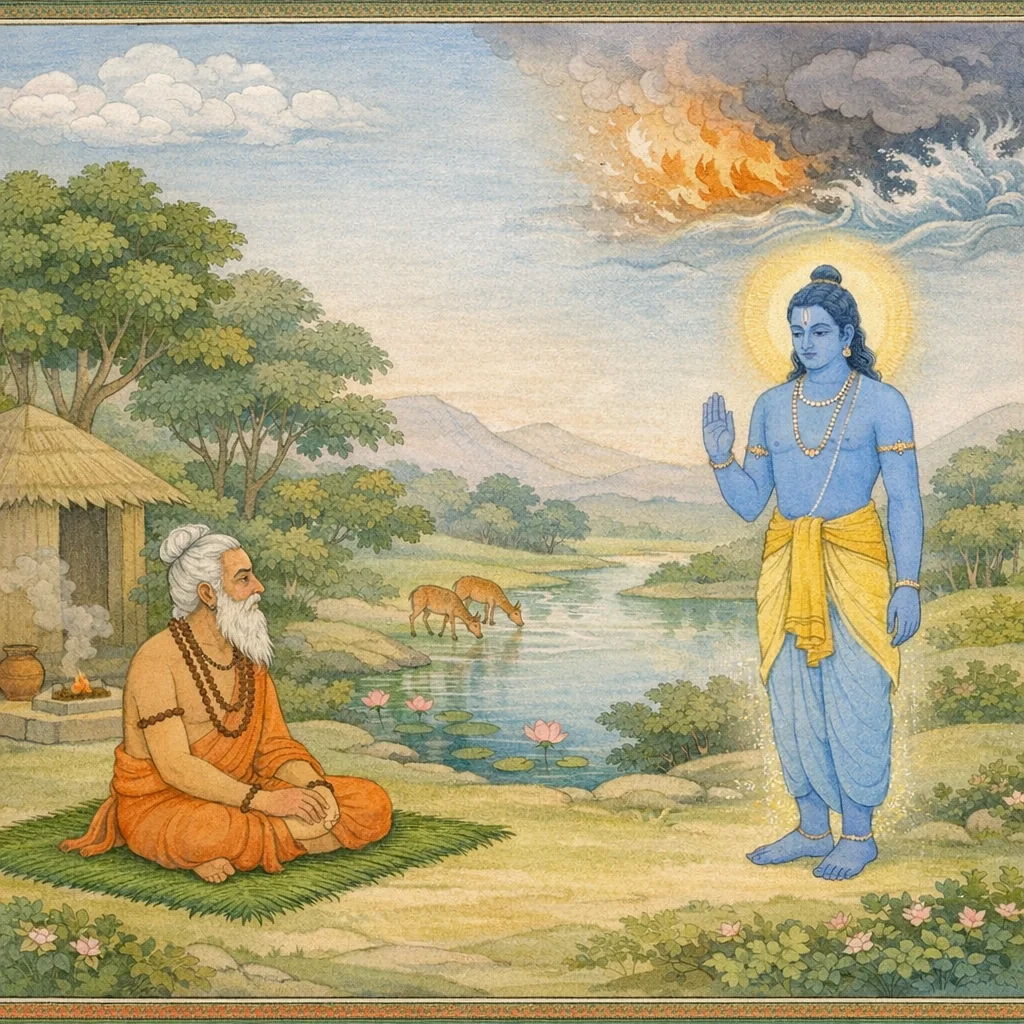
Adhyaya 190
अध्याय १९० — वामदेव-वाम्य-वृत्तान्तः (The Vāmadeva Horses Episode and the Ethics of Promise)
Upa-parva: Mārkaṇḍeya-upākhyāna (Exempla on Truth, Vows, and Consequence)
Vaiśaṃpāyana reports that a Pāṇḍava requests Mārkaṇḍeya to speak further, and Mārkaṇḍeya begins an illustrative account. A king, entering a charming forest-lake, sees a striking maiden gathering flowers and singing. She identifies herself simply as a maiden and states she can be obtained only ‘by a condition’ (samaya), which the king accepts; she later disappears after descending into a well/pond, leaving the king searching in vain. In grief and anger, the king initiates a severe frog-killing campaign, believing frogs responsible for his loss. The frog-king Āyu, disguised as an ascetic, intervenes and explains that the maiden Suśobhanā is his daughter and has deceived many kings; he gives her to the king and pronounces a lineage consequence tied to her prior untruthfulness. The narrative then shifts to a second dharma-test: during a hunt, the king seeks swift horses and learns of Vāmadeva’s famed pair. Vāmadeva lends them on the explicit condition of prompt return after the task. The king later resolves not to return them, prompting Vāmadeva’s demand and a charged exchange that frames vow-breaking as a grave fault with cosmic-legal repercussions. Coercive pressures and escalating threats culminate in the king’s entanglement in wrongdoing; resolution is achieved through prescribed expiatory action and the queen/princess’s intercession, after which the king returns the horses and is released from culpability. The chapter’s thematic center is the binding nature of promises, the danger of desire-driven judgment, and the corrective role of ascetic authority in re-aligning royal power with dharma.
Chapter Arc: वन के एकांत में तपस्वी ब्रह्मर्षि (विप्रर्षि) पितृ-भक्ति और कठोर ब्रह्मचर्य के बल पर दिव्य साक्षात्कार की देहरी पर खड़ा है—और स्वयं नारायण उसके सामने प्रकट होकर उसके तप का कारण बताते हैं। → देवता-कार्य की सिद्धि हेतु भगवान अपने स्वरूप-रहस्य का विस्तार करते हैं: ‘नारा’ (जल) का नामकरण, ‘नारायण’ की व्युत्पत्ति, जगत् के पंचमहाभूत और स्थावर-जंगम का उद्गम-लय—और यह भी कि वही वसन, शयन, विलय तथा संवर्तक अग्नि हैं। श्रोता का विस्मय बढ़ता है; वह समस्त लोकों को देखकर भी अर्थ-ग्रहण में डगमगाता है। → नारायण का विराट्-घोष: ‘मत्तः प्रादुर्भवन्त्येते मामेव प्रविशन्ति च’—समस्त वेद, वर्ण-व्यवस्था, पंचमहाभूत, त्रैलोक्य और प्रलय-चक्र सब उसी से निकलते और उसी में लीन होते हैं; सहस्र युगों के अंत में होने वाले प्रलय का अधिपति वही शंख-चक्र-गदा-धारी विश्वात्मा है। → भगवान श्रोता की पितृभक्ति, शरणागति और ब्रह्मचर्य की प्रशंसा कर उसे ‘श्रेय’ और ‘सुखोदय’ का आश्वासन देते हैं—यह ज्ञान-प्रकाश केवल विस्मय नहीं, साधक के कल्याण का साधन है। → नारायण के इस विराट्-तत्त्व के बाद श्रोता के लिए अगला प्रश्न उभरता है—इस ज्ञान का आचरण-रूप क्या है, और लोक-धर्म के भीतर इसका प्रयोग कैसे हो?
Shlokas
Verse 1
(दाक्षिणात्य अधिक पाठका १ श्लोक मिलाकर कुल १४४ श्लोक हैं) हि आय ० (0) हि २ 7 -अट्टमन्नं शिवो वेदो ब्राह्मणाश्व चतुष्पथा: | केशो भगं समाख्यातं शूलं तद् विक्रयं विदु: ।। (नीलकण्ठकृत टीका) एकोननवर्त्याधेकशततमो< ध्याय: भगवान् बालमुकुन्दका मार्कण्डेयको अपने स्वरूपका परिचय देना तथा मार्कण्डेयद्वारा श्रीकृष्णकी महिमाका प्रतिपादन और पाण्डवोंका श्रीकृष्णकी शरणमें जाना देव उवाच काम देवा अपि न मां विप्र जानन्ति तत्त्वतः | त्वत्प्रीत्या तु प्रवक्ष्यामि यथेदं विसृजाम्पहम्,भगवान् बोले--विप्रवर! देवता भी मेरे स्वरूपको यथेष्ट और यथार्थरूपसे नहीं जानते। मैं जिस प्रकार इस जगत्की रचना करता हूँ, वह तुम्हारे प्रेमके कारण तुम्हें बताऊँगा
The Lord said: “O brahmin, even the gods do not truly know me in my real nature. Yet, out of affection for you, I shall explain how I bring forth this world.”
Verse 2
पितृभक्तो$सि विप्रर्षे मां चैव शरणं गत: । ततो दृष्टो$स्मि ते साक्षाद् ब्रह्मचर्य च ते महत्,ब्रह्मर्ष! तुम पितृभक्त हो, मेरी शरणमें आये हो और तुमने महान् ब्रह्मचर्यका पालन किया है। इन्हीं सब कारणोंसे तुम्हें मेरे साक्षात् स््वरूपका दर्शन हुआ
“O best of sages among the brāhmaṇas, you are devoted to your forefathers (pitṛ), and you have also taken refuge in me. Therefore I have appeared before you directly; and your great observance of brahmacarya as well, O brahmarṣi, has been a decisive cause. Because of these virtues—filial piety, surrender, and disciplined chastity—you have been granted the vision of my manifest form.”
Verse 3
अपां नारा इति पुरा संज्ञाकर्म कृतं मया | तेन नारायणो&प्युक्तो मम तत् त्वयनं सदा,पूर्वकालमें मैंने ही जलका “नारा” नाम रखा था। वह “नारा' मेरा सदा अयन (वासस्थान) है, इसलिये मैं “नारायण' नामसे विख्यात हूँ
The Deity said: “In ancient times I myself assigned the name ‘Nārā’ to the waters. Because those ‘Nārā’ are ever my resting-place and abode (ayana), I am therefore also known as ‘Nārāyaṇa’.”
Verse 4
अहं नारायणो नाम प्रभव: शाश्वृतो5व्यय: । विधाता सर्वभूतानां संहर्ता च द्विजोत्तम,मैं नारायण ही सबकी उत्पत्तिका कारण, सनातन और अविनाशी हूँ। द्विजश्रेष्ठ! सम्पूर्ण भूतोंकी सृष्टि और संहार करनेवाला भी मैं ही हूँ। मैं ही विष्णु हूँ, मैं ही ब्रह्मा हूँ, मैं ही देवराज इन्द्र हूँ और मैं ही राजा कुबेर तथा प्रेतराज यम हूँ
The Deity said: “I am Nārāyaṇa by name—the source of all, eternal and imperishable. O best of the twice-born, I am the ordainer of all beings and also their withdrawer at dissolution.”
Verse 5
अहं विष्णुरहं ब्रह्मा शक्रश्नाहं सुराधिप: । अहं वैश्रवणो राजा यम: प्रेताधिपस्तथा,मैं नारायण ही सबकी उत्पत्तिका कारण, सनातन और अविनाशी हूँ। द्विजश्रेष्ठ! सम्पूर्ण भूतोंकी सृष्टि और संहार करनेवाला भी मैं ही हूँ। मैं ही विष्णु हूँ, मैं ही ब्रह्मा हूँ, मैं ही देवराज इन्द्र हूँ और मैं ही राजा कुबेर तथा प्रेतराज यम हूँ
The Deity said: “I am Viṣṇu; I am Brahmā; I am Śakra (Indra), the lord of the gods. I am also Vaiśravaṇa (Kubera), the king, and likewise Yama, the sovereign of the departed. Know that the powers you revere as separate rulers are, in truth, expressions of the one supreme source who brings forth beings and withdraws them again—therefore act with reverence and self-restraint, seeing the One behind all divine offices.”
Verse 6
अहं शिवश्न सोमश्ष॒ कश्यपो5थ प्रजापति: । अहं धाता विधाता च यज्ञश्षाहं द्विजोत्तम,विप्रवर! मैं ही शिव, चन्द्रमा, प्रजापति कश्यप, धाता, विधाता और यज्ञ हूँ
The Deity said: “I am Śiva; I am Soma (the Moon); I am Kaśyapa, the Prajāpati. I am Dhātṛ and Vidhātṛ as well; and I am the very Yajña (sacrificial order), O best of the twice-born.”
Verse 7
अग्निरास्यं क्षिति: पादौ चन्द्रादित्यौ च लोचने । द्यौर्मूर्धा खं दिश: श्रोत्रे तथा5प: स्वेदसम्भवा:,अग्नि मेरा मुख है, पृथ्वी चरण है, चन्द्रमा और सूर्य नेत्र हैं। द्युलोक मेरा मस्तक है। आकाश और दिशाएँ मेरे कान हैं तथा जल मेरे शरीरके पसीनेसे प्रकट हुआ है। दिशाओंसहित आकाश मेरा शरीर है। वायु मेरे मनमें स्थित है। मैंने पर्याप्त दक्षिणाओंसे युक्त अनेक शत यज्ञोंद्वारा यजन किया है
The Deity declares a cosmic form: “Fire is my mouth; the earth is my feet; the moon and the sun are my eyes. Heaven is my head; space and the directions are my ears; and the waters arise from my sweat.”
Verse 8
सदिशं च नभ: कायो वायुर्मनसि मे स्थित: । मया क्रतुशतैरिष्टं बहुभि: स्वाप्तदक्षिणै:,अग्नि मेरा मुख है, पृथ्वी चरण है, चन्द्रमा और सूर्य नेत्र हैं। द्युलोक मेरा मस्तक है। आकाश और दिशाएँ मेरे कान हैं तथा जल मेरे शरीरके पसीनेसे प्रकट हुआ है। दिशाओंसहित आकाश मेरा शरीर है। वायु मेरे मनमें स्थित है। मैंने पर्याप्त दक्षिणाओंसे युक्त अनेक शत यज्ञोंद्वारा यजन किया है
The Deity declares a cosmic identity: the sky together with the directions is His very body, and the wind abides within His mind. He further says that He has performed hundreds of sacrificial rites, each accompanied by abundant and properly bestowed gifts (dakṣiṇā) to the officiants. In context, the speech ties moral authority to both cosmic pervasiveness and the disciplined practice of yajña—implying that rightful power rests on order (ṛta/dharma), self-restraint, and generous giving rather than mere force.
Verse 9
यजन्ते वेदविदुषो मां देवयजने स्थितम् । पृथिवयां क्षत्रियेन्द्राश्न पार्थिवा: स्वर्गकाड्क्षिण:,शेषो भूत्वाहमेवैतां धारयामि वसुन्धराम् । वेदवेत्ता ब्राह्मण देवयज्ञमें स्थित मुझ यज्ञपुरुषका यजन करते हैं। पृथ्वीका पालन करनेवाले क्षत्रियनरेश स्वर्गप्राप्तिकी अभिलाषासे इस भूतलपर यज्ञोंद्वारा मेरा यजन करते हैं। इसी प्रकार वैश्य भी स्वर्गलोकपर विजय पानेकी इच्छासे मेरी सेवा-पूजा करते हैं। मैं ही शेषनाग होकर मेरुमन्दरसे विभूषित तथा चारों समुद्रोंसे घिरी हुई इस वसुन्धराको अपने सिरपर धारण करता हूँ
The Deity said: “Those who truly know the Veda worship Me, who abide in the divine sacrifice. On this earth, kings and foremost kṣatriyas—rulers who long for heaven—also worship Me through sacrificial rites. And I myself, becoming Śeṣa, uphold this earth.” The passage frames sacrifice not as mere transaction but as a dharmic ordering of society: learned priests, ruling protectors, and other householders approach the divine through prescribed worship, while the divine reciprocally sustains the world itself.
Verse 10
यजन्ते मां तथा वैश्या: स्वर्गलोकजिगीषया । चतुःसमुद्रपर्यन्तां मेरुमन्दर भूषणाम्
The Deity said: “So too, the Vaiśyas worship Me, driven by the desire to win the heavenly world. (They seek) a realm bounded by the four oceans, adorned with Meru and Mandara”—a vision of prosperity and cosmic grandeur that frames devotion as often motivated by the pursuit of reward rather than pure renunciation.
Verse 11
वाराहं रूपमास्थाय मयेयं जगती पुरा,विप्रवर! पूर्वकालमें जब यह पृथ्वी जलमें डूब गयी थी, उस समय मैंने ही वाराहरूप धारण करके इसे बलपूर्वक जलसे बाहर निकाला था। विद्वन! मैं ही बडवामुख अग्नि होकर सदा समुद्रके जलको पीता हूँ और फिर उस जलको बरसा देता हूँ। ब्राह्मण मेरा मुख है, क्षत्रिय दोनों भुजाएँ हैं और वैश्य मेरी दोनों जाँघोंके रूपमें स्थित हैं
The Deity said: “O foremost of Brahmins! In ancient times, when this earth had sunk beneath the waters, it was I who assumed the form of the Boar (Varāha) and, by sheer force, lifted her up from the flood. O wise one! I am also the Mare’s-mouth fire (Vaḍavāmukha) that continually drinks the ocean’s waters and then releases that same water again as rain. The Brahmin is my mouth, the Kshatriya my two arms, and the Vaishya abides as my two thighs.”
Verse 12
मज्जमाना जले विप्र वीयेणासीत् समुद्धृता । अग्निश्च वडवावक्त्रो भूत्वाहं द्विजसत्तम,विप्रवर! पूर्वकालमें जब यह पृथ्वी जलमें डूब गयी थी, उस समय मैंने ही वाराहरूप धारण करके इसे बलपूर्वक जलसे बाहर निकाला था। विद्वन! मैं ही बडवामुख अग्नि होकर सदा समुद्रके जलको पीता हूँ और फिर उस जलको बरसा देता हूँ। ब्राह्मण मेरा मुख है, क्षत्रिय दोनों भुजाएँ हैं और वैश्य मेरी दोनों जाँघोंके रूपमें स्थित हैं
The Deity said: “O brahmin, when the Earth was sinking in the waters, she was lifted out by me through my own might. And, O best of the twice-born, I also become the fire with the mare’s mouth (Vaḍavāmukha) that drinks the ocean’s waters and later releases them again as rain.”
Verse 13
पिबाम्यप: सदा दिद्वंस्ताश्वैवं विसृजाम्यहम् । ब्रह्म वक्त्र॑ भुजौ क्षत्रमूरू मे संस्थिता विश:,विप्रवर! पूर्वकालमें जब यह पृथ्वी जलमें डूब गयी थी, उस समय मैंने ही वाराहरूप धारण करके इसे बलपूर्वक जलसे बाहर निकाला था। विद्वन! मैं ही बडवामुख अग्नि होकर सदा समुद्रके जलको पीता हूँ और फिर उस जलको बरसा देता हूँ। ब्राह्मण मेरा मुख है, क्षत्रिय दोनों भुजाएँ हैं और वैश्य मेरी दोनों जाँघोंके रूपमें स्थित हैं
The Deity said: “I continually drink up the waters, and in that very way I release them again. The Brahmin is my mouth; the Kshatriya are my two arms; and the Vaishya are established as my thighs.”
Verse 14
पादौ शूद्रा भवन्तीमे विक्रमेण क्रमेण च । ऋग्वेद: सामवेदश्च यजुर्वेदो5प्यथर्वण:
“The feet become Śūdras—so it is said—through the acts of stepping forth and moving in ordered steps. And likewise there are the Vedas: the Ṛgveda, the Sāmaveda, the Yajurveda, and also the Atharvaveda.”
Verse 15
यतय: शान्तिपरमा यतात्मानो बुभुत्सव:,मामेव सतत विद्राश्चिन्तयन्त उपासते । शान्तिपरायण, संयमी, जिज्ञासु, काम-क्रोध-द्वेघपहित आसक्तिशून्य, निष्पाप, सात्विक, नित्य अहंकारशून्य तथा अध्यात्मज्ञानकुशल यति एवं ब्राह्मण सदा मेरा ही चिन्तन करते हुए उपासना करते हैं
The Deity said: “Those ascetics whose highest aim is peace—self-restrained, disciplined in spirit, and intent on true understanding—constantly keep their minds fixed on Me alone. Ever contemplating Me, they worship Me, free from attachment and purified of the agitations of desire, anger, and hatred. Such seekers, sinless, sattvic, and devoid of ego, skilled in inner knowledge, live in steady devotion to Me.”
Verse 16
कामक्रोधद्वेषमुक्ता नि:संगा वीतकल्मषा: । सत्त्वस्था निरहड्कारा नित्यमध्यात्मकोविदा:
The Deva said: Those who are freed from desire, anger, and hatred—detached, purified of stain—established in sattva, without egoism, and ever skilled in inner spiritual discernment: such persons embody the ethical ideal of self-mastery and inward wisdom that leads beyond bondage.
Verse 17
अहं संवर्तको वदह्विरहं संवर्तकोडनल:,मैं ही संवर्तक (प्रलयका कारण) वल्ि हूँ। मैं ही संवर्तक अनल हूँ। मैं ही संवर्तक सूर्य हूँ और मैं ही संवर्तक वायु हूँ। द्विजश्रेष्ठ आकाशमें जो ये तारे दिखायी देते हैं उन सबको मेरे ही रोमकूप समझो। रत्नाकर समुद्र और चारों दिशाओंको मेरे वस्त्र, शय्या और निवासस्थान जानो। मैंने ही देवताओंके कार्यकी सिद्धिके लिये इनकी पृथक्-पृथक् रचना की है
The Deity said: “I am the Saṃvartaka fire—the blaze that brings dissolution; I am the Saṃvartaka flame. I am the Saṃvartaka sun, and I am the Saṃvartaka wind. O best of twice-born, know that all the stars seen in the sky are but the pores of my body. Know the jewel-bearing ocean and the four directions to be my garments, my bed, and my dwelling-place. For the fulfillment of the gods’ purposes, I myself fashioned these things in their distinct forms.”
Verse 18
अहं संवर्तकः सूर्यस्त्वहं संवर्तकोडनिल: । तारारूपाणि दृश्यन्ते यान्येतानि नभस्तले,मैं ही संवर्तक (प्रलयका कारण) वल्ि हूँ। मैं ही संवर्तक अनल हूँ। मैं ही संवर्तक सूर्य हूँ और मैं ही संवर्तक वायु हूँ। द्विजश्रेष्ठ आकाशमें जो ये तारे दिखायी देते हैं उन सबको मेरे ही रोमकूप समझो। रत्नाकर समुद्र और चारों दिशाओंको मेरे वस्त्र, शय्या और निवासस्थान जानो। मैंने ही देवताओंके कार्यकी सिद्धिके लिये इनकी पृथक्-पृथक् रचना की है
The Deity said: “I am the Saṃvartaka Sun; I am the Saṃvartaka Wind. The star-like forms that are seen spread across the vault of the sky—know them to be but manifestations of my own being.”
Verse 19
मम वै रोमकूपाणि विद्धि त्वं द्विजसत्तम । रत्नाकरा: समुद्राश्व॒ सर्व एव चतुर्दिशम्,मैं ही संवर्तक (प्रलयका कारण) वल्ि हूँ। मैं ही संवर्तक अनल हूँ। मैं ही संवर्तक सूर्य हूँ और मैं ही संवर्तक वायु हूँ। द्विजश्रेष्ठ आकाशमें जो ये तारे दिखायी देते हैं उन सबको मेरे ही रोमकूप समझो। रत्नाकर समुद्र और चारों दिशाओंको मेरे वस्त्र, शय्या और निवासस्थान जानो। मैंने ही देवताओंके कार्यकी सिद्धिके लिये इनकी पृथक्-पृथक् रचना की है
The Deity said: “Know, O best of Brahmins, that these are indeed my pores. The jewel-bearing oceans and all the four directions—understand them as belonging to me, as the vast expanse that serves as my covering and abode. Thus the whole cosmos is pervaded by me, and its ordered divisions have been fashioned for the fulfillment of the gods’ purposes.”
Verse 20
वसनं शयनं चैव विलयं चैव विद्धि मे । मयैव सुविभक्तास्ते देवकार्यार्थसिद्धये,मैं ही संवर्तक (प्रलयका कारण) वल्ि हूँ। मैं ही संवर्तक अनल हूँ। मैं ही संवर्तक सूर्य हूँ और मैं ही संवर्तक वायु हूँ। द्विजश्रेष्ठ आकाशमें जो ये तारे दिखायी देते हैं उन सबको मेरे ही रोमकूप समझो। रत्नाकर समुद्र और चारों दिशाओंको मेरे वस्त्र, शय्या और निवासस्थान जानो। मैंने ही देवताओंके कार्यकी सिद्धिके लिये इनकी पृथक्-पृथक् रचना की है
The Deity said: “Know that the ocean and the four directions are My clothing, My couch, and My dwelling-place. I have apportioned and arranged them distinctly for the accomplishment of the gods’ purposes.”
Verse 21
साधुशिरोमणे! काम, क्रोध, हर्ष, भय और मोह--इन सभी विकारोंको मेरी ही रोमावली समझो
O crest-jewel among the virtuous! Know desire, anger, joy, fear, and delusion—all these inner agitations—as nothing other than the hairs of my own body.
Verse 22
प्राप्रुवन्ति नरा विप्र यत् कृत्वा कर्म शो भनम् । सत्यं दानं तपश्चोग्रमहिंसा चैव जन्तुषु,ब्रह्म! जिस शुभ कर्मोके आचरणसे मनुष्यको कल्याणकी प्राप्ति होती है, वे सत्य, दान, उग्र तपस्या और किसी भी प्राणीकी हिंसा न करनेका स्वभाव--ये सब मेरे ही विधानसे निर्मित हुए हैं और मेरे ही शरीरमें विहार करते हैं। मैं समस्त प्राणियोंके ज्ञानको जब प्रकट कर देता हूँ, तभी वे चेष्टाशील होते हैं, अन्यथा अपनी इच्छासे वे कुछ नहीं कर सकते
The Deity said: “O Brahmin, people attain welfare by performing noble deeds. Truthfulness, generosity, severe austerity, and non-violence toward living beings—these arise from my ordinance and move within my very being. Only when I manifest knowledge in all creatures do they become capable of purposeful action; otherwise, by their own will alone, they are unable to accomplish anything.”
Verse 23
काम क्रोधं च हर्ष च भयं मोहं तथैव च । ममैव विद्धि रोमाणि सर्वाण्येतानि सत्तम,मद्विधानेन विहिता मम देहविहारिण: । मया<<विर्भूतविज्ञाना विचेष्टन्ते न कामत: ब्रह्म! जिस शुभ कर्मोके आचरणसे मनुष्यको कल्याणकी प्राप्ति होती है, वे सत्य, दान, उग्र तपस्या और किसी भी प्राणीकी हिंसा न करनेका स्वभाव--ये सब मेरे ही विधानसे निर्मित हुए हैं और मेरे ही शरीरमें विहार करते हैं। मैं समस्त प्राणियोंके ज्ञानको जब प्रकट कर देता हूँ, तभी वे चेष्टाशील होते हैं, अन्यथा अपनी इच्छासे वे कुछ नहीं कर सकते
The God said: “Know desire, anger, exhilaration, fear, and delusion to be, as it were, the hairs upon my own body, O best of the good—set in place by my ordinance and moving within my being. Only when I manifest knowledge within creatures do they become capable of action; otherwise, they do nothing by mere personal whim.”
Verse 24
सम्यग् वेदमधीयाना यजन्ते विविधैर्मखै: । शान्तात्मानो जितक्रोधा: प्राप्रुवन्ति द्विजातय:,जो द्विजाति अच्छी तरह वेदोंका अध्ययन करके शान्तचित्त और क्रोधशून्य होकर नाना प्रकारके यज्ञोंद्वारा मेरी आराधना करते हैं, उन्हें ही मेरी प्राप्ति होती है
The Deity said: Those twice-born who properly study the Veda, who are inwardly tranquil and have conquered anger, worship Me through sacrifices of many kinds; it is they who attain Me.
Verse 25
प्राप्तुंन शक्यो यो विद्वन् नरैर्दुष्कृतकर्मभि: । लोभाभिभूतै: कृपणैरनार्यरकृतात्मभि:,विद्वन्! पापकर्मा, लोभी, कृपण, अनार्य और अजितात्मा मनुष्य जिसे कभी नहीं पा सकते वह महान् फल मुझे ही समझो। मैं ही शुद्ध अन्तःकरणवाले मानवोंको सुलभ होनेवाला योगसेवित मार्ग हूँ। मूढ़ मनुष्योंके लिये मैं सर्वथा दुर्लभ हूँ
The Deity said: “O wise one, that attainment which cannot be reached by men of evil deeds—overpowered by greed, miserly, ignoble, and undisciplined—know that supreme fruit to be none other than Me. I am the path cultivated through yoga, easily accessible to those whose inner being is purified; but for the deluded I remain wholly difficult to obtain.”
Verse 26
तं॑ मां महाफलं विद्धि नराणां भावितात्मनाम् | सुदुष्प्रापं विमूढानां मार्ग योगैर्निषेवितम्,विद्वन्! पापकर्मा, लोभी, कृपण, अनार्य और अजितात्मा मनुष्य जिसे कभी नहीं पा सकते वह महान् फल मुझे ही समझो। मैं ही शुद्ध अन्तःकरणवाले मानवोंको सुलभ होनेवाला योगसेवित मार्ग हूँ। मूढ़ मनुष्योंके लिये मैं सर्वथा दुर्लभ हूँ
Know Me to be that supreme reward for people of cultivated, disciplined inner life. For the deluded I am exceedingly hard to attain; I am the path honored and practiced through yoga. The sinful, greedy, miserly, ignoble, and self-unconquered person does not reach Me; but for those whose inner being is purified, I am readily accessible as the yogic way itself.
Verse 27
यदा यदा च धर्मस्य ग्लानिर्भवति सत्तम | अभ्युत्थानमधर्मस्य तदा55त्मानं सृजाम्यहम्,महर्ष!! जब-जब धर्मकी हानि और अधर्मका उत्थान होता है, तब-तब मैं अपने- आपको प्रकट करता हूँ। जब हिंसाप्रेमी दैत्य श्रेष्ठ देवताओंके लिये अवध्य हो जाते हैं तथा भयानक राक्षस जब इस संसारमें उत्पन्न हो अत्याचार करने लगते हैं तब मैं पुण्यात्मा पुरुषोंके घरोंपर मानवशरीरमें प्रविष्ट होकर प्रकट होता हूँ और उन दैत्यों एवं राक्षसोंका सारा उपद्रव शान्त कर देता हूँ
The Deity said: “Whenever righteousness declines, O best of the good, and unrighteousness rises in strength, then I manifest Myself. When violence-loving demons become invincible to the foremost gods, and when dreadful rākṣasas arise in the world and oppress it, I enter human embodiment—appearing in the homes of the virtuous—and I quell the entire menace of those demons and rākṣasas.”
Verse 28
दैत्या हिंसानुरक्ताश्न अवध्या: सुरसत्तमै: । राक्षसाश्षापि लोकेड5स्मिन् यदोत्पत्स्यन्ति दारुणा:,महर्ष!! जब-जब धर्मकी हानि और अधर्मका उत्थान होता है, तब-तब मैं अपने- आपको प्रकट करता हूँ। जब हिंसाप्रेमी दैत्य श्रेष्ठ देवताओंके लिये अवध्य हो जाते हैं तथा भयानक राक्षस जब इस संसारमें उत्पन्न हो अत्याचार करने लगते हैं तब मैं पुण्यात्मा पुरुषोंके घरोंपर मानवशरीरमें प्रविष्ट होकर प्रकट होता हूँ और उन दैत्यों एवं राक्षसोंका सारा उपद्रव शान्त कर देता हूँ
The Deity said: “When violence-loving Daityas become impossible for even the foremost of the gods to slay, and when dreadful Rakshasas arise in this world and begin to oppress it, then I manifest—entering a human body in the homes of the righteous—and I quell the entire menace of those Daityas and Rakshasas.”
Verse 29
तदाहं सम्प्रसूयामि गृहेषु शुभकर्मणाम् । प्रविष्टो मानुषं देहं सर्व प्रशमयाम्पहम्,महर्ष!! जब-जब धर्मकी हानि और अधर्मका उत्थान होता है, तब-तब मैं अपने- आपको प्रकट करता हूँ। जब हिंसाप्रेमी दैत्य श्रेष्ठ देवताओंके लिये अवध्य हो जाते हैं तथा भयानक राक्षस जब इस संसारमें उत्पन्न हो अत्याचार करने लगते हैं तब मैं पुण्यात्मा पुरुषोंके घरोंपर मानवशरीरमें प्रविष्ट होकर प्रकट होता हूँ और उन दैत्यों एवं राक्षसोंका सारा उपद्रव शान्त कर देता हूँ
Therefore, I manifest myself—taking birth in the households of the virtuous. Entering a human body, I quell every disturbance, bringing all turmoil to peace.
Verse 30
सृष्टवा देवमनुष्यांस्तु गन्धर्वोरगराक्षसान् । स्थावराणि च भूतानि संहराम्यात्ममायया,मैं ही अपनी मायासे देवता, मनुष्य, गन्धर्व, नाग, राक्षस तथा स्थावर प्राणियोंकी सृष्टि करके समय आनेपर पुन: उनका संहार कर डालता हूँ
Having brought forth—by my own power—gods and humans, Gandharvas, Nāgas, and Rākṣasas, as well as the immobile orders of beings, I also withdraw them again in due time through my own māyā.
Verse 31
कर्मकाले पुनर्देहमविचिन्त्यं सृजाम्पहम् । आविव्य मानुषं देहं मर्यादाबन्धकारणात्,फिर सृष्टि-रचनाके समय मैं अचिन्त्यस्वरूप धारण करता हूँ; तथा मर्यादाकी स्थापना एवं रक्षाके लिये मानव-शरीरसे अवतार लेता हूँ
At the appointed time of action, I again bring forth a body of inconceivable nature. Entering a human form, I take birth for the sake of establishing and safeguarding the bounds of righteous order (maryādā), so that the world may remain restrained by dharma.
Verse 32
श्वेत: कृतयुगे वर्ण: पीतस्त्रेतायुगे मम । रक्तो द्वापरमासाद्य कृष्ण: कलियुगे तथा,सत्ययुगमें मेरे शरीरका रंग श्वेत, त्रेतामें पीला, द्वापरमें लाल और कलियुगमें काला होता है
In the Kṛta (Satya) Yuga my hue is white; in the Tretā Yuga it is yellow; upon reaching the Dvāpara Yuga it becomes red; and in the Kali Yuga it is black.
Verse 33
त्रयो भागा हुधर्मस्य तस्मिन् काले भवन्ति च । अन्तकाले च सन्प्राप्ते कालो भूत्वातिदारुण:
The Deity said: “At that time, three portions (or aspects) of dharma come to the fore. And when the final hour arrives, Time itself becomes exceedingly dreadful.”
Verse 34
अहं त्रिवर्त्मा विश्वात्मा सर्वतोकसुखावह:,मैं तीनों लोकोंमें व्याप्त, सम्पूर्ण विश्वका आत्मा, सब लोगोंको सुख पहुँचानेवाला, सबकी उत्पत्तिका कारण, सर्वव्यापी, अनन्त, इन्द्रियोंका नियन्ता और महान् विक्रमशाली हूँ। ब्रह्म! यह जो सम्पूर्ण भूतोंका संहार करनेवाला और सबको उद्योगशील बनानेवाला अव्यक्त कालचक्र है, इसका संचालन केवल मैं ही करता हूँ। मुनिश्रेष्ठ! इस प्रकार मेरा स्वरूपभूत आत्मा ही सर्वत्र सब प्राणियोंके भीतर भलीभाँति स्थित है। विप्रवर! इतनेपर भी मुझे कोई जानता नहीं है
The Deity said: “I am the threefold path, the Self of the universe, and the giver of well-being to all worlds. I am the cause of all origination—all-pervading, endless, the ruler of the senses, and mighty in power. O Brahman, this unmanifest wheel of Time, which brings about the destruction of all beings and impels all creatures into activity, is set in motion by Me alone. O best of sages, thus My own essential Self abides everywhere, firmly established within the hearts of all living beings. Yet, O foremost of Brahmins, no one truly knows Me.”
Verse 35
आविर्भू: सर्वगोडनन्तो हृषीकेश उरुक्रम: । कालचक्रं नयाम्येको ब्रह्मन्नहमरूपकम्,मैं तीनों लोकोंमें व्याप्त, सम्पूर्ण विश्वका आत्मा, सब लोगोंको सुख पहुँचानेवाला, सबकी उत्पत्तिका कारण, सर्वव्यापी, अनन्त, इन्द्रियोंका नियन्ता और महान् विक्रमशाली हूँ। ब्रह्म! यह जो सम्पूर्ण भूतोंका संहार करनेवाला और सबको उद्योगशील बनानेवाला अव्यक्त कालचक्र है, इसका संचालन केवल मैं ही करता हूँ। मुनिश्रेष्ठ! इस प्रकार मेरा स्वरूपभूत आत्मा ही सर्वत्र सब प्राणियोंके भीतर भलीभाँति स्थित है। विप्रवर! इतनेपर भी मुझे कोई जानता नहीं है
The Deity said: “I am manifest, all-pervading, endless—Hṛṣīkeśa, the Lord of the senses, and Urukrama, of vast stride and power. O Brahmin, I alone set in motion the formless Wheel of Time, which drives all beings to action and brings about the dissolution of all creatures. Though my own Self abides fully within all living beings everywhere, still no one truly knows me.”
Verse 36
शमन सर्वभूतानां सर्वलोककृतोद्यमम् | एवं प्रणिहित: सम्यड् ममात्मा मुनिसत्तम | सर्वभूतेषु विप्रेन्द्र न च मां वेत्ति कश्चन,मैं तीनों लोकोंमें व्याप्त, सम्पूर्ण विश्वका आत्मा, सब लोगोंको सुख पहुँचानेवाला, सबकी उत्पत्तिका कारण, सर्वव्यापी, अनन्त, इन्द्रियोंका नियन्ता और महान् विक्रमशाली हूँ। ब्रह्म! यह जो सम्पूर्ण भूतोंका संहार करनेवाला और सबको उद्योगशील बनानेवाला अव्यक्त कालचक्र है, इसका संचालन केवल मैं ही करता हूँ। मुनिश्रेष्ठ! इस प्रकार मेरा स्वरूपभूत आत्मा ही सर्वत्र सब प्राणियोंके भीतर भलीभाँति स्थित है। विप्रवर! इतनेपर भी मुझे कोई जानता नहीं है
The Deity said: “I am the pacifier and regulator of all beings, and the one who sets all the worlds into activity. Thus, O best of sages, my very Self is rightly and firmly established everywhere. Yet, O foremost of brahmins, though I abide within all creatures, no one truly knows me.”
Verse 37
सर्वलोके च मां भक्ता: पूजयन्ति च सर्वश: । यच्च किंचित् त्वया प्राप्तं मयि क्लेशात्मकं द्विज,समस्त जगत्में भक्त पुरुष सब प्रकारसे मेरी आराधना करते हैं। तुमने मेरे निकट आकर जो कुछ भी क्लेश उठाया है, ब्रह्मन! वह सब तुम्हारे भावी कल्याण और सुखका साधक है। अनघ! लोकमें तुमने जो कोई भी स्थावर-जंगम पदार्थ देखा है, उसके रूपमें सर्वथा मेरा भूत-भावन आत्मा ही प्रकट हुआ है। सम्पूर्ण लोकोंके पितामह ब्रह्मा मेरा आधा अंग हैं
The Deity said: “Throughout all the worlds, my devotees worship me in every way. And whatever hardship you have undergone in coming to me, O brahmin, is itself a means to your future welfare and happiness. O sinless one, whatever moving or unmoving thing you have seen in the world—there my life-giving Self has manifested in that very form. Brahmā, the grandsire of all the worlds, is half of my own being.”
Verse 38
सुखोदयाय तत् सर्व श्रेयसे च तवानघ । यच्च किंचित् त्वया लोके दृष्टं स्थावरजड्रमम्,समस्त जगत्में भक्त पुरुष सब प्रकारसे मेरी आराधना करते हैं। तुमने मेरे निकट आकर जो कुछ भी क्लेश उठाया है, ब्रह्मन! वह सब तुम्हारे भावी कल्याण और सुखका साधक है। अनघ! लोकमें तुमने जो कोई भी स्थावर-जंगम पदार्थ देखा है, उसके रूपमें सर्वथा मेरा भूत-भावन आत्मा ही प्रकट हुआ है। सम्पूर्ण लोकोंके पितामह ब्रह्मा मेरा आधा अंग हैं
The Deity said: “All that has happened is meant to bring you future happiness and lasting good, O sinless one. Whatever you have seen in this world—whether unmoving or moving beings—know that in every such form it is My life-giving Self alone that is manifested. Even the hardships you endured in coming near Me, O brahmin, become instruments of your welfare and joy to come.”
Verse 39
विहित: सर्वथैवासी ममात्मा भूतभावन: । अर्ध मम शरीरस्य सर्वलोकपितामह:,समस्त जगत्में भक्त पुरुष सब प्रकारसे मेरी आराधना करते हैं। तुमने मेरे निकट आकर जो कुछ भी क्लेश उठाया है, ब्रह्मन! वह सब तुम्हारे भावी कल्याण और सुखका साधक है। अनघ! लोकमें तुमने जो कोई भी स्थावर-जंगम पदार्थ देखा है, उसके रूपमें सर्वथा मेरा भूत-भावन आत्मा ही प्रकट हुआ है। सम्पूर्ण लोकोंके पितामह ब्रह्मा मेरा आधा अंग हैं
The Deity said: “In every way you are established in Me; My very Self—who brings all beings into manifestation—stands revealed. Whatever hardship you have endured by coming near Me, O brāhmaṇa, becomes the means of your future welfare and happiness. O sinless one, whatever moving or unmoving thing you have seen in the world is nothing but My own being, the source of creatures, appearing in that form. And Brahmā, the grandsire of all the worlds, is as it were half of My body.”
Verse 40
अहं नारायणो नाम शड्खचक्रगदाधर: । यावद्युगानां विप्रर्षे सहस्रपरिवर्तनात्,अशिशु: शिशुरूपेण यावदब्रह्मा न बुध्यते । ब्रह्मर्ष! मैं शंख, चक्र और गदा धारण करनेवाला विश्वात्मा नारायण हूँ, सहस्र युगके अन्तमें जो प्रलय होता है वह जबतक रहता है, तबतक सब प्राणियोंको (महानिद्रारूप मायासे) मोहित करके मैं (जलमें) शयन करता हूँ। मुनिश्रेष्ठ! यद्यपि मैं बालक नहीं हूँ, तो भी जबतक ब्रह्मा नहीं जागते, तबतक सदा इसी प्रकार बालकरूप धारण करके यहाँ रहता हूँ
The Deity said: “I am Nārāyaṇa by name, the bearer of conch, discus, and mace. O brahmin-seer, for as long as the dissolution that comes at the completion of a thousand yugas endures, I cast all beings into delusion through the great sleep and lie reposing upon the waters. O best of sages, though I am not truly a child, until Brahmā awakens I remain here in this very way, assuming the form of a child.”
Verse 41
तावत् स्वपिमि विश्वात्मा सर्वभूतानि मोहयन् । एवं सर्वमहं कालमिहास्से मुनिसत्तम
The Deity said: “So long do I sleep as the Universal Self, casting delusion over all beings. Thus I remain here through all time, O best of sages.”
Verse 42
मया च दत्तो विप्राग्रय वरस्ते ब्रह्म॒रूपिणा,विप्रशिरोमणे! तुम ब्रह्मर्षियोंद्वारा पूजित हो। मैंने ही ब्रह्मारूपसे तुम्हारे ऊपर बार-बार संतुष्ट हो तुम्हें अभीष्ट वर प्रदान किया है। मैंने समझ लिया था कि तुम सम्पूर्ण चराचर जगत्को नष्ट तथा एकार्णवमें निमग्न हुआ देखकर व्याकुल हो रहे हो। इसीलिये तुम्हें पुनः जगत्का दर्शन कराया है। ब्रह्मर्ष! जब तुम मेरे शरीरके भीतर प्रविष्ट हुए थे और समस्त संसारको देखकर विस्मय-विमुग्ध हो फिर सचेत नहीं हो पा रहे थे, तब मैंने तुरंत तुम्हें मुखसे बाहर निकाल दिया था
The Deity said: “O foremost of brahmins, jewel among sages! You are honored by the great seers. It was I—appearing in the form of Brahmā—who, being repeatedly pleased with you, granted you the boon you desired. I understood that you were distressed when you beheld the entire moving and unmoving world destroyed and submerged in a single cosmic ocean. Therefore I showed you the world again. O brahmarṣi, when you entered within my body and, seeing the whole universe, became stunned with wonder and could not regain awareness, I immediately drew you out through my mouth.”
Verse 43
असकृत् परितुष्टेन विप्रर्षिगणपूजित । सर्वमेकार्णवं दृष्टवा नष्ट स्थावरजड्रमम्,विप्रशिरोमणे! तुम ब्रह्मर्षियोंद्वारा पूजित हो। मैंने ही ब्रह्मारूपसे तुम्हारे ऊपर बार-बार संतुष्ट हो तुम्हें अभीष्ट वर प्रदान किया है। मैंने समझ लिया था कि तुम सम्पूर्ण चराचर जगत्को नष्ट तथा एकार्णवमें निमग्न हुआ देखकर व्याकुल हो रहे हो। इसीलिये तुम्हें पुनः जगत्का दर्शन कराया है। ब्रह्मर्ष! जब तुम मेरे शरीरके भीतर प्रविष्ट हुए थे और समस्त संसारको देखकर विस्मय-विमुग्ध हो फिर सचेत नहीं हो पा रहे थे, तब मैंने तुरंत तुम्हें मुखसे बाहर निकाल दिया था
The Deity said: “O foremost of brahmins, revered by companies of brahmin seers, I have again and again been pleased with you and, in my Brahmā-form, have granted you the boon you desired. I understood that you were distressed on seeing the entire moving and unmoving world destroyed and submerged in a single cosmic ocean. Therefore I caused you to behold the world once more. O brahmarṣi, when you had entered within my body and, after seeing the whole universe, were struck with wonder and could not regain awareness, I immediately drew you out through my mouth.”
Verse 44
विक्लवो5सि मया ज्ञातस्ततस्ते दर्शितं जगत् । अभ्यन्तरं शरीरस्य प्रविष्टोडसि यदा मम,विप्रशिरोमणे! तुम ब्रह्मर्षियोंद्वारा पूजित हो। मैंने ही ब्रह्मारूपसे तुम्हारे ऊपर बार-बार संतुष्ट हो तुम्हें अभीष्ट वर प्रदान किया है। मैंने समझ लिया था कि तुम सम्पूर्ण चराचर जगत्को नष्ट तथा एकार्णवमें निमग्न हुआ देखकर व्याकुल हो रहे हो। इसीलिये तुम्हें पुनः जगत्का दर्शन कराया है। ब्रह्मर्ष! जब तुम मेरे शरीरके भीतर प्रविष्ट हुए थे और समस्त संसारको देखकर विस्मय-विमुग्ध हो फिर सचेत नहीं हो पा रहे थे, तब मैंने तुरंत तुम्हें मुखसे बाहर निकाल दिया था
The Deity said: “I understood that you were overwhelmed; therefore I showed you the world again. O best of Brahmins, when you had entered within my body and, on beholding everything, were struck with astonishment and could not regain composure, I immediately brought you out through my mouth.”
Verse 45
दृष्टवा लोक॑ समस्तं च विस्मितो नावबुध्यसे । ततो$सि वकत्राद् विप्रषे द्रुतं निःसारितो मया,विप्रशिरोमणे! तुम ब्रह्मर्षियोंद्वारा पूजित हो। मैंने ही ब्रह्मारूपसे तुम्हारे ऊपर बार-बार संतुष्ट हो तुम्हें अभीष्ट वर प्रदान किया है। मैंने समझ लिया था कि तुम सम्पूर्ण चराचर जगत्को नष्ट तथा एकार्णवमें निमग्न हुआ देखकर व्याकुल हो रहे हो। इसीलिये तुम्हें पुनः जगत्का दर्शन कराया है। ब्रह्मर्ष! जब तुम मेरे शरीरके भीतर प्रविष्ट हुए थे और समस्त संसारको देखकर विस्मय-विमुग्ध हो फिर सचेत नहीं हो पा रहे थे, तब मैंने तुरंत तुम्हें मुखसे बाहर निकाल दिया था
The Deity said: “Having beheld the entire universe, you were struck with wonder and could not regain clear awareness. Therefore, O brahmin—O foremost among sages—I swiftly drew you out from my mouth. I understood that, seeing all beings and things destroyed and submerged in the single cosmic ocean, you had become distressed; for that reason I granted you once more the vision of the world. When you had entered within my body and, after seeing the whole cosmos, remained bewildered and unable to return to yourself, I immediately released you outward.”
Verse 46
आखयातस्ते मया चात्मा दुर्जेयो हि सुरासुरै:,ब्रह्मर्ष! इस प्रकार मैंने तुम्हें अपने स्वरूपका उपदेश किया है, जिसका जानना देवता और असुरोंके लिये भी कठिन है। जबतक महातपस्वी भगवान् ब्रह्माका जागरण न हो, तबतक तुम श्रद्धा और विश्वासपूर्वक सुखसे विचरते रहो
The Deity said: “I have now declared to you My own true nature. Indeed, it is hard to comprehend—even for gods and demons. Therefore, O brahmarṣi, until the great ascetic Lord Brahmā awakens, you should continue to move about at ease, sustained by faith and trust.”
Verse 47
यावत् स भगवान ब्रह्मा न बुध्येत महातपा: । तावत् त्वमिह विप्रषें विश्रब्धश्नर वै सुखम्,ब्रह्मर्ष! इस प्रकार मैंने तुम्हें अपने स्वरूपका उपदेश किया है, जिसका जानना देवता और असुरोंके लिये भी कठिन है। जबतक महातपस्वी भगवान् ब्रह्माका जागरण न हो, तबतक तुम श्रद्धा और विश्वासपूर्वक सुखसे विचरते रहो
The Deity said: “So long as that blessed Brahmā, the great ascetic, has not yet awakened to awareness, remain here, O brahmarṣi—move about at ease, free from fear and doubt, with trust and confidence.”
Verse 48
ततो विबुद्धे तस्मिंस्तु सर्वलोकपितामहे । एकीभूतो हि स्रक्ष्यामि शरीराणि द्विजोत्तम,द्विजश्रेष्ठ! सर्वलोकपितामह ब्रह्माके जागनेपर मैं उनसे एकीभूत हो समस्त शरीरोंकी सृष्टि करूँगा
Then, when that Grandfather of all the worlds—Brahmā—awakens, O best of the twice-born, I shall become one with him and bring forth the creation of embodied beings, producing the various bodies for all creatures.
Verse 49
आकाश पृथिवीं ज्योतिर्वायुं सलिलमेव च । लोके यच्च भवेच्छेषमिह स्थावरजड्रमम्,आकाश, पृथ्वी, अग्नि, वायु और जलका तथा इस संसारमें जो अन्य चराचर वस्तुएँ अवशिष्ट हैं, उन सबका निर्माण करूँगा
The Deity said: “I shall bring forth space, earth, fire (light), wind, and water—and whatever else remains in this world here, whether moving or unmoving, even what is inert.”
Verse 50
मार्कण्डेय उवाच इत्युक्त्वान्तर्हितस्तात स देव: परमाद्धुत: । प्रजाश्वैमा: प्रपश्यामि विचित्रा विविधा: कृता:,मार्कण्डेयजी कहते हैं--तात युधिष्ठिर! ऐसा कहकर वे परम अद्भुत देवता भगवान् बालमुकुन्द अन्तर्धान हो गये। उनके अन्तर्धान होते ही मैंने देखा कि यह नाना प्रकारकी विचित्र प्रजा ज्यों-की-त्यों उत्पन्न हो गयी है
Mārkaṇḍeya said: “Having spoken thus, O dear one, that supremely wondrous deity vanished from sight. And as soon as he disappeared, I beheld these beings—variegated and manifold—coming into existence just as they were, fashioned in diverse forms.”
Verse 51
एवं दृष्टं मया राजंस्तस्मिन् प्राप्ते युगक्षये । आश्चर्य भरतश्रेष्ठ सर्वधर्मभूतां वर,सम्पूर्ण धर्मात्माओंमें श्रेष्ठ भरतकुल-तिलक युधिष्ठिर! इस प्रकार उस प्रलयकालके आनेपर मुझे यह आश्चर्यजनक अनुभव हुआ था
O King, when the end of that age arrived, I witnessed this with my own eyes. It was a wondrous event, O best of the Bharatas, foremost among those who uphold all dharma.
Verse 52
य: स देवो मया दृष्ट: पुरा पद्मायतेक्षण: । स एष पुरुषव्याप्र सम्बन्धी ते जनार्दन:,नरश्रेष्ठ! पुरातन प्रलयके समय मुझे जिन कमल-दललोचन देवता भगवान् बालमुकुन्दका दर्शन हुआ था, तुम्हारे सम्बन्धी ये भगवान् श्रीकृष्ण वे ही हैं
Mārkaṇḍeya said: “That very god whom I once beheld long ago—lotus-eyed and radiant—has appeared here as Janārdana. O tiger among men, he is your own kinsman. The ancient Lord whom I saw at the time of dissolution is none other than Śrī Kṛṣṇa.”
Verse 53
अस्यैव वरदानाद्धि स्मृतिर्न प्रजहाति माम् । दीर्घमायुश्न कौन्तेय स्वच्छन्दमरणं मम,कुन्तीनन्दन! इन्हींके वरदानसे मुझे पूर्वजन्मकी स्मृति भूलती नहीं है। मेरी दीर्घकालीन आयु और स्वच्छन्द मृत्यु भी इन्हींकी कृपाका प्रसाद है
Mārkaṇḍeya said: “Indeed, by the boon granted by Him alone, my memory does not abandon me—I do not lose recollection of my former births. O long-lived son of Kuntī, my life has been prolonged, and even my death is at my own choosing, all through His grace.”
Verse 54
स एष कृष्णो वार्ष्णेय: पुराणपुरुषो विभु: । आस्ते हरिरचिन्त्यात्मा क्रीडनज्जिव महाभुज:,ये वृष्णिकुल-भूषण महाबाहु श्रीकृष्ण ही वे सर्वव्यापी, अचिन्त्यस्वरूप, पुराण-पुरुष श्रीहरि हैं जो पहले बालरूपमें मुझे दिखायी दिये थे। वे ही यहाँ अवतीर्ण हो भाँति-भाँतिकी लीलाएँ करते हुए-से दीख रहे हैं
Mārkaṇḍeya said: “This very Kṛṣṇa, the Vārṣṇeya, is the all-powerful, primeval Person. He abides here as Hari, of inconceivable nature—appearing as though engaged in playful sport, mighty-armed. He is the same all-pervading Śrī Hari whom I once beheld in a childlike form; now descended here, he seems to enact many kinds of divine play.”
Verse 55
एष धाता विधाता च संहर्ता चैव शाश्वत: । श्रीवत्सवक्षा गोविन्द: प्रजापतिपति: प्रभु:,श्रीवत्सचिह्न जिनके वक्ष:स्थलकी शोभा बढ़ाता है, वे भगवान् गोविन्द ही इस विश्वकी सृष्टि, पालन और संहार करनेवाले, सनातन प्रभु और प्रजापतियोंके भी पति हैं
Mārkaṇḍeya said: “He alone is the eternal Lord—creator and ordainer, and also the destroyer. Govinda, whose chest is adorned with the Śrīvatsa mark, is the sovereign master even of the Prajāpatis.”
Verse 56
दृष्टवेमं वृष्णिप्रवरं स्मृतिमामियमागता । आदिदेवमयं जिष्णुं पुरुषं पीतवाससम्,इन आदिदेवस्वरूप, विजयशील, पीताम्बरधारी पुरुष वृष्णिकुल-भूषण श्रीकृष्णको देखकर मुझे इस पुरातन घटनाकी स्मृति हो आयी है
Markandeya said: “On seeing this foremost scion of the Vṛṣṇis—this invincible Person, clad in yellow garments, whose very form is that of the Primeval God—there has come upon me the recollection of an ancient event.”
Verse 57
सर्वेषामेव भूतानां पिता माता च माधव: । गच्छध्यमेनं शरणं शरण्यं कौरवर्षभा:,कुरुकुलश्रेष्ठ पाण्डवो! ये माधव ही समस्त प्राणियोंके पिता और माता हैं। ये ही सबको शरण देनेवाले हैं। अत: तुम सब लोग इन्हींकी शरणमें जाओ
Mārkaṇḍeya said: “Mādhava is truly the father and the mother of all beings. He is the one worthy of refuge and the giver of refuge. Therefore, O bulls among the Kurus, go to him for shelter.”
Verse 58
वैशम्पायन उवाच एवमुक्ताश्न ते पार्था यमौ च पुरुषर्षभौ । द्रौपद्या सहिता: सर्वे नमश्नक्रुर्जनार्दनम्,वैशम्पायनजी कहते हैं--जनमेजय! मार्कण्डेय मुनिके ऐसा कहनेपर कुन्तीपुत्र युधिष्ठि, भीम और अर्जुन तथा पुरुषरत्न नकुल-सहदेव--इन सबने द्रौपदीसहित उठकर भगवान् श्रीकृष्णके चरणोंमें प्रणाम किया
Vaiśampāyana said: When this had been spoken, all the Pāṇḍava princes—together with the twin brothers, the best of men—rose with Draupadī and bowed in reverence to Janārdana (Śrī Kṛṣṇa).
Verse 59
स चैतान् पुरुषव्याप्र साम्ना परमवल्गुना । सान्त्वयामास मानाहों मनन््यमानो यथाविधि,नरश्रेष्ठ! फिर सम्माननीय श्रीकृष्णने भी इन सबका विधिपूर्वक समादर करते हुए परम मधुर सान्त्वनापूर्ण वचनोंद्वारा इन्हें सब प्रकारसे आश्वासन दिया
Vaiśampāyana said: “O tiger among men, he then consoled all of them with exceedingly sweet and gentle words. Honouring them properly according to due custom, he reassured them in every way.”
Verse 103
शेषो भूत्वाहमेवैतां धारयामि वसुन्धराम् । वेदवेत्ता ब्राह्मण देवयज्ञमें स्थित मुझ यज्ञपुरुषका यजन करते हैं। पृथ्वीका पालन करनेवाले क्षत्रियनरेश स्वर्गप्राप्तिकी अभिलाषासे इस भूतलपर यज्ञोंद्वारा मेरा यजन करते हैं। इसी प्रकार वैश्य भी स्वर्गलोकपर विजय पानेकी इच्छासे मेरी सेवा-पूजा करते हैं। मैं ही शेषनाग होकर मेरुमन्दरसे विभूषित तथा चारों समुद्रोंसे घिरी हुई इस वसुन्धराको अपने सिरपर धारण करता हूँ
The Deity said: “Becoming Śeṣa, I alone uphold this earth. The Veda-knowing brāhmaṇas, established in the worship of the gods, perform sacrifice to Me—the Yajña-Puruṣa. Kṣatriya kings, protectors of the earth, desiring attainment of heaven, worship Me on this very ground through sacrifices. Likewise, vaiśyas too, wishing to win the heavenly world, render service and worship to Me. Thus it is I, as Śeṣa-nāga, who bears upon my head this earth—adorned with Meru and Mandara and encircled by the four oceans.”
Verse 163
मामेव सतत विद्राश्चिन्तयन्त उपासते । शान्तिपरायण, संयमी, जिज्ञासु, काम-क्रोध-द्वेघपहित आसक्तिशून्य, निष्पाप, सात्विक, नित्य अहंकारशून्य तथा अध्यात्मज्ञानकुशल यति एवं ब्राह्मण सदा मेरा ही चिन्तन करते हुए उपासना करते हैं
The Deity said: Those who are wise and steadfast worship Me alone, constantly keeping their mind on Me. Peace is their chosen refuge; they are self-restrained and eager to know the truth. Free from desire, anger, and hatred, without attachment, sinless, and established in purity—ever devoid of ego and skilled in knowledge of the Self—such ascetics and brahmins continually contemplate Me and live in devoted worship.
Verse 188
इस प्रकार श्रीमह्ाभारत वनपर्वके अन्तर्गत मार्कण्डेयसमास्यापर्वमें एक सौ अद्ठासीवाँ अध्याय पूरा हुआ
Thus, in the Śrī Mahābhārata, within the Vana Parva, the one hundred and eighty-eighth chapter of the Markandeya-summary section comes to an end.
Verse 189
इति श्रीमहाभारते वनपर्वणि मार्कण्डेयसमास्यापर्वणि भविष्यकथने एकोननवत्यधिकशततमो< ध्याय:,इस प्रकार श्रीमहाभारत वनपर्वके अन्तर्गत मार्कण्डेयसमास्यापर्वमें भविष्यकथनविषयक एक सौ नवासीवाँ अध्याय पूरा हुआ
Vaiśampāyana said: “Thus, in the Śrī Mahābhārata, within the Vana Parva, in the section known as the Mārkaṇḍeya-samāsya Parva, the chapter concerned with the narration of future events—namely the one hundred and eighty-ninth chapter—comes to its conclusion.”
Verse 336
त्रैलोक्यं नाशयाम्येक: कृत्स्नं स्थावरजड्रमम् । उस कलिकालमें तीन हिस्सा अधर्म और एक ही हिस्सा धर्म रहता है। प्रलयकाल आनेपर मैं ही अत्यन्त दारुण कालरूप होकर अकेला ही सम्पूर्ण चराचर त्रिलोकीका नाश करता हूँ
The Deity said: “Alone, I bring about the destruction of the entire threefold world—everything, including what is fixed and inert.” In the moral frame implied here, the Lord identifies Himself as the ultimate Time-power: when the age declines and unrighteousness predominates, and when dissolution arrives, it is He alone who, as fierce Time, withdraws all beings and the whole cosmos into destruction.
Verse 413
अशिशु: शिशुरूपेण यावदब्रह्मा न बुध्यते । ब्रह्मर्ष! मैं शंख, चक्र और गदा धारण करनेवाला विश्वात्मा नारायण हूँ, सहस्र युगके अन्तमें जो प्रलय होता है वह जबतक रहता है, तबतक सब प्राणियोंको (महानिद्रारूप मायासे) मोहित करके मैं (जलमें) शयन करता हूँ। मुनिश्रेष्ठ! यद्यपि मैं बालक नहीं हूँ, तो भी जबतक ब्रह्मा नहीं जागते, तबतक सदा इसी प्रकार बालकरूप धारण करके यहाँ रहता हूँ
The Deity said: “Though I am not truly a child, I remain here in the form of an infant until Brahmā awakens. O brahmarṣi, I am Nārāyaṇa, the universal Self, bearing conch, discus, and mace. When the dissolution that comes at the end of a thousand yugas endures, I cast all beings into delusion through the great-sleep-like power of Māyā and lie reposing upon the waters. O best of sages, even though I am not a child, so long as Brahmā has not arisen, I stay here perpetually in this very manner, assuming the form of a child.”
Verse 1463
मत्तः प्रादुर्भवन्त्येते मामेव प्रविशन्ति च | ये शूद्र मेरे दोनों चरण हैं। मेरी शक्तिसे क्रमश: इनका प्रादुर्भाव हुआ है। ऋग्वेद, यजुर्वेद, सामवेद और अथर्ववेद--ये मुझसे ही प्रकट होते और मुझमें ही लीन हो जाते हैं
The Deity said: “From me alone these arise, and into me alone they enter again. By my power they manifest in due order and, when their course is complete, they dissolve back into me. Thus the Vedas—Ṛg, Yajus, Sāma, and Atharva—are revealed from me and finally return to me.”
Frequently Asked Questions
The chapter stages two linked dilemmas: whether grief justifies collective punishment (the frog-killing campaign) and whether a ruler may retain what was received under a conditional loan—testing the king’s fidelity to truth and agreement.
Desire and anger distort judgment; dharma is preserved through truthful speech, honoring conditions, and accepting corrective counsel—especially when obligations cross social roles (ascetic and ruler).
No explicit phalaśruti is presented in the supplied passage; the chapter’s meta-function is exemplum-based instruction, using narrative consequence as its interpretive frame rather than a stated recitational reward.