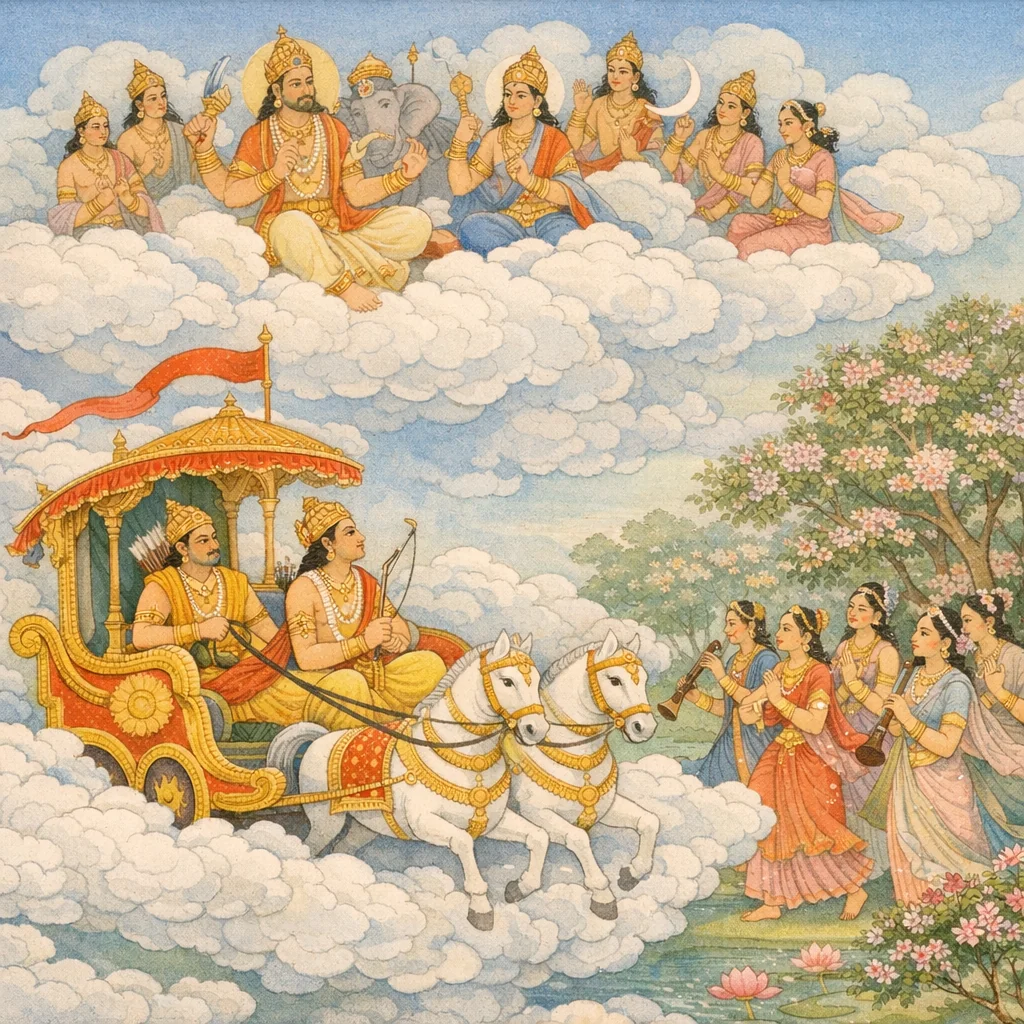
Adhyaya 169
निवातकवचवधः — Arjuna’s Neutralization of the Nivātakavacas (Vajra-astra deployment)
Upa-parva: Nivātakavaca-yuddha (Arjuna’s celestial campaign episode)
Arjuna reports that the Daityas fight through māyā, becoming unseen while continuing hostile operations. His arrows, properly empowered by weapon-science, strike wherever they manifest, forcing the Nivātakavacas to withdraw and briefly restoring visibility, revealing vast casualties and scattered armor and weapons. The adversaries then escalate by covering the sky, hurling rock-masses, and immobilizing Arjuna’s chariot and horses through subterranean restraint, compressing the battlefield into a cave-like enclosure. Observing Arjuna’s distress, Mātali instructs him to invoke the Vajra-astra, a favored weapon of the Devarāja. Arjuna stabilizes his position, consecrates the Gāṇḍīva, and releases razor arrows charged with vajra-force; the projectiles penetrate concealment and subterranean holds, striking the Daityas with overwhelming momentum. The Nivātakavacas fall en masse; notably, Arjuna’s chariot-team and Mātali remain unharmed, underscoring controlled use of extraordinary force. Mātali then contextualizes the episode historically: the city’s prior association with the Devas, its seizure by the Nivātakavacas through austerity and Brahmā’s favor, and the time-conditioned necessity that Arjuna become their ‘end.’ Arjuna concludes by entering the city, completing the operation, and returning with Mātali to the divine abode.
Chapter Arc: रात्रि व्यतीत कर प्रातःकालीन कर्म पूर्ण करके कथावाचक उस द्विजश्रेष्ठ को फिर देखता है—जिसे वह पहले भी देख चुका था—और दिव्य लोकों की झलक का वृत्तान्त सुनाने को उद्यत होता है। → वह ब्राह्मण को यथावत् सब कहता है—कि वह महादेव के सान्निध्य तक पहुँचा, और फिर देव-उपवनों, नन्दन आदि वनों, गन्धर्व-अप्सराओं के तेज, तथा आकाश में विचरते विमानों और देवगणों (वसु, रुद्र, साध्य, मरुत्) का प्रत्यक्ष दर्शन हुआ। दृश्य जितने दिव्य हैं, उतना ही प्रश्न तीखा होता जाता है: मनुष्य-लोक का यात्री इस अनुभव का अर्थ कैसे समझे? → मातलि (इन्द्र के सारथि) के संकेत और देवराज के वचनों के बीच एक निर्णायक प्रतिज्ञा की माँग उठती है—‘प्रतिजानीष्व…’—और उसी प्रतिज्ञा के साथ दिव्य यात्रा का प्रयोजन स्पष्ट होने लगता है: यह केवल दर्शन नहीं, किसी महान् कार्य की भूमिका है। → दिव्य रथ, अश्व-चालन की अद्भुत कला में निपुण मातलि, और इन्द्र के पूर्व-विजयों (शम्बर, नमुचि, बल, वृत्र, प्रह्लाद, नरक आदि पर) का स्मरण—इन सबके द्वारा अध्याय यह स्थापित करता है कि देव-शक्ति का वैभव केवल शोभा नहीं, धर्म-रक्षा का उपकरण है; और यात्री को उसी परम्परा में एक कर्तव्य-रेखा पर खड़ा किया जा रहा है। → प्रतिज्ञा के बाद ‘महान् कार्य’ का अगला चरण क्या है—किस हेतु यह दिव्य दर्शन और यह रथ-यात्रा—यह प्रश्न अगले अध्याय की ओर कथा को धकेल देता है।
Shlokas
Verse 1
/ स्#2.2. “<+ (9) स्#::..3 #:':- ३. आचार्य नीलकण्ठके मतसे स्थूणाकर्ण नाम है शंकुकर्णका, जो भगवान् रुद्रके एक अवतार हैं। वे जिस अस्त्रके देवता है, उसका नाम भी स्थूणाकर्ण है। २. मूलमें जाल शब्द आया है, जिसका अर्थ है, जालसम्बन्धी। यह जलवर्षक अस्त्रकी ही वारुणास्त्र है। ३. जैसे बादल पानीकी वर्षा करता है, उसी प्रकार निरन्तर बाणवर्षा करनेवाला अस्त्र शरवर्ष कहलाता है। ४. जैसे असंख्य टिड्डियाँ आकाशमें मँडराती और पौधोंपर टूट पड़ती हैं, उसी प्रकार जिस अस्त्रसे असंख्य बाण आकाशको आच्छादित करते और शत्रुको अपना लक्ष्य बनाते हैं, उसीका नाम शलभास्त्र है। ५. पत्थरोंकी वर्षा करनेवाले अस्त्रको अश्मवर्ष कहते हैं। अष्ट षष्ट्यांधेिकशततमोब<& ध्याय: अर्जुनद्वारा स्वर्गलोकमें अपनी अस्त्रशिक्षा और निवातकवच दानवोंके साथ युद्धकी तैयारीका कथन अजुन उवाच ततस्तामवसं प्रीतो रजनीं तत्र भारत । प्रसादाद देवदेवस्य >यम्बकस्य महात्मन:,अर्जुन कहते हैं--भारत! देवाधिदेव परमात्मा भगवान् त्रिलोचनके कृपाप्रसादसे मैंने प्रसन्नतापूर्वक वह रात वहीं व्यतीत की
Arjuna said: “O Bhārata, by the gracious favor of the great Lord of lords, Tryambaka (Śiva), I spent that night there in gladness.”
Verse 2
व्युषितो रजनीं चाहं कृत्वा पौर्वाह्निकी: क्रिया: । अपश्यं त॑ द्विजश्रेष्ठं दृष्टवानस्मि यं पुरा,सबेरा होनेपर पूर्वाह्लकालकी क्रिया पूरी करके मैंने पुनः उन्हीं श्रेष्ठ ब्राह्मणको अपने समक्ष पाया, जिनका दर्शन मुझे पहले भी हो चुका था
When the night had passed, and after I had completed the morning rites, I again beheld that foremost of Brahmins—the very one whose sight I had obtained earlier.
Verse 3
तस्मै चाहं यथावृत्तं सर्वमेव न्यवेदयम् । भगवन्तं महादेवं समेतो5स्मीति भारत,भरतकुलभूषण! उनसे मैंने अपना सारा वृत्तान्त यथावत् कह सुनाया और बताया कि 'मैं भगवान् महादेवजीसे मिल चुका हूँ
Then I reported to him everything exactly as it had happened, and I declared, “O Bhārata, I have indeed met the Blessed Mahādeva.”
Verse 4
स मामुवाच राजेन्द्र प्रीयमाणो द्विजोत्तम: । दृष्टस्त्वया महादेवो यथा नान्येन केनचित्,राजेन्द्र! तब वे विप्रवर बड़े प्रसन्न होकर मुझसे बोले--“कुन्तीकुमार! जिस प्रकार तुमने महादेवजीका दर्शन किया है, वैसा दर्शन और किसीने नहीं किया है
The foremost of Brahmins, greatly pleased, said to me, “O best of kings, you have beheld Mahādeva in a manner that no one else has.”
Verse 5
समेत्य लोकपालैस्तु सर्वैर्वैवस्वतादिभि: | द्रष्टास्यनघ देवेन्द्र सच ते5स्त्राणि दास्यति,“अनघ! अब तुम यम आदि लोकपालोंके साथ देवराज इन्द्रका दर्शन करोगे और वे भी तुम्हें अस्त्र प्रदान करेंगे”
“Blameless one, you will go and meet all the guardians of the worlds—beginning with Vaivasvata (Yama)—and you shall behold Indra, the king of the gods. He too will grant you divine weapons.”
Verse 6
एवमुक््त्वा स मां राजन्नाश्लिष्य च पुन: पुन: । अगच्छत् स यथाकाममं ब्राह्मण: सूर्यसंनिभ:,राजन! ऐसा कहकर सूर्यके समान तेजस्वी ब्राह्मण देवताने मुझे बार-बार हृदयसे लगाया और फिर वे इच्छानुसार अपने अभीष्ट स्थानको चले गये
Having spoken thus, O King, that Brahmin—radiant like the sun—embraced me again and again with heartfelt affection, and then departed freely, going wherever he wished.
Verse 7
अथापराल्ने तस्याह्व: प्रावात् पुण्य: समीरण: । पुनर्नवमिमं लोकं कुर्वन्निव सपत्नहन्,शत्रुविजयी नरेश! तदनन्तर जब वह दिन ढलने लगा, तब पुनः इस जगतमें नूतन जीवनका संचार-सा करती हुई पवित्र वायु चलने लगी और उस हिमालयके पार्श्ववर्ती प्रदेशमें दिव्य, नवीन और सुगन्धित पुष्पोंकी वर्षा होने लगी
Then, as the latter part of the day set in, a holy breeze began to blow. It seemed to renew the world with fresh life—O king, slayer of rivals and conqueror of enemies—signaling an auspicious turn in the unfolding events.
Verse 8
दिव्यानि चैव माल्यानि सुगन्धीनि नवानि च । शैशिरस्य गिरे: पादे प्रादुरासन् समीपत:,शत्रुविजयी नरेश! तदनन्तर जब वह दिन ढलने लगा, तब पुनः इस जगतमें नूतन जीवनका संचार-सा करती हुई पवित्र वायु चलने लगी और उस हिमालयके पार्श्ववर्ती प्रदेशमें दिव्य, नवीन और सुगन्धित पुष्पोंकी वर्षा होने लगी
Arjuna said: “Near at hand, at the foot of the Śaiśira mountain, there suddenly appeared divine garlands—fresh and newly made, fragrant with perfume.”
Verse 9
वादित्राणि च दिव्यानि सुघधोराणि समन्ततः । स्तुतयश्रेन्द्रसंयुक्ता अश्रूयन्न्त मनोहरा:,चारों ओर अत्यन्त भयंकर प्रतीत होनेवाले दिव्य वाद्यों और इन्द्रसम्बन्धी स्तोत्रोंके मनोहर शब्द सुनायी देने लगे
Arjuna said: “All around, the sounds of celestial instruments—terrifying in their power—began to be heard, along with enchanting hymns connected with Indra.”
Verse 10
गणाक्षाप्सरसां तत्र गन्धर्वाणां तथैव च । पुरस्ताद् देवदेवस्य जगुर्गीतानि सर्वश:,सब गन्धर्वों और अप्सराओंके समूह वहाँ देवराज इन्द्रके आगे रहकर गीत गा रहे थे
Arjuna said: “There, in that place, the assembled hosts of Apsarases and Gandharvas stood before the lord of the gods and sang songs on every side.”
Verse 11
मरुतां च गणास्तत्र देवयानैरुपागमन् | महेन्द्रानुच॒रा ये च ये च सझनिवासिन:,देवताओंके अनेक गण भी दिव्य विमानोंपर बैठकर वहाँ आये थे। जो महेन्द्रके सेवक थे और जो इन्द्रभवनमें ही निवास करते थे, वे भी वहाँ पधारे
Arjuna said: “There, hosts of the Maruts also arrived, borne in divine aerial cars. And those who attend upon Mahendra (Indra), as well as those who dwell in Indra’s own celestial abode, came to that place.”
Verse 12
ततो मरुत्वान् हरिभिरययुक्तिवाहि: स्वलड्कृतै: । शचीसहायस्तत्रायात् सह सर्वैस्तदामरै:,तदनन्तर थोड़ी ही देरमें विविध आभूषणोंसे विभूषित हरे रंगके घोड़ोंसे जुते हुए एक सुन्दर रथके द्वारा शचीसहित इन्द्रने सम्पूर्ण देवताओंके साथ वहाँ पदार्पण किया
Then, after a brief interval, Indra—lord of the Maruts—arrived there, accompanied by Śacī and attended by all the gods. He came in a splendid chariot drawn by well-adorned, tawny-green horses.
Verse 13
एतस्मिन्नेव काले तु कुबेरो नरवाहन: । दर्शयामास मां राजॉललक्ष्म्या परमया युत:,राजन! इसी समय सर्वोत्वृष्ट ऐश्वर्य--लक्ष्मीसे सम्पन्न नरवाहन कुबेरने भी मुझे दर्शन दिया
Arjuna said: “At that very time, O King, Kubera—he whose vehicle is men—appeared before me, endowed with supreme splendor and prosperity.”
Verse 14
दक्षिणस्यां दिशि यमं प्रत्यपश्यं व्यवस्थितम् । वरुणं देवराजं च यथास्थानमवस्थितम्,दक्षिण दिशाकी ओर दृष्टिपात करनेपर मुझे साक्षात् यमराज खड़े दिखायी दिये। वरुण और देवराज इन्द्र भी क्रमश: पश्चिम और पूर्व दिशामें यथास्थान खड़े हो गये
Casting my gaze toward the southern quarter, I saw Yama himself standing there in readiness. Varuṇa and the king of the gods, Indra, were likewise stationed in their proper places—each abiding in the direction allotted to him.
Verse 15
ते मामूचुर्महाराज सान्त्वयित्वा नरर्षभ । सव्यसाचिन् निरीक्षास्माॉललोकपालानवस्थितान्,महाराज! नरश्रेष्ठ] उन सब लोकपालोंने मुझे सान्त्वना देकर कहा--'सव्यसाची अर्जुन! देखो, हम सब लोकपाल यहाँ खड़े हैं
Arjuna said: “O great king, O bull among men—after consoling me, they spoke these words: ‘Savyasācin Arjuna, look—behold us, the guardians of the worlds, all standing here.’”
Verse 16
सुरकार्यार्थसिद्धयर्थ दृष्टवानसि शड्करम् | अस्मत्तो5पि गृहाण त्वमस्त्राणीति समन्ततः,“देवताओंके कार्यकी सिद्धिके लिये ही तुम्हें भगवान् शंकरका दर्शन प्राप्त हुआ था। अब तुम चारों ओर घूमकर हमलोगोंसे भी दिव्यास्त्र ग्रहण करो”
Arjuna said: “It was for the successful accomplishment of the gods’ purpose that you obtained the vision of Śaṅkara. Now, moving about in every direction, receive divine weapons from us as well.”
Verse 17
ततोऊहं प्रयतो भूत्वा प्रणिपत्य सुरर्षभान् । प्रत्यगृह्नं तदास्त्राणि महान्ति विधिवद् विभो,प्रभो! तब मैंने एकाग्रचित्त हो उन उत्तम देवताओंको प्रणाम करके उन सबसे विधिपूर्वक महान दिव्यास्त्र प्राप्त किये
Then, having composed myself with disciplined focus, I bowed down to those foremost among the gods. In due form and according to proper rite, I received from them the great celestial weapons.
Verse 18
गृहीतास्त्रस्ततो देवैरनुज्ञातो5स्मि भारत । अथ देवा ययु: सर्वे यथागतमरिंदम,भारत! जब मैं अस्त्र ग्रहण कर चुका तब देवताओंने मुझे जानेकी आज्ञा दी। शत्रुदमन! तदनन्तर सब देवता जैसे आये थे, वैसे अपने-अपने स्थानको चले गये
Arjuna said: “O Bhārata, after I had received the divine weapons, the gods granted me leave to depart. Then, O subduer of foes, all the gods returned each to his own abode, just as they had come.”
Verse 19
मघवानपि देवेशो रथमारुहा[ सुप्रभम् । उवाच भगवान् स्वर्ग गन्तव्यं फाल्गुन त्वया,देवेश्वर भगवान् इन्द्रने भी अपने अत्यन्त प्रकाशपूर्ण रथपर आरूढ़ हो मुझसे कहा --'अर्जुन! तुम्हें स्वर्गलोककी यात्रा करनी होगी
Even Maghavan, the lord of the gods, mounted his brilliantly radiant chariot and spoke: “Phalguna, you must journey to Svarga.”
Verse 20
पुरैवागमनादस्माद् वेदाहं त्वां धनंजय । अतः: पर त्वहं वै त्वां दर्शये भरतर्षभ,'भरतश्रेष्ठ धनंजय! यहाँ आनेसे पहले ही मुझे तुम्हारे विषयमें सब कुछ ज्ञात हो गया था। इसके बाद मैंने तुम्हें दर्शन दिया है
Arjuna said: “O Dhanañjaya, even before you arrived here I already knew all about you. Therefore, O bull among the Bharatas, only after that knowledge did I grant you my audience.”
Verse 21
त्वया हि तीर्थेषु पुरा समाप्लाव: कृतोडसकृत् । तपश्चेदं महत् तप्तं स्वर्ग गन्तासि पाण्डव,'पाण्डुनन्दन! तुमने पहले अनेक बार बहुत-से तीर्थोमें स्नान किया है और इस समय इस महान् तपका भी अनुष्ठान कर लिया है, अतः तुम स्वर्गलोकमें सशरीर जानेके अधिकारी हो गये हो
Truly, in former times you bathed again and again at the sacred tīrthas, and now you have completed this mighty austerity. Therefore, O son of Pāṇḍu, you are worthy to go to heaven in this very body.
Verse 22
भूयश्चैव च तप्तव्यं तपश्चरणमुत्तमम् । स्वर्ग त्ववश्यं गन्तव्यं त्वया शत्रुनिष्दन,'शत्रुसूदन! अभी तुम्हें और भी उत्तम तपस्या करनी है और स्वर्गलोकमें अवश्य पदार्पण करना है
And again you must practice austerity—the highest discipline of tapas. And you must surely enter heaven, O slayer of foes.
Verse 23
माललिममन्नियोगात् त्वां त्रिदिवं प्रापयिष्यति । विदितस्त्वं हि देवानां मुनीनां च महात्मनाम्
By Mālalimā’s appointment and command, she will cause you to attain Tridiva, the heavenly world. For you are already well known among the gods and among the great-souled sages.
Verse 24
ततो5हमन्रुवं शक्रं प्रसीद भगवन् मम । आचार्य वरयेयं त्वामस्त्रार्थ त्रिदशेश्वर,तब मैंने देवराज इन्द्रसे कहा--“भगवन्! आप मुझपर प्रसन्न होइये। देवेश्वर! मैं अस्त्रविद्याकी प्राप्तिके लिये आपको अपना आचार्य बनाता हूँ
Then I addressed Śakra (Indra): “Be gracious to me, O Blessed Lord. O sovereign of the gods, for the sake of mastering divine weapons, I choose you as my teacher.”
Verse 25
इन्द्र रवाच क्रूरकर्मास्त्रवित् तात भविष्यसि परंतप । यदर्थमस्त्राणीप्सुस्त्वं तं काम॑ पाण्डवाप्रुहि,इन्द्रने कहा--परंतप तात अर्जुन! दिव्य अस्त्र-शस्त्रोंका ज्ञान प्राप्त कर लेनेपर तुम भयंकर कर्म करने लगोगे। अतः पाण्डुनन्दन! मेरी इच्छा है कि तुम जिसके लिये अस्त्रोंकी शिक्षा प्राप्त करना चाहते हो, तुम्हारा वह उद्देश्य पूर्ण हो
Indra said: “Dear child, O scorcher of foes, once you become a master of weapons you may be driven to terrible deeds. Therefore, O son of Pāṇḍu, tell me plainly the desire and purpose for which you seek instruction in these weapons—so that your aim may be rightly fulfilled.”
Verse 26
ततो>5हमन्रुव॑ नाहं दिव्यान्यस्त्राणि शत्रुहन् । मानुषेषु प्रयोक्ष्यामि विनास्त्रप्रतिघातनात्,यह सुनकर मैंने उत्तर दिया--'शत्रुघाती देवेश्वर! मैं शत्रुओंद्वारा प्रयुक्त दिव्यास्त्रोंका निवारण करनेके सिवा अन्य किसी अवसरपर मनुष्योंके ऊपर दिव्यास्त्रोंका प्रयोग नहीं करूँगा
Then I replied: “O slayer of foes, I will not employ divine weapons against human opponents—except for the single purpose of countering and neutralizing divine missiles launched by enemies.”
Verse 27
तानि दिव्यानि मे<स्त्राणि प्रयच्छ विबुधाधिप । लोकांश्षास्त्रजितान् पश्चाल्लभेयं सुरपुड्रव,“देवराज! सुरश्रेष्ठ! आप मुझे वे दिव्य अस्त्र प्रदान करें। अस्त्रविद्या सीखनेके पश्चात् मैं उन्हीं अस्त्रोंके द्वारा जीते हुए लोकोंपर अधिकार प्राप्त करना चाहता हूँ”
“O king of the gods, lord of the celestials, grant me those divine weapons. After I have learned the lore of arms, I wish to gain sovereignty over the worlds conquered by those very weapons.”
Verse 28
इन्द्र रवाच परीक्षार्थ मयैतत् ते वाक्यमुक्तं धनंजय । ममात्मजस्य वचन सूपपन्नमिदं तव,इन्द्र बोले--धनंजय! मैंने तुम्हारी परीक्षा लेनेके लिये उपर्युक्त बात कही थी। तुमने जो अस्त्रविद्याके प्रति अत्यन्त उत्सुकता प्रकट की है, वह तुम्हारे जैसे मेरे पुत्रके अनुरूप ही है
Indra said: “Dhananjaya, I spoke those words only to test you. The keen eagerness you have shown for the lore of weapons is wholly fitting for you—my son.”
Verse 29
शिक्ष मे भवन गत्वा सर्वाण्यस्त्राणि भारत | वायोरग्नेर्वसुभ्योडपि वरुणात् समरुद्गणात्
Arjuna said: “O Bharata, please instruct me—having gone to them—in all the celestial weapons: from Vāyu, from Agni, from the Vasus as well, from Varuṇa, and from the hosts of the Maruts.”
Verse 30
साध्य॑ पैतामहं चैव गन्धर्वोरगरक्षसाम् | वैष्णवानि च सर्वाणि नैर्ऋलतानि तथैव च
Arjuna said: “(I know) the rites and observances belonging to the Sādhyas and to Pitāmaha (Brahmā), as well as those connected with the Gandharvas, Nāgas, and Rākṣasas; and likewise all the Vaiṣṇava rites, and the Nairṛta (dark, destructive) ones too.”
Verse 31
मदगतानि च जानीहि सर्वास्त्राणि कुरुद्वह । एवमुक्त्वा तु मां शक्रस्तत्रैवान्तरधीयत
“Know also all the weapons that have come to reside with me, O best of the Kurus.” Having spoken thus to me, Śakra (Indra) vanished from that very spot.
Verse 32
भारत! तुम मेरे भवनमें चलकर सम्पूर्ण अस्त्रोंकी शिक्षा प्राप्त करो। कुरुश्रेष्ठ! वायु, अग्नि, वसु, वरुण, मरुद्गण, साध्यगण, ब्रह्मा, गन्धर्वगण, नाग, राक्षस, विष्णु तथा निर्क्रतिके और स्वयं मेरे भी सम्पूर्ण अस्त्रोंका ज्ञान प्राप्त करो, मुझसे ऐसा कहकर इन्द्र वहीं अन्तर्धान हो गये ।। अथापश्य॑ हरियुजं रथमैन्द्रमुपस्थितम् । दिव्यं मायामयं पुण्यं यत्तं मातलिना नूप,तदनन्तर थोड़ी ही देरमें मुझे हरे रंगके घोड़ोंसे जुता हुआ देवराज इन्द्रका रथ वहाँ उपस्थित दिखायी दिया। राजन! वह दिव्य मायामय पवित्र रथ मातलिके द्वारा नियन्त्रित था
Arjuna said: “O descendant of Bharata, come to my celestial abode and receive complete instruction in the science of weapons. O best of the Kurus, gain the knowledge of all missiles and arms belonging to Vāyu, Agni, the Vasus, Varuṇa, the Maruts, the Sādhyas, Brahmā, the Gandharvas, the Nāgas, the Rākṣasas, Viṣṇu, Nirṛti—and also my own.” Having spoken thus to me, Indra vanished on the spot. Soon after, I beheld Indra’s chariot appear before me, yoked with tawny-green horses—divine, wondrous through celestial art, and auspicious—driven and guided by Mātali.
Verse 33
लोकपालेषु यातेषु मामुवाचाथ मातलि: । द्रष्टमिच्छति शक्रस्त्वां देवराजो महाद्युते,जब सभी लोकपाल चले गये, तब मातलिने मुझसे कहा--“महातेजस्वी वीर! देवराज इन्द्र तुमसे मिलना चाहते हैं
When the guardians of the worlds had departed, Mātali then addressed me: “O mighty one of great splendor, Śakra—Indra, the king of the gods—wishes to see you.”
Verse 34
संसिद्धयस्व महाबाहो कुरु कार्यमनन्तरम् | पश्य पुण्यकृताँललोकान् सशरीरो दिवं व्रज,“महाबाहो! तुम उनसे मिलकर कृतार्थ होओ और अब आवश्यक कार्य करो। इसी शरीरसे देवलोकमें चलो तथा पुण्यात्मा पुरुषोंके लोकोंका दर्शन करो
Arjuna said: “O mighty-armed one, go and fulfill your purpose by meeting them; then, without delay, accomplish what must be done. Ascend to heaven in this very body and behold the worlds attained by the doers of merit.”
Verse 35
देवराज: सहस्ाक्षस्त्वां दिदृक्षति भारत । इत्युक्तो5हं मातलिना गिरिमामन्त्रय शैशिरम्
Arjuna said: “O Bhārata, the king of the gods, Sahasrākṣa (Indra), wishes to see you.” Thus addressed by Mātali, I took leave of the Śaiśira mountain and set forth.
Verse 36
प्रदक्षिणमुपावृत्य समारोहं रथोत्तमम् । भरतनन्दन! सहस्र नेत्रोंवाले देवराज इन्द्र तुम्हें देखना चाहते हैं।। मातलिके ऐसा कहनेपर मैं हिमालयसे आज्ञा ले रथकी परिक्रमा करके उस श्रेष्ठ रथमें सवार हुआ ।। ३५६ || चोदयामास स हयान् मनोमारुतरंहस:
Arjuna said: “Having turned and made the respectful circumambulation, I mounted that excellent chariot. O descendant of Bharata, Indra—the thousand‑eyed lord of the gods—wishes to see you.” When Mātali spoke thus, I took leave of Himālaya, circled the chariot in reverence, and ascended that finest of cars. Then Mātali urged on the horses, swift as thought and as the wind.
Verse 37
अवैक्षत च मे वकक्त्रं स्थितस्याथ स सारथि:
Then the charioteer, standing by, looked closely at my face.
Verse 38
तथा क्रान्ते रथे राजन् विस्मितश्लैदमब्रवीत् । राजन! उस समय देवसारथि मातलिने आकाशमें चक्कर लगाते हुए रथपर स्थिरतापूर्वक बैठे हुए मेरे मुखकी ओर दृष्टिपात किया और आश्वर्यवकित होकर कहा -- ३७३ || अत्यद्भुतमिदं त्वद्य विचित्र प्रतिभाति मे
O King, when the chariot had thus moved on, the divine charioteer Mātali—steadfastly seated as it wheeled through the sky—looked toward my face and, struck with wonder, said: “This indeed appears to me today as exceedingly marvelous and strangely extraordinary.”
Verse 39
यदास्थितो रथं दिव्यं पदान्न चलित: पदम् | “भरतश्रेष्ठ!ी आज मुझे यह बड़ी विचित्र और अद्भुत बात दिखायी दे रही है कि इस दिव्य रथपर बैठकर तुम अपने स्थानसे तनिक भी हिल-डुल नहीं रहे हो ।। ३८ ई ।। देवराजो5पि हि मया नित्यमत्रोपलक्षित:,“कुरुकुलभूषण भरतश्रेष्ठ) जब घोड़े पहली बार उड़ान भरते हैं" उस समय मैंने सदा यह देखा है कि देवराज इन्द्र भी विचलित हुए बिना नहीं रह पाते, परंतु तुम चक्कर काटते हुए रथपर भी स्थिरभावसे बैठे हो
Arjuna said: “O best of the Bharatas! Today I am witnessing something truly strange and wondrous: though seated upon this divine chariot, you do not shift even a step from your place. Indeed, I have always observed that even Indra, lord of the gods, cannot remain entirely unshaken when the horses first take flight; yet you, O ornament of the Kuru line, sit steady and composed even while the chariot circles through the sky.”
Verse 40
विचलन प्रथमोत्पाते हयानां भरतर्षभ । त्वं पुन: स्थित एवात्र रथे भ्रान्ते कुरूद्गबह,“कुरुकुलभूषण भरतश्रेष्ठ) जब घोड़े पहली बार उड़ान भरते हैं" उस समय मैंने सदा यह देखा है कि देवराज इन्द्र भी विचलित हुए बिना नहीं रह पाते, परंतु तुम चक्कर काटते हुए रथपर भी स्थिरभावसे बैठे हो
Arjuna said: “O bull among the Bharatas, at the very first sudden leap and jolt of the horses I have always seen even Indra, lord of the gods, unable to remain wholly unshaken. Yet you, O foremost of the Kurus, sit here steady and composed even while the chariot whirls and reels.”
Verse 41
अतिशक्रमिदं सर्व तवेति प्रतिभाति मे । इत्युक्त्वा55काशमाविश्य मातलिविंबुधालयान्,'कुरुश्रेष्ठ! तुम्हारी ये सब बातें मुझे इन्द्रसे भी बढ़कर प्रतीत हो रही हैं।' भरतकुलभूषण नरेश! ऐसा कहकर मातलिने अन्तरिक्षलोकमें प्रविष्ट होकर मुझे देवताओंके घरों और विमानोंका दर्शन कराया, फिर हरे रंगके घोड़ोंसे जुता हुआ वह रथ वहाँसे भी ऊपरकी ओर बढ़ चला
Arjuna said: “All this seems to me to surpass even Indra—such is your greatness.” Having spoken thus, Mātali entered the sky and showed me the celestial abodes, the gods’ mansions, and their aerial cars; then that chariot, yoked with green-hued horses, moved onward still higher.
Verse 42
दर्शयामास मे राजन् विमानानि च भारत | स रथो हरिभिरयुक्तो हार्ध्वमाचक्रमे तत:,'कुरुश्रेष्ठ! तुम्हारी ये सब बातें मुझे इन्द्रसे भी बढ़कर प्रतीत हो रही हैं।' भरतकुलभूषण नरेश! ऐसा कहकर मातलिने अन्तरिक्षलोकमें प्रविष्ट होकर मुझे देवताओंके घरों और विमानोंका दर्शन कराया, फिर हरे रंगके घोड़ोंसे जुता हुआ वह रथ वहाँसे भी ऊपरकी ओर बढ़ चला
Arjuna said: “O King, O scion of Bharata’s line—Mātali showed me the celestial mansions and the divine aerial chariots. Then that chariot, yoked with tawny-green horses, rose upward from there into higher regions of the sky.”
Verse 43
ऋषयो देवताश्वैव पूजयन्ति नरोत्तम | तत: कामगमॉल्लोकानपश्यं वै सुर्िणाम्,नरश्रेष्ठी ऋषि और देवता भी उस रथका समादर करते थे। तदनन्तर मैंने देवर्षियोंके अनेक समुदायोंका दर्शन किया, जो अपनी इच्छाके अनुसार सर्वत्र जानेकी शक्ति रखते हैं
Arjuna said: “O best of men, even the sages and the gods honored that chariot. Thereafter I beheld many assemblies of divine seers, moving through the worlds at will.”
Verse 44
गन्धर्वाप्सरसां चैव प्रभावममितौजसाम् | नन्दनादीनि देवानां वनान्युपवनानि च,अमित तेजस्वी गन्धर्वों और अप्सराओंका प्रभाव भी मुझे प्रत्यक्ष दिखायी दिया। फिर इन्द्रसारथि मातलिने मुझे शीघ्र ही देवताओंके नन्दन आदि वन और उपवन दिखाये। तत्पश्चात् मैंने अमरावतीपुरी तथा इन्द्रभवनका दर्शन किया। वह पुरी इच्छानुसार फल देनेवाले दिव्य वृक्षों तथा रत्नोंसे सुशोभित थी। वहाँ सूर्यका ताप नहीं होता, सर्दी या गर्मीका कष्ट नहीं रहता और न किसी-को थकावट ही होती है
Arjuna said: “I beheld with my own eyes the wondrous power and splendor of the Gandharvas and Apsarases, beings of immeasurable radiance. Then Mātali, Indra’s charioteer, swiftly showed me the divine groves and pleasure-woods of the gods—Nandana and the rest—revealing the ordered beauty of heaven.”
Verse 45
दर्शयामास मे शीघ्र॑ं मातलि: शक्रसारथि: । तत: शक्रस्थ भवनमपश्यममरावतीम्,अमित तेजस्वी गन्धर्वों और अप्सराओंका प्रभाव भी मुझे प्रत्यक्ष दिखायी दिया। फिर इन्द्रसारथि मातलिने मुझे शीघ्र ही देवताओंके नन्दन आदि वन और उपवन दिखाये। तत्पश्चात् मैंने अमरावतीपुरी तथा इन्द्रभवनका दर्शन किया। वह पुरी इच्छानुसार फल देनेवाले दिव्य वृक्षों तथा रत्नोंसे सुशोभित थी। वहाँ सूर्यका ताप नहीं होता, सर्दी या गर्मीका कष्ट नहीं रहता और न किसी-को थकावट ही होती है
Arjuna said: “Mātali, the charioteer of Śakra (Indra), quickly showed me many marvels. Thereafter I beheld Amarāvatī and the palace of Śakra. I directly witnessed the splendor of the Gandharvas and Apsarases; then Mātali swiftly showed me the gods’ pleasure-groves such as Nandana and other parks. After that I saw the city of Amarāvatī and Indra’s own abode—adorned with wish-fulfilling divine trees and radiant jewels. There the sun’s heat does not oppress, neither cold nor excessive warmth causes distress, and no one experiences fatigue.”
Verse 46
दिव्यै: कामफलै वक्ष रत्नैज्ष समलड्कृताम् न तत्र सूर्यस्तपति न शीतोष्णे न च कलम:,अमित तेजस्वी गन्धर्वों और अप्सराओंका प्रभाव भी मुझे प्रत्यक्ष दिखायी दिया। फिर इन्द्रसारथि मातलिने मुझे शीघ्र ही देवताओंके नन्दन आदि वन और उपवन दिखाये। तत्पश्चात् मैंने अमरावतीपुरी तथा इन्द्रभवनका दर्शन किया। वह पुरी इच्छानुसार फल देनेवाले दिव्य वृक्षों तथा रत्नोंसे सुशोभित थी। वहाँ सूर्यका ताप नहीं होता, सर्दी या गर्मीका कष्ट नहीं रहता और न किसी-को थकावट ही होती है
Arjuna said: “That city was adorned with celestial trees that grant whatever one desires and with radiant jewels. There the sun does not scorch; neither cold nor heat causes distress, and no one feels fatigue.”
Verse 47
न बाधते तत्र रजस्तत्रास्ति न जरा नृप । न तत्र शोको दैन्यं वा दौर्बल्यं चोपलक्ष्यते,नरेश्वर! वहाँ रजोगुणजनित विकार नहीं सताते, बुढ़ापा नहीं आता; शोक, दीनता और दुर्बलताका दर्शन नहीं होता
Arjuna said: “O king, there the agitations born of rajas do not afflict one, and old age does not arise. O lord of men, neither grief nor wretchedness is seen there, nor any sign of weakness.”
Verse 48
दिवौकसां महाराज न ग्लानिररिमर्दन । न क्रोधलोभौ तत्रास्तां सुरादीनां विशाम्पते,महाराज! शत्रुसूदन! स्वर्गवासी देवताओंको कभी ग्लानि नहीं होती। उनमें क्रोध और लोभका भी अभाव होता है
Arjuna said: “O great king, O crusher of foes, the dwellers of heaven never fall into dejection or inner weariness. Among the gods and other celestial beings, O lord of men, neither anger nor greed has any place.”
Verse 49
नित्यतुष्टाश्च ते राजन् प्राणिन: सुरवेश्मनि । नित्यपुष्पफलास्तत्र पादपा हरितच्छदा:,राजन! स्वर्गमें निवास करनेवाले प्राणी सदा संतुष्ट रहते हैं। वहाँके वृक्ष सर्वदा फल- फ़ूलसे सम्पन्न और हरे पत्तोंसे सुशोभित रहते हैं
Arjuna said: “O King, the beings who dwell in the celestial abode are ever content. There, the trees are perpetually laden with blossoms and fruits, and they shine with fresh green foliage.”
Verse 50
पुष्करिण्यश्न विविधा: पद्मसौगन्धिकायुता: । शीतस्तत्र ववौ वायु: सुगन्धी जीवन: शुचि:,वहाँ सहस्रों सौगन्धिक कमलोंसे अलंकृत नाना प्रकारके सरोवर शोभा पाते हैं और शीतल, पवित्र, सुगन्धित एवं नवजीवनदायक वायु सदा बहती रहती है
Arjuna said: “There are many kinds of lovely lotus-ponds there, adorned with fragrant saugandhika lotuses. A cool breeze continually blows in that place—pure, sweet-smelling, and life-giving—so that the very air seems to renew one’s vitality.”
Verse 51
सर्वरत्नविचित्रा च भूमि: पुष्पविभूषिता | मृगद्धिजाश्व॒ बहवो रुचिरा मधुरस्वरा:,अस्त्रैश्नाप्पन्वजानन्त संग्रामे विजयेन च । वहाँकी भूमि सब प्रकारके रत्नोंसे विचित्र शोभा धारण करती है और (सब ओर बिखरे हुए) पुष्प उस भूमिके लिये आभूषणका काम देते हैं। स्वर्गलोकमें बहुत-से मनोहर पशु और पक्षी देखे जाते हैं, जिनकी बोली बड़ी मधुर प्रतीत होती है। वहाँ अनेक देवता आकाशमें विमानोंपर विचरते दिखायी देते हैं। तदनन्तर मुझे वसु, रुद्र, साथ्य, मरुद्गण, आदित्य और अश्विनीकुमारोंके दर्शन हुए। मैंने उन सबके आगे मस्तक झुकाकर उनका सम्मान किया। उन सबने मुझे पराक्रमी, यशस्वी, तेजस्वी, बलवान, अस्त्रवेत्ता और संग्राम-विजयी होनेका आशीर्वाद दिया
Arjuna said: “The ground there is adorned with every kind of jewel, and scattered flowers serve as its ornaments. Many delightful beasts and birds are seen, their calls sounding sweet to the ear.” In this vision of the heavenly realm, Arjuna describes a world of beauty and harmony that reflects divine order. The passage frames celestial splendor not as mere luxury, but as a sign of a realm where merit and right conduct bear visible fruit, preparing the listener for Arjuna’s subsequent encounter with the gods and the empowerment that supports righteous struggle.
Verse 52
विमानगामिन श्षात्र दृश्यन्ते बहवोम्बरे । ततो<पश्यं वसून् रुद्रान् साध्यांशक्ष समरुद्गणान्
Arjuna said: “In the sky I see many kṣatriya heroes moving in celestial chariots. Then I beheld the Vasus, the Rudras, and the Sādhyas, together with the hosts of the Maruts.”
Verse 53
आदित्यानश्रिनौ चैव तान् सर्वान् प्रत्यपूजयम् । ते मां वीयेंण यशसा तेजसा च बलेन च
Arjuna said: “I duly honored all of them—Ādityas and the Aśvins alike. And they, in turn, honored me with valor, with renown, with splendor, and with strength.”
Verse 54
प्रविश्य तां पुरी दिव्यां देवगन्धर्वपृूजिताम्,तत्पश्चात् देव-गन्धर्वपूजित दिव्य अमरावतीपुरीमें प्रवेश करके मैंने हाथ जोड़कर सहस्र नेत्रोंवाले देवराज इन्द्रको प्रणाम किया। दाताओंमें श्रेष्ठ देवराज इन्द्रने प्रसन्न होकर मुझे अपने आधे सिंहासनपर स्थान दिया
Having entered that divine city, revered by gods and Gandharvas, I joined my palms and bowed to Indra, the thousand-eyed king of the gods. Pleased, Śakra—foremost among givers—granted me a seat upon half of his own throne.
Verse 55
देवराजं सहस्राक्षमुपातिष्ठं कृताञ्जलि: । ददावर्धासनं प्रीत: शक्रो मे ददतां वर:,तत्पश्चात् देव-गन्धर्वपूजित दिव्य अमरावतीपुरीमें प्रवेश करके मैंने हाथ जोड़कर सहस्र नेत्रोंवाले देवराज इन्द्रको प्रणाम किया। दाताओंमें श्रेष्ठ देवराज इन्द्रने प्रसन्न होकर मुझे अपने आधे सिंहासनपर स्थान दिया
With palms joined in reverence, I approached the thousand-eyed king of the gods, Indra. Pleased by my humility, Śakra—foremost among givers—granted me a seat upon half of his own throne, honoring devotion and disciplined conduct with divine hospitality.
Verse 56
बहुमानाच्च गात्राणि पस्पर्श मम वासव: | तत्राहं देवगन्धर्व: सहितो भूरिदक्षिण,इतना ही नहीं, उन्होंने बड़े आदरके साथ मेरे अंगोंपर हाथ फेरा। यज्ञोंमें पूरी दक्षिणा देनेवाले भरतश्रेष्ठ) उस स्वर्गलोकमें देवताओं और गन्धर्वोके साथ अस्त्रविद्याकी प्राप्तिके लिये रहने लगा और प्रतिदिन अस्त्रोंका अभ्यास करने लगा। उस समय गन्धर्वराज विश्वावसुके पुत्र चित्रसेनके साथ मेरी मैत्री हो गयी थी
Arjuna said: “Out of great respect, Vāsava (Indra) even touched my limbs with his own hand. There, in that heavenly realm—O best of the Bharatas, giver of abundant sacrificial gifts—I stayed among the gods and Gandharvas to gain mastery of the science of weapons, practicing them every day. At that time I also formed a friendship with Citraseṇa, the son of the Gandharva-king Viśvāvasu.”
Verse 57
अस्त्रार्थमवसं स्वर्गे शिक्षाणो<स्त्राणि भारत । विश्वावसोश्र वै पुत्रश्चित्रसेनो5$भवत् सखा,इतना ही नहीं, उन्होंने बड़े आदरके साथ मेरे अंगोंपर हाथ फेरा। यज्ञोंमें पूरी दक्षिणा देनेवाले भरतश्रेष्ठ) उस स्वर्गलोकमें देवताओं और गन्धर्वोके साथ अस्त्रविद्याकी प्राप्तिके लिये रहने लगा और प्रतिदिन अस्त्रोंका अभ्यास करने लगा। उस समय गन्धर्वराज विश्वावसुके पुत्र चित्रसेनके साथ मेरी मैत्री हो गयी थी
Arjuna said: “O Bhārata, dwelling in heaven for the sake of mastering weapons, I trained in the use of celestial missiles. There, Viśvāvasu’s son, the Gandharva Citraseṇa, became my friend.”
Verse 58
स च गान्धर्वमखिलं ग्राहयामास मां नृप । तत्राहमवसं राजन गृहीतास्त्र: सुपूजित:
And he taught me the entire science of the Gandharvas, O king. There I lived for a time, O ruler, having received the sacred weapons and being treated with great honor.
Verse 59
सुखं शक्रस्य भवने सर्वकामसमन्वित: । शृण्वन् वै गीतशब्दं च तूर्यशब्दं च पुष्कलम् । पश्यंश्षाप्सरस: श्रेष्ठा नृत्यन्तीर्भरतर्षभ
Arjuna said: “In Śakra’s celestial mansion, endowed with every delight, one lives in ease—hearing the sounds of song and the abundant music of instruments, and beholding the finest of the Apsarases dancing, O bull among the Bharatas.”
Verse 60
नरेश्वर! उन्होंने मुझे सम्पूर्ण गान्धर्ववेद (संगीत-विद्या)-का अध्ययन कराया। राजन! वहाँ इन्द्रभवनमें अस्त्र-शस्त्रोंकी शिक्षा ग्रहण करते हुए मैं बड़े सम्मान और सुखसे रहने लगा। वहाँ सभी मनोवांछित पदार्थ मेरे लिये सुलभ थे। भरतश्रेष्ठ! मैं वहाँ कभी मनोहर गीत सुनता, कभी पर्याप्तरूपसे दिव्य वाद्योंका आनन्द लेता और कभी-कभी श्रेष्ठ अप्सराओंका नृत्य भी देख लेता था ।। तत् सर्वमनवज्ञाय तथ्यं विज्ञाय भारत | अत्यर्थ प्रतिगृह्माहमस्त्रेष्वेव व्यवस्थित:,भारत! इन समस्त सुख-सुविधाओंकी अवहेलना न करते हुए उन्हें स्वीकार करके भी मैं इनके असली रूपको जानकर--इनकी निःसारताको भलीभाँति समझकर अधिकतर अस्त्रोंके अभ्यासमें ही संलग्न रहता था। (गीत आदिमें कभी आसक्त नहीं हुआ)
Arjuna said: “O king, they had me thoroughly trained in the Gandharva-veda, the science of music. O ruler, while receiving instruction in weapons and arms in Indra’s celestial palace, I lived there with great honor and comfort. Everything I could wish for was readily available to me. Best of the Bharatas, at times I listened to enchanting songs, at times I delighted fully in divine instruments, and sometimes I even watched the dance of the foremost apsarases. Yet, without scorning these pleasures, and while accepting them, I understood their true nature and their lack of lasting substance; therefore I remained chiefly devoted to the practice of weapons.”
Verse 61
ततोअतुष्यत् सहस्राक्षस्तेन कामेन मे विभु: । एवं मे वसतो राजन्नेष कालोत्यगाद् दिवि,अस्त्रविद्याकी ओर मेरी ऐसी अभिरुचि होनेसे सहसनेत्रधारी भगवान् इन्द्र मुझपर बहुत संतुष्ट रहते थे। राजन! इस प्रकार स्वर्गमें रहकर मेरा यह समय सुखपूर्वक बीतने लगा
Then the mighty Thousand-eyed Indra was greatly pleased with me because of that earnest desire of mine (for the knowledge of celestial weapons). O King, as I lived in heaven in this manner, my time there passed on pleasantly and without hardship.
Verse 62
कृतास्त्रमतिविश्वस्तमथ मां हरिवाहन: । संस्पृश्य मूर्थ्नि पाणिभ्यामिदं वचनमब्रवीत्,धीरे-धीरे मैं अस्त्रविद्यामें निपुण हो गया। मेरी विज्ञतापर सबको अधिक विश्वास था। एक दिन भगवान् इन्द्रने अपने दोनों हाथोंसे मेरे मस्तकका स्पर्श करते हुए मुझसे इस प्रकार कहा--
Gradually I became proficient in the lore of weapons, and everyone placed great trust in my skill. One day the blessed Indra, rider of Airāvata, touched my head with both hands and spoke to me as follows—
Verse 63
न त्वमद्य युधा जेतुं शक््य: सुरगणैरपि । कि पुनर्मनुषे लोके मानुषैरकृतात्मभि:,“अर्जुन! अब तुम्हें युद्धमें देवता भी परास्त नहीं कर सकते। फिर मर्त्यलोकमें रहनेवाले बेचारे असंयमी मनुष्योंकी तो बात ही क्या है?
“Arjuna! Today you cannot be conquered in battle even by the hosts of gods. How much less, then, by undisciplined human beings living in the mortal world?”
Verse 64
अप्रमेयो5प्रधृष्यश्न युद्धेष्वप्रतिमस्तथा । अजेयस्त्व॑ हि संग्रामे सर्वैरपि सुरासुरै: । अथाब्रवीत् पुनर्देव: सम्प्रहृष्टतनूरुह:,तुम युद्धमें अप्रमेय, अजेय और अनुपम हो। संग्रामभूमिमें सम्पूर्ण देवता और असुर भी तुम्हें पपाजित नहीं कर सकते।” इतना कहते-कहते देवराजके शरीरमें रोमांच हो आया। तदनन्तर वे फिर बोले--
“You are beyond measure, unassailable, and without equal in battles. Indeed, in war you are unconquerable—even if all the gods and the asuras together were to oppose you.” As he spoke thus, the divine one’s body thrilled with rapture; then he spoke again—
Verse 65
अस्त्रयुद्धे समो वीर न ते कश्चिद् भविष्यति । अप्रमत्त: सदा दक्ष: सत्यवादी जितेन्द्रिय:,“वीर! अस्त्र-युद्धमें तुम्हारा सामना कर सके, ऐसा कोई योद्धा नहीं होगा। कुरुश्रेष्ठ! तुम सर्वदा सावधान रहते हो, प्रत्येक कार्यमें कुशल हो, जितेन्द्रिय, सत्यवादी और ब्राह्मणभक्त हो; तुम्हें अस्त्र-शस्त्रोंका ज्ञान है और तुम अद्भुत शौर्यसे सम्पन्न हो। पार्थ! तुमने पाँच विधियोंसहित पंद्रह अस्त्र प्राप्त किये हैं, अतः इस भूतलपर तुम्हारे-जैसा शूर दूसरा कोई नहीं है। परंतप धनंजय! प्रयोग, उपसंहार, आवृत्ति, प्रायश्चित्त- और प्रतिघातर --ये अस्त्रोंकी पाँच विधियाँ हैं; तुम इन सबका पूर्ण ज्ञान प्राप्त कर चुके हो। अत: अब गुरुदक्षिणा देनेका समय आ गया है
“O hero, in combat with missiles there will be no one who can stand as your equal. Ever vigilant, always skillful in action, truthful in speech, and master of your senses—such are you.”
Verse 66
ब्र्मण्यश्षास्त्रविच्चासि शूरश्चासि कुरूद्वह । अस्त्राणि समवाप्तानि त्वया दश च पञ्त च,“वीर! अस्त्र-युद्धमें तुम्हारा सामना कर सके, ऐसा कोई योद्धा नहीं होगा। कुरुश्रेष्ठ! तुम सर्वदा सावधान रहते हो, प्रत्येक कार्यमें कुशल हो, जितेन्द्रिय, सत्यवादी और ब्राह्मणभक्त हो; तुम्हें अस्त्र-शस्त्रोंका ज्ञान है और तुम अद्भुत शौर्यसे सम्पन्न हो। पार्थ! तुमने पाँच विधियोंसहित पंद्रह अस्त्र प्राप्त किये हैं, अतः इस भूतलपर तुम्हारे-जैसा शूर दूसरा कोई नहीं है। परंतप धनंजय! प्रयोग, उपसंहार, आवृत्ति, प्रायश्चित्त- और प्रतिघातर --ये अस्त्रोंकी पाँच विधियाँ हैं; तुम इन सबका पूर्ण ज्ञान प्राप्त कर चुके हो। अत: अब गुरुदक्षिणा देनेका समय आ गया है
Arjuna said: “You are devoted to the Brahmins and learned in the sacred sciences; you are also a hero, O best of the Kurus. You have fully mastered weapons—ten and five besides. In battle, no warrior could truly stand against you. Ever vigilant, skilled in every undertaking, self-controlled, truthful, and reverent toward Brahmins, you possess both knowledge of arms and extraordinary valor. Having obtained fifteen weapons together with their five modes—application, withdrawal, repetition, expiation, and counteraction—you have completed your training; therefore the time has come to offer the teacher’s fee.”
Verse 67
पज्चभिर्विधिश्रि: पार्थ विद्यते न त्वया सम: । प्रयोगमुपसंहारमावृत्ति च धनंजय,“वीर! अस्त्र-युद्धमें तुम्हारा सामना कर सके, ऐसा कोई योद्धा नहीं होगा। कुरुश्रेष्ठ! तुम सर्वदा सावधान रहते हो, प्रत्येक कार्यमें कुशल हो, जितेन्द्रिय, सत्यवादी और ब्राह्मणभक्त हो; तुम्हें अस्त्र-शस्त्रोंका ज्ञान है और तुम अद्भुत शौर्यसे सम्पन्न हो। पार्थ! तुमने पाँच विधियोंसहित पंद्रह अस्त्र प्राप्त किये हैं, अतः इस भूतलपर तुम्हारे-जैसा शूर दूसरा कोई नहीं है। परंतप धनंजय! प्रयोग, उपसंहार, आवृत्ति, प्रायश्चित्त- और प्रतिघातर --ये अस्त्रोंकी पाँच विधियाँ हैं; तुम इन सबका पूर्ण ज्ञान प्राप्त कर चुके हो। अत: अब गुरुदक्षिणा देनेका समय आ गया है
Arjuna said: “O Pārtha, none is equal to you in this world, for you possess the weapons together with their five proper procedures. O Dhanañjaya, you fully know their application in battle, their withdrawal, and their repetition. Therefore, the time has come to render the teacher’s due.”
Verse 68
प्रायक्षित्तं च वेत्थ त्वं प्रतिघातं च सर्वश: । ततो गुर्वर्थकालो<यं समुत्पन्न: परंतप,“वीर! अस्त्र-युद्धमें तुम्हारा सामना कर सके, ऐसा कोई योद्धा नहीं होगा। कुरुश्रेष्ठ! तुम सर्वदा सावधान रहते हो, प्रत्येक कार्यमें कुशल हो, जितेन्द्रिय, सत्यवादी और ब्राह्मणभक्त हो; तुम्हें अस्त्र-शस्त्रोंका ज्ञान है और तुम अद्भुत शौर्यसे सम्पन्न हो। पार्थ! तुमने पाँच विधियोंसहित पंद्रह अस्त्र प्राप्त किये हैं, अतः इस भूतलपर तुम्हारे-जैसा शूर दूसरा कोई नहीं है। परंतप धनंजय! प्रयोग, उपसंहार, आवृत्ति, प्रायश्चित्त- और प्रतिघातर --ये अस्त्रोंकी पाँच विधियाँ हैं; तुम इन सबका पूर्ण ज्ञान प्राप्त कर चुके हो। अत: अब गुरुदक्षिणा देनेका समय आ गया है
You know, in every respect, both the expiatory procedure and the counter-strike. Therefore, O scorcher of foes, the time has now arisen for the teacher’s due—your guru’s fee.
Verse 69
प्रतिजानीष्व त॑ कर्तु ततो वेत्स्याम्यहं परम् । ततो5हमन्रुवं राजन् देवराजमिदं वच:,“तुम उसे देनेकी प्रतिज्ञा करो, तब मैं अपने महान् कार्यको तुम्हें बताऊँगा।” राजन्! यह सुनकर मैंने देवराजसे कहा--'भगवन्! जो कुछ मैं कर सकता हूँ, उसे किया हुआ ही समझिये।” नरेश्वरर तब बल और वृत्रासुरके शत्रु इन्द्रने मुझसे हँसते हुए कहा --
Arjuna said: “Promise to grant it; then I shall reveal to you the greater purpose.” Hearing this, O King, I addressed Indra, the lord of the gods: “Blessed one, whatever lies within my power—consider it already done.” Then Indra, the mighty slayer of Vṛtra, smiling, spoke to me.
Verse 70
विषहां यन्मया कर्तु कृतमेव निबोध तत् | ततो मामब्रवीद् राजन् प्रहसन् बलवृत्रहा,“तुम उसे देनेकी प्रतिज्ञा करो, तब मैं अपने महान् कार्यको तुम्हें बताऊँगा।” राजन्! यह सुनकर मैंने देवराजसे कहा--'भगवन्! जो कुछ मैं कर सकता हूँ, उसे किया हुआ ही समझिये।” नरेश्वरर तब बल और वृत्रासुरके शत्रु इन्द्रने मुझसे हँसते हुए कहा --
Arjuna said: “Understand this: whatever could be done by me has already been done. Then, O King, the slayer of Bala and Vṛtra (Indra), smiling, spoke to me—‘First make the promise to give it; then I will tell you the great task I have in mind.’”
Verse 71
नाविषदां तवाद्यास्ति त्रिषु लोकेषु किंचन । निवातकवचा नाम दानवा मम शत्रव:,“वीरवर! तीनों लोकोंमें ऐसा कोई कार्य नहीं है, जो तुम्हारे लिये असाध्य हो। निवातकवच नामक दानव मेरे शत्रु हैं
Arjuna said: “O best of heroes, in the three worlds there is nothing at all beyond your power to accomplish. The Dānavas called Nivātakavacas are my enemies.”
Verse 72
समुद्रकुक्षिमाश्रित्य दुर्गे प्रतिवसन्त्युत । तिस्र: कोट्य: समाख्यातास्तुल्यरूपबलप्रभा:,*वे समुद्रके भीतर दुर्गम स्थानका आश्रय लेकर रहते हैं। उनकी संख्या तीन करोड़ बतायी जाती है और उन सभीके रूप, बल और तेज एक समान हैं। कुन्तीनन्दन! तुम उन दानवोंका संहार कर डालो। इतने से ही तुम्हारी गुरु-दक्षिणा पूरी हो जायगी।' ऐसा कहकर इन्द्रने मुझे एक अत्यन्त कान्तिमान् दिव्य रथ प्रदान किया, जिसे मातलि जोतकर लाये थे। उसमें मयूरोंके समान रोमवाले घोड़े जुते हुए थे। रथ आ जानेपर देवराजने यह उत्तम किरीट मेरे मस्तकपर बाँध दिया
Arjuna said: “Taking refuge in the ocean’s depths, they dwell in an inaccessible stronghold. They are said to number three crores, all alike in form, strength, and splendor.”
Verse 73
तांस्तत्र जहि कौन्तेय गुर्वर्थस्ते भविष्यति । ततो मातलिसंयुक्त मयूरसमरोमभि:,*वे समुद्रके भीतर दुर्गम स्थानका आश्रय लेकर रहते हैं। उनकी संख्या तीन करोड़ बतायी जाती है और उन सभीके रूप, बल और तेज एक समान हैं। कुन्तीनन्दन! तुम उन दानवोंका संहार कर डालो। इतने से ही तुम्हारी गुरु-दक्षिणा पूरी हो जायगी।' ऐसा कहकर इन्द्रने मुझे एक अत्यन्त कान्तिमान् दिव्य रथ प्रदान किया, जिसे मातलि जोतकर लाये थे। उसमें मयूरोंके समान रोमवाले घोड़े जुते हुए थे। रथ आ जानेपर देवराजने यह उत्तम किरीट मेरे मस्तकपर बाँध दिया
“Slay them there, O son of Kuntī; by doing so your service to the guru—your guru-dakṣiṇā—will be fulfilled. Then you shall proceed with Mātali, in a chariot drawn by horses whose coats are like peacocks’ plumage.”
Verse 74
हयैरुपेतं प्रादान्मे रथं दिव्यं महाप्रभम् । बबन्ध चैव मे मूर्घ्नि किरीटमिदमुत्तमम्,*वे समुद्रके भीतर दुर्गम स्थानका आश्रय लेकर रहते हैं। उनकी संख्या तीन करोड़ बतायी जाती है और उन सभीके रूप, बल और तेज एक समान हैं। कुन्तीनन्दन! तुम उन दानवोंका संहार कर डालो। इतने से ही तुम्हारी गुरु-दक्षिणा पूरी हो जायगी।' ऐसा कहकर इन्द्रने मुझे एक अत्यन्त कान्तिमान् दिव्य रथ प्रदान किया, जिसे मातलि जोतकर लाये थे। उसमें मयूरोंके समान रोमवाले घोड़े जुते हुए थे। रथ आ जानेपर देवराजने यह उत्तम किरीट मेरे मस्तकपर बाँध दिया
Arjuna said: “Indra granted me a radiant, divine chariot, harnessed with swift horses, splendid in its majesty. He also fastened this excellent crown upon my head.”
Verse 75
स्वरूपसदृशं चैव प्रादादड़विभूषणम् | अभेद्यं कवचं चेदं स्पर्शरूपवदुत्तमम्
Arjuna said: “And he also bestowed an ornament befitting his own form and station. Moreover, this excellent armour is unpierceable, and it possesses a tangible, manifest form.”
Verse 76
फिर उन्होंने मेरे स्वरूपके अनुरूप प्रत्येक अंगमें आभूषण पहना दिये। इसके बाद यह अभेद्य उत्तम कवच धारण कराया, जिसका स्पर्श तथा रूप मनोहर है ।। अजरां ज्यामिमां चापि गाण्डीवे समयोजयत् । ततः प्रायामहं तेन स्यन्दनेन विराजता,तत्पश्चात् मेरे गाण्डीव धनुषमें उन्होंने यह अटूट प्रत्यज्चा जोड़ दी। इस प्रकार युद्धकी सामग्रियोंसे सम्पन्न होकर उस तेजस्वी रथके द्वारा मैं संग्रामके लिये प्रस्थित हुआ, जिसपर आरूढ़ होकर पूर्वकालमें देवराजने विरोचनकुमार बलिको परास्त किया था। महाराज! तब उस रथकी घर्घराहटसे सजग हो सब देवता मुझे देवराज समझकर मेरे पास आये और मुझे देखकर पूछने लगे--'अर्जुन! तुम क्या करनेकी तैयारीमें हो?”
Arjuna said: “He then fitted onto my Gāṇḍīva bow this unaging, unbreakable bowstring. Thereafter, fully equipped for battle, I set out in that splendid chariot—the very one by mounting which the lord of the gods had once defeated Bali, the son of Virocana. Hearing the chariot’s thunderous rumble, all the gods became alert; taking me for Indra himself, they approached and, on recognizing me, asked: ‘Arjuna, what undertaking are you preparing for?’” Ethically, the passage frames Arjuna’s martial readiness not as personal aggression but as a sanctioned, duty-bound enterprise under divine auspices: the weapons and chariot symbolize responsibility, restraint, and the gravity of righteous warfare rather than mere power.
Verse 77
येनाजयद् देवपतिर्बलिं वैरोचनिं पुरा । ततो देवा: सर्व एव तेन घोषेण बोधिता:,तत्पश्चात् मेरे गाण्डीव धनुषमें उन्होंने यह अटूट प्रत्यज्चा जोड़ दी। इस प्रकार युद्धकी सामग्रियोंसे सम्पन्न होकर उस तेजस्वी रथके द्वारा मैं संग्रामके लिये प्रस्थित हुआ, जिसपर आरूढ़ होकर पूर्वकालमें देवराजने विरोचनकुमार बलिको परास्त किया था। महाराज! तब उस रथकी घर्घराहटसे सजग हो सब देवता मुझे देवराज समझकर मेरे पास आये और मुझे देखकर पूछने लगे--'अर्जुन! तुम क्या करनेकी तैयारीमें हो?”
Arjuna said: “That very chariot by which the lord of the gods once defeated Bali, the son of Virocana—by its thunderous sound all the gods were alerted. After that, they fitted onto my Gāṇḍīva bow an unbreakable bowstring. Thus fully equipped with the implements of war, I set out for battle upon that radiant chariot—the same on which, in former times, the king of the gods overcame Bali, Virocana’s son. O King, then, awakened by the chariot’s rumbling, the gods came to me, mistaking me for Indra; and seeing me, they asked: ‘Arjuna, what are you preparing to do?’”
Verse 78
मन्वाना देवराजं मां समाजम्मुर्विशाम्पते । दृष्टवा च मामपृच्छन्त कि करिष्यसि फाल्गुन,तत्पश्चात् मेरे गाण्डीव धनुषमें उन्होंने यह अटूट प्रत्यज्चा जोड़ दी। इस प्रकार युद्धकी सामग्रियोंसे सम्पन्न होकर उस तेजस्वी रथके द्वारा मैं संग्रामके लिये प्रस्थित हुआ, जिसपर आरूढ़ होकर पूर्वकालमें देवराजने विरोचनकुमार बलिको परास्त किया था। महाराज! तब उस रथकी घर्घराहटसे सजग हो सब देवता मुझे देवराज समझकर मेरे पास आये और मुझे देखकर पूछने लगे--'अर्जुन! तुम क्या करनेकी तैयारीमें हो?”
Arjuna said: “O lord of men, the assembled gods, taking me to be Indra, came near. Seeing me, they asked, ‘Phālguna, what do you intend to do?’ After that, they fitted onto my Gāṇḍīva bow an unbreakable bowstring. Thus equipped with the requisites of war, I set out for battle upon that radiant chariot—the very one on which, in former times, the king of the gods had defeated Bali, the son of Virocana. O king, awakened by the chariot’s rumbling roar, all the gods approached me, mistaking me for Indra; and on seeing me they inquired, ‘Arjuna, what action are you preparing to undertake?’
Verse 79
५ क्र तानब्रुवं यथाभूतमिदं कर्तास्मि संयुगे । निवातकवचानां तु प्रस्थितं मां वधैषिणम्,तब मैंने उनसे सब बातें बताकर कहा---'मैं युद्धमें यही करने जा रहा हूँ। आपको यह ज्ञात होना चाहिये कि मैं निवातकवच नामक दानवोंके वधकी इच्छासे प्रस्थित हुआ हूँ। अतः निष्पाप एवं महाभाग देवताओ! आप मुझे ऐसा आशीर्वाद दें, जिससे मेरा मंगल हो।' राजन! तब वे देवतालोग प्रसन्न हो देवराज इन्द्रकी भाँति श्रेष्ठ एवं मधुर वाणीद्वारा मेरी स्तुति करते हुए बोले--
Arjuna said: “I told them everything exactly as it had happened and declared, ‘This is what I am going to do in battle. Know that I have set out with the intent to slay the demons called the Nivātakavacas. Therefore, O sinless and most fortunate gods, grant me such a blessing as will ensure my welfare and success.’ Then, O King, those gods, pleased with him, praised Arjuna in sweet and excellent words, likening him to Indra, the lord of the gods.
Verse 80
निबोधत महाभागा: शिवं चाशास्त मेडनघा: । ततो वाग्भि: प्रशस्ताभिस्त्रिदशा: पृथिवीपते । तुष्ठबुर्मा प्रसन्नास्ते यथा देवं पुरंदरम्,तब मैंने उनसे सब बातें बताकर कहा---'मैं युद्धमें यही करने जा रहा हूँ। आपको यह ज्ञात होना चाहिये कि मैं निवातकवच नामक दानवोंके वधकी इच्छासे प्रस्थित हुआ हूँ। अतः निष्पाप एवं महाभाग देवताओ! आप मुझे ऐसा आशीर्वाद दें, जिससे मेरा मंगल हो।' राजन! तब वे देवतालोग प्रसन्न हो देवराज इन्द्रकी भाँति श्रेष्ठ एवं मधुर वाणीद्वारा मेरी स्तुति करते हुए बोले--
Arjuna said: “Understand, O fortunate and sinless ones, and grant me what is auspicious.” Then, O lord of the earth, those gods—pleased and gracious—praised me with noble words, just as they would praise Purandara (Indra). In this moment the narrative highlights a warrior’s ethical resolve: before undertaking violent action, Arjuna seeks divine sanction and a blessing for right outcome, framing the coming battle as a duty-bound mission rather than personal aggression.
Verse 81
इस रथके द्वारा इन्द्रने युद्धमें शम्बरासुरपर विजय पायी है। नमुचि, बल, वृत्र, प्रह्नाद और नरकासुरको परास्त किया है
Arjuna said: “With this very chariot, Indra won victory in battle over the demon Śambara. By it he also subdued Namuci, Bala, Vṛtra, Prahrāda, and Narakāsura.”
Verse 82
बहूनि च सहस्राणि प्रयतान्यर्बुदान्यपि । रथेनानेन दैत्यानां जितवान् मघवा युधि,“इनके सिवा अन्य बहुत-से दैत्योंको भी इस रथके द्वारा पराजित किया है, जिनकी संख्या सहस्रों, लाखों और अरबोंतक पुहँच गयी है
Arjuna said: “With this very chariot, Maghavā (Indra) has conquered in battle not only these, but also many other hosts of Dāityas—so numerous that their count reached into thousands, lakhs, and even crores.”
Verse 83
त्वमप्यनेन कौन्तेय निवातकवचान् रणे | विजेता युधि विक्रम्य पुरेव मघवा वशी,“कुन्तीनन्दन! जैसे पूर्वकालमें सबको वशमें करनेवाले इन्द्रने असुरोंपर विजय पायी थी, उसी प्रकार तुम भी इस रथके द्वारा युद्धमें पराक्रम करके निवातकवचोंको परास्त करोगे
“O son of Kuntī, you too—by means of this chariot—will conquer the Nivātakavacas in battle. Advancing with valor in war, you will defeat them just as, in former times, the mighty Indra, lord of the gods who brought all under his control, overcame the asuras.”
Verse 84
अयं च शंखप्रवरो येन जेतासि दानवान् | अनेन विजिता लोका: शक्रेणापि महात्मना,“यह श्रेष्ठ शंख है, जिसे बजानेसे तुम्हें दानवोंपर विजय प्राप्त हो सकती है। महामना इन्द्रने भी इसके द्वारा सम्पूर्ण लोकोंपर विजय पायी है'
Arjuna said: “And this is that foremost conch; by sounding it you will be able to conquer the Dānavas. By this very conch, even the great-souled Śakra (Indra) is said to have won mastery over the worlds.”
Verse 85
प्रदीयमान देवैस्तं देवदत्तं जलोद्धवम् । प्रत्यगृह्लं जयायैनं स्तूयमानस्तदामरै:,वही यह शंख है, जिसे मैंने अपनी विजयके लिये ग्रहण किया था। देवताओंने उसे दिया था, इसलिये इसका नाम देवदत्त है। शंख लेकर देवताओंके मुखसे अपनी स्तुति सुनता हुआ मैं कवच, बाण तथा धनुषसे सज्जित हो युद्धकी इच्छासे अत्यन्त भयंकर दानवोंके नगरकी ओर चल दिया
Arjuna said: “That conch, Devadatta—raised from the waters and bestowed by the gods—I accepted for the sake of victory. While the immortals praised me, I took up my armor, arrows, and bow, and, intent on battle, set out toward the city of the exceedingly fearsome demons.”
Verse 86
स शड्ुखी कवची बाणी प्रगृूहीतशरासन: । दानवालयमत्युग्रं प्रयातो5स्मि युयुत्सया,वही यह शंख है, जिसे मैंने अपनी विजयके लिये ग्रहण किया था। देवताओंने उसे दिया था, इसलिये इसका नाम देवदत्त है। शंख लेकर देवताओंके मुखसे अपनी स्तुति सुनता हुआ मैं कवच, बाण तथा धनुषसे सज्जित हो युद्धकी इच्छासे अत्यन्त भयंकर दानवोंके नगरकी ओर चल दिया
Arjuna said: “Bearing a six-faced weapon, clad in armour, furnished with arrows, and holding my bow, I set out with the desire to fight toward the exceedingly dreadful stronghold of the Dānavas.”
Verse 167
इस प्रकार श्रीमह्याभारत वनपर्वके अन्तर्गत निवातकवचयुद्धपर्वमें गन्धमादननिवासकालिक युधिष्ठिर-अर्जुन-संवादविषयक एक सौ सरसठवाँ अध्याय पूरा हुआ
Thus ends the one hundred and sixty-ninth chapter of the Vana Parva of the Śrī Mahābhārata, within the section on the battle with the Nivātakavacas—describing the dialogue between Yudhiṣṭhira and Arjuna during their stay at Gandhamādana.
Verse 168
इति श्रीमहाभारते वनपर्वणि निवातकवचयुद्धपर्वण्यर्जुनवाक्ये अष्टषष्ट्यघधिकशततमो<ध्याय:
Thus, in the Śrī Mahābhārata, within the Vana Parva—specifically in the section describing the battle with the Nivātakavacas—this marks the close of Arjuna’s speech and the completion of the one-hundred-and-sixty-eighth chapter.
Verse 236
इहस्थ: पाण्डवश्रेष्ठ तप: कुर्वन् सुदुष्करम् । “मेरी आज्ञासे मातलि तुम्हें स्वर्गमें पहुँचा देगा। पाण्डवश्रेष्ठ! यहाँ रहकर जो तुम अत्यन्त दुष्कर तप कर रहे हो, इसके कारण देवताओं तथा महात्मा मुनियोंमें तुम्हारी ख्याति बहुत बढ़ गयी है”
Arjuna said: “O best of the Pāṇḍavas, while you remain here performing an exceedingly difficult austerity, know this: by my command Mātali will convey you to heaven. Because of the severe penance you are undertaking here, your renown has greatly increased among the gods and among the great-souled sages.”
Verse 363
मातलिहयतत्त्वज्ञो यथावद् भूरिदक्षिण: । मातलि अश्वसंचालनकी कलाके मर्मज्ञ थे। सारथिके कार्यमें अत्यन्त कुशल थे। उन्होंने मन तथा वायुके समान वेगशाली अश्वोंको यथोचित रीतिसे आगे बढ़ाया
Arjuna said: “Mātali, a knower of the true principles and highly accomplished, expertly performed the charioteer’s duty. Skilled in the art of handling horses, he urged forward the steeds—swift as mind and wind—in the proper manner.”
Verse 533
अस्त्रैश्नाप्पन्वजानन्त संग्रामे विजयेन च । वहाँकी भूमि सब प्रकारके रत्नोंसे विचित्र शोभा धारण करती है और (सब ओर बिखरे हुए) पुष्प उस भूमिके लिये आभूषणका काम देते हैं। स्वर्गलोकमें बहुत-से मनोहर पशु और पक्षी देखे जाते हैं, जिनकी बोली बड़ी मधुर प्रतीत होती है। वहाँ अनेक देवता आकाशमें विमानोंपर विचरते दिखायी देते हैं। तदनन्तर मुझे वसु, रुद्र, साथ्य, मरुद्गण, आदित्य और अश्विनीकुमारोंके दर्शन हुए। मैंने उन सबके आगे मस्तक झुकाकर उनका सम्मान किया। उन सबने मुझे पराक्रमी, यशस्वी, तेजस्वी, बलवान, अस्त्रवेत्ता और संग्राम-विजयी होनेका आशीर्वाद दिया
Arjuna said: “There the very ground shone, variegated with every kind of jewel, while flowers scattered on all sides served as its ornaments. In that heavenly realm many delightful beasts and birds were seen, and their calls sounded exceedingly sweet. Many gods were also seen moving through the sky in celestial chariots. Thereafter I beheld the Vasus, the Rudras, the Sādhyas, the hosts of Maruts, the Ādityas, and the twin Aśvins. Bowing my head before them all, I paid them due honor. And they, in turn, blessed me to become heroic, renowned, radiant, strong, a knower of weapons, and victorious in battle.”
Verse 831
रथेनानेन मघवा जितवान् शम्बरं युधि । नमुचिं बलवृत्रौ च प्रह्लादनरकावपि
Arjuna said: “With this very chariot, Maghavān (Indra) conquered Śambara in battle; and he also overcame Namuci, the mighty Vṛtra, and even Prahlāda and Naraka. This chariot is thus remembered as an instrument of righteous victory over oppressive powers.”
Frequently Asked Questions
The tension lies in employing extraordinary, potentially wide-impact astras against concealed opponents while maintaining discernment and restraint so that force remains targeted and duty-aligned.
Competent counsel and correct method (astra-prayoga with stability and intention) can neutralize deceptive advantages; disciplined procedure is portrayed as superior to panic-driven reaction.
No explicit phalaśruti is stated here; the meta-commentary is implicit in Mātali’s framing of kāla (time) and divine sanction, positioning the episode as part of a larger ethical-historical necessity.