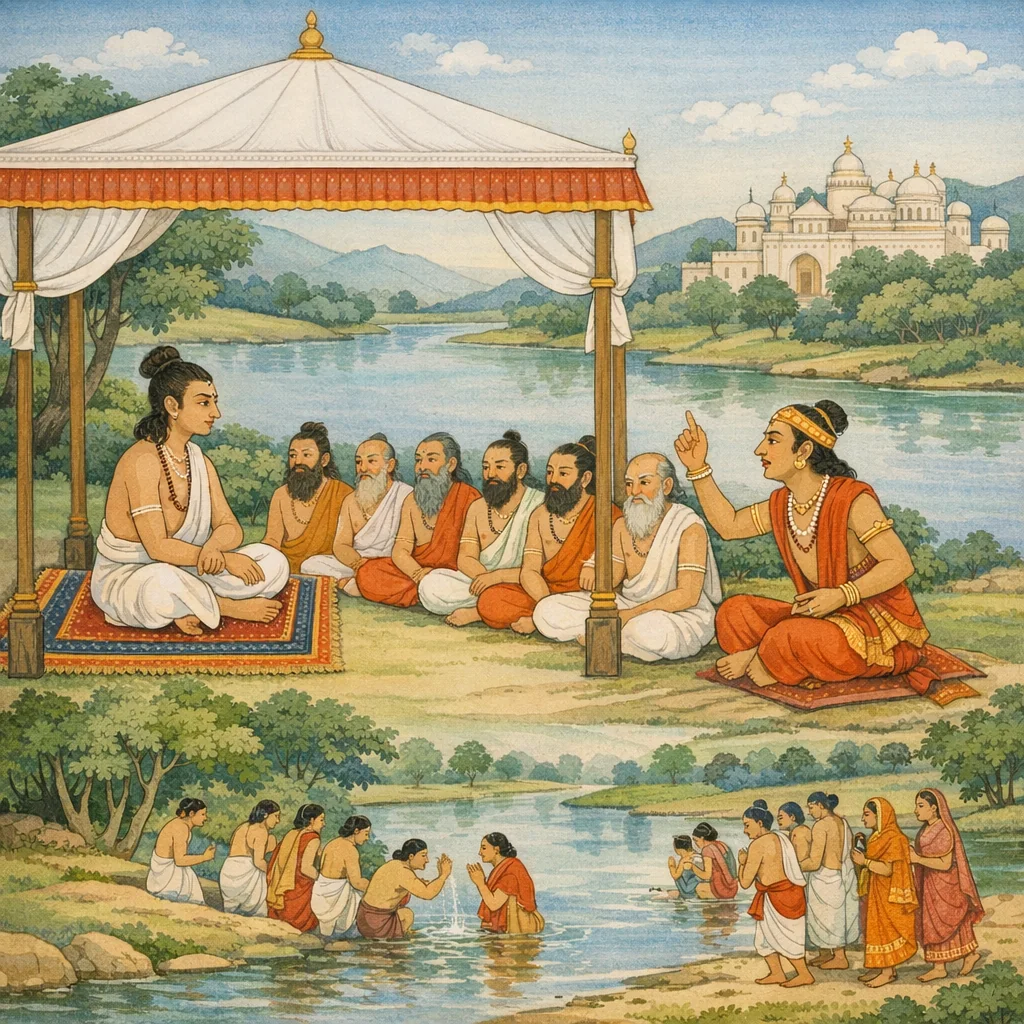
Adhyaya 135
Gaṅgā-Tīrtha Darśana and the Prelude to the Yavakrīta–Indra Exemplum (लोमश-युधिष्ठिर संवादः)
Upa-parva: Tīrtha-yātrā: Gaṅgā-Samaṅgā–Kanakhala–Raibhyāśrama Context (Lomāśa’s itinerary teaching)
Lomāśa identifies a sequence of sacred locales visible to Yudhiṣṭhira: Madhuvilā and the river Samaṅgā, associated with ritual cleansing and the removal of misfortune (alakṣmī). He references mythic precedents—Indra’s purification after slaying Vṛtra, and Aditi’s ritual cooking in Maināka’s region—framing the landscape as a moral archive. Lomāśa advises the Pāṇḍavas to ascend the mountain to dispel reputational darkness and misfortune, then points out Kanakhala and the Gaṅgā, noting Sanatkumāra’s attainment and promising liberation from sins through bathing. Further sites are named (Apāṃ-hrada, Bhṛgutunga), with a directive to approach in silence and with restraint, explicitly renouncing pride and anger. The narrative then shifts as Lomāśa indicates the illustrious Raibhyāśrama, where the sage Yavakrīta met destruction. Yudhiṣṭhira asks how Bharadvāja became distinguished and why Yavakrīta perished. Lomāśa begins the backstory: friendship between Bharadvāja and Raibhya, Raibhya’s sons Arvāvasu and Parāvasu, and Yavakrīta’s resentment at his father’s lack of honor compared to Raibhya. Seeking Vedic knowledge through severe tapas rather than traditional study, Yavakrīta confronts Indra, who warns that bypassing the teacher is an improper path. Persisting, Yavakrīta forces a negotiation; Indra employs a didactic analogy (building a sand-bridge across the Gaṅgā) to demonstrate the futility of certain aims, finally granting the boon that the Vedas will appear to Yavakrīta and his father as desired, and inviting further requests—ending this chapter on the threshold of subsequent consequences.
Chapter Arc: Lomasha resumes the tirtha-journey tale and draws Yudhishthira into the famed disputation where Vandi—proud of his victories—faces the unbending resolve of Ashtavakra, while the shadow of abducted sages hangs over the assembly. → Vandi’s taunts and warnings sharpen the stakes: he likens waking a sleeping danger to rousing a venomous serpent, and mocks the challenger’s confidence—suggesting that arrogance shatters its own hand against an unscarred mountain. → The verbal duel reaches its crest as Vandi’s bravado is met with steadiness and fearless counter-speech; the contest becomes not merely of meters and meanings, but of dharma—who may bind the learned, and who has the right to liberate them. → The narrative turns from the heat of debate to the sanctified aftermath: the rescued and honored brahmins are worshipped by the great Varuna, and all rise to approach King Janaka; the chapter widens into the grandeur of Janaka’s rite where sacred chants and offerings flourish. → Lomasha points the Pandavas onward to the newly sanctified Samanga river—where bathing is said to cleanse sin—inviting Yudhishthira and his brothers to enter the next tirtha and its promised merit.
Shlokas
Verse 1
(दाक्षिणात्य अधिक पाठका १ श्लोक मिलाकर कुल ३१ श्लोक हैं) #ड.7 ऋण (_) हि ० चतुस्त्रिंशर्दाधिकशततमो< ध्याय: बन्दी और अष्टावक्रका शानच्त्रार्थ, बन्दीकी पराजय तथा समड़्ामें स्सनानसे अष्टावक्रके अंगोंका सीधा होना सअद्टावक्र उवाच अत्रोग्रसेन समितेषु राजन् समागतेष्वप्रतिमेषु राजसु । नावैमि बर्न्दिं वरमत्र वादिनां महाजले हंसमिवाददामि,अष्टावक्र बोले--भयंकर सेनाओंसे युक्त महाराज जनक! इस सभामें सब ओरसे अप्रतिम प्रभावशाली राजा आकर एकत्र हुए हैं; परंतु मैं इन सबके बीचमें वादियोंमें प्रधान बन्दीको नहीं पहचान पाता हूँ। यदि पहचान लूँ तो अगाध जलमें हंसकी भाँति उन्हें अवश्य पकड़ लूँगा
Aṣṭāvakra said: “O King, here—amid these assembled formidable armies—when peerless kings have gathered together, I cannot yet make out Bandi, the foremost of debaters. But if I do recognize him, I shall seize him, as a swan takes its prey in the vast waters.”
Verse 2
न मेड्द्य वक्ष्यस्यतिवादिमानिन् ग्लहं प्रपन्न: सरितामिवागम: । हुताशनस्येव समिद्धतेजस: स्थिरो भवस्वेह ममाद्य बन्दिन्,अपनेको अतिवादी माननेवाले बन्दी! तुमने पराजित हुए पण्डितोंको पानीमें डुबवा देनेका नियम कर रखा है, किंतु आज मेरे सामने तुम्हारी बोली बंद हो जायगी। जैसे प्रलयकालके प्रज्वलित अग्निके समीप नदियोंका प्रवाह सूख जाता है, उसी प्रकार मेरे सामने आनेपर तुम भी सूख जाओगे--तुम्हारी वादशक्ति नष्ट हो जायगी। बन्दी! आज मेरे सामने स्थिर होकर बैठो
Aṣṭāvakra said: “O Bandi, proud of your excessive disputation—today your speech will not prevail. Like the flow of rivers checked when it meets a mighty current, so will your torrent of words be restrained. As streams dry up when they approach a blazing, fully kindled fire, so too, on coming before me, your power of debate will be extinguished. Sit here today, steady and firm, O Bandi.”
Verse 3
बन्द्ुवाच व्याप्रं शयानं प्रति मा प्रबोधय आशीविषं सृक्किणी लेलिहानम् । पदाहतस्येह शिरो5भिहत्य नादष्टो वै मोक्ष्यसे तन्निबोध,बन्दीने कहा--मुझे सोता हुआ सिंह समझकर न जगाओ (न छेड़ो), अपने जबड़ोंको चाटता हुआ विषैला सर्प मानो। तुमने पैरोंसे ठोकर मारकर मेरे मस्तकको कुचल दिया है। अब जबतक तुम डँस लिये नहीं जाते तबतक तुम्हें छुटकारा नहीं मिल सकता, इस बातको अच्छी तरह समझ लो
The captive said: “Do not rouse me, taking me for a sleeping tiger; regard me as a venomous serpent licking its jaws. You have struck and crushed my head here with your foot—know this well: until you are bitten, you will not be released.”
Verse 4
यो वै दर्पात् संहननोपपन्न: सुदुर्बल: पर्वतमाविहन्ति । तस्यैव पाणि: सनखो विदीर्यते न चैव शैलस्य हि दृश्यते व्रण:,जो देहधारी अत्यन्त दुर्बल होकर भी अहंकारवश अपने हाथसे पर्वतपर चोट करता है, उसीके हाथ और नख विदीर्ण हो जाते हैं। उस चोटसे पर्वतमें घाव होता नहीं देखा जाता है
Even if a man is extremely weak, when—out of arrogance—he strikes a mountain with his hand, it is his own hand and nails that split and bleed; no wound is seen upon the rock.
Verse 5
अद्टावक्र उवाच सर्वे राज्ञो मैथिलस्य मैनाकस्येव पर्वता: । निकृष्टभूता राजानो वत्सा अनडुहो यथा,अष्टावक्र बोले--जैसे सब पर्वत मैनाकसे छोटे हैं, सारे बछड़े बैलोंसे लघुतर हैं, उसी प्रकार भूमण्डलके समस्त राजा मिथिलानरेश महाराज जनककी अपेक्षा निम्न श्रेणीमें हैं
Aṣṭāvakra said: “Just as all mountains are smaller than Maināka, and as calves are inferior in strength to full-grown bulls, so too are all the kings of the earth of a lower rank when compared with the king of Mithilā, Janaka.”
Verse 6
यथा महेन्द्र: प्रवर: सुराणां नदीषु गड्जा प्रवरा यथैव । तथा नृपाणां प्रवरस्त्वमेको बन्दिं समभ्यानय मत्सकाशम्,राजन! जैसे देवताओंमें महेन्द्र श्रेष्ठ हैं और नदियोंमें गंगा श्रेष्ठ हैं, उसी प्रकार सब राजाओंमें एकमात्र आप ही उत्तम हैं। अब बन्दीको मेरे निकट बुलवाइये
“As Mahendra (Indra) is foremost among the gods, and as the Gaṅgā is foremost among rivers, so among kings you alone are supreme. Now, O King, have Bandin brought into my presence.”
Verse 7
लोगमश उवाच एवमष्टावक्र: समितौ हि गर्जन्- जातक्रोधो बन्दिनमाह राजन् । उक्ते वाक्ये चोत्तरं मे ब्रवीहि वाक्यस्य चाप्युत्तरं ते ब्रवीमि,लोमशजी कहते हैं--युधिष्ठिर! (बन्दीके सामने आ जानेपर) राजसभामें गर्जते हुए अष्टावक्रने बन्दीसे कुपित होकर इस प्रकार कहा--'मेरी पूछी हुई बातका उत्तर तुम दो और तुम्हारी बातका उत्तर मैं देता हूँ”
Lomaśa said: “O King (Yudhiṣṭhira), then Aṣṭāvakra, roaring in the royal assembly, angered, addressed Bandin: ‘Answer the question I put to you; and I, in turn, will answer your question.’”
Verse 8
बन्द्युवाच एक एवाग्निर्बहुधा समिध्यते एक: सूर्य: सर्वमिदं विभाति । एको वीरो देवराजो5रिहन्ता यम: पितृणामीश्वरश्वैक एव,तब बन्दीने कहा--अष्टावक्र! एक ही अग्नि अनेक प्रकारसे प्रकाशित होती है, एक ही सूर्य इस सम्पूर्ण जगत्को प्रकाशित करता है। शत्रुओंका नाश करनेवाला देवराज इन्द्र एक ही वीर है तथा पितरोंका स्वामी यमराज भी एक ही है
Bandi said: “One and the same fire is kindled into many forms; one and the same sun illumines this entire world. So too there is but one heroic lord of the gods—Indra, the slayer of foes—and likewise Yama alone is the sovereign of the ancestors.”
Verse 9
जअद्टाावक्र उवाच द्वाविन्द्राग्नी चरतो वै सखायौ द्वौ देवर्षी नारदपर्वतौ च । द्वावश्विनौ द्वे रथस्यापि चक्रे भार्यापती द्वौ विहितौ विधात्रा,अष्टावक्र बोले--जो दो मित्रोंकी भाँति सदा साथ विचरते हैं, वे इन्द्र और अग्नि दो देवता हैं। परस्पर मित्रभाव रखनेवाले देवर्षि नारद और पर्वत भी दो ही हैं। अश्विनीकुमारोंकी भी संख्या दो ही है, रथके पहिये भी दो ही होते हैं तथा विधाताने (एक-दूसरेके जीवनसंगी) पति और पत्नी भी दो ही बनाये हैं
Aṣṭāvakra said: “Two deities move together as friends—Indra and Agni. Two are the divine seers who share companionship—Nārada and Parvata. Two are the Aśvins; two are the wheels of a chariot; and the Creator has likewise ordained two life-partners—husband and wife.”
Verse 10
गा पप--> ' गा है | जज न् ६ “20 | / (5 एड ॥। है ॥ ब्द् बन्द्ुवाच त्रि: सूयते कर्मणा वै प्रजेय॑ त्रयो युक्ता वाजपेयं वहन्ति । अध्वर्यवस्त्रिसवनानि तन्वते त्रयो लोकास्त्रीणि ज्योतींषि चाहु:,बन्दीने कहा--यह सम्पूर्ण प्रजा कर्मवश देवता, मनुष्य और तिर्यक्रूप तीन प्रकारका जन्म धारण करती है, ऋक्ू, साम, और यजु--ये तीन वेद ही परस्पर संयुक्त हो बाजपेय आदि यज्ञ-कर्मोका निर्वाह करते हैं। अध्वर्युलोग भी प्रातः:सवन, मध्याह्मॉसलवन और सायंसवनके भेदसे तीन सवनों (यज्ञों)-का ही अनुष्ठान करते हैं। (कर्मानुसार प्राप्त होनेवाले भोगोंके लिये) स्वर्ग, मृत्यु और नरक-ये लोक भी तीन ही बताये गये हैं और मुनियोंने सूर्य, चन्द्र और अग्निरूप तीन ही प्रकारकी ज्योतियाँ बतलायी हैं
Bandin said: “All beings are born threefold, driven by their own actions—appearing as gods, humans, and animals. The three Vedas—Ṛg, Sāma, and Yajus—joined together, sustain sacrificial rites such as the Vājapeya. The officiating priests likewise extend the ritual into three pressings (savana): morning, midday, and evening. In the same way, the worlds spoken of for experiencing the fruits of action are three—heaven, the mortal realm, and hell; and the sages also declare three lights: the sun, the moon, and fire.”
Verse 11
अष्टावक्र उवाच चतुष्टयं ब्राह्मणानां निकेत॑ं चत्वारो वर्णा यज्ञमिमं वहन्ति । दिशश्वतस्रो वर्णचतुष्टयं च चतुष्पदा गौरपि शश्रचदुक्ता,अष्टावक्र बोले--ब्राह्मणोंके लिये आश्रम चार हैं। वर्ण: भी चार ही हैं जो इस यज्ञका भार वहन करते हैं। मुख्य दिशाएँः भी चार ही हैं। वर्ण“ भी चार ही हैं तथा गो अर्थात् वाणी भी सदा चार ही चरणोंसे* युक्त बतायी गयी है
Aṣṭāvakra said: “For Brahmins there are four settled stages of life (āśramas). There are also four social orders (varṇas) that bear the burden of this sacrificial order. The principal directions are four as well. Likewise, the ‘fourfold’ is spoken of again: even Speech—called ‘cow’—is eternally described as having four ‘feet’ (levels).”
Verse 12
बन्द्ुवाच पज्चाग्नय: पञ्चपदा च पड्क्ति- ्यज्ञा: पञज्चैवाप्यथ पज्चेन्द्रियाणि । दृष्टा वेदे पज्चचूडाप्सराश्न लोके ख्यातं पञ्चनदं च पुण्यम्,बन्दीने कहा--यज्ञकी अग्नि गार्हपत्य, दक्षिणाग्नि, आहवनीय, सभ्य और आवसश्यके भेदसे पाँच प्रकारकी कही गयी है। पंक्ति छन््द भी पाँच पादोंसे ही बनता है, यज्ञ भी पाँच ही हैं--देवयज्ञ, पितृयज्ञ, ऋषियज्ञ, भूतयज्ञ और मनुष्ययज्ञ। इसी प्रकार इन्द्रियोंकी संख्या भी पाँच ही हैं?। वेदमें पाँच वेणीवाली (पंचचूड़ा“) अप्सराका वर्णन देखा गया है तथा लोकमें पाँच” नदियोंसे विशिष्ट पुण्यमय पठ्चनद प्रदेश विख्यात है
Aṣṭāvakra said: “In the tradition one speaks of five sacred fires; the Paṅkti metre too is formed of five feet. The sacrifices are also five—offered to the gods, the ancestors, the seers, living beings, and human guests—and the senses are likewise five. In the Veda one even finds mention of an apsaras adorned with five braids, and in the world the holy land famed as Pañcanada, ‘the region of five rivers,’ is well known.”
Verse 13
अष्टावक्र उवाच षडाधाने दक्षिणामाहुरेके षट् चैवेमे ऋतव: कालचक्रम् । षडिन्न्द्रियाण्युत षट् कृत्तिकाश्न षट् साद्यस्का: सर्ववेदेषु दृष्टा:,अष्टावक्र बोले--कुछ विद्वानोंका मत है कि अग्निकी स्थापनाके समय दक्षिणामें छः गौ ही देनी चाहिये। ये छः ऋतुएँ ही संवत्सररूप कालचक्रकी सिद्धि करती हैं। मनसहित ज्ञानेन्द्रियाँ भी छः ही हैं। कृत्तिकाओंकी संख्या छः: ही है तथा सम्पूर्ण वेदोंमें साद्यस्क नामक यज्ञ भी छः: ही देखे गये हैं
Aṣṭāvakra said: “Some authorities declare that at the rite of establishing the sacred fire, the priestly fee (dakṣiṇā) should be six cows. These six seasons complete the wheel of time that is the year. The senses, together with the mind, are also reckoned as six; the Kṛttikā stars are six in number; and throughout the Vedas one also finds the Sādyaska sacrifices described as six. Thus, the tradition repeatedly points to ‘six’ as a measure of completeness in ritual and cosmic order.”
Verse 14
बन्द्ुवाच सप्त ग्राम्या: पशव: सप्त वन्या: सप्तच्छन्दांसि क्रतुमेक॑ वहन्ति । सप्तर्षय: सप्त चाप्यर्हणानि सप्ततन्त्री प्रथिता चैव वीणा,बन्दीने कहा-ग्राम्य पशु सात हैं (जिनके नाम इस प्रकार हैं)--गाय, भैंस, बकरी, भेंड़, घोड़ा, कुत्ता और गदहा। जंगली पशु भी सात हैं (यथा--सिंह, बाघ, भेड़िया, हाथी, वानर, भालू और मृग)। गायत्री, उष्णिक्, अनुष्टप, बृहती, पंक्ति, त्रिष्टप् और जगती--ये सात ही छन््द एक-एक यज्ञका निर्वाह करते हैं। सप्तर्षि नामसे प्रसिद्ध ऋषियोंकीः संख्या भी सात ही है (यथा--मरीचि, अत्रि, पुलह, पुलस्त्य, क्रतु, अंगिरा और वसिष्ठ), पूजनके संक्षिप्त उपचार भी सात हैं (यथा--गन्ध, पुष्प, धूप, दीप, नैवेद्य, आचमन और ताम्बूल) तथा वीणाके भी सात ही तार विख्यात हैं
Aṣṭāvakra said: “There are seven domestic animals and seven wild ones. The sacred metres are seven, and each sustains a sacrificial rite in its own way. The sages famed as the Seven Ṛṣis are seven, and the principal offerings of worship are also seven. Even the vīṇā is renowned as having seven strings.”
Verse 15
अष्टावक्र उवाच अष्टौ शाणा: शतमानं वहन्ति तथाष्टपाद: शरभ: सिंहघाती । अष्टौ वसूज्शुश्रुम देवतासु यूपश्चाष्टस्रिविहित: सर्वयज्ञे,अष्टावक्र बोले--तराजूमें लगी हुई सनकी डोरियाँ भी आठ ही होती हैं, जो सैकड़ोंका मान (तौल) करती हैं। सिंहको भी मार गिरानेवाले शरभके आठ ही पैर होते हैं। देवताओंमें वसुओंकी* संख्या भी आठ ही सुनी गयी है और सम्पूर्ण यज्ञोंमें आठ कोणके ही यूपका निर्माण किया जाता है
Aṣṭāvakra said: “Even the cords fixed to a balance are eight in number, yet they bear and determine weights up to a hundred measures. Likewise, the śarabha—said to be capable of bringing down a lion—has eight feet. Among the gods too, we have heard that the Vasus are eight. And in every sacrifice, the sacrificial post (yūpa) is fashioned with eight corners. Thus, ‘eight’ is repeatedly seen as a complete and effective measure in the order of the world and of ritual.”
Verse 16
बन्द्ुवाच नवैवोक्ता: सामिधेन्य: पितृणां तथा प्राहुर्नवयोगं विसर्गम् | नवाक्षरा बृहती सम्प्रदिष्टा नवयोगो गणनामेति शश्वत्,बन्दीने कहा--पितृयज्ञमें समिधा देकर अग्निको उद्दीप्त करनेके लिये जो मन्त्र पढ़े जाते हैं उन्हें सामिधेनी ऋचा कहते हैं, उनकी संख्या नौ ही बतायी गयी है। यह जो नाना प्रकारकी सृष्टि दिखायी देती है, इसमें प्रकृति, पुरुष, महत्तत्त्व, अहंकार तथा पज्चतन्मात्रा--इन नौ पदार्थोंका संयोग कारण है, ऐसा विज्ञ पुरुषोंका कथन है। बृहती-छन्दके प्रत्येक चरणमें नौ अक्षर बताये गये हैं और एकसे लेकर नौ अंकोंका योग ही सदा गणनाके उपयोगमें आता है
Aṣṭāvakra said: Bandī replied—“In the rite for the Fathers (pitṛ-yajña), the kindling-verses called Sāmidhēnī are declared to be nine. Likewise, the wise describe creation as arising from a ‘ninefold conjunction’: the manifold world-appearance proceeds from the combination of nine principles. Further, the Bṛhatī metre is taught as having nine syllables in each quarter; and in counting too, the series from one to nine is perpetually the basis of enumeration.”
Verse 17
अष्टावक्र उवाच दिशो दशोक्ता: पुरुषस्य लोके सहस्रमाहुर्दशपूर्ण शतानि । दशैव मासान् बिश्रति गर्भवत्यो दशैरका दश दाशा दशार्हा:,अष्टावक्रने कहा--पुरुषके लिये संसारमें दस दिशाएँ बतायी गयी हैं। दस सौ मिलकर ही पूरा एक सहस्र कहा जाता है, गर्भवती स्त्रियाँ दस मासतक ही गर्भ धारण करती हैं, निन्दक भी दसः ही होते हैं, शरीरकी अवस्थाएँ भी दसः हैं तथा पूजनीय पुरुष भी दसः ही बताये गये हैं
Aṣṭāvakra said: “For a human being in this world, ten directions are spoken of. Ten hundreds together are called a thousand. Pregnant women carry the child for ten months. The suns are ten; the ‘dāśas’ are ten; and those worthy of honor are also said to be ten.”
Verse 18
बन्द्ुवाच एकादशैकादशिन: पशूना- मेकादशैवात्र भवन्ति यूपा: । एकादश प्राणभृतां विकारा एकादशोक्ता दिवि देवेषु रुद्रा:,बन्दीने कहा--प्राणधारी पशुओं (जीवों)-के लिये ग्यारह विषयः हैं। उन्हें प्रकाशित करनेवाली इन्द्रियाँ भी ग्यारह ही हैं, यज्ञ, याग आदियमें यूप भी ग्यारह ही होते हैं, प्राणियोंके विकारः भी ग्यारह हैं, तथा स्वर्गीय देवताओंमें जो रुद्र+ कहलाते हैं; उनकी संख्या भी ग्यारह ही है
Bandī said: “For living creatures there are eleven spheres of experience, and the faculties that illuminate them are likewise eleven. In sacrifices too, the sacrificial posts (yūpa) are spoken of as eleven. The transformations found in embodied beings are eleven, and in heaven among the gods the Rudras are also declared to be eleven.”
Verse 19
अद्टावक्र उवाच संवत्सरं द्वादशमासमाहु- ज॑गत्या: पादो द्वादशैवाक्षराणि । द्वादशाह: प्राकृतो यज्ञ उक्तो द्वादशादित्यान् कथयन्तीह धीरा:,अष्टावक्र बोले--एक संवत्सरमें बारह महीने बताये गये हैं, जगती छन््दका प्रत्येक पाद बारह अक्षरोंका होता है, प्राकृत यज्ञ बारह दिनोंका माना गया है, ज्ञानी पुरुष यहाँ बारहरें आदित्योंका वर्णन करते हैं
Aṣṭāvakra said: “They declare that a year consists of twelve months; in the Jagatī metre each quarter has twelve syllables; the ‘Prākṛta’ sacrifice is said to last twelve days; and the wise here speak of the twelve Ādityas. Thus, in many domains, the number twelve is upheld as a measure of order and completeness.”
Verse 20
बन्द्युवाच त्रयोदशी तिथिरुक्ता प्रशस्ता त्रयोदशद्वीपवती मही च । बन्दीने कहा--त्रयोदशी तिथि उत्तम बतायी गयी है तथा यह पृथ्वी तेरह द्वीपोंसे युक्त है। लोगश उवाच एतावदुक्त्वा विर॒राम बन्दी श्लोकस्यार्ध व्याजहाराष्ट्रवक्र: । लोमशजी कहते हैं--इतना कहकर बन्दी चुप हो गया। तब शेष आधे श्लोककी पूर्ति अष्टावक्रने इस प्रकार की। अद्टावक्र उवाच त्रयोदशाहानि ससार केशी त्रयोदशादीन्यतिच्छन्दांसि चाहु:,अष्टावक्र बोले--केशी नामक दानवने भगवान् विष्णुके साथ तेरह* दिनोंतक युद्ध किया था। वेदमें जो अतिशब्द-विशिष्ट छन््द बताये गये हैं, उनका एक-एक पाद तेरह आदि अक्षरोंसे सम्पन्न होता है (अर्थात् अतिजगती छन््दका एक पाद तेरह अक्षरोंका, अतिशक्वरीका एक पाद पन्न्द्रह अक्षरोंका, अत्यष्टिका प्रत्येक पाद सत्रह अक्षरोंका तथा अतिधृतिका हर एक पाद उन्नीस अक्षरोंका होता है)
Aṣṭāvakra said: “The demon Keśī fought with Lord Viṣṇu for thirteen days. And the Veda too speaks of the ‘ati-’ metres—those marked by the prefix ati—whose quarters begin with thirteen syllables and then increase beyond that.” Thus Aṣṭāvakra completed the half-verse Bandin had left unfinished, displaying mastery not only of lore but of Vedic prosody, and turning a contest of learning into a proof of disciplined, truthful speech.
Verse 21
ततो महानुदतिष्ठन्निनाद- स्तृष्णींभूतं सूतपुत्र॑ निशम्य | अधोमुखं ध्यानपरं तदानी- मष्टावक्रं चाप्युदीर्यन्तमेव,लोमशजी कहते हैं--इतना सुनते ही सूतपुत्र बन्दी चुप हो गया और मुँह नीचा किये किसी भारी सोच-विचारमें पड़ गया। इधर अष्टावक्र बोलते ही रहे, यह सब देख दर्शकों और श्रोताओंमें महान् कोलाहल मच गया
Then a great uproar arose. Hearing that the sūta’s son, Bandin, had fallen silent—his face lowered, lost in thought—Aṣṭāvakra continued to speak; and seeing this, the assembled spectators and listeners burst into loud commotion.
Verse 22
तस्मिंस्तथा संकुले वर्तमाने स्फीते यज्ञे जनकस्योत राज्ञ: | अष्टावक्रं पूजयन्तो< भ्युपेयु- विंप्रा: सर्वे प्राजजलय: प्रतीता:,महाराज जनकके उस समृद्धिशाली यज्ञमें जबकि चारों ओर कोलाहल व्याप्त हो रहा था, सब ब्राह्मण हाथ जोड़े हुए श्रद्धापूर्वक अष्टावक्रके समीप आये और उनका आदर-सत्कारपूर्वक पूजन किया
As King Janaka’s grand sacrifice went on—crowded and bustling on every side—the Brahmins, all composed and reverent with hands joined in salutation, approached Aṣṭāvakra and honored him with respectful worship.
Verse 23
अष्टावक्र उवाच अनेनैव ब्राह्मणा: शुश्रुवांसो वादे जित्वा सलिले मज्जिता: प्राक् । तानेव धर्मानयमद्य बन्दी प्राप्रोतु गृह्दाप्सु निमज्जयैनम्,तत्पश्चात् अष्टावक्रने कहा--महाराज! इस बन्दीने पहले बहुत-से शास्त्रज्ञ (विद्वान) ब्राह्मणोंको शास्त्रार्थमें पराजित करके पानीमें डुबवाया है, अत: इसकी भी वही गति होनी चाहिये जो इसके द्वारा दूसरोंकी हुई। इसलिये इसे पकड़कर शीघ्र पानीमें डुबवा दीजिये
Aṣṭāvakra said: “By this very man, many learned Brāhmaṇas—men of sacred learning—were once defeated in debate and then drowned in the water. Therefore, let Bandin today meet that same fate, by the very rule he imposed on others. Seize him and plunge him into the waters.”
Verse 24
बन्द्ुवाच अहं पुत्रो वरुणस्योत राज्ञ- स्तत्रास सत्रं द्वादशवार्षिकं वै । सत्रेण ते जनक तुल्यकालं तदर्थ ते प्रहिता मे द्विजाग्रया:,बन्दी बोला--महाराज जनक! मैं राजा वरुणका पुत्र हूँ। मेरे पिताके यहाँ भी आपके इस यज्ञके समान ही बारह वर्षोमें पूर्ण होनेवाला यज्ञ हो रहा था। उस यज्ञके अनुष्ठानके लिये ही (जलमें डुबानेके बहाने) कुछ चुने हुए श्रेष्ठ ब्राह्मणोंको मैंने वरूणलोकमें भेज दिया था
Bandin said: “O King Janaka, I am the son of King Varuṇa. In my father’s realm there was also a twelve-year sacrificial session (satra), equal in duration to your own. For the sake of that rite, I dispatched select foremost Brahmins—the best among the twice-born—to Varuṇa’s world, under the pretext of submerging them in water.”
Verse 25
ते तु सर्वे वरुणस्योत यज्ञं द्रष्ट गता इह आयान्ति भूय: । अष्टावक्रं पूजये पूजनीयं यस्य हेतोर्जनितारं समेष्ये,वे सब-के-सब वरुणका यज्ञ देखनेके लिये गये हैं और अब पुनः लौटकर आ रहे हैं। मैं पूजनीय ब्राह्मण अष्टावक्रजीका सत्कार करता हूँ; जिनके कारण मेरा अपने पिताजीसे मिलना होगा
All of them have gone from here to see Varuṇa’s sacrifice, and now they are returning again. I honor Aṣṭāvakra, that venerable Brahmin worthy of reverence—for it is because of him that I shall be reunited with my father.
Verse 26
अद्टावक्र उवाच विप्रा: समुद्राम्भसि मज्जिता ये वाचा जिता मेधया वा विदाना: । तां मेधया वाचमथोज्जहार यथा वाचमवचिन्वन्ति सन्त:,अष्टावक्र बोले--राजन्! बन्दीने अपनी जिस वाणी (प्रवचनपटुता अथवा मेधा--बुद्धिबल)-से विद्वान् ब्राह्मणोंको भी परास्त किया और समुद्रके जलमें डुबोया है, उसकी उस वाकृशक्तिको मैंने अपनी बुद्धिसे किस प्रकार उखाड़ फेंका है, यह सब इस सभामें बैठे हुए विद्वान् पुरुष मेरी बातें सुनकर ही जान गये होंगे
Aṣṭāvakra said: “O King, those learned brāhmaṇas who had been defeated by his speech or by his intellect and then plunged into the waters of the sea—how I, by my own intelligence, uprooted that very power of speech: the wise men seated in this assembly will have understood it simply by hearing my words.”
Verse 27
अन्निर्दहज्जातवेदा: सतां गृहान् विसर्जयंस्तेजसा न सम धाक्षीत् बालेषु पुत्रेषु कृपणं वदत्सु तथा वाचमवचिन्वन्ति सन्त:,अग्नि स्वभावसे ही दहन करनेवाला है तो भी वह ज्ञेय विषयको तत्काल जाननेमें समर्थ है। इस कारण परीक्षाके समय जो सदाचारी और सत्यवादी होते हैं उनके घरोंको (शरीरोंको) छोड़ देता है, जलाता नहीं। वैसे ही संतलोग भी विनम्रभावसे बोलनेवाले बालक पुत्रोंके वचनोंमेंसे जो सत्य और हितकर बात होती है, उसे चुन लेते हैं--(उसे मान लेते हैं, उनकी अवहेलना नहीं करते)। भाव यह कि तुमको मेरे वचनोंका भाव समझकर उन्हें ग्रहण करना चाहिये
Agnī, the all-knowing fire, is by nature a burner; yet at the time of testing it releases the dwellings of the righteous and does not consume them with its heat. In the same way, when young sons speak humbly and even timidly, the wise discern and select from their words what is true and beneficial, rather than dismissing them. Therefore, you should grasp the intended meaning of my words and accept them.
Verse 28
श्लेष्मातकी क्षीणवर्चा: शृणोषि उताहो त्वां स्तुतयों मादयन्ति । हस्तीव त्वं जनक विनुद्यमानो न मामिकां वाचमिमां शूणोषि,राजन! जान पड़ता है, तुमने लसोड़ेके पत्तोंपर भोजन किया है या उसका फल खा लिया है, इसीसे तुम्हारा तेज क्षीण हो गया है; अतः तुम बन्दीकी बात सुन रहे हो, अथवा इस बन्दीद्वारा की गयी स्तुतियाँ तुम्हें उन््मत्त कर रही हैं। यही कारण है कि अंकुशकी मार खाकर भी न माननेवाले मतवाले हाथीकी भाँति तुम मेरी इन बातोंको नहीं सुन रहे हो
Aṣṭāvakra said: “O Janaka, has your radiance been dulled by eating the leaves or fruit of the śleṣmātakī tree? Or is it that the flatterers’ praises have intoxicated you? For like an elephant goaded with the hook, you still do not heed these words of mine, O king.”
Verse 29
जनक उवाच शृणोमि वाचं तव दिव्यरूपा- ममानुषीं दिव्यरूपो5सि साक्षात् | अजैषीर्यद् बन्दिनं त्वं विवादे निसृष्ट एष तव कामोउद्य बन्दी,जनकने कहा--ब्रह्मन्! मैं आपकी दिव्य एवं अलौकिक वाणी सुन रहा हूँ, आप साक्षात् दिव्यस्वरूप हैं, आपने शात्त्रार्थमें बन्दीको जीत लिया है। आपकी इच्छा अभी पूरी की जा रही है। देखिये यह है आपके द्वारा जीता हुआ बन्दी
Janaka said: “I hear your voice—divine in form and beyond the human. You are manifestly of a divine nature. Since you have defeated Bandi in learned debate, your wish is being fulfilled today. Behold—here is Bandi, won by you.”
Verse 30
अष्टावक्र उवाच नानेन जीवता कक्रिदर्थों मे बन्दिना नूप । पिता यद्यस्य वरुणो मज्जयैनं जलाशये,अष्टावक्र बोले--महाराज! इस बन्दीके जीवित रहनेसे मेरा कोई प्रयोजन नहीं है। यदि इसके पिता वरुणदेव हैं तो उनके पास जानेके लिये इसे निश्चय ही जलाशयमें डुबो दीजिये
Aṣṭāvakra said: “O king, I have no purpose in letting this Bandin remain alive. If his father is indeed Varuṇa, then send him to his father—surely, drown him in the reservoir.”
Verse 31
बन्द्युवाच अहं पुत्रो वरुणस्योत राज्ञो न मे भयं विद्यते मज्जितस्य । इमं मुहूर्त पितरं द्रक्ष्यते5य- मष्टावक्रश्चिरनष्टं कहोडम्,बन्दीने कहा--राजन! मैं वास्तवमें राजा वरुणका पुत्र हूँ, अत: जलमें डुबाये जानेका मुझे कोई भय नहीं है। ये अष्टावक्र दीर्घकालसे नष्ट हुए अपने पिता कहोडको इसी समय देखेंगे
Bandyu said: “I am truly the son of King Varuṇa; therefore I have no fear of being plunged into the waters. At this very moment, Aṣṭāvakra will behold his father Kahoda, long thought lost.”
Verse 32
लोगश उवाच ततस्ते पूजिता विप्रा वरुणेन महात्मना । उदतिष्ठंस्तत: सर्वे जनकस्य समीपत:,लोमशजी कहते हैं--युधिष्ठिर! तदनन्तर महामना वरुणद्वारा पूजित हुए वे समस्त ब्राह्मण (जो बन्दीद्वारा जलमें डुबोये गये थे) सहसा राजा जनकके समीप प्रकट हो गये
Lomaśa said: Then those brāhmaṇas, honored by the great-souled Varuṇa, all rose up at once and appeared near King Janaka.
Verse 33
कहोड उवाच इत्यर्थमिच्छन्ति सुताञउ्जना जनक कर्मणा । यदहं नाशकं कर्तु तत् पुत्र: कृतवान् मम,उस समय कहोडने कहा--जनकराज! लोग इसीलिये अच्छे कर्मोद्वारा पुत्र पानेकी इच्छा रखते हैं, क्योंकि जो कार्य मैं नहीं कर सका, उसे मेरे पुत्रने कर दिखाया
Kahoḍa said: “O King Janaka, people desire sons through meritorious deeds for this very reason: what I was unable to accomplish, my son has accomplished on my behalf.”
Verse 34
उताबलस्य बलवानुत बालस्य पण्डित: । उत वाविदुषो विद्वान् पुत्रो जनक जायते,जनकराज! कभी-कभी निर्बलके भी बलवान, मूर्खके भी पण्डित तथा अज्ञानीके भी ज्ञानी पुत्र उत्पन्न हो जाता है
Kahoda said: “O King Janaka, it is indeed seen that a strong son may be born to a weak man, a learned son to a foolish man, and a wise son even to one who lacks knowledge.”
Verse 35
शितेन ते परशुना स्वयमेवान्तको नृप । शिरांस्यपाहरत्वाजौ रिपूणां भद्रमस्तु ते,राजन्! आपका कल्याण हो, युद्धमें स्वयं ही यमराज तीखे फरसेसे आपके शत्रुओंके मस्तक काटते रहें
Kahoḍa said: “O king, may Antaka (Death) himself, taking up your sharp axe, keep on severing the heads of your enemies in battle. May auspiciousness be yours.”
Verse 36
महदौक्थ्यं गीयते साम चाग्रयं सम्यक् सोम: पीयते चात्र सत्रे शुचीन् भगान् प्रतिजगृहुश्न हृष्टा: साक्षाद् देवा जनकस्योत राज्ञ:,महाराज जनकके इस यज्ञमें उत्तम एवं महत्त्वपूर्ण और औक्थ्य- सामका गान किया जाता है, विधिपूर्वक सोमरसका पान हो रहा है, देवगण प्रत्यक्ष दर्शन देकर बड़े हर्षके साथ अपने-अपने पवित्र भाग ग्रहण कर रहे हैं
Kahoda said: “In this sacrificial session of King Janaka, the excellent and weighty Aukthya rite is being performed, and the foremost Sāman chants are being sung. Here the Soma is being drunk in due order. The gods themselves have appeared in person, and, rejoicing, they are receiving their pure allotted shares.”
Verse 37
लोगश उवाच समुत्थितेष्वथ सर्वेषु राजन् विप्रेषु तेष्वधिकं सुप्रभेषु । अनुज्ञातो जनकेनाथ राज्ञा विवेश तोयं सागरस्योत बन्दी,लोमशजी कहते हैं--राजन! बन्दीद्वारा जलमें डुबोये हुए वे सभी ब्राह्मण जब वहाँ अधिक तेजस्वी रूपसे प्रकट हो गये, तब राजाकी आज्ञा लेकर बन्दी स्वयं ही समुद्रके जलमें समा गया
Lomaśa said: “O King, when all those brāhmaṇas—who had been submerged—rose up again there, appearing with even greater radiance, then Bandī, having obtained permission from King Janaka, entered and disappeared into the waters of the ocean.”
Verse 38
अष्टावक्र: पितरं पूजयित्वा सम्पूजितो ब्राह्मणैस्तैर्यथावत् । प्रत्याजगामाश्रममेव चाग्रयं जित्वा सौतिं सहितो मातुलेन,अष्टावक्र अपने पिताकी पूजा करके स्वयं भी दूसरे ब्राह्मणोंद्वारा यथोचितरूपसे सम्मानित हुए; और इस प्रकार बन्दीपर विजय पाकर पिता एवं मामाके साथ अपने श्रेष्ठ आश्रमपर ही लौट आये
Having first honored his father, Aṣṭāvakra was in turn duly honored by those brāhmaṇas. Then, after defeating Bandin, the charioteer’s son, in debate, he returned to his excellent hermitage together with his father and his maternal uncle.
Verse 39
ततोडष्टावक्रमातुरथान्तिके पिता नदीं समड्जां शीघ्रमिमां विशस्व । प्रोवाच चैनं स तथा विवेश समैरद्जैश्वापि बभूव सद्य:,तदनन्तर पिता कहोडने अष्टावक्रकी माता सुजाताके निकट पुत्र अष्टावक्रसे कहा--“बेटा! तुम शीघ्र ही इस “समंगा” नदीमें स्नानके लिये प्रवेश करो।' पिताकी आज्ञाके अनुसार उन्होंने उस नदीमें स्नानके लिये प्रवेश किया। उसके जलका स्पर्श होनेपर तत्काल ही उनके सब अंग सीधे हो गये
Then his father, Kahoda, standing close by, said to Aṣṭāvakra, “My son, quickly enter this river Samaṅgā to bathe.” Obeying his father’s command, he stepped into the river; and as soon as the water touched him, all his limbs at once became straight and well-formed.
Verse 40
नदी समड् च बभूव पुण्या यस्यां स्नातो मुच्यते किल्बिषाद्धि | त्वमप्येनां सनानपानावगाहै: सभ्रातृक: सहभारयों विशस्व,युधिष्ठिर! इसीसे समंगा नदी पुण्यमयी हो गयी। इसमें स्नान करनेवाला मनुष्य सब पापोंसे मुक्त हो जाता है। तुम भी स्नान, पान (आचमन) और अवगाहनके लिये अपनी पत्नी और भाइयोंके साथ इस नदीमें प्रवेश करो
Lomaśa said: “This river, the Samaṅgā, has become holy; one who bathes in it is indeed freed from sin. Therefore you too, Yudhiṣṭhira—together with your brothers and your wife—enter this river for bathing, for sipping the water as a purificatory act, and for full immersion.”
Verse 41
अत्र कौन्तेय सहितो भ्रातृभिस्त्व॑ सुखोषित: सह विप्रै: प्रतीत: । पुण्यान्यन्यानि शुचिकर्मैकभक्ति- मया सार्थ चरितस्याजमीढ,अजमीढकुलभूषण कुन्तीनन्दन! तुम विश्वासपूर्वक अपने भाइयों और ब्राह्मणोंके साथ यहाँ एक रात सुखसे रहकर कलसे पुनः मेरे साथ पवित्र कर्मोमें अविचल श्रद्धा-भक्ति रखते हुए दूसरे-दूसरे पुण्यतीर्थोकी यात्रा करना
Here, O son of Kuntī, stay comfortably for one night together with your brothers and the Brahmins, in full confidence and goodwill. Then, from tomorrow onward, travel again with me to other sacred fords and holy places—performing pure rites and keeping unwavering, single-minded devotion to righteous conduct. O descendant of Ajāmīḍha, ornament of Ajāmīḍha’s line, let your pilgrimage be marked by faith, purity, and steadfastness in dharma.
Verse 133
इस प्रकार श्रीमहाभारत वनपर्वके अन्तर्गत तीर्थयात्रापर्वमें लोमशती र्थयात्राके प्रसंगमें अष्टावक्रीयोपाख्यानविषयक एक सौ तैतीसवाँ अध्याय पूरा हुआ
Thus ends the one hundred and thirty-third chapter of the Aṣṭāvakra episode, occurring within the Tīrthayātrā section of the Vana Parva of the Śrī Mahābhārata, in the context of Lomāśa’s pilgrimage narrative. The colophon signals the completion of this unit, framing the episode as part of the broader ethical and instructive journey through sacred places and teachings.
Verse 134
इति श्रीमहा भारते वनपर्वणि तीर्थयात्रापर्वणि लोमशतीर्थयात्रायामष्टावक्रीये चतुस्त्रिंशयदाधिकशततमो<ध्याय:
Thus, in the revered Mahābhārata, within the Vana Parva—specifically the Tīrtha-yātrā section, in the account of Lomāśa’s pilgrimage and the episode concerning Aṣṭāvakra—this concludes the one-hundred-and-thirty-fourth chapter (i.e., the 134th adhyāya).
Frequently Asked Questions
Whether sacred knowledge can be legitimately obtained through self-willed austerity that bypasses the teacher-student discipline, especially when driven by resentment and status anxiety.
Certain objectives are structurally unsound when pursued by improper means; effort alone does not validate a method, and epistemic goals require appropriate pathways (adhyāyana, guidance, restraint).
Rather than a formal phalaśruti verse, the chapter embeds efficacy claims through tīrtha narration: bathing and disciplined conduct at Gaṅgā-linked sites are said to remove sins and misfortune, contingent on humility and anger-restraint.