Adhyaya 198
मनस्–बुद्धि–गुणविचारः (Manas–Buddhi–Guṇa Inquiry) — Meditation and Nirguṇa Realization
Upa-parva: Mokṣa-dharma (Liberation Teachings) — Manuvāda / Sāṃkhya-Yoga Discourse Unit
Manu outlines a technical psychology of knowledge: mind (manas) is presented as a jñāna-attribute that, when conjoined with the instrument of discernment (prajñā-karaṇa), gives rise to buddhi (intellect). When buddhi operates with karmic guṇas within mind, Brahman is ‘known’ through dhyāna-yoga-samādhi; yet this guṇa-bearing buddhi naturally circulates among guṇas, illustrated by the metaphor of water descending from a mountain peak. A transition is then described: when meditation in the mind reaches the nirguṇa condition, Brahman becomes knowable, compared to testing gold on a touchstone. The chapter stresses the limits of sensory demonstration for the nirguṇa and prescribes closing the sensory ‘gates’ and establishing ekāgratā. It further distinguishes the unmanifest (avyakta) as lacking comparable illustrative analogies and recommends tapas, inference, śruti, and purified inner self as supports. The discourse situates nairguṇya as the route to Brahman, while saguṇa involvement entails return to conditioned operations; it concludes with a compact Sāṃkhya-style enumeration (puruṣa, prakṛti, buddhi, indriyas, ahaṃkāra) and a moral-psychological note contrasting attachment with dispassionate knowledge.
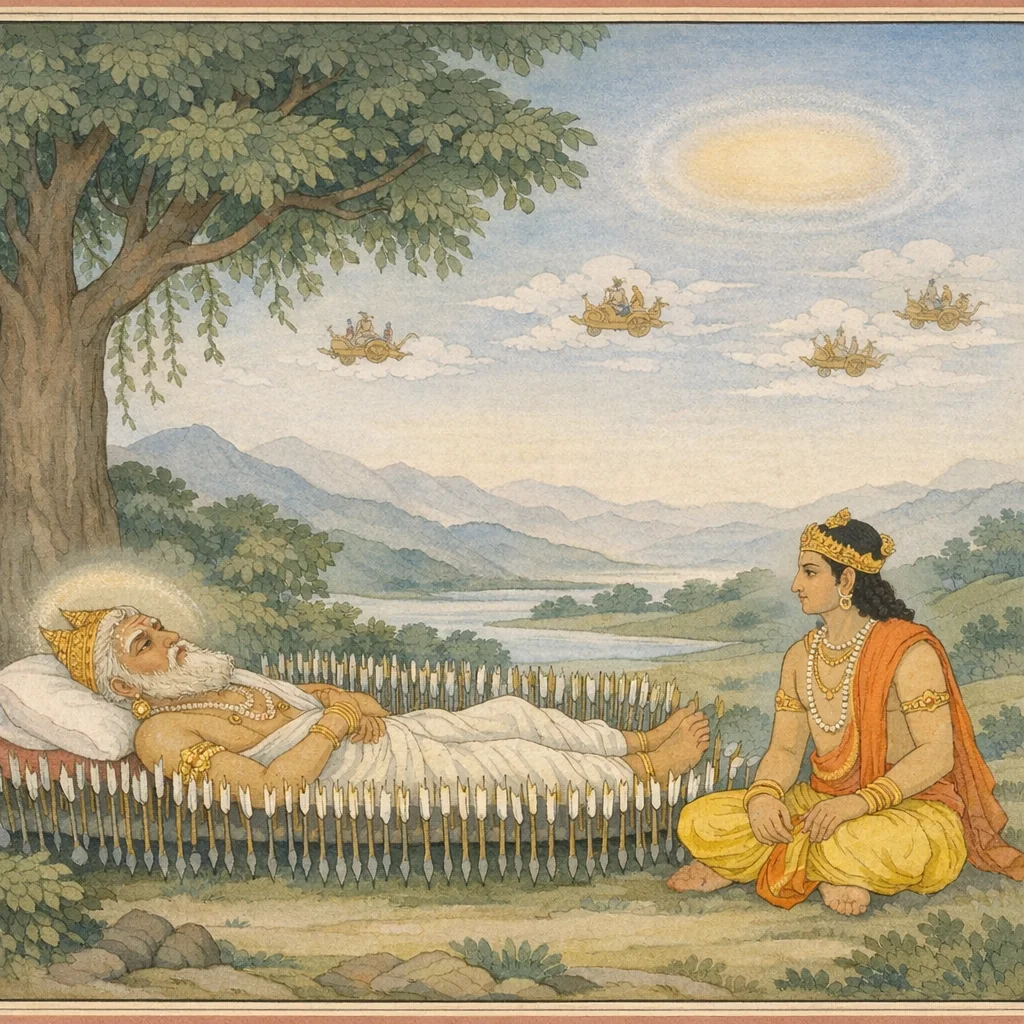
Chapter Arc: भीष्म युधिष्ठिर को संबोधित कर कहते हैं—‘अनघ! तुम धर्म के अंश से उत्पन्न हो; अब सावधान होकर वह वचन सुनो जो धर्म-मूल का आश्रय है।’ → वर्णन देव-लोकों के नाना रूप, रंग, विमान, सभाएँ और क्रीड़ा-स्थल से आगे बढ़कर उस परमधाम की ओर मुड़ता है जो इन सब दिव्य वैभवों से भी परे है—जहाँ भय, कारण-बंधन और क्लेश का प्रवेश नहीं। → परमात्मा के परमधाम का निर्णायक निरूपण: वह अभय, अनिमित्त, क्लेश-रहित है; चार लक्षणों (दृष्टि, श्रुति, मति, विज्ञाति) और चार कारणों से परे है; काल की उत्पत्ति वहीं से है, पर काल वहाँ प्रभु नहीं—वहाँ का स्वामी वही परम है। → भीष्म बताते हैं कि आत्म-केवलता (कैवल्य) को प्राप्त पुरुष वहाँ जाकर शोक से रहित हो जाता है; और जो ‘नरक’ कहे गए, वे उसी परम-स्थान की तुलना में निम्न अवस्थाएँ/गिरावटें हैं—इस प्रकार नरकों का यथार्थ कथन भी पूर्ण होता है।
Shlokas
Verse 1
इस प्रकार श्रीमहाभारत शान्तिपर्वके अन्तर्गत मोक्षधर्मपर्वमें जापकका उपाख्यानविषयक एक सौ सत्तानबेवाँ अध्याय पूरा हुआ ॥/ १९७ ॥। ऑपन--मा_जल बछ। -स:िॉ - इस प्रकरणमें पुनर्जन्मको ही नरकके नामसे कहा गया है। यह बात छठे और सातवें श्लोकके वर्णनसे स्पष्ट हो जाती है। अष्टनवर्त्याधेकशततमोब् ध्याय: परमधामके अधिकारी जापकके लिये देवलोक भी नरक-तुल्य हैं--इसका प्रतिपादन युधिषछ्िर उवाच कीदृशं निरयं याति जापको वर्णयस्व मे । कौतूहलं हि राजन् मे तद् भवान् वक्तुमहति,युधिष्ठिरने पूछा--दादाजी! जप करनेवालेको उसके दोषोंके कारण किस तरहके नरककी प्राप्ति होती है? उसका मुझसे वर्णन कीजिये। राजन्! उसे जाननेके लिये मेरे मनमें बड़ा कौतूहल हो रहा है; अतः: आप अवश्य बतावें
Thus ends the one-hundred-and-ninety-seventh chapter, concerning the episode of Jāpaka, in the Mokṣa-dharma section within the Śānti Parva of the Śrī Mahābhārata. Yudhiṣṭhira said: “What kind of hell does a practitioner of japa fall into when tainted by faults? Please describe it to me. Venerable grandsire, my mind is filled with curiosity to understand this; therefore you are indeed fit to explain it.”
Verse 2
भीष्म उवाच धर्मस्यांशप्रसूतो $सि धर्मिष्ठोईसि स्वभावत: । धर्ममूलाश्रयं वाक््यं शृणुष्वावहितो5नघ,भीष्मजीने कहा--अनघ! तुम धर्मके अंशसे उत्पन्न हुए हो और स्वभावसे ही धर्मनिष्ठ हो; अतः सावधान होकर धर्मके मूलभूत वेद और परमात्मासे सम्बन्ध रखनेवाली मेरी बात सुनो
Bhishma said: “O Anagha, blameless one, you are born of a portion of dharma and are by nature devoted to dharma. Therefore, listen attentively to my words—words grounded in the very root of dharma, the Vedas, and in their relation to the Paramātman, the Supreme Self.”
Verse 3
अमूनि यानि स्थानानि देवानां परमात्मनाम् | नानासंस्थानवर्णानि नानारूपफलानि च,परम बुद्धिमान् देवताओंके ये जो स्थान बताये जाते हैं, उनके रूप-रंग अनेक प्रकारके हैं। फल भी नाना प्रकारके हैं। देवताओंके यहाँ इच्छानुसार विचरनेवाले दिव्य विमान तथा दिव्य सभाएँ होती हैं। राजन! उनके यहाँ नाना प्रकारके क्रीडास्थल तथा सुवर्णमय कमलोंसे सुशोभित बावलियाँ होती हैं
Bhishma said: “Those abodes of the gods—lofty, self-governing beings—are described as manifold in their structures and colors, and diverse in the forms of their rewards. In the divine realms there are celestial aerial cars and splendid assembly-halls where one may move at will; and, O king, there are many kinds of pleasure-grounds and stepwells adorned with golden lotuses.”
Verse 4
दिव्यानि कामचारीणि विमानानि सभास्तथा । आक्रीडा विविधा राजन पद्मिन्यश्वैव काज्चना:,परम बुद्धिमान् देवताओंके ये जो स्थान बताये जाते हैं, उनके रूप-रंग अनेक प्रकारके हैं। फल भी नाना प्रकारके हैं। देवताओंके यहाँ इच्छानुसार विचरनेवाले दिव्य विमान तथा दिव्य सभाएँ होती हैं। राजन! उनके यहाँ नाना प्रकारके क्रीडास्थल तथा सुवर्णमय कमलोंसे सुशोभित बावलियाँ होती हैं
Bhīṣma said: “In the worlds of the gods there are celestial aerial cars that move at will, and splendid assembly-halls as well. O King, there are many kinds of pleasure-groves and play-grounds, and also golden lotus-filled tanks and stepwells. Thus the divine abodes spoken of by the wise are adorned with varied forms and enjoyments, illustrating the fruits that arise from exalted merit.”
Verse 5
चतुर्णा लोकपालानां शुक्रस्याथ बृहस्पते: । मसरुतां विश्वदेवानां साध्यानामश्चिनोरपि,तात! वरुण, कुबेर, इन्द्र और यमराज--इन चारों लोकपालों, शुक्र, बृहस्पति, मरुदगण, विश्वेदेव, साध्य, अश्विनीकुमार, रुद्र, आदित्य, वसु तथा अन्य देवताओंके जो ऐसे ही लोक हैं, वे सब परमात्माके परमधामके सामने नरक ही हैं
Bhīṣma said: “Dear child, the worlds belonging to the four guardians of the quarters—Varuṇa, Kubera, Indra, and Yama—as well as the worlds of Śukra and Bṛhaspati, of the Maruts, the Viśvedevas, the Sādhyas, and the Aśvins—indeed, the realms of Rudras, Ādityas, Vasus, and other deities too—however exalted they may be, are, in comparison with the Supreme Self’s highest abode, no better than hell.”
Verse 6
रुद्रादित्यवसूनां च तथान्येषां दिवौकसाम् | एते वै निरयास्तात स्थानस्य परमात्मन:,तात! वरुण, कुबेर, इन्द्र और यमराज--इन चारों लोकपालों, शुक्र, बृहस्पति, मरुदगण, विश्वेदेव, साध्य, अश्विनीकुमार, रुद्र, आदित्य, वसु तथा अन्य देवताओंके जो ऐसे ही लोक हैं, वे सब परमात्माके परमधामके सामने नरक ही हैं
Bhīṣma said: “O dear one, even the celestial realms belonging to the Rudras, Ādityas, Vasus, and other dwellers of heaven are, in comparison to the Supreme Self’s highest abode, no better than hell. Such is the immeasurable superiority of the Paramātman’s supreme station over all divine enjoyments.”
Verse 7
अभयं चानिमित्तं च न तत् क्लेशसमावृतम् । द्वाभ्यां मुक्त त्रिभिर्मुक्तमष्टाभिस्त्रिभिरेव च,परमात्माका परमधाम विनाशके भयसे रहित है; क्योंकि वह कारणरहित नित्य-सिद्ध है। वह अविद्या, अस्मिता, राग, द्वेष और अभिनिवेश नामक पाँच क्लेशोंसे घिरा हुआ नहीं है। उसमें प्रिय और अप्रिय ये दो भाव नहीं हैं*। प्रिय और अप्रियके हेतुभूत तीन गुण--सत्त्व, रज और तम भी नहीं हैं तथा वह परमधाम भूत, इन्द्रिय, मन, बुद्धि, उपासना, कर्म, प्राण और अविद्या--इन आठ पुरियोंसे: भी मुक्त है। वहाँ ज्ञाता, ज्ञान और ज्ञेय--इस त्रिपुटीका भी अभाव है
Bhishma said: That Supreme Reality is fearless and without any external cause; it is not veiled by afflictions. It is free from the pair of likes and dislikes; free from the three guṇas that generate such reactions; and free as well from the eightfold complex of embodied existence. There, even the triad of knower, knowing, and known does not obtain—thus it is taught as the highest abode beyond decay and fear.
Verse 8
चतुर्लक्षणवर्ज तु चतुष्कारणवर्जितम् | अप्रहर्षमनानन्दमशोकं विगतक्क्लमम्,इतना ही नहीं, वह दृष्टि, श्रुति, मति और विज्ञाति-इन चार लक्षणोंसे रहित हैः। ज्ञानके कारणभूत प्रत्यक्ष, अनुमान, उपमान और शब्द--इन चारोंसे वह परे है। वहाँ इष्ट विषयकी प्राप्तिसे होनेवाले हर्ष और उसके भोगजनित आनन्दका भी अभाव है। वह शोक और श्रमसे भी सर्वथा रहित है
Bhīṣma said: That supreme state is devoid of the four marks—seeing, hearing, thinking, and cognizing. It lies beyond the four means that generate ordinary knowledge: direct perception, inference, comparison, and verbal testimony. There, neither exhilaration at gaining a desired object nor the pleasure born of its enjoyment arises. It is entirely free from grief and from fatigue.
Verse 9
काल: सम्पद्यते तत्र कालस्तत्र न वै प्रभु: । स कालस्य प्रभू राजन् स्वर्गस्यापि तथेश्वर:,राजन! कालकी उत्पत्ति भी वहींसे होती है। उस धामपर कालकी प्रभुता नहीं चलती। वह परमात्मा कालका भी स्वामी और स्वर्गका भी ईश्वर है
Bhīṣma said: “O King, Time itself arises from that supreme realm; yet in that abode Time has no dominion. He—the Supreme Lord—is the master even of Time, and likewise the sovereign of heaven as well.”
Verse 10
आत्मकेवलतां प्राप्तस्तत्र गत्वा न शोचति । ईदृशं परमं स्थान निरयास्ते च तादृशा:,जो आत्मकैवल्यको प्राप्त हो चुका है वही मनुष्य वहाँ जाकर शोकसे रहित हो जाता है। उस परमधामका स्वरूप ऐसा ही है और पहले जो नाना प्रकारके सुखभोगोंसे सम्पन्न लोक बताये गये हैं, वे सभी उसकी तुलनामें नरक हैं
Bhīṣma said: “One who has attained the state of absolute self-alone-ness (ātma-kaivalya) goes there and becomes free from grief. Such is that supreme abode; and compared with it, even those worlds earlier described as filled with many kinds of pleasures are, in truth, like hell.”
Verse 11
एते ते निरया: प्रोक्ता: सर्व एव यथातथम् | तस्य स्थानवरस्येह सर्वे निरयसंज्ञिता:,राजन! इस प्रकार मैंने तुम्हें यथार्थरूपसे ये सभी नरक बताये हैं। उस परमपदके सामने वस्तुत: वे सभी लोक “नरक' ही कहलाने योग्य हैं
Bhīṣma said: “Thus I have described to you, exactly as they are, all these hells. Yet, O King, in comparison with that supreme and most excellent state, all these realms here are, in truth, fit to be called ‘hell’.”
Verse 198
इति श्रीमहाभारते शान्तिपर्वणि मोक्षधर्मपर्वणि जापकोपाख्याने अष्टनवत्यधिकशततमो< ध्याय:,इस प्रकार श्रीमहाभारत शान्तिपर्वके अन्तर्गत मोक्षधर्मपर्वमें जापकका उपाख्यानविषयक एक सौ अद्दानबेवाँ अध्याय पूरा हुआ
Thus, in the Śrī Mahābhārata, within the Śānti Parvan—specifically the Mokṣa-dharma section—ends the one-hundred-and-ninety-eighth chapter, known as the episode concerning Jāpaka.
Frequently Asked Questions
The chapter frames an internal ethical tension rather than a plot dilemma: whether cognition remains driven by guṇas and sensory objects (thus reinforcing conditioned patterns) or is disciplined through restraint and meditation to approach nirguṇa realization.
Buddhi arises and functions through mind, but its guṇa-entanglement limits realization; by closing sensory channels, cultivating ekāgratā, and practicing dhyāna-yoga-samādhi with inner purification, one can move from saguṇa operations toward insight into Brahman.
No explicit phalaśruti is stated; the implied meta-point is soteriological: nairguṇya is presented as the operative condition for attaining Brahman, while saguṇa involvement is associated with return to conditioned functioning.