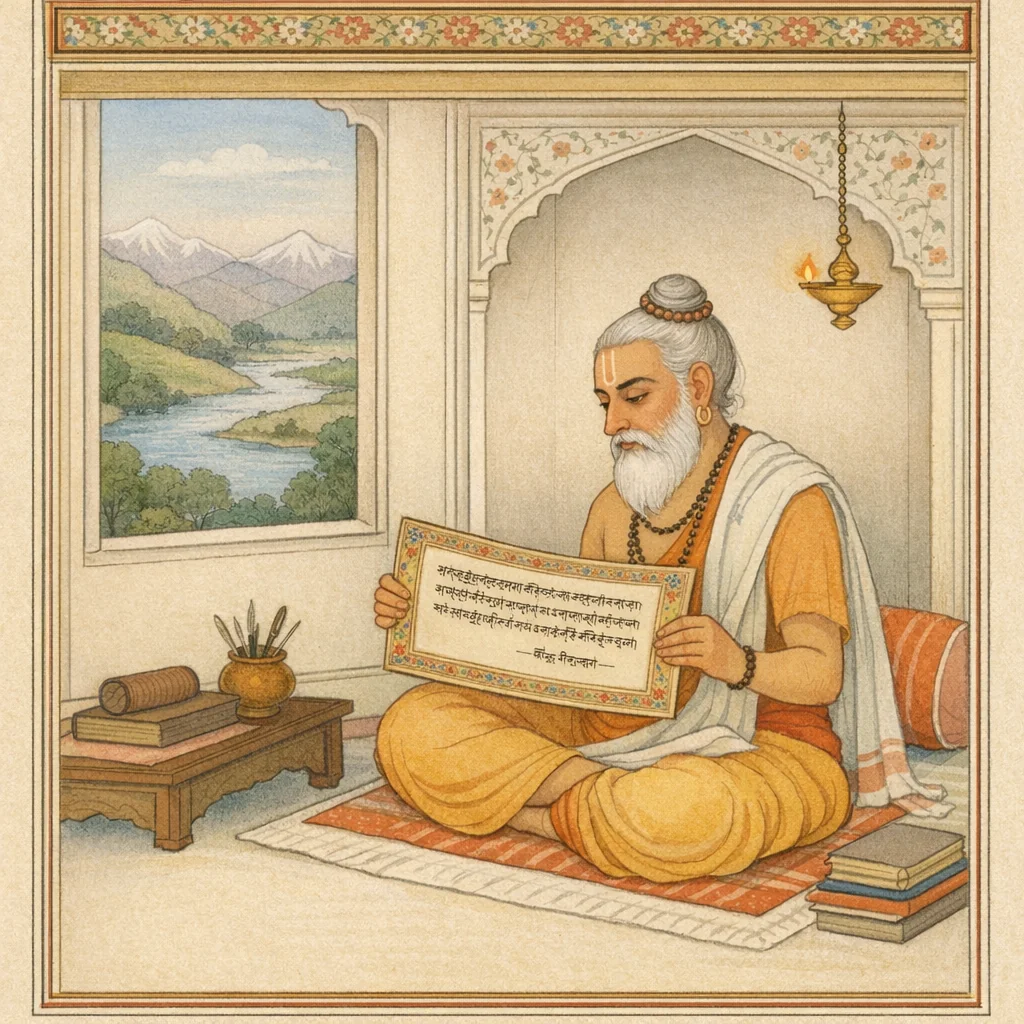
Adhyaya 93
सक्तुदानमहिमा — The Merit of Justly-Earned Charity (Kapotī Brāhmaṇa and Dharma as Atithi)
Upa-parva: Āśvamedha-yajña-āścarya-kathā (Episode on the ‘wonder’ at the Aśvamedha: the Kapotī Brāhmaṇa exemplum)
Nakula addresses the sacrificial assembly by outlining the ‘supreme fruit’ of dāna when it is nyāya-labdha (acquired by lawful means), subtle in quantity, and offered to a worthy recipient. He recounts a Kurukṣetra-region account of an elderly uñchavṛtti brāhmaṇa living austerely with wife, son, and daughter-in-law during severe famine. After a long interval they obtain a small measure of barley and prepare saktu, dividing it equally after rites. A hungry brāhmaṇa guest arrives; the family welcomes him with arghya/pādya and offers their share, yet the guest remains unsatisfied. In successive deliberations, the wife, then the son, and finally the daughter-in-law offer their portions, each invoking dharma-based reasons; the elder resists harming dependents but ultimately accepts the daughter-in-law’s insistence grounded in guru-sevā and family continuity. The guest is revealed as Dharma (personified), who praises the purity of intent, capacity-based giving, and self-restraint, declaring their act superior in fruit to many large sacrifices. A divine conveyance appears; the family ascends to heaven. The framing returns to the Aśvamedha, emphasizing that ethical excellence—non-harm, contentment, straightforwardness, tapas, self-control, truth, and charity—are co-equal pillars of dharma.
Chapter Arc: सूत्रधार-स्वर में ग्रन्थ का प्रवाह एक विराम पर आता है—पूर्व अध्याय (नकुलोपाख्यान) की समाप्ति का संकेत देकर पाठक को यह बोध कराया जाता है कि अनुगीत-पर्व की कथा-धारा अब समापन की ओर मुड़ रही है। → कथानक-तनाव युद्ध या संवाद से नहीं, बल्कि ‘समाप्ति’ की गंभीरता से उठता है—पाठ-परम्पराओं (दाक्षिणात्य अधिक-पाठ) के भेद, श्लोक-संख्या का उल्लेख, और छन्द-निर्देश यह प्रश्न जगाते हैं कि महाग्रन्थ का यह विराट शरीर कैसे संहिताबद्ध हुआ। → घोषणा-रूप चरम बिन्दु: ‘आश्वमेधिकपर्व सम्पूर्णम्’—यह वाक्य स्वयं एक अनुष्ठानिक मुहर की तरह पड़ता है, जहाँ कथा नहीं, ग्रन्थ-समाप्ति ही घटना बन जाती है। → समापन-लेख (कोलोफोन) के साथ अध्याय/पर्व का औपचारिक निष्कर्ष—श्लोक-संख्या, छन्द-सूचना और पाठ-भेद का संकेत देकर पाठ को ‘पूर्ण’ घोषित किया जाता है।
Shlokas
Verse 92
इस प्रकार श्रीमह्याभारत आश्वमेधिकपर्वके अन्तर्गत अनुगीतापर्वरमें नकुलोपाख्यानविषयक बानबेवाँ अध्याय पूरा हुआ
Thus ends the ninety-second chapter of the Nakula episode within the Anugītā section of the Aśvamedhika Parva of the sacred Mahābhārata. This closing colophon signals the completion of a narrative unit meant to preserve and transmit ethical reflection through exemplary story and instruction.
Verse 29157
(दाक्षिणात्य अधिक पाठके १२२० श्लोक मिलाकर कुल १२७३ श्लोक हैं) ऑपन-- मा बछ। अप ऋाल ।। आश्वमेधिकपर्व सम्पूर्णम् ।। ब्प्स अनुष्टुप् ( अन्य बड़े छन्द ) बड़े छन््दोंको ३२ अक्षरोंके कुल योग अनुष्टुप् मानकर गिननेपर उत्तर भारतीय पाठसे लिये गये २७४७॥ . (१२२॥ ) १६८
Vaiśampāyana states a colophon-style note: in the Southern (Dakṣiṇātya) recension, an additional 1,220 verses are included, making a total of 1,273 verses for this section; thus the Aśvamedhika Parva is concluded. For metrical counting, longer metres are sometimes converted into an equivalent Anuṣṭubh count by treating each set of 32 syllables as one Anuṣṭubh; by that method, the Northern recension yields a count of 2,747. This passage is editorial and metrical bookkeeping rather than narrative instruction, marking the formal completion of the parva and indicating textual-variant statistics.
Frequently Asked Questions
How a household facing famine should balance self-preservation and dependent-care against the absolute duty of atithi-hospitality, especially when resources are insufficient for both.
Merit depends on purity of means and intention: even a small, lawfully-earned gift offered with śraddhā and self-restraint can surpass grand ritual acts, while anger and greed can nullify dāna’s fruit.
Yes: Dharma explicitly declares the family’s subtle gift as heaven-winning and superior in outcome to many large sacrifices, presenting the episode as an evaluative standard for dāna and ethical discipline within ritual contexts.