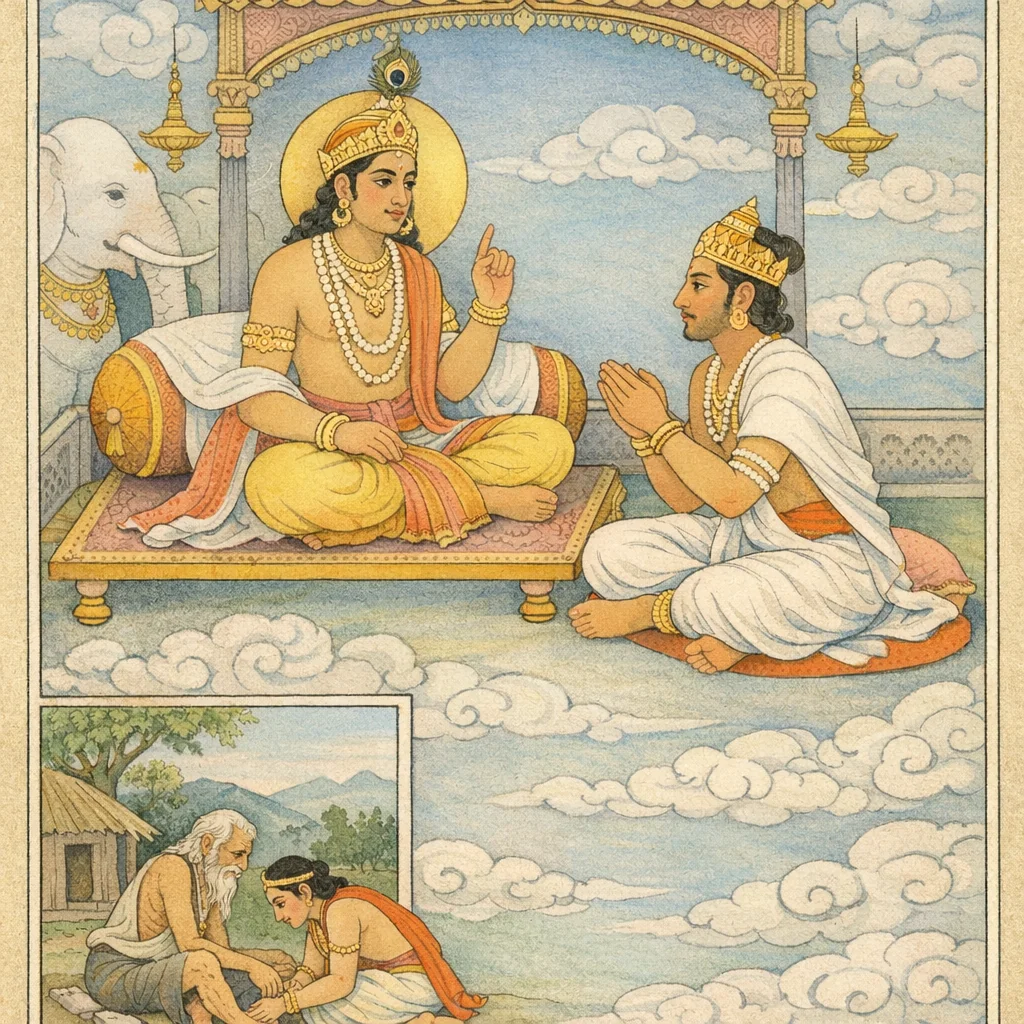
Adhyaya 88
ययाति–दौहित्रसंवादः (Yayāti and the Grandsons: Discourse on Lokas, Dāna, and Satya)
Upa-parva: Sambhava Parva (Genealogies and Origins) — Yayāti–Dauhitra (Grandsons) Episode
Chapter 88 presents a structured dialogue in which royal interlocutors inquire about the existence and status of their heavenly “lokas” (merit-realms). Vasumanā first questions Yayāti, who describes vast, enduring celestial domains. Vasumanā then offers to transfer his lokas to Yayāti, even proposing a symbolic ‘purchase’ with a straw; Yayāti refuses, citing the impropriety of a transaction he has not practiced before and the risk of taking merit ‘in vain.’ Śibi similarly offers his lokas; Yayāti again declines, stating he does not delight in what is given by others. Aṣṭaka warns that if their gifts are not accepted, they will incur a negative fate; Yayāti replies that the virtuous should give to the worthy, but he will not undertake what he has not done previously. Aṣṭaka observes five golden chariots; Yayāti confirms they are for the group. They ascend together on a ‘stainless path’ toward the divine abode. Aṣṭaka questions why Śibi advances ahead; Yayāti explains Śibi’s excellence through sustained giving and enumerates virtues—dāna, tapas, satya, dharma, modesty, prosperity, forgiveness, gentleness, endurance—attributing Śibi’s precedence to consistent, non-cruel disposition. The chapter closes with Aṣṭaka asking Yayāti’s identity; Yayāti reveals himself as Nahuṣa’s son and Pūru’s father, recounts expansive gifts to brāhmaṇas and his commitment to truth, and a concluding statement indicates that one who faithfully reports their deeds to worthy twice-born persons attains their world. Vaiśaṃpāyana’s frame ends the episode: Yayāti is ‘rescued’ by his grandsons and reaches heaven through his works.
Chapter Arc: स्वर्गलोक में पुण्यात्मा, जितेन्द्रिय राजा ययाति दीर्घकाल से विचरते हुए एक दिन देवराज शक्र (इन्द्र) के समीप आते हैं; देवसभा में उनके पूर्व जीवन की गूँज फिर उठती है। → इन्द्र ययाति से सत्य पूछते हैं—जब पूरु ने पिता के रूप में जरा धारण कर पृथ्वी पर विचरण किया और तुमने उसे राज्य सौंपा, तब तुमने उसे कौन-सा उपदेश दिया था? प्रश्न के साथ ही राजधर्म और वाणी-धर्म की कसौटी उपस्थित हो जाती है। → ययाति पूरु को दिए उपदेश का सार सुनाते हैं: दैन्य, शाठ्य, क्रोध, जैह्म्य, मत्सर और वैर से सर्वत्र बचो; निन्दा-गाली सुनकर प्रत्युत्तर न दो—क्षमा का तेज निन्दक को ही जला देता है; कटु, तीक्ष्ण, परुष वाणी को अलक्ष्मी का निवास मानो; दया, मैत्री, दान और मधुर वचन—तीनों लोकों में इससे बढ़कर संवनन (मेल-मिलाप) नहीं। → उपदेश का निष्कर्ष स्पष्ट होता है—सदा सान्त्वनापूर्ण वाणी बोलो, कठोर वचन कभी न कहो; पूज्यों का सम्मान करो, दान दो, पर कभी याचना का स्वभाव न अपनाओ। इन्द्र के प्रश्न का उत्तर धर्म-नीति के रूप में स्थिर हो जाता है।
Shlokas
Verse 1
अप्-४#-#रल सप्ताशीतितमोब ध्याय: इन्द्रके पूछनेपर ययातिका अपने पुत्र पूरुको दिये हुए उपदेशकी चर्चा करना वैशम्पायन उवाच स्वर्गतः स तु राजेन्द्रो निवसन् देववेश्मनि । पूजितस्त्रिदशै: साध्यर्मरुद्धिर्वसुभिस्तथा,वैशम्पायनजी कहते हैं--जनमेजय! स्वर्गलोकमें जाकर महाराज ययाति देवभवनमें निवास करने लगे। वहाँ देवताओं, साध्यगणों, मरुदगणों तथा वसुओंने उनका बड़ा स्वागत- सत्कार किया
Vaiśampāyana said: O best of kings, that ruler (Yayāti), having attained heaven, dwelt in the divine mansion. There he was duly honored and received by the gods—the Thirty-three—as well as by the Sādhyas, the Maruts, and the Vasus.
Verse 2
देवलोकं ब्रह्मलोक॑ संचरन् पुण्यकृद् वशी । अवसत् पृथिवीपालो दीर्घकालमिति श्रुति:,सुना जाता है कि पुण्यात्मा तथा जितेन्द्रिय राजा ययाति देवलोक और ब्रह्मलोकमें भ्रमण करते हुए वहाँ दीर्घकालतक रहे
Vaiśampāyana said: It is heard in tradition that the righteous and self-controlled king Yayāti, having wandered through the realms of the gods and even Brahmā’s world, dwelt there for a very long time.
Verse 3
स कदाचिन्नूपश्रेष्ठो ययाति: शक्रमागमत् | कथान्ते तत्र शक्रेण स पृष्ट: पृथिवीपति:,एक दिन नृपश्रेष्ठ ययाति देवराज इन्द्रके पास आये। दोनोंमें वार्तालाप हुआ और अन्तमें इन्द्रने राजा ययातिसे पूछा
Vaiśampāyana said: Once, the foremost of kings, Yayāti, went to Śakra (Indra). They conversed there, and when their discussion came to an end, Śakra questioned that lord of the earth.
Verse 4
शक्र उवाच यदा स पूरुस्तव रूपेण राजन् जरां गृहीत्वा प्रचचार भूमौ | तदा च राज्यं सम्प्रदायैव तस्मै त्वया किमुक्तः कथयेह सत्यम्,इन्द्रने पूछा--राजन्! जब पूरु तुमसे वृद्धावस्था लेकर तुम्हारे स्वरूपसे इस पृथ्वीपर विचरण करने लगा, तुम सत्य कहो, उस समय राज्य देकर तुमने उसको क्या आदेश दिया था?
Śakra said: “O King, when Pūru, assuming your very form and taking upon himself old age, began to move about upon the earth, tell me the truth: at that time, after handing over the kingdom to him, what instruction did you give him?”
Verse 5
ययातिरुवाच गड़ायमुनयोर्म ध्ये कृत्स्नो5यं विषयस्तव । मध्ये पृथिव्यास्त्वं राजा भ्रातरो<न्त्याधिपास्तव,ययातिने कहा--(देवराज! मैंने अपने पुत्र पूरसे कहा था कि) बेटा! गंगा और यमुनाके बीचका यह सारा प्रदेश तुम्हारे अधिकारमें रहेगा। यह पृथ्वीका मध्य भाग है, इसके तुम राजा होओगे और तुम्हारे भाई सीमान्त देशोंके अधिपति होंगे
Yayāti said: “The entire territory lying between the Gaṅgā and the Yamunā is yours. This is the central region of the earth; you shall be its king, while your brothers shall rule the frontier realms.”
Verse 6
(न च कुर्यन्निरो दैन्यं शाठ्यं क्रोधं तथैव च । जैह्म्यं च मत्सरं वैरं सर्वत्रैव न कारयेत् ।। मातरं पितरं चैव विद्वांसं च तपोधनम् । क्षमावन्तं च देवेन्द्र नावमन्येत बुद्धिमान् ।। शक्तस्तु क्षमते नित्यमशक्तः: क्रुध्यते नर: । दुर्जन: सुजन द्वेष्टि दुर्बलो बलवत्तरम् ।। रूपवन्तमरूपी च धनवन्तं च निर्धन: । अकर्मी कर्मिण द्वेष्टि धार्मिक च न धार्मिक: ।। निर्गुणो गुणवन्तं च शक्रैतत् कलिलक्षणम् ।) देवेन्द्र! (इसके बाद मैंने यह आदेश दिया कि) मनुष्य दीनता, शठता और क्रोध न करे। कुटिलता, मात्सर्य और वैर कहीं न करे। माता-पिता, विद्वान, तपस्वी तथा क्षमाशील पुरुषका बुद्धिमान् मनुष्य कभी अपमान न करे। शक्तिशाली पुरुष सदा क्षमा करता है। शक्तिहीन मनुष्य सदा क्रोध करता है। दुष्ट मानव साधु पुरुषसे और दुर्बल अधिक बलवान्से द्वेष करता है। कुरूप मनुष्य रूपवानसे, निर्धन धनवानसे, अकर्मण्य कर्मनिष्ठसे और अधार्मिक धर्मात्मासे द्वेष करता है। इसी प्रकार गुणहीन मनुष्य गुणवानसे डाह रखता है। इन्द्र! यह कलिका लक्षण है। अक्रोधन: क्रोधने भ्यो विशिष्ट- स्तथा तितिक्षुरतितिक्षोविशिष्ट: । अमानुषेभ्यो मानुषाश्च प्रधाना विद्वांस्तथैवाविदुष: प्रधान:,क्रोध करनेवालोंसे वह पुरुष श्रेष्ठ है, जो कभी क्रोध नहीं करता। इसी प्रकार असहनशीलसे सहनशील उत्तम है, मनुष्येतर प्राणियोंसे मनुष्य श्रेष्ठ हैं और मूर्खोंसे विद्वान् उत्तम है
Yayāti continued: “O Devendra! After that I gave this command: a man should not sink into wretchedness, nor practice deceit, nor give way to anger. Nor should he anywhere resort to crookedness, envy, or enmity. A wise man should never insult his mother and father, a learned man, an ascetic rich in austerity, or one who is forgiving. The strong are ever forgiving; the weak are prone to anger. The wicked hate the good, and the feeble hate those stronger than themselves. The ugly resent the handsome; the poor resent the wealthy; the idle resent the industrious; the unrighteous resent the righteous. Likewise, the meritless envy the meritorious. O Śakra, these are the marks of Kali. Better than the wrathful is he who does not grow angry; better than the intolerant is the forbearing; humans are foremost among non-human beings; and the wise are foremost among the unwise.”
Verse 7
आक्रुश्यमानो नाक्रोशेन्मन्युरेव तितिक्षत: । आक्रोष्टारं निर्दहति सुकृतं चास्य विन्दति,यदि कोई किसीकी निन््दा करता या उसे गाली देता हो तो वह भी बदलेमें निन््दा या गाली-गलौज न करे; क्योंकि जो गाली या निन्दा सह लेता है, उस पुरुषका आन्तरिक दुःख ही गाली देनेवाले या अपमान करनेवालेको जला डालता है। साथ ही उसके पुण्यको भी वह ले लेता है
Śakra said: “When one is abused, one should not abuse in return; one should endure, restraining one’s anger. For patient endurance itself burns the abuser, and the one who endures also gains the other’s merit.”
Verse 8
नारुन्तुदः स्यान्न नृशंसवादी न हीनत: परमभ्याददीत । ययास्य वाचा पर उद्विजेत नतां वदेदुषतीं पापलोक्याम्,क्रोधवश किसीके मर्म-स्थानमें चोट न पहुँचाये (ऐसा बर्ताव न करे, जिससे किसीको मार्मिक पीड़ा हो)। किसीके प्रति कठोर बात भी मुँहसे न निकाले। अनुचित उपायसे शत्रुको भी वशमें न करे। जो जीको जलानेवाली हो, जिससे दूसरेको उद्वेग होता हो, ऐसी बात मुँहसे न बोले; क्योंकि पापीलोग ही ऐसी बातें बोला करते हैं
Śakra said: “One should not be a tormentor of others, nor a speaker of cruel words. One should not seek advantage over another by base or ignoble means. One should not utter speech by which another is distressed; such burning, agitating talk belongs to sinful people.”
Verse 9
अरुन्तुरदं परुषं तीक्षणवाचं वाक्कण्टकैर्वितुदन्तं मनुष्यान् । विद्यादलक्ष्मीकतमं जनानां मुखे निबद्धां निर्क्रतिं वहन्तम्,जो स्वभावका कठोर हो, दूसरोंके मर्ममें चोट पहुँचाता हो, तीखी बातें बोलता हो और कठोर वचनरूपी काँटोंसे दूसरे मनुष्यको पीड़ा देता हो, उसे अत्यन्त लक्ष्मीहीन (दरिद्र या अभागा) समझे। (उसको देखना भी बुरा है; क्योंकि) वह कड़वी बोलीके रूपमें अपने मुँहमें बँधी हुई एक पिशाचिनीको ढो रहा है
Śakra said: “One who is harsh by nature, whose speech is cutting, and who torments people with thorn-like words should be known as the most fortune-less among men. For he goes about bearing in his mouth a ghastly, bound-up demoness in the form of bitter speech—an evil presence that makes even his sight inauspicious.”
Verse 10
सद्धिः पुरस्तादभिपूजित: स्यात् सद्धिस्तथा पृष्ठतो रक्षित: स्यात् सदासतामतिवादांस्तितिक्षेत् सतां वृत्तं चाददीतार्यवृत्त:,(अपना बर्ताव और व्यवहार ऐसा रखे, जिससे) साधु पुरुष सामने तो सत्कार करें ही, पीठ-पीछे भी उनके द्वारा अपनी रक्षा हो। दुष्ट लोगोंकी कही हुई अनुचित बातें सदा सह लेनी चाहिये तथा श्रेष्ठ पुरुषोंके सदाचारका आश्रय लेकर साधु पुरुषोंके व्यवहारको ही अपनाना चाहिये
Śakra said: “One should conduct oneself so that the good honor him openly and also protect him behind his back. One should always endure the harsh and improper speech of the wicked, and, taking refuge in the good conduct of the noble, adopt the very way of life practiced by the virtuous.”
Verse 11
वाक्सायका वदनान्निष्पतन्ति यैराहत: शोचति रात्र्यहानि । परस्य नामर्मसु ते पतन्ति तान् पण्डितो नावसूजेत् परेषु,दुष्ट मनुष्योंक मुखसे कटु वचनरूपी बाण सदा छूटते रहते हैं, जिनसे आहत होकर मनुष्य रात-दिन शोक और चिन्तामें डूबा रहता है। वे वाग्बाण दूसरोंके मर्मस्थानोंपर ही चोट करते हैं। अतः विद्वान पुरुष दूसरेके प्रति ऐसी कठोर वाणीका प्रयोग न करे
Śakra said: “From a person’s mouth fly arrows in the form of speech; struck by them, one grieves day and night. Those verbal arrows fall upon another’s vital, sensitive points. Therefore, a wise person should not hurl such harsh words at others.”
Verse 12
न हीदृशं संवनन त्रिषु लोकेषु विद्यते । दया मैत्री च भूतेषु दानं च मधुरा च वाक्,सभी प्राणियोंके प्रति दया और मैत्रीका बर्ताव, दान और सबके प्रति मधुर वाणीका प्रयोग--तीनों लोकोंमें इनके समान कोई वशीकरण नहीं है
Śakra (Indra) said: “In the three worlds there is no means of winning others over like this: compassion and friendliness toward all beings, generosity, and the use of sweet, gentle speech.”
Verse 13
तस्मात् सान्त्वं सदा वाच्यं न वाच्यं परुषं क्वचित् | पूज्यान् सम्पूजयेद् दद्यान्न च याचेत् कदाचन,इसलिये कभी कठोर वचन न बोले। सदा सान्त्वनापूर्ण मधुर वचन ही बोले। पूजनीय पुरुषोंका पूजन (आदर-सत्कार) करे। दूसरोंको दान दे और स्वयं कभी किसीसे कुछ न माँगे
Therefore one should always speak words that soothe and reassure, and never utter harsh speech at any time. One should honor those who are worthy of reverence, give gifts to others, and never beg or solicit anything for oneself.
Verse 87
इति श्रीमहाभारते आदिपर्वणि सम्भवपर्वणि उत्तरयायाते सप्ताशीतितमो< ध्याय: ।। ८७ |।। इस प्रकार श्रीमह्या भारत आदिपव॑के अन्तर्गत सम्भवपर्वमें उत्तरयायातविषयक सत्तासीवाँ अध्याय पूरा हुआ
Thus, in the Śrī Mahābhārata, within the Ādi Parva and specifically the Sambhava Parva, the eighty-seventh chapter—concerning the episode of Uttarayāyāta—comes to its conclusion. The colophon marks the formal close of the section, signaling a transition in the genealogy-and-origins narrative that frames later ethical and dynastic developments.
Frequently Asked Questions
Whether it is ethically valid for a king to accept or ‘acquire’ another person’s merit-realms (lokas), especially in a transactional form, when such acceptance is not aligned with the recipient’s established conduct and moral precedent.
Virtue is not merely transferable property: dāna must be directed to the worthy, and pratigraha must be consistent with integrity and prior practice; satya is portrayed as a stabilizing principle that supports cosmic and social order.
Yes. The chapter includes a merit-claim that one who truthfully reports the full account of their deeds to worthy twice-born authorities (without malice) attains the same world (salokatā), functioning as an embedded validation of truthful narration and ethical accountability.