Adhyaya 24
Garuḍa’s Inquiry on Permissible Prey and Vinatā’s Counsel (ब्राह्मणावध्यता–उपदेशः)
Upa-parva: Āstīka Upākhyāna (Nāga–Garuḍa Episode)
Chapter 24 records a dialogue framed by Sūta’s narration: Garuḍa, prompted by the serpents’ demand for amṛta, asks his mother Vinatā where he may obtain food while undertaking the retrieval. Vinatā directs him to a niṣāda habitation near the ocean and instructs him to consume many there, but she establishes a categorical prohibition against harming a brāhmaṇa, describing the brāhmaṇa as universally inviolable and, when angered, comparable to fire, sun, poison, and weaponry—an idiom for social and ritual power. Garuḍa requests identifying marks, and Vinatā provides a pragmatic test: if a swallowed being burns his throat like a hot coal or fishhook, he should be recognized as a brāhmaṇa-ṛṣabha and released/avoided. Vinatā then offers protective blessings invoking deities (wind, moon, fire, sun), after which Garuḍa flies, approaches the niṣādas, and begins a forceful feeding sequence described with cosmic-scale imagery (dust clouds, drying waters, shaking nearby mountains), emphasizing both his capacity and the narrative’s insistence on ethical constraint amid overwhelming power.
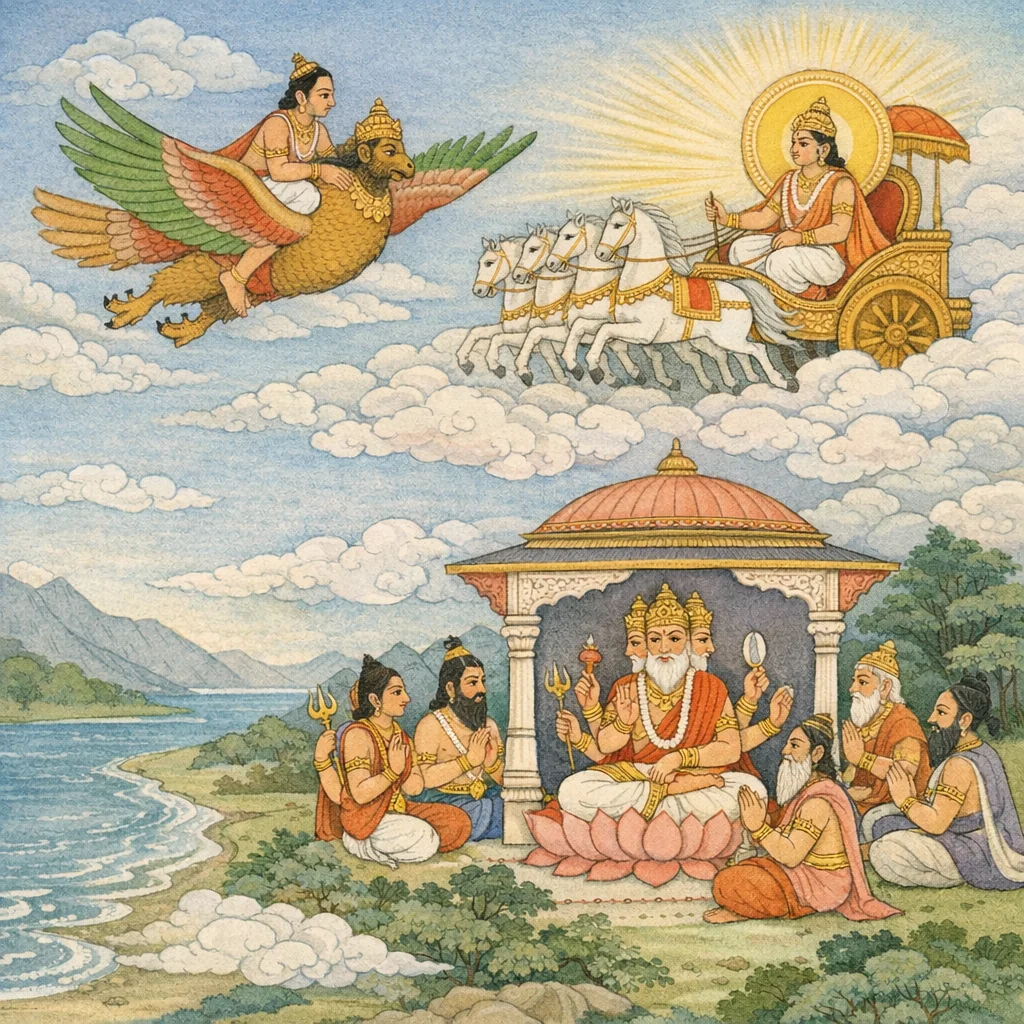
Chapter Arc: गरुड के प्रचण्ड, भीमरूप तेज से देवगण व्याकुल हो उठते हैं; स्वयं गरुड भी समझते हैं कि उनका देह-दर्शन ही भय का कारण बन रहा है। → देवताओं की घबराहट बढ़ती है और वे ब्रह्मा के पास जाकर पूछते हैं कि आज यह दाहकृत भय क्यों उत्पन्न हुआ। उधर सूर्य का क्रोधजनित तीव्र तेज लोकों को दग्ध करने को उद्यत होता है—सृष्टि-रक्षा का संकट सामने आ खड़ा होता है। → ब्रह्मा पूर्व-नियोजित उपाय प्रकट करते हैं: कश्यपपुत्र अरुण सूर्य के आगे रथ पर स्थित होकर सारथ्य करेंगे और सूर्य के दाहक तेज को शान्त/संयत करेंगे; गरुड अरुण को अपनी पीठ पर बैठाकर माता के निकट/समुद्र-तीर की ओर ले जाते हैं—उपाय क्रियान्वित होता है। → अरुण का सूर्य-रथ पर अग्रस्थित होना सूर्य के उग्र तेज को नियंत्रित करता है; लोक, ऋषि और देवगण स्वस्ति पाते हैं और दाह का भय टल जाता है। → रुरु का प्रश्न उठता है—सूर्य के मन में लोकदाह का क्रोध क्यों आया—जिससे आगे कारण-व्याख्या की भूमिका बनती है।
Shlokas
Verse 1
पम्प छा अर: 2 चतुर्विशो$ध्याय: गरुडके द्वारा अपने तेज और शरीरका संकोच तथा सूर्यके क्रोधजनित तीव्र तेजकी शान्तिके लिये अरुणका उनके रथपर स्थित होना सौतिरुवाच स श्रुत्वाथात्मनो देहं सुपर्ण: प्रेक्ष्य च स्वयम् । शरीरप्रतिसंहारमात्मन: सम्प्रचक्रमे,उग्रश्रवाजी कहते हैं--शौनकादि महर्षियो! देवताओंद्वारा की हुई स्तुति सुनकर गरुडजीने स्वयं भी अपने शरीरकी ओर दृष्टिपात किया और उसे संकुचित कर लेनेकी तैयारी करने लगे
Sauti said: Having heard the praise offered by the gods, Suparṇa (Garuḍa) looked upon his own body and then began to draw it in—preparing to restrain his vast form. The episode underscores disciplined self-control: even overwhelming power is to be governed, not displayed without measure, especially when it may disturb the cosmic order.
Verse 2
युपर्ण उवाच न मे सर्वाणि भूतानि विभियुर्देहदर्शनात् । भीमरूपात् समुद्विग्नास्तस्मात् तेजस्तु संहरे,गरुडजीने कहा--देवताओ! मेरे इस शरीरको देखनेसे संसारके समस्त प्राणी उस भयानक स्वरूपसे उद्विग्न होकर डर न जायाँ इसलिये मैं अपने तेजको समेट लेता हूँ
Yuparṇa said: “Let not all beings be frightened merely by seeing my body. Disturbed by my fearsome form, they may fall into terror; therefore I shall withdraw and restrain my radiance.”
Verse 3
सौतिरुवाच तत: कामगम: पक्षी कामवीर्यों विहंगम: । अरुणं चात्मन: पृष्ठमारोप्य स पितुर्गहात्
Sauti said: Then that bird, swift as desire itself and possessed of wish-fulfilling strength, lifted Aruṇa onto his own back and set out from his father’s house. The episode underscores purposeful action and filial responsibility: power and speed are directed not toward display, but toward carrying out a duty owed to one’s kin.
Verse 4
मातुरन्तिकमागच्छत् परं तीरं महोदथे: । उग्रश्रवाजी कहते हैं--तदनन्तर इच्छानुसार चलने तथा रुचिके अनुसार पराक्रम प्रकट करनेवाले पक्षी गरुड अपने भाई अरुणको पीठपर चढ़ाकर पिताके घरसे माताके समीप महासागरके दूसरे तटपर आये || ३ $ ।। तत्रारुणश्न निक्षिप्तो दिशं पूर्वा महाद्युति:
Then he came near his mother, reaching the farther shore of the great ocean. Ugraśravā said: Thereafter Garuḍa, the bird who moved as he willed and displayed valor as he pleased, set his brother Aruṇa upon his back, departed from his father’s house, and arrived near his mother on the ocean’s opposite bank. There he set down Aruṇa, radiant with great splendor, facing east.
Verse 5
रुरुर्वाच किमर्थ भगवान् सूर्यो लोकान् दग्धुमनास्तदा
Ruru said: “For what reason did the revered Sun, at that time, set his mind on burning the worlds?”
Verse 6
प्रमतिरुवाच चन्द्रार्काभ्यां यदा राहुराख्यातो हामृतं पिबन्,प्रमतिने कहा--अनघ! जब राहु अमृत पी रहा था, उस समय चन्द्रमा और सूर्यने उसका भेद बता दिया; इसीलिये उसने चन्द्रमा और सूर्यसे भारी वैर बाँध लिया और उन्हें सताने लगा। राहुसे पीड़ित होनेपर सूर्यके मनमें क्रोधका आवेश हुआ
Pramati said: When Rāhu, while drinking the nectar of immortality, was exposed by the Moon and the Sun, he bound a deep enmity against them. From that time he set himself to harass them. And when the Sun was afflicted by Rāhu, a surge of anger arose in him—showing how betrayal (real or perceived) can harden into lasting hostility and provoke retaliatory passion.
Verse 7
वैरानुबन्ध॑ं कृतवांश्वन्द्रादित्यौ तदानघ । वध्यमाने ग्रहेणाथ आदित्ये मन्युराविशत्,प्रमतिने कहा--अनघ! जब राहु अमृत पी रहा था, उस समय चन्द्रमा और सूर्यने उसका भेद बता दिया; इसीलिये उसने चन्द्रमा और सूर्यसे भारी वैर बाँध लिया और उन्हें सताने लगा। राहुसे पीड़ित होनेपर सूर्यके मनमें क्रोधका आवेश हुआ
Yuparṇa said: “O sinless one, because the Moon and the Sun revealed him at that time, Rahu formed a lasting enmity toward them. Thereafter, when that planet began to afflict and assail the Sun, anger surged within the Sun.”
Verse 8
सुरार्थाय समुत्पन्नो रोषो राहोस्तु मां प्रति बह्ननर्थकरं पापमेको5हं समवाप्लुयाम्,वे सोचने लगे, “देवताओंके हितके लिये ही मैंने राहुका भेद खोला था जिससे मेरे प्रति राहुका रोष बढ़ गया। अब उसका अत्यन्त अनर्थकारी परिणाम दुःखके रूपमें अकेले मुझे प्राप्त होता है
He lamented: “For the sake of the gods I revealed Rāhu’s secret, and thus Rāhu’s wrath against me only grew. Now the grievously ruinous fruit of that sin comes to me alone, as sorrow.”
Verse 9
सहाय एव कार्येषु न च कृच्छेषु दृश्यते । पश्यन्ति ग्रस्यमानं मां सहन्ते वै दिवौकस:,“संकटके अवसरोंपर मुझे अपना कोई सहायक ही नहीं दिखायी देता। देवतालोग मुझे राहुसे ग्रस्त होते देखते हैं तो भी चुपचाप सह लेते हैं
“In ordinary tasks a helper is seen, but in distress none appears. The gods look on as I am seized—as if by Rāhu—and yet they endure it in silence, offering no aid.”
Verse 10
तस्माललोकविनाशार्थ हावतिछे न संशय: । एवं कृतमति: सूर्यो हृस्तमभ्यगमद् गिरिम्,“अतः सम्पूर्ण लोकोंका विनाश करनेके लिये निःसंदेह मैं अस्ताचलपर जाकर वहीं ठहर जाऊँगा।' ऐसा निश्चय करके सूर्यदेव अस्ताचलको चले गये
“Therefore, to bring about the destruction of all the worlds—there is no doubt of it—I shall go to Mount Astācala, the setting peak, and remain there.” Having formed this resolve, the Sun-god, pleased with his decision, went toward that mountain.
Verse 11
तस्माललोकविनाशाय संतापयत भास्कर: । ततो देवानुपागम्य प्रोचुरेवं महर्षय:,और वहींसे सूर्यदेवने सम्पूर्ण जगत्का विनाश करनेके लिये सबको संताप देना आरम्भ किया। तब महर्षिगण देवताओंके पास जाकर इस प्रकार बोले--
Thus, intent on destroying the world, Bhāskara—the Sun—began to scorch all beings with oppressive heat. Then the great seers approached the gods and spoke to them as follows—
Verse 12
अद्यार्धरात्रसमये सर्वलोकभयावह: । उत्पत्स्यते महान् दाहस्त्रैलोक्यस्य विनाशन:,“देवगण! आज आधी रातके समय सब लोकोंको भयभीत करनेवाला महान् दाह उत्पन्न होगा, जो तीनों लोकोंका विनाश करनेवाला हो सकता है'
Yuparṇa said: “O gods! Tonight, at the very middle of the night, a great conflagration will arise—terrifying to all worlds—one that could bring ruin upon the three worlds.”
Verse 13
ततो देवा: सर्षिगणा उपगम्य पितामहम् । अन्रुवन् किमिवेहाद्य महद् दाहकृतं भयम्,तदनन्तर देवता ऋषियोंको साथ ले ब्रह्माजीके पास जाकर बोले--“भगवन्! आज यह कैसा महान् दाहजनित भय उपस्थित होना चाहता है? अभी सूर्य नहीं दिखायी देते तो भी ऐसी गरमी प्रतीत होती है मानो जगत॒का विनाश हो जायगा। फिर सूर्योदय होनेपर गरमी कैसी तीव्र होगी, यह कौन कह सकता है?”
Then the gods, accompanied by companies of seers, approached Pitāmaha Brahmā and said: “Blessed Lord, what is this great, fire-born terror that seems to be rising here today? Even before the sun is visible, such heat is felt as though the world were about to be destroyed. When the sun truly rises, how fierce will that heat be—who can say?”
Verse 14
न तावद् दृश्यते सूर्य: क्षयो5यं प्रतिभाति च । उदिते भगवन् भानौ कथमेतद् भविष्यति,तदनन्तर देवता ऋषियोंको साथ ले ब्रह्माजीके पास जाकर बोले--“भगवन्! आज यह कैसा महान् दाहजनित भय उपस्थित होना चाहता है? अभी सूर्य नहीं दिखायी देते तो भी ऐसी गरमी प्रतीत होती है मानो जगत॒का विनाश हो जायगा। फिर सूर्योदय होनेपर गरमी कैसी तीव्र होगी, यह कौन कह सकता है?”
Yuparṇa said: “The sun is not yet visible, and yet it feels as though destruction is at hand. O venerable one, when the blessed sun actually rises, how will this be?” Thereafter the deities, taking the ṛṣis with them, went to Brahmā and said: “Lord, what is this great, burning fear that seems about to arise today? Even without the sun appearing, such heat is felt as though the world would perish. Then at sunrise, how fierce will the heat become—who can say?”
Verse 15
पितामह उवाच एष लोकविनाशाय रविरुद्यन्तुमुद्यत: । दृश्यन्नेव हि लोकान् स भस्मराशीकरिष्यति,ब्रद्माजीने कहा--ये सूर्यदेव आज सम्पूर्ण लोकोंका विनाश करनेके लिये ही उद्यत होना चाहते हैं। जान पड़ता है, ये दृष्टिमें आते ही सम्पूर्ण लोकोंको भस्म कर देंगे
Pitāmaha said: “This Sun seems intent on rising only to bring about the destruction of the worlds. Indeed, the very moment he becomes visible, he will reduce all realms to heaps of ash.”
Verse 16
तस्य प्रतिविधानं च विहितं पूर्वमेव हि । कश्यपस्य सुतो धीमानरुणेत्यभिविश्रुत:,किंतु उनके भीषण संतापसे बचनेका उपाय मैंने पहलेसे ही कर रखा है। महर्षि कश्यपके एक बुद्धिमान पुत्र हैं, जो अरुण नामसे विख्यात हैं
“Indeed, I had already arranged the means to counteract his fierce heat. There is a wise son of the sage Kaśyapa, renowned by the name Aruṇa.”
Verse 17
महाकायो महातेजा: स स्थास्यति पुरो रवे: । करिष्यति च सारथ्यं तेजश्नलास्य हरिष्यति
The Grandsire said: “Mighty in stature and radiant in power, he will stand before the Sun. He will also undertake the office of charioteer, and by the blaze of his own splendor he will take away—i.e., eclipse—the Sun’s burning glare.”
Verse 18
प्रमतिरु्वाच ततः: पितामहाज्ञात: सर्व चक्रे तदारुण:,प्रमति कहते हैं--तत्पश्चात् पितामह ब्रह्माजीकी आज्ञासे अरुणने उस समय सब कार्य उसी प्रकार किया। सूर्य अरुणसे आवृत होकर उदित हुए। वत्स! सूर्यके मनमें क्यों क्रोधका आवेश हुआ था, इस प्रश्नके उत्तरमें मैंने ये सब बातें कही हैं
Pramati said: “Thereafter, by the command of the Pitāmaha (Brahmā), Aruṇa carried out everything as required at that time. The Sun rose, veiled by Aruṇa. Dear child, I have related all this in reply to your question about why anger surged in the Sun’s mind.”
Verse 19
उदितश्चैव सविता हारुणेन समावृत: । एतत् ते सर्वमाख्यातं यत् सूर्य मन्युराविशत्,प्रमति कहते हैं--तत्पश्चात् पितामह ब्रह्माजीकी आज्ञासे अरुणने उस समय सब कार्य उसी प्रकार किया। सूर्य अरुणसे आवृत होकर उदित हुए। वत्स! सूर्यके मनमें क्यों क्रोधका आवेश हुआ था, इस प्रश्नके उत्तरमें मैंने ये सब बातें कही हैं
And thus the Sun rose, veiled by Aruṇa. I have now told you everything in answer to your question—how it was that anger entered the Sun’s mind.
Verse 20
अरुण श्न यथैवास्य सारथ्यमकरोत् प्रभु: । भूय एवापरं प्रश्न॑ं शृणु पूर्वमुदाह्ूतम्,शक्तिशाली अरुणने सूर्यके सारथिका कार्य क्यों किया, यह बात भी इस प्रसंगमें स्पष्ट हो गयी है। अब अपने पूर्वकथित दूसरे प्रश्नका पुनः उत्तर सुनो
“How the mighty Aruṇa came to serve as his charioteer has already been made clear in this account. Now listen again to the other question you asked earlier, and to its answer.”
Verse 23
इस प्रकार श्रीमह्या भारत आदिपव॑ीके अन्तर्गत आस्तीकपरवर्में गरुडचरित्रविषयक तेईसवाँ अध्याय पूरा हुआ
Thus ends the twenty-third chapter, concerning the narrative of Garuḍa, within the Āstīka section of the Ādi Parva of the revered Mahābhārata.
Verse 24
इति श्रीमहाभारते आदिपर्वणि आस्तीकपर्वणि सौपर्णे चतुर्विशो5ध्याय:
Thus ends the twenty-fourth chapter of the Sauparṇa section within the Āstīka sub-parvan of the Ādi Parva of the sacred Mahābhārata.
Verse 46
सूर्यस्तेजोभिरत्युग्रैलोकान् दग्धुमना यदा । जब सूर्यने अपने भयंकर तेजके द्वारा सम्पूर्ण लोकोंको दग्ध करनेका विचार किया, उस समय गरुडजी महान् तेजस्वी अरुणको पुनः पूर्व दिशामें लाकर सूर्यके समीप रख आये
Yuparaṇa said: When the Sun, with his exceedingly fierce rays, conceived the intention to burn the worlds, Garuḍa—radiant with great splendor—once again brought Aruṇa to the eastern quarter and placed him close beside the Sun. The episode shows how timely, dharmic intervention can restrain destructive power and restore cosmic balance.
Verse 56
किमस्यापद्त॑ देवै्येनेमं मन्युराविशत् । रुरुने पूछा--पिताजी! भगवान् सूर्यने उस समय सम्पूर्ण लोकोंको दग्ध कर डालनेका विचार क्यों किया? देवताओंने उनका क्या हड़प लिया था, जिससे उनके मनमें क्रोधका संचार हो गया?
Yuparṇa said: “What calamity befell him, and what did the gods do, that such anger entered him? Why did the blessed Sun, at that time, conceive the thought of scorching all the worlds?”
Verse 1736
लोकानां स्वस्ति चैवं स्वाद ऋषीणां च दिवौकसाम् । उनका शरीर विशाल है। वे महान् तेजस्वी हैं। वे ही सूर्यके आगे रथपर बैठेंगे। उनके सारथिका कार्य करेंगे और उनके तेजका भी अपहरण करेंगे। ऐसा करनेसे सम्पूर्ण लोकों, ऋषि-महर्षियों तथा देवताओंका भी कल्याण होगा
Thus, may there be well-being for all the worlds, and likewise for the seers and for the dwellers in heaven (the gods). By this act, the cosmic order is protected: the welfare of beings across realms is secured, and the righteous purpose of the sages and the gods is upheld.
Frequently Asked Questions
The dilemma is how to meet urgent survival needs (food for a powerful agent on a mission) without violating categorical ethical prohibitions—specifically, the injunction against harming brāhmaṇas, framed as a non-negotiable boundary.
Capability does not license indiscriminate action: the text models dharma as constraint, requiring discernment and self-limitation even when objectives are extraordinary and the actor possesses overwhelming force.
No explicit phalaśruti is stated here; the meta-commentary is implicit through Vinatā’s normative instruction and blessings, positioning ethical restraint and protection of ritual authority as stabilizing principles within the broader epic causality.