Adhyaya 202
Sundopasundayor Digvijayaḥ — The Conquests of Sunda and Upasunda (Nārada’s Account)
Upa-parva: Sundopasunda-Upākhyāna (Episode of Sunda and Upasunda)
Nārada describes how Sunda and Upasunda, aspiring to tri-loka supremacy, consult advisors and depart with a heavily armed asura host amid victory-invocations. They move with extraordinary mobility, assault the deva abode, and overrun Indra’s sphere along with yakṣas, rākṣasas, and aerial beings; they also subdue nāgas and maritime communities. Turning to earth-wide conquest, they identify royal sages and brāhmaṇas as force-multipliers for the devas because yajñas increase divine tejas and bala. They therefore instruct their forces to eliminate sacrificers and officiants, violate āśrama sanctuaries by seizing agnihotra fires and casting them into water, and proceed without restraint. Curses pronounced by ascetics fail to take effect due to the brothers’ boon, prompting brāhmaṇas and perfected ascetics to flee. The world is portrayed as emptied and socially suspended: rites, study, commerce, agriculture, protection of cattle, marriages, and ancestral offerings cease; settlements and hermitages are devastated, and the landscape becomes strewn with remains. Cosmic observers (sun, moon, stars, and devas) are said to be distressed. Having conquered all directions through harsh action, the brothers establish an unrivaled encampment at Kurukṣetra.
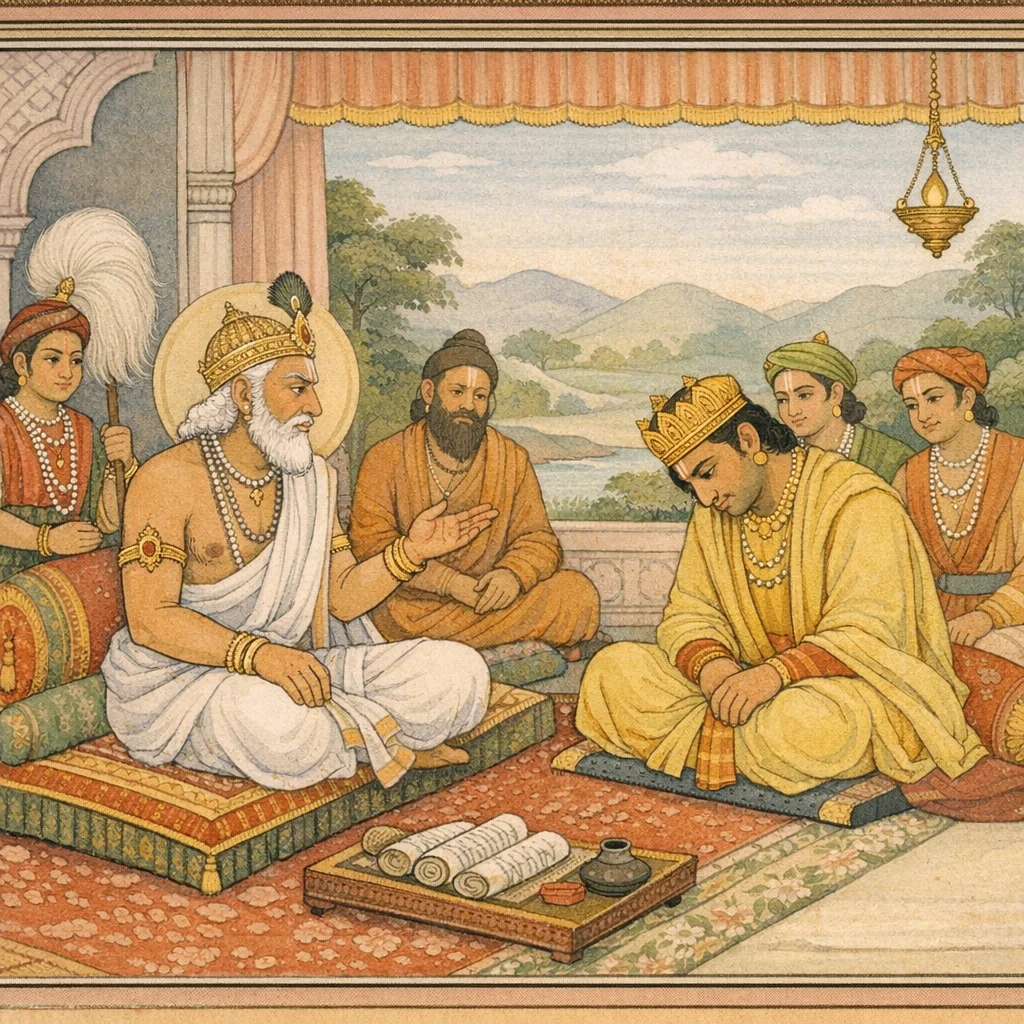
Chapter Arc: हस्तिनापुर की सभा में भीष्म धृतराष्ट्र के सामने कठोर सत्य रख देते हैं—पाण्डुपुत्रों से युद्ध उन्हें किसी भी प्रकार रुचिकर नहीं, और राज्य-नीति का मार्ग अब धर्म से ही निकलेगा। → भीष्म धृतराष्ट्र को स्मरण कराते हैं कि गान्धारी के पुत्र जैसे उनके अपने हैं, वैसे ही कुन्ती के पुत्र भी; अतः राजा का कर्तव्य दोनों पक्षों की समान रक्षा है। वे चेताते हैं कि पाण्डव जीवित हैं, पुरोचन का पापी षड्यंत्र सफल नहीं हुआ, और पाण्डवों के रहते उनका पैतृक अंश बलपूर्वक छीना नहीं जा सकता। → भीष्म निर्णायक आदेश-सा वचन देते हैं—यदि धृतराष्ट्र धर्म करना चाहते हैं, भीष्म का प्रिय चाहते हैं, और राज्य का क्षेम चाहते हैं, तो पाण्डवों को उनका ‘अर्थ’ (अधिकार/भाग) दे दिया जाए; कुरुकुलोचित धर्म का पालन कर पूर्वजों के अनुरूप आचरण किया जाए। → भीष्म का निष्कर्ष स्पष्ट है: संघर्ष नहीं, समविभाजन और संरक्षण; पाण्डवों को आधा राज्य देकर वैर की आग को शान्त करना ही राजधर्म और कुलधर्म दोनों की रक्षा है। → धृतराष्ट्र इस धर्मोपदेश को स्वीकार करेंगे या दुर्योधन-पक्ष की आसक्ति के आगे झुकेंगे—यही अनिश्चितता अगले प्रसंग की ओर धकेलती है।
Shlokas
Verse 1
अपन क्ात बछ। आर: 2 द्र्याधिकद्विशततमो< ध्याय: भीष्मकी दुर्योधनसे पाण्डवोंको आधा राज्य देनेकी सलाह भीष्म उवाच न रोचते विग्रहो मे पाण्डुपुत्रै: कथंचन । यथैव धृतराष्ट्री मे तथा पाण्डुरसंशयम्,भीष्मजी बोले--मुझे पाण्डवोंके साथ विरोध या युद्ध किसी प्रकार भी पसंद नहीं है। मेरे लिये जैसे धृतराष्ट्र हैं, वैसे ही पाण्डु--इसमें संशय नहीं है
Bhīṣma said: “I do not, in any way, approve of conflict with the sons of Pāṇḍu. To me, Dhṛtarāṣṭra is as my own, and so is Pāṇḍu—of this there is no doubt.”
Verse 2
गान्धार्याश्व यथा पुत्रास्तथा कुन्तीसुता मम । यथा च मम ते रक्ष्या धृतराष्ट्र तथा तव,धृतराष्ट्र! जैसे गान्धारीके पुत्र मेरे अपने हैं, उसी प्रकार कुन्तीके पुत्र भी हैं; इसीलिये जैसे मुझे पाण्डवोंकी रक्षा करनी चाहिये, वैसे तुम्हें भी
Bhīṣma said: “Just as the sons of Gāndhārī are my own sons, so too are Kuntī’s sons mine. Therefore, as it is my duty to protect the Pāṇḍavas, so it is yours as well, O Dhṛtarāṣṭra.”
Verse 3
यथा च मम राज्ञश्न तथा दुर्योधनस्य ते । तथा कुरूणां सर्वेषामन्येषामपि पार्थिव,भूपाल! मेरे और तुम्हारे लिये जैसे पाण्डवोंकी रक्षा आवश्यक है, वैसे ही दुर्योधन तथा अन्य समस्त कौरवोंको भी उनकी रक्षा करनी चाहिये
Bhīṣma said: “Just as protection is necessary for me and for the king, so too it is necessary for Duryodhana—and likewise for all the Kurus and the other rulers as well.”
Verse 4
एवं गते विग्रहं तैर्न रोचे संधाय वीरैदीयतामर्ध भूमि: । तेषामपीदं प्रपितामहानां राज्यं पितुश्चैव कुरूत्तमानाम्,ऐसी दशामें मैं पाण्डवोंके साथ लड़ाई-झगड़ा पसंद नहीं करता। उन वीरोंके साथ संधि करके उन्हें आधा राज्य दे दिया जाय। (दुर्योधनकी ही भाँति) उन कुरुश्रेष्ठ पाण्डवोंके भी बाप-दादोंका यह राज्य है
Bhishma said: “Since matters have come to this pass, I do not approve of conflict with those heroes. Let a settlement be made with them, and let half the land be granted. For this kingdom belongs to them as well—those foremost of the Kurus—for it is the inheritance of their forefathers and of their father.”
Verse 5
दुर्योधन यथा राज्यं त्वमिदं तात पश्यसि । मम पैतृकमित्येवं तेडपि पश्यन्ति पाण्डवा:,तात दुर्योधन! जैसे तुम इस राज्यको अपनी पैतृक सम्पत्तिके रूपमें देखते हो, उसी प्रकार पाण्डव भी देखते हैं
Bhīṣma said: “O Duryodhana, dear child, just as you look upon this kingdom as your own ancestral inheritance, in the very same way the Pāṇḍavas also regard it as theirs. Therefore, do not treat their claim as illegitimate; recognize that the dispute is between equal heirs and must be approached with fairness and restraint.”
Verse 6
यदि राज्यं न ते प्राप्ता: पाण्डवेया यशस्विन: । कुत एव तवापीदं भारतस्यापि कस्यचित्,यदि यशस्वी पाण्डव इस राज्यको नहीं पा सकते तो तुम्हें अथवा भरतवंशके किसी अन्य पुरुषको भी वह कैसे प्राप्त हो सकता है?
Bhishma said: If the illustrious sons of Pandu cannot obtain the kingdom, then how could you—or indeed any other man of the Bharata line—ever obtain it? The statement underscores that rightful sovereignty is grounded in merit, legitimacy, and dharma, not merely in desire or force.
Verse 7
अधर्मेण च राज्यं त्वं प्राप्तवान् भरतर्षभ | तेडपि राज्यमनुप्राप्ता: पूर्वमेवेति मे मति:,भरतश्रेष्ठ! तुमने अधर्मपूर्वक इस राज्यको हथिया लिया है; परंतु मेरा विचार यह है कि तुमसे पहले ही वे भी इस राज्यको पा चुके थे
Bhīṣma said: “O bull among the Bharatas, you have obtained the kingdom through unrighteous means. Yet my considered view is this: even they had already come into possession of that very kingdom before you.”
Verse 8
मधुरेणैव राज्यस्य तेषामर्ध प्रदीयताम् एतद्धि पुरुषव्यात्र हितं सर्वजनस्य च,पुरुषसिंह! प्रेमपूर्वक ही उन्हें आधा राज्य दे दो। इसीमें सब लोगोंका हित है
Bhīṣma said: “With conciliatory words, grant them half of the kingdom. O tiger among men, this course truly serves the welfare of all people.”
Verse 9
अतो<न्न्यथा चेत् क्रियते न हितं नो भविष्यति । तवाप्यकीर्ति: सकला भविष्यति न संशय:,यदि इसके विपरीत कुछ किया जायगा तो हमारी भलाई नहीं हो सकती और तुम्हें भी पूरा-पूरा अपयश मिलेगा--इसमें संशय नहीं है
Therefore, if anything is done otherwise than what is proper, it will not lead to our welfare. And you too will incur complete disgrace—of this there is no doubt.
Verse 10
कीर्तिरक्षणमातिष्ठ कीर्तिहि परमं बलम् । नष्टकीर्तेर्मनुष्यस्य जीवितं हाूफलं स्मृतम्,अतः अपनी कीर्तिकी रक्षा करो, कीर्ति ही श्रेष्ठ बल है; जिसकी कीर्ति नष्ट हो जाती है, उस मनुष्यका जीवन निष्फल माना गया है
Bhishma said: “Take up the safeguarding of your good name; for reputation is indeed the highest strength. For the life of a person whose fame has been ruined is remembered as fruitless.”
Verse 11
यावत्कीर्तिर्मिनुष्यस्य न प्रणश्यति कौरव । तावज्जीवति गान्धारे नष्टकीर्तिस्तु नश्यति,गन्धारीनन्दन! कुरुश्रेष्ठ! मनुष्यकी कीर्ति जबतक नष्ट नहीं होती, तभीतक वह जीवित है; जिसकी कीर्ति नष्ट हो गयी, उसका तो जीवन ही नष्ट हो जाता है
Bhīṣma said: “O Kaurava, as long as a man’s good fame does not perish, so long he is truly alive. But when one’s reputation is ruined, he is as good as destroyed—even while breathing.”
Verse 12
तमिमं समुपातिष्ठ धर्म कुरुकुलोचितम् । अनुरूप महाबाहो पूर्वेषामात्मन: कुरु,महाबाहो! कुरुकुलके लिये उचित इस उत्तम धर्मका पालन करो। अपने पूर्वजोंके अनुरूप कार्य करते रहो
Bhīṣma said: “Uphold this very dharma—noble and fitting for the Kuru lineage. O mighty-armed one, act in a way that accords with your forefathers; keep your conduct aligned with the ancestral standard of righteousness.”
Verse 13
दिष्टया प्रियन्ते पार्था हि दिष्टया जीवति सा पृथा । दिष्टया पुरोचन: पापो न सकामोत्ययं गत:,सौभाग्यकी बात है कि कुन्तीके पुत्र जीवित हैं; यह भी सौभाग्यकी ही बात है कि कुन्ती भी मरी नहीं है और सबसे बड़े सौभाग्यका विषय यह है कि पापी पुरोचन अपने (बुरे) इरादेमें सफल न होकर स्वयं नष्ट हो गया
Bhīṣma said: “By good fortune the sons of Pṛthā (Kuntī) are safe and well; by good fortune Pṛthā herself still lives. And greatest of all is this good fortune: the sinful Purocana, failing to accomplish his wicked design, has perished himself.”
Verse 14
यदा प्रभृति दग्धास्ते कुन्तिभोजसुतासुता: । तदा प्रभृति गान्धारे न शक््नोम्यभिवीक्षितुम्,गान्धारीकुमार! जबसे मैंने सुना कि कुन्तीके पुत्र लाक्षागृहकी आगमें जल गये तथा कुन्ती भी उसी अवस्थाको प्राप्त हुई है, तभीसे मैं (लज्जाके मारे) जगत॒के किसी भी प्राणीकी ओर आँख उठाकर देख नहीं सकता था। नरश्रेष्ठ] लोग इस कार्यके लिये पुरोचनको उतना दोषी नहीं मानते, जितना तुम्हें दोषी समझते हैं
Bhishma said: “From the moment I heard that the sons of Kunti—born of Kuntibhoja’s line—had been burned in the fire of the lac-house, and that Kunti too had met the same fate, from that very time I have been unable, out of shame, to raise my eyes and look upon any living being. The noble regard Purochana as not so culpable in this deed as they hold you to be, O prince of Gandhara.”
Verse 15
लोके प्राणभृतां कंचिच्छुत्वा कुन्तीं तथागताम् । न चापि दोषेण तथा लोको मन्येत् पुरोचनम् | यथा त्वां पुरुषव्यात्र लोको दोषेण गच्छति,गान्धारीकुमार! जबसे मैंने सुना कि कुन्तीके पुत्र लाक्षागृहकी आगमें जल गये तथा कुन्ती भी उसी अवस्थाको प्राप्त हुई है, तभीसे मैं (लज्जाके मारे) जगत॒के किसी भी प्राणीकी ओर आँख उठाकर देख नहीं सकता था। नरश्रेष्ठ] लोग इस कार्यके लिये पुरोचनको उतना दोषी नहीं मानते, जितना तुम्हें दोषी समझते हैं
Bhishma said: “After hearing that Kunti and her sons had perished in the fire of the lac-house, I could not raise my eyes to look upon any living being in the world, overcome with shame. Yet people do not blame Purocana for that deed as much as they blame you, O tiger among men, son of Gandhari.”
Verse 16
तदिदं जीवित तेषां तव किल्बिषनाशनम् । सम्मन्तव्यं महाराज पाण्डवानां च दर्शनम्,अतः महाराज! पाण्डवोंका यह जीवित रहना और उनका दर्शन होना वास्तवमें तुम्हारे ऊपर लगे हुए कलंकका नाश करनेवाला है, ऐसा मानना चाहिये
Bhishma said: “Indeed, the very survival of those Pāṇḍavas—and also the fact that you behold them—should be regarded, O great king, as something that destroys the stain of wrongdoing upon you.”
Verse 17
न चापि तेषां वीराणां जीवतां कुरुनन्दन । पित्र्यों$श: शक्य आदातुमपि वज्रभूता स्वयम्,कुरुनन्दन! पाण्डववीरोंके जीते-जी उनका पैतृक अंश साक्षात् वज्रधारी इन्द्र भी नहीं ले सकते
Bhishma said: “O joy of the Kurus, while those heroic men are still alive, their paternal share cannot be taken away. Even if Indra himself—wielder of the thunderbolt—were to stand against them, he could not seize what is rightfully theirs.”
Verse 18
ते सर्वेडवस्थिता धर्मे सर्वे चैवैकचेतस: । अधर्मेण निरस्ताश्च तुल्ये राज्ये विशेषत:,वे सब धर्ममें स्थित हैं; उन सबका एक चित्त--एक विचार है। इस राज्यपर तुम्हारा और उनका समान स्वत्व है, तो भी उनके साथ विशेष अधर्मपूर्ण बर्ताव करके उन्हें यहाँसे हटाया गया है
They all stand established in dharma, and all are of one mind. In this kingdom, your claim and theirs are equal; yet they have been driven out from here by conduct that is especially unrighteous, contrary to dharma.
Verse 19
यदि धर्मस्त्वया कार्यो यदि कार्य प्रियं च मे । क्षेमं च यदि कर्तव्यं तेषामर्थ प्रदीयताम्,यदि तुम्हें धर्मके अनुकूल चलना है, यदि मेरा प्रिय करना है और यदि (संसारमें) भलाई करनी है, तो उन्हें आधा राज्य दे दो
Bhishma said: “If you truly intend to act in accordance with dharma, if you wish to do what is dear to me, and if you seek the welfare of the world, then grant them their due share of the kingdom.”
Verse 201
इस प्रकार श्रीमहाभारत आदिपर्वके अन्तर्गत विदुरागमन-राज्यलम्भपर्वमें धुतराष्ट्रगनत्रणासम्बन्धी दो सौ पहला अध्याय पूरा हुआ
Thus ends the two-hundred-and-first chapter of the Ādi Parva of the Śrī Mahābhārata, within the section concerning Vidura’s arrival and the gaining of the kingdom, dealing with Dhṛtarāṣṭra’s protection and safeguarding.
Verse 202
इति श्रीमहा भारते आदिपर्वणि विदुरागमनराज्यलम्भपर्वणि भीष्मवाक्ये दयधिकद्वधिशततमो<ध्याय:
Thus ends the two-hundred-and-second chapter in the Ādi Parva of the Śrī Mahābhārata, within the section titled “Vidura’s Arrival and the Attainment of the Kingdom,” in the portion known as “Bhīṣma’s Speech.”
Frequently Asked Questions
The chapter frames a dharma-crisis where power seeks total sovereignty while recognizing that ritual and learning sustain divine order; the ethical tension lies in targeting social benefactors (kings and brāhmaṇas performing yajña) to weaken a rival polity.
Institutional supports—sacrifice, study, protected ascetic spaces, and civic exchange—are portrayed as collective stabilizers; when coercive actors dismantle them, disorder propagates across social, ecological, and even cosmic registers.
No explicit phalaśruti is stated in this passage; the meta-function is exemplary, using Nārada’s narration to document how boon-backed impunity can neutralize customary restraints (including curses) and thereby magnify systemic harm.