Adhyaya 11
Ruru–Ḍuṇḍubha Saṃvāda: Śāpa, Mokṣa, and Ahiṃsā-Upadeśa (Chapter 11)
Upa-parva: Āstīka Upākhyāna (Sarpa-satra Context)
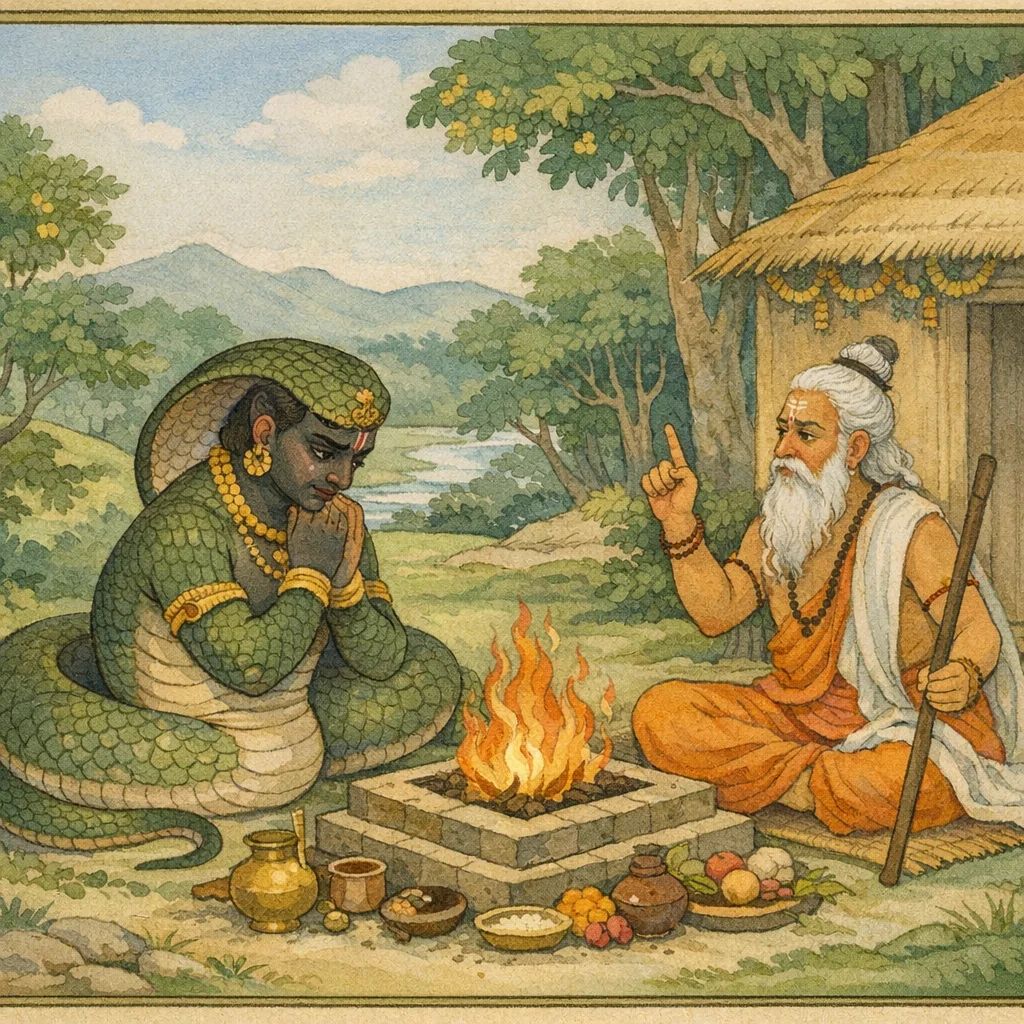
This chapter presents a didactic dialogue framed as Ḍuṇḍubha’s recollection. A prior friendship is described between Ḍuṇḍubha and a dvija named Khagama, characterized by ascetic strength and disciplined speech. During childhood play, Ḍuṇḍubha fashions a mock serpent and frightens Khagama while he is engaged in agnihotra; the shock causes Khagama to lose composure. Regaining consciousness, the ascetic utters a curse: as Ḍuṇḍubha made a serpent of fearful potency, so will Ḍuṇḍubha become a serpent-like being through the ascetic’s anger. Ḍuṇḍubha, aware of tapas-power, apologizes with folded hands and requests reversal; Khagama asserts the irreversibility of truthful speech but provides a conditional release: the curse will be lifted upon encountering Ruru, the pure son of Pramati. The narrative then identifies the listener as that very Ruru and transitions into ethical instruction: ahiṃsā is declared the highest dharma for all beings; the brāhmaṇa ideal is gentleness and fearlessness-giving; brahmin dharma is defined as ahiṃsā, truth, and forgiveness, even surpassing mere Vedic retention. By contrast, kṣatriya dharma is described as coercive authority and protection. The chapter foreshadows the Janamejaya episode by referencing prior serpent-harm and subsequent rescue through the brahmin Āstīka at the sarpa-satra, positioning the present instruction as a corrective to violence justified by duty.
Chapter Arc: डुण्डुभ (सहस्रपाद) अपनी आत्मकथा सुनाता है—कैसे एक बाल-लीला में हुई भूल ने उसे भय और शाप के द्वार पर ला खड़ा किया। → बाल्यावस्था में खेलते हुए डुण्डुभ ने अनजाने में तपस्वी ब्राह्मण ‘खगम’ के अग्निहोत्र में विघ्न डाला; तपोधन क्रोध से दग्ध-सा होकर शाप देने को उद्यत हुआ। डुण्डुभ भयभीत होकर क्षमा और शाप-निवृत्ति की याचना करता है। → खगम शाप को पूर्णतः लौटाता नहीं, पर धर्म-उपदेश देकर शाप का अर्थ बदल देता है—अहिंसा, प्राणियों को अभय, और वर्णधर्म की मर्यादा का प्रतिपादन करते हुए रुरु को हिंसा से विरत करने की दिशा में निर्णायक वचन कहे जाते हैं। → उपदेश के बाद खगम डुण्डुभ-रूप का परित्याग कर पुनः अपने तेजस्वी स्वरूप को प्राप्त होता है; कथा का निष्कर्ष रुरु के लिए नैतिक निर्देश बनता है—ब्राह्मण का धर्म वेद-धारण व अभयदान, और क्षत्रिय का दण्ड-धारण व प्रजा-पालन। → रुरु के सामने प्रश्न शेष रहता है—वह अपने क्रोध/प्रतिशोध को धर्म-सीमा में कैसे बाँधे, और अहिंसा को व्यवहार में कैसे उतारे?
Shlokas
Verse 1
अपन बछ। ] अतिफऑशाए:< एकादशोब< ध्याय: डुण्डुभकी आत्मकथा तथा उसके द्वारा रुकुको अहिंसाका उपदेश डुण्ड्रुभ उवाच सखा बभूव मे पूर्व खगमो नाम वै द्विज: । भृशं संशितवाक् तात तपोबलसमन्वित:,डुण्डुभने कहा--तात! पूर्वकालमें खगम नामसे प्रसिद्ध एक ब्राह्मण मेरा मित्र था। वह महान् तपोबलसे सम्पन्न होकर भी बहुत कठोर वचन बोला करता था। एक दिन वह अन्निहोत्रमें लगा था। मैंने खिलवाड़में तिनकोंका एक सर्प बनाकर उसे डरा दिया। वह भयके मारे मूर्च्छित हो गया
Duṇḍrubha said: “Dear one, long ago I had a friend—a brahmin named Khagama. Though endowed with the power born of austerities, he was exceedingly sharp-tongued and spoke harshly.”
Verse 2
स मया क्रीडता बाल्ये कृत्वा तार्ण भुजज्रमम् । अगन्निहोत्रे प्रसक्तस्तु भीषित: प्रमुमोह वै,डुण्डुभने कहा--तात! पूर्वकालमें खगम नामसे प्रसिद्ध एक ब्राह्मण मेरा मित्र था। वह महान् तपोबलसे सम्पन्न होकर भी बहुत कठोर वचन बोला करता था। एक दिन वह अन्निहोत्रमें लगा था। मैंने खिलवाड़में तिनकोंका एक सर्प बनाकर उसे डरा दिया। वह भयके मारे मूर्च्छित हो गया
When I was a child at play, I fashioned a snake from blades of grass and frightened him. Absorbed in the Agnihotra rite, he was seized by terror and truly fainted. Thus is it shown how heedless sport can turn to harm when aimed at one engaged in sacred duty.
Verse 3
लब्ध्वा स च पुन: संज्ञां मामुवाच तपोधन: । निर्दहन्निव कोपेन सत्यवाक् संशितव्रत:,फिर होशमें आनेपर वह सत्यवादी एवं कठोरव्रती तपस्वी मुझे क्रोधसे दग्ध-सा करता हुआ बोला--
When he regained consciousness, that ascetic—abounding in the power of austerity, truthful in speech, and steadfast in his vows—addressed me as though scorching me with the heat of his anger.
Verse 4
यथावीर्यस्त्वया सर्प: कृतो5यं मद्बिभीषया । तथावीर्यों भुजड़स्त्वं मम शापाद् भविष्यसि,“अरे! तूने मुझे डरानेके लिये जैसा अल्प शक्तिवाला सर्प बनाया था, मेरे शापवश ऐसा ही अल्पशक्तिसम्पन्न सर्प तुझे भी होना पड़ेगा”
Ḍuṇḍrubha said: “Just as you made this serpent weak in power in order to frighten me, so too—by my curse—you yourself shall become a serpent of the same diminished strength.”
Verse 5
तस्याहं तपसो वीर्य जानन्नासं तपोधन । भृशमुद्विग्नह्ददयस्तमवोचमहं तदा,तपोधन! मैं उसकी तपस्याका बल जानता था, अतः मेरा हृदय अत्यन्त उद्विग्न हो उठा और बड़े वेगसे उसके चरणोंमें प्रणाम करके, हाथ जोड़, सामने खड़ा हो, उस तपोधनसे बोला--सखे! मैंने परिहासके लिये सहसा यह कार्य कर डाला है। ब्रह्मन! इसके लिये क्षमा करो और अपना यह शाप लौटा लो। मुझे अत्यन्त घबराया हुआ देखकर सम्भ्रममें पड़े हुए उस तपस्वीने बार-बार गरम साँस खींचते हुए कहा--“मेरी कही हुई यह बात किसी प्रकार झूठी नहीं हो सकती”
I knew, O treasure of austerity, the potency of his penance; therefore my heart was sorely shaken, and at that moment I spoke to him.
Verse 6
प्रणत: सम्भ्रमाच्चैव प्राउ्जलि: पुरत: स्थित: । सखेति सहसेदं ते नर्मार्थ वै कृतं मया,तपोधन! मैं उसकी तपस्याका बल जानता था, अतः मेरा हृदय अत्यन्त उद्विग्न हो उठा और बड़े वेगसे उसके चरणोंमें प्रणाम करके, हाथ जोड़, सामने खड़ा हो, उस तपोधनसे बोला--सखे! मैंने परिहासके लिये सहसा यह कार्य कर डाला है। ब्रह्मन! इसके लिये क्षमा करो और अपना यह शाप लौटा लो। मुझे अत्यन्त घबराया हुआ देखकर सम्भ्रममें पड़े हुए उस तपस्वीने बार-बार गरम साँस खींचते हुए कहा--“मेरी कही हुई यह बात किसी प्रकार झूठी नहीं हो सकती”
Overcome with alarm, he bowed down, and with palms joined stood before him. Addressing him as a friend, he said: “O treasure of austerity, I did this to you on a sudden, merely in jest. I knew the power of your penance, and therefore my heart has been deeply shaken. Forgive me, O brāhmaṇa, and withdraw your curse.” Yet the ascetic, disturbed and breathing hotly again and again, replied that the word he had spoken could not, in any way, become false.
Verse 7
क्षन्तुमर्हसि मे ब्रह्मनू शापो5यं विनिवर्त्यताम् | सो<थ मामब्रवीद् दृष्टवा भृशमुद्धिग्नचेतसम्,तपोधन! मैं उसकी तपस्याका बल जानता था, अतः मेरा हृदय अत्यन्त उद्विग्न हो उठा और बड़े वेगसे उसके चरणोंमें प्रणाम करके, हाथ जोड़, सामने खड़ा हो, उस तपोधनसे बोला--सखे! मैंने परिहासके लिये सहसा यह कार्य कर डाला है। ब्रह्मन! इसके लिये क्षमा करो और अपना यह शाप लौटा लो। मुझे अत्यन्त घबराया हुआ देखकर सम्भ्रममें पड़े हुए उस तपस्वीने बार-बार गरम साँस खींचते हुए कहा--“मेरी कही हुई यह बात किसी प्रकार झूठी नहीं हो सकती”
Ḍuṇḍrubha said: “O Brahmin, forgive me; let this curse be withdrawn.” Then, seeing my heart greatly shaken, he spoke to me. The scene reveals the moral weight of speech: a rash deed done in jest can draw a grave reply, and once an ascetic has uttered a vow-like word or a curse, it is not easily recalled.
Verse 8
मुहुरुष्णं विनि:श्वस्य सुसम्भ्रान्तस्तपोधन: । नानृतं वै मया प्रोक्त भवितेद॑ं कथंचन,तपोधन! मैं उसकी तपस्याका बल जानता था, अतः मेरा हृदय अत्यन्त उद्विग्न हो उठा और बड़े वेगसे उसके चरणोंमें प्रणाम करके, हाथ जोड़, सामने खड़ा हो, उस तपोधनसे बोला--सखे! मैंने परिहासके लिये सहसा यह कार्य कर डाला है। ब्रह्मन! इसके लिये क्षमा करो और अपना यह शाप लौटा लो। मुझे अत्यन्त घबराया हुआ देखकर सम्भ्रममें पड़े हुए उस तपस्वीने बार-बार गरम साँस खींचते हुए कहा--“मेरी कही हुई यह बात किसी प्रकार झूठी नहीं हो सकती”
Breathing out hot sighs again and again, the ascetic—deeply agitated—declared: “What I have spoken is certainly not untrue; this will not turn out otherwise in any way.” The moment underscores that a disciplined ascetic’s word is treated as irrevocable: even when provoked by a prank, its consequence is held to stand.
Verse 9
यत्तु वक्ष्यामि ते वाक््यं शृणु तन्मे तपोधन । श्रुत्वा च हृदि ते वाक्यमिदमस्तु सदानघ,“निष्पाप तपोधन! इस समय मैं तुमसे जो कुछ कहता हूँ, उसे सुनो और सुनकर अपने हृदयमें सदा धारण करो
Ḍuṇḍrubha said: “O treasure of austerity, listen to the words I am about to speak to you. Having heard them, keep this counsel always in your heart, O ever-blameless one.”
Verse 10
उत्पत्स्यति रुरुर्नाम प्रमतेरात्मज: शुचि: । त॑ दृष्टवा शापमोक्षस्ते भविता नचिरादिव,“भविष्यमें महर्षि प्रमतिके पवित्र पुत्र रुरु उत्पन्न होंगे, उनका दर्शन करके तुम्हें शीघ्र ही इस शापसे छुटकारा मिल जायगा'
Ḍuṇḍrubha said: “In time, a pure son of the sage Pramati will be born, named Ruru. Upon seeing him, you will soon be released from this curse.” The verse frames liberation not as random fortune but as a morally ordered consequence: the curse has a destined end, and the sight of a virtuous person becomes the occasion for restoration.
Verse 11
स त्वं रुुरिति ख्यात: प्रमतेरात्मजोडपि च । स्वरूपं प्रतिपद्याहमद्य वक्ष्यामि ते हितम्,जान पड़ता है तुम वही रुरु नामसे विख्यात महर्षि प्रमतिके पुत्र हो। अब मैं अपना स्वरूप धारण करके तुम्हारे हितकी बात बताऊँगा
“You are indeed the one famed as Ruru, the son of Pramati. Now, assuming my own true form, I shall tell you today what is for your welfare.”
Verse 12
स डौण्डुभं परित्यज्य रूपं विप्रर्षभस्तदा । स्वरूपं भास्वरं भूय: प्रतिपेदे महायशा:,इतना कहकर महायशस्वी विप्रवर सहस्रपादने डुण्डुभका रूप त्यागकर पुनः अपने प्रकाशमान स्वरूपको प्राप्त कर लिया। फिर अनुपम ओजवाले रुरुसे यह बात कही --'समस्त प्राणियोंमें श्रेष्ठ ब्राह्मण! अहिंसा सबसे उत्तम धर्म है
Having thus spoken, the illustrious bull among Brahmins abandoned the form of Dauṇḍubha and once again regained his own radiant, original nature. In the surrounding narrative, this transformation frames an ethical instruction: the highest dharma is non-violence (ahiṃsā), addressed to a foremost Brahmin as a guiding principle for conduct toward all beings.
Verse 13
इदं चोवाच वचन रुरुमप्रतिमौजसम् | अहिंसा परमो धर्म: सर्वप्राणभूतां वर,इतना कहकर महायशस्वी विप्रवर सहस्रपादने डुण्डुभका रूप त्यागकर पुनः अपने प्रकाशमान स्वरूपको प्राप्त कर लिया। फिर अनुपम ओजवाले रुरुसे यह बात कही --'समस्त प्राणियोंमें श्रेष्ठ ब्राह्मण! अहिंसा सबसे उत्तम धर्म है
Then he spoke these words to Ruru, whose energy was incomparable: “O best among all living beings, non-violence is the highest dharma.” In the narrative frame, the illustrious brahmin—who had assumed the form of the drum-like creature Dundubha—relinquishes that guise and returns to his radiant true form, and then instructs Ruru with this ethical maxim.
Verse 14
तस्मात् प्राणभूत:ः सर्वान् न हिंस्याद् ब्राह्मण: क्वचित् | ब्राह्मण: सौम्य एवेह भवतीति परा श्रुति:,“अतः ब्राह्मणको समस्त प्राणियोंमेंसे किसीकी कभी और कहीं भी हिंसा नहीं करनी चाहिये। ब्राह्मण इस लोकमें सदा सौम्य स्वभावका ही होता है, ऐसा श्रुतिका उत्तम वचन है
Therefore a brāhmaṇa should never, at any time or in any place, do harm to any living being. A brāhmaṇa in this world is ever of gentle nature—so declares the highest utterance of the Śruti.
Verse 15
वेदवेदाड़विन्नाम सर्वभूताभयप्रद: । अहिंसा सत्यवचन क्षमा चेति विनिश्चितम्,“वह वेद-वेदांगोंका विद्वान् और समस्त प्राणियोंको अभय देनेवाला होता है। अहिंसा, सत्यभाषण, क्षमा और वेदोंका स्वाध्याय निश्चय ही ये ब्राह्मणके उत्तम धर्म हैं। क्षत्रियका जो धर्म है वह तुम्हारे लिये अभीष्ट नहीं है
Ḍuṇḍubha said: “A true knower of the Vedas and the Vedāṅgas is one who grants fearlessness to all living beings. Non-violence, truthful speech, and forbearance—these, along with disciplined study of the Vedas—are firmly established as the highest duties of a brāhmaṇa. The warrior’s code is not what is fitting for you at present.”
Verse 16
ब्राह्मणस्य परो धर्मो वेदानां धारणापि च । क्षत्रियस्य हि यो धर्म: स हि नेष्येत वै तव,“वह वेद-वेदांगोंका विद्वान् और समस्त प्राणियोंको अभय देनेवाला होता है। अहिंसा, सत्यभाषण, क्षमा और वेदोंका स्वाध्याय निश्चय ही ये ब्राह्मणके उत्तम धर्म हैं। क्षत्रियका जो धर्म है वह तुम्हारे लिये अभीष्ट नहीं है
Ḍuṇḍubha said: “For a brāhmaṇa, the highest duty is the preservation and study of the Vedas. The duty that belongs to a kṣatriya is not what should be pursued by you.” In ethical terms, the speaker draws a clear boundary between vocations: the brāhmaṇa’s path is grounded in learning, restraint, truthfulness, forbearance, and non-violence, whereas the kṣatriya’s path centers on force and combat—unsuitable here for one committed to Vedic discipline and the protection of beings through moral conduct.
Verse 17
दण्डधारणमुग्रत्वं प्रजानां परिपालनम् | तदिदं क्षत्रियस्यासीत् कर्म वै शृणु मे रुरो,“रुरो! दण्डधारण, उमग्रता और प्रजापालन--ये सब क्षत्रियोंके कर्म रहे हैं। मेरी बात सुनो, पहले राजा जनमेजयके यज्ञमें सर्पोकी बड़ी भारी हिंसा हुई। द्विजश्रेष्ठ) फिर उसी सर्पसत्रमें तपस्याके बल-वीर्यसे सम्पन्न, वेद वेदांगोंके पारंगत विद्वान् विप्रवर आस्तीक नामक ब्राह्मणके द्वारा भयभीत सर्पोंकी प्राणरक्षा हुई!
“Ruru, listen to me. The bearing of the rod of punishment, stern strength, and the protection of the people—these indeed are the proper duties of a kṣatriya. And know this: earlier, in King Janamejaya’s sacrifice, there was a vast slaughter of serpents; yet in that very serpent-sacrifice, the terrified serpents’ lives were saved through the power of austerity by the eminent Brahmin Āstīka, accomplished in the Vedas and their auxiliaries.”
Verse 18
जनमेजयस्य यज्ञेडस्मिन् सर्पाणां हिंसनं पुरा । परित्राणं च भीतानां सर्पाणां ब्राह्मणादपि,“रुरो! दण्डधारण, उमग्रता और प्रजापालन--ये सब क्षत्रियोंके कर्म रहे हैं। मेरी बात सुनो, पहले राजा जनमेजयके यज्ञमें सर्पोकी बड़ी भारी हिंसा हुई। द्विजश्रेष्ठ) फिर उसी सर्पसत्रमें तपस्याके बल-वीर्यसे सम्पन्न, वेद वेदांगोंके पारंगत विद्वान् विप्रवर आस्तीक नामक ब्राह्मणके द्वारा भयभीत सर्पोंकी प्राणरक्षा हुई!
Ḍuṇḍrubha said: “In this very sacrifice of King Janamejaya, long ago, there was a terrible slaughter of serpents. Yet even there, the frightened serpents found protection—rescued by a Brahmin as well.”
Verse 19
तपोवीर्यबलोपेताद वेदवेदाड़पारगात् । आस्तीकाद् द्विजमुख्याद् वै सर्पसत्रे द्विजोत्तम,“रुरो! दण्डधारण, उमग्रता और प्रजापालन--ये सब क्षत्रियोंके कर्म रहे हैं। मेरी बात सुनो, पहले राजा जनमेजयके यज्ञमें सर्पोकी बड़ी भारी हिंसा हुई। द्विजश्रेष्ठ) फिर उसी सर्पसत्रमें तपस्याके बल-वीर्यसे सम्पन्न, वेद वेदांगोंके पारंगत विद्वान् विप्रवर आस्तीक नामक ब्राह्मणके द्वारा भयभीत सर्पोंकी प्राणरक्षा हुई! इति श्रीमहाभारते आदिपर्वणि पौलोमपर्वणि डुण्डुभशापमोक्षे एकादशो<ध्याय: ।। १२२ || इस प्रकार श्रीमह्याभारत आदिपर्वके अन्तर्गत पौलोगपर्वमें डुण्ड्रुभशापमोक्षविषयक ग्यारहवाँ अध्याय पूरा हुआ
“O best of Brahmins! In that great Snake-sacrifice, it was the eminent Brahmin Āstīka—endowed with the power born of austerity, and fully versed in the Vedas and their auxiliaries—who became the means of saving the lives of the terrified serpents. Thus, even when violence is unleashed in the name of ritual or royal resolve, spiritual authority grounded in learning and tapas can intervene to restore protection and restraint.”
Frequently Asked Questions
The chapter stages a dharma-sankat between harm done in play and the real consequences of ascetic speech-power: a minor act of frightening becomes morally weighty when it disrupts ritual focus, leading to a curse that cannot be casually withdrawn.
Ahiṃsā is presented as the highest norm for all beings, with brāhmaṇa duty explicitly tied to non-injury, truth, and forgiveness; the text also distinguishes this from kṣatriya governance duties, framing protection and restraint as the proper boundary of power.
No explicit phalaśruti formula appears here; instead, the chapter offers functional meta-ethical framing by linking the immediate instruction on ahiṃsā and role-dharma to later large-scale consequences (the sarpa-satra and Āstīka’s intervention), implying interpretive value through narrative foreshadowing rather than stated merit.