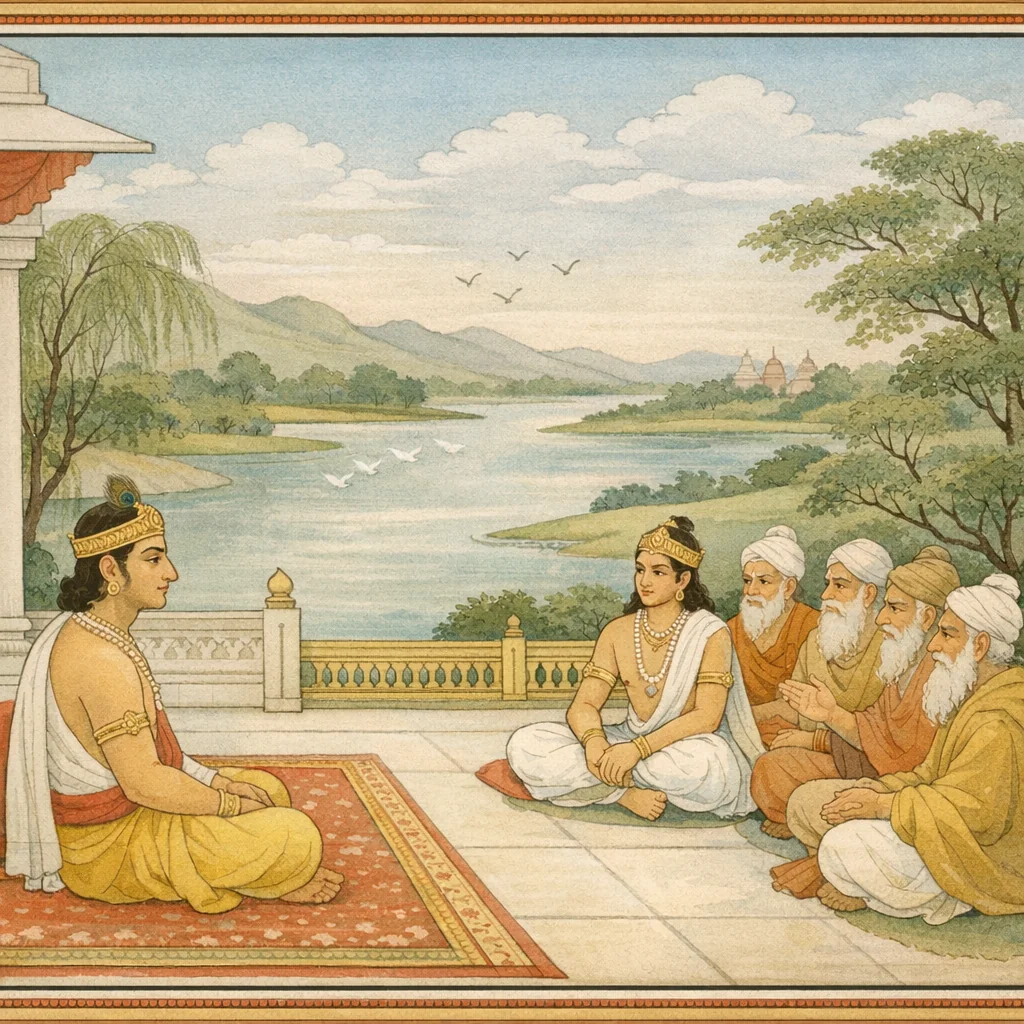
Adhyaya 101
Āṇīmāṇḍavya–Upākhyāna (The Account of Āṇīmāṇḍavya and the Birth of Vidura)
Upa-parva: Āṇīmāṇḍavya–Dharmaśāpa (Episode of Māṇḍavya and the Curse of Dharma)
Janamejaya asks what act caused Dharma to incur a curse and be born in a śūdra womb. Vaiśaṃpāyana recounts the renowned brāhmaṇa ascetic Māṇḍavya, steadfast in truth and tapas, observing silence at his hermitage. Thieves pursued by royal guards hide stolen goods in his dwelling; when questioned, he gives no reply due to his vow. The guards discover the goods, suspect the ascetic, and report to the king, who orders punishment alongside the thieves. Māṇḍavya is impaled but does not die, sustaining life through ascetic power; other sages are distressed. The king later seeks forgiveness and has him taken down, but the stake’s tip remains lodged within him; he becomes known as Āṇīmāṇḍavya. He then confronts Dharma, questioning the disproportionate result of an unknown offense. Dharma explains the cause: as a child, Māṇḍavya had pierced insects’ tails with a blade of grass. Māṇḍavya condemns the excess of punishment for a minor act, curses Dharma to be born as a human in a śūdra lineage, and establishes a normative boundary: before the age of fourteen, acts should not be treated as full moral transgressions in the same way. The narration closes by identifying Dharma’s birth as Vidura, characterized by competence in dharma and artha, freedom from greed and anger, and commitment to Kuru welfare.
Chapter Arc: Sauti’s narration turns to the Bharata throne’s luminous pillar—King Shantanu—whose very body and conduct are described as omens of royal fortune. → A cascade of praises builds: Shantanu’s self-mastery, generosity, forbearance, intellect, and splendor; his perfect kingly marks and lion-like vigor. Yet beneath the eulogy runs an anxious subtext—dynasty depends on heirs, and a single son is a fragile lamp in a storm. → The chapter’s heart tightens around lineage and succession: the fear of calamity befalling Ganga’s son (Devavrata) and the stark maxim that one child scarcely equals true posterity—pressing the royal house toward fateful decisions. → The narrative settles into a clear portrait of Shantanu as dharma- and artha-skilled protector of all, while the court’s attention fixes on marriage, progeny, and the worthiness of alliances (with Satyavati looming in the background). → The stage is set for Devavrata’s terrible vow—an approaching thunderclap that will secure Shantanu’s desire yet scar the future of the Kuru line.
Shlokas
Verse 1
/ (दाक्षिणात्य अधिक पाठके २ श्लोक मिलाकर कुल ५१ श्लोक हैं) अपन का छा | अकाल - द्यु” का ही नाम 'द्यो' है, जैसा कि पहले कई बार आ चुका है। शततमो< ध्याय: साधक गुण और सदाचारकी प्रशंसा, गंगाजीके द्वारा शैक्षित' पुत्रकी प्राप्ति तथा देवव्रतकी भीष्म-प्रतिज्ञा वैशम्पायन उवाच स राजा शान्तनुर्धीमान् देवराजर्षिसत्कृत: । धर्मात्मा सर्वलोकेषु सत्यवागिति विश्रुत:,वैशम्पायनजी कहते हैं--जनमेजय! राजा शान्तनु बड़े बुद्धिमान् थे; देवता तथा राजर्षि भी उनका सत्कार करते थे। वे धर्मात्मा नरेश सम्पूर्ण जगतमें सत्यवादीके रूपमें विख्यात थे
Vaiśampāyana said: That king Śāntanu was wise, honored by the gods and by royal seers. A righteous-souled ruler, he was renowned throughout all worlds as one whose speech was truthful.
Verse 2
दमो दान क्षमा बुद्धिह्लीर्धतिस्तेज उत्तमम् । नित्यान्यासन् महासत्त्वे शान्तनौ पुरुषर्षभे,उन महाबली नरश्रेष्ठ शान्तनुमें इन्द्रियसंयम, दान, क्षमा, बुद्धि, लज्जा, धैर्य तथा उत्तम तेज आदि सदगुण सदा विद्यमान थे
Vaiśampāyana said: In Śāntanu—the bull among men, a great-souled and mighty ruler—self-restraint, generosity, forgiveness, sound judgment, modesty, steadfastness, and the highest splendor were ever present.
Verse 3
एवं स गुणसम्पन्नो धर्मार्थकुशलो नृप: । आसीदू भरतवंशस्य गोप्ता सर्वजनस्य च,इस प्रकार उत्तम गुणोंसे सम्पन्न एवं धर्म और अर्थके साधनमें कुशल राजा शान्तनु भरतवंशका पालन तथा सम्पूर्ण प्रजाकी रक्षा करते थे
Thus King Śāntanu—endowed with excellent qualities and skilled in the means of dharma and artha—served as the protector of the Bharata lineage and the guardian of all his people.
Verse 4
कम्बुग्रीव: पृथुव्यंसो मत्तवारणविक्रम: । अन्वित: परिपूर्णार्थ: सर्वे्नुपतिलक्षणै:,उनकी ग्रीवा शंखके समान शोभा पाती थी। कंधे विशाल थे। वे मतवाले हाथीके समान पराक्रमी थे। उनमें सभी राजोचित शुभ लक्षण पूर्ण सार्थक होकर निवास करते थे
Vaiśampāyana said: He had a conch-like neck, broad shoulders, and the prowess of an intoxicated elephant. In him, all auspicious marks befitting a king were present—complete and fully meaningful—signifying innate fitness for sovereignty and the ethical ideal of royal excellence.
Verse 5
तस्य कीर्तिमतो वृत्तमवेक्ष्म सततं नरा: । धर्म एव पर: कामादर्थाच्चेति व्यवस्थिता:,उन यशस्वी महाराजके धर्मपूर्ण सदाचारको देखकर सब मनुष्य सदा इसी निश्चयपर पहुँचे थे कि काम और अर्थसे धर्म ही श्रेष्ठ है
Observing the conduct of that illustrious king, people continually came to a settled conviction: that dharma alone is superior to both desire (kāma) and material gain (artha).
Verse 6
एतान्यासन् महासत्त्वे शान्तनौ पुरुषर्षभे । न चास्य सदृशः कश्रिद् धर्मतः पार्थिवो5भवत्,महान् शक्तिशाली पुरुषश्रेष्ठ शान्तनुमें ये सभी सदगुण विद्यमान थे। उनके समान धर्मपूर्वक शासन करनेवाला दूसरा कोई राजा नहीं था
Vaiśampāyana said: In Śāntanu—bull among men, a great-souled king—these noble qualities were present. And among earthly rulers there was none equal to him in governing according to dharma.
Verse 7
वर्तमान हि धर्मेषु सर्वधर्मभूतां वरम् । त॑ महीपा महीपालं राजराज्ये5भ्यषेचयन्,वे धर्ममें सदा स्थिर रहनेवाले और सम्पूर्ण धर्मात्माओंमें श्रेष्ठ थे; अतः समस्त राजाओंने मिलकर राजा शान्तनुको राजराजेश्वर (सम्राट)-के पदपर अभिषिक्त कर दिया
Vaiśampāyana said: Ever steadfast in the ways of dharma and foremost among all who embodied righteousness, he was therefore anointed by the assembled kings—those guardians of the earth—as the overlord of kings, the imperial sovereign.
Verse 8
वीतशोकभयाबाधा: सुखस्वप्ननिबोधना: । पति भारत गोप्तारं समपद्यन्त भूमिपा:,जनमेजय! जब सब राजाओंने शान्तनुको अपना स्वामी तथा रक्षक बना लिया, तब किसीको शोक, भय और मानसिक संताप नहीं रहा। सब लोग सुखसे सोने और जागने लगे
Vaiśampāyana said: O Janamejaya, when the kings accepted Śāntanu as their lord and protector of the Bhāratas, they became free from grief, fear, and mental affliction. People then slept and awoke in comfort, as if their dreams themselves were auspicious—signaling the peace that arises when righteous protection is established.
Verse 9
तेन कीर्तिमता शिष्टा: शक्रप्रतिमतेजसा । यज्ञदानक्रियाशीला: समपद्यन्त भूमिपा:,इन्द्रके समान तेजस्वी और कीर्तिशाली शान्तनुके शासनमें रहकर अन्य राजालोग भी दान और यज्ञ कर्मोमें स्वभावतः प्रवृत्त होने लगे
Guided by that renowned ruler, whose splendor was like Indra’s, the other kings too became well-disciplined and naturally inclined toward the performance of sacrifices, acts of giving, and righteous royal duties—so that his governance fostered a culture of merit and public virtue.
Verse 10
शान्तनुप्रमुखैर्गुप्ते लोके नृपतिभिस्तदा । नियमात् सर्ववर्णानां धर्मोत्तरमवर्तत,उस समय शान्तनुप्रधान राजाओंद्वारा सुरक्षित जगत्में सभी वर्णोके लोग नियमपूर्वक प्रत्येक बर्तावमें धर्मको ही प्रधानता देने लगे
At that time, with the world protected by kings headed by Śāntanu, people of all the social orders lived under discipline; in every sphere of conduct, righteousness (dharma) came to prevail as the highest guiding principle.
Verse 11
ब्रह्म पर्यचरत् क्षत्रं विश: क्षत्रमनुव्रता: । ब्र्मक्षत्रानुरक्ताश्न शूद्रा: पर्यचरन् विश:,क्षत्रियलोग ब्राह्मणोंकी सेवा करते, वैश्य ब्राह्मण और क्षत्रियोंमें अनुरक्त रहते तथा शूद्र ब्राह्मण और क्षत्रियोंमें अनुराग रखते हुए वैश्योंकी सेवामें तत्पर रहते थे
Vaiśampāyana said: In that well-ordered age, the Brahmins were served by the Kshatriyas; the Vaishyas, devoted to the Kshatriyas, followed them in duty; and the Shudras, attached in loyalty to Brahmins and Kshatriyas, diligently served the Vaishyas. Thus each social order upheld its appointed role, sustaining harmony through disciplined service and mutual dependence.
Verse 12
स हास्तिनपुरे रम्ये कुरूणां पुटभेदने । वसन् सागरफपर्यन्तामन्वशासद् वसुन्धराम्,महाराज शान्तनु कुर॒ुवंशकी रमणीय राजधानी हस्तिनापुरमें निवास करते हुए समुद्रपर्यन्त पृथ्वीका शासन और पालन करते थे
Vaiśampāyana said: In the delightful city of Hastināpura—renowned as the stronghold of the Kurus—King Śāntanu lived as its ruler and, from that Kurū lineage’s beautiful capital, governed and protected the earth up to the very shores of the ocean. The verse frames kingship as not merely command but responsible guardianship over the realm.
Verse 13
स देवराजसदृशो धर्मज्ञ: सत्यवागृजु: । दानधर्मतपोयोगाच्छ़िया परमया युतः,वे देवराज इन्द्रके समान पराक्रमी, धर्मज्ञ, सत्यवादी तथा सरल थे। दान, धर्म और तपस्या तीनोंके योगसे उनमें दिव्य कान्तिकी वृद्धि हो रही थी
Vaiśampāyana said: He was like the king of the gods—knowing dharma, speaking truth, and straightforward in conduct. Through the combined practice of generosity, righteous duty, and austerity, he was endowed with the highest splendor, his divine radiance steadily increasing.
Verse 14
अरागद्वेषसंयुक्त: सोमवत् प्रियदर्शन: । तेजसा सूर्यकल्पो5 भूद् वायुवेगसमो जवे । अन्तकप्रतिम: कोपे क्षमया पृथिवीसम:,उनमें न राग था न द्वेष। चन्द्रमाकी भाँति उनका दर्शन सबको प्यारा लगता था। वे तेजमें सूर्य और वेगमें वायुके समान जान पड़ते थे; क्रोधमें यमराज और क्षमामें पृथ्वीकी समानता करते थे
Vaiśampāyana said: He was free from attachment and aversion, and like the moon his appearance was pleasing to all. In radiance he was like the sun, and in swiftness like the wind; in anger he resembled Death itself, yet in forbearance he was like the earth—enduring and steady.
Verse 15
वध: पशुवराहाणां तथैव मृगपक्षिणाम् । शान्तनौ पृथिवीपाले नावर्तत तथा नृूप,जनमेजय! महाराज शान्तनुके इस पृथ्वीका पालन करते समय पशुओं, वराहों, मृगों तथा पक्षियोंका वध नहीं होता था
Vaiśampāyana said: O King Janamejaya, while Śāntanu was protecting the earth as its ruler, the killing of animals—cattle and other beasts, boars, deer, and birds—did not take place.
Verse 16
ब्रह्मधर्मोत्तरे राज्ये शान्तनुर्विनयात्मवान् । सम॑ शशास भूतानि कामरागविवर्जित:,उनके राज्यमें ब्रह्म और धर्मकी प्रधानता थी। महाराज शान्तनु बड़े विनयशील तथा काम-राग आदि दोषोंसे दूर रहनेवाले थे। वे सब प्राणियोंका समानभावसे शासन करते थे
In that kingdom, Brahmanical wisdom and dharma held primacy. King Śāntanu, whose nature was marked by humility and discipline, was free from the pull of desire and passion; he governed all beings with an even hand, without partiality.
Verse 17
देवर्षिपितृयज्ञार्थमार भ्यन्त तदा क्रिया: । न चाधर्मेण केषांचित् प्राणिनामभवद् वध:,उन दिनों देवयज्ञ, ऋषियज्ञ तथा पितृयज्ञके लिये कर्मोंका आरम्भ होता था। अधर्मका भय होनेके कारण किसी भी प्राणीका वध नहीं किया जाता था
Vaiśampāyana said: “In those days, rites were undertaken for the sake of offerings to the gods, the seers, and the ancestors. And no living being was slain, for such killing would have been contrary to dharma.”
Verse 18
असुखानामनाथानां तिर्यग्योनिषु वर्तताम् । स एव राजा सर्वेषां भूतानामभवत् पिता,दुःखी, अनाथ एवं पशु-पक्षीकी योनिमें पड़े हुए जीव--इन सब प्राणियोंका वे राजा शान्तनु ही पिताके समान पालन करते थे
Vaiśampāyana said: Even for those who were afflicted and without refuge, living in the wombs of animals and birds, that very king became a father to all beings. In other words, Śāntanu’s kingship was marked by compassionate guardianship: he protected the helpless across all forms of life, treating them as his own dependents.
Verse 19
तस्मिन् कुरुपतिश्रेष्ठे राजराजेश्वरे सति । श्रिता वागभवत् सत्यं दानधर्माश्रितं मन:,कुरुवंशी नरेशोंमें श्रेष्ठ राजराजेश्वर शान्तनुके शासन-कालमें सबकी वाणी सत्यके आश्रित थी--सभी सत्य बोलते थे और सबका मन दान एवं धर्ममें लगता था
When that foremost lord of the Kurus—Śāntanu, sovereign among kings—sat upon the throne, speech was grounded in truth: all spoke what was true, and their minds were devoted to generosity and dharma.
Verse 20
स समा: षोडशाष्टौ च चतस्रोषष्टौ तथापरा: । रतिमप्राप्रुवन् स्त्रीषु बभूव वनगोचर:,राजा शान्तनु सोलह, आठ, चार और आठ कुल छत्तीस वर्षोतक स्त्रीविषयक अनुरागका अनुभव न करते हुए वनमें रहे
Vaiśampāyana said: For sixteen years, and then eight more, and thereafter another sixty-four as well, King Śāntanu found no delight in women; he lived like one who roams the forest—self-restrained and withdrawn from sensual attachment.
Verse 21
तथारूपस्तथाचारस्तथावृत्तस्तथाश्रुत: । गाड़ेयस्तस्य पुत्रो5 भून्नाम्ना देवव्रतो वसु:,वसुके अवतारभूत गांगेय उनके पुत्र हुए, जिनका नाम देवव्रत था। वे पिताके समान ही रूप, आचार, व्यवहार तथा विद्यासे सम्पन्न थे
Vaiśampāyana said: Like his father in appearance, conduct, behavior, and learning, there was born to him a son of the Gaṅgā—named Devavrata, a Vasu-incarnation—endowed with the same noble qualities and education.
Verse 22
सवस्त्रिषु स निष्णात: पार्थिवेष्वितरेषु च । महाबलो महासत्त्वो महावीरयों महारथ:,लौकिक और अलौकिक सब प्रकारके अस्त्रशस्त्रोंकी कलामें वे पारंगत थे। उनके बल, सत्त्व (वैर्य) तथा वीर्य (पराक्रम) महान् थे। वे महारथी वीर थे
Vaiśampāyana said: He was thoroughly trained in every kind of weapon and missile—both those used in the human realm and those of extraordinary, superhuman power. Great was his strength, great his steadfast valor, and great his heroic energy; he was a foremost chariot-warrior, fit to stand among the best in battle.
Verse 23
स कदाचिन्मृगं विद्ध्वा गड्जामनुसरन् नदीम् । भागीरथीमल्पजलां शान््लनुर्दृष्टवान् नृप:,एक समय किसी हिंसक पशुको बाणोंसे बीधकर राजा शान्तनु उसका पीछा करते हुए भागीरथी गंगाके तटपर आये। उन्होंने देखा कि गंगाजीमें बहुत थोड़ा जल रह गया है
Vaiśampāyana said: Once, after striking a wild animal with an arrow, King Śāntanu pursued it along the river. Reaching the Bhāgīrathī (Gaṅgā), he observed that the river’s water had become very scant.
Verse 24
तां दृष्टवा चिन्तयामास शान्तनुः पुरुषर्षभ: । स्वन्दते कि त्वियं नाद्य सरिच्छेष्ठा यथा पुरा,उसे देखकर पुरुषोंमें श्रेष्ठ महाराज शान्तनु इस चिन्तामें पड़ गये कि यह सरिताओंमें श्रेष्ठ देवनदी आज पहलेकी तरह क्यों नहीं बह रही है
Seeing her, Śāntanu—the bull among men—fell into reflection: “Why does this best of rivers not flow today as it used to before?”
Verse 25
ततो निमित्तमन्विच्छन् ददर्श स महामना: । कुमारं रूपसम्पन्नं बृहन्तं चारुदर्शनम्,तदनन्तर उन महामना नरेशने इसके कारणका पता लगाते हुए जब आगे बढ़कर देखा, तब मालूम हुआ कि एक परम सुन्दर मनोहर रूपसे सम्पन्न विशालकाय कुमार देवराज इन्द्रके समान दिव्यास्त्रका अभ्यास कर रहा है और अपने तीखे बाणोंसे समूची गंगाकी धाराको रोककर खड़ा है
Then that great-souled one, seeking the cause of the portent, looked ahead and beheld a youth—handsome in form, of imposing stature, and pleasing to behold.
Verse 26
दिव्यमस्त्रं विकुर्वाणं यथा देव॑ पुरन्दरम् । कृत्स्नां गड़ां समावृत्य शरैस्तीक्ष्णमरवस्थितम्,तदनन्तर उन महामना नरेशने इसके कारणका पता लगाते हुए जब आगे बढ़कर देखा, तब मालूम हुआ कि एक परम सुन्दर मनोहर रूपसे सम्पन्न विशालकाय कुमार देवराज इन्द्रके समान दिव्यास्त्रका अभ्यास कर रहा है और अपने तीखे बाणोंसे समूची गंगाकी धाराको रोककर खड़ा है
Vaiśampāyana said: “He was wielding a celestial weapon, like Purandara (Indra) himself. Having checked the entire flow of the Gaṅgā with his sharp arrows, he stood there, firmly poised.”
Verse 27
तां शरैराचितां दृष्टवा नदीं गड़ां तदन्तिके । अभवद् विस्मितो राजा दृष्टवा कर्मातिमानुषम्,राजाने उसके निकटकी गंगा नदीको उसके बाणोंसे व्याप्त देखा। उस बालकका यह अलौकिक कर्म देखकर उन्हें बड़ा आश्वर्य हुआ
Vaiśampāyana said: Seeing the river Gaṅgā near him filled and covered with arrows, the king was struck with amazement, for he beheld a deed beyond ordinary human power.
Verse 28
जातमात्र पुरा दृष्टवा त॑ पुत्र शान्तनुस्तदा । नोपलेभे स्मृतिं धीमानभिज्ञातुं तमात्मजम्,शान्तनुने अपने पुत्रको पहले पैदा होनेके समय ही देखा था; अतः उन बुद्धिमान् नरेशको उस समय उसकी याद नहीं आयी; इसीलिये वे अपने ही पुत्रको पहचान न सके
Vaiśampāyana said: Having seen the boy only once long ago, at the very moment of his birth, King Śāntanu did not then recover the memory needed to recognize him. Thus, though wise, he could not identify his own son.
Verse 29
सतुतंपितरं दृष्टवा मोहयामास मायया | सम्मोहा तु ततः क्षिप्रं तत्रैवान्तरधीयत,बालकने अपने पिताको देखकर उन्हें मायासे मोहित कर दिया और मोहित कर दिया और मोहित करके शीघ्र वहीं अन्तर्धान हो गया
Vaiśampāyana said: Seeing his father, the boy bewildered him by māyā, a magical illusion; and then, having cast him into complete delusion, he quickly vanished from that very spot.
Verse 30
तदद्भुतं ततो दृष्टवा तत्र राजा स शान्तनुः । शड्कमान: सुतं गड्भगमब्रवीद् दर्शयेति ह,यह अद्भुत बात देखकर राजा शान्तनुको कुछ संदेह हुआ और उन्होंने गंगासे अपने पुत्रको दिखानेकी कहा
Seeing that astonishing deed, King Śāntanu, standing there, became troubled with suspicion. He then spoke to Gaṅgā, asking her to show him their son.
Verse 31
दर्शयामास तं गड्ढा बिभ्रती रूपमुत्तमम् । गृहीत्वा दक्षिणे पाणौ त॑ कुमारमलंकृतम्,तब गंगाजी परम सुन्दर रूप धारण करके अपने पुत्रका दाहिना हाथ पकड़े सामने आयीं और दिव्य वस्त्राभूषणोंसे विभूषित कुमार देवव्रतको दिखाया
Vaiśampāyana said: Then the goddess Gaṅgā appeared, assuming a supremely beautiful form. Taking the adorned boy by his right hand, she presented that radiant child—Devavrata—resplendent with divine garments and ornaments.
Verse 32
अलंकृतामाभरणैर्विरजो<म्बरसंवृताम् । दृष्टपूर्वामपि स तां नाभ्यजानात् स शान्तनु:,गंगा दिव्य आभूषणोंसे अलंकृत हो स्वच्छ सुन्दर साड़ी पहने हुई थीं। इससे उनका अनुपम सौन्दर्य इतना बढ़ गया था कि पहलेकी देखी होनेपर भी राजा शान्तनु उन्हें पहचान न सके
Vaiśampāyana said: Adorned with divine ornaments and clothed in spotless, radiant garments, she appeared so transformed in beauty that King Śāntanu—though he had seen her before—did not recognize her.
Verse 33
गजड़ोवाच य॑ पुत्रमष्टमं राजंस्त्वं पुरा मय्यविन्दथा: । स चायं पुरुषव्यात्र सर्वास्त्रविदनुत्तम:,गंगाजीने कहा--महाराज! पूर्वकालमें आपने अपने जिस आठवें पुत्रको मेरे गर्भसे प्राप्त किया था, यह वही है। पुरुषसिंह! यह सम्पूर्ण अस्त्रवेत्ताओंमें अत्यन्त उत्तम है
Gaṅgā said: “O King! The eighth son whom you once obtained from my womb—this is he. O lion among men, he is the foremost of all who know the weapons, unsurpassed in the knowledge of every astra.”
Verse 34
गृहाणेमं महाराज मया संवर्धितं सुतम् । आदाय पुरुषव्याप्र नयस्वैनं गृहं विभो,राजन! मैंने इसे पाल-पोसकर बड़ा कर दिया है। अब आप अपने इस पुत्रको ग्रहण कीजिये। नरश्रेष्ठ! स्वामिन! इसे घर ले जाइये
Vaiśampāyana said: “O great king, accept this son whom I have reared and brought up. Take him with you, O tiger among men; lead him home, O mighty lord.”
Verse 35
वेदानधिजगे साजड्न् वसिष्ठादेष वीर्यवान् । कृतास्त्र: परमेष्वासो देवराजसमो युधि,आपका यह बलवान पुत्र महर्षि वसिष्ठसे छहों अंगोंसहित समस्त वेदोंका अध्ययन कर चुका है। यह अस्त्र-विद्याका भी पण्डित है, महान् धनुर्धर है और युद्धमें देवराज इन्द्रके समान पराक्रमी है
Vaiśampāyana said: “This mighty one has mastered the Vedas together with the six auxiliary disciplines under Vasiṣṭha. He is fully trained in the science of weapons, a supreme archer, and in battle his prowess equals that of Indra, the king of the gods.”
Verse 36
सुराणां सम्मतो नित्यमसुराणां च भारत । उशना वेद यच्छास्त्रमयं तद् वेद सर्वश:,भारत! देवता और असुर भी इसका सदा सम्मान करते हैं। शुक्राचार्य जिस (नीति) शास्त्रको जानते हैं, उसका यह भी पूर्णरूपसे जानकार है
“O Bhārata, he is ever held in esteem by both the gods and the asuras. Whatever treatise of polity and conduct Uśanā (Śukrācārya) knows, that entire science he too knows completely in all its parts.”
Verse 37
तथैवाज्धिरस: पुत्र: सुरासुरनमस्कृत: । यद् वेद शास्त्र तच्चापि कृत्स्नमस्मिन् प्रतिष्ठितम्,मया दत्तं निजं पुत्र वीरं वीर गृहं नय । इसी प्रकार अंगिराके पुत्र देव-दानव-वन्दित बृहस्पति जिस शास्त्रको जानते हैं, वह भी आपके इस महाबाहु महात्मा पुत्रमें अंग और उपांगोंसहित पूर्णरूपसे प्रतिष्ठित है। जो दूसरोंसे परास्त नहीं होते, वे प्रतापी महर्षि जमदग्निनन्दन परशुराम जिस अस्त्र-विद्याको जानते हैं, वह भी मेरे इस पुत्रमें प्रतिष्ठित है। वीरवर महाराज! यह कुमार राजधर्म तथा अर्थशास्त्रका महान् पण्डित है। मेरे दिये हुए इस महाथनुर्धर वीर पुत्रको आप घर ले जाइये
Vaiśaṃpāyana said: “Likewise, the entire body of sacred learning that Bṛhaspati—the son of Aṅgiras, revered by gods and demons—knows is fully established in this youth. O best of kings, he is a great knower of royal duty and statecraft. Take to your home this heroic son whom I have given—an unconquered, mighty archer.”
Verse 38
तव पुत्रे महाबाहौ साड्रोपाड़ं महात्मनि । ऋषि: परैरनाधृष्यो जामदग्न्य: प्रतापवान्
Vaiśampāyana said: “O mighty-armed one, in the case of your son—the great-souled hero—there was the sage Jāmadagnya (Paraśurāma), a man of blazing power, whom no others could overpower, along with his full retinue and equipment.”
Verse 39
यदस्त्रं वेद रामश्न तदेतस्मिन् प्रतिष्ठितम् । महेष्वासमिमं राजन् राजधर्मार्थकोविदम्
Vaiśampāyana said: “Whatever weapon-lore Rāmaśna knows is firmly established in this man. O King, behold this great archer—one who is skilled in the principles and practical aims of royal dharma.”
Verse 40
वैशम्पायन उवाच (इत्युक्त्वा सा महाभागा तत्रैवान्तरधीयत ।) तयैवं समनुज्ञात: पुत्रमादाय शान्तनु:,वैशम्पायनजी कहते हैं--ऐसा कहकर महाभागा गंगादेवी वहीं अन्तर्धान हो गयीं। गंगाजीके इस प्रकार आज्ञा देनेपर महाराज शान्तनु सूर्यके समान प्रकाशित होनेवाले अपने पुत्रको लेकर राजधानीमें आये। उनका हस्तिनापुर इन्द्रनगगरी अमरावतीके समान सुन्दर था। पूरुवंशी राजा शान्तनु पुत्रसहित उसमें जाकर अपने-आपको सम्पूर्ण कामनाओंसे सम्पन्न एवं सफलमनोरथ मानने लगे। तदनन्तर उन्होंने सबको अभय देनेवाले महात्मा एवं गुणवान् पुत्रको राजकाजमें सहयोग करनेके लिये समस्त पौरवोंके बीचमें युवराज-पदपर अभिषिक्त कर दिया। जनमेजय! शान्तनुके उस महायशस्वी पुत्रने अपने आचार-व्यवहारसे पिताको, पौरवसमाजको तथा समूचे राष्ट्रको प्रसन्न कर लिया। अमितपराक्रमी राजा शान्तनुने वैसे गुणवान् पुत्रके साथ आनन्दपूर्वक रहते हुए चार वर्ष व्यतीत किये। एक दिन वे यमुना नदीके निकटवर्ती वनमें गये
Vaiśampāyana said: Having spoken thus, that illustrious goddess disappeared then and there. When she had granted him permission in this way, Śāntanu took up his son and departed—accepting the divine command and resuming his royal duty with the child entrusted to him.
Verse 41
भ्राजमानं यथादित्यमाययौ स्वपुरं प्रति । पौरवस्तु पुरी गत्वा पुरन्दरपुरोपमाम्,वैशम्पायनजी कहते हैं--ऐसा कहकर महाभागा गंगादेवी वहीं अन्तर्धान हो गयीं। गंगाजीके इस प्रकार आज्ञा देनेपर महाराज शान्तनु सूर्यके समान प्रकाशित होनेवाले अपने पुत्रको लेकर राजधानीमें आये। उनका हस्तिनापुर इन्द्रनगगरी अमरावतीके समान सुन्दर था। पूरुवंशी राजा शान्तनु पुत्रसहित उसमें जाकर अपने-आपको सम्पूर्ण कामनाओंसे सम्पन्न एवं सफलमनोरथ मानने लगे। तदनन्तर उन्होंने सबको अभय देनेवाले महात्मा एवं गुणवान् पुत्रको राजकाजमें सहयोग करनेके लिये समस्त पौरवोंके बीचमें युवराज-पदपर अभिषिक्त कर दिया। जनमेजय! शान्तनुके उस महायशस्वी पुत्रने अपने आचार-व्यवहारसे पिताको, पौरवसमाजको तथा समूचे राष्ट्रको प्रसन्न कर लिया। अमितपराक्रमी राजा शान्तनुने वैसे गुणवान् पुत्रके साथ आनन्दपूर्वक रहते हुए चार वर्ष व्यतीत किये। एक दिन वे यमुना नदीके निकटवर्ती वनमें गये
Vaiśaṃpāyana said: Shining like the sun, he set out toward his own city. And the Paurava king, having entered the city—like Purandara’s (Indra’s) own capital—came to regard himself as fulfilled in his aims.
Verse 42
सर्वकामसमृद्धार्थ मेने सो55त्मानमात्मना । पौरवेषु ततः पुत्र राज्यार्थमभयप्रदम्,वैशम्पायनजी कहते हैं--ऐसा कहकर महाभागा गंगादेवी वहीं अन्तर्धान हो गयीं। गंगाजीके इस प्रकार आज्ञा देनेपर महाराज शान्तनु सूर्यके समान प्रकाशित होनेवाले अपने पुत्रको लेकर राजधानीमें आये। उनका हस्तिनापुर इन्द्रनगगरी अमरावतीके समान सुन्दर था। पूरुवंशी राजा शान्तनु पुत्रसहित उसमें जाकर अपने-आपको सम्पूर्ण कामनाओंसे सम्पन्न एवं सफलमनोरथ मानने लगे। तदनन्तर उन्होंने सबको अभय देनेवाले महात्मा एवं गुणवान् पुत्रको राजकाजमें सहयोग करनेके लिये समस्त पौरवोंके बीचमें युवराज-पदपर अभिषिक्त कर दिया। जनमेजय! शान्तनुके उस महायशस्वी पुत्रने अपने आचार-व्यवहारसे पिताको, पौरवसमाजको तथा समूचे राष्ट्रको प्रसन्न कर लिया। अमितपराक्रमी राजा शान्तनुने वैसे गुणवान् पुत्रके साथ आनन्दपूर्वक रहते हुए चार वर्ष व्यतीत किये। एक दिन वे यमुना नदीके निकटवर्ती वनमें गये
Vaiśampāyana said: Śāntanu, reflecting within himself, considered his own life fulfilled—his aims prospered and all desires satisfied. Thereafter, among the Pauravas, he installed his son—one who would secure the kingdom’s affairs and grant fearlessness—as heir-apparent, entrusting him with the work of governance.
Verse 43
गुणवन्तं महात्मानं यौवराज्ये5भ्यषेचयत् । पौरवाउ्छान्तनो: पुत्र: पितरं च महायशा:,वैशम्पायनजी कहते हैं--ऐसा कहकर महाभागा गंगादेवी वहीं अन्तर्धान हो गयीं। गंगाजीके इस प्रकार आज्ञा देनेपर महाराज शान्तनु सूर्यके समान प्रकाशित होनेवाले अपने पुत्रको लेकर राजधानीमें आये। उनका हस्तिनापुर इन्द्रनगगरी अमरावतीके समान सुन्दर था। पूरुवंशी राजा शान्तनु पुत्रसहित उसमें जाकर अपने-आपको सम्पूर्ण कामनाओंसे सम्पन्न एवं सफलमनोरथ मानने लगे। तदनन्तर उन्होंने सबको अभय देनेवाले महात्मा एवं गुणवान् पुत्रको राजकाजमें सहयोग करनेके लिये समस्त पौरवोंके बीचमें युवराज-पदपर अभिषिक्त कर दिया। जनमेजय! शान्तनुके उस महायशस्वी पुत्रने अपने आचार-व्यवहारसे पिताको, पौरवसमाजको तथा समूचे राष्ट्रको प्रसन्न कर लिया। अमितपराक्रमी राजा शान्तनुने वैसे गुणवान् पुत्रके साथ आनन्दपूर्वक रहते हुए चार वर्ष व्यतीत किये। एक दिन वे यमुना नदीके निकटवर्ती वनमें गये
Vaiśaṃpāyana said: Then King Śāntanu, of the Paurava line, performed the consecration of his virtuous, noble-souled son as Yuvarāja (crown prince). That illustrious son, by his conduct and discipline, brought satisfaction to his father and to the Paurava community.
Verse 44
राष्ट्र च रज्जयामास वृत्तेन भरतर्षभ | स तथा सह पुत्रेण रममाणो महीपति:,वैशम्पायनजी कहते हैं--ऐसा कहकर महाभागा गंगादेवी वहीं अन्तर्धान हो गयीं। गंगाजीके इस प्रकार आज्ञा देनेपर महाराज शान्तनु सूर्यके समान प्रकाशित होनेवाले अपने पुत्रको लेकर राजधानीमें आये। उनका हस्तिनापुर इन्द्रनगगरी अमरावतीके समान सुन्दर था। पूरुवंशी राजा शान्तनु पुत्रसहित उसमें जाकर अपने-आपको सम्पूर्ण कामनाओंसे सम्पन्न एवं सफलमनोरथ मानने लगे। तदनन्तर उन्होंने सबको अभय देनेवाले महात्मा एवं गुणवान् पुत्रको राजकाजमें सहयोग करनेके लिये समस्त पौरवोंके बीचमें युवराज-पदपर अभिषिक्त कर दिया। जनमेजय! शान्तनुके उस महायशस्वी पुत्रने अपने आचार-व्यवहारसे पिताको, पौरवसमाजको तथा समूचे राष्ट्रको प्रसन्न कर लिया। अमितपराक्रमी राजा शान्तनुने वैसे गुणवान् पुत्रके साथ आनन्दपूर्वक रहते हुए चार वर्ष व्यतीत किये। एक दिन वे यमुना नदीके निकटवर्ती वनमें गये
Vaiśampāyana said: “O bull among the Bharatas, by his upright conduct he delighted the whole realm. That king, living in harmony with his son, passed his days in contentment and joy.”
Verse 45
वर्तयामास वर्षाणि चत्वार्यमितविक्रम: । स कदाचिद् वन॑ यातो यमुनामभितो नदीम्,वैशम्पायनजी कहते हैं--ऐसा कहकर महाभागा गंगादेवी वहीं अन्तर्धान हो गयीं। गंगाजीके इस प्रकार आज्ञा देनेपर महाराज शान्तनु सूर्यके समान प्रकाशित होनेवाले अपने पुत्रको लेकर राजधानीमें आये। उनका हस्तिनापुर इन्द्रनगगरी अमरावतीके समान सुन्दर था। पूरुवंशी राजा शान्तनु पुत्रसहित उसमें जाकर अपने-आपको सम्पूर्ण कामनाओंसे सम्पन्न एवं सफलमनोरथ मानने लगे। तदनन्तर उन्होंने सबको अभय देनेवाले महात्मा एवं गुणवान् पुत्रको राजकाजमें सहयोग करनेके लिये समस्त पौरवोंके बीचमें युवराज-पदपर अभिषिक्त कर दिया। जनमेजय! शान्तनुके उस महायशस्वी पुत्रने अपने आचार-व्यवहारसे पिताको, पौरवसमाजको तथा समूचे राष्ट्रको प्रसन्न कर लिया। अमितपराक्रमी राजा शान्तनुने वैसे गुणवान् पुत्रके साथ आनन्दपूर्वक रहते हुए चार वर्ष व्यतीत किये। एक दिन वे यमुना नदीके निकटवर्ती वनमें गये
Vaiśampāyana said: The king of immeasurable prowess spent four years in this manner. Then, on one occasion, he went to a forest tract by the river Yamunā.
Verse 46
महीपतिरनिर्देश्यमाजिघ्रद् गन्धमुत्तमम् । तस्य प्रभवमन्विच्छन् विचचार समन्तत:,वहाँ राजाको अवर्णनीय एवं परम उत्तम सुगन्धका अनुभव हुआ। वे उसके उद्गमस्थानका पता लगाते हुए सब ओर विचरने लगे
Vaiśampāyana said: The king perceived an indescribable, supremely excellent fragrance. Seeking to discover its source, he wandered about in every direction.
Verse 47
स ददर्श तदा कनन््यां दाशानां देवरूपिणीम् | तामपृच्छत् स दृष्टवैव कन््यामसितलोचनाम्,घूमते-घूमते उन्होंने मल्लाहोंकी एक कन्या देखी, जो देवांगनाओंके समान रूपवती थी। श्याम नेत्रोंवाली उस कन्याको देखते ही राजाने पूछा---
Vaiśampāyana said: Then he saw a maiden among the fisherfolk, possessing a beauty like that of a celestial nymph. The moment he beheld the dark-eyed girl, he questioned her.
Verse 48
कस्य त्वमसि का चासि कि च भीरु चिकीर्षसि । साब्रवीद् दाशकन्यास्मि धर्मार्थ वाहये तरिम्,'भीरु! तू कौन है, किसकी पुत्री है और क्या करना चाहती है?” वह बोली--'राजन! आपका कल्याण हो। मैं निषादकन्या हूँ और अपने पिता महामना निषादराजकी आज्ञासे धर्मार्थ नाव चलाती हूँ।' राजा शान्तनुने रूप, माधुर्य तथा सुगन्धसे युक्त देवांगनाके तुल्य उस निषादकन्याको देखकर उसे प्राप्त करनेकी इच्छा की। तदनन्तर उसके पिताके समीप जाकर उन्होंने उसका वरण किया
Vaiśampāyana said: “Whose are you, and who are you? And what do you wish to do, timid one?” She replied, “I am a boatman’s daughter. For the sake of dharma, in obedience to my father, I ferry people across in this boat.”
Verse 49
पितुर्नियोगाद् भद्गं ते दाशराज्ञों महात्मन: । रूपमाधुर्यगन्धैस्तां संयुक्तां देवरूपिणीम्,'भीरु! तू कौन है, किसकी पुत्री है और क्या करना चाहती है?” वह बोली--'राजन! आपका कल्याण हो। मैं निषादकन्या हूँ और अपने पिता महामना निषादराजकी आज्ञासे धर्मार्थ नाव चलाती हूँ।' राजा शान्तनुने रूप, माधुर्य तथा सुगन्धसे युक्त देवांगनाके तुल्य उस निषादकन्याको देखकर उसे प्राप्त करनेकी इच्छा की। तदनन्तर उसके पिताके समीप जाकर उन्होंने उसका वरण किया
Vaiśampāyana said: “By her father’s command, O king, that maiden—daughter of the great-hearted chief of the fisherfolk, Daśarāja—earned her living by the righteous duty of ferrying people across. Endowed with beauty, sweetness in speech and bearing, and a pleasing fragrance, she seemed like a celestial maiden.” Seeing her, King Śāntanu was seized by the desire to obtain her, and then went to her father to seek her hand in due form.
Verse 50
समीक्ष्य राजा दाशेयीं कामयामास शान्तनु: । स गत्वा पितरं तस्या वरयामास तां तदा,'भीरु! तू कौन है, किसकी पुत्री है और क्या करना चाहती है?” वह बोली--'राजन! आपका कल्याण हो। मैं निषादकन्या हूँ और अपने पिता महामना निषादराजकी आज्ञासे धर्मार्थ नाव चलाती हूँ।' राजा शान्तनुने रूप, माधुर्य तथा सुगन्धसे युक्त देवांगनाके तुल्य उस निषादकन्याको देखकर उसे प्राप्त करनेकी इच्छा की। तदनन्तर उसके पिताके समीप जाकर उन्होंने उसका वरण किया
After observing the fisher-girl, King Śāntanu was seized with the desire to marry her. He then went to her father and formally sought her hand. The episode underscores that royal desire, though backed by power, is expected to move through recognized consent and guardianship rather than force.
Verse 51
पर्यपूच्छत् ततस्तस्या: पितरं सो55त्मकारणात् | सचतं प्रत्युवाचेदं दाशराजो महीपतिम्,उन्होंने उसके पितासे पूछा--“मैं अपने लिये तुम्हारी कन्या चाहता हूँ।' यह सुनकर निषादराजने राजा शान्तनुको यह उत्तर दिया--
Then, moved by his own purpose, he questioned her father. Hearing the king’s request—“I desire your daughter for myself”—Daśarāja, lord of the fisherfolk, replied to King Śāntanu with a measured answer.
Verse 52
जातमात्रैव मे देया वराय वरवर्णिनी । ह्ृदि कामस्तु मे कश्नचित् त॑ं निबोध जनेश्वर,'जनेश्वर! जबसे इस सुन्दरी कनन््याका जन्म हुआ है, तभीसे मेरे मनमें यह चिन्ता है कि इसका किसी श्रेष्ठ वरके साथ विवाह करना चाहिये; किंतु मेरे हृदयमें एक अभिलाषा है, उसे सुन लीजिये
Daśarāja said: “From the moment this fair maiden was born, a thought has lived in my heart: that she should be given to a worthy bridegroom. Yet there is one desire within me—know it, O lord of men.”
Verse 53
यदीमां धर्मपत्नीं त्वं मत्तः प्रार्थयसेडनघ । सत्यवागसि सत्येन समयं कुरु मे ततः,“पापरहित नरेश! यदि इस कन्याको अपनी धर्मपत्नी बनानेके लिये आप मुझसे माँग रहे हैं, तो सत्यको सामने रखकर मेरी इच्छा पूर्ण करनेकी प्रतिज्ञा कीजिये; क्योंकि आप सत्यवादी हैं
“O blameless king! If you ask this maiden of me to be your lawful wife in dharma, then—since you are a speaker of truth—make with me an agreement sealed by truth, so that my desire may be fulfilled.”
Verse 54
समयेन प्रदद्यां ते कन््यामहमिमां नृप । न हि मे त्वत्सम: कश्चिद् वरो जातु भविष्यति,“राजन! मैं इस कनन््याको एक शर्तके साथ आपकी सेवामें दूँगा। मुझे आपके समान दूसरा कोई श्रेष्ठ वर कभी नहीं मिलेगा”
Vaiśampāyana said: “O king, I shall give you this maiden—but only upon a stipulated condition. For to me there will never be any bridegroom equal to you.”
Verse 55
थान्तनुरु॒वाच श्रुत्वा तव वरं दाश व्यवस्येयमहं तव । दातव्यं चेत् प्रदास्यामि न त्वदेयं कथंचन,शान्तनुने कहा--निषाद! पहले तुम्हारे अभीष्ट वरको सुन लेनेपर मैं उसके विषयमें कुछ निश्चय कर सकता हूँ। यदि देनेयोग्य होगा, तो दूँगा और देनेयोग्य नहीं होगा, तो कदापि नहीं दे सकता
Śāntanu said: “O fisherman, after hearing the boon you desire, I will decide about it. If it is something that may rightly be granted, I shall grant it; but if it is not fit to be given, I will not give it—under any circumstances.”
Verse 56
दाश उवाच अस्यां जायेत य: पुत्र: स राजा पृथिवीपते । त्वदूर्ध्वमभिषेक्तव्यो नान्य: कश्नन पार्थिव,निषाद बोला--पृथ्वीपते! इसके गर्भसे जो पुत्र उत्पन्न हो, आपके बाद उसीका राजाके पदपर अभिषेक किया जाय, अन्य किसी राजकुमारका नहीं
Dāśa said: “O lord of the earth, whichever son is born from her—he alone shall be king. After you, he must be consecrated to the throne; no other prince is to be anointed.”
Verse 57
वैशम्पायन उवाच नाकामयत त॑ दातुं वरं दाशाय शान्तनु: । शरीरजेन तीव्रेण दह्ममानोडपि भारत,वैशम्पायनजी कहते हैं--जनमेजय! राजा शान्तनु प्रचण्ड कामाग्निसे जल रहे थे, तो भी उनके मनमें निषादको वह वर देनेकी इच्छा नहीं हुई
Vaiśampāyana said: “O Bhārata (Janamejaya), even though King Śāntanu was being scorched by an intense, bodily-born fire of desire, he still did not wish to grant that boon to the fisherman.”
Verse 58
स चिन्तयन्नेव तदा दाशकन्यां महीपति: । प्रत्ययाद्धास्तिनपुरं कामोपहतचेतन:,कामकी वेदनासे उनका चित्त चंचल था। वे उस निषादकन्याका ही चिन्तन करते हुए उस समय हस्तिनापुरको लौट गये
Vaiśampāyana said: “Then the king, his mind struck and unsettled by desire, kept thinking only of the fisher-girl. In that very state he returned to Hāstinapura.”
Verse 59
ततः कदाचिच्छोचन्तं शान्तनुं ध्यानमास्थितम् । पुत्रो देवव्रतो5भ्येत्य पितरं वाक्यमब्रवीत्,तदनन्तर एक दिन राजा शान्तनु ध्यानस्थ होकर कुछ सोच रहे थे--चिन्तामें पड़े थे। इसी समय उनके पुत्र देवव्रत अपने पिताके पास आये और इस प्रकार बोले--
Then, on one occasion, King Śāntanu—absorbed in meditation and weighed down by sorrowful reflection—sat brooding. At that time his son Devavrata approached his father and spoke to him.
Verse 60
सर्वतो भवतः: क्षेमं विधेया: सर्वपार्थिवा: । तत् किमर्थमिहाभी क्ष्णं परिशोचसि दु:खित:,“पिताजी! आपका तो सब ओरसे कुशल-मंगल है, भू-मण्डलके सभी नरेश आपकी आज्ञाके अधीन हैं; फिर किसलिये आप निरन्तर दुःखी होकर शोक और चिन्तामें डूबे रहते हैं
Vaiśampāyana said: “On every side, your welfare is secure; all the kings of the earth stand obedient to your command. Why then do you remain continually distressed, sinking again and again into sorrow and anxious brooding?”
Verse 61
ध्यायन्निव च मां राजन्नाभिभाषसि किंचन । नचाश्वेन विनिर्यासि विवर्णो हरिण: कृश:,“राजन! आप इस तरह मौन बैठे रहते हैं, मानो किसीका ध्यान कर रहे हों; मुझसे कोई बातचीततक नहीं करते। घोड़ेपर सवार हो कहीं बाहर भी नहीं निकलते। आपकी कान्ति मलिन होती जा रही है। आप पीले और दुबले हो गये हैं
Vaiśampāyana said: “O King, you sit in silence as though absorbed in contemplation; you scarcely speak to me at all. Nor do you go out riding your horse. Your complexion has grown dull; you have become pale and thin.”
Verse 62
व्याधिमिच्छामि ते ज्ञातुं प्रतिकुर्या हि तत्र वै । एवमुक्त: स पुत्रेण शान्तनु: प्रत्यभाषत,“आपको कौन-सा रोग लग गया है, यह मैं जानना चाहता हूँ, जिससे मैं उसका प्रतीकार कर सकूँ।' पुत्रके ऐसा कहनेपर शान्तनुने उत्तर दिया--
“I wish to know what illness afflicts you, so that I may indeed apply the proper remedy.” Thus addressed by his son, King Śāntanu replied.
Verse 63
असंशयं ध्यानपरो यथा वत्स तथा शृणु । अपत्यं नस्त्वमेवैक: कुले महति भारत,“बेटा! इसमें संदेह नहीं कि मैं चिन्तामें डूबा रहता हूँ। वह चिन्ता कैसी है, सो बताता हूँ, सुनो। भारत! तुम इस विशाल वंशमें मेरे एक ही पुत्र हो
Vaiśaṃpāyana said: “Without any doubt, my mind is absorbed in anxious reflection. What that concern is—listen, my child. O Bhārata, in this great lineage you are my only offspring.”
Verse 64
शस्त्रनित्यश्व॒ सततं पौरुषे पर्यवस्थित: । अनित्यतां च लोकानामनुशोचामि पुत्रक,“तुम भी सदा अस्त्र-शस्त्रोंके अभ्यासमें लगे रहते हो और पुरुषार्थके लिये सदैव उद्यत रहते हो। बेटा! मैं इस जगत्की अनित्यताको लेकर निरन्तर शोकग्रस्त एवं चिन्तित रहता हूँ
Vaiśampāyana said: “You are always devoted to the constant practice of weapons and ever firmly set upon manly effort and enterprise. Yet, my son, reflecting on the impermanence of all worlds and all conditions of life, I remain continually sorrowful and anxious.”
Verse 65
कथंचित् तव गाड़ेय विपत्ता नास्ति न: कुलम् । असंशयं त्वमेवैक: शतादपि वर: सुत:,“गंगानन्दन! यदि किसी प्रकार तुमपर कोई विपत्ति आयी, तो उसी दिन हमारा यह वंश समाप्त हो जायगा। इसमें संदेह नहीं कि तुम अकेले ही मेरे लिये सौ पुत्रोंसे भी बढ़कर हो
Vaiśaṃpāyana said: “O son of Gaṅgā, if by any chance a calamity were to befall you, our lineage would come to an end that very day. Of this there is no doubt: you alone are, to me, better than even a hundred sons.”
Verse 66
न चाप्यहं वृथा भूयो दारान् कर्तुमिहोत्सहे । संतानस्यथाविनाशाय कामये भद्रमस्तु ते,“मैं पुनः व्यर्थ विवाह नहीं करना चाहता; किंतु हमारी वंशपरम्पराका लोप न हो, इसीके लिये मुझे पुनः पत्नीकी कामना हुई है। तुम्हारा कल्याण हो
Vaiśampāyana said: “Nor do I wish, here, to take wives again without purpose. Yet, so that our line of descendants may not be cut off, I desire a wife once more. May good befall you.”
Verse 67
अनपत्यतैकपुत्रत्वमित्याहुर्धर्मवादिन: । (चक्षुरेकं च पुत्रश्न अस्ति नास्ति च भारत । चक्षुर्नाशे तनोरनाश: पुत्रनाशे कुलक्षय: ।।) अन्निहोत्रं त्रयीविद्यासंतानमपि चाक्षयम्
Vaiśampāyana said: The expounders of dharma declare that childlessness is like having only a single son. For, O Bhārata, the eye and the son are each in a sense both ‘present and absent’: if an eye is lost, the body still remains; but if a son is lost, the lineage itself is ruined. Therefore the Agnihotra rite, the knowledge of the three Vedas, and progeny are spoken of as imperishable supports—means by which a householder’s continuity and duty endure.
Verse 68
एवमेतन्मनुष्येषु तच्च सर्वप्रजास्विति,“इस प्रकार संतानका महत्त्व जैसा मनुष्योंमें मान्य है, उसी प्रकार अन्य सब प्राणियोंमें भी है
Vaiśampāyana said: “So it is among human beings; and the same principle holds true among all creatures.”
Verse 69
यदपत्यं महाप्राज्ञ तत्र मे नास्ति संशय: । एषा त्रयीपुराणानां देवतानां च शाश्वती,(अपत्यं कर्म विद्या च त्रीणि ज्योतींषि भारत । यदिदं कारणं तात सर्वमाख्यातमञ्जसा ।।) “भारत! महाप्राज्ञ! इस बातमें मुझे तनिक भी संदेह नहीं है कि संतान, कर्म और विद्या --ये तीन ज्योतियाँ हैं; इनमें भी जो संतान है, उसका महत्त्व सबसे अधिक है। यही वेदत्रयी पुराण तथा देवताओंका भी सनातन मत है। तात! मेरी चिन्ताका जो कारण है, वह सब तुम्हें स्पष्ट बता दिया
Vaiśampāyana said: “O greatly wise one, I have no doubt at all about this: offspring is of the highest importance. This is the eternal conviction upheld by the three Vedas, the Purāṇas, and even the gods. ‘O Bhārata, offspring, righteous action, and knowledge are three lights; among them, offspring is foremost.’ Dear one, I have plainly told you the entire reason for my concern.”
Verse 70
त्वं च शूर: सदामर्षी शस्त्रनित्यश्व भारत | नान्यत्र युद्धात् तस्मात् ते निधनं विद्यते क्वचित्,“भारत! तुम शूरवीर हो। तुम कभी किसीकी बात सहन नहीं कर सकते और सदा अस्त्र-शस्त्रोंके अभ्यासमें ही लगे रहते हो; अतः युद्धके सिवा और किसी कारणसे कभी तुम्हारी मृत्यु होनेकी सम्भावना नहीं है
Vaiśampāyana said: “And you, O Bhārata, are a hero—ever intolerant of insult and constantly devoted to the practice of weapons. Therefore, for you there is no death to be found from any cause other than battle.”
Verse 71
सो5स्मि संशयमापन्नस्त्वयि शान्ते कथं भवेत् | इति ते कारणं तात दुःखस्योक्तमशेषत:,“इसीलिये मैं इस संदेहमें पड़ा हूँ कि तुम्हारे शान्त हो जानेपर इस वंशपरम्पराका निर्वाह कैसे होगा? तात! यही मेरे दुःखका कारण है; वह सब-का-सब तुम्हें बता दिया”
“I am caught in doubt: if you become calm and withdraw, how will the continuity of this royal lineage be sustained? Dear child, this is the cause of my sorrow—everything has now been told to you in full.”
Verse 72
वैशम्पायन उवाच ततस्तत्कारणं राज्ञो ज्ञात्वा सर्वमशेषत: । देवव्रतो महाबुद्धि: प्रज्ञया चान्वचिन्तयत्,वैशम्पायनजी कहते हैं--जनमेजय! राजाके दुःखका वह सारा कारण जानकर परम बुद्धिमान देवव्रतने अपनी बुद्धिसे भी उसपर विचार किया
Vaiśampāyana said: Then, having learned completely and without remainder the entire cause of the king’s distress, Devavrata—of great intellect—reflected upon it with discerning wisdom.
Verse 73
अभ्यगच्छत् तदैवाशु वृद्धामात्यं पितुर्हितम् । तमपृच्छत् तदाभ्येत्य पितुस्तच्छोककारणम्,तदनन्तर वे उसी समय तुरंत अपने पिताके हितैषी बूढ़े मन्त्रीके पास गये और पिताके शोकका वास्तविक कारण क्या है, इसके विषयमें उनसे पूछताछ की
Then, without delay, he quickly went to the aged minister who was devoted to his father’s welfare. Approaching him, he inquired into the true cause of his father’s grief.
Verse 74
तस्मै स कुरुमुख्याय यथावत् परिपृच्छते । वरं शशंस कन्यां तामुद्दिश्य भरतर्षभ,भरतश्रेष्ठ! कुरुवंशके श्रेष्ठ पुरुष देवव्रतके भलीभाँति पूछनेपर वृद्ध मन्त्रीने बताया कि महाराज एक कन्यासे विवाह करना चाहते हैं
Vaiśampāyana said: When that foremost of the Kurus questioned him properly and in due order, the aged minister disclosed the boon that was sought—speaking of that maiden whom the king wished to take in marriage, O bull among the Bhāratas.
Verse 75
(सूतं भूयो5पि संतप्त आह्वयामास वै पितु: ।। सूतस्तु कुरुमुख्यस्थ उपयातस्तदाज्ञया । तमुवाच महाप्राज्ञो भीष्मो वै सारथिं पितु: ।। उसके बाद भी दु:खसे दुःखी देवव्रतने पिताके सारथिको बुलाया। राजकुमारकी आज्ञा पाकर कुरुराज शान्तनुका सारथि उनके पास आया। तब महाप्राज्ञ भीष्मने पिताके सारथिसे पूछा। भीष्म उवाच त्वं सारथे पितुर्महां सखासि रथयुग् यतः । अपि जानासि यदि वै कस्यां भावो नृपस्य तु ।। यथा वक्ष्यसि मे पृष्ट: करिष्ये न तदन्यथा । भीष्म बोले--सारथे! तुम मेरे पिताके सखा हो, क्योंकि उनका रथ जोतनेवाले हो। क्या तुम जानते हो कि महाराजका अनुराग किस स्त्रीमें है? मेरे पूछनेपर तुम जैसा कहोगे, वैसा ही करूँगा, उसके विपरीत नहीं करूँगा। यूत उवाच दाशकन्या नरश्रेष्ठ तत्र भाव: पितुर्गतः । वृतः स नरदेवेन तदा वचनमत्रवीत् ।। योअस्यां पुमान् भवेद् गर्भ: स राजा त्वदनन्तरम् | नाकामयत त॑ दातुं पिता तव वरं तदा ।। स चापि निश्चयस्तस्य न च दद्यामतोडन्यथा । एवं ते कथितं वीर कुरुष्व यदनन्तरम् ।।) सूत बोला--नरश्रेष्ठ] एक धीवरकी कन्या है, उसीके प्रति आपके पिताका अनुराग हो गया है। महाराजने धीवरसे उस कन्याको माँगा भी था, परंतु उस समय उसने यह शर्त रखी कि “इसके गर्भसे जो पुत्र हो, वही आपके बाद राजा होना चाहिये।” आपके पिताजीके मनमें धीवरको ऐसा वर देनेकी इच्छा नहीं हुई। इधर उसका भी पक्का निश्चय है कि यह शर्त स्वीकार किये बिना मैं अपनी कन्या नहीं दूँगा। वीर! यही वृत्तान्त है, जो मैंने आपसे निवेदन कर दिया। इसके बाद आप जैसा उचित समझें, वैसा करें। ततो देवव्तो वृद्धै: क्षत्रियै:ः सहितस्तदा | अभिगम्य दाशराजं कन्यां वत्रे पितु: स्वयम्,यह सुनकर कुमार देवव्रतने उस समय बूढ़े क्षत्रियोंक साथ निषादराजके पास जाकर स्वयं अपने पिताके लिये उसकी कन्या माँगी
The charioteer said: Devavrata, again tormented by grief, summoned his father’s charioteer. Obeying the prince’s command, the driver of King Śāntanu came before him, and the wise Bhīṣma questioned him. Bhīṣma said: “O charioteer, you are my father’s close companion, for you yoke his chariot. Do you know in which woman the king’s affection rests? Whatever you tell me in answer, I shall do exactly so—nothing otherwise.” The charioteer replied: “O best of men, the king’s heart has gone to a fisherman’s daughter. The lord of men asked for her, but the fisherman set a condition: ‘The son born of her must become king after you.’ Your father did not wish to grant that boon; yet the fisherman is firmly resolved and will not give his daughter on any other terms. This is what I have reported to you, O hero; now do what you judge best.” Hearing this, Devavrata, accompanied by aged Kṣatriyas, went to the king of the fishermen and himself sought the maiden for his father.
Verse 76
तं दाश: प्रतिजग्राह विधिवत् प्रतिपूज्य च । अब्रवीच्चैनमासीनं राजसंसदि भारत,भारत! उस समय निषादने उनका बड़ा सत्कार किया और विधिपूर्वक पूजा करके आसनपर बैठनेके पश्चात् साथ आये हुए क्षत्रियोंकी मण्डलीमें दाशराजने उनसे कहा
Then the Niṣāda chief Dāśa received him with due courtesy, honoring him according to proper rites. When the guest had taken his seat in the royal assembly, Dāśa addressed him there, O Bhārata.
Verse 77
दाश उवाच (राज्यशुल्का प्रदातव्या कन्येयं याचतां वर | अपत्यं यद् भवेत् तस्या: स राजास्तु पितु: परम् ।।) दाशराज बोला--याचकोंमें श्रेष्ठ राजकुमार! इस कन्याको देनेमें मैंने राज्यको ही शुल्क रखा है। इसके गर्भसे जो पुत्र उत्पन्न हो, वही पिताके बाद राजा हो। त्वमेव नाथ: पर्याप्त: शान्तनोर्भरतर्षभ | पुत्र: शस्त्र भूतां श्रेष्ठ: कि तु वक्ष्यामि ते वच:,भरतर्षभ! राजा शानन््तनुके पुत्र अकेले आप ही सबकी रक्षाके लिये पर्याप्त हैं। शस्त्रधारियोंमें आप सबसे श्रेष्ठ समझे जाते हैं; परंतु तो भी मैं अपनी बात आपके सामने रखूँगा
Dāśa said: “O best among suitors, this maiden is to be given only with a bride-price of the kingdom itself. Whatever child is born from her, let that son become king after his father.”
Verse 78
को हि सम्बन्धकं शलाध्यमीप्सितं यौनमीदृशम् । अतिक्रामन्न तप्येत साक्षादपि शतक्रतु:,ऐसे मनो$नुकूल और स्पृहणीय उत्तम विवाह-सम्बन्धको ठुकराकर कौन ऐसा मनुष्य होगा जिसके मनमें संताप न हो? भले ही वह साक्षात् इन्द्र ही क्यों न हो
Dāśa said: “Who could reject such a praiseworthy and much-desired marriage-alliance, so agreeable to one’s own mind, and not feel remorse? Even if he were Śatakratu himself—Indra in person—he would still burn with regret.”
Verse 79
अपत्यं चैतदार्यस्य यो युष्माकं॑ समो गुणै: । यस्य शुक्रात् सत्यवती सम्भूता वरवर्णिनी,यह कन्या एक आर्य पुरुषकी संतान है, जो गुणोंमें आपलोगोंके ही समान हैं और जिनके वीर्यसे इस सुन्दरी सत्यवतीका जन्म हुआ है
Dāśa said: “This girl is the offspring of a noble man—one who is equal to you in virtues. From his seed was born this fair-complexioned Satyavatī.”
Verse 80
तेन मे बहुशस्तात पिता ते परिकीर्तित:ः । अर्ह: सत्यवतीं बोढुं धर्मज्ञ: स नराधिप:,तात! उन्होंने अनेक बार मुझसे आपके पिताके विषयमें चर्चा की थी। वे कहते थे, सत्यवतीको ब्याहनेयोग्य तो केवल धर्मज्ञ राजा शान्तनु ही हैं
“Therefore, dear child, your father spoke to me many times about you. He used to say: the only one truly worthy to marry Satyavatī is that dharma-knowing king, the lord of men.”
Verse 81
अर्थितश्नापि राजर्षि: प्रत्याख्यात: पुरा मया । स चाप्यासीत् सत्यवत्या भृशमर्थी महायशा:,महान् कीर्तिवाले राजर्षि शान्तनु सत्यवतीको पहले भी बहुत आग्रहपूर्वक माँग चुके हैं; किंतु उनके माँगनेपर भी मैंने उनकी बात अस्वीकार कर दी थी। युवराज! मैं कन्याका पिता होनेके कारण कुछ आपसे भी कहूँगा ही। आपके यहाँ जो सम्बन्ध हो रहा है, उसमें मुझे केवल एक दोष दिखायी देता है, बलवानके साथ शत्रुता
Daśa said: “Even earlier I refused that royal sage when he came to me with a request. That illustrious king—Śāntanu—had earnestly sought Satyavatī. Yet, despite his entreaty, I rejected his proposal. Prince, since I am the girl’s father, I must also speak to you: in this alliance I see one fault—enmity with the powerful.”
Verse 82
कन्यापितृत्वात् किंचित् तु वक्ष्यामि त्वां नराधिप । बलवत्सपत्नतामत्र दोष पश्यामि केवलम्,महान् कीर्तिवाले राजर्षि शान्तनु सत्यवतीको पहले भी बहुत आग्रहपूर्वक माँग चुके हैं; किंतु उनके माँगनेपर भी मैंने उनकी बात अस्वीकार कर दी थी। युवराज! मैं कन्याका पिता होनेके कारण कुछ आपसे भी कहूँगा ही। आपके यहाँ जो सम्बन्ध हो रहा है, उसमें मुझे केवल एक दोष दिखायी देता है, बलवानके साथ शत्रुता
Daśa said: “Because I am the father of the maiden, I must say a little more to you, O lord of men. In this proposed alliance I see only one fault: it would create a powerful enmity—hostility with one who is strong.”
Verse 83
यस्य हि त्वं सपत्न: स्या गन्धर्वस्यासुरस्य वा । नसजातु चिरं जीवेत् त्वयि क्रुद्धे परंतप,परंतप! आप जिसके शत्रु होंगे, वह गन्धर्व हो या असुर, आपके कुपित होनेपर कभी चिरजीवी नहीं हो सकता
Dāśa said: “Whoever has you as an enemy—be he a Gandharva or an Asura—cannot live long if you are angered, O scorcher of foes. Your wrath makes even mighty beings perish swiftly.”
Verse 84
एतावानत्र दोषो हि नान्य: कश्चन् पार्थिव । एतज्जानीहि भद्रं ते दानादाने परंतप,पृथ्वीनाथ! बस, इस विवाहमें इतना ही दोष है, दूसरा कोई नहीं। परंतप! आपका कल्याण हो, कन्याको देने या न देनेमें केवल यही दोष विचारणीय है; इस बातको आप अच्छी तरह समझ लें
O king, this alone is the fault here—there is no other. Know this clearly for your welfare, O Parantapa: in deciding whether to give the maiden in marriage or not, this alone is the point that deserves consideration.
Verse 85
वैशम्पायन उवाच एवमुक्तस्तु गाड़्रेयस्तद्युक्त प्रत्यभाषत । शृण्वतां भूमिपालानां पितुरर्थाय भारत
Vaiśampāyana said: Thus addressed, Gāḍreya—composed and speaking appropriately—replied in the hearing of the assembled kings, O Bhārata, acting for the sake of his father.
Verse 86
वैशम्पायनजी कहते हैं-जनमेजय! निषादके ऐसा कहनेपर गंगानन्दन देवद्रतने पिताके मनोरथको पूर्ण करनेके लिये सब राजाओंके सुनते-सुनते यह उचित उत्तर दिया -- ८५ ॥। इदं मे व्रतमादत्स्व सत्यं सत्यवतां वर । नैव जातो न वाजात ईदृशं वक्तुमुत्सहेत्,'सत्यवानोंमें श्रेष्ठ निघादराज! मेरी यह सच्ची प्रतिज्ञा सुनो और ग्रहण करो। ऐसी बात कह सकनेवाला कोई मनुष्य न अबतक पैदा हुआ है और न आगे पैदा होगा
Vaiśampāyana said: “O Janamejaya! When the Niṣāda spoke thus, Devavrata, the son of the Ganges, wishing to fulfill his father’s desire, gave a fitting reply in the hearing of all the kings: ‘O best among the truthful, accept this vow of mine—true and unwavering. No man has ever been born, nor will any be born, who would dare to utter a pledge like this.’”
Verse 87
एवमेतत् करिष्यामि यथा त्वमनुभाषसे । योअस्यां जनिष्यते पुत्र: स नो राजा भविष्यति,“लो, तुम जो कुछ चाहते या कहते हो, वैसा ही करूँगा। इस सत्यवतीके गर्भसे जो पुत्र पैदा होगा, वही हमारा राजा बनेगा”
“So be it. I shall act exactly as you have spoken. The son who is born from her womb will become our king.”
Verse 88
इत्युक्त: पुनरेवाथ तं दाश: प्रत्यभाषत । चिकीर्षुर्दुष्करं कर्म राज्यार्थे भरतर्षभ,भरतवंशावतंस जनमेजय! देवव्रतके ऐसा कहनेपर निषाद उनसे फिर बोला। वह राज्यके लिये उनसे कोई दुष्कर प्रतिज्ञा कराना चाहता था
Vaiśaṃpāyana said: When he had thus spoken, the fisherman addressed him again. Seeking the sake of the kingdom, O bull among the Bharatas, he wished to exact from him a difficult deed—an onerous pledge.
Verse 89
त्वमेव नाथ: सम्प्राप्त: शान्तनोरमितद़ुते । कन्यायाश्वैव धर्मात्मन् प्रभुर्दानाय चेश्वर:,उसने कहा--“अमित तेजस्वी युवराज! आप ही महाराज शान्तनुकी ओरसे मालिक बनकर यहाँ आये हैं। धर्मात्मन्! इस कन्यापर भी आपका पूरा अधिकार है। आप जिसे चाहें, इसे दे सकते हैं। आप सब कुछ करनेमें समर्थ हैं
Vaiśampāyana said: “O lord, you have come here as the rightful master on behalf of Śāntanu, O one of immeasurable splendor. O righteous-souled one, you hold full authority over this maiden as well; you are empowered to bestow her upon whomever you choose, for you are competent and sovereign in this matter.”
Verse 90
इदं तु वचन सौम्य कार्य चैव निबोध मे । कौमारिकाणां शीलेन वक्ष्याम्पहमरिन्दम,'परंतु सौम्य! इस विषयमें मुझे आपसे कुछ और कहना है और वह आवश्यक कार्य है; अतः आप मेरे इस कथनको सुनिये। शत्रुदमन! कन्याओंके प्रति स्नेह रखनेवाले सगे- सम्बन्धियोंका जैसा स्वभाव होता है, उसीसे प्रेरित होकर मैं आपसे कुछ निवेदन करूँगा
Vaiśampāyana said: “But, gentle one, understand this further word of mine—it is also a necessary matter of duty. O subduer of foes, moved by the natural concern that kinsmen feel for unmarried maidens, I shall state to you what ought to be said.”
Verse 91
यत् त्वया सत्यवत्यर्थे सत्यधर्मपरायण । राजमध्ये प्रतिज्ञातमनुरूपं तवैव तत्,'सत्यधर्मपरायण राजकुमार! आपने सत्यवतीके हितके लिये इन राजाओंके बीचमें जो प्रतिज्ञा की है, वह आपके ही योग्य है
Vaiśampāyana said: “O prince devoted to truth and dharma, the vow you proclaimed in the midst of kings for Satyavatī’s welfare is wholly fitting for you alone—worthy of your character and resolve.”
Verse 92
नान्यथा तन्महाबाहो संशयोत्र न कश्नन । तवापत्यं भवेद् यत् तु तत्र न: संशयो महान्,“महाबाहो! वह टल नहीं सकती; उसके विषयमें मुझे कोई संदेह नहीं है, परंतु आपका जो पुत्र होगा, वह शायद इस प्रतिज्ञापर दृढ़ न रहे, यही हमारे मनमें बड़ा भारी संशय है!
Vaiśampāyana said: “O mighty-armed one, it cannot be otherwise; on this point there is no doubt at all. But as to the son who will be born to you—whether he will remain steadfast to this vow—about that we have a great misgiving.”
Verse 93
वैशम्पायन उवाच तस्यैतन्मतमाज्ञाय सत्यधर्मपरायण: । प्रत्यजानात् तदा राजन् पितु: प्रियचिकीर्षया,वैशम्पायनजी कहते हैं--राजन्! निषादराजके इस अभिप्रायको समझकर सत्यधर्ममें तत्पर रहनेवाले कुमार देवव्रतने उस समय पिताका प्रिय करनेकी इच्छासे यह कठोर प्रतिज्ञा की
Vaiśampāyana said: “O King, understanding this intention of the Niṣāda ruler, the prince Devavrata—steadfast in truth and dharma—then made a severe vow, desiring to do what would please his father.”
Verse 94
गाड़ेय उवाच दाशराज निबोधेदं वचन मे नरोत्तम । (ऋषयो वाथवा देवा भूतान्यन्तर्हितानि च । यानि यानीह शृण्वन्तु नास्ति वक्ता हि मत्सम: ।। इदं वचनमादत्स्व सत्येन मम जल्पत: ।) शृण्वतां भूमिपालानां यद् ब्रवीमि पितु: कृते,भीष्मने कहा--नरश्रेष्ठ निषादराज! मेरी यह बात सुनो। जो-जो ऋषि, देवता एवं अन्तरिक्षके प्राणी यहाँ हों, वे सब भी सुनें। मेरे समान वचन देनेवाला दूसरा नहीं है। निषाद! मैं सत्य कहता हूँ, पिताके हितके लिये सब भूमिपालोंके सुनते हुए मैं जो कुछ कहता हूँ, मेरी इस बातको समझो
Gāḍeya said: “O king of the fishermen, O best of men, understand this word of mine. Let whatever sages, gods, and hidden beings of the unseen realms are present here listen as well, for there is no speaker equal to me. Accept this statement as I speak in truth: in the hearing of the kings assembled here, I declare what I say for my father’s sake.”
Verse 95
राज्यं तावत् पूर्वमेव मया त्यक्तं नराधिपा: । अपत्यहेतोरपि च करिष्येड्द्य विनिश्चयम्,राजाओ! राज्य तो मैंने पहले ही छोड़ दिया है; अब संतानके लिये भी अटल निश्चय कर रहा हूँ
Gāḍeya said: “O kings, I had already renounced sovereignty long ago. And now, even for the sake of obtaining offspring, I am making a firm resolve today.”
Verse 96
अद्यप्रभृति मे दाश ब्रह्मचर्य भविष्यति । अपुत्रस्यापि मे लोका भविष्यन्त्यक्षया दिवि,निषादराज! आजसे मेरा आजीवन अखण्ड ब्रह्मचर्य व्रत चलता रहेगा। मेरे पुत्र न होनेपर भी स्वर्गमें मुझे अक्षय लोक प्राप्त होंगे
Gāḍeya said: “From this very day, O fisherman, I shall live in lifelong brahmacarya (perfect continence). Even though I may have no son, O king of the Niṣādas, imperishable worlds in heaven shall be mine.”
Verse 97
(न हि जन्मप्रभृत्युक्ते मम किंचिदिहानूतम् । यावत् प्राणा प्रियन्ते वै मम देहं समाश्रिता: ।। तावन्न जनयिष्यामि पित्रे कन्यां प्रयच्छ मे । परित्यजाम्बहं राज्यं मैथुनं चापि सर्वश: ।। ऊर्ध्वरेता भविष्यामि दाश सत्यं ब्रवीमि ते ।) मैंने जन्मसे लेकर अबतक कोई झूठ बात नहीं कही है। जबतक मेरे शरीरमें प्राण रहेंगे, तबतक मैं संतान नहीं उत्पन्न करूँगा। तुम पिताजीके लिये अपनी कन्या दे दो। दाश! मैं राज्य तथा मैथुनका सर्वथा परित्याग करूँगा और ऊध्वरेता (नैप्ठिक ब्रह्मचारी) होकर रहूँगा--यह मैं तुमसे सत्य कहता हूँ। वैशम्पायन उवाच तस्य तदू वचन श्रुत्वा सम्प्रहृष्टतनूरुह: । ददानीत्येव तं दाशो धर्मात्मा प्रत्यभाषत,वैशम्पायनजी कहते हैं--देवव्रतका यह वचन सुनकर धर्मात्मा निषादराजके रोंगटे खड़े हो गये। उसने तुरंत उत्तर दिया--“मैं यह कन्या आपके पिताके लिये अवश्य देता हूँ"
Devavrata said: “From my birth until now I have spoken no falsehood. As long as life-breath remains lodged in this body, I will not beget children. Therefore, grant me your daughter for my father. O fisherman, I renounce the kingdom entirely, and I renounce sexual union altogether. I shall live as one whose seed is turned upward—a lifelong celibate. This I declare to you in truth.” Vaiśampāyana said: Hearing these words, the righteous king of the fishermen was thrilled, his hair standing on end. He replied at once, “I will give her.”
Verse 98
ततोडन्तरिक्षेडप्सरसो देवा: सर्षिगणास्तदा । अभ्यवर्षन्त कुसुमैर्भीष्मो5यमिति चाब्रुवन्,उस समय अन्तरिक्षमें अप्सरा, देवता तथा ऋषिगण फूलोंकी वर्षा करने लगे और बोल उठे--'ये भयंकर प्रतिज्ञा करनेवाले राजकुमार भीष्म हैं (अर्थात् भीष्मके नामसे इनकी ख्याति होगी)”
Then, in the sky, the Apsarases, the gods, and the seers together showered flowers, proclaiming, “This is Bhīṣma!”—signifying that because of his awe-inspiring vow and steadfast resolve, the prince would become renowned by the name Bhīṣma.
Verse 99
ततः स पितुरर्थाय तामुवाच यशस्विनीम् । अधिरोह रथं मातर्गच्छाव: स्वगृहानिति,तत्पश्चात् भीष्म पिताके मनोरथकी सिद्धिके लिये उस यशस्विनी निषादकन्यासे बोले --“माताजी! इस रथपर बैठिये। अब हमलोग अपने घर चलें”
Then, to fulfill his father’s purpose, he addressed that illustrious maiden and said, “Mother, mount the chariot; let us now go to our home.”
Verse 100
वैशम्पायन उवाच एवमुकक््त्वा तु भीष्मस्तां रथमारोप्य भाविनीम् | आगम्य हास्तिनपुरं शान्तनो: संन्यवेदयत्,वैशम्पायनजी कहते हैं-जनमेजय! ऐसा कहकर भीष्मने उस भामिनीको रथपर बैठा लिया और हस्तिनापुर आकर उसे महाराज शान्तनुको सौंप दिया इति श्रीमहा भारते आदिपर्वणि सम्भवपर्वणि सत्यवतीला भोपाख्याने शततमो<ध्याय:
Vaiśampāyana said: Having spoken thus, Bhīṣma placed that noble lady upon the chariot; then, coming to Hāstinapura, he formally presented her to King Śāntanu.
Verse 101
तस्य तद् दुष्करं कर्म प्रशशंसुर्नराधिपा: । समेताश्न पृथक् चैव भीष्मोड्यमिति चाब्रुवन्,उनके इस दुष्कर कर्मकी सब राजालोग एकत्र होकर और अलग-अलग भी प्रशंसा करने लगे। सबने एक स्वरसे कहा, “यह राजकुमार वास्तवमें भीष्म है”
Seeing that extraordinarily difficult deed of his, the assembled kings praised him—both collectively and each in his own way. With one voice they declared, “This prince is truly Bhīṣma.”
Verse 102
नच्छुत्वा दुष्करं कर्म कृतं भीष्मेण शान्तनुः । स्वच्छन्दमरणं तुष्टो ददौ तस्मै महात्मने,भीष्मके द्वारा किये हुए उस दुष्कर कर्मकी बात सुनकर राजा शान्तनु बहुत संतुष्ट हुए और उन्होंने उन महात्मा भीष्मको स्वच्छन्द मृत्युका वरदान दिया
When King Śāntanu heard of the arduous and extraordinary deed performed by Bhīṣma, he was deeply pleased. In gratitude, he granted that great-souled Bhīṣma the boon of dying at his own will.
Verse 103
देवव्रत (भीष्म)-की भीषण प्रतिज्ञा न ते मृत्यु: प्रभविता यावज्जीवितुमिच्छसि । त्वत्तो हानुज्ञां सम्प्राप्य मृत्यु: प्रभवितानधघ,वे बोले--'मेरे निष्पाप पुत्र! तुम जबतक यहाँ जीवित रहना चाहोगे, तबतक मृत्यु तुम्हारे ऊपर अपना प्रभाव नहीं डाल सकती। तुमसे आज्ञा लेकर ही मृत्यु तुमपर अपना प्रभाव प्रकट कर सकती है”
Vaiśampāyana said: “O sinless one, so long as you wish to live here, Death shall have no power over you. Only after obtaining your permission will Death be able to exercise its power upon you.”
Verse 396
मया दत्तं निजं पुत्र वीरं वीर गृहं नय । इसी प्रकार अंगिराके पुत्र देव-दानव-वन्दित बृहस्पति जिस शास्त्रको जानते हैं, वह भी आपके इस महाबाहु महात्मा पुत्रमें अंग और उपांगोंसहित पूर्णरूपसे प्रतिष्ठित है। जो दूसरोंसे परास्त नहीं होते, वे प्रतापी महर्षि जमदग्निनन्दन परशुराम जिस अस्त्र-विद्याको जानते हैं, वह भी मेरे इस पुत्रमें प्रतिष्ठित है। वीरवर महाराज! यह कुमार राजधर्म तथा अर्थशास्त्रका महान् पण्डित है। मेरे दिये हुए इस महाथनुर्धर वीर पुत्रको आप घर ले जाइये
Vaiśampāyana said: “I have given you my own son—take this hero, O hero, and lead him to your home. In him is fully established, together with all its limbs and subsidiary branches, the sacred learning known to Bṛhaspati, the son of Aṅgiras, revered by gods and demons alike. In him is also established the science of weapons known to Paraśurāma, the mighty sage, son of Jamadagni, who is not overcome by others. O best of kings, this youth is a great knower of royal duty and of statecraft. Take this great archer, this valiant son whom I have bestowed, and bring him to your household.”
Verse 676
सर्वाण्येतान्यपत्यस्य कलां नाहन्ति षोडशीम् । “धर्मवादी विद्वान् कहते हैं कि एक पुत्रका होना संतानहीनताके ही तुल्य है। भारत! एक आँख अथवा एक पुत्र यदि है, तो वह भी नहींके बराबर है। नेत्रका नाश होनेपर मानो शरीरका ही नाश हो जाता है, इसी प्रकार पुत्रके नष्ट होनेपर कुलपरम्परा ही नष्ट हो जाती है। अग्निहोत्र, तीनों वेद तथा शिष्य-प्रशिष्यके क्रमसे चलनेवाले विद्याजनित वंशकी अक्षय परम्परा--ये सब मिलकर भी जन्मसे होनेवाली संतानकी सोलहवीं कलाके भी बराबर नहीं है
Vaiśaṃpāyana said: All these—rituals, Vedic learning, and lineages sustained through teaching—do not equal even a sixteenth part of the worth of offspring. The learned exponents of dharma declare that having only one son is, in effect, like being without progeny: as a single eye is as good as none, and when the eye is lost the body seems ruined, so too when a son is lost the continuity of the family line is cut off. Thus, even the combined merit of the agnihotra, the three Vedas, and the unbroken succession of knowledge through disciples cannot match even a fraction of the value of children born into the lineage.
Frequently Asked Questions
The dilemma is the ethical failure of disproportionate punishment under uncertainty: the ascetic is penalized severely due to circumstantial association and silence under vow, raising questions about intent, evidence, and the limits of state coercion.
Justice is not merely procedural; it must be proportionate and context-sensitive. The chapter also models that even ‘Dharma’ is accountable to critique when outcomes violate fairness, and it links ethical governance to careful calibration of daṇḍa.
No explicit phalaśruti is stated; the meta-commentary is etiological and normative—explaining Vidura’s birth as Dharma’s consequence and articulating a maryādā that actions before fourteen years should not be assessed as full pātaka in the same manner.