Adhyaya 10
Ādi Parva, Adhyāya 10: Ruru’s Vow and Ḍuṇḍubha’s Appeal (रुरोः प्रतिज्ञा—डुण्डुभोपदेशः)
Upa-parva: Pauloma Parva (Ruru–Pramadvarā Episode)
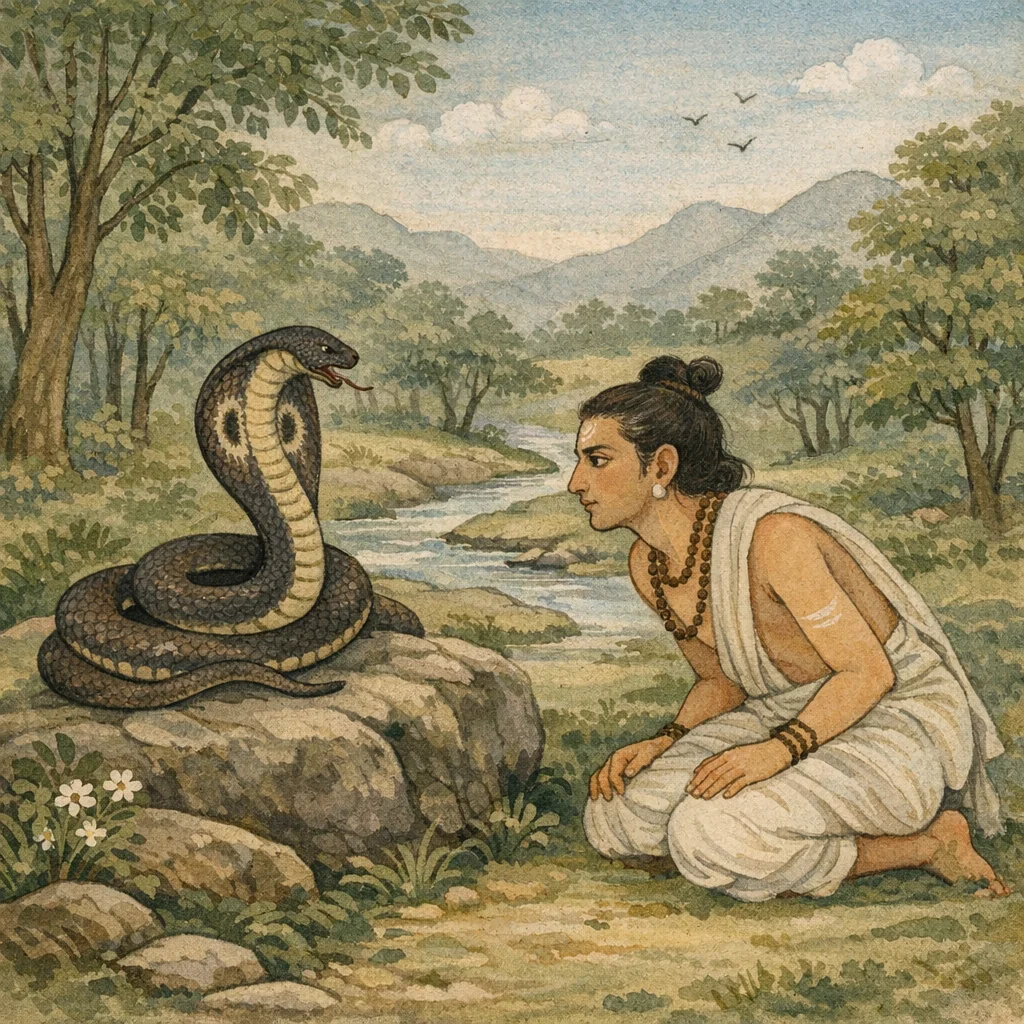
This chapter presents a dialogue structured around grief, retributive intention, and ethical correction. Ruru states that his wife—described as dear as his own life—was bitten by a serpent, leading him to adopt a severe resolution: he will kill any serpent he sees. He then attempts to kill the serpent before him, declaring that the serpent may escape only by surrendering its life. The serpent, identifying itself as Ḍuṇḍubha, responds with a dharma-based argument: other serpents may be responsible for biting humans, but Ḍuṇḍubha is not to be harmed merely due to ‘snake-odor’ or appearance; harms and benefits are not uniform across individuals. The narrator (Sūta) notes that Ruru, alarmed, refrains—mistaking Ḍuṇḍubha for a ṛṣi. Ruru then questions the serpent’s unusual condition, and Ḍuṇḍubha reveals a prior identity as a ṛṣi named Ruru, transformed into a serpent through a brāhmaṇa’s curse. The chapter closes with Ruru asking the cause and duration of the curse, setting up further ethical and causal exposition.
Chapter Arc: Promadvara’s near-loss has turned Ruru into a vow-bound avenger: wherever he sees a serpent, he strikes—his grief sharpened into a single, dangerous purpose. → Ruru encounters a serpent named Dundubha and, true to his vow, rushes to kill it. The serpent speaks—calm, reasoned, and unsettling—warning him that not every snake is guilty, and that blind retaliation itself becomes adharma. → Dundubha reveals a startling truth: he is no ordinary serpent but the cursed rishi Sahasrapad, fallen into snake-form by a brahmin’s imprecation. The intended victim becomes a mirror, forcing Ruru to confront the moral weight of his rage. → Hearing Dundubha’s words and sensing him to be an ascetic rather than a mere beast, Ruru restrains his hand and does not kill him. He questions Dundubha about the cause and term of the curse, shifting from violence to inquiry. → Ruru’s question hangs: why was Sahasrapad cursed, and how long must he endure this serpent-body before release?
Shlokas
Verse 1
(दाक्षिणात्य अधिक पाठका १ श्लोक मिलाकर कुल २४ श्लोक हैं) ऑपन---+र< बक। है २ दशमो<ध्याय: रुरु मुनि और डुण्डुभका संवाद रुस्स्वाच मम प्राणसमा भार्या दष्टासीद् भुजगेन ह | तत्र मे समयो घोर आत्मनोरग वै कृत:,रुरु बोला--सर्प! मेरी प्राणोंके समान प्यारी पत्नीको एक साँपने डँस लिया था। उसी समय मैंने यह घोर प्रतिज्ञा कर ली कि जिस-जिस सर्पको देख लूँगा, उसे-उसे अवश्य मार डालूँगा। उसी प्रतिज्ञाके अनुसार मैं तुम्हें मार डालना चाहता हूँ। अतः आज तुम्हें अपने प्राणोंसे हाथ धोना पड़ेगा
Ruru said: “My wife, as dear to me as my very life, was bitten by a serpent. In that moment I made a terrible vow: whenever I see a snake, I will surely kill it. Bound by that vow, I now intend to kill you; today you must forfeit your life.”
Verse 2
भुजड़ूं वै सदा हन्यां यं यं पश्येयमित्युत । ततोऊहं त्वां जिघांसामि जीवितेनाद्य मोक्ष्यसे,रुरु बोला--सर्प! मेरी प्राणोंके समान प्यारी पत्नीको एक साँपने डँस लिया था। उसी समय मैंने यह घोर प्रतिज्ञा कर ली कि जिस-जिस सर्पको देख लूँगा, उसे-उसे अवश्य मार डालूँगा। उसी प्रतिज्ञाके अनुसार मैं तुम्हें मार डालना चाहता हूँ। अतः आज तुम्हें अपने प्राणोंसे हाथ धोना पड़ेगा
“Indeed, I have vowed that I will always kill whatever serpent I happen to see. Therefore I now intend to slay you; today you shall be parted from your life.”
Verse 3
डुण्ड्रुभ उवाच अन््ये ते भुजगा ब्रह्मन् ये दशन्तीह मानवान् | डुण्डुभानहिगन्धेन न त्वं हिंसितुमहसि,डुण्डुभने कहा--ब्रह्मन्! वे दूसरे ही साँप हैं जो इस लोकमें मनुष्योंको डँसते हैं। साँपोंकी आकृति-मात्रसे ही तुम्हें डुण्डुभोंको नहीं मारना चाहिये
Ḍuṇḍrubha said: “O Brahmin, there are other serpents who bite human beings in this world. You should not harm us ḍuṇḍubhas merely because we carry the scent (or resemblance) of snakes.”
Verse 4
रुरुके दर्शनसे सहस्रपाद ऋषिकी सर्पयोनिसे मुक्ति एकानर्थान् पृथगर्थनिकदुःखान् पृथक्सुखान् । डुण्डुभान् धर्मविद् भूत्वा न त्वं हिंसितुमहसि,अहो! आश्चर्य है, बेचारे डुण्डुभ अनर्थ भोगनेमें सब सर्पोंके साथ एक हैं; परंतु उनका स्वभाव दूसरे सर्पोंसे भिन्न है तथा दुःख भोगनेमें तो वे सब सर्पोके साथ एक हैं; किंतु सुख सबका अलग-अलग है। तुम धर्मज्ञ हो, अतः तुम्हें डुण्डुभोंकी हिंसा नहीं करनी चाहिये
Ḍuṇḍrubha said: “O Ruru, though we share the same serpent-birth and are bound together in suffering and misfortune, each creature’s nature differs, and whatever happiness comes is experienced separately. Since you are one who knows dharma, you should not commit violence against the ḍuṇḍubhas. How strange it is—wretched as we are, we are united in calamity, yet not in joy.”
Verse 5
सौतिर्वाच इति श्रुत्वा वचस्तस्य भुजगस्य रुरुस्तदा । नावधीद् भयसंविग्नमृषिं मत्वाथ डुण्डुभम्,उग्रश्रवाजी कहते हैं--डुण्डुभ सर्पका यह वचन सुनकर रुऱुने उसे कोई भयभीत ऋषि समझा, अतः उसका वध नहीं किया
Sauti said: Hearing those words of the serpent, Ruru at that moment did not strike him down. Taking Ḍuṇḍubha to be a frightened sage, he refrained from killing.
Verse 6
उवाच चैनं भगवान् रुरु: संशमयन्निव । काम॑ मां भुजग ब्रूहि को$सीमां विक्रियां गत:,इसके सिवा, बड़भागी रुसने उसे शान्ति प्रदान करते हुए-से कहा--“भुजंगम! बताओ, इस विकृत (सर्प)-योनिमें पड़े हुए तुम कौन हो?”
Ruru, the venerable one, spoke to him as though soothing him: “O serpent, tell me freely—who are you, fallen into this distorted condition (as a snake)?”
Verse 7
डुण्ड्रुभ उवाच अहं पुरा रुरो नाम्ना ऋषिरासं सहस्रपात् । सो<हं शापेन विप्रस्य भुजगत्वमुपागत:,डुण्डुभने कहा--रुरो! मैं पूर्वजन्ममें सहस्रपाद नामक ऋषि था; किंतु एक ब्राह्मणके शापसे मुझे सर्पयोनिमें आना पड़ा है
Ḍuṇḍrubha said: “Formerly I was a sage named Ruru, known as ‘the thousand-footed one.’ But through the curse of a brāhmaṇa I have fallen into the state of a serpent.”
Verse 8
रुरुस्वाच किमर्थ शप्तवान् क्रुद्धो द्विजस्त्वां भुजगोत्तम । कियन्तं चैव काल॑ ते वपुरेतद् भविष्यति,रुरुने पूछा--भुजगोत्तम! उस ब्राह्मणने किसलिये कुपित होकर तुम्हें शाप दिया? तुम्हारा यह शरीर अभी कितने समयतक रहेगा?
Ruru said: “For what reason did the Brahmin, angered, curse you, O best of serpents? And for how long will this body-form of yours continue to exist?”
Verse 9
इस प्रकार श्रीमहाभारत आदिपव॑ीके अन्तर्गत पौलोगपर्वमें प्रमद्वराके जीवित होनेये सम्बन्ध रखनेवाला नवाँ अध्याय पूरा हुआ
Thus ends the ninth chapter of the Pauloga section within the Ādi Parva of the Śrī Mahābhārata, concerning the account of Pramadvarā being restored to life.
Verse 10
इति श्रीमहाभारते आदिपर्वणि पौलोमपर्वणि रुरुडडुण्डुभसंवादे दशमो<5ध्याय: ॥। १० इस प्रकार श्रीमह्याभारत आदिपर्वके अन्तर्गत पौलोगपर्वमें रुु-डुण्ड्रुभसंवादाविषयक दसवाँ अध्याय पूरा हुआ
Thus, in the Śrī Mahābhārata, within the Ādi Parva, in the Pauloma section, the tenth chapter—concerning the dialogue between Rurū and Ḍuṇḍubha—comes to an end.
Frequently Asked Questions
Ruru’s dilemma is whether personal grief justifies indiscriminate retaliation against an entire class (all serpents) when culpability is unverified, and whether appearance alone is sufficient grounds for harm.
The chapter teaches that dharma requires discernment: ethical action should be proportionate, evidence-sensitive, and attentive to individual difference rather than driven by generalized anger or categorical blame.
No explicit phalaśruti is stated in these verses; the meta-function is implicit—positioning the episode as an ethical exemplum within Ādi Parva’s broader instruction on restraint, causality, and the limits of retribution.