Adhyaya 93
अन्धकानुग्रहः—शूलारोपणं, रुद्रस्मरण-फलम्, तथा गाणपत्य-प्रदानम् (अध्याय 93)
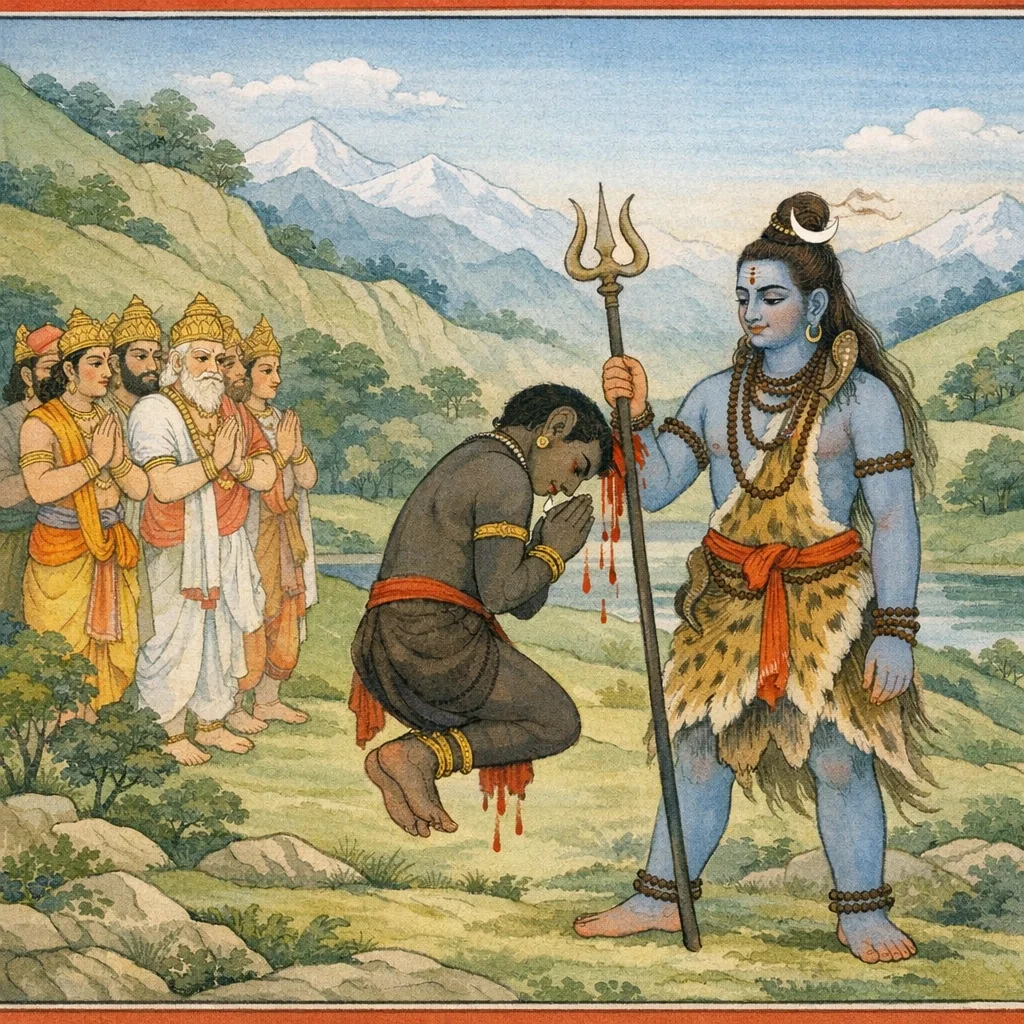
The sages ask how Andhaka, subdued in the lovely cavern of Mount Mandara, received from Maheshvara the status of “Gāṇapatya.” Sūta recounts Andhaka’s background: granted near-invulnerability by Brahmā, he conquers the three worlds and terrifies Indra. The devas, led by Nārāyaṇa, take refuge at Mandara and petition Śiva. Śiva, with his Gaṇas, confronts Andhaka, reduces the asura host to ashes, and pierces Andhaka with the śūla (trident). Impaled upon its tip, a sāttvika disposition awakens in Andhaka; realizing the power of remembering Rudra, he hymns Śiva. The compassionate Nīlalohita asks what boon he desires; Andhaka begs for the “rare śraddhā,” true faith. Śiva grants him śraddhā and the rank of Gāṇapatya, with the devas witnessing the consecration. The episode teaches that beyond mere subjugation, Śiva’s grace transforms the surrendered soul, affirming the path of bhakti in the ensuing tradition of praise.
Shlokas
Verse 1
इति श्रीलिङ्गमहापुराणे पूर्वभागे वाराणसीश्रीशैलमाहात्म्यकथनं नाम द्विनवतितमो ऽध्यायः ऋषय ऊचुः अन्धको नाम दैत्येन्द्रो मन्दरे चारुकन्दरे दमितस्तु कथं लेभे गाणपत्यं महेश्वरात्
Thus, in the Śrī Liṅga Mahāpurāṇa, in the Pūrva-bhāga, the ninety-third chapter called “The Account of the Greatness of Vārāṇasī and Śrīśaila.” The sages said: “Andhaka, lord of the Dānavas—though subdued in the lovely cavern of Mandara—how did he obtain from Maheśvara the status of gāṇapatya, belonging to Śiva’s Gaṇas?”
Verse 2
वक्तुमर्हसि चास्माकं यथावृत्तं यथाश्रुतम् सूत उवाच अन्धकानुग्रहं चैव मन्दरे शोषणं तथा
“You are able to tell us—just as it happened and just as you have heard.” Sūta said: “I shall relate the Lord’s grace shown to Andhaka, and also the drying up at Mandara—exactly so.”
Verse 3
वरलाभमशेषं च प्रवदामि समासतः हिरण्याक्षस्य तनयो हिरण्यनयनोपमः
Now I shall succinctly yet fully relate the obtaining of boons: there was a son of Hiraṇyākṣa, whose eyes were like gold.
Verse 4
पुरान्धक इति ख्यातस् तपसा लब्धविक्रमः प्रसादाद्ब्रह्मणः साक्षाद् अवध्यत्वमवाप्य च
He became renowned as Pūrāndhaka; through austerity he gained mighty prowess, and by the direct grace of Brahmā he also obtained the boon of invincibility, thinking himself beyond being slain.
Verse 5
त्रैलोक्यमखिलं भुक्त्वा जित्वा चेन्द्रपुरं पुरा लीलया चाप्रयत्नेन त्रासयामास वासवम्
Having once overrun and dominated the entire three worlds, and even conquering Indra’s city, he effortlessly—merely as a sport—struck fear into Vāsava (Indra).
Verse 6
बाधितास्ताडिता बद्धाः पातितास्तेन ते सुराः विविशुर्मन्दरं भीता नारायणपुरोगमाः
Harried, struck, bound, and cast down by him, those gods—terrified—entered Mount Mandara, with Nārāyaṇa leading them.
Verse 7
एवं संपीड्य वै देवान् अन्धको ऽपि महासुरः यदृच्छया गिरिं प्राप्तो मन्दरं चारुकन्दरम्
Thus, after grievously oppressing the Devas, Andhaka too—the great Asura—by mere chance came upon Mount Mandara, famed for its lovely caverns.
Verse 8
ततस्ते समस्ताः सुरेन्द्राः ससाध्याः सुरेशं महेशं पुरेत्याहुरेवम् द्रुतं चाल्पवीर्यप्रभिन्नाङ्गभिन्ना वयं दैत्यराजस्य शस्त्रैर्निकृत्ताः
Then all those lords of the Devas, together with the Sādhyas, hastened to the city of Sureśa—Mahēśa—and spoke thus: “Swiftly have we come, our strength diminished; our limbs are shattered and torn. By the weapons of the king of the Daityas we have been cut down.”
Verse 9
इतीदमखिलं श्रुत्वा दैत्यागमम् अनौपमम् गणेश्वरैश् च भगवान् अन्धकाभिमुखं ययौ
Having thus heard in full of the unparalleled advance of the Daitya host, the Blessed Lord—accompanied by the chiefs of his gaṇas—set forth facing Andhaka.
Verse 10
तत्रेन्द्रपद्मोद्भवविष्णुमुख्याः सुरेश्वरा विप्रवराश् च सर्वे /* जयेति वाचा भगवन्तम् ऊचुः किरीटबद्धाञ्जलयः समन्तात्
There, Indra, the Lotus-born (Brahmā), and Viṣṇu at their head—together with the hosts of gods and all the foremost seers—addressed the Blessed Lord on every side, their hands joined in reverence beneath their crowns, crying out: “Victory!”
Verse 11
अथाशेषासुरांस्तस्य कोटिकोटिशतैस् ततः भस्मीकृत्य महादेवो निर्बिभेदान्धकं तदा
Then Mahādeva, having reduced all of Andhaka’s demons to ashes in countless multitudes, at that very time pierced Andhaka—revealing the Lord (Pati) as the irresistible dissolver of all pasha-bound forces.
Verse 12
शूलेन शूलिना प्रोतं दग्धकल्मषकञ्चुकम् दृष्ट्वान्धकं ननादेशं प्रणम्य स पितामहः
Seeing Andhaka transfixed by the trident of the Trident-bearer—his cloak of sin scorched away—Pitāmaha (Brahmā) bowed down and cried out in awe.
Verse 13
तन्नादश्रवणान्नेदुर् देवा देवं प्रणम्य तम् ननृतुर्मुनयः सर्वे मुमुदुर्गणपुङ्गवाः
On hearing that divine sound, the Devas cried out in exultation; bowing to that Lord, they offered reverent salutations. All the sages began to dance, and the foremost of Śiva’s Gaṇas rejoiced—signs of the paśu turning toward the Pati through the awakening of sacred nāda.
Verse 14
ससृजुः पुष्पवर्षाणि देवाः शंभोस्तदोपरि त्रैलोक्यमखिलं हर्षान् ननन्द च ननाद च
The Devas showered rains of flowers upon Śambhu. And all the three worlds, filled with joy, rejoiced and resounded aloud.
Verse 15
दग्धो ऽग्निना च शूलेन प्रोतः प्रेत इवान्धकः सात्त्विकं भावमास्थाय चिन्तयामास चेतसा
Burned by fire and pierced through by the trident, Andhaka lay like a corpse. Yet, taking refuge in a sāttvic disposition, he reflected inwardly—his mind turning toward clarity amid the crushing force of Śiva’s śakti.
Verse 16
जन्मान्तरे ऽपि देवेन दग्धो यस्माच्छिवेन वै आराधितो मया शंभुः पुरा साक्षान्महेश्वरः
Because, in a former birth too, I was burned by that very god—Śiva; yet I had formerly worshipped Śambhu, the directly manifest Maheśvara. Therefore, even that burning became part of the Lord’s purifying grace.
Verse 17
तस्मादेतन्मया लब्धम् अन्यथा नोपपद्यते यः स्मरेन्मनसा रुद्रं प्राणान्ते सकृदेव वा
Therefore I have obtained this truth; it cannot be otherwise. Whoever remembers Rudra within the mind—even once at life’s final moment—attains the destined fulfillment through that remembrance.
Verse 18
स याति शिवसायुज्यं किं पुनर्बहुशः स्मरन् ब्रह्मा च भगवान्विष्णुः सर्वे देवाः सवासवाः
He attains Śiva-sāyujya—complete union with Lord Śiva. How much more so one who remembers Him again and again! This is affirmed by Brahmā, the blessed Lord Viṣṇu, and all the gods together with Indra.
Verse 19
शरणं प्राप्य तिष्ठन्ति तमेव शरणं व्रजेत् एवं संचिन्त्य तुष्टात्मा सो ऽन्धकश् चान्धकार्दनम्
“Having attained refuge, beings abide in safety; therefore one should go to that very Refuge.” Reflecting thus, Andhaka—his mind calm and content—approached Andhakārdana, the Dispeller of darkness, Lord Śiva.
Verse 20
सगणं शिवमीशानम् अस्तुवत्पुण्यगौरवात् प्रार्थितस्तेन भगवान् परमार्तिहरो हरः
Together with his gaṇas, he praised Śiva, the Lord Īśāna; and by the weight and dignity of that merit, Bhagavān Hara—remover of the soul’s deepest affliction—was entreated by him and graciously turned His attention.
Verse 21
हिरण्यनेत्रतनयं शूलाग्रस्थं सुरेश्वरः प्रोवाच दानवं प्रेक्ष्य घृणया नीललोहितः
Seeing the Dānava—Hiraṇyanetra’s son—impaled upon the tip of the trident, the Lord of the Devas, Nīlalohita, addressed him with compassion.
Verse 22
तुष्टो ऽस्मि वत्स भद्रं ते कामं किं करवाणि ते वरान्वरय दैत्येन्द्र वरदो ऽहं तवान्धक
“I am pleased, dear child; blessings upon you. What desire shall I fulfill for you? Choose your boons, O lord of the Daityas—for I am the giver of boons to you, Andhaka.”
Verse 23
श्रुत्वा वाक्यं तदा शंभोर् हिरण्यनयनात्मजः हर्षगद्गदया वाचा प्रोवाचेदं महेश्वरम्
Having heard Śambhu’s words, the son of Hiraṇyanayana—his voice choked with joy—then spoke these words to Maheśvara.
Verse 24
भगवन्देवदेवेश भक्तार्तिहर शङ्कर त्वयि भक्तिः प्रसीदेश यदि देयो वरश् च मे
O Blessed Lord, God of gods, O Śaṅkara who removes the distress of devotees—be gracious. If a boon is to be granted to me, let it be unwavering devotion to You.
Verse 25
श्रुत्वा भवो ऽपि वचनम् अन्धकस्य महात्मनः प्रददौ दुर्लभां श्रद्धां दैत्येन्द्राय महाद्युतिः
Hearing the words of the great-souled Andhaka, Bhava (Lord Śiva) himself—of immense splendor—bestowed upon that lord of the Dānavas the rare gift of śraddhā, steadfast faith.
Verse 26
गाणपत्यं च दैत्याय प्रददौ चावरोप्य तम् प्रणेमुस्तं सुरेन्द्राद्या गाणपत्ये प्रतिष्ठितम्
Having installed him, he also bestowed the Gaṇapatya office upon the Daitya. Then Indra and the other gods bowed to him, now firmly established in the Gaṇapatya station—honoured as the lord of the Gaṇas under the sovereignty of Pati (Śiva).
Frequently Asked Questions
Because the narrative emphasizes inner reversal: when Andhaka’s mind turns sāttvika through Rudra-smaraṇa and śaraṇāgati, Shiva responds as Paramārtihara—granting bhakti (śraddhā) and elevating him, showing that grace follows sincere transformation rather than mere identity (deva/asura).
That even a single, heartfelt remembrance of Rudra at the end of life (prāṇānte sakṛd eva) leads to Shiva-sāyujya; repeated remembrance and surrender deepen that certainty.
In this episode it denotes a granted status/affiliation with Shiva’s gaṇas (gaṇa-sambandha, gaṇādhipatya-like honor), conferred by Maheshvara as a fruit of awakened devotion and śraddhā.