Adhyaya 88
मुनिमोहशमनम् (Pāśupata-yoga, Siddhis, Puruṣa-darśana, Saṃsāra, and Prāṇa-Rudra Pañcāhutī)
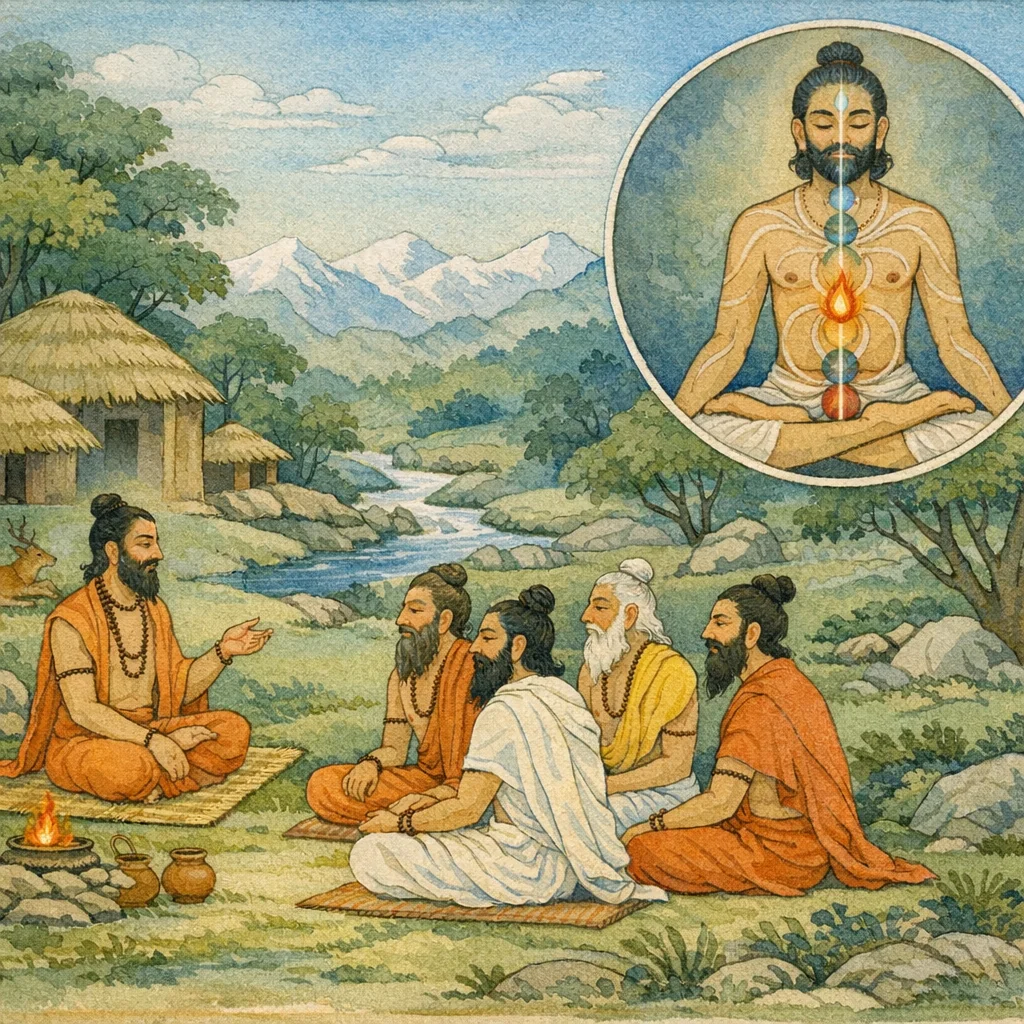
The sages ask Sūta how yogins attain aṇimā and other powers. Sūta teaches a rare fivefold Pāśupata-yoga—steadying the mind, visualizing the lotus-seat, and meditating on Umāpati through Śakti/Rudra configurations—leading to unsurpassed knowledge. He lists the eight siddhis and explains they arise from yoga, not from countless rituals alone. The chapter then turns to the highest aim, apavarga and Śiva-sāyujya, describing the puruṣa as subtle, all-pervading, beyond sensory qualities, known by yogic insight. A long ethical-karmic passage recounts conception, fetal growth, birth, hells, and graded rebirths, urging dhyāna as the remedy for fear of saṃsāra. The teaching culminates in an inward offering: five āhutis to prāṇa, apāna, vyāna, udāna, and samāna, identifying Rudra with prāṇa and the heart-fire (vaiśvānara). The closing verses praise ash-bearing Śaiva practice and recitation/hearing as means to the supreme state, linking this yoga instruction to later Śaiva sādhana themes.
Shlokas
Verse 1
इति श्रीलिङ्गमहापुराणे पूर्वभागे मुनिमोहशमनं नाम सप्ताशीतितमो ऽध्यायः ऋषय ऊचुः केन योगेन वै सूत गुणप्राप्तिः सतामिह अणिमादिगुणोपेता भवन्त्येवेह योगिनः तत्सर्वं विस्तरात्सूत वक्तुमर्हसि सांप्रतम्
Thus, in the Śrī Liṅga Mahāpurāṇa, in the Pūrvabhāga, begins the eighty-eighth chapter called “The Pacification of the Sages’ Delusion.” The sages said: “By what Yoga, O Sūta, do the virtuous attain the higher qualities here? By what means do yogins, even in this very life, become endowed with powers beginning with aṇimā? Please explain all of that to us in full detail now.”
Verse 2
सूत उवाच अत ऊर्ध्वं प्रवक्ष्यामि योगं परमदुर्लभम् पञ्चधा संस्मरेदादौ स्थाप्य चित्ते सनातनम्
Sūta said: “Now, hereafter, I shall expound the Yoga that is supremely difficult to attain. In the beginning, having established the Eternal One within the mind, one should contemplate Him in fivefold manner.”
Verse 3
कल्पयेच्चासनं पद्मं सोमसूर्याग्निसंयुतम् षड्विंशच्छक्तिसंयुक्तम् अष्टधा च द्विजोत्तमाः
O best of the twice-born, one should fashion a lotus-seat (padmāsana) endowed with the powers of Soma, Sūrya, and Agni—joined with the twenty-six Śaktis—and arrange it in eightfold form, as the proper support for worship of Pati, Lord Śiva.
Verse 4
ततः षोडशधा चैव पुनर्द्वादशधा द्विजाः स्मरेच् च तत् तथा मध्ये देव्या देवम् उमापतिम्
Thereafter, O twice-born ones, one should contemplate it in sixteenfold form, and again in twelvefold form; and likewise, in the very midst, one should remember the Lord Umāpati—Shiva—together with the Goddess.
Verse 5
अष्टशक्तिसमायुक्तम् अष्टमूर्तिमजं प्रभुम् ताभिश्चाष्टविधा रुद्राश् चतुःषष्टिविधाः पुनः
United with the eight Śaktis, the unborn Lord—supreme and of the eightfold form (Aṣṭamūrti)—is declared. Through those very Śaktis, Rudra becomes eightfold; and again, in further differentiation, He is spoken of as sixty‑fourfold.
Verse 6
शक्तयश् च तथा सर्वा गुणाष्टकसमन्विताः एवं स्मरेत्क्रमेणैव लब्ध्वा ज्ञानमनुत्तमम्
Likewise, one should contemplate all the Śaktis—endowed with the eightfold set of guṇas—in due sequence; thus, having attained unsurpassed knowledge, the seeker proceeds toward liberation under the Lord, the Pati.
Verse 7
एवं पाशुपतं योगं मोक्षसिद्धिप्रदायकम् तस्याणिमादयो विप्रा नान्यथा कर्मकोटिभिः
Thus the Pāśupata Yoga bestows the perfected attainment of liberation (mokṣa-siddhi). From it arise the accomplishments beginning with aṇimā; O brāhmaṇas, such fruits are not gained by any other means, even by crores of ritual actions.
Verse 8
ऐश्वर्य तत्राष्टगुणमैश्वर्यं योगिनां समुदाहृतम् तत्सर्वं क्रमयोगेन ह्य् उच्यमानं निबोधत
In this teaching, the yogins’ lordly power (aiśvarya) is declared to be eightfold. Understand it all as it is taught in due order through progressive yoga, under Pati—the Lord who loosens the pāśa (bond) of the bound paśu (soul).
Verse 9
अणिमा लघिमा चैव महिमा प्राप्तिरेव च प्राकाम्यं चैव सर्वत्र ईशित्वं चैव सर्वतः
Aṇimā (becoming minute), Laghimā (becoming light), Mahimā (becoming vast), and Prāpti (attainment) are achieved; likewise Prākāmya (irresistible fulfillment of will) everywhere, and Īśitva (sovereign lordship) in all respects—these yogic powers arise by the grace of Pati, Śiva, when the paśu (embodied soul) is loosened from pāśa (bondage).
Verse 10
वशित्वमथ सर्वत्र यत्र कामावसायिता तच्चापि त्रिविधं ज्ञेयम् ऐश्वर्यं सार्वकामिकम्
Now, vaśitva—mastery everywhere, wherein one’s intention (kāma) attains decisive fulfillment—is also to be understood as threefold: a universal lordly power (aiśvarya) able to accomplish all aims.
Verse 11
सावद्यं निरवद्यं च सूक्ष्मं चैव प्रवर्तते सावद्यं नाम यत्तत्र पञ्चभूतात्मकं स्मृतम्
In experience there operates what is ‘fault-marked’ and what is ‘faultless’, as well as the subtle principle. Here, that which is called ‘fault-marked’ is understood to be constituted of the five great elements (pañca-bhūta).
Verse 12
इन्द्रियाणि मनश्चैव अहङ्कारश् च यः स्मृतः तत्र सूक्ष्मप्रवृत्तिस्तु पञ्चभूतात्मिका पुनः
The senses, the mind, and that which is remembered as egoity (ahaṅkāra)—within these operates the subtle activity (sūkṣma-pravṛtti), which again is constituted of the five great elements. Thus the embodied soul (paśu) experiences the world through elemental bondage (pāśa) until it turns toward the Lord (Pati), Śiva.
Verse 13
इन्द्रियाणि मनश्चित्तबुद्ध्यहङ्कारसंज्ञितम् तथा सर्वमयं चैव आत्मस्था ख्यातिरेव च
The sense-faculties, along with mind, citta, intellect, and ego—so named—are all pervaded by consciousness; and the very awareness (khyāti) abiding in the Self is indeed the basis of them all. In this way, the bound soul (paśu) experiences these instruments as coverings (pāśa), while the Lord (Pati), Śiva, remains the inner Witness.
Verse 14
संयोग एव त्रिविधः सूक्ष्मेष्वेव प्रवर्तते पुनरष्टगुणश्चापि सूक्ष्मेष्वेव विधीयते
Conjunction (saṁyoga) is indeed threefold, and it operates only among subtle principles. Again, the eightfold set of qualities, too, is established only in those subtle principles.
Verse 15
तस्य रूपं प्रवक्ष्यामि यथाह भगवान्प्रभुः त्रैलोक्ये सर्वभूतेषु यथास्य नियमः स्मृतः
I shall declare His form, exactly as the Blessed Lord taught—along with the ordinance remembered as governing all beings throughout the three worlds.
Verse 16
अणिमाद्यं तथाव्यक्तं सर्वत्रैव प्रतिष्ठितम् त्रैलोक्ये सर्वभूतानां दुष्प्राप्यं समुदाहृतम्
He is the source of aṇimā and the other siddhis, and yet is the Unmanifest (avyakta). Established everywhere, He is declared in the three worlds to be difficult of attainment for all beings—being the supreme Pati beyond the reach of the bound paśu.
Verse 17
तत् तस्य भवति प्राप्यं प्रथमं योगिनां बलम् लङ्घनं प्लवनं लोके रूपमस्य सदा भवेत्
For him, this becomes the first strength attained by yogins: in the world he gains the constant capacity to leap and to traverse, even across spaces or waters.
Verse 18
शीघ्रत्वं सर्वभूतेषु द्वितीयं तु पदं स्मृतम् त्रैलोक्ये सर्वभूतानां महिम्ना चैव वन्दितम्
Swiftness in relation to all beings is remembered as the second attribute (pada). Throughout the three worlds, all beings bow to Him, venerating Him for His divine majesty.
Verse 19
महित्वं चापि लोके ऽस्मिंस् तृतीयो योग उच्यते त्रैलोक्ये सर्वभूतेषु यथेष्टगमनं स्मृतम्
In this world, the attainment of vastness (mahitva) is declared to be the third form of Yoga; it is remembered as the power to move at will throughout the three worlds and among all beings.
Verse 20
प्राकामान् विषयान् भुङ्क्ते तथाप्रतिहतः क्वचित् त्रैलोक्ये सर्वभूतानां सुखदुःखं प्रवर्तते
He enjoys the desired objects of the senses, and at times remains entirely unobstructed. In the three worlds, the experiences of pleasure and pain of all beings proceed under His governance—He, the Pati, ordains their course according to karma.
Verse 21
ईशो भवति सर्वत्र प्रविभागेन योगवित् वश्यानि चास्य भूतानि त्रैलोक्ये सचराचरे
As the all-knowing master of Yoga, He becomes the Lord everywhere, governing through precise differentiation; and all beings in the three worlds—moving and unmoving—remain under His sway.
Verse 22
इच्छया तस्य रूपाणि भवन्ति न भवन्ति च यत्र कामावसायित्वं त्रैलोक्ये सचराचरे
By His mere will, His forms arise into manifestation—and also do not manifest. In Him abides the decisive fulfillment of all desires throughout the three worlds, among all that moves and all that is unmoving.
Verse 23
शब्दः स्पर्शो रसो गन्धो रूपं चैव मनस् तथा प्रवर्तन्ते ऽस्य चेच्छातो न भवन्ति यथेच्छया
Sound, touch, taste, smell, form, and also the mind—these operate only by His will; they do not function according to their own whim. Thus the paśu’s faculties move under the governance of the supreme Pati (Śiva), not by independent agency.
Verse 24
योगिन् इस् फ़्रेएद् फ़्रोम् अत्तछ्मेन्त् न जायते न म्रियते छिद्यते न च भिद्यते न दह्यते न मुह्येत लीयते न च लिप्यते
The yogin, freed from attachment (pāśa), is not born and does not die. He is not cut, nor split; he is not burned, nor deluded. He does not dissolve away, and he is not tainted—abiding in the stainless awareness upheld by Śiva, the Pati who liberates the paśu.
Verse 25
न क्षीयते न क्षरति खिद्यते न कदाचन क्रियते वा न सर्वत्र तथा विक्रियते न च
He does not diminish, nor does He leak away or decay; He is never afflicted. He is not something newly produced by action, nor is He altered anywhere—thus He undergoes no modification at all. This is the mark of Pati (Śiva), the immutable Reality beyond all pāśa-bound change.
Verse 26
अगन्धरसरूपस्तु अस्पर्शः शब्दवर्जितः अवर्णो ह्यस्वरश् चैव असवर्णस्तु कर्हिचित्
He is of a nature beyond smell and taste; beyond touch; and devoid of sound. He is without color and without tone—never falling into any class or category. Thus is Pati (Śiva) taught as nirguṇa, transcending the grasp of the senses.
Verse 27
स भुङ्क्ते विषयांश्चैव विषयैर्न च युज्यते अणुत्वात्तु परः सूक्ष्मः सूक्ष्मत्वाद् अपवर्गिकः
He truly experiences the objects of experience, yet He is not bound or entangled by them. Because He is supremely subtle—finer than the finest—He remains beyond all contact; and by that very subtlety He bestows apavarga, liberation from bondage.
Verse 28
व्यापकस्त्वपवर्गाच्च व्यापकात्पुरुषः स्मृतः पुरुषः सूक्ष्मभावात्तु ऐश्वर्ये परमे स्थितः
He is called the All-pervading because He bestows apavarga (liberation); and from that all-pervasiveness He is remembered as the Puruṣa. Because His nature is supremely subtle, that Puruṣa abides in the highest sovereignty—Śiva as Pati, beyond bondage.
Verse 29
गुणोत्तरमथैश्वर्ये सर्वतः सूक्ष्ममुच्यते ऐश्वर्यं चाप्रतीघातं प्राप्य योगमनुत्तमम्
Then, transcending the guṇas, one is said to become subtle in every way through divine lordship; and, attaining unobstructed sovereignty, one reaches the unsurpassed Yoga—union with Pati (Śiva) beyond all bonds.
Verse 30
अपवर्गं ततो गच्छेत् सूक्ष्मं तत्परमं पदम् एवं पाशुपतं योगं ज्ञातव्यं मुनिपुङ्गवाः
Thereafter the bound soul (paśu) attains apavarga—release—reaching that subtle, supreme abode. Thus is the Pāśupata Yoga to be understood, O foremost of sages.
Verse 31
स्वर्गापवर्गफलदं शिवसायुज्यकारणम् अथवा गतविज्ञानो रागात्कर्म समाचरेत्
It bestows the fruits of heaven and liberation, and is a direct cause of śiva-sāyujya—union with Śiva. Yet one who has let true discernment slip away may still perform actions merely out of rāga, attachment.
Verse 32
राजसं तामसं वापि भुक्त्वा तत्रैव मुच्यते ब्रह्मन् गुअरन्तेएस् लिबेरतिओन् तथा सुकृतकर्मा तु फलं स्वर्गे समश्नुते
O Brahman, having fully undergone the fruits of rajasic or tamasic actions, one is released from them there itself. Likewise, the doer of meritorious deeds enjoys the reward in heaven. Yet beyond all such guṇa-born experiences lies the higher release that comes from turning to Pati (Śiva); by His grace the pashu is freed from pasha.
Verse 33
तस्मात्स्थानात्पुनः श्रेष्ठो मानुष्यमुपपद्यते तस्माद्ब्रह्म परं सौख्यं ब्रह्म शाश्वतम् उत्तमम्
From that state, one again attains the superior condition of human birth. Therefore Brahman alone is the supreme happiness—Brahman is eternal and unsurpassed.
Verse 34
ब्रह्म एव हि सेवेत ब्रह्मैव हि परं सुखम् परिश्रमो हि यज्ञानां महतार्थेन वर्तते
One should serve Brahman alone; Brahman alone is the supreme bliss. For the toil of sacrificial rites truly finds its fulfillment only when aimed at the highest purpose—realization of the Great, the Supreme.
Verse 35
भूयो मृत्युवशं याति तस्मान्मोक्षः परं सुखम् अथवा ध्यानसंयुक्तो ब्रह्मतत्त्वपरायणः
One who again falls under the dominion of Death returns to bondage; therefore mokṣa is the highest bliss. Or else, yoked to meditation and devoted to the true principle of Brahman—understood as the supreme Lord (Pati), Śiva—one attains that liberating state beyond rebirth.
Verse 36
न तु च्यावयितुं शक्यो मन्वन्तरशतैरपि दृष्ट्वा तु पुरुषं दिव्यं विश्वाख्यं विश्वतोमुखम्
He cannot be made to waver—even by hundreds of Manvantaras. But upon beholding that divine Puruṣa, famed as the All (Viśva) and facing in every direction, they recognized the Pati beyond all change, before whom the pashu’s bondage (pāśa) loses its power.
Verse 37
विश्वपादशिरोग्रीवं विश्वेशं विश्वरूपिणम् विश्वगन्धं विश्वमाल्यं विश्वांबरधरं प्रभुम्
I worship the sovereign Lord—whose feet, head, and neck are the very universe; the Lord of all worlds, of universal form; whose fragrance and garlands are the universe itself; the supreme Master who wears the universe as His garment.
Verse 38
गोभिर् महीं संपतते पतत्रिणो नैवं भूयो जनयत्येवमेव कविं पुराणम् अनुशासितारं सूक्ष्माच्च सूक्ष्मं महतो महान्तम्
As birds descend upon the earth in flocks, so too do beings repeatedly arise; yet none can generate again that primordial Seer—the ancient Kavi, the Purāṇa itself—who is the supreme Instructor: subtler than the subtle and greater than the great (Śiva, the Pati beyond all paśu-birth and pāśa-bondage).
Verse 39
योगेन पश्येन्न च चक्षुषा पुनर् निरिन्द्रियं पुरुषं रुक्मवर्णम् अलिङ्गिनं निर्गुणं चेतनं च नित्यं सदा सर्वगं सर्वसारम्
One should behold Him through Yoga—not again by the physical eye: that Puruṣa who is beyond the senses, of golden radiance, without any limiting mark (aliṅgin), beyond the guṇas, pure Consciousness—eternal, ever-present, all-pervading, and the very essence of all.
Verse 40
पश्यन्ति युक्त्या ह्यचलप्रकाशं तद्भावितास्तेजसा दीप्यमानम् /* अपाणिपादोदरपार्श्वजिह्वो ह्यतीन्द्रियो वापि सुसूक्ष्म एकः
Through disciplined insight they behold the unmoving Light—made manifest by contemplation and blazing with its own radiance. He is the One, exceedingly subtle and beyond the senses: without hands and feet, yet present as belly, sides, and tongue—pervading all while remaining transcendent.
Verse 41
पश्यत्यचक्षुः स शृणोत्यकर्णो न चास्त्यबुद्धं न च बुद्धिर् अस्ति /* स वेद सर्वं न च सर्ववेद्यं तमाहुरग्र्यं पुरुषं महान्तम्
He sees without eyes; He hears without ears. In Him there is neither non-intelligence nor limited intellect. He knows all, yet He is not an object fully knowable by all. Him they proclaim as the foremost, the Great Person—Śiva, the supreme Pati beyond the senses and mind.
Verse 42
अचेतनां सर्वगतां सूक्ष्मां प्रसवधर्मिणीम् प्रकृतिं सर्वभूतानां युक्ताः पश्यन्ति योगिनः
Yogins, disciplined in Yoga, directly behold Prakṛti—the insentient, all-pervading, subtle principle whose very nature is to bring forth manifestation—as the source and operative ground within all beings.
Verse 43
सर्वतः पाणिपादं तत् सर्वतो ऽक्षिशिरोमुखम् सर्वतः श्रुतिमल् लोके सर्वमावृत्य तिष्ठति
That Supreme Reality (Pati, Śiva) has hands and feet everywhere; everywhere are His eyes, heads, and faces. Everywhere in the world He is the Hearer; enveloping all, He abides—immanent in everything, yet beyond all limitation.
Verse 44
युक्तो योगेन चेशानं सर्वतश् च सनातनम् पुरुषं सर्वभूतानां तं विद्वान्न विमुह्यति
United with Him through Yoga, the wise truly know Īśāna—eternal and all-pervading, the Supreme Person, the indwelling Lord of all beings; having known that Pati, they are no longer deluded by the pāśa-bonds that bind the paśu (soul).
Verse 45
भूतात्मानं महात्मानं परमात्मानमव्ययम् सर्वात्मानं परं ब्रह्म तद्वै ध्याता न मुह्यति
One who meditates on Śiva as the indwelling Self of all beings (Bhūtātman), the Great Soul (Mahātman), the imperishable Supreme Self (Paramātman), and the supreme Brahman—the Self of all—such a contemplator is never deluded.
Verse 46
पवनो हि यथा ग्राह्यो विचरन्सर्वमूर्तिषु पुरि शेते सुदुर्ग्राह्यस् तस्मात्पुरुष उच्यते
Just as the wind, though moving through all forms, is grasped only with difficulty, so too the indwelling Lord abides within the ‘city’ (the body) and is exceedingly hard to apprehend; therefore He is called Puruṣa.
Verse 47
देवेलोप्मेन्त् ओफ़् अन् एम्ब्र्यो अथ चेल्लुप्तधर्मा तु सावशेषैः स्वकर्मभिः ततस्तु ब्रह्मगर्भे वै शुक्रशोणितसंयुते
Then the embodied pashu (the individual soul), fallen from its former state, is borne onward by the residual force of its own karma. Thereafter it enters the womb fashioned by Brahmā, where semen and blood are conjoined; thus the embryo begins to take form under the governance of Pati (Śiva) and the bonds of pāśa.
Verse 48
स्त्रीपुंसोः संप्रयोगे हि जायते हि ततः प्रभुः ततस्तु गर्भकालेन कललं नाम जायते
From the union of woman and man, by the Lord’s ordinance, creation is set in motion; then, in the course of gestation, the first embryonic mass called kalala comes into being.
Verse 49
कालेन कललं चापि बुद्बुदं सम्प्रजायते मृत्पिण्डस्तु यथा चक्रे चक्रावर्तेन पीडितः
Through the force of Time (Kāla), the embryo’s first mass (kalala) becomes a bubble-like form; just as a lump of clay, pressed and driven by the whirl of the potter’s wheel, undergoes its transformation.
Verse 50
हस्ताभ्यां क्रियमाणस्तु बिंबत्वमनुगच्छति एवमाध्यात्मिकैर्युक्ता वायुना संप्रपूरितः
When it is fashioned by the two hands, it assumes a well-formed shape. In the same way, when the inner (adhyātmika) factors are properly joined, it becomes fully pervaded and filled by Vāyu—the life-breath—thus indicating the subtle formation of embodied existence through prāṇa.
Verse 51
यदि योनिं विमुञ्चामि तत्प्रपद्ये महेश्वरम् यावद्धि वैष्णवो वायुर् जातमात्रं न संस्पृशेत्
If I am to be released from the womb, I take refuge in Maheśvara—so long as the Vaiṣṇava wind does not touch the newborn at the very moment of birth.
Verse 52
तावत्कालं महादेवम् अर्चयामीति चिन्तयेत् जायते मानुषस्तत्र यथारूपं यथावयः
For that span of time, one should inwardly resolve, “I am worshipping Mahādeva (Śiva).” By that Shiva-directed contemplation, the paśu (bound soul) is born there as a human being, endowed with a form and age corresponding to the nature of that worship.
Verse 53
वायुः संभवते खात्तु वाताद्भवति वै जलम् जलात् सम्भवति प्राणः प्राणाच्छुक्रं विवर्धते
From Space (kha/ākāśa) arises Wind; from Wind indeed comes Water. From Water arises the vital breath (prāṇa), and from prāṇa the generative essence (śukra) is nourished and increases. Thus the embodied paśu is formed through a graded unfolding of tattvas under the governance of Pati, Śiva.
Verse 54
रक्तभागास् त्रयस्त्रिंशद् रेतोभागाश् चतुर्दश भागतो ऽर्धफलं कृत्वा ततो गर्भो निषिच्यते
From thirty-three parts of the mother’s blood and fourteen parts of the father’s seed, having made a half-fruit portion by due division, the embryo is then infused and set in place. Thus the embodied paśu enters the course of birth under the governance of Pati (Śiva) and the bonds of pāśa.
Verse 55
ततस्तु गर्भसंयुक्तः पञ्चभिर् वायुभिर् वृतः पितुः शरीरात्प्रत्यङ्गं रूपमस्योपजायते
Then, joined to the womb and enclosed by the five vital airs, the embodied soul takes form—each limb and feature arising in due order from the father’s body. Thus the paśu (individual self), bound by pāśa through embodied becoming, enters the field where only Pati, Śiva, can later grant release.
Verse 56
ततो ऽस्य मातुराहारात् पीतलीढप्रवेशनात् नाभिदेशेन वै प्राणास् ते ह्य् आधारा हि देहिनाम्
Thereafter, from the mother’s nourishment—entering by what is drunk and licked—the prāṇas (vital breaths) indeed move through the region of the navel; for those prāṇas are truly the supports of embodied beings (dehins).
Verse 57
नवमासात् परिक्लिष्टः संवेष्टितशिरोधरः वेष्टितः सर्वगात्रैश् च अपर्याप्तप्रवेशनः
Afflicted through nine months in the womb, with head and neck tightly constricted and the whole body wrapped and compressed, the bound jīva finds no sufficient space to move or to emerge. Thus it suffers under the force of pāśa (bondage), until the grace of Pati (Śiva) becomes the true passage to freedom.
Verse 58
नवमासोषितश्चापि योनिच्छिद्रादवाङ्मुखः हेल्ल् ततः स्वकर्मभिः पापैर् निरयं सम्प्रपद्यते
Having remained confined and dried for nine months, the embodied being rushes forth headlong through the opening of the womb. Then, driven by the sins born of its own actions, it falls into naraka (hell)—such is the hard pāśa (bondage) that karma weaves for the paśu (individual soul) when it turns away from the Lord, the Pati.
Verse 59
असिपत्रवनं चैव शाल्मलिच्छेदनं तथा ताडनं भक्षणं चैव पूयशोणितभक्षणम्
There is also the forest of sword-like leaves (asipatravana), the cutting by śālmali-thorns, beating and devouring—indeed, even the forced eating of pus and blood. Thus the paśus, bound by pāśa born of their own karma, are made to taste the bitter fruit of adharma until they turn toward the Pati, Śiva, the liberator.
Verse 60
यथा ह्यापस्तु संछिन्नाः संश्लेष्मम् उपयान्ति वै तथा छिन्नाश् च भिन्नाश्च यातनास्थानम् आगताः
Just as waters, when cut off and divided, gather again into a single continuous flow, so too beings who are cut and broken are brought back again to the place of torment, bound by the force of their own karma.
Verse 61
एवं जीवास्तु तैः पापैस् तप्यमानाः स्वयंकृतैः प्राप्नुयुः कर्मभिः शेषैर् दुःखं वा यदि वेतरत्
Thus the embodied souls (paśus), scorched by the sins they themselves have committed, attain—through the remaining residues of their karma—either suffering or its opposite (well-being), according to what is left to ripen.
Verse 62
एकेनैव तु गन्तव्यं सर्वमुत्सृज्य वै जनम् एकेनैव तु भोक्तव्यं तस्मात्सुकृतमाचरेत्
Truly one must depart alone, leaving all people behind; and alone one must taste the fruits of karma. Therefore practice sukṛta—meritorious conduct—so that the paśu (bound soul) may move toward Shiva, the Lord (Pati), beyond pāśa (bondage).
Verse 63
न ह्येनं प्रस्थितं कश्चिद् गच्छन्तम् अनुगच्छति यदनेन कृतं कर्म तदेनमनुगच्छति
When one sets forth from this world, no one follows him as he departs; only the karma he himself has done follows him.
Verse 64
ते नित्यं यमविषयेषु सम्प्रवृत्ताः क्रोशन्तः सततमनिष्टसंप्रयोगैः शुष्यन्ते परिगतवेदनाः शरीरा बह्वीभिः सुभृशमनन्तयातनाभिः
Ever driven into Yama’s domain, those bound souls continually wail. By constant contact with what is hateful and adverse, their bodies wither—pervaded by pain—tormented by many fierce and seemingly endless punishments. Thus does pāśa (bondage) mature into suffering when the paśu turns away from Pati, the Lord.
Verse 65
दिफ़्फ़्। फ़ोर्म्स् ओफ़् रेबिर्थ् कर्मणा मनसा वाचा यदभीक्ष्णं निषेवते तदभ्यासो हरत्येनं तस्मात्कल्याणमाचरेत्
Whatever a being repeatedly engages in—through action, thought, or speech—that very practice carries the soul along into its destiny. Therefore cultivate what is auspicious and dharmic, so that the paśu is led away from pāśa and toward Shiva’s liberating grace.
Verse 66
अनादिमान्प्रबन्धः स्यात् पूर्वकर्मणि देहिनः संसारं तामसं घोरं षड्विधं प्रतिपद्यते
For the embodied paśu, due to prior karma, there arises a beginningless continuity of bondage; and it enters the dreadful, tamasic cycle of saṃsāra, manifesting in sixfold forms.
Verse 67
मानुष्यात्पशुभावश् च पशुभावान् मृगो भवेत् मृगत्वात्पक्षिभावश् च तस्माच्चैव सरीसृपः
From the human state, the paśu (the soul bound by pāśa) may fall into an animal condition; from the animal condition it may become a deer. From deerhood it may take on the state of a bird, and from there even become a creeping creature. Thus the jīva wanders through lower births while fettered by pāśa, until it turns again toward Pati, Lord Śiva, the liberator.
Verse 68
सरीसृपत्वाद्गच्छेद्वै स्थावरत्वं न संशयः स्थावरत्वे पुनः प्राप्ते यावद् उन्मिलते जनः
From the state of being a creeping creature, one indeed falls into the condition of an immobile being (sthāvara)—of this there is no doubt. And when that immobile state is attained again, the bound soul remains so until, in due course, the being “opens its eyes,” awakening once more into manifest life.
Verse 69
कुलालचक्रवद्भ्रान्तस् तत्रैव परिवर्तते इत्येवं हि मनुष्यादिः संसारः स्थावरान्तिकः
Like a potter’s wheel whirling in delusion, the bound paśu turns again and again within the very same circuit. Thus saṃsāra proceeds—from human and other births—down to the state of the immobile (sthāvara), so long as the paśu remains fettered by pāśa and does not take refuge in Pati, Śiva.
Verse 70
विज्ञेयस्तामसो नाम तत्रैव परिवर्तते सात्त्विकश्चापि संसारो ब्रह्मादिः परिकीर्तितः
Know that there is a cycle called “tāmasa”; it turns again and again within that very sphere. Likewise, the “sāttvika” cycle of transmigratory existence—beginning with Brahmā—is also declared. (Thus the paśu, bound by pāśa in the form of the guṇas, revolves in saṃsāra until turning toward Pati, Śiva.)
Verse 71
पिशाचान्तः स विज्ञेयः स्वर्गस्थानेषु देहिनाम् ब्राह्मे तु केवलं सत्त्वं स्थावरे केवलं तमः
Among embodied beings who attain heavenly stations, one should understand the range to extend down even to the state of a piśāca. But in the Brahmā-world there is pure sattva alone, while in the realm of the immobile (sthāvara) there is tamas alone.
Verse 72
चतुर्दशानां स्थानानां मध्ये विष्टम्भकं रजः मर्मसु छिद्यमानेषु वेदनार्तस्य देहिनः
Among the fourteen seats of the body, rajas—the agitating guṇa—becomes a power of obstruction; and when the marmas, the vital joints, are cut or pierced, the embodied soul, the pashu, is overwhelmed by pain and distress.
Verse 73
ततस्तत्परमं ब्रह्म कथं विप्रः स्मरिष्यति संसारः पूर्वधर्मस्य भावनाभिः प्रणोदितः
How, then, will a brahmin remember that Supreme Brahman? For saṃsāra is driven onward by bhāvanās—residual impressions born of former dharma—binding the pashu, the individual soul, again and again through pasha, the fetter of conditioning.
Verse 74
मानुषं भजते नित्यं तस्माद्ध्यानं समाचरेत् चतुर्दशविधं ह्येतद् बुद्ध्वा संसारमण्डलम्
The embodied pashu continually clings to the human condition; therefore one should diligently practice meditation. Having understood this fourteenfold maṇḍala of saṃsāra, one turns toward Pati—Lord Śiva—beyond pasha, bondage.
Verse 75
नित्यं समारभेद्धर्मं संसारभयपीडितः ततस्तरति संसारं क्रमेण परिवर्तितः
One afflicted by fear of saṃsāra should constantly undertake dharma; then, being gradually transformed, he crosses beyond saṃsāra.
Verse 76
तस्माच्च सततं युक्तो ध्यानतत्परयुञ्जकः तथा समारभेद्योगं यथात्मानं स पश्यति
Therefore, ever disciplined and intent on meditation, the practitioner should duly undertake Yoga; by that means he comes to behold the Self as it truly is—the inner pashu—through the grace-filled path that leads to Pati, Śiva.
Verse 77
एष आपः परं ज्योतिर् एष सेतुरनुत्तमः विवृत्या ह्येष संभेदाद् भूतानां चैव शाश्वतः
This indeed is the primordial Waters (āpaḥ); this is the Supreme Light. This is the unsurpassed Bridge (setu). By His expansive unfolding—and also by His differentiating power—the Eternal One becomes the ground of all manifest beings.
Verse 78
तदेनं सेतुमात्मानम् अग्निं वै विश्वतोमुखम् हृदिस्थं सर्वभूतानाम् उपासीत महेश्वरम्
Therefore one should worship that Maheshvara who is the inner Self and the sacred Bridge (setu) that carries one across, who is verily the fire facing all directions, and who abides in the heart of all beings.
Verse 79
तथान्तः संस्थितं देवं स्वशक्त्या परिमण्डितम् अष्टधा चाष्टधा चैव तथा चाष्टविधेन च
Thus one should behold the Deva abiding within, encircled and adorned by His own innate Śakti—manifesting in eightfold ways, again in eightfold ways, and likewise through the eightfold mode.
Verse 80
सृष्ट्यर्थं संस्थितं वह्निं संक्षिप्य च हृदि स्थितम् ध्यात्वा यथावद्देवेशं रुद्रं भुवननायकम्
Having drawn inward the sacred fire established for creation and set it within the heart, one should meditate in the proper manner upon Rudra—the Lord of the gods, the sovereign guide of all the worlds—who is Pati, the inner ruler who frees the paśu from pāśa through right contemplation.
Verse 81
हुत्वा पञ्चाहुतीः सम्यक् तच्चिन्तागतमानसः वैश्वानरं हृदिस्थं तु यथावदनुपूर्वशः
Having duly offered the five oblations, with the mind absorbed in that contemplation, one should in proper sequence meditate upon Vaiśvānara—the inner sacrificial fire abiding in the heart—as Pati, the Lord who burns away the bonds (pāśa) of the paśu.
Verse 82
आपः पूताः सकृत्प्राश्य तूष्णीं हुत्वा ह्युपाविशन् प्राणायेति ततस्तस्य प्रथमा ह्याहुतिः स्मृता
Having sipped the purified water once and offered the oblation in silence, one should then sit down. Thereafter, the offering made with the mantra “prāṇāya” is remembered as the first āhuti, beginning the discipline of breath that steadies the pashu (individual soul) for worship of Pati, Śiva.
Verse 83
अपानाय द्वितीया च व्यानायेति तथा परा उदानाय चतुर्थी स्यात् समानायेति पञ्चमी
The second formula is for Apāna; the next is for Vyāna. The fourth should be for Udāna, and the fifth for Samāna—thus the vital airs are invoked in order, establishing the body as a fit vessel for Śiva-worship.
Verse 84
स्वाहाकारैः पृथग्घुत्वा शेषं भुञ्जीत कामतः अपः पुनः सकृत्प्राश्य आचम्य हृदयं स्पृशेत्
Having offered the oblations separately with the utterance of “svāhā,” one may then partake of what remains according to one’s capacity. Thereafter, sipping water once again and performing ācamana, one should touch the heart—centering the rite within the Self, in devotion to Pati, the Lord.
Verse 85
प्राणानां ग्रन्थिरस्यात्मा रुद्रो ह्यात्मा विशान्तकः रुद्रो वै ह्यात्मनः प्राण एवमाप्याययेत्स्वयम्
Rudra is indeed the inner knot (binding core) of the vital breaths; He is this very Self, the One who brings complete pacification. Truly, Rudra is the prāṇa of the Self—thus one should nourish and steady oneself by realizing Him within.
Verse 86
प्राणे निविष्टो वै रुद्रस् तस्मात्प्राणमयः स्वयम् प्राणाय चैव रुद्राय जुहोत्यमृतमुत्तमम्
Rudra indeed abides within the vital breath; therefore He Himself is of the very nature of prāṇa. Hence one should offer the supreme nectar as an oblation to prāṇa—and to Rudra—recognizing them as one reality.
Verse 87
शिवाविशेह मामीश स्वाहा ब्रह्मात्मने स्वयम् एवं पञ्चाहुतीश्चैव प्रभुः प्रीणातु शाश्वतः
O Lord, may Shiva’s undivided, all-pervading power enter into me and protect me—svāhā! Oblation to the Self-born One whose very Self is Brahman. Thus, by these five oblations, may the Eternal Lord be wholly pleased.
Verse 88
पुरुषो ऽसि पुरे शेषे त्वं अङ्गुष्ठप्रमाणतः आश्रितश्चैव चाङ्गुष्ठम् ईशः परमकारणम्
You are that Puruṣa dwelling in the “city” of the body as the indwelling remainder; you are of the measure of a thumb. Yet even that thumb-sized Self is upheld by You—O Īśa, You are the Supreme Cause of all.
Verse 89
सर्वस्य जगतश्चैव प्रभुः प्रीणातु शाश्वतः त्वं देवानामसि ज्येष्ठो रुद्रस्त्वं च पुरो वृषा
May the Eternal Lord, sovereign of all this universe, be pleased. You are the foremost among the gods; You are Rudra, the primal Bull (Vṛṣa) who leads from the front.
Verse 90
मृदुस्त्वमन्नमस्मभ्यम् एतदस्तु हुतं तव इत्येवं कथितं सर्वं गुणप्राप्तिविशेषतः
“You are gentle; be food for us—let this indeed be offered into You as an oblation.” Thus the whole matter is declared, with special emphasis on the distinctive attainment of merit; for through such consecrated offering the paśu (bound soul) is purified and draws near to Pati, the Lord.
Verse 91
योगाचारः स्वयं तेन ब्रह्मणा कथितः पुरा एवं पाशुपतं ज्ञानं ज्ञातव्यं च प्रयत्नतः
This discipline of Yoga was taught in ancient times by Brahmā himself. In the same way, the knowledge of the Pāśupata path should be understood with earnestness and sustained effort.
Verse 92
भस्मस्नायी भवेन् नित्यं भस्मलिप्तः सदा भवेत् यः पठेच्छृणुयाद्वापि श्रावयेद्वा द्विजोत्तमान्
Let him ever bathe with sacred ash (bhasma); let him always remain anointed with ash. Whoever—especially the best among the twice-born—recites this, hears it, or causes it to be heard, becomes established in the Śaiva discipline that purifies the paśu (the bound soul) and turns it toward the Lord, Pati (Śiva).
Verse 93
दैवे कर्मणि पित्र्ये वा स याति परमां गतिम्
Whether engaged in offerings to the Devas or in rites for the Pitṛs, that devotee attains the supreme course—reaching the highest state through Śiva’s grace, beyond the pāśa (bonds) that bind the paśu (individual soul).
Frequently Asked Questions
It is a Śaiva yogic discipline taught by Sūta involving mind-fixation, structured contemplation of Umāpati with Śakti/Rudra frameworks, and progressive inner realization; its highest fruit is mokṣa/apavarga and Śiva-sāyujya, while siddhis are presented as subordinate outcomes.
Aṇimā, laghimā, mahimā, prāpti, prākāmya, īśitva, vaśitva, and yatra-kāmāvasāyitā are enumerated; the text emphasizes they arise through yoga (krama-yoga/Pāśupata-yoga) and should not distract from liberation.
A heart-centered internal homa in which five offerings are made with svāhā to prāṇa, apāna, vyāna, udāna, and samāna, while meditating on vaiśvānara and identifying Rudra with prāṇa and the inner self.
To demonstrate the inevitability of karmic consequence and the terror of saṃsāra, thereby strengthening vairāgya and motivating sustained dhyāna and Śiva-oriented yoga as the reliable means to transcend repeated birth and suffering.