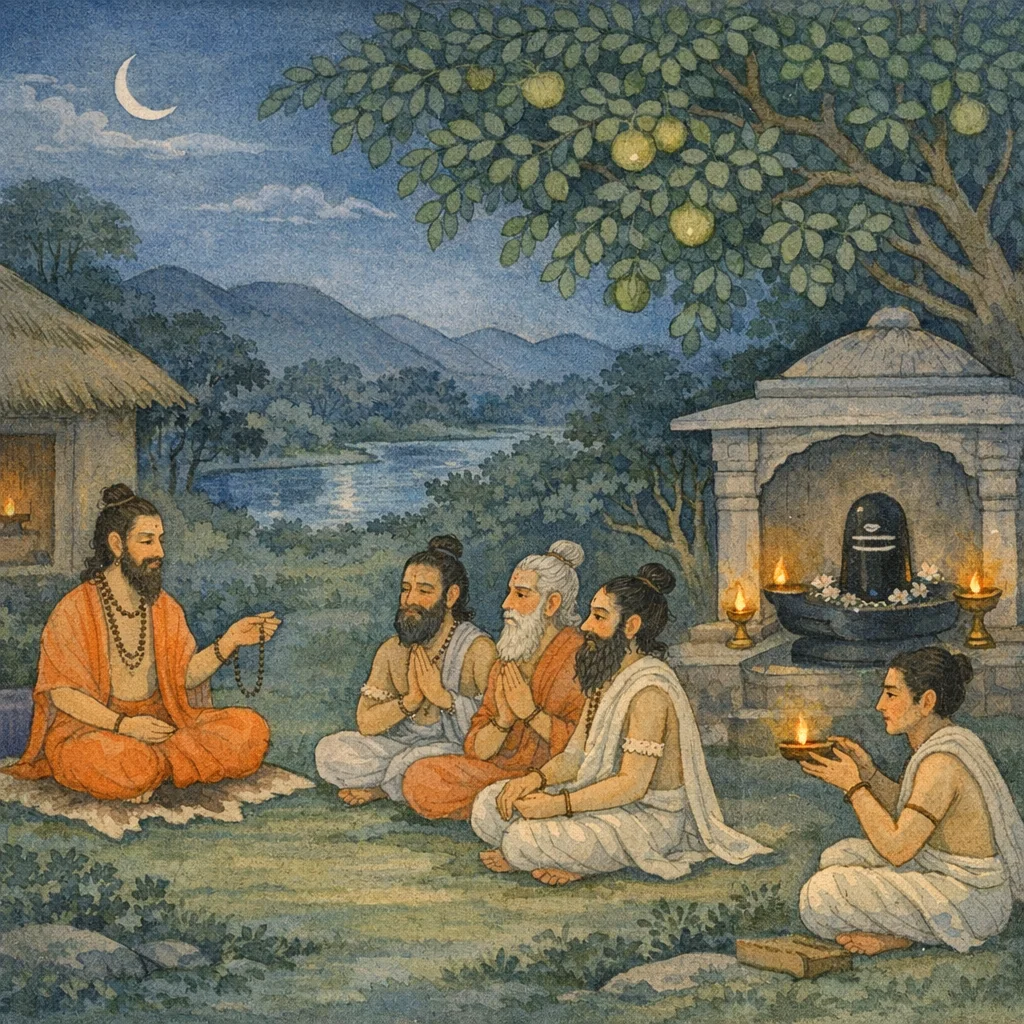
Adhyaya 79
Adhyaya 79 — Bhakti-Mahima and Linga-Archana-Vidhi (Condensed Ritual Sequence)
The sages ask how short-lived, limited humans can worship Mahādeva when even the gods struggle to behold Him through long tapas. Sūta replies that the concern is valid, yet Śiva is approached and even “seen” through śraddhā (reverent faith), and He grants results in accord with the worshipper’s inner disposition. The chapter contrasts impure or wrongly intended worship with correspondingly lower fruits, then presents a constructive, stepwise liṅga-pūjā: purify the liṅga and seat, invoke the deity, offer arghya and other upacāras, perform abhiṣeka with sanctified liquids, adorn with sandal and flowers (especially bilva), offer dhūpa and varied naivedyas, complete pradakṣiṇā and repeated namaskāras, and conclude with mantra-worship of Śiva’s pañcabrahma aspects—Īśāna, Tatpuruṣa/Puruṣa, Aghora, Vāmadeva, and Sadyojāta. It further teaches the devotional economy: even seeing, hearing, approving, or offering a ghee lamp—especially in Kārttika—yields exalted lokas and culminates in Śiva-sāyujya. Thus this adhyāya bridges bhakti doctrine to repeatable daily ritual practice, preparing for further Śiva-centered instruction.
Shlokas
Verse 1
इति श्रीलिङ्गमहापुराणे पूर्वभागे भक्तिमहिमवर्णनं नामाष्टसप्ततितमो ऽध्यायः ऋषय ऊचुः कथं पूज्यो महादेवो मर्त्यैर्मन्दैर्महामते कल्पायुषैर् अल्पवीर्यैर् अल्पसत्त्वैः प्रजापतिः
Thus, in the Śrī Liṅga-Mahāpurāṇa, in the Pūrvabhāga, begins the seventy-ninth chapter called “The Glorification of the Greatness of Bhakti.” The sages said: “O great-minded one, how is Mahādeva—Prajāpati, Lord of beings—to be worshipped by mortal men who are dull, short-lived in this age, of little strength, and of limited inner capacity?”
Verse 2
संवत्सरसहस्रैश् च तपसा पूज्य शङ्करम् न पश्यन्ति सुराश्चापि कथं देवं यजन्ति ते
Even after worshipping Śaṅkara through austerity for thousands of years, the Devas still do not behold Him. If they cannot even see that Deva, how can they truly perform His worship?
Verse 3
सूत उवाच कथितं तथ्यम् एवात्र युष्माभिर् मुनिपुङ्गवाः तथापि श्रद्धया दृश्यः पूज्यः संभाष्य एव च
Sūta said: “O foremost of sages, what you have stated here is indeed true. Even so, He should be approached with faith—beheld with reverence, worshipped, and respectfully addressed.”
Verse 4
प्रसंगाच्चैव सम्पूज्य भक्तिहीनैरपि द्विजाः भावानुरूपफलदो भगवानिति कीर्तितः
O twice-born ones, even when worship is performed only incidentally and without devotion, the Lord (Pati) is praised as the giver of results in accordance with the worshipper’s inner disposition (bhāva).
Verse 5
उच्छिष्टः पूजयन्याति पैशाचं तु द्विजाधमः संक्रुद्धो राक्षसं स्थानं प्राप्नुयान् मूढधीर् द्विजाः
O twice-born ones, a twice-born of the lowest conduct, if he worships while tainted by food-remnants (ucciṣṭa), falls into a piśāca-state. If, with a deluded mind, he worships in anger, he attains a rākṣasa-like station. Thus, O brāhmaṇas, improper disposition and impurity bind the paśu (soul) more tightly to pāśa, rather than leading it toward Pati, Śiva.
Verse 6
अभक्ष्यभक्षी सम्पूज्य याक्षं प्राप्नोति दुर्जनः गानशीलश् च गान्धर्वं नृत्यशीलस्तथैव च
A wicked person who eats what is forbidden, even if he performs worship, attains the state of a Yakṣa. One devoted to singing attains the condition of a Gandharva; likewise, one devoted to dance attains a corresponding destiny. Thus, embodied souls (paśu) move into particular births according to their dominant conduct and tendencies, while true Śiva-realization requires purification beyond mere external acts.
Verse 7
ख्यातिशीलस् तथा चान्द्रं स्त्रीषु सक्तो नराधमः मदार्तः पूजयन् रुद्रं सोमस्थानमवाप्नुयात्
Even a man of low conduct—though famed, of lunar temperament, attached to women, and afflicted by intoxication—if he worships Rudra, attains the abode of Soma, the lunar realm.
Verse 8
गायत्र्या देवमभ्यर्च्य प्राजापत्यमवाप्नुयात् ब्राह्मं हि प्रणवेनैव वैष्णवं चाभिनन्द्य च
Worshipping the Deity with the Gāyatrī, one attains the Prajāpati-state; indeed, by the Pranava (Oṁ) alone one attains the Brahmā-state, and by offering reverent praise one attains the Vaiṣṇava-state as well.
Verse 9
श्रद्धया सकृदेवापि समभ्यर्च्य महेश्वरम् रुद्रलोकमनुप्राप्य रुद्रैः सार्धं प्रमोदते
Even by worshipping Maheśvara (Mahādeva) just once with faith, the bound soul (paśu) attains Rudra’s realm; reaching Rudraloka, one rejoices in the company of the Rudras.
Verse 10
संशोध्य च शुभं लिङ्गम् अमरासुरपूजितम् जलैः पूतैस्तथा पीठे देवमावाह्य भक्तितः
Having first purified the auspicious Liṅga—worshipped by the Devas and even revered among the Asuras—one should cleanse it with sanctified waters; then, upon the pedestal (pīṭha), invoke the Lord with devotion.
Verse 11
दृष्ट्वा देवं यथान्यायं प्रणिपत्य च शङ्करम् कल्पिते चासने स्थाप्य धर्मज्ञानमये शुभे
Having beheld the Lord in the properly prescribed manner and bowing down to Śaṅkara, one should seat Him upon a duly prepared, auspicious seat—imbued with dharma and true knowledge—so that the bound soul (paśu), through right ritual and right understanding, may turn toward the Lord (Pati).
Verse 12
वैराग्यैश्वर्यसम्पन्ने सर्वलोकनमस्कृते ओङ्कारपद्ममध्ये तु सोमसूर्याग्निसंभवे
O Lord, endowed with vairāgya (dispassion) and aiśvarya (sovereign power), revered by all worlds—you manifest within the lotus of Oṃkāra, arising as the threefold radiance of Soma (moon), Sūrya (sun), and Agni (fire).
Verse 13
पाद्यमाचमनं चार्घ्यं दत्त्वा रुद्राय शंभवे स्नापयेद्दिव्यतोयैश् च घृतेन पयसा तथा
Having offered pādya (foot-water), ācamanīya (sipping-water), and arghya to Rudra—the auspicious Śambhu—one should bathe the (Śiva-)Liṅga with consecrated waters, and likewise with ghee and with milk.
Verse 14
दध्ना च स्नापयेद्रुद्रं शोधयेच्च यथाविधि ततः शुद्धांबुना स्नाप्य चन्दनाद्यैश् च पूजयेत्
One should bathe Rudra with dadhi (curd) and purify the worship according to the prescribed rite; then, having bathed Him with pure water, one should worship Him with sandalpaste and other offerings.
Verse 15
रोचनाद्यैश् च सम्पूज्य दिव्यपुष्पैश् च पूजयेत् बिल्वपत्रैरखण्डैश् च पद्मैर्नानाविधैस् तथा
After duly venerating with rocanā and similar sacred unguents, one should worship with celestial flowers; likewise, one should offer unbroken bilva leaves and many kinds of lotuses—thus performing the floral service to Pati, the Lord who loosens the pāśa (bond) of the paśu (soul).
Verse 16
नीलोत्पलैश् च राजीवैर् नद्यावर्तैश् च मल्लिकैः चम्पकैर् जातिपुष्पैश्च बकुलैः करवीरकैः
He should worship Śiva’s Liṅga—Pati, the Lord who loosens the pāśa of the paśu—by offering blue lotuses, red lotuses, nandyāvarta blossoms, jasmine (mallikā), campaka flowers, jāti-flowers, bakula blossoms, and karavīra flowers.
Verse 17
शमीपुष्पैर् बृहत्पुष्पैर् उन्मत्तागस्त्यजैरपि अपामार्गकदम्बैश् च भूषणैरपि शोभनैः
He should adorn the Lord’s Liṅga with śamī blossoms, with large flowers, and also with the flowers of unmattā and agastya; likewise with apāmārga and kadamba, and with beautiful ornaments besides—thus making the worship splendid for Pati, the Lord who frees the paśu from pāśa.
Verse 18
दत्त्वा पञ्चविधं धूपं पायसं च निवेदयेत् दधिभक्तं च मध्वाज्यपरिप्लुतमतः परम्
Having offered five kinds of incense, one should present sweet rice (pāyasa) as naivedya. Thereafter, as the superior offering, one should offer rice mixed with curd, richly moistened with honey and ghee—thus completing the upacāras for the Liṅga, the manifest sign of Pati who releases the paśu from pāśa.
Verse 19
शुद्धान्नं चैव मुद्गान्नं षड्विधं च निवेदयेत् अथ पञ्चविधं वापि सघृतं विनिवेदयेत्
One should offer to the Liṅga pure cooked rice and a preparation of mudga (mung beans), presenting them in six varieties; or else one may offer five kinds of food, each enriched with ghee. Thus the devotee performs naivedya as reverent service to Pati (Śiva), loosening the pāśa of impurity that binds the paśu.
Verse 20
केवलं चापि शुद्धान्नम् आढकं तण्डुलं पचेत् कृत्वा प्रदक्षिणं चान्ते नमस्कृत्य मुहुर्मुहुः
He should also cook a simple, pure meal, using one āḍhaka measure of rice. Then, at the end, having circumambulated (the Lord/Śiva-liṅga), he should bow down again and again.
Verse 21
स्तुत्वा च देवमीशानं पुनः सम्पूज्य शङ्करम् ईशानं पुरुषं चैव अघोरं वाममेव च
Having praised the Lord Īśāna and again duly worshipped Śaṅkara, the devotee should contemplate and adore Śiva as Īśāna, as Puruṣa (Tatpuruṣa), as Aghora, and as Vāma (Vāmadeva).
Verse 22
सद्योजातं जपंश्चापि पञ्चभिः पूजयेच्छिवम् अनेन विधिना देवः प्रसीदति महेश्वरः
By reciting the Sadyojāta mantra and worshipping Śiva through the fivefold Pañcabrahma method, by this very rite the Lord Maheśvara becomes gracious and well pleased.
Verse 23
वृक्षाः पुष्पादिपत्राद्यैर् उपयुक्ताः शिवार्चने गावश्चैव द्विजश्रेष्ठाः प्रयान्ति परमां गतिम्
O best of the twice-born, trees—when their flowers, leaves, and the like are used in Śiva’s worship—and likewise cows, attain the supreme state, for even bound beings are uplifted when linked to the service of Pati, Lord Śiva.
Verse 24
पूजयेद्यः शिवं रुद्रं शर्वं भवमजं सकृत् स याति शिवसायुज्यं पुनरावृत्तिवर्जितम्
Whoever even once worships Śiva—Rudra, Śarva, Bhava, the Unborn—attains śiva-sāyujya, union with Śiva, and is freed from return, with rebirth brought to an end.
Verse 25
अर्चितं परमेशानं भवं शर्वमुमापतिम् सकृत्प्रसंगाद्वा दृष्ट्वा सर्वपापैः प्रमुच्यते
Having beheld—even once, whether intentionally or by mere chance—the worshipped Supreme Lord, Parameśāna, Pati: Bhava, Śarva, the consort of Umā, one is released from all sins and from the pāśa-like impurities that bind the soul.
Verse 26
पूजितं वा महादेवं पूज्यमानमथापि वा दृष्ट्वा प्रयाति वै मर्त्यो ब्रह्मलोकं न संशयः
Whether Mahādeva has already been worshipped or is being worshipped, merely seeing that worship a mortal surely attains Brahmaloka; of this there is no doubt.
Verse 27
श्रुत्वानुमोदयेच्चापि स याति परमां गतिम् यो दद्याद् घृतदीपं च सकृल्लिङ्गस्य चाग्रतः
Even one who merely hears of this and gives reverent assent attains the supreme state. How much more the one who, even once, offers a ghee-lamp before the Liṅga: he reaches the highest goal, draws near to Pati (Śiva), and loosens the pāśa-bonds that bind the paśu, the individual soul.
Verse 28
स तां गतिम् अवाप्नोति स्वाश्रमैर् दुर्लभां स्थिराम् दीपवृक्षं पार्थिवं वा दारवं वा शिवालये
He attains that steadfast state—rare even for those established in their own āśramas—by setting up in Śiva’s temple (Śivālaya) a lamp-stand, the “lamp-tree” (dīpa-vṛkṣa), whether made of earth or fashioned from wood.
Verse 29
दत्त्वा कुलशतं साग्रं शिवलोके महीयते आयसं ताम्रजं वापि रौप्यं सौवर्णिकं तथा
Having bestowed in full measure a gift that benefits a hundred families, one is honored in Śiva’s world. Such an offering may be of iron, or of copper, or of silver, and likewise of gold.
Verse 30
शिवाय दीपं यो दद्याद् विधिना वापि भक्तितः सूर्यायुतसमैः श्लक्ष्णैर् यानैः शिवपुरं व्रजेत्
Whoever offers a lamp to Śiva—according to proper rite or even purely out of devotion—shall proceed to Śiva’s city (Śivapura), conveyed by exquisite chariots radiant like ten thousand suns.
Verse 31
कार्तिके मासि यो दद्याद् घृतदीपं शिवाग्रतः सम्पूज्यमानं वा पश्येद् विधिना परमेश्वरम्
Whoever, in the month of Kārttika, offers a ghee-lamp before Śiva—or, according to proper rite, beholds Parameśvara being duly worshipped—attains the auspicious fruit born of that sacred act of Śiva-devotion (Śiva-bhakti).
Verse 32
स याति ब्रह्मणो लोकं श्रद्धया मुनिसत्तमाः आवाहनं सुसान्निध्यं स्थापनं पूजनं तथा
O best of sages, one who, with faith, performs the Lord’s invocation in the Liṅga (āvāhana), the rite of establishing His auspicious presence (susānnidhya), the installation (sthāpana), and the worship (pūjana), attains the world of Brahmā, rising by merit on the path that culminates in the grace of Pati, Śiva.
Verse 33
सम्प्रोक्तं रुद्रगायत्र्या आसनं प्रणवेन वै पञ्चभिः स्नपनं प्रोक्तं रुद्राद्यैश् च विशेषतः
The seat offering (āsana) is prescribed with the Rudra-Gāyatrī, and indeed with the Praṇava (Oṁ). The purificatory bathing (snapana) is taught with five cleansing formulas, especially with the Rudra-mantras and the others.
Verse 34
एवं सम्पूजयेन्नित्यं देवदेवमुमापतिम् ब्रह्माणं दक्षिणे तस्य प्रणवेन समर्चयेत्
Thus one should worship daily the God of gods—Umāpati, the Lord united with Śakti. On His right side one should also duly honor Brahmā, offering worship with the Praṇava (Oṁ).
Verse 35
उत्तरे देवदेवेशं विष्णुं गायत्रिया यजेत् वह्नौ हुत्वा यथान्यायं पञ्चभिः प्रणवेन च
Then, in the northern direction, one should worship Viṣṇu—the Lord of the gods—by means of the Gāyatrī; and, having offered oblations into the sacred fire according to rule, one should also offer five oblations with the Praṇava (Oṁ).
Verse 36
स याति शिवसायुज्यम् एवं सम्पूज्य शङ्करम् इति संक्षेपतः प्रोक्तो लिङ्गार्चनविधिक्रमः
Thus, having duly worshipped Śaṅkara in this manner, the paśu (bound soul) attains Śiva-sāyujya—union in the Lord’s nearness and participation in His divine sameness. In brief, this is the taught sequence of the rite for worship of the Liṅga.
Verse 37
व्यासेन कथितः पूर्वं श्रुत्वा रुद्रमुखात्स्वयम्
Formerly, Vyāsa expounded this after personally hearing it from the very mouth of Rudra; thus the Śaiva teaching is preserved as the direct revelation of Pati (Śiva), for the liberation of the paśu, the bound soul.
Frequently Asked Questions
Liṅga and pīṭha purification (śodhana), āvāhana (invocation), respectful darśana and praṇāma, offering pādya–ācamanīya–arghya, abhiṣeka with pure waters and auspicious substances (ghee, milk, curd, etc.), adornment with sandal/flowers and bilva, dhūpa and naivedya, pradakṣiṇā and repeated namaskāra, and mantra-worship through the pañcabrahma forms (Īśāna, Tatpuruṣa, Aghora, Vāmadeva, Sadyojāta).
It states that even once-only worship with śraddhā can lead to Rudraloka and joy among Rudras, and that worship, darśana of worship, hearing and approving it (anumodana), and dīpa-dāna can elevate one through higher lokas—culminating in Śiva-sāyujya, described as freedom from return (punarāvṛtti-varjita).
Offering a ghee lamp before the liṅga is presented as a powerful, accessible act whose merit grants rare, stable attainment; Kārttika-month lamp offerings and proper darśana of worship are specifically linked to Brahmaloka and higher spiritual fruition.