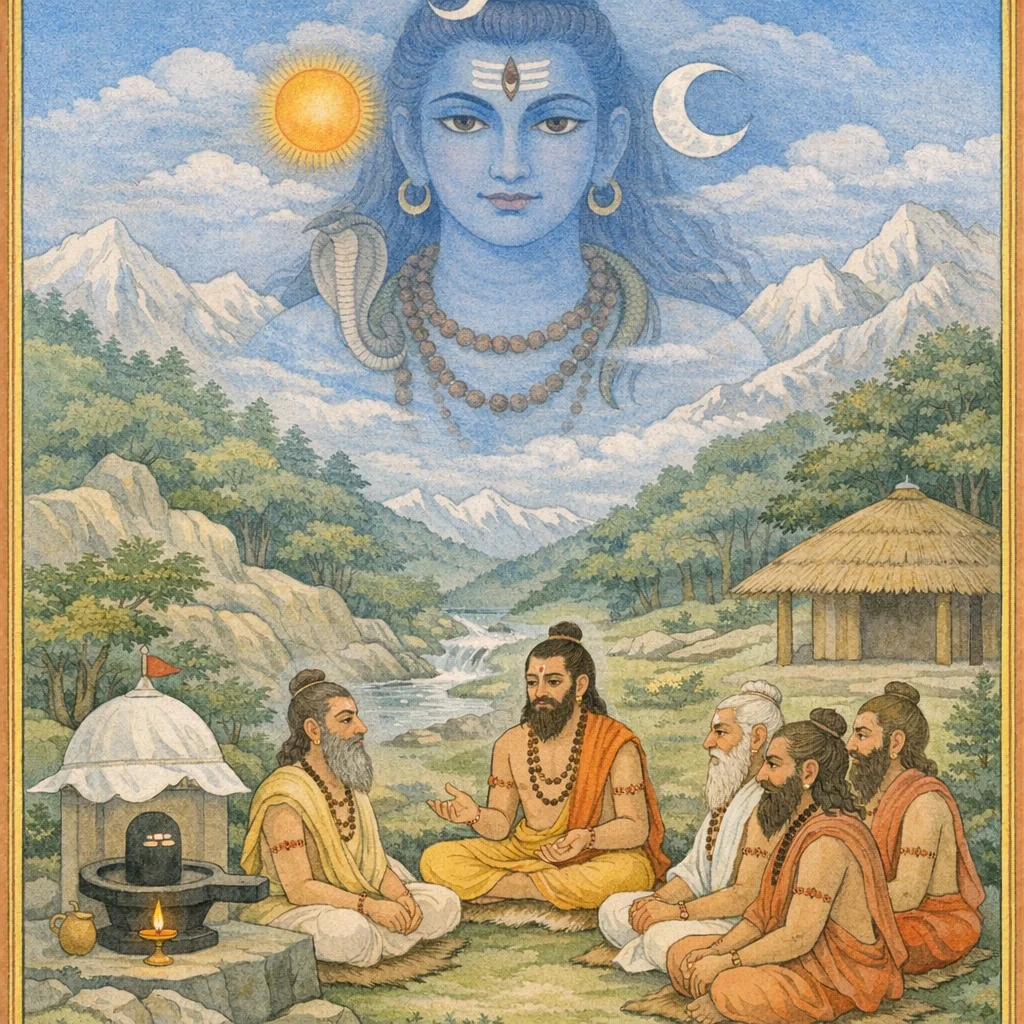
Adhyaya 75
Adhyaya 75: Nishkala–Sakala Shiva, Twofold Linga, and the Supremacy of Dhyana-Yajna
In reply to the ṛṣis’ question of how the eternally partless Śiva (niṣkala) appears as if possessed of parts (sakala), Sūta presents differing yet convergent teachings on jñāna: some call true knowing the realization centered on the praṇava (Om), others define it as errorless cognition, and others as supportless nirvikalpa purity illumined by the guru. Mokṣa depends on jñāna, is perfected by prasāda (grace), and made steady through yoga. The chapter then maps Śiva as the cosmic body (sky as head, sun–moon–fire as eyes, directions as ears, and so on), joining metaphysical unity with devotional visualization. A graded discipline is taught—karma-yajña < tapo-yajña < japa-yajña < dhyāna-yajña—declaring meditation the highest sacrifice that reveals Śiva’s nearness. It distinguishes the gross external liṅga for ritualists from the subtle inner liṅga directly manifest to jñānins, warning against outward worship without inward realization. Finally it reconciles unity and multiplicity: all that is perceived is Śiva; difference is mere appearance, and Śiva’s praised threefold body (niṣkala, sakala-niṣkala, sakala) guides seekers from form-based worship to contemplative non-duality, preparing the next teaching on worship-forms and yogic vision within yantric geometries.
Shlokas
Verse 1
इति श्रीलिङ्गमहापुराणे पूर्वभागे शिवलिङ्गभेदसंस्थापनादिवर्णनं नाम चतुःसप्ततितमो ऽध्यायः ऋषय ऊचुः निष्कलो निर्मलो नित्यः सकलत्वं कथं गतः वक्तुमर्हसि चास्माकं यथा पूर्वं यथा श्रुतम्
Thus, in the Śrī Liṅga-Mahāpurāṇa, in the Pūrva-bhāga, begins the seventy-fifth chapter, called “The description of the varieties of the Śiva-Liṅga and the rules of their installation.” The sages said: “He who is partless, stainless, and eternal—how did that very Lord attain a ‘manifest-with-parts’ state? Please explain this to us, just as it was formerly stated and as we have heard in tradition.”
Verse 2
सूत उवाच परमार्थविदः केचिद् ऊचुः प्रणवरूपिणम् विज्ञानमिति विप्रेन्द्राः श्रुत्वा श्रुतिशिरस्यजम्
Sūta said: O best of Brahmins, some knowers of the highest truth declared, after hearing of Him who is born from the crest of the Veda, that the supreme liberating Knowledge is of the very form of the Praṇava (Oṁ)—the Pati (Lord) revealed as the essence of the Upaniṣadic summit.
Verse 3
शब्दादिविषयं ज्ञानं ज्ञानमित्यभिधीयते तज्ज्ञानं भ्रान्तिरहितम् इत्यन्ये नेति चापरे
Cognition that has sound and the other sense-objects as its field is called “knowledge.” Some maintain that knowledge is what is free from delusion; others, however, deny this as a complete definition.
Verse 4
यज्ज्ञानं निर्मलं शुद्धं निर्विकल्पं निराश्रयम् गुरुप्रकाशकं ज्ञानम् इत्यन्ये मुनयो द्विजाः
That knowledge which is stainless and pure, free from mental constructions and independent of external supports—knowledge that illumines the Guru (as the revealer of the Pati, Śiva)—thus do other sages and twice-born ones describe true knowledge.
Verse 5
ज्ञानेनैव भवेन्मुक्तिः प्रसादो ज्ञानसिद्धये उभाभ्यां मुच्यते योगी तत्रानन्दमयो भवेत्
Liberation arises through knowledge alone; yet divine grace brings knowledge to perfection. Endowed with both (knowledge and grace), the yogin is released from bondage, and in that state he becomes filled with bliss.
Verse 6
वदन्ति मुनयः केचित् कर्मणा तस्य संगतिम् कल्पनाकल्पितं रूपं संहृत्य स्वेच्छयैव हि
Some sages say that His association with embodied existence is due to karma; yet, having withdrawn the form fashioned by conceptual construction, He abides and acts solely by His own free will. Thus the Pati (Lord), untouched by bonds, assumes and dissolves appearances without being conditioned by them.
Verse 7
द्यौर्मूर्धा तु विभोस्तस्य खं नाभिः परमेष्ठिनः सोमसूर्याग्नयो नेत्रे दिशः श्रोत्रं महात्मनः
The sky is the head of that all-pervading Lord; the open firmament is the navel of the Supreme Creator. The Moon, the Sun, and Fire are His eyes, and the directions themselves are the ears of that Great-Souled One.
Verse 8
चरणौ चैव पातालं समुद्रस्तस्य चांबरम् देवास्तस्य भुजाः सर्वे नक्षत्राणि च भूषणम्
The netherworlds are indeed His feet; the ocean is His garment. All the Devas are His arms, and the constellations are His ornaments. Thus is the all-pervading Lord (Pati), the inner Self of the cosmos, envisioned in the Linga Purana’s Shaiva vision.
Verse 9
प्रकृतिस्तस्य पत्नी च पुरुषो लिङ्गमुच्यते वक्त्राद्वै ब्राह्मणाः सर्वे ब्रह्मा च भगवान्प्रभुः
Prakṛti is declared to be His consort, and the Puruṣa is spoken of as the Liṅga, the supreme sign. From His mouth, indeed, all the Brāhmaṇas arise—and Brahmā, the blessed Lord and sovereign, is born there as well.
Verse 10
इन्द्रोपेन्द्रौ भुजाभ्यां तु क्षत्रियाश् च महात्मनः वैश्याश्चोरुप्रदेशात्तु शूद्राः पादात्पिनाकिनः
From His arms arose Indra and Upendra, and also the Kṣatriyas, O great-souled one; from the region of His thighs came the Vaiśyas; and from His feet came the Śūdras—thus all issued forth from Pinākin, the Lord who bears the bow.
Verse 11
पुष्करावर्तकाद्यास्तु केशास्तस्य प्रकीर्तिताः वायवो घ्राणजास्तस्य गतिः श्रौतं स्मृतिस् तथा
His hairs are proclaimed to be the whirlpools beginning with Puṣkara-āvarta; from His sense of smell arise the winds. His movement accords with the Śrauta (Vedic sacrificial) order, and so too does the remembered tradition (Smṛti).
Verse 12
अथानेनैव कर्मात्मा प्रकृतेस्तु प्रवर्तकः पुंसां तु पुरुषः श्रीमान् ज्ञानगम्यो न चान्यथा
Thus, by Him alone—the very Self of action—the movement of Prakṛti is set in motion; and for embodied beings, that auspicious Puruṣa (the Lord, Pati) is attainable only through true knowledge, and by no other means.
Verse 13
कर्मयज्ञसहस्रेभ्यस् तपोयज्ञो विशिष्यते तपोयज्ञसहस्रेभ्यो जपयज्ञो विशिष्यते
Than a thousand ritual sacrifices performed through action, the sacrifice of austerity is superior; and than a thousand sacrifices of austerity, the sacrifice of japa—the repetition of the Divine Name, especially of Śiva—is superior. Thus, for the bound soul (paśu), inward worship through mantra becomes the most direct means toward Śiva (Pati).
Verse 14
जपयज्ञसहस्रेभ्यो ध्यानयज्ञो विशिष्यते ध्यानयज्ञात्परो नास्ति ध्यानं ज्ञानस्य साधनम्
More excellent than thousands of sacrifices of mantra-recitation is the sacrifice of meditation. There is nothing higher than the meditative sacrifice, for meditation is the direct means to liberating knowledge—where the bound soul (paśu) recognizes the Lord (Pati) beyond all bonds (pāśa).
Verse 15
यदा समरसे निष्ठो योगी ध्यानेन पश्यति ध्यानयज्ञरतस्यास्य तदा संनिहितः शिवः
When the yogin, firmly established in the state of equal savor (samarasa), beholds through meditation, then for that practitioner devoted to the sacrifice of contemplation (dhyāna-yajña), Śiva becomes directly present—near at hand.
Verse 16
नास्ति विज्ञानिनां शौचं प्रायश्चित्तादि चोदना विशुद्धा विद्यया सर्वे ब्रह्मविद्याविदो जनाः
For those established in true spiritual knowledge, there is no injunction regarding ritual purity or expiatory rites. All who know Brahma-vidyā are purified by knowledge itself.
Verse 17
नास्ति क्रिया च लोकेषु सुखं दुःखं विचारतः धर्माधर्मौ जपो होमो ध्यानिनां संनिधिः सदा
Upon true discernment, no action in the worlds is, in itself, happiness or sorrow. So too, dharma and adharma, japa and homa—these ever abide in the presence of the meditators, for their inward contemplation gathers all rites into the nearness of the Lord (Pati).
Verse 18
परानन्दात्मकं लिङ्गं विशुद्धं शिवमक्षरम् निष्कलं सर्वगं ज्ञेयं योगिनां हृदि संस्थितम्
Know the Liṅga as the very essence of supreme bliss—utterly pure, Shiva Himself, the imperishable Reality; partless (beyond divisions), all-pervading, and established within the heart of yogins.
Verse 19
लिङ्गं तु द्विविधं प्राहुर् बाह्यमाभ्यन्तरं द्विजाः बाह्यं स्थूलं मुनिश्रेष्ठाः सूक्ष्ममाभ्यन्तरं द्विजाः
The twice-born declare that the Liṅga is of two kinds—external and internal. The external Liṅga is the gross form, O best of sages; the internal Liṅga, O twice-born, is subtle, known through inward realization.
Verse 20
कर्मयज्ञरताः स्थूलाः स्थूललिङ्गार्चने रताः असतां भावनार्थाय नान्यथा स्थूलविग्रहः
Those intent on ritual action and sacrifice—whose understanding remains outward and gross—delight in worship of the gross (manifest) Liṅga. For the sake of cultivating bhakti and right contemplation in unrefined minds, the gross embodied form is prescribed; it is not otherwise.
Verse 21
आध्यात्मिकं च यल्लिङ्गं प्रत्यक्षं यस्य नो भवेत् असौ मूढो बहिः सर्वं कल्पयित्वैव नान्यथा
For one to whom the inner, spiritual Liṅga is not directly evident, that person is deluded—projecting everything outward by imagination alone, and in no other way.
Verse 22
ज्ञानिनां सूक्ष्मममलं भवेत्प्रत्यक्षमव्ययम् यथा स्थूलमयुक्तानां मृत्काष्ठाद्यैः प्रकल्पितम्
For the jñānins, the subtle, stainless, imperishable Reality becomes directly evident; but for the unyoked and undisciplined, it is imagined only as something gross—fashioned from clay, wood, and the like.
Verse 23
अर्थो विचारतो नास्तीत्य् अन्ये तत्त्वार्थवेदिनः निष्कलः सकलश्चेति सर्वं शिवमयं ततः
Others—knowers of the true purport of reality—declare: “When examined in ultimate discernment, no separate ‘object’ truly exists.” Therefore, whether as the partless (niṣkala) or as the manifest with parts (sakala), everything is pervaded by Shiva alone.
Verse 24
व्योमैकमपि दृष्टं हि शरावं प्रति सुव्रताः पृथक्त्वं चापृथक्त्वं च शङ्करस्येति चापरे
O steadfast ones, just as the one sky is perceived in relation to a bowl as though divided, so too some speak of Śaṅkara as both distinct and not distinct—appearing as differentiated for the sake of manifestation, yet remaining non-different in His supreme reality as Pati.
Verse 25
प्रत्ययार्थं हि जगताम् एकस्थो ऽपि दिवाकरः एको ऽपि बहुधा दृष्टो जलाधारेषु सुव्रताः
For the sake of certitude for beings in the worlds, the Sun—though stationed in one place—appears as many when reflected in vessels of water, O you of noble vows. Likewise, the one Pati (Śiva) is perceived as manifold through the upādhis of the pashus, while remaining non-dual in essence.
Verse 26
जन्तवो दिवि भूमौ च सर्वे वै पाञ्चभौतिकाः तथापि बहुला दृष्टा जातिव्यक्तिविभेदतः
All living beings—whether in heaven or on earth—are indeed constituted of the five great elements. Yet they are seen to be manifold, owing to distinctions of species and individual embodiment.
Verse 27
दृश्यते श्रूयते यद्यत् तत्तद्विद्धि शिवात्मकम् भेदो जनानां लोके ऽस्मिन् प्रतिभासो विचारतः
Whatever is seen and whatever is heard—know all that to be of Śiva’s very nature. The sense of difference among people in this world is only an appearance, when examined with true discernment.
Verse 28
स्वप्ने च विपुलान् भोगान् भुक्त्वा मर्त्यः सुखी भवेत् दुःखी च भोगं दुःखं च नानुभूतं विचारतः
Even in a dream, having “enjoyed” abundant pleasures, a mortal may feel happy; and likewise may feel sorrow. Yet, by right discrimination, one knows that neither pleasure nor pain was truly experienced—being only a projection of the mind, not the reality of the Pati (Lord) beyond all change.
Verse 29
एवमाहुस्तथान्ये च सर्वे वेदार्थतत्त्वगाः हृदि संसारिणां साक्षात् सकलः परमेश्वरः
So declare they—and others as well—all who have realized the true purport of the Vedas: within the heart of embodied beings bound to transmigration, the Supreme Lord Parameśvara is present directly, in His complete (sakala) form.
Verse 30
योगिनां निष्कलो देवो ज्ञानिनां च जगन्मयः त्रिविधं परमेशस्य वपुर्लोके प्रशस्यते
For yogins, the Deva is partless and transcendent (niṣkala); for the knowers of truth, He is immanent as the very body of the universe. Thus, in the world, Parameśvara is praised as having a threefold form.
Verse 31
निष्कलं प्रथमं चैकं ततः सकलनिष्कलम् तृतीयं सकलं चैव नान्यथेति द्विजोत्तमाः
O best of the twice-born, the first is the one, partless Reality (niṣkala); then comes that which is both with-form and formless (sakala–niṣkala); the third is wholly with-form (sakala). It is not otherwise.
Verse 32
अर्चयन्ति मुहुः केचित् सदा सकलनिष्कलम् सर्वज्ञं हृदये केचिच् छिवलिङ्गे विभावसौ
Some repeatedly worship the all-knowing Lord, who is ever both with form (sakala) and beyond form (niṣkala). Others contemplate that omniscient Shiva within the heart; and others worship Him as the Shiva-Linga in the sacred fire (Agni).
Verse 33
सकलं मुनयः केचित् सदा संसारवर्तिनः एवमभ्यर्चयन्त्येव सदाराः ससुता नराः
O sages, some seers—though ever moving within the round of saṁsāra—worship in this very manner; likewise do householders, together with their wives and sons, continually perform reverent adoration of the Lord as the Liṅga.
Verse 34
यथा शिवस् तथा देवी यथा देवी तथा शिवः तस्मादभेदबुद्ध्यैव सप्तविंशत्प्रभेदतः
As Shiva is, so is the Goddess; and as the Goddess is, so is Shiva. Therefore one should hold the understanding of their non-difference, though they are spoken of through the twenty-sevenfold classifications.
Verse 35
यजन्ति देहे बाह्ये च चतुष्कोणे षडस्रके दशारे द्वादशारे च षोडशारे त्रिरस्रके
They worship (Śiva) within the body and also externally—establishing the sacred form in a four-cornered (square) enclosure, in a six-angled figure, in a ten-pointed, in a twelve-pointed, in a sixteen-pointed, and in a triangular mandala.
Verse 36
स स्वेच्छया शिवः साक्षाद् देव्या सार्धं स्थितः प्रभुः संतारणार्थं च शिवः सदसद्व्यक्तिवर्जितः
By his own free will, Shiva—the Lord himself—stood manifest, together with the Goddess. And for the sake of ferrying beings across bondage, Shiva abides beyond the categories of existent and non-existent, and beyond the merely manifest and unmanifest.
Verse 37
तमेकमाहुर्द्विगुणं च केचित् केचित्तमाहुस्त्रिगुणात्मकं च ऊचुस् तथा तं च शिवं तथान्ये संसारिणं वेदविदो वदन्ति
The knowers of the Veda speak of Him in many ways: some declare Him the One alone; some describe Him as endowed with twofold powers; others call Him of the nature of the three guṇas. Some proclaim Him as Śiva, while others even describe Him as moving within saṃsāra—thus do the learned speak, according to their standpoints.
Verse 38
भक्त्या च योगेन शुभेन युक्ता विप्राः सदा धर्मरता विशिष्टाः यजन्ति योगेशम् अशेषमूर्तिं षडस्रमध्ये भगवन्तमेव
Endowed with devotion and auspicious Yoga, the eminent brahmin sages—ever devoted to dharma—worship within the six-angled sacred diagram that very Blessed Lord, the Lord of Yoga, whose forms are without limit and who pervades all manifestations.
Verse 39
ये तत्र पश्यन्ति शिवं त्रिरस्रे त्रितत्त्वमध्ये त्रिगुणं त्रियक्षम् ते यान्ति चैनं न च योगिनो ऽन्ये तया च देव्या पुरुषं पुराणम्
Those who, there (in that yogic locus), behold Śiva—three-edged, abiding in the midst of the three principles, appearing through the three guṇas, and the Three‑Eyed Lord—attain Him. Other yogins do not reach that Eternal, Primordial Puruṣa unless led by that Devī (Śakti).
Frequently Asked Questions
It presents Shiva as fundamentally niṣkala (partless, pure) while also approachable as sakala through manifestation and worship; the ‘sakala-niṣkala’ mode bridges ritual form and inner realization without denying transcendence.
Because dhyāna is explicitly called the direct sādhana of jñāna; when the yogin abides in one-flavor absorption (samarasa), Shiva is said to be immediately present (sannihitaḥ).
The gross external liṅga supports embodied practitioners by giving a stable focus for bhāvanā and devotion; it is a compassionate aid for those not yet able to perceive the subtle inner liṅga directly.