Adhyaya 61
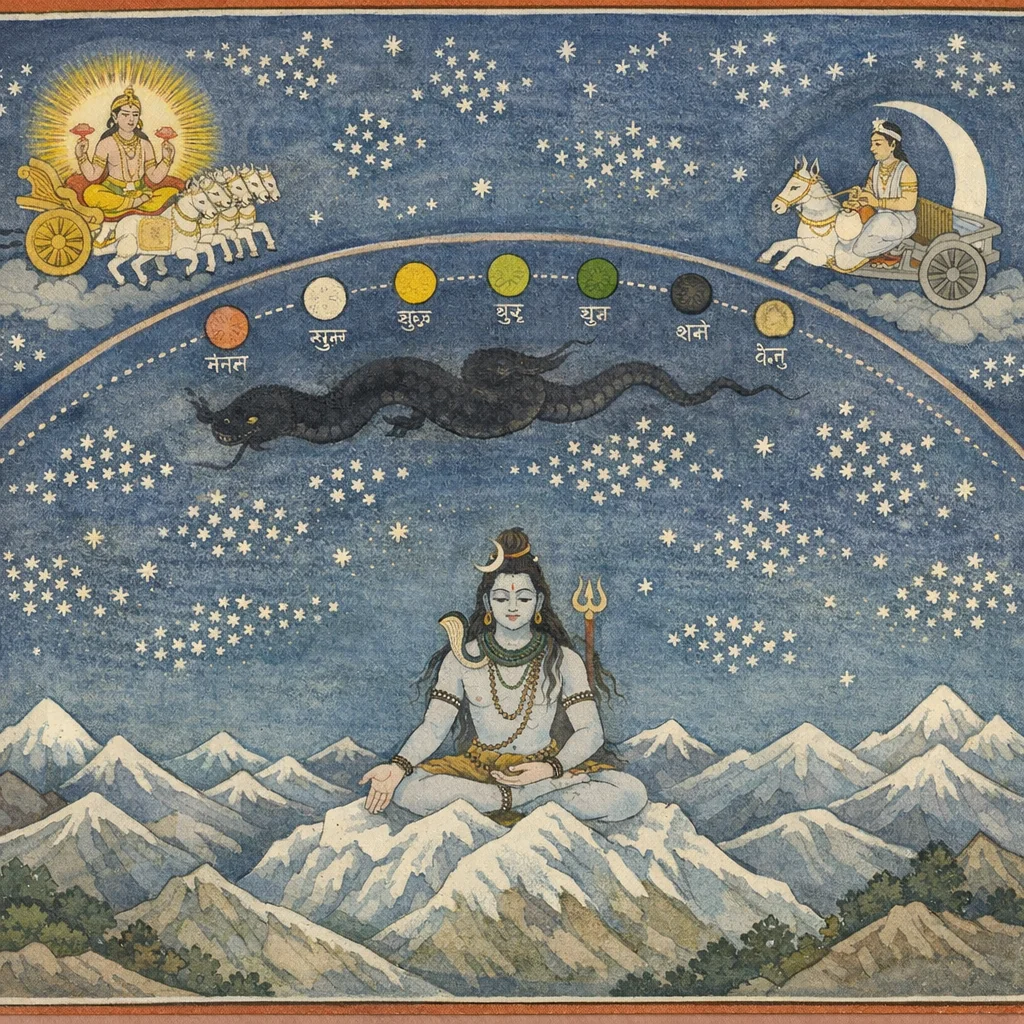
Adhyaya 61 — ग्रह-नक्षत्र-स्थाननिर्णयः (Cosmic Abodes of Luminaries and the Shaiva Order of Time)
Suta explains that the Sun, Moon, planets, and stars serve as “abodes/positions” (gṛha/sthāna) for divine presences across the manvantaras, created by Svayambhu at the kalpa’s beginning and enduring until pralaya. The chapter gives etymologies (such as Savitṛ), describes the solar and lunar spheres as luminous and aqueous in nature, and enumerates the planetary residences—Sun (sauram), Moon (saumyam), Venus (śaukrum), Jupiter (Bṛhaspati), Mars (lohita), Saturn (Śanaiścara), Mercury (baudha), and Svarbhanu/Rahu—along with their colors, rays, and yojana-based proportions. It notes nakshatra origins connected with various grahas and explains Rahu’s dark station and motion relative to Sun and Moon in mythic-technical terms that frame eclipse-like dynamics. The discourse concludes with a Shaiva thesis: the entire jyotisha order was arranged by Mahadeva for practical worldly governance and for the discernment of the wise, confirmed through śāstra, perception, inference, and disciplined examination, preparing for later teachings where cosmic order upholds dharma and Shiva-oriented liberation.
Shlokas
Verse 1
इति श्रीलिङ्गमहापुराणे पूर्वभागे षष्टितमो ऽध्यायः सूत उवाच क्षेत्राण्येतानि सर्वाणि आतपन्ति गभस्तिभिः तेषां क्षेत्राण्यथादत्ते सूर्यो नक्षत्रतारकाः
Sūta said: All these sacred fields (kṣetras) are warmed and illumined by the Sun’s rays; and for those very regions, the Sun—together with the lunar mansions (nakṣatras) and the stars—apportions their due measures of time and order. Thus even the celestial lights serve the sanctity and rhythm of the holy kṣetras, where Pati (Śiva) is worshipped to release the paśu from pāśa.
Verse 2
चीर्णेन सुकृतेनेह सुकृतान्ते ग्रहाश्रयाः तारणात्तारका ह्येताः शुक्लत्वाच्चैव तारकाः
By the sukṛta (merit) practiced here, at the culmination of that merit beings attain the abodes of the grahas (luminaries). They are called “tārakās” because they ferry the bound paśu across; and they are also called “tārakās” because of their bright, white radiance.
Verse 3
दिव्यानां पार्थिवानां च नैशानां चैव सर्वशः आदानान्नित्यमादित्यस् तेजसां तमसामपि
From the celestial, the earthly, and the nocturnal realms in every way, Āditya (the Sun) continually draws in and absorbs all powers—both the luminous energies and even the darkening forces. Thus he functions as the cosmic collector within the Lord’s ordered creation.
Verse 4
सवने स्यन्दने ऽर्थे च धातुर् एष विभाष्यते सवनात्तेजसो ऽपां च तेनासौ सविता मतः
This verbal root is explained with the senses of “impelling/bringing forth” and “causing to flow.” Because he brings forth tejas (radiance) and sets the waters in motion, he is therefore understood as Savitṛ. In the Śaiva vision, this enlivening power functions under Pati—Śiva—as the inner Lord who awakens creation.
Verse 5
बहुलश्चन्द्र इत्येष ह्लादने धातुरुच्यते शुक्लत्वे चामृतत्वे च शीतत्वे च विभाव्यते
The names “Bahula” and “Candra” are said to arise from the verbal root meaning “to gladden.” They are understood through whiteness, amṛta-like immortality, and coolingness.
Verse 6
सूर्याचन्द्रमसोर्दिव्ये मण्डले भास्वरे खगे जलतेजोमये शुक्ले वृत्तकुंभनिभे शुभे
In the divine, radiant celestial sphere of the Sun and the Moon—bright in the sky—there shines an auspicious white orb, formed of water and fiery brilliance, like a perfectly rounded jar.
Verse 7
घनतोयात्मकं तत्र मण्डलं शशिनः स्मृतम् घनतेजोमयं शुक्लं मण्डलं भास्करस्य तु
There, the lunar orb (Śaśin) is taught to be of the nature of condensed water; but the solar orb (Bhāskara) is a bright, white sphere made of concentrated radiance. Thus the Purāṇa distinguishes the Moon’s cooling, nourishing principle from the Sun’s blazing, illuminating power—both functioning within Śiva’s cosmic order that binds and guides the paśu (embodied soul) toward right discernment.
Verse 8
वसन्ति सर्वदेवाश् च स्थानान्येतानि सर्वशः मन्वन्तरेषु सर्वेषु ऋक्षसूर्यग्रहाश्रयाः
All the gods dwell—everywhere—in these sacred abodes, throughout all Manvantaras, as the sustaining supports of the constellations, the Sun, and the planets.
Verse 9
तेन ग्रहा गृहाण्येव तदाख्यास्ते भवन्ति च सौरं सूर्यो ऽविशत्स्थानं सौम्यं सोमस्तथैव च
Therefore the Grahas (planetary deities) are known by the very names of their respective abodes. Thus the Sun entered the solar station (Saura), and in the same manner the Moon entered the lunar station (Saumya).
Verse 10
शौक्रं शुक्रो ऽविशत्स्थानं षोडशार्चिः प्रतापवान् बृहद् बृहस्पतिश्चैव लोहितश्चैव लोहितम्
The radiant Śukra entered his Venusian station, blazing with sixteen rays and mighty splendor. Likewise Bṛhaspati entered the great Jovian station, and Lohita (Maṅgala) entered the red Martian station.
Verse 11
शनैश्चरं तथा स्थानं देवश्चापि शनैश्चरः बौधं बुधस्तु स्वर्भानुः स्वर्भानुस्थानमाश्रितः
Likewise, the abode of Śanaiścara (Saturn) is established, and the deity there is also Śanaiścara. Budha (Mercury) abides in the Budha-region; and Svarbhānu (Rāhu), having taken refuge in his own station, remains in the Svarbhānu-abode.
Verse 12
नक्षत्राणि च सर्वाणि नक्षत्राणि विशन्ति च गृहाण्येतानि सर्वाणि ज्योतींषि सुकृतात्मनाम्
All the constellations and stellar stations are entered as abodes; all these luminous spheres become the dwellings of those whose inner being is refined by meritorious action—souls (paśu) uplifted through dharma and devotion toward the Lord Paśupati.
Verse 13
कल्पादौ सम्प्रवृत्तानि निर्मितानि स्वयंभुवा स्थानान्येतानि तिष्ठन्ति यावद् आभूतसंप्लवम्
These sacred abodes, set in motion at the very beginning of the kalpa and established by Svayambhū (Brahmā), endure unchanged until the great dissolution that overwhelms all beings.
Verse 14
मन्वन्तरेषु सर्वेषु देवस्थानानि तानि वै अभिमानिनो ऽवतिष्ठन्ते देवाः स्थानं पुनः पुनः
In every Manvantara, those very divine abodes indeed remain; and the presiding Devas—identified with their respective offices—take their station there again and again, returning repeatedly to the same posts.
Verse 15
अतीतैस्तु सहैतानि भाव्याभाव्यैः सुरैः सह वर्तन्ते वर्तमानैश् च स्थानिभिस्तैः सुरैः सह
These cosmic functions and stations endure in unbroken continuity—together with the gods of the past, together with the gods yet to come (and those not destined to arise), and also with the presently existing gods who hold their appointed offices.
Verse 16
अस्मिन्मन्वन्तरे चैव ग्रहा वैमानिकाः स्मृताः विवस्वानदितेः पुत्रः सूर्यो वैवस्वते ऽन्तरे
In this Manvantara, the planetary powers (grahas) are remembered as celestial beings moving in aerial cars. In the Vaivasvata period, the Sun—Vivasvān, the son of Aditi—presides as the solar lord, sustaining the cosmic order that ultimately rests upon Pati, Śiva.
Verse 17
द्युतिमानृषिपुत्रस्तु सोमो देवो वसुः स्मृतः शुक्रो देवस्तु विज्ञेयो भार्गवो ऽसुरयाजकः
The radiant Soma, born of a sage’s son, is remembered as a Deva among the Vasus. And Śukra is to be known as a Deva—the Bhārgava who serves as the priest of the Asuras.
Verse 18
बृहत्तेजाः स्मृतो देवो देवाचार्यो ऽङ्गिरःसुतः बुधो मनोहरश्चैव ऋषिपुत्रस्तु स स्मृतः
That deity is remembered as ‘Bṛhat-tejā’ (of vast radiance)—the preceptor of the gods, the son of Aṅgiras; he is also known as Budha, the charming one, and is remembered as the son of a Ṛṣi.
Verse 19
शनैश्चरो विरूपस्तु संज्ञापुत्रो विवस्वतः अग्निर्विकेश्यां जज्ञे तु युवासौ लोहितार्चिषः
Śanaiścara (Saturn), also called Virūpa, was the son of Saṃjñā and Vivasvān (the Sun). And from Agni and Vikeśī was born the youthful one, Lohitārciṣ (the red-flamed).
Verse 20
नक्षत्रऋक्षनामिन्यो दाक्षायण्यस्तु ताः स्मृताः स्वर्भानुः सिंहिकापुत्रो भूतसंतापनो ऽसुरः
Those daughters born of Dakṣa are remembered as bearing the names of the Nakṣatras and the Ṛkṣas. And Svarbhānu—son of Siṃhikā—is the Asura who torments living beings.
Verse 21
सोमर्क्षग्रहसूर्येषु कीर्तितास्त्वभिमानिनः स्थानान्येतान्यथोक्तानि स्थानिन्यश्चैव देवताः
In the Moon, the lunar mansions, the planets, and the Sun are proclaimed the presiding powers (abhimānins). Thus have these abodes been stated as said—together with the deities who dwell in and govern those stations.
Verse 22
सौरम् अग्निमयं स्थानं सहस्रांशोर्विवस्वतः हिमांशोस्तु स्मृतं स्थानम् अम्मयं शुक्लमेव च
The solar realm of Vivasvān, the thousand-rayed Sun, is of the nature of fire. But the abode of Himāṃśu (the Moon) is remembered as water-born and wholly white.
Verse 23
आप्यं श्यामं मनोज्ञं च बुधरश्मिगृहं स्मृतम् शुक्लस्याप्यम्मयं शुक्लं पदं षोडशरश्मिवत्
The watery (āpya) realm—dark-hued and pleasing—is declared to be the abode formed of Mercury’s rays. And the White One’s station is likewise watery in essence: a bright, white plane, radiant with sixteen rays.
Verse 24
नवरश्मि तु भौमस्य लोहितं स्थानम् उत्तमम् हरिद्राभं बृहच्चापि षोडशार्चिर्बृहस्पतेः
Mars is said to have nine rays, and his most excellent sphere is crimson-red. Jupiter, vast in form, is turmeric-golden in hue and is described as having sixteen radiant flames.
Verse 25
अष्टरश्मिगृहं चापि प्रोक्तं कृष्णं शनैश्चरे स्वर्भानोस्तामसं स्थानं भूतसंतापनालयम्
The abode of eight rays is also declared to belong to Śanaiścara (Saturn) and is described as dark in hue. And the dwelling of Svarbhānu (Rāhu) is said to be a tāmasa realm—an abode that brings affliction upon beings.
Verse 26
विज्ञेयास्तारकाः सर्वास् त्व् ऋषयस्त्वेकरश्मयः आश्रयाः पुण्यकीर्तीनां शुक्लाश्चापि स्ववर्णतः
Know that all the stars are to be understood as the Ṛṣis themselves—single-rayed lights—serving as the abodes of those whose fame is meritorious; and by their own nature they are also white in hue.
Verse 27
घनतोयात्मिका ज्ञेयाः कल्पादावेव निर्मिताः आदित्यरश्मिसंयोगात् संप्रकाशात्मिकाः स्मृताः
They are to be understood as constituted of dense waters, fashioned indeed at the very beginning of the kalpa. Through contact with the Sun’s rays, they are remembered as becoming fully radiant in nature.
Verse 28
नवयोजनसाहस्रो विष्कंभः सवितुः स्मृतः त्रिगुणस्तस्य विस्तारो मण्डलस्य प्रमाणतः
The diameter (viṣkambha) of Savitṛ, the Sun, is said to be nine thousand yojanas; and, by the measure of his solar disc (maṇḍala), its expanse is three times that.
Verse 29
द्विगुणः सूर्यविस्ताराद् विस्तारः शशिनः स्मृतः तुल्यस्तयोस्तु स्वर्भानुर् भूत्वाधस्तात्प्रसर्पति
The Moon’s expanse is taught to be twice the Sun’s diameter; and Svarbhānu (Rāhu), becoming equal to both in measure, moves beneath them—gliding below as the cause of eclipse. In this ordered cosmos, the Lord (Pati) alone remains the sovereign regulator, while the luminaries and grahas act within the bonds (pāśa) of measured motion.
Verse 30
उद्धृत्य पृथिवीछायां निर्मितां मण्डलाकृतिम् स्वर्भानोस्तु बृहत्स्थानं तृतीयं यत्तमोमयम्
Having drawn forth the Earth’s shadow, fashioned as a circular disc, there is said to be Svarbhānu’s vast domain—the third region—made wholly of darkness.
Verse 31
आदित्यात्तच्च निष्क्रम्य समं गच्छति पर्वसु आदित्यमेति सोमाच्च पुनः सौरेषु पर्वसु
Departing from the Sun, it moves evenly through the junctions (parvas). And again, from the Moon it returns to the Sun at the solar junctions—thus the cycle of sacred time is set in order.
Verse 32
स्वर्भानुं नुदते यस्मात् तस्मात्स्वर्भानुरुच्यते चन्द्रस्य षोडशो भागो भार्गवस्य विधीयते
Because he strikes down (or restrains) Svarbhānu, therefore he is called ‘Svarbhānu’. And a sixteenth portion of the Moon is assigned to Bhārgava (Śukra).
Verse 33
विष्कंभान्मण्डलाच्चैव योजनाग्रात्प्रमाणतः भार्गवात्पादहीनस्तु विज्ञेयो वै बृहस्पतिः
From the diameter and circular extent of the celestial sphere, measured in yojanas, know that Bṛhaspati (Jupiter) is one quarter less than Bhārgava (Śukra/Venus).
Verse 34
बृहस्पतेः पादहीनौ वक्रसौरी उभौ स्मृतौ विस्तारान्मण्डलाच्चैव पादहीनस्तयोर्बुधः
In comparison with Bṛhaspati, both Vakra and Saurī are remembered as being ‘one quarter less’ in measure; and Budha (Mercury) is likewise described as one quarter less than those two, in both breadth and orbital sphere.
Verse 35
तारानक्षत्ररूपाणि वपुष्मन्तीह यानि वै बुधेन तानि तुल्यानि विस्तारान्मण्डलाच्च वै
Whatever embodied forms here are known as stars and constellations—those are said to be comparable to Budha (Mercury) in both their extent and their circular spheres. Thus even the heavenly lights move within ordained measures, revealing the Lord (Pati) as the measurer and governor of cosmic order.
Verse 36
प्रायशश्चन्द्रयोगीनि विद्यादृक्षाणि तत्त्ववित् तारानक्षत्ररूपाणि हीनानि तु परस्परम्
A knower of principles (tattva-vit) should understand that most of these are lunar conjunctions (candra-yogas) and astral measures discerned by the science of time. They appear as stars and constellations, yet each differs from the other according to its own lesser or greater potency.
Verse 37
शतानि पञ्च चत्वारि त्रीणि द्वे चैव योजने सर्वोपरि निकृष्टानि तारकामण्डलानि तु
The starry spheres (tārakāmaṇḍalas) are measured in yojanas as two, three, four, and five hundreds; and among them, some are the highest while others are the lowest—arrayed above in graded order.
Verse 38
योजनान्यर्धमात्राणि तेभ्यो ह्रस्वं न विद्यते उपरिष्टात्त्रयस्तेषां ग्रहास्ते दूरसर्पिणः
Their measures are in half-yojanas; nothing smaller than that is reckoned here. Above them are three grahas (planets), moving far and wide in their courses.
Verse 39
सौरो ऽङ्गिराश् च वक्रश् च ज्ञेया मन्दविचारिणः पूर्वमेव समाख्याता गतिस्तेषां यथाक्रमम्
The Sauras, the Āṅgirasa-s, and the Vakra-s are to be known as persons of dull discernment. Their respective destinies have already been declared earlier, in their proper order.
Verse 40
एतेष्वेव ग्रहाः सर्वे नक्षत्रेषु समुत्थिताः विवस्वानदितेः पुत्रः सूर्यो वै मुनिसत्तमाः
From these very nakṣatras, all the grahas are said to arise. And Vivasvān—Aditi’s son—is indeed the Sun, O best of sages.
Verse 41
विशाखासु समुत्पन्नो ग्रहाणां प्रथमो ग्रहः त्विषिमान् धर्मपुत्रस्तु सोमो देवो वसुस्तु सः
Born in the asterism Viśākhā, the first among the grahas is Soma. Radiant in splendor, he is said to be Dharma’s son; indeed that god Soma is a Vasu.
Verse 42
शीतरश्मिः समुत्पन्नः कृत्तिकासु निशाकरः षोडशार्चिर्भृगोः पुत्रः शुक्रः सूर्यादनन्तरम्
From the Kṛttikās arose the Moon, the cool-rayed Night-maker. Then Śukra—Bhṛgu’s son, radiant with sixteen splendors—came forth next after the Sun.
Verse 43
ताराग्रहाणां प्रवरस् तिष्ये क्षेत्रे समुत्थितः ग्रहश्चाङ्गिरसः पुत्रो द्वादशार्चिर्बृहस्पतिः
Among the starry planets, the foremost is Bṛhaspati: he arose in the sacred field of Tiṣya. He is a Graha, the son of Aṅgiras, and shines with twelve radiances—thus is Bṛhaspati declared.
Verse 44
फाल्गुनीषु समुत्पन्नः पूर्वाख्यासु जगद्गुरुः नवार्चिर्लोहिताङ्गश् च प्रजापतिसुतो ग्रहः
Born in the Phālgunī asterisms, and known in the earlier accounts as the “Guru of the world”, this planet—Navārci, also called Lohitāṅga—arose as a son of Prajāpati, functioning as a graha that governs embodied beings under the Lord (Pati).
Verse 45
आषाढास्विह पूर्वासु समुत्पन्न इति स्मृतः रेवतीष्वेव सप्तार्चिःस्थाने सौरिः शनैश्चरः
It is remembered that, in this cosmic ordering, Śanaiścara—the slow-moving one, Sauri—was born in the Pūrvāṣāḍhā nakṣatra; and his established station is in Revatī, in the locus called Saptārciḥ (the Seven Flames).
Verse 46
सौम्यो बुधो धनिष्ठासु पञ्चार्चिर् उदितो ग्रहः तमोमयो मृत्युसुतः प्रजाक्षयकरः शिखी
Budha (Mercury), gentle in disposition, rises in the lunar mansion Dhaniṣṭhā with five rays. Yet he is also described as formed of darkness, born of Mṛtyu (Death), crested with a flame, and as one who can waste away progeny—showing how the grahas, under the governance of Pati (Śiva), become instruments through which karmic bonds (pāśa) ripen for the paśu (embodied soul).
Verse 47
आश्लेषासु समुत्पन्नः सर्वहारी महाग्रहः तथा स्वनामधेयेषु दाक्षायण्यः समुत्थिताः
In the Āśleṣā constellation there arose a mighty, planet-like afflicter, a total despoiler; likewise, among the stars bearing their own names, the daughters of Dakṣa (the Dākṣāyaṇīs) manifested as ominous risings.
Verse 48
तमोवीर्यमयो राहुः प्रकृत्या कृष्णमण्डलः भरणीषु समुत्पन्नो ग्रहश्चन्द्रार्कमर्दनः
Rāhu is constituted of the potency of tamas; by his very nature he is a dark orb. Born among the Bharaṇīs, he is the graha (seizing planet) who afflicts the Moon and the Sun.
Verse 49
एते तारा ग्रहाश्चापि बोद्धव्या भार्गवादयः जन्मनक्षत्रपीडासु यान्ति वैगुण्यतां यतः
These too—stars and planets—are to be understood, beginning with Bhārgava (Śukra); for when one’s birth-asterism is afflicted, their influence becomes defective and yields inauspicious results. Therefore their condition must be known, for the sake of remedial Śaiva rites.
Verse 50
मुच्यते तेन दोषेण ततस्तद्ग्रहभक्तितः सर्वग्रहाणामेतेषाम् आदिरादित्य उच्यते
By devotion to that very graha, one is released from the affliction caused by it. Therefore, among all these celestial grahas, Āditya (the Sun) is declared the first and foremost.
Verse 51
ताराग्रहाणां शुक्रस्तु केतूनां चापि धूमवान् ध्रुवः किल ग्रहाणां तु विभक्तानां चतुर्दिशम्
Among the stellar grahas, Śukra (Venus) is declared the foremost; among the ketus (comets), Dhūmavān is likewise chief. And Dhruva indeed stands as the fixed regulator for the grahas as they are apportioned toward the four quarters, upholding the ordered directions.
Verse 52
नक्षत्राणां श्रविष्ठा स्याद् अयनानां तथोत्तरम् वर्षाणां चैव पञ्चानाम् आद्यः संवत्सरः स्मृतः
Among the nakṣatras, Śraviṣṭhā (Dhaniṣṭhā) is declared foremost; among the ayanas, the northern course (Uttarāyaṇa) is likewise supreme. And among the five kinds of year-reckonings, the Saṃvatsara is remembered as the first—thus kāla (Time) is classified for right observance in Śiva’s order.
Verse 53
ऋतूनां शिशिरश्चापि मासानां माघ उच्यते पक्षाणां शुक्लपक्षस्तु तिथीनां प्रतिपत्तथा
Among the seasons, Śiśira (late winter) is declared foremost; among the months, Māgha is said to be supreme; among the fortnights, the bright fortnight (Śukla-pakṣa) is best; and among the tithis, Pratipat (the first lunar day) is likewise pre-eminent.
Verse 54
अहोरात्रविभागानाम् अहश्चादिः प्रकीर्तितः मुहूर्तानां तथैवादिर् मुहूर्तो रुद्रदैवतः
In the division of day and night, the ‘day’ is declared to be the first. Likewise, among the muhūrtas, the first muhūrta is said to have Rudra as its presiding deity.
Verse 55
क्षणश्चापि निमेषादिः कालः कालविदां वराः श्रवणान्तं धनिष्ठादि युगं स्यात्पञ्चवार्षिकम्
O best among the knowers of Time: the unit called kṣaṇa, beginning from the nimeṣa and the rest, is indeed Time. And the yuga that begins with Dhaniṣṭhā and extends up to Śravaṇā is said to be a five-year cycle.
Verse 56
भानोर्गतिविशेषेण चक्रवत्परिवर्तते दिवाकरः स्मृतस्तस्मात् कालकृद्विभुरीश्वरः
Because of the sun’s distinctive course, it turns like a wheel. Therefore it is remembered as “Divākara,” the Day-maker; and through it that all-pervading Lord, the Supreme Īśvara, is the very maker of Time (Kāla).
Verse 57
चतुर्विधानां भूतानां प्रवर्तकनिवर्तकः तस्यापि भगवान् रुद्रः साक्षाद्देवः प्रवर्तकः
For the fourfold classes of beings, He is the One who sets them into activity and also restrains them. And even of that governing principle, Bhagavān Rudra is the direct Divine Impeller—manifestly the Deva who initiates all movement.
Verse 58
इत्येष ज्योतिषामेवं संनिवेशो ऽर्थनिश्चयः लोकसंव्यवहारार्थं महादेवेन निर्मितः
Thus, this orderly arrangement of the celestial luminaries—and the determination of their functions—was established by Mahādeva for the sake of the world’s practical order and conduct.
Verse 59
बुद्धिपूर्वं भगवता कल्पादौ सम्प्रवर्तितः स आश्रयो ऽभिमानी च सर्वस्य ज्योतिरात्मकः
At the beginning of the kalpa, the Blessed Lord first set forth Buddhi (cosmic intelligence). Thereafter arises the principle that becomes the support of all, the one that assumes ‘I’-ness (abhimāna), and the luminous essence (jyotis) pervading everything.
Verse 60
एकरूपप्रधानस्य परिणामो ऽयमद्भुतः नैष शक्यः प्रसंख्यातुं याथातथ्येन केनचित्
This wondrous manifestation is the transformation (pariṇāma) of Pradhāna, of one undifferentiated form. No one can enumerate it exactly as it truly is.
Verse 61
गतागतं मनुष्येण ज्योतिषां मांसचक्षुषा आगमादनुमानाच्च प्रत्यक्षादुपपत्तितः
The comings and goings of the luminaries cannot be fully grasped by a human with the fleshly eye. They are to be ascertained by Āgama (authoritative revelation), by inference, by direct perception where possible, and by reasoned demonstration.
Verse 62
परीक्ष्य निपुणं बुद्ध्या श्रद्धातव्यं विपश्चिता चक्षुः शास्त्रं जलं लेख्यं गणितं मुनिसत्तमाः
O best of sages, the wise should place faith only after careful examination with a keen intellect. For the discerning, direct seeing, the test of water, written record, and calculation are the means by which truth is verified.
Verse 63
पञ्चैते हेतवो ज्ञेया ज्योतिर्मानविनिर्णये
For determining the true measures and calculations of the luminaries (jyotis), these five causes are to be known.
Frequently Asked Questions
They are described as ‘homes/abodes’ (gṛha/sthāna) where presiding deities abide across manvantaras; the term is theological as well as cosmographic, linking celestial bodies to divine governance of time and fate.
It portrays the solar sphere as predominantly tejas (fiery luminosity) and the lunar sphere as predominantly ap (watery/cooling essence), both shining and auspicious, establishing a symbolic cosmology of heat/light and cool/nectar-like radiance.
Svarbhanu is presented as a sinhaikā-putra asura associated with darkness (tamas), moving beneath/around the luminaries; his special dark abode and motion explain disruptive celestial events in a mythic-technical idiom.
The chapter lists a fivefold toolkit: eye/observation (cakṣuḥ), śāstra (textual authority), water (reflective/observational aid), writing/record (lekhya), and calculation (gaṇita), urging careful examination with intellect and faith.