Adhyaya 59
Adhyaya 59 — सूर्याद्यभिषेककथनम् (Surya and Related Abhisheka/ Cosmological Determinations)
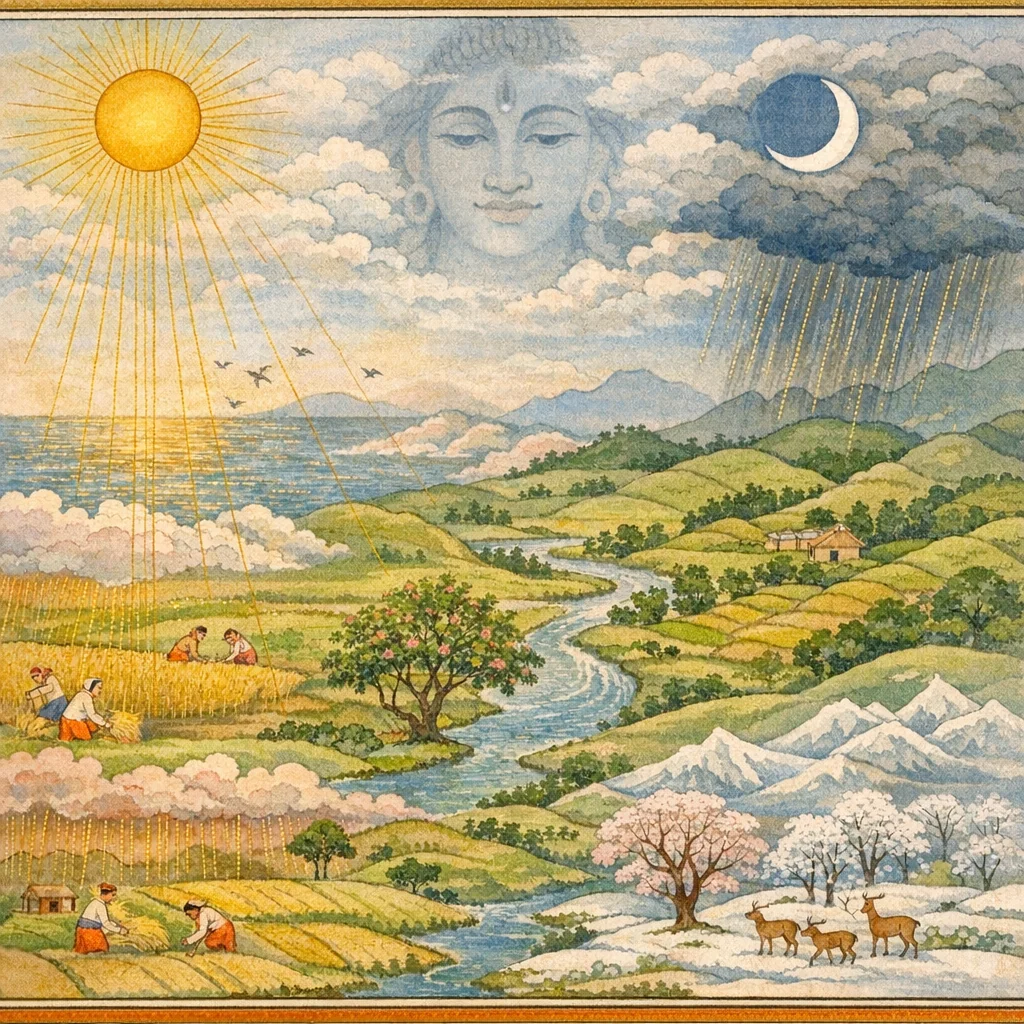
After hearing the prior account, the sages approach Sūta Romaharṣaṇa with renewed doubt and ask for a fuller, precise determination (vinirṇaya) of the heavenly luminaries (jyotiṣa), especially the courses and functions of the Sun and Moon. Sūta shifts from the ritual heading to cosmological causation, explaining the origin and threefold division of Agni—soura (divine/solar), pārthiva (terrestrial), and vārigarbha/vaidyuta (watery/atmospheric)—and how these fires enter and nourish one another. The Sun is said to “drink” the waters through its rays, governing the alternation of day and night and the seasonal effects of heat, rain, and cold. The chapter maps ray-channels (nāḍī), types of rays and their results (rain, dew/frost, heat), correlates solar names and administrators across the months, and lists the ray-counts for each. It concludes by grounding the Moon, planets, and nakṣatras as derived from the Sun, and by presenting Sun and Moon as the Lord’s “eyes,” preparing the link between cosmic function, Śaiva sacred order, and the ritual logic of abhiṣeka in what follows.
Shlokas
Verse 1
इति श्रीलिङ्गमहापुराणे सूर्याद्यभिषेककथनं नामाष्टपञ्चाशत्तमो ऽध्यायः सूत उवाच एतच्छ्रुत्वा तु मुनयः पुनस्तं संशयान्विताः पप्रच्छुरुत्तरं भूयस् तदा ते रोमहर्षणम्
Thus, in the Śrī Liṅga Mahāpurāṇa, the fifty-ninth chapter, called “The narration of abhiṣeka beginning with the Sun,” is set forth. Sūta said: Having heard this, the sages—still bearing doubts—again questioned Romaharṣaṇa (Sūta), seeking a fuller reply.
Verse 2
ऋषय ऊचुः यदेतदुक्तं भवता सूतेह वदतां वर एतद्विस्तरतो ब्रूहि ज्योतिषां च विनिर्णयम्
The sages said: “O Sūta, best among speakers! What you have stated—please explain it in full detail, and also set forth the clear determination regarding the luminaries (jyotiṣ).”
Verse 3
श्रुत्वा तु वचनं तेषां तदा सूतः समाहितः उवाच परमं वाक्यं तेषां संशयनिर्णये
Having heard their words, Sūta—collected in mind—then spoke a supreme teaching in order to settle their doubt.
Verse 4
अस्मिन्नर्थे महाप्राज्ञैर् यदुक्तं शान्तबुद्धिभिः एतद्वो ऽहं प्रवक्ष्यामि सूर्यचन्द्रमसोर्गतिम्
Concerning this very subject, what has been taught by the great sages of vast discernment and tranquil mind—this I shall now declare to you: the course and movement of the Sun and the Moon.
Verse 5
फ़िरे-wअतेर्-चिर्च्ले यथा देवगृहाणीह सूर्यचन्द्रादयो ग्रहाः अतः परं तु त्रिविधम् अग्नेर्वक्ष्ये समुद्भवम्
Just as, here, the luminaries—the Sun, the Moon, and the other planets—move in their ordained circuits like sacred precincts of the gods, so now I shall declare the threefold origin of Agni. This order of the cosmos proceeds under the governance of Pati (Śiva), while the paśus (souls) experience it according to their pāśa (bondage) and merit.
Verse 6
दिव्यस्य भौतिकस्याग्नेर् अथो ऽग्नेः पार्थिवस्य च व्युष्टायां तु रजन्यां च ब्रह्मणो ऽव्यक्तजन्मनः
Of the divine fire, of the elemental cosmic fire, and also of the earthly fire—at dawn and again in the night—thus it is declared concerning Brahmā, whose birth is from the Avyakta, the Unmanifest.
Verse 7
अव्याकृतमिदं त्वासीन् नैशेन तमसा वृतम् चतुर्भागावशिष्टे ऽस्मिन् लोके नष्टे विशेषतः
At that time, all this was in an unmanifest state (avyākṛta), veiled by the darkness of the cosmic night. When this world—left as though only a quarter remained—fell into dissolution, distinctions were lost.
Verse 8
स्वयंभूर्भगवांस्तत्र लोकसर्वार्थसाधकः खद्योतवत्स व्यचरद् आविर्भावचिकीर्षया
There, the Self-born Blessed Lord (Svayambhū)—who accomplishes every true aim of the worlds—moved about like a firefly, intending to make His manifestation visible.
Verse 9
सो ऽग्निं सृष्ट्वाथ लोकादौ पृथिवीजलसंश्रितः संहृत्य तत्प्रकाशार्थं त्रिधा व्यभजदीश्वरः
Having first manifested Agni at the beginning of the worlds, the Lord—abiding through earth and water—then withdrew that fire and, for the sake of making its illumination operative, divided it into three forms.
Verse 10
पवनो यस्तु लोके ऽस्मिन् पार्थिवो वह्निरुच्यते यश्चासौ लोकादौ सूर्ये शुचिरग्निस्तु स स्मृतः
In this world, the fire sustained by wind is called the terrestrial fire; and that pure fire which shines at the beginning of the worlds as the Sun is remembered as Śuci Agni, the immaculate Agni.
Verse 11
वैद्युतो ऽब्जस्तु विज्ञेयस् तेषां वक्ष्ये तु लक्षणम् वैद्युतो जाठरः सौरो वारिगर्भास्त्रयो ऽग्नयः
Know that the “Abja” fire, lotus-born, is to be understood as the lightning-born fire (Vaidyuta). Now I shall declare their defining marks. The fires are three: the lightning-fire (Vaidyuta), the gastric fire (Jāṭhara), and the solar fire (Saura), whose origin is said to be “water-wombed” (Vārigarbha).
Verse 12
तस्मादपः पिबन्सूर्यो गोभिर् दीप्यत्यसौ विभुः जले चाब्जः समाविष्टो नाद्भिर् अग्निः प्रशाम्यति
Therefore the all-pervading Sun, drinking in the waters, blazes forth through his rays. The lotus abides within water, and fire is not extinguished by water—for all these act by the Lord’s own Śakti, the Pati immanent in the elements.
Verse 13
मानवानां च कुक्षिस्थो नाग्निः शाम्यति पावकः अर्चिष्मान्पवनः सो ऽग्निर् निष्प्रभो जाठरः स्मृतः
In humans, the fire abiding in the belly does not become extinguished. That very fire—fanned by the vital wind (pavana)—though without outward flame or radiance, is known as Jāṭharāgni, the gastric fire.
Verse 14
यश्चायं मण्डली शुक्ली निरूष्मा सम्प्रजायते प्रभा सौरी तु पादेन ह्य् अस्तं याते दिवाकरे
And this white, circular radiance that is born—cool and without heat—is the solar brilliance; it manifests only as a quarter-part when the Sun has gone to its setting. Thus the cosmic order is marked by measured degrees of light.
Verse 15
अग्निमाविशते रात्रौ तस्माद्दूरात्प्रकाशते उद्यन्तं च पुनः सूर्यम् औष्ण्यम् अग्नेः समाविशेत्
At night, fire enters and pervades the world; therefore it shines from afar. And again, as the Sun rises, the heat (uṣṇatā) of Agni enters into the Sun. Thus the one tejas appears as fire and as the solar orb by mutual indwelling.
Verse 16
पादेन पार्थिवस्याग्नेस् तस्मादग्निस्तपत्यसौ प्रकाशोष्णस्वरूपे च सौराग्नेये तु तेजसी
By one quarter, Agni is of the earthly principle; therefore this Fire indeed burns. Its nature is light and heat, and in the solar and fiery domains its radiance is revealed as tejas.
Verse 17
परस्परानुप्रवेशाद् आप्यायेते परस्परम् उत्तरे चैव भूम्यर्धे तथा ह्यग्निश् च दक्षिणे
Through mutual interpenetration, the elements nourish and augment one another. In the northern half lies the portion of Earth; likewise, Agni is established in the southern region.
Verse 18
उत्तिष्ठति पुनः सूर्यः पुनर्वै प्रविशत्य् अपः तस्मात्ताम्रा भवन्त्यापो दिवारात्रिप्रवेशनात्
The Sun rises again, and again indeed enters into the waters; therefore the waters take on a coppery hue, for he enters them by day and by night. Thus the very rhythms of time reveal Pati, the Lord, as the inner governor of cosmic order.
Verse 19
अस्तं याति पुनः सूर्यो ऽहर्वै प्रविशत्य् अपः तस्मान्नक्तं पुनः शुक्ला आपो दृश्यन्ति भास्वराः
When the Sun sets again, the day, as it were, enters into the waters. Therefore at night the waters are once more seen as bright and white with radiance.
Verse 20
एतेन क्रमयोगेन भूम्यर्धे दक्षिणोत्तरे उदयास्तमने नित्यम् अहोरात्रं विशत्य् अपः
By this sequential discipline (krama-yoga), in the southern and northern halves of the earth, at sunrise and at sunset, the waters continually enter into the cycle of day and night.
Verse 21
यश्चासौ तपते सूर्यः पिबन्नंभो गभस्तिभिः पार्थिवाग्निविमिश्रो ऽसौ दिव्यः शुचिरिति स्मृतः
That Sun blazes forth, drinking up the waters with his rays—mingled with the terrestrial fire—and thus is remembered as divine and pure in his very nature.
Verse 22
सहस्रपादसौ वह्निर् वृत्तकुम्भनिभः स्मृतः आदत्ते स तु नाडीनां सहस्रेण समन्ततः
That Fire (Vahni) is remembered as “thousand-footed” and shaped like a round water-pot; from every side it draws in and gathers through a thousand nāḍīs.
Verse 23
नादेयीश्चैव सामुद्रीः कूपाश्चैव तथा घनाः स्थावरा जङ्गमाश्चैव वापीकुल्यादिका अपः
Waters are of many kinds: river-born and oceanic, drawn from wells and gathered from rain; some are still and some are moving—such as those of tanks, canals, and the like. These waters are to be understood as fit media for rites of purification and for offerings in Śiva’s worship.
Verse 24
च्लस्सेस् ओफ़् सुन्रय्स् तस्य रश्मिसहस्रं तच् छीतवर्षोष्णनिःस्रवम् तासां चतुःशता नाड्यो वर्षन्ते चित्रमूर्तयः
From that (Sun) arise a thousand streams of rays, issuing as cold, rainy, and hot outflows. From those, four hundred channels (nāḍīs) pour forth, appearing in many wondrous forms.
Verse 25
भजनाश्चैव माल्याश् च केतनाः पतनास् तथा अमृता नामतः सर्वा रश्मयो वृष्टिसर्जनाः
The solar rays are all known by the names Bhajanā, Mālyā, Ketanā, Patanā, and Amṛtā; these rays are the very agencies through which rainfall is generated. Thus, by the Lord’s ordered power (Pati), the world is sustained through the descent of waters that nurture embodied souls (paśu) bound by nature’s fetter (pāśa).
Verse 26
हिमोद्वहाश् च ता नाड्यो रश्मयस् त्रिशताः पुनः रेशा मेघाश् च वात्स्याश् च ह्लादिन्यो हिमसर्जनाः
Those nāḍīs are bearers of snow; again, the rays are said to be three hundred. They are also called Reśā, Meghā, and Vātsya—cooling channels that generate frost and snow.
Verse 27
चन्द्रभा नामतः सर्वा पीताभाश् च गभस्तयः शुक्लाश् च ककुभाश्चैव गावो विश्वभृतस् तथा
All these are known as “Candrabhā” (moon-lustrous). The sunrays are yellow-hued, the quarters are white, and likewise the world-sustaining powers—the “cows” that uphold the universe—are also so described.
Verse 28
शुक्लास्ता नामतः सर्वास् त्रिशतीर्घर्मसर्जनाः सोमो बिभर्ति ताभिस्तु मनुष्यपितृदेवताः
All those are called “Śuklā” by name—three hundred in number, generating heat and vitality. By them Soma (the Moon) sustains humans, the Pitṛs, and the Devas; thus the cosmic order is upheld under the Lord (Pati) whose power pervades the luminaries.
Verse 29
मनुष्यानौषधेनेह स्वधया च पितॄनपि अमृतेन सुरान् सर्वांस् तिसृभिस् तर्पयत्यसौ
Here, he satisfies human beings by medicinal herbs, the Pitṛs by the oblation called svadhā, and all the Devas by nectar; thus, by these three means he brings full contentment to the three orders.
Verse 30
वसन्ते चैव ग्रीष्मे च शतैः स तपते त्रिभिः वर्षास्वथो शरदि च चतुर्भिः संप्रवर्षति
In spring and in summer, he blazes with three hundred rays; and in the rainy season, and again in autumn, he pours forth rain with four hundred (rays). Thus the Lord, as the cosmic regulator, sustains the worlds through heat and rainfall.
Verse 31
हेमन्ते शिशिरे चैव हिममुत्सृजते त्रिभिः गऺत्तेर् इन् देर् सोन्ने इन्द्रो धाता भगः पूषा मित्रो ऽथ वरुणो ऽर्यमा
In Hemanta and Śiśira, the cold (frost) is dispelled by these three; and in the Sun’s course preside the powers—Indra, Dhātṛ, Bhaga, Pūṣan, Mitra, and then Varuṇa and Aryaman—who regulate the order of time. Thus, under the Lord Pati, the inner ruler of all deities, the cosmic rhythm proceeds without obstruction.
Verse 32
अंशुर् विवस्वांस्त्वष्टा च पर्जन्यो विष्णुरेव च वरुणो माघमासे तु सूर्य एव तु फाल्गुने
In the sequence of the Sun’s names, he is called Aṃśu, Vivasvān, Tvaṣṭṛ, Parjanya, Viṣṇu, and Varuṇa. In the month of Māgha he is especially Varuṇa, and in Phālguna he is called Sūrya.
Verse 33
चैत्रे मासि भवेदंशुर् धाता वैशाखतापनः ज्येष्ठे मासि भवेदिन्द्र आषाढे चार्यमा रविः
In the month of Caitra, the Sun functions as Aṃśu; in Vaiśākha, as Dhātā, the bringer of heat; in Jyeṣṭha, as Indra; and in Āṣāḍha, as Aryamā—the radiant Ravi—governing time and sustaining the worlds by his appointed powers.
Verse 34
विवस्वान् श्रावणे मासि प्रौष्ठपदे भगः स्मृतः पर्जन्यो ऽश्वयुजे मासि त्वष्टा वै कार्तिके रविः
In the month of Śrāvaṇa, the Sun is known as Vivasvān. In Prauṣṭhapada, he is remembered as Bhaga. In Āśvayuja, he becomes Parjanya; and in Kārtika, the Sun is indeed Tvaṣṭṛ.
Verse 35
मार्गशीर्षे भवेन्मित्रः पौषे विष्णुः सनातनः पञ्चरश्मिसहस्राणि वरुणस्यार्ककर्मणि
In the month of Mārgaśīrṣa, the solar power functions as Mitra; in Pauṣa, the eternal Viṣṇu presides. In Varuṇa’s solar operation (arka-karma), five thousand rays are at work.
Verse 36
षड्भिः सहस्रैः पूषा तु देवो ऽंशुः सप्तभिस् तथा धाताष्टभिः सहस्रैस्तु नवभिस्तु शतक्रतुः
Pūṣan is reckoned with six thousand attendants; the deva Aṃśu likewise with seven thousand; Dhātṛ with eight thousand; and Śatakratu (Indra) with nine thousand. Thus the hosts of the gods are enumerated.
Verse 37
विवस्वान् दशभिर् याति यात्येकादशभिर् भगः सप्तभिस्तपते मित्रस् त्वष्टा चैवाष्टभिः स्मृतः
Vivasvān proceeds with ten rays; Bhaga moves with eleven. Mitra shines with seven, and Tvaṣṭṛ is remembered as having eight—thus the Ādityas function through distinct measures of solar power, sustaining the cosmic order.
Verse 38
अर्यमा दशभिर् याति पर्जन्यो नवभिस् तथा षड्भी रश्मिसहस्रैस्तु विष्णुस्तपति मेदिनीम्
Aryamā proceeds with ten (rays), and Parjanya likewise with nine; but Viṣṇu, with six thousand rays, heats and illumines the earth.
Verse 39
वसंते कपिलः सूर्यो ग्रीष्मे काञ्चनसप्रभः श्वेतो वर्षासु वर्णेन पाण्डुः शरदि भास्करः
In spring the Sun appears tawny; in summer he shines with a golden radiance; in the rains he becomes white in hue; and in autumn the illuminator is pale. Thus the Lord’s ordered power is seen as the changing qualities of time.
Verse 40
हेमन्ते ताम्रवर्णस्तु शिशिरे लोहितो रविः इति वर्णाः समाख्याता मया सूर्यसमुद्भवाः
In Hemanta (early winter) the Sun appears copper-hued, and in Śiśira (late winter) the Sun appears red. Thus have I described the seasonal colours that arise from the Sun—signs to be read as the ordered manifestation of the Lord’s cosmic governance.
Verse 41
ओषधीषु बलं धत्ते स्वधया च पितृष्वपि सूर्यो ऽमरेष्वप्यमृतं त्रयं त्रिषु नियच्छति
The Sun places strength within medicinal herbs; by the offering called svadhā he sustains the Pitṛs as well; and among the Devas he upholds amṛta, the nectar of immortality—thus he governs these three within their three respective domains.
Verse 42
एवं रश्मिसहस्रं तत् सौरं लोकार्थसाधकम् भिद्यते लोकमासाद्य जलशीतोष्णनिःस्रवम्
Thus the Sun’s thousandfold radiance, which accomplishes the welfare of the worlds, reaches the earthly realm and becomes differentiated—flowing forth as water in forms that are cooling and warming.
Verse 43
इत्येतन्मण्डलं शुक्लं भास्वरं सूर्यसंज्ञितम् नक्षत्रग्रहसोमानां प्रतिष्ठायोनिरेव च
Thus this radiant, white, resplendent circle is known as the Sun; it is indeed the ground of establishment and the very womb-source for the nakṣatras, the planets, and Soma (the Moon).
Verse 44
चन्द्रऋक्षग्रहाः सर्वे विज्ञेयाः सूर्यसंभवाः नक्षत्राधिपतिः सोमो नयनं वाममीशितुः
All the Moon, the constellations, and the planets are to be understood as arising from the Sun. Soma, the lord of the Nakṣatras, is the left eye of the Supreme Lord (Īśa).
Verse 45
नयनं चैवम् ईशस्य दक्षिणं भास्करः स्वयम् तेषां जनानां लोके ऽस्मिन् नयनं नयते यतः
Thus the Sun (Bhāskara) himself is the right eye of Īśa; for in this world he leads the sight of beings, thereby guiding their power of seeing.
Frequently Asked Questions
The chapter distinguishes soura (solar/divine), jathara (digestive/fire within beings), and varigarbha/vaidyuta (watery-atmospheric/lightning-related) Agni. Their mutual ‘entry’ explains how heat, digestion, weather, and solar radiance function as a single integrated cosmic economy.
It presents the Sun as drawing waters via rays and distributing effects through ray-channels (nāḍīs): sets of rays are associated with rainfall, heat (gharma), and cold/frost (hima), producing seasonal alternations through day–night and north–south movement.
The chapter states that luminaries (chandra, grahas, nakṣatras) are to be understood as arising from or grounded in the solar principle, with Soma as nakṣatra-lord, while Sun and Moon function as the Lord’s right and left ‘eyes’ governing perception and order in the world.