Adhyaya 45
Adhyaya 45: Rudra as Sarvatma—Seven Lokas, Seven Talas, and the Cosmic Body of Shiva
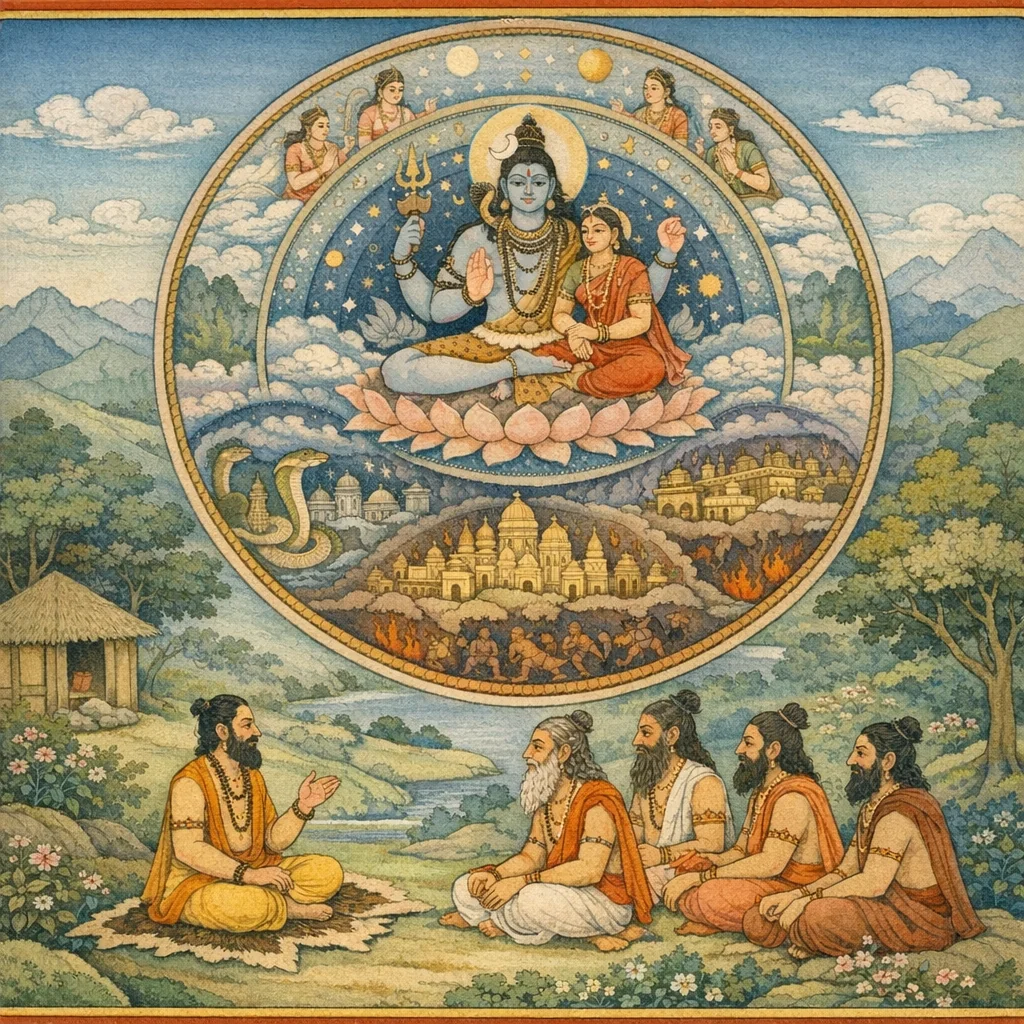
Continuing the Purva-bhaga teaching, the rishis ask Suta to describe Śaṅkara’s sarvātma-bhāva and Rudra’s true svarūpa beyond ordinary perception. Suta answers by setting out the cosmic order—Bhūr, Bhuvar, Svar, Mahas, Jana, Tapas, Satya—together with Pātāla and hell-realms, declaring that these worlds and celestial stations (grahas, nakṣatra-like references, Dhruva, the Saptarṣis, and vimānika beings) abide by Śiva’s prasāda. Though ever established as the collective Self (samaṣṭi-rūpa sarvātman), Śiva is not recognized by beings deluded by māyā. The doctrinal pivot is stated plainly: the three worlds are Rudra’s body; therefore reverence to Śiva must precede any true nirṇaya about the universe. Suta then describes the seven talas (such as Mahātala, Rasātala, Talātala, Sutala, Vitala, Atala), their splendor and inhabitants (Nāgas, Daityas/Asuras, ancient kings), and concludes by portraying Parameśvara with Ambā, Skanda, Nandin, and the gaṇas pervading these regions, preparing for the next ordering of realms in Śiva-centered cosmology.
Shlokas
Verse 1
इति श्रीलिङ्गमहापुराणे पूर्वभागे नन्दिकेश्वराभिषेको नाम चतुश्चत्वारिंशो ऽध्यायः ऋषय ऊचुः सूत सुव्यक्तमखिलं कथितं शङ्करस्य तु सर्वात्मभावं रुद्रस्य स्वरूपं वक्तुमर्हसि
The sages said: “O Sūta, you have clearly narrated all things. Now, as is fitting, describe the true nature (svarūpa) of Rudra—Śaṅkara as the indwelling Self of all (sarvātmabhāva).”
Verse 2
सूत उवाच भूर्भुवः स्वर्महश्चैव जनः साक्षात्तपस् तथा सत्यलोकश् च पातालं नरकार्णवकोटयः
Sūta said: Bhūr, Bhuvar, Svar, and also Mahas; then Jana; likewise Tapas; and Satyaloka—along with Pātāla and the countless oceans of hells—these are the vast divisions of the cosmos.
Verse 3
तारकाग्रहसोमार्का ध्रुवः सप्तर्षयस् तथा वैमानिकास्तथान्ये च तिष्ठन्त्यस्य प्रसादतः
By his grace alone, the stars, the planets, the Moon and the Sun, Dhruva, the Seven Sages, the celestial beings who move in vimānas, and all others remain established in their ordained stations.
Verse 4
अनेन निर्मितास्त्वेवं तदात्मानो द्विजर्षभाः समष्टिरूपः सर्वात्मा संस्थितः सर्वदा शिवः
Thus, O best of the twice-born, by Him all these were fashioned as expressions of His own being. Shiva—ever established as the Self of all—abides perpetually in the universal, collective form (samaṣṭi-rūpa).
Verse 5
सर्वात्मानं महात्मानं महादेवं महेश्वरम् न विजानन्ति संमूढा मायया तस्य मोहिताः
Deluded by His Māyā, the utterly bewildered do not recognize Mahādeva—Maheśvara, the Great Soul, the Self of all beings—the Pati (Lord) beyond the bonds of pāśa.
Verse 6
तस्य देवस्य रुद्रस्य शरीरं वै जगत्त्रयम् तस्मात्प्रणम्य तं वक्ष्ये जगतां निर्णयं शुभम्
The three worlds are indeed the very body of that God, Rudra. Therefore, having bowed to Him, I shall declare the auspicious determination of the worlds—how the cosmos is established and understood in truth.
Verse 7
पुरा वः कथितं सर्वं मयाण्डस्य यथा कृतिः भुवनानां स्वरूपं च ब्रह्माण्डे कथयाम्यहम्
Previously I have told you everything about how the cosmic Egg was fashioned; now I shall describe, within that Brahmāṇḍa, the true forms and arrangement of the worlds.
Verse 8
पृथिवी चान्तरिक्षं च स्वर्महर्जन एव च तपः सत्यं च सप्तैते लोकास्त्वण्डोद्भवाः शुभाः
Earth, the mid-region (atmosphere), heaven, Maharloka, Janaloka, Tapoloka, and Satyaloka—these seven auspicious worlds arise from the cosmic egg. In Shaiva understanding, such ordered realms belong to manifested creation, within which the bound soul (paśu) moves under bondage (pāśa) until it turns to the Lord (Pati), Shiva, for liberation.
Verse 9
अधस्तादत्र चैतेषां द्विजाः सप्त तलानि तु महातलादयस्तेषां अधस्तान्नरकाः क्रमात्
O twice-born ones, below these realms are the seven subterranean regions beginning with Mahātala; and beneath them, in due order, lie the hells. Thus the cosmos is arranged by gradation—so that the bound souls (paśu) experience the fruits of their karma under the governance of the Lord (Pati).
Verse 10
महातलं हेमतलं सर्वरत्नोपशोभितम् प्रासादैश् च विचित्रैश् च भवस्यायतनैस् तथा
There was a vast expanse—golden-floored and adorned with every kind of jewel—filled with wondrous palaces and, likewise, with sanctuaries that were the holy abodes of Bhava (Śiva).
Verse 11
अनन्तेन च संयुक्तं मुचुकुन्देन धीमता नृपेण बलिना चैव पातालस्वर्गवासिना
It was joined with Ananta, and with the wise king Mucukunda—indeed with that mighty ruler who dwelt in the nether realms and also in heaven.
Verse 12
शैलं रसातलं विप्राः शार्करं हि तलातलम् पीतं सुतलमित्युक्तं वितलं विद्रुमप्रभम्
O brāhmaṇas, Rasātala is said to be stony; Talātala is indeed gravelly. Sutala is described as golden-yellow, and Vitala shines with the radiance of coral.
Verse 13
सितं हि अतलं तच्च तलं यच्च सितेतरम् क्ष्मायास्तु यावद्विस्तारो ह्य् अधस्तेषां च सुव्रताः
Atala is indeed described as “white”; and that Tala is of a different (non‑white) hue. O you of good vows, the extent of these regions below is said to be as wide as the spread of the earth.
Verse 14
तलानां चैव सर्वेषां तावत्संख्या समाहिता सहस्रयोजनं व्योम दशसाहस्रमेव च
Thus the full enumeration of all the nether levels (talas) is gathered together. The expanse of space (vyoman) is said to be a thousand yojanas, and indeed ten thousand as well.
Verse 15
लक्षं सप्तसहस्रं हि तलानां सघनस्य तु व्योम्नः प्रमाणं मूलं तु त्रिंशत्साहस्रकेण तु
Indeed, the measured extent of the dense nether regions (the talas) is one hundred and seven thousand; and the fundamental measure of the intervening sky-space (vyoman) is established as thirty thousand.
Verse 16
सुवर्णेन मुनिश्रेष्ठास् तथा वासुकिना शुभम् रसातलमिति ख्यातं तथान्यैश् च निषेवितम्
O best of sages, that auspicious region—adorned with gold and presided over by Vāsuki—is renowned as Rasātala; other beings too dwell there and resort to it.
Verse 17
विरोचनहिरण्याक्षनरकाद्यैश् च सेवितम् तलातलमिति ख्यातं सर्वशोभासमन्वितम्
That realm is attended by Virocana, Hiraṇyākṣa, Naraka and others; it is renowned as Talātala, endowed on every side with splendid beauty.
Verse 18
वैनायकादिभिश्चैव कालनेमिपुरोगमैः पूर्वदेवैः समाकीर्णं सुतलं च तथापरैः
Sutala, too, is densely filled with the ancient divine beings—led by Kālanemi and accompanied by hosts such as the Vaināyakas—along with many other classes of beings besides.
Verse 19
वितलं दानवाद्यैश् च तारकाग्निमुखैस् तथा महान्तकाद्यैर् नागैश् च प्रह्लादेनासुरेण च
Vitalā is inhabited by the Dānavas and others—by Tāraka and Agnimukha as well—by the Nāgas beginning with Mahāntaka, and also by the Asura Prahlāda.
Verse 20
वितलं चात्र विख्यातं कम्बलाश्वनिषेवितम् महाकुम्भेन वीरेण हयग्रीवेण धीमता
Here too, the realm famed as Vitala is well known—frequented by Kambala and Aśva—and it is ruled by the heroic and wise Hayagrīva, the mighty Mahākumbha.
Verse 21
शङ्कुकर्णेन संभिन्नं तथा नमुचिपूर्वकैः तथान्यैर् विविधैर् वीरैस् तलं चैव सुशोभितम्
That ground was split open by Śaṅkukarṇa, and likewise by Namuci and the others; and by many different heroes it was made resplendent, everywhere marked with the signs of their valor.
Verse 22
तलेषु तेषु सर्वेषु चाम्बया परमेश्वरः स्कन्देन नन्दिना सार्धं गणपैः सर्वतो वृतः
In all those lower regions, the Supreme Lord, Parameśvara, together with Ambā (Umā), accompanied by Skanda and Nandin, moved about—surrounded on every side by the hosts of Gaṇas.
Verse 23
तलानां चैव सर्वेषाम् ऊर्ध्वतः सप्तसप्तमाः क्ष्मातलानि धरा चापि सप्तधा कथयामि वः
Above all the subterranean realms (talas) are the seven successive earth-levels; and the supporting Earth (dharā) too is spoken of as sevenfold—these I shall now explain to you.
Frequently Asked Questions
It presents a Shaiva non-dual/theistic metaphysic where the cosmos is a manifestation within Shiva, not independent of Him; realizing this counters māyā-driven ignorance and supports liberation-oriented devotion and knowledge.
Bhur (Earth), Bhuvar (Antariksha), Svar, Mahas, Jana, Tapas, and Satya—presented as auspicious, egg-born (aṇḍodbhava) realms within the Brahmāṇḍa framework.
Nandikeshvara signifies disciplined Shaiva devotion and proximity to Shiva; framing the chapter as ‘Abhisheka’ aligns cosmic teaching with worship—suggesting that knowing Shiva as Sarvatma culminates in reverent rites that purify and orient the seeker toward moksha.