Adhyaya 42
Indra’s Account: Shilada’s Tapas and Shiva’s Manifestation as Nandi
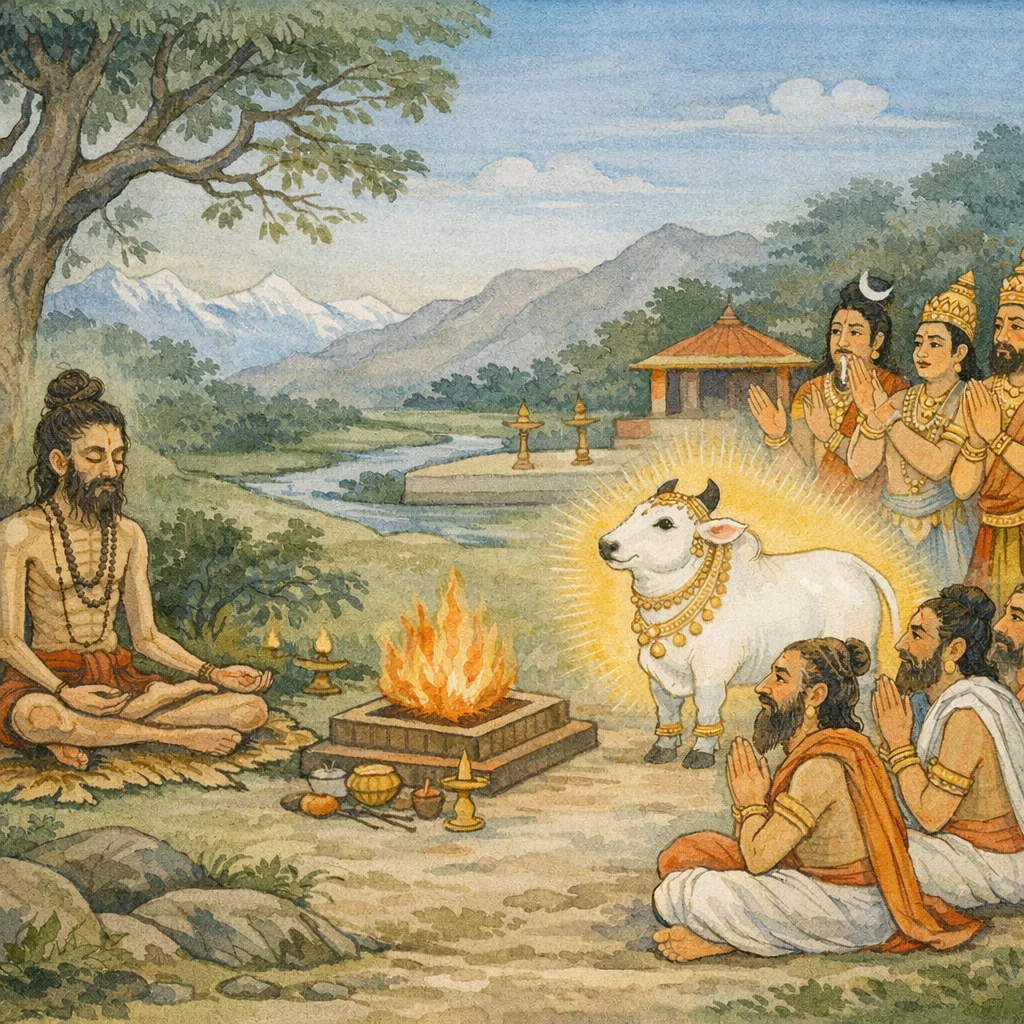
Suta recounts a Shaiva exemplum of Shilada’s unwavering devotion to Mahadeva. After long, severe tapas—so intense that he becomes emaciated and covered with insects—he remains absorbed in Shiva. Pleased, Shankara appears with Uma and his ganas, asks the aim of the austerity, and offers a boon: an all-knowing son, master of shastra meanings. Shilada asks for an ayonija, deathless son. Shiva grants it, declaring that by prior worship and cosmic intent he himself will be born as Shilada’s son, named Nandi, making Shilada the father of the Father of the worlds. Nandi manifests in the yajna arena in a terrifying yet radiant form (trinetra, chaturbhuja, bearing weapons), and gods, rishis, and divine powers praise him. Shilada’s stuti proclaims Nandi as protector and Jagadguru, inviting the assembled sages to witness his fortune—bridging to later Shaiva narratives where Shiva’s grace answers concentrated worship and ritual purity.
Shlokas
Verse 1
इति श्रीलिङ्गमहापुराणे पूर्वभागे इन्द्रवाक्यं नामैकचत्वारिंशो ऽध्यायः सूत उवाच गते पुण्ये च वरदे सहस्राक्षे शिलाशनः आराधयन्महादेवं तपसातोषयद्भवम्
Thus, in the Śrī Liṅga Mahāpurāṇa, in the Pūrva-bhāga, in the chapter called “Indra’s Statement,” Sūta said: When the meritorious, boon-bestowing Sahasrākṣa (Indra) had departed, Śilāśana continued to worship Mahādeva, and by tapas he pleased Bhava (Śiva), the Pati who loosens the pāśa that binds the paśu, the bound soul.
Verse 2
अथ तस्यैवमनिशं तत्परस्य द्विजस्य तु दिव्यं वर्षसहस्रं तु गतं क्षणमिवाद्भुतम्
Then, for that twice-born who remained ceaselessly absorbed in Him with single-pointed intent, a thousand divine years passed—astonishingly—as though they were but a single moment.
Verse 3
वल्मीकेनावृताङ्गश् च लक्ष्यः कीटगणैर्मुनिः वज्रसूचीमुखैश्चान्यै रक्तकीटैश् च सर्वतः
His limbs were covered by an anthill; the sage became a visible mark for swarms of insects—some with mouths like vajra-needles, and others blood-red worms—assailing him from every side. Yet, steadfast in tapas, he endured, letting the bonds of embodied pain be consumed by endurance on the path toward Pati (Śiva).
Verse 4
निर्मांसरुधिरत्वग् वै निर्लेपः कुड्यवत् स्थितः अस्थिशेषो ऽभवत्पश्चात् तममन्यत शङ्करः
Devoid of flesh, blood, and skin, he stood unstained and motionless like a wall. Later, when only the remnant of bones remained, Śaṅkara (Śiva) recognized him as His own true form—beyond all coverings.
Verse 5
यदा स्पृष्टो मुनिस्तेन करेण च स्मरारिणा तदैव मुनिशार्दूलश् चोत्ससर्ज क्लमं द्विजः
When that sage was touched by the hand of Smarāri (the Foe of Kāma—Lord Śiva), at that very moment the tiger among sages, that twice-born one, cast off his fatigue and affliction.
Verse 6
तपतस्तस्य तपसा प्रभुस्तुष्टाथ शङ्करः तुष्टस्तवेत्यथोवाच सगणश्चोमया सह
As he continued his austerities, Lord Śaṅkara—the sovereign Pati—was pleased by that tapas. Then, accompanied by His gaṇas and together with Umā, He said: “I am pleased with you.”
Verse 7
तपसानेन किं कार्यं भवतस्ते महामते ददामि पुत्रं सर्वज्ञं सर्वशास्त्रार्थपारगम्
“O great-minded one, what further need have you of such austerity? I grant you a son—omniscient, and fully accomplished in the true purport of all the śāstras.”
Verse 8
ततः प्रणम्य देवेशं स्तुत्वोवाच शिलाशनः हर्षगद्गदया वाचा सोमं सोमविभूषणम्
Then Śilāśana, having bowed down to the Lord of the Devas, praised Him and spoke—his voice trembling with joy—addressing Soma, the Moon who is His ornament: the Supreme Pati who bears Soma as His adornment.
Verse 9
शिलाद उवाच भगवन्देवदेवेश त्रिपुरार्दन शङ्कर अयोनिजं मृत्युहीनं पुत्रमिच्छामि सत्तम
Śilāda said: “O Blessed One, Lord of the gods, Tripurārdana, Śaṅkara—O best of beings, I desire a son who is not born from a womb, and who is free from death.”
Verse 10
सूत उवाच पूर्वमाराधितः प्राह तपसा परमेश्वरः शिलादं ब्रह्मणा रुद्रः प्रीत्या परमया पुनः
Sūta said: Having been worshipped before through austerity, the Supreme Lord Rudra—moved again by the highest delight—spoke to Śilāda, who had been commended by Brahmā.
Verse 11
श्रीदेवदेव उवाच पूर्वमाराधितो विप्र ब्रह्मणाहं तपोधन तपसा चावतारार्थं मुनिभिश् च सुरोत्तमैः
Śrī Devadeva said: O brāhmaṇa, O treasure of austerity—formerly Brahmā worshipped Me through tapas; and for the very purpose of My descent, sages and the foremost of the gods likewise propitiated Me by their austerities.
Verse 12
तव पुत्रो भविष्यामि नन्दिनाम्ना त्वयोनिजः पिता भविष्यसि मम पितुर्वै जगतां मुने
“I shall become your son, bearing the name Nandī—born not from a womb but from you alone. And you, O sage of the worlds, shall indeed become the father of My father.”
Verse 13
एवमुक्त्वा मुनिं प्रेक्ष्य प्रणिपत्य स्थितं घृणी सोमः सोमोपमः प्रीतस् तत्रैवान्तरधीयत
Having spoken thus, Soma—radiant like Soma himself—looked upon the sage, bowed down, and, standing there with compassion and delight, vanished on that very spot.
Verse 14
लब्धपुत्रः पिता रुद्रात् प्रीतो मम महामुने यज्ञाङ्गणं महत्प्राप्य यज्ञार्थं यज्ञवित्तमः
O great sage, my father—having obtained a son through Rudra’s grace—became deeply pleased. Foremost in the knowledge and wealth of sacrifice, he reached the great sacrificial arena to accomplish the rite of the yajña.
Verse 15
तदङ्गणादहं शंभोस् तनुजस्तस्य चाज्ञया संजातः पूर्वमेवाहं युगान्ताग्निसमप्रभः
From that very sacred courtyard, I—born as a son of Śambhu—came into being by His command, already manifested earlier, blazing with a radiance equal to the fire at the end of an age (yuga).
Verse 16
ववर्षुस्तदा पुष्करावर्तकाद्या जगुः खेचराः किन्नराः सिद्धसाध्याः शिलादात्मजत्वं गते मय्युपेन्द्रः ससर्जाथ वृष्टिं सुपुष्पौघमिश्राम्
Then Puṣkarāvartaka and the other hosts of clouds poured down rain; the sky-roaming beings sang—Kinnaras, Siddhas, and Sādhyas. And when Upendra (Viṣṇu) entered the state of being Śilāda’s son, he released a shower mingled with torrents of excellent flowers.
Verse 17
मां दृष्ट्वा कालसूर्याभं जटामुकुटधारिणम् त्र्यक्षं चतुर्भुजं बालं शूलटङ्कगदाधरम्
On seeing me—radiant like the Sun of Time (all-consuming Kāla), wearing a crown of matted locks, three-eyed, four-armed, youthful in form, and bearing the trident, the battle-axe, and the mace—they beheld the Lord as Pati, the sovereign beyond all bonds.
Verse 18
वज्रिणं वज्रदंष्ट्रं च वज्रिणाराधितं शिशुम् वज्रकुण्डलिनं घोरं नीरदोपमनिःस्वनम्
I contemplate the Thunderbolt-Bearer—he whose fangs are like the vajra; the youthful One worshipped by Indra; the Fierce Lord adorned with vajra-like earrings, whose roar resounds like a mass of storm-clouds.
Verse 19
ब्रह्माद्यास्तुष्टुवुः सर्वे सुरेन्द्रश् च मुनीश्वराः नेदुः समन्ततः सर्वे ननृतुश्चाप्सरोगणाः
Then all—beginning with Brahmā—praised the Lord; Indra and the lordly sages also sang hymns. From every side they raised loud acclamations, and the bands of Apsarās danced in celebration—honouring Pati who liberates the paśu from the fetters of pāśa.
Verse 20
ऋषयो मुनिशार्दूल ऋग्यजुःसामसंभवैः मन्त्रैर्माहेश्वरैः स्तुत्वा सम्प्रणेमुर्मुदान्विताः
O tiger among sages, the Ṛṣis—having praised Mahādeva with the Maheśvara-mantras born of the Ṛg, Yajur, and Sāma Vedas—then bowed down in full prostration, filled with joy.
Verse 21
ब्रह्मा हरिश् च रुद्रश् च शक्रः साक्षाच्छिवांबिका जीवश्चेन्दुर्महातेजा भास्करः पवनो ऽनलः
He is Brahmā, Hari (Viṣṇu), and Rudra; he is Śakra (Indra). He is Śiva himself, directly, together with Ambikā (Śakti). He is the jīva (the individual soul), the Moon of great splendor, the Sun, the Wind, and Fire.
Verse 22
ईशानो निरृतिर्यक्षो यमो वरुण एव च विश्वेदेवास् तथा रुद्रा वसवश् च महाबलाः
Īśāna, Nirṛti, the hosts of Yakṣas, Yama, and Varuṇa; as well as the Viśvedevās, the Rudras, and the mighty Vasus—all these stand as powerful divine forces, aligned under the Lord’s cosmic governance.
Verse 23
लक्ष्मीः साक्षाच्छची ज्येष्ठा देवी चैव सरस्वती अदितिश् च दितिश्चैव श्रद्धा लज्जा धृतिस् तथा
Lakṣmī herself—indeed Śacī, Jyeṣṭhā, Devī, and also Sarasvatī; likewise Aditi and Diti—together with Śraddhā (faith), Lajjā (modesty), and Dhṛti (steadfastness)—are spoken of as manifest divine powers. In the Śaiva vision, these are modes of Śakti operating within creation under the lordship of Pati (Śiva).
Verse 24
नन्दा भद्रा च सुरभी सुशीला सुमनास् तथा वृषेन्द्रश् च महातेजा धर्मो धर्मात्मजस् तथा
Nandā, Bhadrā, Surabhī, Suśīlā, and Sumanā—along with Vṛṣendra of great radiance—are also mentioned; likewise there is Dharma, and the son who embodies Dharma itself.
Verse 25
आवृत्य मां तथालिङ्ग्य तुष्टुवुर्मुनिसत्तम शिलादो ऽपि मुनिर्दृष्ट्वा पिता मे तादृशं तदा
O best of sages, surrounding me and embracing me thus, they praised me. Then the sage Śilāda too—my father—seeing me in that very form at that time, was filled with wonder and devotion.
Verse 26
प्रीत्या प्रणम्य पुण्यात्मा तुष्टावेष्टप्रदं सुतम् शिलाद उवाच भगवन्देवदेवेश त्रियंबक ममाव्यय
Bowing with loving devotion, the virtuous Śilāda praised the Lord who grants the wished-for boons as a son would. Then Śilāda said: “O Bhagavān, Lord of the lords of the gods, O Tryambaka, O imperishable One—hear my prayer.”
Verse 27
पुत्रो ऽसि जगतां यस्मात् त्राता दुःखाद्धि किं पुनः रक्षको जगतां यस्मात् पिता मे पुत्र सर्वग
You are the son of the worlds, for you deliver them from sorrow—what more need be said? Since you are the protector of the worlds, you are my father as well, O my son, all-pervading one.
Verse 28
अयोनिज नमस्तुभ्यं जगद्योने पितामह पिता पुत्र महेशान जगतां च जगद्गुरो
Salutations to You, the Unborn (Ayonija)—O womb and source of the universe. O Pitāmaha, primordial Ancestor, You are father and son; O Maheśāna, World-Teacher, You are the Guru of all beings.
Verse 29
वत्स वत्स महाभाग पाहि मां परमेश्वर त्वयाहं नन्दितो यस्मान् नन्दी नाम्ना सुरेश्वर
“O dear one, O dear one—O greatly fortunate Lord! Protect me, O Parameśvara. Since I have been gladdened and blessed by You, O Lord of the gods, I am therefore known by the name ‘Nandī’.”
Verse 30
तस्मान्नन्दय मां नन्दिन् नमामि जगदीश्वरम् प्रसीद पितरौ मे ऽद्य रुद्रलोकं गतौ विभो
Therefore, O Nandin, gladden me. I bow to Jagadīśvara, the Lord of the worlds. Be gracious, O Mighty One (Vibhū)—for today my two parents have gone to Rudra’s realm.
Verse 31
पितामहश् च भो नन्दिन् नवतीर्णे महेश्वरे ममैव सफलं लोके जन्म वै जगतां प्रभो
Pitāmaha (Brahmā) said: “O Nandin, now that Mahādeva has descended, my birth in this world has truly become fruitful, O Lord of the worlds.”
Verse 32
अवतीर्णे सुते नन्दिन् रक्षार्थं मह्यमीश्वर तुभ्यं नमः सुरेशान नन्दीश्वर नमो ऽस्तु ते
“O Nandin—now that my son has descended for my protection—O Īśvara, Lord of the gods, to You I bow. O Nandīśvara, may my salutations be unto You.”
Verse 33
पुत्र पाहि महाबाहो देवदेव जगद्गुरो पुत्रत्वमेव नन्दीश मत्वा यत्कीर्तितं मया
“O Son, protect me—O Mighty-armed One, O God of gods, O Guru of the universe. O Nandīśa, regarding You as my very son, I have spoken what I have praised and proclaimed.”
Verse 34
त्वया तत्क्षम्यतां वत्स स्तवस्तव्य सुरासुरैः यः पठेच्छृणुयाद्वापि मम पुत्रप्रभाषितम्
“O dear child, may this be pardoned by you: this hymn is indeed worthy to be praised by both Devas and Asuras. Whoever recites it or even listens to it—this utterance spoken by my son—attains its sanctifying merit.”
Verse 35
श्रावयेद्वा द्विजान् भक्त्या मया सार्धं स मोदते एवं स्तुत्वा सुतं बालं प्रणम्य बहुमानतः
Or, with devotion, he should recite it aloud for the twice-born; joining with me, he rejoices. Thus, having praised the young son, he bowed down with great reverence.
Verse 36
मुनीश्वरांश् च सम्प्रेक्ष्य शिलाद उवाच सुव्रतः पश्यध्वं मुनयः सर्वे महाभाग्यं ममाव्ययः
Beholding the lordly sages, Śilāda—the steadfast keeper of sacred vows—said: “Behold, O sages, all of you, my imperishable great fortune.”
Verse 37
नन्दी यज्ञाङ्गणे देवश् चावतीर्णो यतः प्रभुः मत्समः कः पुमांल्लोके देवो वा दानवो ऽपि वा
Since the Lord has descended into the sacrificial arena as Nandī himself, who in this world—whether god or even demon—can be equal to me?
Verse 38
एष नन्दी यतो जातो यज्ञभूमौ हिताय मे
“This is Nandī—born here upon the sacrificial ground—for my welfare and for the protection of this rite.”
Frequently Asked Questions
The request signals a desire for a divine, non-karmically constrained lineage—free from ordinary birth and death—so that the boon is not merely worldly progeny but a manifestation of Shiva’s own protective and liberating presence.
It dramatizes Shaiva anugraha: Shiva can assume form for devotees without losing transcendence, and the devotee’s relationship (bhakta–bhagavan) can become intimate (as father–son), reinforcing devotion as a direct path to divine realization.
The yajna setting links Vedic ritual order with Shaiva revelation, implying that true ritual culminates in the presence of the Lord; it also legitimizes Shaiva worship within a broader dharmic-sacrificial framework.