Adhyaya 4
Adhyaya 4: अहोरात्र-युग-मन्वन्तर-कल्पमान तथा प्रलयान्ते सृष्ट्युपक्रमः
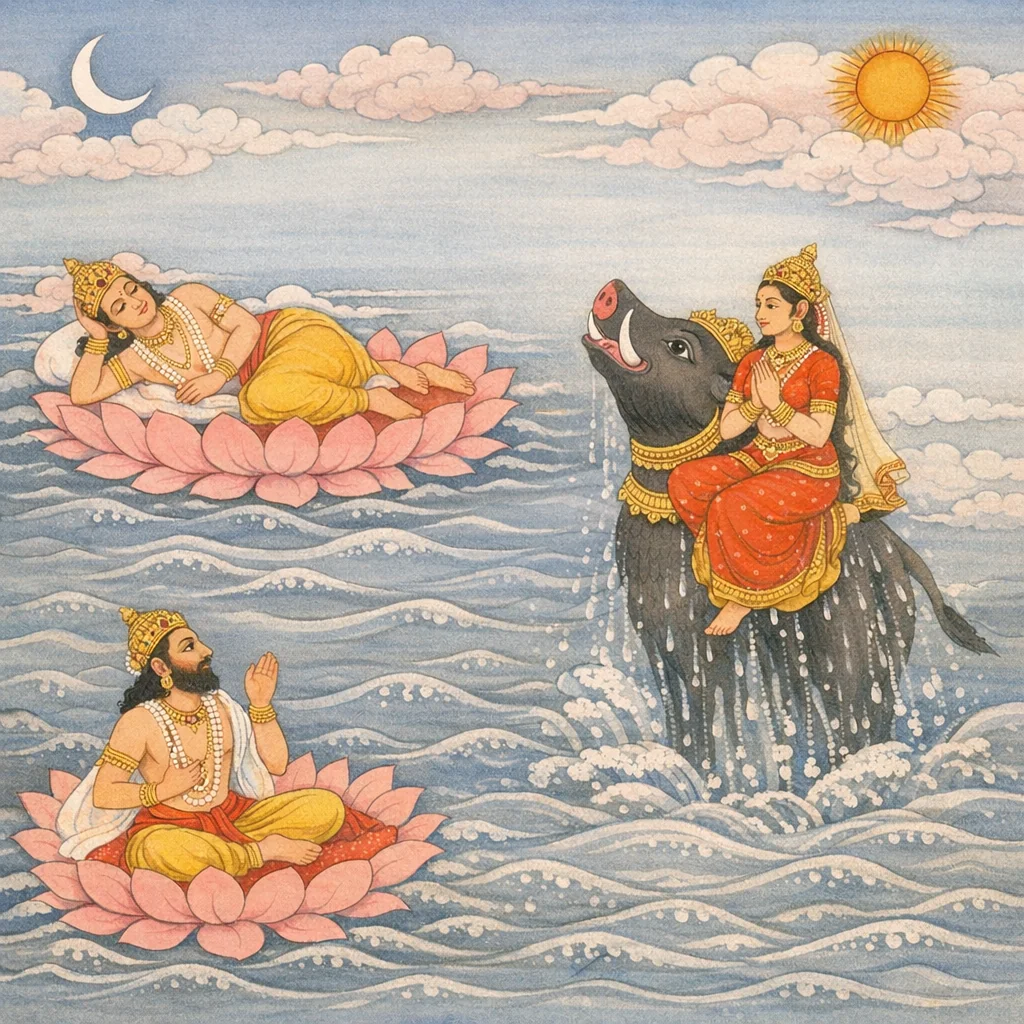
Sūta explains that the creator’s “day” signifies manifestation and the “night” dissolution, a conventional expression rather than a literal diurnal cycle. The chapter then sets out a graded cosmological chronology: human measures (from nimeṣa to muhūrta), pitṛ time (their day-night and year), and divine time (ayanas as day-night), culminating in the yugas—kṛta, tretā, dvāpara, kali—with their sandhyā junctions, the full caturyuga, and the vast scales of manvantara and kalpa (a thousand caturyugas). It stresses that all transformations (vikāras) are withdrawn by Śiva’s command; when the guṇas return to equilibrium dissolution occurs, and when disequilibrium arises creation proceeds—Śiva remains the ultimate cause. The narrative then turns to pralaya and renewal: Brahmā sleeps in the waters, awakens, and prepares to create again; the earth is restored (Varāha motif), setting the stage for later chapters on renewed world-order, beings, and Śaiva meaning within cyclical cosmology.
Shlokas
Verse 1
सूत उवाच अथ प्राथमिकस्येह यः कालस्तदहः स्मृतम् सर्गस्य तादृशी रात्रिः प्राकृतस्य समासतः
Sūta said: Here, the span of time belonging to the primordial phase is called its “day.” In summary, an equivalent span is also the “night” of prākṛta creation.
Verse 2
दिवा सृष्टिं विकुरुते रजन्यां प्रलयं विभुः औपचारिकमस्यैतद् अहोरात्रं न विद्यते
By “day” the all-pervading Lord brings forth creation, and by “night” He withdraws it into dissolution. Yet for Him this division into day and night is only a manner of speaking—for in His own reality there is no day-and-night at all.
Verse 3
दिवा विकृतयः सर्वे विकारा विश्वदेवताः प्रजानां पतयः सर्वे तिष्ठन्त्यन्ये महर्षयः
By day, all the evolutes (vikṛtis) and all the manifested modifications (vikāras)—the deities presiding over the cosmos—stand forth; likewise, all the lords of progeny (prajāpatis) and the other great seers remain established in their respective functions.
Verse 4
रात्रौ सर्वे प्रलीयन्ते निशान्ते सम्भवन्ति च अहस्तु तस्य वैकल्पो रात्रिस्तादृग्विधा स्मृता
During that (cosmic) night all beings dissolve into the unmanifest; at the night’s end they arise again. Such is the alternation for Him—day and night are understood in this manner, as cycles of manifestation and re-absorption.
Verse 5
चतुर्युगसहस्रान्ते मनवस्तु चतुर्दश चत्वारि तु सहस्राणि वत्सराणां कृतं द्विजाः
At the completion of a thousand cycles of the four yugas, there are fourteen Manus; and four thousand years constitute the Kṛta age, O twice-born sages.
Verse 6
तावच्छती च वै संध्या संध्यांशश् च कृतस्य तु त्रिशती द्विशती संध्या तथा चैकशती क्रमात्
For the Kṛta Yuga, the twilight junction (sandhyā) and its concluding portion (sandhyāṃśa) are each of the same measure—four hundred years. Thereafter, in due order, the sandhyā measures are three hundred, two hundred, and one hundred years for the succeeding yugas.
Verse 7
अंशकः षट्शतं तस्मात् कृतसंध्यांशकं विना त्रिद्व्येकसाहस्रमितो विना संध्यांशकेन तु
Therefore the aṃśakas are six hundred; and, excluding the aṃśaka-portion assigned to the Kṛta-yuga’s saṃdhyā (twilight), the measure is three thousand—again, without counting the saṃdhyā-aṃśaka.
Verse 8
त्रेताद्वापरतिष्याणां कृतस्य कथयामि वः निमेषपञ्चदशका काष्ठा स्वस्थस्य सुव्रताः
I shall explain to you the time-measures of the Tretā, Dvāpara, and Kali ages, and also of the Kṛta age. O you of good vows, for one in a normal, steady state, a kāṣṭhā consists of fifteen nimeṣas.
Verse 9
मर्त्यस्य चाक्ष्णोस्तस्याश् च ततस् त्रिंशतिका कला कलात्रिंशतिको विप्रा मुहूर्त इति कल्पितः
For a mortal, the time of opening and closing the eyes is taken as the basic unit; from that a kalā is defined. O brāhmaṇas, thirty kalās are conceived as one muhūrta.
Verse 10
मुहूर्तपञ्चदशिका रजनी तादृशं त्वहः पित्र्ये रात्र्यहनी मासः प्रविभागस्तयोः पुनः
A night consists of fifteen muhūrtas, and the day is of the same measure. In the realm of the Pitṛs (ancestors), their ‘night and day’ together constitute a month—such is the further division of those two.
Verse 11
कृष्णपक्षस्त्वहस्तेषां शुक्लः स्वप्नाय शर्वरी त्रिंशद्ये मानुषा मासाः पित्र्यो मासस्तु स स्मृतः
For the Pitṛs (ancestral beings), the dark fortnight (kṛṣṇa-pakṣa) is their day, while the bright fortnight (śukla-pakṣa) is their night meant for sleep. Thirty human months are remembered as one month in the reckoning of the Pitṛs.
Verse 12
शतानि त्रीणि मासानां षष्ट्या चाप्यधिकानि वै पित्र्यः संवत्सरो ह्येष मानुषेण विभाव्यते
By human reckoning, three hundred and sixty human months are understood to make one year in the realm of the Pitṛs (ancestral beings).
Verse 13
मानुषेणैव मानेन वर्षाणां यच्छतं भवेत् पितॄणां त्रीणि वर्षाणि संख्यातानीह तानि वै
By the human standard, whatever amounts to one hundred years becomes, in the reckoning of the Pitṛs (ancestral beings), three years—this is the established count here.
Verse 14
दश वै द्व्यधिका मासाः पितृसंख्येह संस्मृता लौकिकेनैव मानेन अब्दो यो मानुषः स्मृतः
Here, in the reckoning of the Pitṛs (ancestral beings), ten months plus two are remembered; by the ordinary human measure, that is what is known as a ‘human year’.
Verse 15
एतद्दिव्यमहोरात्रम् इति लैङ्गे ऽत्र पठ्यते दिव्ये रात्र्यहनी वर्षं प्रविभागस्तयोः पुनः
Thus it is recited here in the Liṅga tradition: this is the ‘divine day-and-night’. And again, from that very divine night and day, the measure of a year is determined by their division.
Verse 16
अहस्तत्रोदगयनं रात्रिः स्याद्दक्षिणायनम् एते रात्र्यहनी दिव्ये प्रसंख्याते विशेषतः
In that divine order of time, the ‘day’ is the northward course (Uttarāyaṇa), and the ‘night’ is the southward course (Dakṣiṇāyaṇa). Thus these two—divine day and divine night—are reckoned distinctly and with precision.
Verse 17
त्रिंशद्यानि तु वर्षाणि दिव्यो मासस्तु स स्मृतः मानुषं तु शतं विप्रा दिव्यमासास्त्रयस्तु ते
Thirty human years are declared to make one “divine month.” And, O brāhmaṇas, one hundred human years are said to equal three such divine months—thus is the measure of time taught, by which the cycles of creation and dissolution under Pati (Śiva) are understood.
Verse 18
दश चैव तथाहानि दिव्यो ह्येष विधिः स्मृतः त्रीणि वर्षशतान्येव षष्टिवर्षाणि यानि तु
And ten such days are remembered as a divine measure of time. Indeed, three hundred years—together with the additional sixty years—are what are stated here.
Verse 19
दिव्यः संवत्सरो ह्येष मानुषेण प्रकीर्तितः त्रीणि वर्षसहस्राणि मानुषाणि प्रमाणतः
This is called a “divine year” when reckoned by human measure; by standard human calculation it equals three thousand human years.
Verse 20
त्रिंशदन्यानि वर्षाणि मतः सप्तर्षिवत्सरः नव यानि सहस्राणि वर्षाणां मानुषाणि तु
Thirty (divine) years are understood to constitute one “Saptarṣi-year”; and that single Saptarṣi-year is reckoned as nine thousand human years. Thus the Purāṇa sets forth the scale of time by which embodied souls (paśu) measure the unfolding of creation under the Lord (Pati).
Verse 21
अन्यानि नवतीश्चैव ध्रौवः संवत्सरस्तु सः षट्त्रिंशत्तु सहस्राणि वर्षाणां मानुषाणि तु
Ninety more (years) indeed—such is that “Dhrauva” year; it amounts to thirty-six thousand human years.
Verse 22
वर्षाणां तच्छतं ज्ञेयं दिव्यो ह्येष विधिः स्मृतः त्रीण्येव नियुतान्याहुर् वर्षाणां मानुषाणि तु
That span is to be understood as a hundred years; this is remembered as the divine rule of reckoning. Yet they declare that, in human years, it amounts to three niyutas—three hundred thousand years.
Verse 23
षष्टिश्चैव सहस्राणि संख्यातानि तु संख्यया दिव्यं वर्षसहस्रं तु प्राहुः संख्याविदो जनाः
Those skilled in sacred computation declare that sixty thousand (units), duly reckoned by measure, constitute a thousand divine years.
Verse 24
दिव्येनैव प्रमाणेन युगसंख्याप्रकल्पनम् पूर्वं कृतयुगं नाम ततस्त्रेता विधीयते
By the divine standard of measure, the reckoning of the yugas is set forth: first is established the age called Kṛta (Satya), and thereafter the Tretā is ordained.
Verse 25
द्वापरश्च कलिश्चैव युगान्येतानि सुव्रताः अथ संवत्सरा दृष्टा मानुषेण प्रमाणतः
“Dvāpara and Kali—these too are the Yugas, O you of excellent vows. Now, the measure of the years (saṃvatsara) is to be understood according to the human standard of reckoning.”
Verse 26
कृतस्याद्यस्य विप्रेन्द्रा दिव्यमानेन कीर्तितम् सहस्राणां शतान्यासंश् चतुर्दश च संख्यया
O best of Brahmins, the duration of the first Kṛta age is declared according to the divine measure: it consists, by count, of one million four hundred thousand years.
Verse 27
चत्वारिंशत्सहस्राणि तथान्यानि कृतं युगम् तथा दशसहस्राणां वर्षाणां शतसंख्यया
The Kṛta (Satya) Yuga is said to be forty thousand years, with additional years as its complement, reckoned by counting in hundreds of ten-thousands of years.
Verse 28
अशीतिश् च सहस्राणि कालस्त्रेतायुगस्य च सप्तैव नियुतान्याहुर् वर्षाणां मानुषाणि तु
The Tretā-yuga is said to last eighty thousand years; and they declare that, in human years, it is reckoned as seven niyutas of years.
Verse 29
विंशतिश् च सहस्राणि कालस्तु द्वापरस्य च तथा शतसहस्राणि वर्षाणां त्रीणि संख्यया
The Dvāpara-yuga lasts twenty thousand years; likewise, by numerical reckoning, it amounts to three hundred thousand years in total.
Verse 30
षष्टिश्चैव सहस्राणि कालः कलियुगस्य तु एवं चतुर्युगः काल ऋते संध्यांशकात्स्मृतः
The Kali-yuga is said to last sixty thousand years. In the same way, the span of the fourfold age-cycle (caturyuga) is remembered—excluding the twilight portions (saṃdhyā-aṃśas) at the junctions of the yugas.
Verse 31
नियुतान्येव षट्त्रिंशन् निरंशानि तु तानि वै चत्वारिंशत्तथा त्रीणि नियुतानीह संख्यया
Here the reckoning is stated in niyutas: thirty-six, and these are without remainder; likewise, by enumeration, forty-three niyutas are also declared.
Verse 32
विंशतिश् च सहस्राणि संध्यांशश् च चतुर्युगः एवं चतुर्युगाख्यानां साधिका ह्येकसप्ततिः
A Caturyuga, together with its twilight portions (saṁdhyā-aṁśas), amounts to twenty thousand divine years. Thus the count of Caturyugas is said to be seventy-one, with an additional fraction beyond that.
Verse 33
कृतत्रेतादियुक्तानां मनोरन्तरमुच्यते मन्वन्तरस्य संख्या च वर्षाग्रेण प्रकीर्तिता
The interval of a Manu—comprising the Kṛta, Tretā, and the other yugas—is declared to be a Manvantara; and the total measure of a Manvantara is likewise proclaimed according to the count of years.
Verse 34
त्रिंशत्कोट्यस्तु वर्षाणां मानुषेण द्विजोत्तमाः सप्तषष्टिस्तथान्यानि नियुतान्यधिकानि तु
O best of the twice-born, reckoned in human years it amounts to thirty koṭis of years; and further, sixty-seven niyutas (myriads) are to be added as well.
Verse 35
विंशतिश् च सहस्राणि कालो ऽयम् अधिकं विना मन्वन्तरस्य संख्यैषा लैङ्गे ऽस्मिन्कीर्तिता द्विजाः
O twice-born sages, this is the measure of a Manvantara—twenty thousand (units of time), not counting the additional intercalary portion; this enumeration is taught here in this Liṅga Purāṇa.
Verse 36
चतुर्युगस्य च तथा वर्षसंख्या प्रकीर्तिता चतुर्युगसहस्रं वै कल्पश्चैको द्विजोत्तमाः
Thus the number of years comprising a Caturyuga has been declared. Know, O best of the twice-born, that a single Kalpa consists of a thousand such Caturyugas—this is the measure of the cosmic cycle in which creation unfolds under the Lord (Pati).
Verse 37
निशान्ते सृजते लोकान् नश्यन्ते निशि जन्तवः तत्र वैमानिकानां तु अष्टाविंशतिकोटयः
At the close of the night the worlds are brought forth; in the night embodied beings perish. In that realm, indeed, there are twenty-eight crores of the celestial beings who dwell in vimānas.
Verse 38
मन्वन्तरेषु वै संख्या सान्तरेषु यथातथा त्रीणि कोटिशतान्यासन् कोट्यो द्विनवतिस् तथा
In the Manvantaras, the numbers are stated—together with their intermediate periods—just as they are handed down. They amount to three hundred crores, and likewise ninety-two crores, according to the given reckoning.
Verse 39
कल्पे ऽतीते तु वै विप्राः सहस्राणां तु सप्ततिः पुनस्तथाष्टसाहस्रं सर्वत्रैव समासतः
O Brahmin sages, when a kalpa has passed, it is stated in summary as seventy thousand, and again likewise eight thousand; this is the total count declared everywhere in the traditional reckoning.
Verse 40
कल्पावसानिकांस्त्यक्त्वा प्रलये समुपस्थिते महर्लोकात् प्रयान्त्येते जनलोकं जनास्ततः
When the dissolution that ends a kalpa draws near, casting off the kalpa-ending conditions, the beings there depart from Maharloka and proceed from there to Janaloka.
Verse 41
कोटीनां द्वे सहस्रे तु अष्टौ कोटिशतानि तु द्विषष्टिश् च तथा कोट्यो नियुतानि च सप्ततिः
In this enumeration the measure is stated as: two thousand crores; eight hundred crores; sixty-two crores; and likewise seventy niyutas of crores—such is the measure given in this reckoning.
Verse 42
कल्पार्धसंख्या दिव्या वै कल्पमेवं तु कल्पयेत् कल्पानां वै सहस्रं तु वर्षमेकमजस्य तु
Indeed, the divine measure is reckoned as half of a Kalpa; thus one should conceive the Kalpa in this way. A thousand such Kalpas constitute a single year of the Unborn, Aja—the transcendent Lord, Pati, beyond all created time.
Verse 43
वर्षाणामष्टसाहस्रं ब्राह्मं वै ब्रह्मणो युगम् सवनं युगसाहस्रं सर्वदेवोद्भवस्य तु
Eight thousand years constitute a Brāhma yuga of Brahmā; and a “savana” is a thousand yugas—pertaining to the manifestation (udbhava) of all the Devas.
Verse 44
सवनानां सहस्रं तु त्रिविधं त्रिगुणं तथा ब्रह्मणस्तु तथा प्रोक्तः कालः कालात्मनः प्रभो
A thousand savanas are described as threefold and again as triple in quality (triguṇa); likewise, O Lord who are Time’s very Self, the measure of Brahmā’s time is declared in this same manner.
Verse 45
भवोद्भवस्तपश्चैव भव्यो रम्भः क्रतुः पुनः ऋतुर्वह्निर्हव्यवाहः सावित्रः शुद्ध एव च
He is Bhavodbhava, the source from whom becoming itself arises; He is Tapas, the power of ascetic heat. He is Bhavya, the auspicious and beneficent One; Rambha, the delightful Presence. He is Kratu, the very form of Vedic sacrifice; He is Ṛtu, the ordered rhythm of the seasons. He is Vahni, the sacred Fire, and Havyavāha, the bearer of oblations; He is Sāvitra, the divine inspirer of the intellect; and He alone is Śuddha, ever-pure, untouched by pāśa (bondage).
Verse 46
उशिकः कुशिकश्चैव गान्धारो मुनिसत्तमाः ऋषभश् च तथा षड्जो मज्जालीयश् च मध्यमः
Among the foremost sages were Uśika, Kuśika, and Gāndhāra; likewise Ṛṣabha, Ṣaḍja, Majjālīya, and Madhyama—eminent seers remembered in the sacred lineage that preserves the knowledge leading the paśu (individual soul) toward Pati, Lord Śiva.
Verse 47
वैराजो वै निषादश् च मुख्यो वै मेघवाहनः पञ्चमश्चित्रकश्चैव आकूतिर् ज्ञान एव च
Vairāja, Niṣāda, the foremost Meghavāhana; the fifth, Citraka, and also Ākūti—these indeed are the lineages called Jñāna, the principle of knowing, as enumerated in the unfolding of creation under the Lord (Pati).
Verse 48
मनः सुदर्शो बृंहश् च तथा वै श्वेतलोहितः रक्तश् च पीतवासाश् च असितः सर्वरूपकः
He is Mind itself; He is the Auspicious-Visioned One; He is the Vast and Expansive. He is the Lord of white-and-red hue; He is red; He is clad in yellow garments; He is dark, unfathomable—indeed, He is the One who assumes every form. Thus is Pati, the all-pervading Śiva, described through His many appearances while remaining beyond all limiting attributes.
Verse 49
एवं कल्पास्तु संख्याता ब्रह्मणो ऽव्यक्तजन्मनः कोटिकोटिसहस्राणि कल्पानां मुनिसत्तमाः
Thus are the aeons (kalpas) enumerated for Brahmā, whose birth arises from the Unmanifest. O best of sages, they amount to crores upon crores and thousands upon thousands of kalpas.
Verse 50
गतानि तावच्छेषाणि अहर्निश्यानि वै पुनः परान्ते वै विकाराणि विकारं यान्ति विश्वतः
So long as the remaining days and nights pass on again and again, at the far end of the cycle all conditioned transformations everywhere proceed into further transformation—returning to change itself.
Verse 51
विकारस्य शिवस्याज्ञावशेनैव तु संहृतिः संहृते तु विकारे च प्रधाने चात्मनि स्थिते
The reabsorption of the manifested modification (vikāra) occurs only under the command of Śiva. And when that modification has been withdrawn, the Pradhāna (primordial Nature) remains, and the Self (Ātman)—the inner conscious principle—abides established in itself.
Verse 52
साधर्म्येणावतिष्ठेते प्रधानपुरुषावुभौ गुणानां चैव वैषम्ये विप्राः सृष्टिरिति स्मृता
When Pradhāna (primordial Nature) and Puruṣa (the conscious principle) abide in equilibrium, sharing one condition, creation does not proceed. But when the guṇas become unequal and disturbed, O brāhmaṇas, that very imbalance is remembered as the arising of creation.
Verse 53
साम्ये लयो गुणानां तु तयोर्हेतुर्महेश्वरः लीलया देवदेवेन सर्गास्त्वीदृग्विधाः कृताः
When the guṇas return to equilibrium, dissolution (laya) occurs; and for both their equilibrium and their dissolution, Mahāśvara is the cause. By the divine play (līlā) of the God of gods, creations of just this kind are brought forth.
Verse 54
असंख्याताश् च संक्षेपात् प्रधानाद् अन्वधिष्ठितात् असंख्याताश् च कल्पाख्या ह्य् असंख्याताः पितामहाः
From the unmanifest Pradhāna (avyakta)—presided over by the Lord and spoken of here in brief—there arise innumerable cycles called kalpas; and accordingly innumerable Pitāmahas (Brahmās) appear as the cosmic grandsires.
Verse 55
हरयश्चाप्यसंख्यातास् त्व् एक एव महेश्वरः प्रधानादिप्रवृत्तानि लीलया प्राकृतानि तु
Countless indeed are the forms called Hari, yet Mahādeva alone is the single Supreme Lord, the Pati. The evolutes beginning with Pradhāna and the rest are merely natural (prākṛta) manifestations, brought forth by His divine play (līlā).
Verse 56
गुणात्मिका च तद्वृत्तिस् तस्य देवस्य वै त्रिधा अप्राकृतस्य तस्यादिर् मध्यान्तं नास्ति चात्मनः
The functioning of the guṇas is indeed threefold and operates in relation to that Deva; yet that Lord is beyond Prakṛti. For that Self there is no beginning, no middle, and no end.
Verse 57
पितामहस्याथ परः परार्धद्वयसंमितः दिवा सृष्टं तु यत्सर्वं निशि नश्यति चास्य तत्
Beyond the cosmic Day of Pitāmaha (Brahmā) is his Night, equal in measure to two parārdhas; whatever is manifested in his Day—this entire creation—dissolves again during that Night.
Verse 58
भूर्भुवःस्वर्महस्तत्र नश्यते चोर्ध्वतो न च रात्रौ चैकार्णवे ब्रह्मा नष्टे स्थावरजङ्गमे
There, the realms Bhūr, Bhuvaḥ, Svar and Mahas perish, and nothing remains above them either. In that Night, when all becomes a single ocean and the stationary and moving beings are dissolved, Brahmā too is withdrawn into latency.
Verse 59
सुष्वापाम्भसि यस्तस्मान् नारायण इति स्मृतः शर्वर्यन्ते प्रबुद्धो वै दृष्ट्वा शून्यं चराचरम्
Because he slept upon the primal waters, he is therefore remembered as Nārāyaṇa. At the end of the cosmic night, he awoke and beheld the entire moving and unmoving world as void—without manifested forms.
Verse 60
स्रष्टुं तदा मतिं चक्रे ब्रह्मा ब्रह्मविदां वरः उदकैराप्लुतां क्ष्मां तां समादाय सनातनः
Then Brahmā—foremost among the knowers of sacred wisdom—formed the resolve to create. Taking up that eternal Earth, flooded on all sides by the waters, he set about the work of manifestation.
Verse 61
पूर्ववत्स्थापयामास वाराहं रूपमास्थितः नदीनदसमुद्रांश् च पूर्ववच्चाकरोत्प्रभुः
Assuming the form of the Boar (Varāha), the Lord re-established everything as before; and He likewise restored the rivers, streams, and oceans to their former order.
Verse 62
कृत्वा धरां प्रयत्नेन निम्नोन्नतिविवर्जिताम् धरायां सो ऽचिनोत्सर्वान् गिरीन् दग्धान् पुराग्निना
With deliberate effort he made the earth even, free of hollows and heights; then upon that earth he gathered all the mountains that had been scorched by the primeval fire.
Verse 63
भूराद्यांश् चतुरो लोकान् कल्पयामास पूर्ववत् स्रष्टुं च भगवांश्चक्रे तदा स्रष्टा पुनर्मतिम्
As before, the Blessed Lord fashioned the four worlds beginning with Bhūḥ; then the Creator again turned his mind toward emanation, so that creation might proceed.
Frequently Asked Questions
No. This chapter focuses on cosmic time-measures (human, pitṛ, divine), yuga–manvantara–kalpa structure, and the principle that dissolution and creation occur under Śiva’s lordship; it only transitions to renewal imagery (Brahmā awakening and earth-restoration).
It frames prakṛti’s transformations as contingent and cyclical, while asserting Mahēśvara as the decisive cause: equilibrium of guṇas leads to laya (dissolution), disequilibrium leads to sṛṣṭi (creation), and Śiva’s will governs both—supporting a Śaiva reading where the timeless Lord transcends the cycles he initiates.