Adhyaya 35
Adhyaya 35 — दधीचि-क्षुप-युद्धम्, भार्गवोपदेशः, मृतसंजीवनी (त्र्यम्बक) मन्त्रः
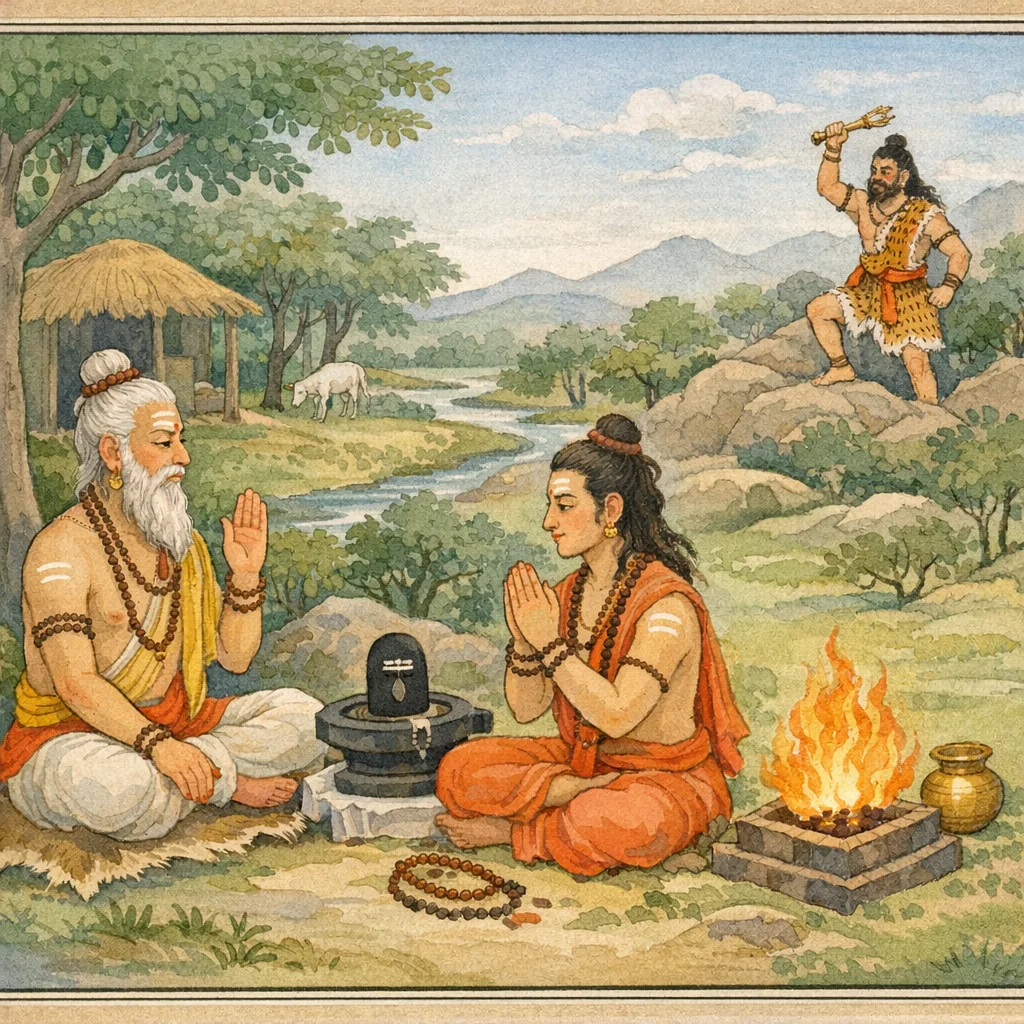
Answering Sanatkumāra, Śailādi relates that Kṣupa, a king born of Brahmā and once Dadhīci’s friend, became his opponent amid the dispute of “kṣatriya supremacy” versus “vipra (brahmin) supremacy.” Claiming to embody the eight Lokapālas and forbidding disrespect, Kṣupa is struck in Dadhīci’s wrath, yet fells Dadhīci with a vajra. Grieving, Dadhīci remembers Bhārgava (Śukra); Śukra arrives by yogic power, restores his body, and teaches the Mṛtasañjīvanī—Śiva’s Tryambaka (Umāpati) mantra, “tryambakaṃ yajāmahe… sugandhiṃ puṣṭivardhanam…,” praying through truth, svādhyāya, yoga, and meditation to cut the noose of death. In the Liṅga’s presence, by japa, homa, consecration, and drinking mantra-charged water, one gains freedom from fear of death and vajra-like firmness/invulnerability. When battle resumes, Kṣupa’s vajra can no longer destroy Dadhīci; seeing his potency, Kṣupa turns toward refuge in Hari (Mukunda), opening the ensuing thread on the mutual reliance of divine powers and the Śaiva–Vaiṣṇava relationship.
Shlokas
Verse 1
इति श्रीलिङ्गमहापुराणे पूर्वभागे योगिप्रशंसा नाम चतुस्त्रिंशो ऽध्यायः सनत्कुमार उवाच कथं जघान राजानं क्षुपं पादेन सुव्रत दधीचः समरे जित्वा देवदेवं जनार्दनम्
Thus ends, in the Śrī Liṅga Mahāpurāṇa (Pūrva-bhāga), the thirty-fourth chapter called “Praise of the Yogins.” Sanatkumāra said: “O you of excellent vows, how did Dadhīca, having conquered in battle even Janārdana—the God of gods—strike down the king Kṣupa with a single foot?”
Verse 2
वज्रास्थित्वं कथं लेभे महादेवान्महातपाः वक्तुमर्हसि शैलादे जितो मृत्युस्त्वया यथा
O Śailāda, great ascetic—how did you obtain from Mahādeva that adamantine steadfastness? You are worthy to tell us how Death itself was conquered by you.
Verse 3
शैलादिरुवाच ब्रह्मपुत्रो महातेजा राजा क्षुप इति स्मृतः अभून्मित्रो दधीचस्य मुनीन्द्रस्य जनेश्वरः
Śailādi said: “There was a mighty, radiant king—Kṣupa by name—born as a son of Brahmā. That lord of men became a friend of the great sage Dadhīci, the foremost among munis.”
Verse 4
चिरात्तयोः प्रसंगाद्वै वादः क्षुपदधीचयोः अभवत् क्षत्रियश्रेष्ठो विप्र एवेति विश्रुतः
In the course of time, due to their association, a dispute arose between Kṣupa and Dadhīci: “Is he famed as the foremost among kṣatriyas, or is he truly a brāhmaṇa?” Thus the contention became well known.
Verse 5
अष्टानां लोकपालानां वपुर्धारयते नृपः तस्मादिन्द्रो ह्ययं वह्निर् यमश् च निरृतिस् तथा
O king, the ruler bears within himself the embodied powers of the eight guardians of the worlds. Therefore he is to be regarded as Indra, as Agni, as Yama, and likewise as Nirṛti—manifesting their sovereign functions in governance.
Verse 6
वरुणश्चैव वायुश् च सोमो धनद एव च ईश्वरो ऽहं न संदेहो नावमन्तव्य एव च
“I am indeed Varuṇa, and Vāyu, and Soma, and also Dhanada (Kubera). I am the Supreme Lord (Īśvara)—there is no doubt. Therefore, I must never be treated with contempt.”
Verse 7
महती देवता या सा महतश्चापि सुव्रत तस्मात्त्वया महाभाग च्यावनेय सदा ह्यहम्
That Deity who is truly “the Great” is indeed the Supreme Greatness itself, O you of excellent vow. Therefore, O fortunate one—descendant of Cyavana—I am ever to be approached through you, as the guiding means.
Verse 8
नावमन्तव्य एवेह पूजनीयश् च सर्वथा श्रुत्वा तथा मतं तस्य क्षुपस्य मुनिसत्तमः
“Here, he should never be slighted; indeed, he must always be honored and revered.” Having heard that resolve of the ascetic, the best of sages accepted it as proper.
Verse 9
दधीचश् च्यावनिश् चोग्रो गौरवादात्मनो द्विजः अताडयत्क्षुपं मूर्ध्नि दधीचो वाममुष्टिना चिछेद वज्रेण च तं दधीचं बलवान् क्षुपः
Dadhīci, the fierce son of Cyavana, puffed up with his own importance, struck Kṣupa upon the head. Then Dadhīci smashed him with his left fist; but the mighty Kṣupa, in turn, cut down Dadhīci with a thunderbolt-like vajra weapon.
Verse 10
ब्रह्मलोके पुरासौ हि ब्रह्मणः क्षुतसंभवः लब्धं वज्रं च कार्यार्थं वज्रिणा चोदितः प्रभुः
Formerly, in Brahmā’s realm, that mighty one—born from Brahmā’s hunger—obtained the vajra to accomplish a divine task, urged on by Vajrī (Indra), lord of the devas.
Verse 11
स्वेच्छयैव नरो भूत्वा नरपालो बभूव सः तस्माद्राजा स विप्रेन्द्रम् अजयद्वै महाबलः
By his own free will, having become a man, he became a protector of men—a king. Therefore that mighty king indeed overcame the foremost of Brahmins, revealing the force of worldly sovereignty when it is not restrained by dharma.
Verse 12
यथा वज्रधरः श्रीमान् बलवांस्तमसान्वितः पपात भूमौ निहतो वज्रेण द्विजपुङ्गवः
Thus the foremost Brāhmaṇa, though radiant and mighty like the wielder of the vajra, was clouded by tamas; struck down by the vajra, he fell upon the earth.
Verse 13
सस्मार च तदा तत्र दुःखाद्वै भार्गवं मुनिम् शुक्रो ऽपि संधयामास ताडितं कुलिशेन तम्
Then, in that very place, stricken with grief, he remembered the Bhārgava sage. And Śukra, too, restored and made whole the one who had been struck by the thunderbolt (vajra).
Verse 14
योगादेत्य दधीचस्य देहं देहभृतांवरः संधाय पूर्ववद्देहं दधीचस्याह भार्गवः
By the power of yoga, Bhārgava—foremost among embodied beings—approached Dadhīci’s body and rejoined it, restoring Dadhīci’s form exactly as before.
Verse 15
भो दधीच महाभाग देवदेवमुमापतिम् सम्पूज्य पूज्यं ब्रह्माद्यैर् देवदेवं निरञ्जनम्
O greatly fortunate Dadhīca, having duly worshipped Devadeva—Umā’s Lord—who is worthy of worship even by Brahmā and the other gods, approach that stainless Lord of the Devas, the transcendent Pati beyond all taints.
Verse 16
अवध्यो भव विप्रर्षे प्रसादात्त्र्यम्बकस्य तु मृतसंजीवनं तस्माल् लब्धमेतन्मया द्विज
O best of brahmin sages, become inviolable; by the grace of Tryambaka (Śiva) I have obtained this Mṛtasaṃjīvanī—the life-restoring sacred knowledge. Therefore, O twice-born one, this has been attained by me through His favor.
Verse 17
नास्ति मृत्युभयं शंभोर् भक्तानामिह सर्वतः मृतसंजीवनं चापि शैवमद्य वदामि ते
For the devotees of Śambhu, there is no fear of death anywhere in this world. Now I shall teach you the Śaiva secret called “reviving the dead”—the life-restoring power that arises from taking refuge in the Lord as Pati.
Verse 18
त्रियंबकं यजामहे त्रैलोक्यपितरं प्रभुम् त्रिमण्डलस्य पितरं त्रिगुणस्य महेश्वरम्
We worship Triyambaka, the three‑eyed Lord—sovereign Master and Father of the three worlds; Father of the triple cosmic sphere, and Maheśvara who presides over the three guṇas. As Pati, He alone is the refuge who loosens the pāśa that binds the paśu.
Verse 19
त्रितत्त्वस्य त्रिवह्नेश् च त्रिधाभूतस्य सर्वतः त्रिवेदस्य महादेवं सुगन्धिं पुष्टिवर्धनम्
I worship Mahādeva—the Lord of the three sacred fires, the ground of the three principles (tattva), and the all-pervading source of the threefold elements; the very essence of the three Vedas—fragrant with auspiciousness and the increaser of nourishment, strength, and spiritual flourishing.
Verse 20
सर्वभूतेषु सर्वत्र त्रिगुणे प्रकृतौ तथा इन्द्रियेषु तथान्येषु देवेषु च गणेषु च
He is present in all beings, everywhere—likewise within Prakṛti constituted of the three guṇas; within the sense-faculties (indriya) and other powers; and also among the Devas and the hosts of Gaṇas.
Verse 21
पुष्पेषु गन्धवत्सूक्ष्मः सुगन्धिः परमेश्वरः पुष्टिश् च प्रकृतिर्यस्मात् पुरुषस्य द्विजोत्तम
O best of the twice-born, Parameśvara abides in flowers as their subtle fragrance—indeed as the sweet scent itself. And because He is the nourishing power and the very Prakṛti of the Puruṣa, He is the inner essence that sustains embodied beings.
Verse 22
महदादिविशेषान्तविकल्पस्यापि सुव्रत विष्णोः पितामहस्यापि मुनीनां च महामुने
O you of excellent vows, even the whole range of conceptual distinctions—from Mahat down to the last of the particulars—lies beyond complete reckoning; so too for Viṣṇu, for Pitāmaha (Brahmā), and even for the sages, O great seer. Therefore the Supreme Pati, Śiva, transcends all tattvas and the mind’s constructions.
Verse 23
इन्द्रस्यापि च देवानां तस्माद्वै पुष्टिवर्धनः तं देवममृतं रुद्रं कर्मणा तपसा तथा
Therefore, for Indra and for all the Devas as well, He alone is the increaser of strength and nourishment. That immortal Deity—Rudra—should be approached and honoured through sacred action and through tapas, for He is the Pati who empowers the hosts of heaven.
Verse 24
स्वाध्यायेन च योगेन ध्यानेन च यजामहे सत्येनानेन मुक्षीयान् मृत्युपाशाद् भवः स्वयम्
By sacred study (svādhyāya), by Yoga-discipline, and by meditative contemplation (dhyāna) we worship the Lord. By this very truth, may Bhava—Śiva Himself—release us from the noose of death (mṛtyu-pāśa).
Verse 25
बन्धमोक्षकरो यस्माद् उर्वारुकमिव प्रभुः मृतसंजीवनो मन्त्रो मया लब्धस्तु शङ्करात्
Because the Lord is the One who brings release from bondage—like a ripe cucumber that detaches from its stalk—therefore the life-restoring mantra (Mṛtasaṃjīvanī) was obtained by me from Śaṅkara. It is the means by which the bound soul (paśu) is freed from the fetter (pāśa) through the grace of Pati, the Lord.
Verse 26
जप्त्वा हुत्वाभिमन्त्र्यैवं जलं पीत्वा दिवानिशम् लिङ्गस्य संनिधौ ध्यात्वा नास्ति मृत्युभयं द्विज
Having recited (the mantra) as japa, having offered oblations (huta), and thus consecrating the water with mantra, one should drink that water day and night. Meditating in the presence of the Śiva-liṅga—O twice-born (dvija)—there is no fear of death.
Verse 27
तस्य तद्वचनं श्रुत्वा तपसाराध्य शङ्करम् वज्रास्थित्वम् अवध्यत्वम् अदीनत्वं च लब्धवान्
Having heard his words, he worshipped Śaṅkara through tapas; and by that propitiation he obtained a body firm as a vajra, the state of being unassailable, and an unbroken steadfastness—free from dejection—through the grace of the Lord as Pati, who loosens the pasha-bonds of the pashu.
Verse 28
एवमाराध्य देवेशं दधीचो मुनिसत्तमः प्राप्यावध्यत्वमन्यैश् च वज्रास्थित्वं प्रयत्नतः
Thus, Dadhīci, the foremost of sages, having worshipped the Lord of the Devas with steadfast effort, obtained the boon of being unassailable by others, and his bones became adamantine like a vajra.
Verse 29
अताडयच्च राजेन्द्रं पादमूलेन मूर्धनि क्षुपो दधीचं वज्रेण जघानोरसि च प्रभुः
Then, O best of kings, he struck the king upon the head with the sole of his foot; and the mighty lord Dadhīci, with his thunderbolt, smote (his opponent) upon the chest.
Verse 30
नाभून्नाशाय तद्वज्रं दधीचस्य महात्मनः प्रभावात्परमेशस्य वज्रबद्धशरीरिणः
That thunderbolt did not become a cause of destruction for the great-souled Dadhīci, for by the power of Parameśvara his body had been bound into adamant, firm as a vajra.
Verse 31
दृष्ट्वाप्यवध्यत्वमदीनतां च क्षुपो दधीचस्य तदा प्रभावम् आराधयामास हरिं मुकुन्दम् इन्द्रानुजं प्रेक्ष्य तदांबुजाक्षम्
Seeing the inviolability, the unbroken courage, and the spiritual radiance of Dadhīci, Kṣupa then began to worship Hari—Mukunda, the Liberator—gazing upon the lotus-eyed younger brother of Indra.
Frequently Asked Questions
Bhargava teaches a Shiva-centered regimen: worship of Tryambaka (Shiva), recitation of the Mṛtasañjīvanī/Tryambaka formula, and disciplined practice of japa, homa, abhi-mantrita water (sanctified water), and dhyāna performed in the presence of the Shiva Linga.
The hymn describes Shiva as pervasive across all beings and domains—within the trigunas and prakriti, within the indriyas, among devas and ganas—thereby presenting a metaphysical basis for why Shiva’s grace can ‘cut the noose of death’ and grant resilience (avadhyatva).
Because Dadhichi attains ‘vajra-bound embodiment’ (vajra-baddha-śarīra) and invincibility through Shiva’s grace obtained via austerity and the Mritasanjivani-oriented worship; thus the weapon cannot accomplish destruction.