Adhyaya 33
Adhyaya 33: Pashupata Conduct, Bhasma-Vrata, and Shiva’s Boon to the Sages
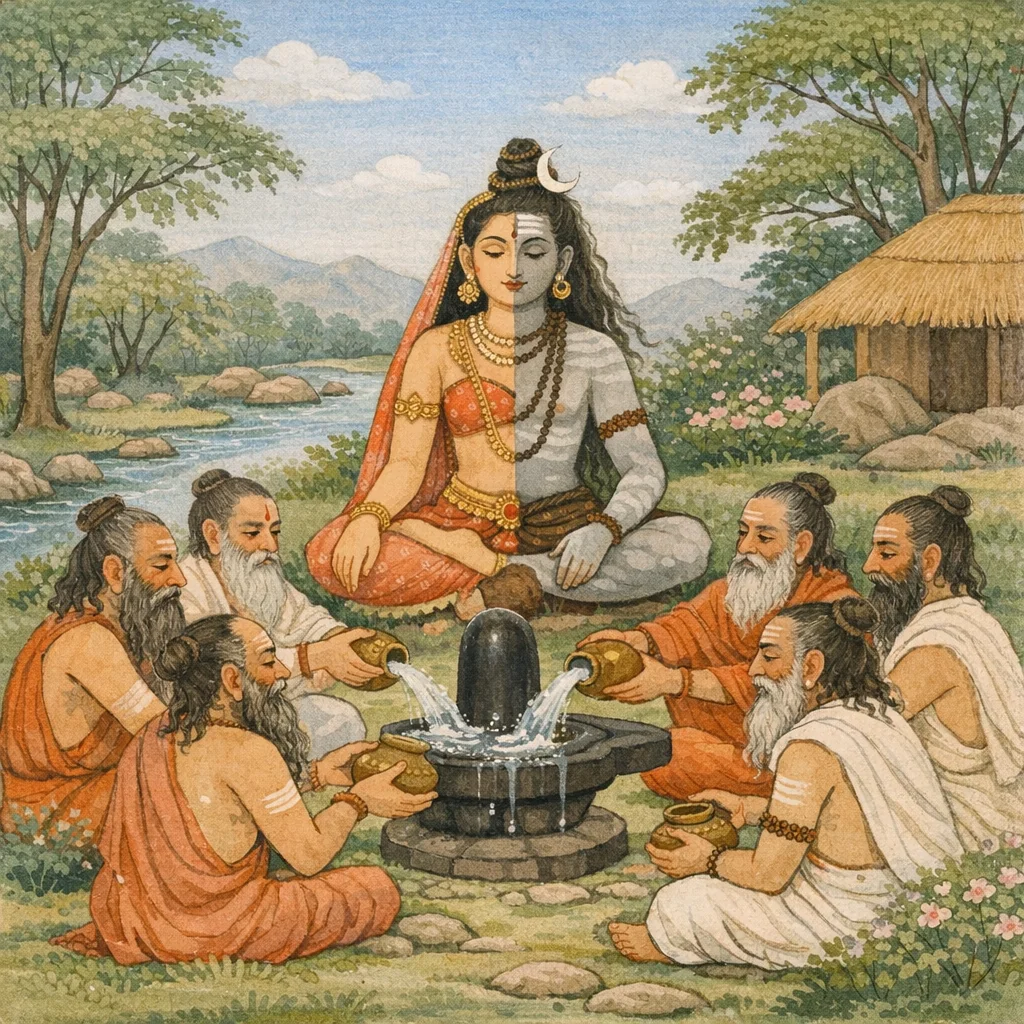
Nandī recounts that Mahēśvara, pleased on hearing the sages’ hymn, proclaims the merit of reciting, hearing, and teaching that stava, granting the worthy a Gaṇapatya-like attainment. Śiva then sets forth a doctrine of creation through the paired principles of strīliṅga (prakṛti) and puṁliṅga (puruṣa), both arising from his own being, revealing a non-dual Śaiva metaphysics beneath gendered symbolism. He gives ethical injunctions: do not mock or revile the digvāsas/ascetic who may seem childlike or mad, yet is devoted to Śiva and speaks brahman. He praises disciplined, meditative brāhmaṇas who bear bhasma, restrain speech, mind, and body, worship Mahādeva, attain Rudra-loka, and do not return. The learned must not transgress or insult bhasma-vratins and munda-ascetics; honoring them is honoring Śaṅkara, while condemning them is condemning Mahādeva. Freed from fear and delusion, the sages perform abhiṣeka with pure waters, kuśa, and flowers, chanting secret mantras and huṁkāras, and praising Ardhanārīśvara. Delighted, Śiva invites them to ask a boon; the assembled ṛṣis then inquire into the meanings of bhasma-bathing, nudity, “leftness” (vāmatva), contrariness (pratilomatā), and what is to be served or avoided, preparing the next teaching.
Shlokas
Verse 1
इति श्रीलिङ्गमहापुराणे पूर्वभागे द्वात्रिंशो ऽध्यायः नन्द्युवाच ततस्तुतोष भगवान् अनुगृह्य महेश्वरः स्तुतिं श्रुत्वा स्तुतस्तेषाम् इदं वचनमब्रवीत्
Thus ends the thirty-second chapter of the Śrī Liṅga Mahāpurāṇa (Pūrva-bhāga). Nandī said: Then Bhagavān Maheśvara, gracious to His devotees, became pleased. Having heard their hymn and being praised by them, the Lord spoke these words—bestowing His favor upon the bound souls (paśu) through His lordship as Pati.
Verse 2
यः पठेच्छृणुयाद्वापि युष्माभिः कीर्तितं स्तवम् श्रावयेद्वा द्विजान्विप्रो गाणपत्यमवाप्नुयात्
Whoever recites, or even listens to, this hymn praised by you—and the learned brāhmaṇa who also causes the twice-born to hear it—attains gaṇapatya-status: the grace and lordship associated with Gaṇapati, as the fruit of devotion aligned with Śiva’s divine order.
Verse 3
वक्ष्यामि वो हितं पुण्यं भक्तानां मुनिपुङ्गवाः अद्वन्तगेस् ओफ़् थे पाशुपत बेहविओउर् स्त्रीलिङ्गमखिलं देवी प्रकृतिर्मम देहजा
O best of sages, I shall declare to you what is auspicious and beneficial for devotees. The Goddess—Prakṛti, born of My own body—constitutes the entire feminine principle (strī-liṅga).
Verse 4
पुंल्लिङ्गं पुरुषो विप्रा मम देहसमुद्भवः उभाभ्यामेव वै सृष्टिर् मम विप्रा न संशयः
O Brahmin sages, the masculine principle (puṃ-liṅga)—the Purusha—arose from My own body. From both (male and female principles) creation proceeds, yet it is from Me alone, O sages; of this there is no doubt.
Verse 5
न निन्देद्यतिनं तस्माद् दिग्वाससमनुत्तमम् बालोन्मत्तविचेष्टं तु मत्परं ब्रह्मवादिनम्
Therefore one should never disparage a renunciant (yati)—supreme among those clad in the directions (digvāsa)—who may act like a child or a madman, yet is wholly devoted to Me and proclaims Brahman. Such a one is the Pati-oriented sage, who has gone beyond the pāśa that binds the paśu (the individual soul).
Verse 6
ये हि मां भस्मनिरता भस्मना दग्धकिल्बिषाः यथोक्तकारिणो दान्ता विप्रा ध्यानपरायणाः
Those Brahmin seers who are devoted to Me through the sacred ash (bhasma)—whose sins are burned away by that ash—who act exactly as enjoined, are self-restrained, and are wholly intent on meditation: they are truly aligned with Me, the Pati (Lord) who frees the paśu (individual soul) from the fetters of pāśa.
Verse 7
महादेवपरा नित्यं चरन्तो ह्यूर्ध्वरेतसः अर्चयन्ति महादेवं वाङ्मनःकायसंयताः
Ever devoted to Mahādeva, living in constant discipline as those who preserve and sublimate their vital energy, they worship Mahādeva with speech, mind, and body fully restrained.
Verse 8
रुद्रलोकमनुप्राप्य न निवर्तन्ति ते पुनः तस्मादेतद्व्रतं दिव्यम् अव्यक्तं व्यक्तलिङ्गिनः
Having attained Rudra’s world, they do not return again. Therefore this divine vow—subtle in essence, yet manifest through the Linga—belongs to the Lord who bears the revealed sign, and it grants the bound soul release from return.
Verse 9
भस्मव्रताश् च मुण्डाश् च व्रतिनो विश्वरूपिणः न तान्परिवदेद्विद्वान् न चैतान्नाभिलङ्घयेत्
Those who observe the ash-vow, those who are shaven-headed, and the vowed ascetics who bear the universal marks of Śiva—a wise person should not speak ill of them, nor should he insult or overstep them.
Verse 10
न हसेन्नाप्रियं ब्रूयाद् अमुत्रेह हितार्थवान् यस्तान्निन्दति मूढात्मा महादेवं स निन्दति
Seeking true welfare in this world and the next, one should neither mock nor speak what is harsh. The deluded soul who censures the devotees and Śaiva observances thereby censures Mahādeva Himself—for Pati, Lord Śiva, is present where His bhaktas and dharma are honored.
Verse 11
यस् त्वेतान् पूजयेन् नित्यं स पूजयति शङ्करम् एवमेष महादेवो लोकानां हितकाम्यया
But whoever worships these regularly—he truly worships Śaṅkara. Thus Mahādeva, desiring the welfare of the worlds, makes this principle known: through right worship, the bound soul (paśu) reaches the Lord (pati).
Verse 12
युगे युगे महायोगी क्रीडते भस्मगुण्ठितः एवं चरत भद्रं वस् ततः सिद्धिमवाप्स्यथ
In every age the Great Yogin (Śiva) sports in divine play, his body covered with sacred ash. Live and practice in this very way—may auspiciousness be yours—and then you shall attain siddhi, spiritual accomplishment.
Verse 13
अतुलमिह महाभयप्रणाशहेतुं शिवकथितं परमं पदं विदित्वा व्यपगतभवलोभमोहचित्ताः प्रणिपतिताः सहसा शिरोभिर् उग्रम्
Here, having understood the incomparable Supreme State taught by Śiva—the very cause of the destruction of great fear—their minds, freed from worldly becoming, greed, and delusion, at once fell down, bowing their heads in reverence before the awe-inspiring Lord.
Verse 14
ततः प्रमुदिता विप्राः श्रुत्वैवं कथितं तदा गन्धोदकैः सुशुद्धैश् च कुशपुष्पविमिश्रितैः
Then the Brahmin sages, delighted on hearing it thus explained, proceeded at that time with perfectly pure, fragrant water mixed with kuśa grass and flowers, preparing the sanctifying offering for Śiva’s worship.
Verse 15
स्नापयन्ति महाकुम्भैर् अद्भिर् एव महेश्वरम् गायन्ति विविधैर्गुह्यैर् हुंकारैश्चापि सुस्वरैः
They bathe Maheśvara with water poured from great ritual pitchers, and they sing many secret hymns, uttering resonant huṃ-kāra invocations in well-tuned voices.
Verse 16
नमो देवाधिदेवाय महादेवाय वै नमः अर्धनारीशरीराय सांख्ययोगप्रवर्तिने
Salutations to the God beyond all gods—verily, salutations to Mahādeva; salutations to Him whose very body is half Woman (Ardhanārīśvara), the revealer and establisher of Sāṃkhya and Yoga—the discriminative knowledge and liberating discipline that lead the bound soul (paśu) toward the Lord (Pati).
Verse 17
मेघवाहनकृष्णाय गजचर्मनिवासिने कृष्णाजिनोत्तरीयाय व्यालयज्ञोपवीतिने
Salutations to the dark-hued Lord who rides upon the cloud; who is clad in an elephant-hide; who wears the black antelope-skin as His upper garment; and who bears a sacred thread formed of serpents.
Verse 18
सुरचितसुविचित्रकुण्डलाय सुरचितमाल्यविभूषणाय तुभ्यम् मृगपतिवरचर्मवाससे च प्रथितयशसे नमो ऽस्तु शङ्कराय
Salutations to Śaṅkara—to You who are adorned with exquisitely fashioned, wondrous earrings, who are beautified with well-made garlands and ornaments; to You who wear the noble hide of the lord of beasts, and whose glory is renowned everywhere. May my homage be to You.
Verse 19
ततस् तान् स मुनीन् प्रीतः प्रत्युवाच महेश्वरः प्रीतो ऽस्मि तपसा युष्मान् वरं वृणुत सुव्रताः
Then Mahādeva (Maheśvara), pleased, spoke in reply to those sages: “By your tapas I am satisfied with you. O you of excellent vows, choose a boon.”
Verse 20
ततस्ते मुनयः सर्वे प्रणिपत्य महेश्वरम् भृग्वङ्गिरा वसिष्ठश् च विश्वामित्रस्तथैव च
Then all those sages bowed down in reverence to Maheśvara—Bhr̥gu, Aṅgirā, Vasiṣṭha, and likewise Viśvāmitra—acknowledging the Supreme Lord (Pati) who releases bound souls (paśu) from their fetters (pāśa).
Verse 21
गौतमो ऽत्रिः सुकेशश् च पुलस्त्यः पुलहः क्रतुः मरीचिः कश्यपः कण्वः संवर्तश् च महातपाः
Gautama, Atri, and Sukeśa; Pulastya, Pulaha, and Kratu; Marīci, Kaśyapa, Kaṇva, and Saṃvarta—these are the great ascetics, mighty in tapas.
Verse 22
ते प्रणम्य महादेवम् इदं वचनमब्रुवन् भस्मस्नानं च नग्नत्वं वामत्वं प्रतिलोमता
Having bowed to Mahādeva, they spoke these words: “Bathing with sacred ash (bhasma), nakedness, leftward (contrarian) conduct, and reversal of the ordinary order—are these the disciplines to be observed?”
Verse 23
सेव्यासेव्यत्वमेवं च ह्य् एतदिच्छाम वेदितुम् ततस्तेषां वचः श्रुत्वा भगवान्परमेश्वरः
“We wish to understand precisely this distinction—what is worthy of service (and worship) and what is not.” Then, having heard their words, Bhagavān Parameśvara, the Supreme Lord Śiva, prepared to respond.
Verse 24
सस्मितं प्राह सम्प्रेक्ष्य सर्वान्मुनिवरांस्तदा
Then, after looking upon all those foremost sages, he spoke with a gentle smile—signaling gracious instruction from the Lord (Pati) to the bound souls (paśu) seeking release from pāśa.
Frequently Asked Questions
It presents bhasma as a vow-marker of Śaiva purity and discipline: those devoted to bhasma, self-controlled, and meditative—worshiping Mahādeva with restraint—attain Rudra-loka and are described as not returning again, indicating a liberation-oriented fruition.
Because an ascetic may appear childish or mad yet be wholly devoted to Śiva and established in brahma-vāda; condemning such votaries is equated with condemning Mahādeva, while honoring them is treated as direct worship of Śaṅkara.
The sages explicitly salute Śiva as ‘ardhanārīśarīra’ and as the propounder of sāṁkhya and yoga, integrating metaphysics (prakṛti–puruṣa) with devotional stuti and ritual abhiṣeka.