Adhyaya 19
Mahādeva’s Boon: Unwavering Bhakti, Tri-functional Cosmos, and the Supratiṣṭhā of Liṅga-Arcā
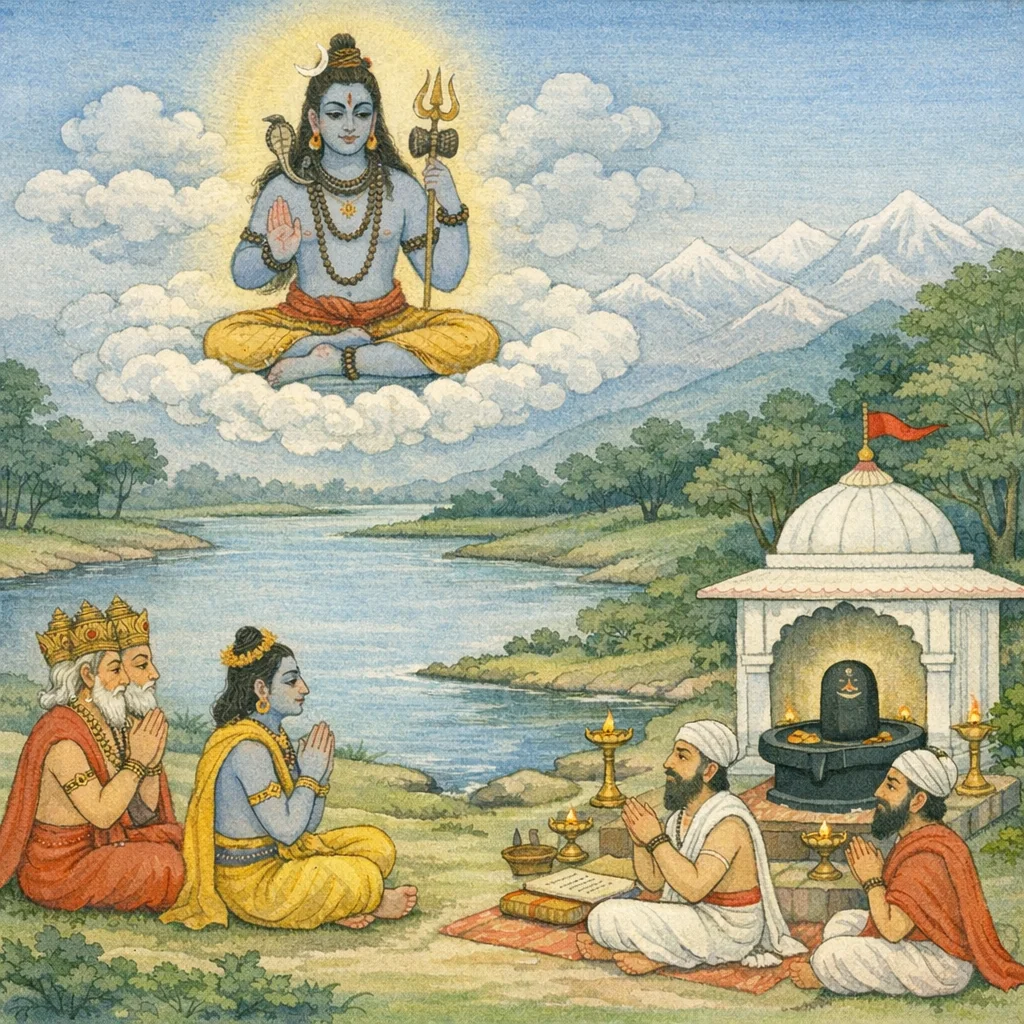
Sūta recounts Mahādeva’s compassionate revelation before Brahmā and Viṣṇu: the mere sight of him dispels fear and restores cosmic order. Shiva declares that Brahmā and Viṣṇu arise from the sides of his own body, derivative yet indispensable in their offices. Pleased, he offers a boon; Viṣṇu asks not for dominion but for nitya, avyabhicāriṇī bhakti—eternal, unwavering devotion. Shiva grants steadfast bhakti to both Brahmā and Viṣṇu, then settles their earlier dispute by clarifying the three cosmic functions—sarga (creation), sthiti/rakṣā (maintenance/protection), and laya (dissolution)—while proclaiming himself the guṇa-free, transcendent Paramēśvara. He instructs Viṣṇu to abandon delusion and protect Brahmā, foretelling future recognition in the Padma-kalpa. After Shiva vanishes, the narrative turns from theophany to institution: Liṅga-arcā is firmly established across the worlds; the Liṅga-vedī is identified with Devī and the Liṅga with Shiva himself. The chapter ends with a salvific promise—reciting this Liṅga narrative in the Liṅga’s presence leads the devotee to śivatā—bridging divine mediation to the ensuing ritual-theological focus on the Liṅga as symbol and locus of liberation.
Shlokas
Verse 1
सूत उवाच अथोवाच महादेवः प्रीतो ऽहं सुरसत्तमौ पश्यतां मां महादेवं भयं सर्वं विमुच्यताम्
Sūta said: Then Mahādeva spoke: “O you two, the best among the gods, I am pleased. Behold Me—Mahādeva—and let all fear be cast away completely.”
Verse 2
युवां प्रसूतौ गात्राभ्यां मम पूर्वं महाबलौ अयं मे दक्षिणे पार्श्वे ब्रह्मा लोकपितामहः
“You two, mighty in power, were brought forth earlier from My own limbs. And here, on My right side, is Brahmā, the Grandfather of the worlds.”
Verse 3
वामे पार्श्वे च मे विष्णुर् विश्वात्मा हृदयोद्भवः प्रीतो ऽहं युवयोः सम्यग् वरं दद्मि यथेप्सितम्
“On My left side abides Vishnu—the Universal Self, arisen from the Heart. Fully pleased with you both, I grant you the boon you desire.”
Verse 4
एवमुक्त्वा तु तं विष्णुं कराभ्यां परमेश्वरः पस्पर्श सुभगाभ्यां तु कृपया तु कृपानिधिः
Having spoken thus to Vishnu, the Supreme Lord (Parameśvara)—the very treasury of compassion—tenderly touched him with His auspicious hands, moved purely by grace.
Verse 5
ततः प्रहृष्टमनसा प्रणिपत्य महेश्वरम् प्राह नारायणो नाथं लिङ्गस्थं लिङ्गवर्जितम्
Then Nārāyaṇa, his mind filled with joy, bowed down to Maheśvara and addressed the Lord—who abides in the Liṅga, yet in truth is beyond all marks and attributes, though appearing as the Liṅga.
Verse 6
यदि प्रीतिः समुत्पन्ना यदि देयो वरश् च नौ भक्तिर्भवतु नौ नित्यं त्वयि चाव्यभिचारिणी
If true affection has arisen (in you toward us), and if a boon is to be granted to us, then let this be our boon: may unwavering devotion arise in us—eternal and unerring—toward you alone.
Verse 7
देवः प्रदत्तवान् देवाः स्वात्मन्यव्यभिचारिणीम् ब्रह्मणे विष्णवे चैव श्रद्धां शीतांशुभूषणः
Adorned with the moon, the Deva (Śiva) bestowed upon the gods an unwavering faith fixed in His own Self—granting that same steadfast śraddhā to Brahmā and to Viṣṇu as well.
Verse 8
जानुभ्यामवनीं गत्वा पुनर्नारायणः स्वयम् प्रणिपत्य च विश्वेशं प्राह मन्दतरं वशी
Again Nārāyaṇa himself went down to the earth upon his knees; and, bowing in full prostration to Viśveśa—the Lord of all—he, self-restrained and subdued in pride, spoke in a gentler tone.
Verse 9
आवयोर्देवदेवेश विवादमतिशोभनम् इहागतो भवान् यस्माद् विवादशमनाय नौ
O Lord of the gods, God of gods—because a splendid yet intense dispute has arisen between the two of us, you have come here to pacify our contention.
Verse 10
तस्य तद्वचनं श्रुत्वा पुनः प्राह हरो हरिम् प्रणिपत्य स्थितं मूर्ध्ना कृताञ्जलिपुटं स्मयन्
Having heard his words, Hara (Śiva) again addressed Hari (Viṣṇu). Hari stood with his head bowed in reverence, hands joined in añjali; and Śiva, smiling, spoke to him.
Verse 11
श्रीमहादेव उवाच प्रलयस्थितिसर्गाणां कर्ता त्वं धरणीपते वत्स वत्स हरे विष्णो पालयैतच्चराचरम्
Śrī Mahādeva said: “O Lord of the earth, dear child—O Hari, O Viṣṇu—within dissolution, maintenance, and creation, you are the appointed doer. Therefore protect this entire universe, the moving and the unmoving.”
Verse 12
त्रिधा भिन्नो ह्यहं विष्णो ब्रह्मविष्णुभवाख्यया सर्गरक्षालयगुणैर् निष्कलः परमेश्वरः
I, the all-pervading Lord, am spoken of as threefold—Brahmā, Viṣṇu, and Bhava—according to the qualities that govern creation, preservation, and dissolution; yet in truth I am the partless, transcendent Parameśvara, beyond all limiting functions.
Verse 13
संमोहं त्यज भो विष्णो पालयैनं पितामहम् पाद्मे भविष्यति सुतः कल्पे तव पितामहः
“Abandon this delusion, O Viṣṇu. Protect this Grandfather (Brahmā). In the Padma-kalpa he will again become your son, and in that cycle he will be your grandsire.”
Verse 14
तदा द्रक्ष्यसि मां चैवं सो ऽपि द्रक्ष्यति पद्मजः एवमुक्त्वा स भगवांस् तत्रैवान्तरधीयत
“Then you will behold Me in this very manner, and the Lotus-born (Brahmā) too will behold (Me).” Having spoken thus, that Blessed Lord—Pati, the revealer of the Liṅga—vanished right there.
Verse 15
तदाप्रभृति लोकेषु लिङ्गार्चा सुप्रतिष्ठिता लिङ्गवेदी महादेवी लिङ्गं साक्षान्महेश्वरः
From that time onward, throughout the worlds, the worship of the Liṅga became firmly established. The liṅga-vedī, the Liṅga-altar, is Mahādevī herself, and the Liṅga is Maheśvara in visible, immediate presence.
Verse 16
लयनाल्लिङ्गमित्युक्तं तत्रैव निखिलं सुराः यस्तु लैङ्गं पठेन्नित्यम् आख्यानं लिङ्गसन्निधौ
Because it is the place of dissolution (laya), it is called the Liṅga; there indeed all the gods abide. Whoever daily recites this sacred narrative concerning the Liṅga in the very presence of the Liṅga—becomes fit for Śiva’s grace.
Verse 17
स याति शिवतां विप्रो नात्र कार्या विचारणा
That vipra, the twice-born, attains Śiva-hood—union with the state of Śiva; on this there is no need for doubt or further deliberation.
Frequently Asked Questions
Viṣṇu asks for nitya, avyabhicāriṇī bhakti—perpetual, unwavering devotion to Shiva—rather than worldly power, making bhakti the chapter’s central salvific gift.
Shiva states Brahmā and Viṣṇu arise from his own body (right and left sides) and that he is functionally ‘threefold’ as Brahmā–Viṣṇu–Bhava for sarga, rakṣā, and laya, while remaining Niṣkala as the supreme Paramēśvara.
The text links ‘liṅga’ with laya (dissolution/absorption), indicating the Liṅga as the locus where the cosmos is gathered back—hence a sign of Shiva’s transcendent ground and cosmic reabsorption.
It sacralizes the pedestal/altar (vedī) as Devī (Śakti), presenting worship as a Shiva–Shakti unity: Liṅga as sākṣān Mahēśvara and its seat as the divine feminine support of manifestation and ritual presence.