Adhyaya 11
Brahmā’s Yogic Vision of Sadyōjāta in the Śvetalohita Kalpa
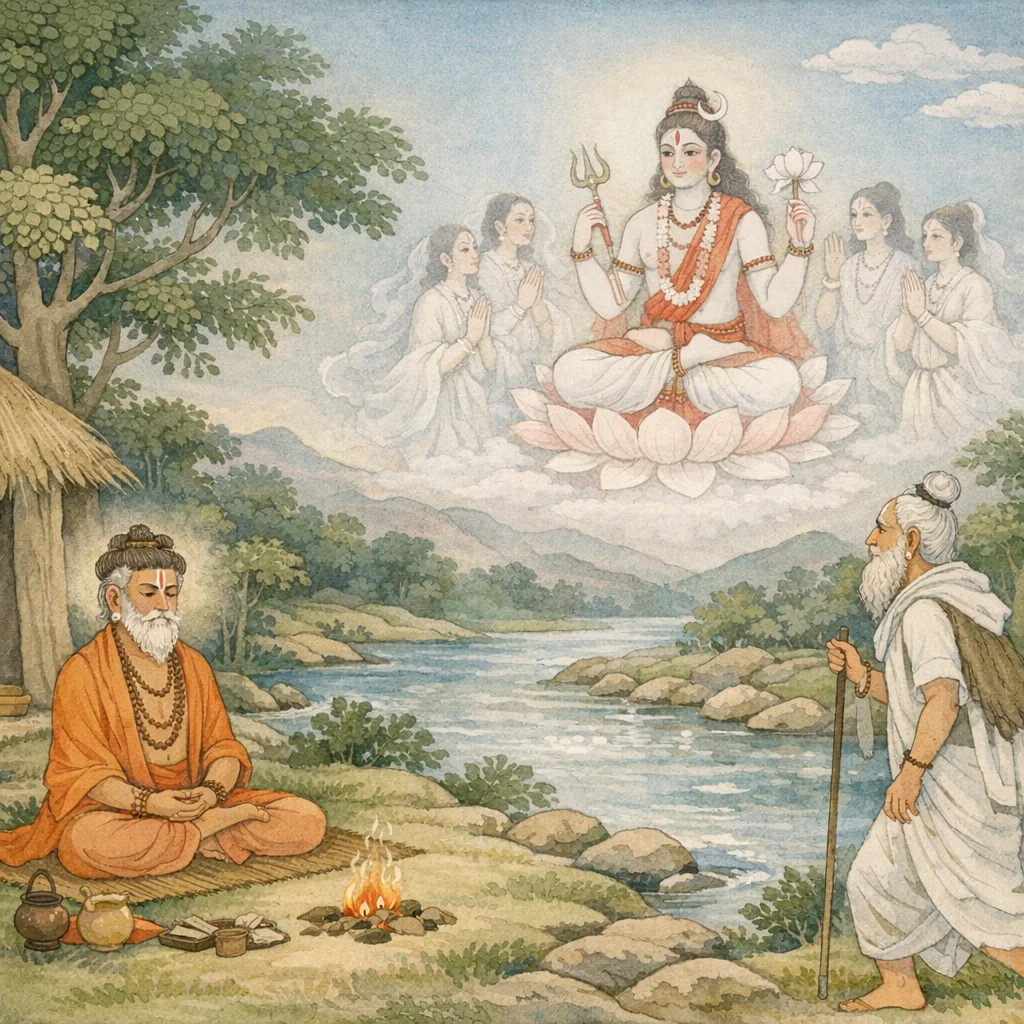
The sages ask how Brahmā beheld Mahēśvara as Sadyōjāta, and also as Vāmadeva, Aghora, and Īśāna. Sūta places the account in the Śvetalohita Kalpa and says that Brahmā, absorbed in supreme meditation (parama-dhyāna), sees a radiant, śikhā-bearing manifestation—the Śvetalohita Kumāra. Brahmā draws the vision inward as the Brahma-rūpi Īśvara, deepens in dhyāna-yoga, and culminates in reverent worship of Sadyōjāta. From Brahmā’s side arise white-hued attendants and disciples—Sunanda, Nandana, Viśvananda, and Upanandana—signaling the emergence of a Śaiva retinue and transmission. A great sage named Śveta appears, and from him Hara is said to be born/manifest, reinforcing Śiva’s self-revelation through sanctified consciousness. The assembled munis surrender with intense bhakti, praising the eternal Brahman as Mahēśvara. The chapter ends with a saving promise: twice-born seekers who take refuge in Viśvēśvara, practice prāṇāyāma, and fix the mind on Brahman become sinless and radiant, and advance beyond Viṣṇuloka to Rudraloka, setting up the next teaching on sustained Śaiva devotion and its metaphysical destinations.
Shlokas
Verse 1
ऋषय ऊचुः कथं वै दृष्टवान्ब्रह्मा सद्योजातं महेश्वरम् वामदेवं महात्मानं पुराणपुरुषोत्तमम्
The sages said: “How indeed did Brahmā behold Maheśvara as Sadyojāta, and that great-souled Vāmadeva—the Primeval Supreme Person, the highest among the eternal Puruṣas?”
Verse 2
अघोरं च तथेशानं यथावद्वक्तुमर्हसि सूत उवाच एकोनत्रिंशकः कल्पो विज्ञेयः श्वेतलोहितः
“Aghora and likewise Īśāna—please explain them properly, as is fitting.” Sūta said: “Know that the Kalpa is the twenty-ninth, renowned as Śveta-lohita.”
Verse 3
तस्मिंस्तत्परमं ध्यानं ध्यायतो ब्रह्मणस्तदा उत्पन्नस्तु शिखायुक्तः कुमारः श्वेतलोहितः
While Brahmā was absorbed in that supreme contemplation, there then arose a youthful being—Śvetalohita—endowed with a tufted crest, manifesting as the immediate fruit of that highest meditation.
Verse 4
तं दृष्ट्वा पुरुषं श्रीमान् ब्रह्मा वै विश्वतोमुखः हृदि कृत्वा महात्मानं ब्रह्मरूपिणमीश्वरम्
Seeing that Supreme Person, the glorious Brahmā—faced toward all directions—held within his heart that great-souled Lord, Īśvara, who manifests as Brahman itself.
Verse 5
सद्योजातं ततो ब्रह्मा ध्यानयोगपरो ऽभवत् ध्यानयोगात्परं ज्ञात्वा ववन्दे देवमीश्वरम्
Then Brahmā, in the aspect of Sadyojāta, became wholly intent on the yoga of meditation. Realizing through that meditative yoga the Supreme beyond all, he bowed in reverence to the Divine Lord, Īśvara (Śiva)—the Pati who transcends the bonds of pāśa and uplifts the paśu-souls.
Verse 6
सद्योजातं ततो ब्रह्म ब्रह्म वै समचिन्तयत् ततो ऽस्य पार्श्वतः श्वेताः प्रादुर्भूता महायशाः
Then Brahmā—newly manifested—contemplated Brahman, the Supreme Reality. From his sides there arose radiant, white beings of great and illustrious glory.
Verse 7
सुनन्दो नन्दनश्चैव विश्वनन्दोपनन्दनौ शिष्यास्ते वै महात्मानो यैस्तद्ब्रह्म सदावृतम्
Sunanda, Nandana, Viśvananda, and Upanandana—these were the great-souled disciples by whom that Brahman, the Śiva-realizing knowledge, was ever preserved and protected.
Verse 8
तस्याग्रे श्वेतवर्णाभः श्वेतो नाम महामुनिः विजज्ञे ऽथ महातेजास् तस्माज्जज्ञे हरस्त्वसौ
From him there first arose the great sage named Śveta, radiant with a white lustre. From that mighty effulgent one, Hara (Śiva)—the Lord who removes bondage—was then born.
Verse 9
तत्र ते मुनयः सर्वे सद्योजातं महेश्वरम् प्रपन्नाः परया भक्त्या गृणन्तो ब्रह्म शाश्वतम्
There, all those sages, taking refuge in Mahādeva as Sadyojāta, with supreme devotion sang praises to the Eternal Brahman—Śiva, the timeless Pati beyond all change.
Verse 10
तस्माद्विश्वेश्वरं देवं ये प्रपद्यन्ति वै द्विजाः प्राणायामपरा भूत्वा ब्रह्मतत्परमानसाः
Therefore, the twice-born who take refuge in Lord Viśveśvara—devoting themselves to prāṇāyāma and fixing their minds on the Supreme Brahman—turn toward the Pati (Śiva) as the sure means to loosen the pāśa, the bonds that bind the paśu, the individual soul.
Verse 11
ते सर्वे पापनिर्मुक्ता विमला ब्रह्मवर्चसः विष्णुलोकमतिक्रम्य रुद्रलोकं व्रजन्ति ते
All of them, freed from sin, stainless and radiant with brahmanic splendor, transcend even Viṣṇu’s realm and proceed to Rudra’s world—attaining the state of Pati (Śiva) as the pāśa that binds the paśu is loosened.
Frequently Asked Questions
It is presented as a result of parama-dhyāna: Brahmā’s concentrated contemplation yields a luminous manifestation (Śvetalohita), which Brahmā recognizes inwardly as Īśvara, then worships as Sadyōjāta—showing revelation arising through yogic cognition rather than ordinary sight.
Those who take refuge with bhakti, engage in prāṇāyāma, and keep a Brahman-focused mind are said to become purified of sin, attain spiritual radiance, and progress beyond Viṣṇuloka to Rudraloka—indicating Shiva-oriented liberation and post-mortem ascent.