Adhyaya 105
Devas Praise Śiva; Gaṇeśa Manifests as Vighneśvara and Receives the Primacy of Worship
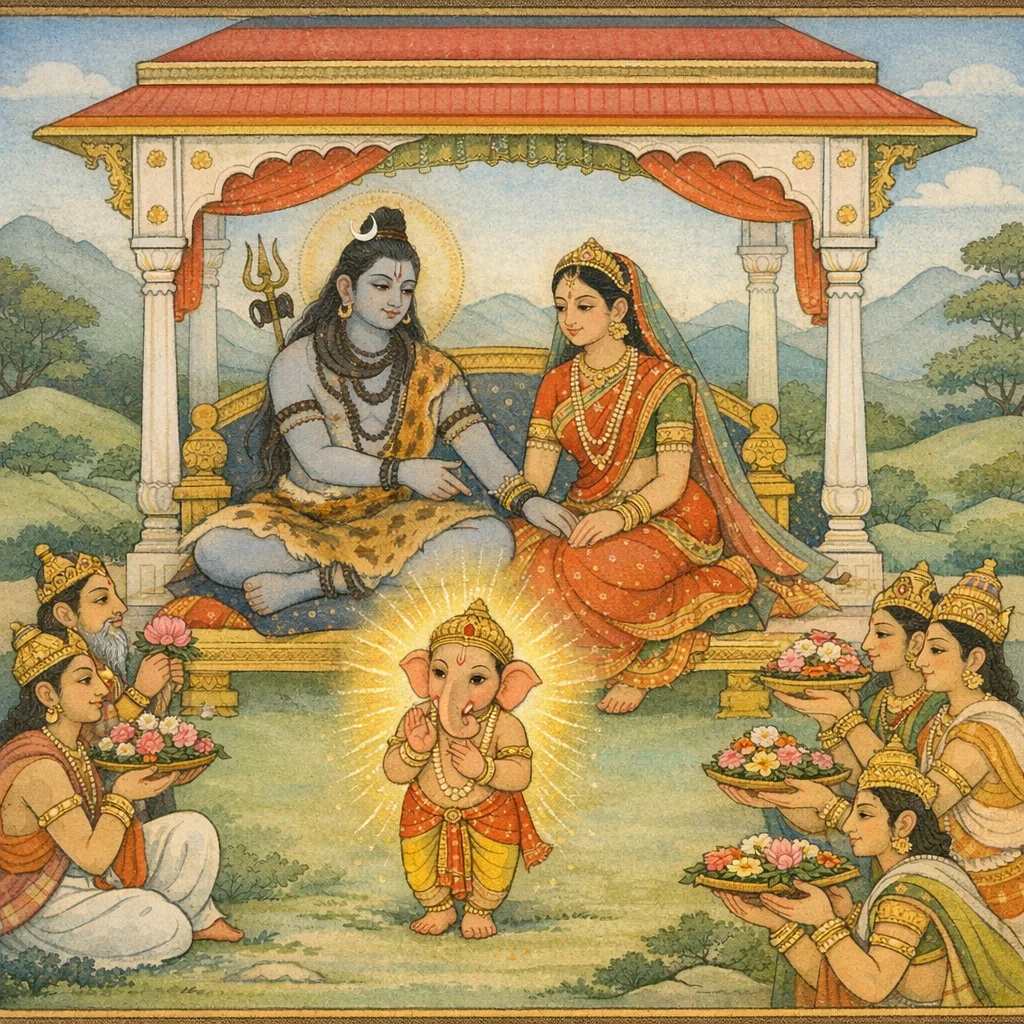
Sūta recounts that the devas approach and bow to Śiva (Pinākadhṛk, Maheśvara), receiving his compassionate glance and blessing. Seeking protection for their undertakings, they ask that those who harm the devas and disrupt sacred acts be checked and obstructed. Śiva then manifests as Gaṇeśvara/Vināyaka; devas and gaṇa-hosts shower flowers and sing hymns to the elephant-faced Lord, praised with weapons and auspicious marks. A radiant, childlike Gaṇeśa appears, honored by Śiva and Ambikā. Śiva appoints him a cosmic role: to hinder unrighteous deeds—especially flawed yajñas, improper teaching and learning, and those fallen from dharma—while safeguarding devotees of every age. The chapter establishes Gaṇeśa’s universal authority over vighnas and proclaims his primacy in worship: without worship of him, śrauta, smārta, and worldly acts fail; with it, success and honor follow, grounding the Śaiva ritual order so that worship of the Liṅga bears fruit.
Shlokas
Verse 1
इति श्रीलिङ्गमहापुराणे पूर्वभागे देवस्तुतिर्नाम चतुरधिकशततमो ऽध्यायः सूत उवाच यदा स्थिताः सुरेश्वराः प्रणम्य चैवमीश्वरम् तदांबिकापतिर् भवः पिनाकधृङ् महेश्वरः
Thus, in the Śrī Liṅga Mahāpurāṇa, in the Pūrvabhāga, begins the one-hundred-and-fifth chapter called “The Hymn of the Devas.” Sūta said: When the lords of the gods stood and bowed in reverence to Īśvara in this manner, then Bhava—Mahādeva, bearer of the Pināka bow, Lord of Ambikā (Śakti)—manifested before them as the supreme Pati who loosens the pāśa (bond) of the paśus (souls).
Verse 2
ददौ निरीक्षणं क्षणाद् भवः स तान्सुरोत्तमान् प्रणेमुरादराद्धरं सुरा मुदार्द्रलोचनाः
In an instant Bhava cast His gracious glance upon those foremost of the gods; and the devas, their eyes moist with joy, bowed with reverent devotion to Hara—the Lord who bears and upholds all.
Verse 3
भवः सुधामृतोपमैर् निरीक्षणैर्निरीक्षणात् तदाह भद्रमस्तु वः सुरेश्वरान् महेश्वरः
Then Bhava (Śiva), gazing upon them with looks like nectar and ambrosia, addressed the lords of the gods: “May auspiciousness be upon you.” Thus spoke Maheśvara.
Verse 4
वरार्थमीश वीक्ष्यते सुरा गृहं गतास्त्विमे प्रणम्य चाह वाक्पतिः पतिं निरीक्ष्य निर्भयः
Seeing the Lord (Īśa) intent upon granting a boon, these Devas went to His abode. Having bowed down, Vākpati (Bṛhaspati), fearlessly beholding the Pati—the Lord who frees the bound paśu—spoke.
Verse 5
सुरेतरादिभिः सदा ह्य् अविघ्नमर्थितो भवान् समस्तकर्मसिद्धये सुरापकारकारिभिः
O Pati, the gods and all other beings ever entreat You for an unobstructed course and the fulfillment of every undertaking—especially when those who harm the devas bring calamity. By Your grace, all actions attain siddhi (perfect completion).
Verse 6
ततः प्रसीदताद् भवान् सुविघ्नकर्मकारणम् सुरापकारकारिणाम् इहैष एव नो वरः
Therefore, be gracious to us. Here this alone is our boon: become the very cause of auspicious, obstacle-free action, and the restrainer of those who do harm against the Devas. O Pati, loosen the pasha that breeds hindrance, so that the paśus may proceed on the path of right worship and attainment.
Verse 7
ततस्तदा निशम्य वै पिनाकधृक् सुरेश्वरः गणेश्वरं सुरेश्वरं वपुर्दधार सः शिवः
Then, having heard that, Śiva—bearer of Pināka and Lord of the Devas—assumed a bodily form as Gaṇeśvara, sovereign over the hosts, the very overlord of the gods.
Verse 8
गणेश्वराश् च तुष्टुवुः सुरेश्वरा महेश्वरम् समस्तलोकसंभवं भवार्त्तिहारिणं शुभम्
And the lords of the Gaṇas, together with the lords of the Devas, praised Maheśvara—He from whom all worlds arise, the auspicious Pati who removes the distress of saṃsāra and dispels the suffering of the bound paśus.
Verse 9
इभाननाश्रितं वरं त्रिशूलपाशधारिणम् समस्तलोकसंभवं गजाननं तदांबिका
Then Ambikā invoked the noble Gajānana—he who is attended by the elephant-faced hosts, who bears the trident and the noose (pāśa), and who is the source from whom the worlds arise—calling upon him for the removal of bonds and the fulfillment of auspicious aims.
Verse 10
ददुः पुष्पवर्षं हि सिद्धा मुनीन्द्रास् तथा खेचरा देवसंघास्तदानीम् तदा तुष्टुवुश्चैकदन्तं सुरेशाः प्रणेमुर्गणेशं महेशं वितन्द्राः
At that very time, the Siddhas, the foremost sages, and the hosts of gods moving through the sky showered a rain of flowers. Then the lords of the Devas praised Ekadanta and, free from all lethargy, bowed down to Gaṇeśa and to Maheśa, the supreme Pati.
Verse 11
तदा तयोर्विनिर्गतः सुभैरवः स मूर्तिमान् स्थितो ननर्त बालकः समस्तमङ्गलालयः
Then, from those two, Subhairava—embodied and manifest—came forth; standing there as a child, he danced, being the very abode of all auspiciousness.
Verse 12
विचित्रवस्त्रभूषणैर् अलंकृतो गजाननः महेश्वरस्य पुत्रको ऽभिवन्द्य तातम् अम्बिकाम्
Adorned with wondrous garments and ornaments, the elephant-faced Lord—Mahādeva’s son—bowed in reverence to his father (Śiva) and to Ambikā (the Divine Mother).
Verse 13
जातमात्रं सुतं दृष्ट्वा चकार भगवान्भवः गजाननाय कृत्यांस्तु सर्वान्सर्वेश्वरः स्वयम्
Seeing his son just born, the Blessed Bhava (Śiva), the Lord of all, Himself ordained and assigned every sacred duty and function for Gajānanā (the Elephant-Faced Lord).
Verse 14
आदाय च कराभ्यां च सुसुखाभ्यां भवः स्वयम् आलिङ्ग्याघ्राय मूर्धानं महादेवो जगद्गुरुः
Then Bhava (Śiva) Himself, with both His supremely gentle hands, took him close; the great God—Mahādeva, the Guru of the worlds—embraced him and, smelling (kissing) the crown of his head, bestowed intimate grace.
Verse 15
तवावतारो दैत्यानां विनाशाय ममात्मज देवानामुपकारार्थं द्विजानां ब्रह्मवादिनाम्
O my son, your descent is for the destruction of the Daityas, for the welfare of the Devas, and for the protection and support of the twice-born Brahma-proclaimers—so that dharma may stand firm under the Lord (Pati) and the bound souls (paśu) may be guided away from bondage (pāśa).
Verse 16
यज्ञश् च दक्षिणाहीनः कृतो येन महीतले तस्य धर्मस्य विघ्नं च कुरु स्वर्गपथे स्थितः
Whoever on earth has performed a sacrifice lacking the prescribed dakṣiṇā—while you stand upon the path to heaven, create an obstruction to the merit (dharma) arising from that act.
Verse 17
अध्यापनं चाध्ययनं व्याख्यानं कर्म एव च यो ऽन्यायतः करोत्यस्मिन् तस्य प्राणान्सदा हर
Whoever, in this sacred discipline, performs teaching, study, exposition, or ritual action in an unrighteous way—do thou ever seize his very life-breaths (prāṇa). Such misuse of dharma binds the paśu (soul) more tightly in pāśa (bondage) and stands opposed to the path that leads to Pati, Lord Śiva.
Verse 18
वर्णाच्च्युतानां नारीणां नराणां नरपुङ्गव स्वधर्मरहितानां च प्राणानपहर प्रभो
O Lord, bull among men, withdraw the life-breath of those women and men who have fallen away from their ordained station and who are bereft of their own svadharma.
Verse 19
याः स्त्रियस्त्वां सदा कालं पुरुषाश् च विनायक यजन्ति तासां तेषां च त्वत्साम्यं दातुमर्हसि
O Vināyaka, those women and those men who worship you at all times—grant them likeness to you, a share in your auspicious state, through your grace that loosens the pāśas binding the paśu (the soul).
Verse 20
त्वं भक्तान् सर्वयत्नेन रक्ष बालगणेश्वर यौवनस्थांश् च वृद्धांश् च इहामुत्र च पूजितः
O Bāla-Gaṇeśvara, protect your devotees with every effort—those in youth and those in old age. Worshipped here and in the next world, you grant guardianship across both realms, removing the pāśas that afflict the paśu (the bound soul) and leading it toward Pati (the Lord).
Verse 21
जगत्त्रये ऽत्र सर्वत्र त्वं हि विघ्नगणेश्वरः संपूज्यो वन्दनीयश् च भविष्यसि न संशयः
Throughout the whole triple world, in every place, you indeed are Vighnagaṇeśvara, the Lord who governs obstacles; you shall surely become one who is to be duly worshipped and reverently saluted—of this there is no doubt.
Verse 22
मां च नारायणं वापि ब्रह्माणम् अपि पुत्रक यजन्ति यज्ञैर्वा विप्रैर् अग्रे पूज्यो भविष्यसि
“O child, whether they worship Me, or Nārāyaṇa, or even Brahmā—by sacrifices performed through the Brāhmaṇas—you shall, in the foremost place, become worthy of honor and worship first.”
Verse 23
त्वाम् अनभ्यर्च्य कल्याणं श्रौतं स्मार्तं च लौकिकम् कुरुते तस्य कल्याणम् अकल्याणं भविष्यति
Without first worshipping You, O Auspicious Lord, whoever undertakes any auspicious act—whether Vedic (śrauta), tradition-based (smārta), or worldly (laukika)—for him even that ‘good’ becomes inauspicious, for it is severed from the grace of Pati (Śiva), the giver of all auspiciousness.
Verse 24
ब्राह्मणैः क्षत्रियैर्वैश्यैः शूद्रैश्चैव गजानन सम्पूज्य सर्वसिद्ध्यर्थं भक्ष्यभोज्यादिभिः शुभैः
O Gajānana, when brāhmaṇas, kṣatriyas, vaiśyas, and śūdras alike worship You with full reverence and offer auspicious foods and refreshments, one attains the fulfillment of all siddhis.
Verse 25
त्वां गन्धपुष्पधूपाद्यैर् अनभ्यर्च्य जगत्त्रये देवैरपि तथान्यैश् च लब्धव्यं नास्ति कुत्रचित्
Without worshipping You with offerings such as fragrance, flowers, incense, and the like, no being anywhere in the three worlds—not even the devas nor any others—can attain You.
Verse 26
अभ्यर्चयन्ति ये लोका मानवास्तु विनायकम् ते चार्चनीयाः शक्राद्यैर् भविष्यन्ति न संशयः
Those people—indeed, those human beings—who devoutly worship Vināyaka will themselves become worthy of worship even by Indra and the other gods; of this there is no doubt.
Verse 27
अजं हरिं च मां वापि शक्रमन्यान्सुरानपि विघ्नैर् बाधयसि त्वां चेन् नार्चयन्ति फलार्थिनः
If you obstruct Aja (Brahmā), Hari (Viṣṇu), me (Śiva), Śakra (Indra), and the other gods with impediments, then those who seek results will no longer worship you.
Verse 28
ससर्ज च तदा विघ्नगणं गणपतिः प्रभुः गणैः सार्धं नमस्कृत्वाप्य् अतिष्ठत्तस्य चाग्रतः
Then the Lord Gaṇapati, the sovereign of the gaṇas, brought forth the host of the vighnas. Accompanied by his attendants, he bowed in reverence and stood before Him in readiness.
Verse 29
तदा प्रभृति लोके ऽस्मिन् पूजयन्ति गणेश्वरम् दैत्यानां धर्मविघ्नं च चकारासौ गणेश्वरः
From that time onward, in this world people worship Gaṇeśvara; and that very Lord of the Gaṇas became the maker of obstacles to the dharma of the Daityas, so that their unrighteous power might be checked and the path aligned to Śiva’s order (Pati’s governance) might prevail.
Verse 30
एतद्वः कथितं सर्वं स्कन्दाग्रजसमुद्भवम् यः पठेच्छृणुयाद्वापि श्रावयेद्वा सुखीभवेत्
Thus, all this has been told to you—the account concerning the manifestation of Skanda’s elder-born one. Whoever recites it, hears it, or causes it to be heard becomes happy and attains well-being, by the grace of Pati (Śiva), who loosens the pāśa that binds the paśu.
Frequently Asked Questions
Śiva grants Gaṇeśa ādyapūjā (primacy of worship) so that all śrauta, smārta, and worldly undertakings become ritually ‘unblocked’ and dharmically aligned; without honoring Vināyaka first, actions tend toward akalyāṇa (inauspicious outcome).
He is commissioned to place vighnas upon adharma—such as yajñas performed improperly (e.g., lacking due dakṣiṇā), unjust or illegitimate teaching/learning/practice, and those who abandon svadharma—while safeguarding sincere devotees.
It teaches that divine grace operates through ritual order: protecting yajña, śāstra, and svadharma preserves cosmic harmony, and Gaṇeśa’s governance of vighnas ensures that devotion produces stable, dharmic, and spiritually fruitful outcomes.