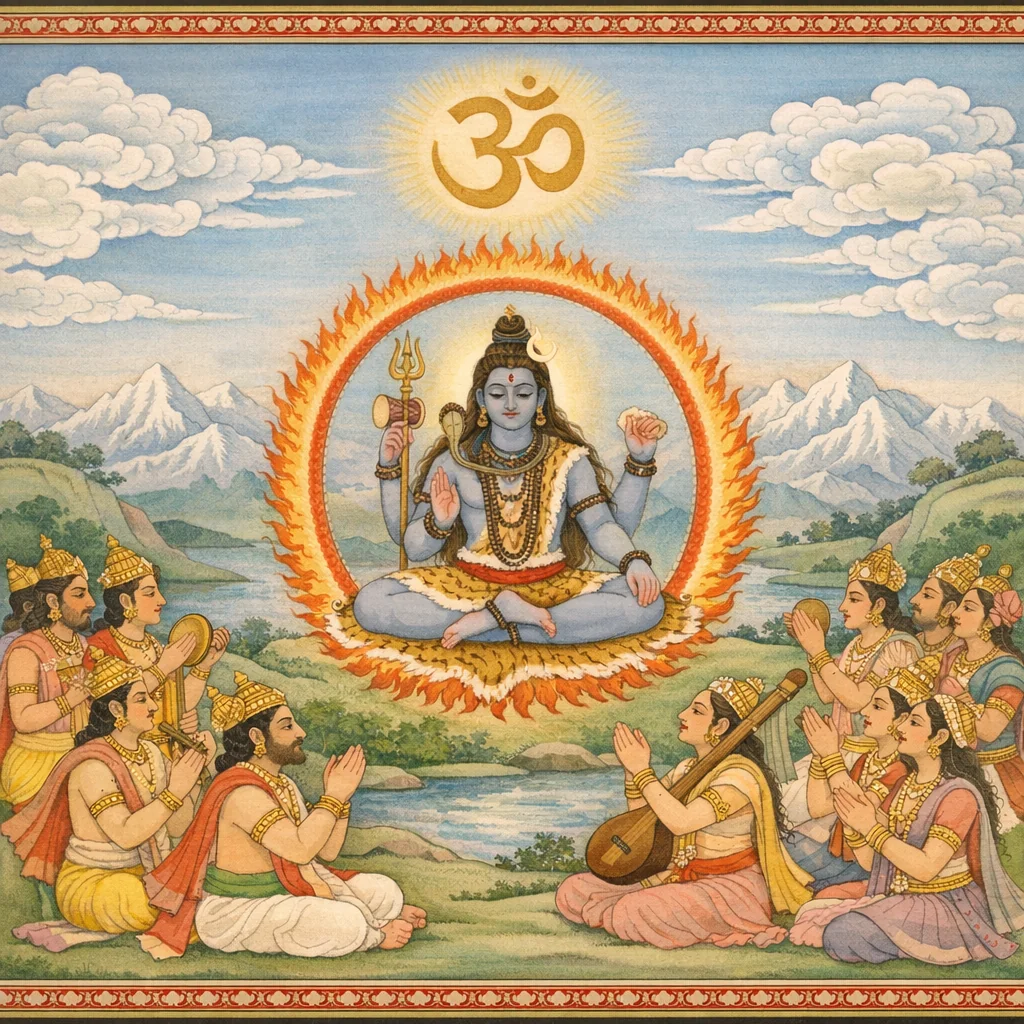
Adhyaya 104
Vighneshvara-Prashna and Deva-Krita Shiva-Stava (Adhyaya 104)
The rishis ask Sūta to explain how Vināyaka—elephant-faced Gaṇeśvara—was born and why his mastery over obstacles is so great. Sūta begins with a cosmic turning point where the devas (with Indra and Upendra) seek to uphold dharma by resisting daitya-led disruption. “Vighna” is presented not merely as misfortune but as a regulator of karmic results: for the devas to remain avighna (unobstructed) and for humans to gain putra (offspring) and karma-siddhi (success in undertakings), Śiva must be praised and a Gaṇapa/Vighneśa brought forth. The devas then offer an expansive hymn, identifying Śiva with Kāla, Kālāgni-Rudra, Oṃkāra, the Vedas, the pañcākṣara, and the One beyond the guṇas, blending mantra-ontology with devotional praise. The chapter ends with the phalaśruti: whoever recites or teaches this deva-hymn with bhakti attains the highest state, preparing for the next account of Vighneśvara’s emergence and function.
Shlokas
Verse 1
इति श्रीलिङ्गमहापुराणे पूर्वभागे पार्वतीविवाहवर्णनं नाम त्र्यधिकशततमो ऽध्यायः ऋषय ऊचुः कथं विनायको जातो गजवक्त्रो गणेश्वरः कथं प्रभावस्तस्यैवं सूत वक्तुमिहार्हसि
Thus, in the Śrī Liṅga Mahāpurāṇa, in the Pūrvabhāga, begins the one-hundred-and-fourth chapter called “The Account of Pārvatī’s Marriage.” The sages said: “How was Vināyaka born—he who has the face of an elephant and is the Lord of the Gaṇas? And how is his greatness such? O Sūta, you are fit to tell this here.”
Verse 2
सूत उवाच एतस्मिन्नन्तरे देवाः सेन्द्रोपेन्द्राः समेत्य ते धर्मविघ्नं तदा कर्तुं दैत्यानामभवन्द्विजाः
Sūta said: Meanwhile, the Devas—along with Indra and Upendra (Viṣṇu)—assembled together and, in order to hinder the Daityas’ dharma at that time, assumed the form of twice-born brāhmaṇas.
Verse 3
असुरा यातुधानाश् च राक्षसाः क्रूरकर्मिणः तामसाश् च तथा चान्ये राजसाश् च तथा भुवि
On earth there are Asuras, Yātudhānas, and Rākṣasas—beings of fierce deeds—who are predominantly tāmasic; and there are also others who are predominantly rājasic.
Verse 4
अविघ्नं यज्ञदानाद्यैः समभ्यर्च्य महेश्वरम् ब्रह्माणं च हरिं विप्रा लब्धेप्सितवरा यतः
O brāhmaṇas, by duly worshipping Maheśvara (Mahādeva)—along with Brahmā and Hari—through sacrifice, charity, and related rites, they became free from obstacles and obtained the boons they had desired.
Verse 5
ततो ऽस्माकं सुरश्रेष्ठाः सदा विजयसंभवः तेषां ततस्तु विघ्नार्थम् अविघ्नाय दिवौकसाम्
Then, O best among the gods, victory was ever ordained for our side. Therefore, to raise obstacles for them—while granting the dwellers of heaven freedom from obstacles—the divine counter-force was set in motion.
Verse 6
पुत्रार्थं चैव नारीणां नराणां कर्मसिद्धये विघ्नेशं शङ्करं स्रष्टुं गणपं स्तोतुमर्हथ
For women seeking offspring and for men seeking success in their undertakings, you should worship and praise Gaṇapa—Vighneśa—whom Śaṅkara brought forth as the Lord who removes obstacles and grants accomplishment.
Verse 7
इत्युक्त्वान्योन्यमनघं तुष्टुवुः शिवमीश्वरम् नमः सर्वात्मने तुभ्यं सर्वज्ञाय पिनाकिने
Having thus spoken to one another, they praised the flawless Lord Śiva, the Supreme Ruler: “Salutations to You, the Self of all beings; salutations to You, the all-knowing One, the bearer of the Pināka bow.”
Verse 8
अनघाय विरिञ्चाय देव्याः कार्यार्थदायिने अकायायार्थकायाय हरेः कायापहारिणे
Salutations to the sinless One; to Viriñca (Brahmā); to Him who grants the Goddess the power to accomplish her purpose; to the bodiless Lord who yet assumes a meaningful form for the sake of beings; and to Him who withdraws and absorbs even the embodied condition of Hari (Viṣṇu).
Verse 9
कायान्तस्थामृताधारमण्डलावस्थिताय ते कृतादिभेदकालाय कालवेगाय ते नमः
Salutations to You who abide within the body’s inner sphere as the support of amṛta, the nectar of immortality; salutations to You who are Time, distinguishing the ages beginning with Kṛta; and salutations to You who are the very impetuous force, the swift surge of Time.
Verse 10
कालाग्निरुद्ररूपाय धर्माद्यष्टपदाय च कालीविशुद्धदेहाय कालिकाकारणाय ते
Salutations to You—whose form is Kālāgni-Rudra; who are the eightfold foundation beginning with Dharma; whose body is purified by (and as) Kālī; and who are the very cause and source of Kālikā.
Verse 11
कालकण्ठाय मुख्याय वाहनाय वराय ते अंबिकापतये तुभ्यं हिरण्यपतये नमः
Salutations to You—O Blue-throated Lord, the Supreme Chief; O exalted Carrier and bestower of boons; O consort of Ambikā; O Lord of gold and prosperity.
Verse 12
हिरण्यरेतसे चैव नमः शर्वाय शूलिने कपालदण्डपाशासिचर्माङ्कुशधराय च
Salutations indeed to Hiraṇyaretas, and to Śarva the Trident-bearer—who bears the skull-staff, the noose, the sword, the hide, and the goad: to that Lord (Pati) I bow.
Verse 13
पतये हैमवत्याश् च हेमशुक्लाय ते नमः पीतशुक्लाय रक्षार्थं सुराणां कृष्णवर्त्मने
Salutations to You—the Lord (Pati) of Haimavatī (Pārvatī), the golden-bright One. Salutations to You who are yellow-white, who guard the Devas; salutations to the One whose path is dark—mysterious and unfathomable.
Verse 14
पञ्चमाय महापञ्चयज्ञिनां फलदाय च पञ्चास्यफणिहाराय पञ्चाक्षरमयाय ते
Salutations to You who are the Fifth—transcending the fivefold order—who bestow the fruit upon the performers of the great five sacrifices; to You who wear the serpent-hoods upon Your five faces; to You whose very essence is the five-syllabled mantra (namaḥ śivāya).
Verse 15
पञ्चधा पञ्चकैवल्यदेवैरर्चितमूर्तये पञ्चाक्षरदृशे तुभ्यं परात्परतराय ते
Salutations to You—the Supreme beyond the beyond—whose form is worshiped in fivefold ways by the five Kaivalya-deities, and who is directly revealed through the five-syllabled vision-mantra, “Namaḥ Śivāya.”
Verse 16
षोडशस्वरवज्राङ्गवक्त्रायाक्षयरूपिणे कादिपञ्चकहस्ताय चादिहस्ताय ते नमः
Salutations to You—whose face is radiant and adamantine with the power of the sixteen sacred vowels; whose essential form is imperishable; who bears the “ka” and the fivefold letter-group as Your hand, the power of mantra; and who are Yourself the primal Hand, the first source of all agency.
Verse 17
टादिपादाय रुद्राय तादिपादाय ते नमः पादिमेण्ढ्राय यद्यङ्गधातुसप्तकधारिणे
Salutations to You, Rudra—You whose feet are the primal foundation. Homage again to You, the support of all footing, who bears within Himself the seven bodily constituents and the limbs of embodied existence.
Verse 18
शान्तात्मरूपिणे साक्षात् क्षदन्तक्रोधिने नमः लवरेफहलाङ्गाय निरङ्गाय च ते नमः
Salutations to You whose very form is the tranquil Self, the manifest Reality; salutations to You who subdues and consumes wrath. Salutations to You whose body is the sacred syllabic form (la–va–ra–re–pha–ha–lāṅga), and salutations again to You, the formless and stainless One.
Verse 19
सर्वेषाम् एव भूतानां हृदि निःस्वनकारिणे भ्रुवोर् अन्ते सदा सद्भिर् दृष्टायात्यन्तभानवे
Salutations to the supremely radiant One who awakens the subtle inner resonance within the hearts of all beings, and who is ever beheld by the virtuous at the final point between the brows.
Verse 20
भानुसोमाग्निनेत्राय परमात्मस्वरूपिणे गुणत्रयोपरिस्थाय तीर्थपादाय ते नमः
Salutations to You—whose eyes are the Sun, the Moon, and Fire; whose very form is the Supreme Self; who stands beyond the three guṇas; and whose feet are themselves holy tīrthas, purifying and granting passage to liberation.
Verse 21
तीर्थतत्त्वाय साराय तस्मादपि पराय ते ऋग्यजुःसामवेदाय ओंकाराय नमो नमः
Salutations again and again to You—who are the very principle of all tīrthas (tīrtha-tattva), the inner essence (sāra), and the Supreme beyond even that; salutations to You who are the Ṛg, Yajus, and Sāma Vedas, and who are the praṇava, Oṃkāra.
Verse 22
ओङ्कारे त्रिविधं रूपम् आस्थायोपरिवासिने पीताय कृष्णवर्णाय रक्तायात्यन्ततेजसे
Abiding in the syllable Oṃ, He assumes a threefold form—dwelling above as the transcendent Lord; appearing as yellow, as dark-hued, and as red—He whose radiance is immeasurable.
Verse 23
स्थानपञ्चकसंस्थाय पञ्चधाण्डबहिः क्रमात् ब्रह्मणे विष्णवे तुभ्यं कुमाराय नमोनमः
Homage, homage to You who abide as the fivefold stations of reality and who, in ordered succession, stand beyond the five enclosures of limitation. Homage to Brahmā, to Viṣṇu, and to You—the divine Kumāra (Skanda), in whom Pati becomes manifest for the uplift of bound paśus.
Verse 24
अंबायाः परमेशाय सर्वोपरिचराय ते मूलसूक्ष्मस्वरूपाय स्थूलसूक्ष्माय ते नमः
Salutations to You, the Supreme Lord of Ambā (Śakti), whom all beings attend and serve; salutations to You whose nature is the causal, most subtle Reality, and who are both the gross and the subtle.
Verse 25
सर्वसंकल्पशून्याय सर्वस्माद्रक्षिताय ते आदिमध्यान्तशून्याय चित्संस्थाय नमोनमः
Salutations again and again to You—free from all mental constructions (saṅkalpa), safeguarded from every limiting condition; devoid of beginning, middle, and end; established as pure Consciousness (Cit).
Verse 26
यमाग्निवायुरुद्रांबुसोमशक्रनिशाचरैः दिङ्मुखे दिङ्मुखे नित्यं सगणैः पूजिताय ते
O Pati, in every direction and at every gateway of the quarters, You are ever worshipped—together with Your gaṇas—by Yama, Agni, Vāyu, Rudra, Varuṇa (Lord of the Waters), Soma, Śakra (Indra), and the night-roaming beings (niśācaras).
Verse 27
सर्वेषु सर्वदा सर्वमार्गे सम्पूजिताय ते रुद्राय रुद्रनीलाय कद्रुद्राय प्रचेतसे महेश्वराय धीराय नमः साक्षाच्छिवाय ते
Salutations to You—the Rudra worshipped by all, at all times, by every path; to Rudra of deep-blue hue, the fierce Rudra, the all-knowing Pracetas; to Mahēśvara, steadfast and serene—salutations to You, manifestly and truly Śiva Himself, the Pati who grants release to the bound paśu.
Verse 28
अथ शृणु भगवन् स्तवच्छलेन कथितमजेन्द्रमुखैः सुरासुरेशैः /* मखमदनयमाग्निदक्षयज्ञक्षपणविचित्रविचेष्टितं क्षमस्व
Now, O Blessed Lord, please listen to what has been spoken—under the guise of praise—by Brahmā and by the lords of Devas and Asuras. Forgive this wondrous display of Your deeds: the subduing of Makha, the humbling of Madana, the checking of Yama and Agni, and the extraordinary destruction of Dakṣa’s sacrifice.
Verse 29
सूत उवाच यः पठेत्तु स्तवं भक्त्या शक्राग्निप्रमुखैः सुरैः कीर्तितं श्रावयेद्विद्वान् स याति परमां गतिम्
Sūta said: Whoever recites this hymn with devotion—this praise sung by the gods led by Indra and Agni—and the learned person who makes others hear it, attains the supreme state (the highest liberation in Śiva, the Pati).
Frequently Asked Questions
The rishis ask how Vināyaka (Gaṇeśvara) was born with an elephant face and why his authority over obstacles is uniquely powerful.
Shiva is praised as Kāla and Kālāgni-Rudra, as Oṃkāra and the very substance of Ṛg–Yajus–Sāma, as pañcākṣara-maya, as the inner Self of all beings, and as transcendent beyond the three guṇas—uniting ritual, mantra, and metaphysics.
The text states that one who recites it with devotion—or a learned person who causes it to be heard—attains paramā gati, the supreme state associated with liberation through Shiva’s grace.