Adhyaya 101
अध्याय १०१: हैमवती-तपः, तारकवंश-उत्पातः, स्कन्द-प्रत्याशा, मदनदहनम्
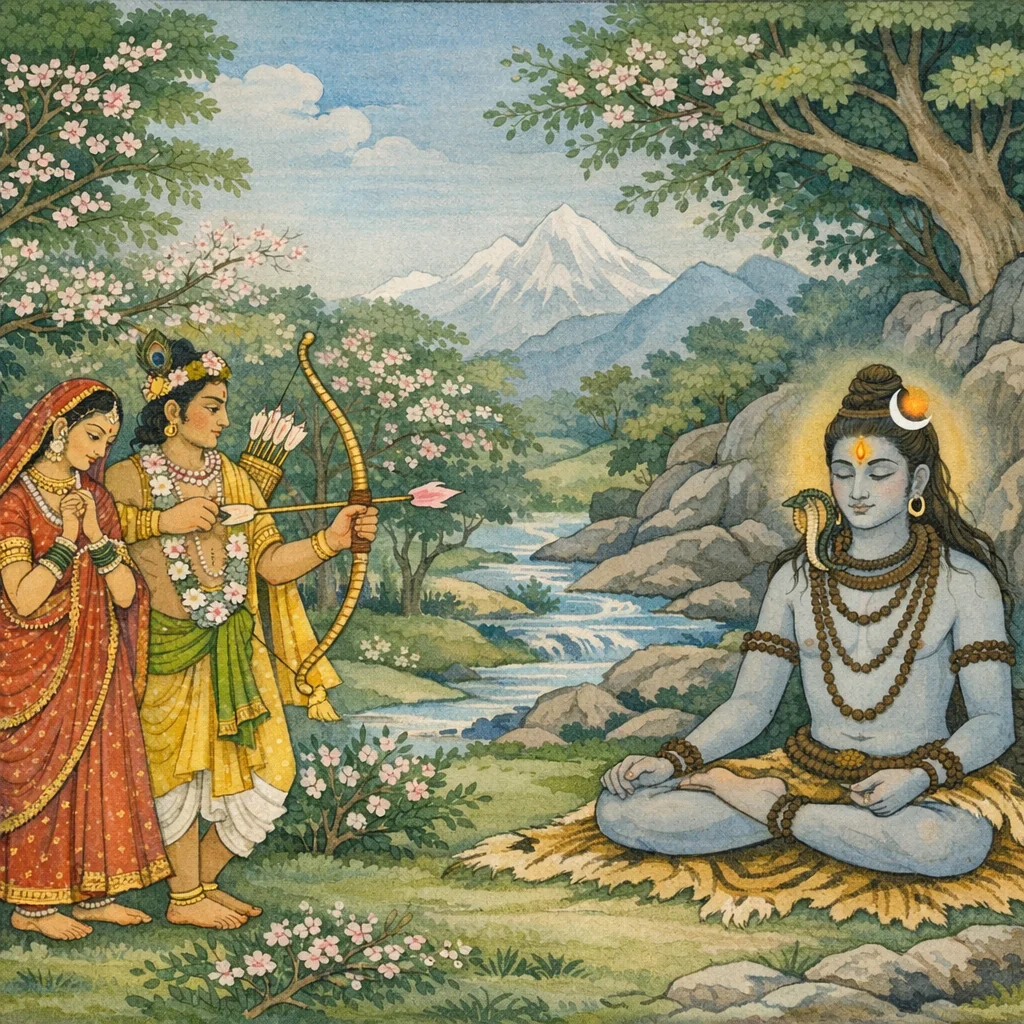
The sages ask about Sati’s rebirth: how she became Haimavati (Uma/Parvati), daughter of Himavat, and how she attained Shiva as her husband. Suta explains that the Goddess, by her own will, entered Mena’s body and was born as Haimavati; the mountain-king performed her rites of consecration. At twelve she began austerities with her younger sisters; names and forms such as Aparna, Ekaparna, and Ekapatala indicate different ascetic vows, showing that Shiva’s grace is easily won through single-minded devotion. At that time the asura Taraka, empowered by tapas and Brahma’s boon, defeated even Vishnu, and the frightened gods lamented to Brihaspati. Brahma declared that from the union of Uma and Shiva Skanda would be born, and he would slay Taraka. To accomplish the gods’ purpose, Indra sent Kama-deva to kindle Shiva and Uma’s union; Madana, with Rati and Spring, approached Shiva’s hermitage, but Tryambaka burned him with the fire of the third eye. Seeing Rati’s grief, Shiva granted a boon: Kama would remain bodiless and later, in a future episode connected with Vishnu (Vasudeva) and a curse, would be reborn as a son. The chapter thus sets the stage for Parvati’s tapas, Skanda’s advent, and Taraka’s death, while proclaiming Shiva’s detachment and sovereign power through the burning of Kama.
Shlokas
Verse 1
इति श्रीलिङ्गमहापुराणे पूर्वभागे शिवकृद्दक्षयज्ञविध्वंसनो नाम शततमो ऽध्यायः ऋषय ऊचुः कथं हिमवतः पुत्री बभूवांबा सती शुभा कथं वा देवदेवेशम् अवाप पतिमीश्वरम्
Thus, in the Śrī Liṅga Mahāpurāṇa (Pūrvabhāga) begins the hundred-and-first chapter, called “The Destruction of Dakṣa’s Sacrifice by Śiva.” The sages said: “How did the auspicious Satī—revered as the Mother—become the daughter of Himavat? And how did she attain as her husband that Lord, the Supreme Īśvara, the God of gods?”
Verse 2
सूत उवाच सा मेनातनुम् आश्रित्य स्वेच्छयैव वराङ्गना तदा हैमवती जज्ञे तपसा च द्विजोत्तमाः
Sūta said: O best of the twice-born, that noble lady—by her own free will—took refuge in Menā’s body; and then Haimavatī (Pārvatī), the daughter of Himavān, was born, brought forth through austerity (tapas).
Verse 3
जातकर्मादिकाः सर्वाश् चकार च गिरीश्वरः द्वादशे च तदा वर्षे पूर्णे हैमवती शुभा
Girīśvara (Śiva), the Lord of the mountains, duly performed all the birth-rites beginning with the jātakarman; and when the twelfth year was completed, the auspicious Haimavatī attained a blessed maturity.
Verse 4
तपस्तेपे तया सार्धम् अनुजा च शुभानना अन्या च देवी ह्यनुजा सर्वलोके नमस्कृता
Together with her, her younger sister of auspicious countenance also performed tapas; and another younger sister as well—truly a Goddess, revered and bowed to throughout all the worlds.
Verse 5
ऋषयश् च तदा सर्वे सर्वलोकमहेश्वरीम् तुष्टुवुस् तपसा देवीं समावृत्य समन्ततः
Then all the ṛṣis, surrounding the Goddess—the Sovereign Lady of all the worlds—on every side, praised her through their tapas; for she is Śiva’s Śakti, the power by which Pati grants release to the bound paśus.
Verse 6
ज्येष्ठा ह्यपर्णा ह्यनुजा चैकपर्णा शुभानना तृतीया च वरारोहा तथा चैवैकपाटला
She is the Eldest—Aparṇā. She is also the Younger—Ekaparṇā, of auspicious face. She is the Third; the fair-thighed one; and likewise she is Ekapāṭalā.
Verse 7
तपसा च महादेव्याः पार्वत्याः परमेश्वरः वशीकृतो महादेवः सर्वभूतपतिर्भवः
By the tapas of the Great Goddess Pārvatī, the Supreme Lord—Mahādeva, Bhava, the Pati of all beings—was won over and graciously inclined toward her.
Verse 8
एतस्मिन्नेव काले तु तारको नाम दानवः तारात्मजो महातेजा बभूव दितिनन्दनः
At that very time, a Daitya named Tāraka—born of Tārā, blazing with great splendor—came into being as a beloved descendant of Diti.
Verse 9
तस्य पुत्रास्त्रयश्चापि तारकाक्षो महासुरः विद्युन्माली च भगवान् कमलाक्षश् च वीर्यवान्
He had three sons as well—Tārakākṣa, a mighty asura; Vidyunmālī, revered among his hosts; and Kamalākṣa, endowed with great prowess.
Verse 10
पितामहस् तथा चैषां तारो नाम महाबलः तपसा लब्धवीर्यश् च प्रसादाद्ब्रह्मणः प्रभोः
And among them there was also a forefather named Tāra, exceedingly mighty—one who gained spiritual potency through austerity, and who, by the gracious favor of Lord Brahmā, attained his strength.
Verse 11
सो ऽपि तारो महातेजास् त्रैलोक्यं सचराचरम् विजित्य समरे पूर्वं विष्णुं च जितवान् असौ
That mighty and radiant Tāra too, having first conquered in battle the three worlds with all that moves and does not move, had even defeated Viṣṇu in combat.
Verse 12
तयोः समभवद्युद्धं सुघोरं रोमहर्षणम् दिव्यं वर्षसहस्रं तु दिवारात्रम् अविश्रमम्
Between those two, a battle arose—most dreadful, hair-raising—enduring for a divine thousand years, unceasingly, by day and by night, without rest. In the Purāṇic vision, such relentless conflict signals the working out of pāśa (bondage) through time, until Pati (Śiva) alone grants resolution beyond mere force.
Verse 13
सरथं विष्णुमादाय चिक्षेप शतयोजनम् तारेण विजितः संख्ये दुद्राव गरुडध्वजः
Seizing Viṣṇu together with his chariot, Tāra hurled him a hundred yojanas away. Defeated by Tāra in that battle, the Garuḍa-bannered Lord withdrew and fled.
Verse 14
तारो वराञ्छतगुणं लब्ध्वा शतगुणं बलम् पितामहाज्जगत्सर्वम् अवाप दितिनन्दनः
Having received from the Grandsire (Brahmā) a boon increased a hundredfold, Tāraka gained strength a hundred times over; and that son of Diti came to dominate the whole world by the force of the granted power.
Verse 15
देवेन्द्रप्रमुखाञ्जित्वा देवान्देवेश्वरेश्वरः वारयामास तैर् देवान् सर्वलोकेषु मायया
Having subdued the Devas led by Indra, the Supreme Lord—Īśvara, Lord over the lord of the gods—by His māyā restrained those very Devas in all the worlds, making them instruments of restraint.
Verse 16
देवताश् च सहेन्द्रेण तारकाद्भयपीडिताः न शान्तिं लेभिरे शूराः शरणं वा भयार्दिताः
Tormented by fear of Tāraka, the Devas—together with Indra—found no peace; though valiant, they were driven by dread to seek a refuge beyond their own power.
Verse 17
तदामरपतिः श्रीमान् संनिपत्यामरप्रभुः उवाचाङ्गिरसं देवो देवानामपि संनिधौ
Then Indra, the blessed lord of the immortals and sovereign among the Devas, having convened the assembly, addressed the sage Aṅgirā in the very presence of the gods.
Verse 18
भगवंस्तारको नाम तारजो दानवोत्तमः तेन संनिहता युद्धे वत्सा गोपतिना यथा
O Blessed one, there is a foremost Dānava named Tāraka, born of Tārā. In battle we were struck down by him—like calves subdued by their herdsman.
Verse 19
भयात्तस्मान्महाभाग बृहद्युद्धे बृहस्पते अनिकेता भ्रमन्त्येते शकुन्ता इव पञ्जरे
Therefore, O fortunate one—O Bṛhaspati—out of fear in this great battle, these beings, bereft of shelter and refuge, wander about like birds trapped within a cage. In the Śaiva understanding, such fearful roaming is the state of the paśu bound by pāśa, until it takes refuge in Pati, Lord Śiva, the sole giver of fearlessness.
Verse 20
अस्माकं यान्य् अमोघानि आयुधान्य् अङ्गिरो वर तानि मोघानि जायन्ते प्रभावादमरद्विषः
O best of the Aṅgiras line, our weapons that were once unfailing are now becoming futile, overpowered by the might of the enemy of the immortals.
Verse 21
दशवर्षसहस्राणि द्विगुणानि बृहस्पते विष्णुना योधितो युद्धे तेनापि न च सूदितः
O Bṛhaspati, for twice ten thousand years he was fought against in battle by Viṣṇu; yet even by him he was not slain.
Verse 22
यस्तेनानिर्जितो युद्धे विष्णुना प्रभविष्णुना कथमस्मद्विधस्तस्य स्थास्यते समरे ऽग्रतः
He whom Viṣṇu, mighty in prowess, could not defeat in battle—how could one like us possibly stand before him at the very front of the battlefield?
Verse 23
एवम् उक्तस् तु शक्रेण जीवः सार्धं सुराधिपैः सहस्राक्षेण च विभुं सम्प्राप्याह कुशध्वजम्
Thus addressed by Śakra (Indra), Jīva, accompanied by the lords of the gods and by the thousand‑eyed one, approached the mighty Kuśadhvaja and spoke—seeking the right course that, through dharma and Śiva’s grace, leads the bound soul (paśu) toward the Lord (Pati).
Verse 24
सो ऽपि तस्य मुखाच्छ्रुत्वा प्रणयात्प्रणतार्तिहा देवैरशेषैः सेन्द्रैस्तु जीवमाह पितामहः
Hearing it from his very mouth, the Grandsire Brahmā—remover of the distress of those who bow in loving devotion—spoke words that restore life, while all the gods, with Indra among them, stood present.
Verse 25
जाने वो ऽर्तिं सुरेन्द्राणां तथापि शृणु सांप्रतम् विनिन्द्य दक्षं या देवी सती रुद्राङ्गसंभवा
I know your distress, O lords of the Devas; yet hear now my words. The Goddess Satī—born from Rudra’s own being—rebuked Dakṣa and proclaimed the truth of Śiva’s supremacy.
Verse 26
उमा हैमवती जज्ञे सर्वलोकनमस्कृता तस्याश्चैवेह रूपेण यूयं देवाः सुरोत्तमाः
Umā Haimavatī, daughter of Himavat, was born, revered by all the worlds. And here, O best of the Suras, you behold Her in this very form.
Verse 27
विभोर्यतध्वमाक्रष्टुं रुद्रस्यास्य मनो महत् तयोर्योगेन सम्भूतः स्कन्दः शक्तिधरः प्रभुः
To draw forth the mighty, all-pervading potency of the Vibhū, Rudra’s exalted intention arose. From the yogic union of the two—Rudra and Śakti—Skanda was manifested, the Lord who bears the divine Power (Śakti).
Verse 28
षडास्यो द्वादशभुजः सेनानीः पावकिः प्रभुः स्वाहेयः कार्तिकेयश् च गाङ्गेयः शरधामजः
He is the six-faced, twelve-armed Lord—the commander of the divine hosts; born of Fire, mighty and sovereign; the son of Svāhā, called Svāhēya, Kārttikeya; also named Gāṅgeya, and the one born amid the reeds (Śaradhā).
Verse 29
देवः शाखो विशाखश् च नैगमेशश् च वीर्यवान् सेनापतिः कुमाराख्यः सर्वलोकनमस्कृतः
He is divine; he is Śākha and Viśākha; he is Naigameṣa, mighty in valor. He is the Commander of the Deva-hosts, known as Kumāra, and is revered by all the worlds.
Verse 30
लीलयैव महासेनः प्रबलं तारकासुरम् बालो ऽपि विनिहत्यैको देवान् संतारयिष्यति
Even as a mere child, Mahāsena will, as if in play, single-handedly slay the mighty demon Tārakāsura; and by the will of the Pati (the Lord) he will carry the Devas across their peril, restoring them to safety and sovereignty.
Verse 31
एवम् उक्तस् तदा तेन ब्रह्मणा परमेष्ठिना बृहस्पतिस् तथा सेन्द्रैर् देवैर् देवं प्रणम्य तम्
Thus addressed by Brahmā, the supreme Parameṣṭhin, Bṛhaspati—together with Indra and the other Devas—bowed down in reverence to that God, Mahādeva, the Pati who frees the paśus from the bond of pāśa.
Verse 32
शिव बुर्न्स् काम मेरोः शिखरमासाद्य स्मरं सस्मार सुव्रतः स्मरणाद्देवदेवस्य स्मरो ऽपि सह भार्यया
Lord Śiva, of noble vow, reached the summit of Mount Meru and called Smara (Kāma) to mind. By the mere remembrance of the Deva of Devas, even Smara—together with his wife—became manifest beneath Śiva’s sovereign gaze.
Verse 33
रत्या समं समागम्य नमस्कृत्य कृताञ्जलिः सशक्रमाह तं जीवं जगज्जीवो द्विजोत्तमाः
O best of the twice-born, Smara came together with Rati and, with joined palms, bowed in reverence. Then, along with Śakra (Indra), he addressed that jīva, while the Lord—Life of the universe (Jagajjīva), Pati over all paśus—stood as the inner witness.
Verse 34
स्मृतो यद्भवता जीव सम्प्राप्तो ऽहं तवान्तिकम् ब्रूहि यन्मे विधातव्यं तमाह सुरपूजितः
“O jīva, bound soul, since you have remembered me, I have come into your presence. Tell me what I should enjoin for you—what I should prescribe for your welfare.” Thus spoke the One worshipped by the gods.
Verse 35
तम् आह भगवाञ्छक्रः संभाव्य मकरध्वजम् शङ्करेणांबिकामद्य संयोजय यथासुखम्
Then the blessed Śakra (Indra), honoring Makaradhvaja (Kāma), said to him: “Today unite Ambikā with Śaṅkara, in a manner that is fitting and agreeable.”
Verse 36
तया स रमते येन भगवान् वृषभध्वजः तेन मार्गेण मार्गस्व पत्न्या रत्यानया सह
Follow that very path by which the Blessed Lord, the Bull-bannered (Śiva), delights with Her; proceed on that way together with your wife, this Rati.
Verse 37
सो ऽपि तुष्टो महादेवः प्रदास्यति शुभां गतिम् विप्रयुक्तस्तया पूर्वं लब्ध्वा तां गिरिजामुमाम्
Pleased, that Mahādeva too will grant an auspicious state (gati). For he had previously been separated from her, and then regained Girijā—Umā—once again.
Verse 38
एवमुक्तो नमस्कृत्य देवदेवं शचीपतिम् देवदेवाश्रमं गन्तुं मतिं चक्रे तया सह
Thus addressed, he bowed in reverence to Śacī’s lord—Indra, the god of gods—and, together with her, resolved to go to the hermitage of Devadeva (Śiva).
Verse 39
गत्वा तदाश्रये शंभोः सह रत्या महाबलः वसंतेन सहायेन देवं योक्तुमना भवत्
Having gone to the refuge of Śambhu with Rati, the mighty one—helped by Vasanta, the Spring—became intent on awakening and yoking the Lord toward kāma (desire).
Verse 40
ततः सम्प्रेक्ष्य मदनं हसन् देवस् त्रियंबकः नयनेन तृतीयेन सावज्ञं तम् अवैक्षत
Then, seeing Madana (Kāma), Triyambaka, the three-eyed Deva, smiled and—disdainfully—fixed him with His third eye, declaring the Pati untouched by the kāma that binds the paśu (soul).
Verse 41
ततो ऽस्य नेत्रजो वह्निर् मदनं पार्श्वतः स्थितम् अदहत्तत्क्षणादेव ललाप करुणं रतिः
Then the fire born from Śiva’s eye instantly burned Madana (Kāma), who stood at His side; and Rati lamented in sorrow.
Verse 42
रत्याः प्रलापमाकर्ण्य देवदेवो वृषध्वजः कृपया परया प्राह कामपत्नीं निरीक्ष्य च
Hearing Rati’s lament, the God of gods—Śiva, whose banner bears the bull—looked upon Kāma’s wife and, moved by supreme compassion, spoke to her.
Verse 43
अमूर्तो ऽपि ध्रुवं भद्रे कार्यं सर्वं पतिस्तव रतिकाले ध्रुवे भद्रे करिष्यति न संशयः
O auspicious lady, though your Lord (Pati) is formless (amūrta), He will surely accomplish every purpose for you. At the time of union, O blessed one, Dhruva will bring it to pass—without doubt.
Verse 44
यदा विष्णुश् च भविता वासुदेवो महायशाः शापाद्भृगोर्महातेजाः सर्वलोकहिताय वै
When, by the mighty curse of the great-splendoured Bhṛgu, Viṣṇu—of vast renown—becomes manifest as Vāsudeva, it is indeed for the welfare of all the worlds. The wise know that such descents unfold under the lordship of Pati, Śiva, who turns even a curse into a means of loka-hita and loosens the pasha that binds embodied beings.
Verse 45
तदा तस्य सुतो यश् च स पतिस्ते भविष्यति सा प्रणम्य तदा रुद्रं कामपत्नी शुचिस्मिता
Then (Rudra declared): “And the son born of him shall become your husband (pati).” Thereupon Kāma’s wife—gentle and smiling in purity—bowed down to Rudra.
Verse 46
जगाम मदनं लब्ध्वा वसंतेन समन्विता
United with the season of spring, she went forth—having obtained the influence of Madana (Kāma), the awakener of desire.
Frequently Asked Questions
Haimavati is Uma/Parvati born as the daughter of Himavan and Menā, described here as Sati’s re-manifestation by her own will. The chapter frames her birth and tapas as the continuity of the Devi’s purpose: reunion with Shiva and restoration of cosmic balance.
They function as tapasya-identifiers—names reflecting distinctive austerity modes and vows (vrata) undertaken by Parvati. In Shaiva-Puranic framing, such names encode the intensity of renunciation and single-pointed devotion that draws Shiva’s grace.
Kamadeva’s attempt to provoke desire in Shiva symbolizes intrusion into yogic stillness. Shiva’s third eye represents jnana-agni (the fire of higher awareness) that consumes kama (desire). The later boon to Rati preserves cosmic dharma by allowing love to continue in subtler, ‘ananga’ (bodiless) form.
It establishes (1) Parvati’s tapas as the cause for Shiva-Uma union, (2) Taraka’s oppressive power as the crisis, and (3) Brahma’s prophecy that Skanda will be born to defeat Taraka—setting up subsequent chapters focused on Skanda’s manifestation and the devas’ deliverance.