Adhyaya 1
Commencement of the Upari-bhāga: The Sages Request Brahma-vidyā; Vyāsa Recalls the Badarikā Inquiry and Śiva–Viṣṇu Theophany
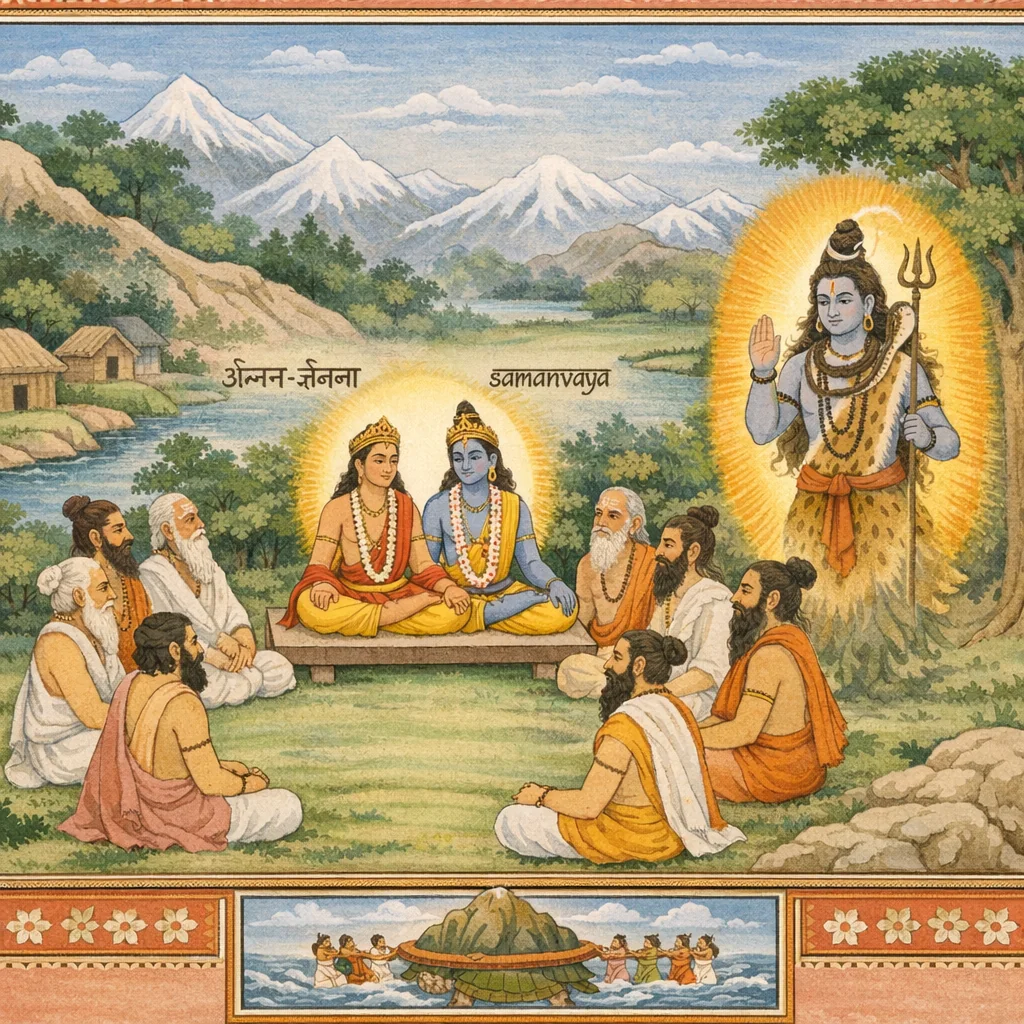
Concluding the last chapter of the Pūrva-bhāga, the narrative turns to the Upari-bhāga. The gathered sages affirm that creation from Svāyambhuva Manu, the expansion of the brahmāṇḍa, and the Manvantaras have been duly explained, and they now seek the supreme knowledge that destroys saṃsāra and grants direct realization of Brahman. Sūta honors Vyāsa as the rightful teacher of Brahman-centered doctrine; Vyāsa arrives at the satra, is welcomed, and agrees to transmit a revelation once spoken by Viṣṇu in the form of Kūrma and preserved through the guru lineage. Vyāsa then recalls an earlier episode at Badarikā: Sanatkumāra and other yogic authorities, troubled by doubt, perform austerities and approach Nara–Nārāyaṇa, asking foundational Vedāntic questions—about the universe’s cause, the transmigrating principle, the reality of Ātman, the nature of mokṣa, and the origin of saṃsāra. The vision widens into a united theophany as Mahādeva appears; the sages hymn Śiva as the cosmic cause. At Viṣṇu’s request, Śiva is asked to reveal Self-knowledge in Viṣṇu’s presence, establishing the teaching’s authority and preparing for the next chapter’s systematic exposition of yoga, Ātman, and liberation (often linked with the Ishvara Gītā stream).
Shlokas
Verse 1
इति श्रीकूर्मपुराणे षट्साहस्त्र्यां संहितायां पूर्वविभागे एकपञ्चाशो ऽध्यायः उपरिविभागः ऋषय ऊचुः भवता कथितः सम्यक् सर्गः स्वायंभुवस्ततः / ब्रह्माण्डस्यास्य विस्तारो मन्वन्तरविनिश्चयः
Thus, in the Śrī Kūrma Purāṇa, within the six-thousand-verse Saṃhitā, in the Pūrva-bhāga, the fifty-first chapter concludes. Now begins the Upari-bhāga. The sages said: “You have rightly described the creation beginning from Svāyambhuva (Manu), and the expansion of this cosmic egg (brahmāṇḍa), together with the definite account of the Manvantaras.”
Verse 2
तत्रेश्वरेश्वरो देवो वर्णिभिर्धर्मतत्परैः / ज्ञानयोगरतैर्नित्यमाराध्यः कथितस्त्वया
There you declared that the God, the Lord of all lords, is to be worshipped continually by those of the four varṇas devoted to dharma, and by those ever engaged in the Yoga of knowledge (jñāna-yoga).
Verse 3
तद्वदाशेषसंसारदुः खनाशमनुत्तमम् / ज्ञानं ब्रह्मैकविषयं येन पश्येम तत्परम्
Likewise, teach us that unsurpassed knowledge which destroys all the sufferings of saṃsāra—knowledge whose sole object is Brahman—by which we may directly behold the Supreme Reality.
Verse 4
त्वं हि नारायणात्साक्षात् कृष्णद्वैपायनात् प्रभो / अवाप्ताखिलविज्ञानस्तत्त्वां पृच्छामहे पुनः
O Lord, you stand directly (in lineage and authority) from Nārāyaṇa and from Kṛṣṇa Dvaipāyana (Vyāsa). Having attained complete knowledge, we therefore ask you again about the highest truth.
Verse 5
श्रुत्वा मुनीनां तद् वाक्यं कृष्णद्वैपायनं प्रभुम् / सूतः पौराणिकः स्मृत्वा भाषितुं ह्युपचक्रमे
Having heard the sages’ request, Sūta, the Purāṇic narrator, remembering the venerable lord Kṛṣṇa Dvaipāyana (Vyāsa), then began to speak.
Verse 6
अथास्मिन्नन्तरे व्यासः कृष्णद्वैपायनः स्वयम् / आजगाम मुनिश्रेष्ठा यत्र सत्रं समासते
Then, at that very time, Vyāsa—Kṛṣṇa Dvaipāyana himself—arrived there, O best of sages, where the ṛṣis were assembled in a satra, a long sacrificial session.
Verse 7
तं दृष्ट्वा वेदविद्वांसं कालमेघसमद्युतिम् / व्यासं कमलपत्राक्षं प्रणेमुर्द्विजपुङ्गवाः
Seeing Vyāsa—learned in the Vedas, radiant like a dark rain-cloud, and lotus-petaled of eye—the foremost among the twice-born bowed to him in reverence.
Verse 8
पपात दण्डवद् भूमौ दृष्ट्वासौ रोमहर्षणः / प्रदक्षिणीकृत्य गुरुं प्राञ्जलिः पार्श्वगो ऽभवत्
On seeing him, Romaharṣaṇa fell to the ground like a staff in full prostration. Having circumambulated the Guru in pradakṣiṇā, he stood at his side with folded hands.
Verse 9
पृष्टास्ते ऽनामयं विप्राः शौनकाद्या महामुनिम् / समाश्वास्यासनं तस्मै तद्योग्यं समकल्पयन्
Questioned about his well-being, the brāhmaṇa sages—Śaunaka and the others—comforted the great seer and arranged for him a seat befitting him.
Verse 10
अथैतानब्रवीद् वाक्यं पराशरसुतः प्रभुः / कच्चिन्न तपसो हानिः स्वाध्यायस्य श्रुतस्य च
Then the lordly son of Parāśara (Vyāsa) spoke to them: “Has there been no decline in your tapas (austerity), in your svādhyāya (self-study of the Veda), and in your śruta—your received sacred learning?”
Verse 11
ततः स सूतः स्वगुरुं प्रणम्याह महामुनिम् / ज्ञानं तद् ब्रह्मविषयं मुनीनां वक्तुमर्हसि
Then Sūta, bowing to his own guru—the great sage—said: “You are worthy to expound to the sages that knowledge whose object is Brahman.”
Verse 12
इमे हि मुनयः शान्तास्तापसा धर्मतत्पराः / शुश्रूषा जायते चैषां वक्तुमर्हसि तत्त्वतः
For these sages are truly tranquil, austere, and devoted to dharma; and in them a sincere desire to listen and serve has arisen. Therefore, you ought to teach the truth to them as it really is.
Verse 13
ज्ञानं विमुक्तिदं दिव्यं यन्मे साक्षात् त्वयोदितम् / मुनीनां व्याहृतं पूर्वं विष्णुना कूर्मरूपिणा
That divine knowledge which grants liberation—spoken directly by you to me—was formerly proclaimed to the sages by Viṣṇu himself, in the form of the Tortoise (Kūrma).
Verse 14
श्रुत्वा सूतस्य वचनं मुनिः सत्यवतीसुतः / प्रणम्य शिरसा रुद्रं वचः प्राह सुखावहम्
Hearing Sūta’s words, the sage—the son of Satyavatī—bowed his head to Rudra and then spoke words that bestow well-being and ease.
Verse 15
व्यास उवाच वक्ष्ये देवो महादेवः पृष्टो योगीश्वरैः पुरा / सनत्कुमारप्रमुखैः स्वयं यत्समभाषत
Vyāsa said: “I shall declare what the Lord, Mahādeva, when questioned long ago by the masters of Yoga—Sanatkumāra and others—Himself spoke.”
Verse 16
सनत्कुमारः सनकस्तथैव च सनन्दनः / अङ्गिरा रुद्रसहितो भृगुः परमधर्मवित्
Sanatkumāra, Sanaka, and likewise Sanandana; Aṅgiras together with Rudra; and Bhṛgu—the knower of the highest Dharma—were present.
Verse 17
कणादः कपिलो योगी वामदेवो महामुनिः / शुक्रो वसिष्ठो भगवान् सर्वे संयतमानसाः
Kaṇāda, Kapila the yogin, Vāmadeva the great sage, Śukra, and the revered Vasiṣṭha—indeed all of them—were masters of self-restraint, their minds perfectly disciplined.
Verse 18
परस्परं विचार्यैते संशयाविष्टचेतसः / तप्तवन्तस्तपो घोरं पुण्ये बदरिकाश्रमे
After deliberating among themselves, their minds seized by doubt, they undertook fierce austerities in the holy hermitage of Badarikā.
Verse 19
अपश्यंस्ते महायोगमृषिं धर्मसुतं शुचिम् / नारायणमनाद्यन्तं नरेण सहितं तदा
Then they beheld the great Yogin-sage, the pure son of Dharma—Nārāyaṇa, beginningless and endless—together with Nara.
Verse 20
संस्तूय विविधैः स्तोत्रैः सर्वे वेदसमुद्भवैः / प्रणेमुर्भक्तिसंयुक्ता योगिनो योगवित्तमम्
After extolling Him with many hymns drawn from the Vedas, all those yogins—filled with devotion—bowed down to the one who is the foremost knower of Yoga.
Verse 21
विज्ञाय वाञ्छितं तेषां भगवानपि सर्ववित् / प्राह गम्भीरया वाचा किमर्थं तप्यते तपः
Knowing what they sought, the Blessed Lord, all-knowing, spoke in a deep voice: “For what purpose is this austerity undertaken?”
Verse 22
अब्रुवन् हृष्टमनसो विश्वात्मानं सनातनम् / साक्षान्नारायणं देवमागतं सिद्धिसूचकम्
With hearts uplifted in joy, they addressed the Eternal Soul of the universe—Nārāyaṇa Himself, the divine Lord—who had arrived as the very sign and assurance of success.
Verse 23
वयं संशयमापन्नाः सर्वे वै ब्रह्मवादिनः / भवन्तमेकं शरणं प्रपन्नाः पुरुषोत्तमम्
We—all of us, the expounders of Brahman—have fallen into doubt. Therefore we have taken refuge in You alone, O Puruṣottama, the Supreme Person.
Verse 24
त्वं हि तद् वेत्थ परमं सर्वज्ञो भगवानृषिः / नारायणः स्वयं साक्षात् पुराणो ऽव्यक्तपूरुषः
You indeed know that Supreme Reality, for you are the omniscient divine seer. You are Nārāyaṇa Himself, directly manifest: the Primordial One, the Unmanifest Person.
Verse 25
नह्यन्यो विद्यते वेत्ता त्वामृते परमेश्वर / शुश्रूषास्माकमखिलं संशयं छेत्तुमर्हसि
O Parameśvara, none other exists who truly knows apart from You. Since we long to listen and serve, please cut through all of our doubts completely.
Verse 26
किं कारणमिदं कृत्स्नं को ऽनुसंसरते सदा / कश्चिदात्मा च का मुक्तिः संसारः किंनिमित्तकः
What is the cause of this entire universe? Who is it that ever transmigrates? Is there truly the Self (Ātman)? And what is liberation (mokṣa)? For what reason does saṃsāra arise?
Verse 27
कः संसारयतीशानः को वा सर्वं प्रपश्यति / किं तत् परतरं ब्रह्म सर्वं नो वक्तुमर्हसि
Who is that Īśāna who sets beings into the cycle of saṃsāra? And who is it that beholds all? What is that supreme Brahman beyond which there is nothing higher? Please tell us all of this.
Verse 28
एवमुक्ते तु मुनयः प्रापश्यन् पुरुषोत्तमम् / विहाय तापसं रूपं संस्थितं स्वेन तेजसा
When this had been spoken, the sages beheld Purushottama, the Supreme Person. Casting aside the ascetic’s guise, He stood revealed in His own radiance.
Verse 29
विभ्राजमानं विमलं प्रभामण्डलमण्डितम् / श्रीवत्सवक्षसं देवं तप्तजाम्बूनदप्रभम्
They beheld the God—radiant and stainless—adorned with a halo of splendor, bearing the Śrīvatsa mark upon His chest, and shining with the luster of heated Jāmbūnada gold.
Verse 30
शङ्खचक्रगदापाणिं शार्ङ्गहस्तं श्रियावृतम् / न दृष्टस्तत्क्षणादेव नरस्तस्यैव तेजसा
Bearing conch, discus, and mace in His hands, holding the Śārṅga bow, and encompassed by Śrī (Lakṣmī)—a man could not behold Him; in that very instant he was overpowered by the sheer radiance of that Lord alone.
Verse 31
तदन्तरे महादेवः शशाङ्काङ्कितशेखरः / प्रसादाभिमुखो रुद्रः प्रादुरासीन्महेश्वरः
Meanwhile, Mahādeva—Rudra, Maheśvara, whose crest bears the mark of the moon—appeared, facing them with gracious favor.
Verse 32
निरीक्ष्य ते जगन्नाथं त्रिनेत्रं चन्द्रभूषणम् / तुष्टुवुर्हृष्टमनसो भक्त्या तं परमेश्वरम्
Beholding Jagannātha, the Lord of the universe—three-eyed and adorned with the moon—their hearts rejoiced, and with devotion they praised Him as Parameśvara, the Supreme Lord.
Verse 33
जयेश्वर महादेव जय भूतपते शिव / जयाशेषमुनीशान तपसाभिप्रपूजित
Victory to You, O Īśvara, Mahādeva! Victory to You, O Śiva, Bhūtapati, Lord of all beings! Victory to You, supreme ruler of sages, revered and worshiped through tapas.
Verse 34
सहस्रमूर्ते विश्वात्मन् जगद्यन्त्रप्रवर्तक / जयानन्त जगज्जन्मत्राणसंहारकारण
O Thousand-formed One, Soul of the universe, impeller of the world’s mechanism—victory to You, O Endless One, the very cause of the world’s birth, its protection, and its dissolution.
Verse 35
सहस्रचरणेशान शंभो योगीन्द्रवन्दित / जयाम्बिकापते देव नमस्ते परमेश्वर
O Lord of a thousand feet, O Īśāna—O Śambhu, revered by the foremost of yogins; O divine Lord, consort of Jayāmbikā—salutations to You, O Parameśvara, the Supreme Lord.
Verse 36
संस्तुतो भगवानीशस्त्र्यम्बको भक्तवत्सलः / समालिङ्ग्य हृषीकेशं प्राह गम्भीरया गिरा
Thus praised, the Blessed Lord—Īśa, three‑eyed Tryambaka, tender to his devotees—embraced Hṛṣīkeśa and spoke in a deep, resonant voice.
Verse 37
किमर्थं पुण्डरीकाक्ष मुनीन्द्रा ब्रह्मवादिनः / इमं समागता देशं किं वा कार्यं मयाच्युत
O Lotus‑eyed One, why have these foremost sages—expounders of Brahman—come to this place? And, O Acyuta, what task is to be accomplished by me?
Verse 38
आकर्ण्य भगवद्वाक्यं देवदेवो जनार्दनः / प्राह देवो महादेवं प्रसादाभिमुखं स्थितम्
Having heard the Blessed Lord’s words, Janārdana—the God of gods—spoke to Mahādeva, who stood facing him with a gracious and favorable countenance.
Verse 39
इमे हि मुनयो देव तापसाः क्षीणकल्मषाः / अभ्यागता मां शरणं सम्यग्दर्शनकाङ्क्षिणः
O Lord, these sages—ascetics whose impurities have been worn away—have come to me for refuge, longing for the true vision, the right knowledge of reality.
Verse 40
यदि प्रसन्नो भगवान् मुनीनां भावितात्मनाम् / सन्निधौ मम तज्ज्ञानं दिव्यं वक्तुमिहार्हसि
If the Blessed Lord is pleased with the sages whose selves are purified and disciplined, then, in my very presence, you are indeed fit to speak here that divine knowledge.
Verse 41
त्वं हि वेत्थ स्वमात्मानं न ह्यन्यो विद्यते शिव / ततस्त्वमात्मनात्मानं मुनीन्द्रेभ्यः प्रदर्शय
O Śiva, you alone truly know your own Self, for none other exists who can know it independently. Therefore, by your own Self, reveal the Self to the foremost of sages.
Verse 42
एवमुक्त्वा हृषीकेशः प्रोवाच मुनिपुङ्गवान् / प्रदर्शयन् योगसिद्धिं निरीक्ष्य वृषभध्वजम्
Having spoken thus, Hṛṣīkeśa, Lord of the senses, addressed the foremost of sages; and, gazing upon Vṛṣabhadhvaja—Śiva whose banner bears the bull—he revealed the accomplished power of Yoga.
Verse 43
संदर्शनान्महेशस्य शङ्करस्याथ शूलिनः / कृतार्थं स्वयमात्मानं ज्ञातुमर्हथ तत्त्वतः
By the very sight of Mahēśa—Śaṅkara, the Trident-bearer—you become fulfilled; therefore you ought to know your own Self in truth, in its real nature.
Verse 44
प्रष्टुमर्हथ विश्वेशं प्रत्यक्षं पुरतः स्थितम् / ममैव सन्निधावेष यथावद् वक्तुमीश्वरः
You are worthy to question Viśveśa, the Lord of the universe, who stands manifest before you. In my very presence, this Īśvara is able to speak to you properly and in due order.
Verse 45
निशम्य विष्णुवचनं प्रणम्य वृषभध्वजम् / सनत्कुमारप्रमुखाः पृच्छन्ति स्म महेश्वरम्
Having heard Lord Viṣṇu’s words and bowing to Vṛṣabhadhvaja—Śiva of the bull-banner—Sanatkumāra and the other foremost sages then proceeded to question Mahēśvara.
Verse 46
अथास्मिन्नन्तरे दिव्यमासनं विमलं शिवम् / किमप्यचिन्त्यं गगनादीश्वरार्हं समुद्बभौ
Then, in that interval, there arose a divine seat—spotless, auspicious, and bearing Śiva-like sanctity—something inconceivable, worthy of the Lord of the heavens, appearing forth in splendour.
Verse 47
तत्राससाद योगात्मा विष्णुना सह विश्वकृत् / तेजसा पूरयन् विश्वं भाति देवो महेश्वरः
There, Mahēśvara—the cosmic creator, the very soul of Yoga—sat together with Viṣṇu; and, filling the universe with his radiant tejas, the Divine Lord shone forth.
Verse 48
तं ते देवादिदेवेशं शङ्करं ब्रह्मवादिनः / विभ्राजमानं विमले तस्मिन् ददृशुरासने
Then those expounders of Brahman beheld Śaṅkara—the Lord of gods, the God of gods—radiant with splendour, seated upon that stainless, pure throne.
Verse 49
यं प्रपश्यन्तियोगस्थाः स्वात्मन्यात्मानमीश्वरमा / अनन्यतेजसं शान्तं शिवं ददृशिरे किल
Established in Yoga, they behold within their own Self that Self as the Lord—of unrivalled radiance, tranquil, auspicious; indeed, they truly perceived Him as Śiva.
Verse 50
यतः प्रसूतिर्भूतानां यत्रैतत् प्रविलीयते / तमासनस्थं भूतानामीशं ददृशिरे किल
From Him proceeds the birth of all beings, and in Him this universe is dissolved; Him—the Lord of beings—seated upon the yogic seat, they indeed beheld.
Verse 51
यदन्तरा सर्वमेतद् यतो ऽभिन्नमिदं जगत् / स वासुदेवमासीनं तमीशं ददृशुः किल
He within whom all this abides, and from whom this universe is not separate—Him they indeed beheld: Vasudeva, seated, that very Lord (Īśa).
Verse 52
प्रोवाच पृष्टो भगवान् मुनीनां परमेश्वरः / निरीक्ष्य पुण्डरीकाक्षं स्वात्मयोगमनुत्तमम्
When questioned, the Blessed Lord—the Supreme Ruler of the sages—spoke, having contemplated the Lotus‑eyed One and the unsurpassed yoga of the Supreme Self.
Verse 53
तच्छृणुध्वं यथान्यायमुच्यमानं मयानघाः / प्रशान्तमानसाः सर्वे ज्ञानमीश्वरभाषितम्
Therefore, O sinless ones, listen—according to proper method—to this teaching as it is spoken by me. With minds fully pacified, hear the knowledge proclaimed by the Lord.
Frequently Asked Questions
Jñāna is presented as ‘unsurpassed knowledge’ whose sole object is Brahman and which destroys the sufferings of saṃsāra, culminating in direct vision (sākṣātkāra) of the Supreme Reality rather than merely ritual or cosmographic understanding.
The sages’ questions assume a real problem of transmigration and bondage, while the theophany and the instruction-to-come imply that liberation arises through realizing Ātman in its true nature as non-separate from the Supreme—expressed through the vision of the Lord ‘within the Self’ and the Śiva/Vāsudeva identification, consistent with a Vedāntic-yogic synthesis framed by devotion.
Viṣṇu explicitly states that Śiva alone truly knows his own Self and thus is uniquely fit to reveal Self-knowledge; teaching in Viṣṇu’s presence functions as textual authorization and a deliberate samanvaya device, harmonizing Vaiṣṇava devotion with Śaiva revelation.